User Panel
User Panel
User Panel
|
Posted: 7/28/2006 7:41:56 AM EDT
Let's start a thread about radio communications in general. I am a licensed Extra Class ham radio operator. I will invite any other knowlegible hams or other radio-savvy people to join in.
Let's keep it from getting too techie, OK? We want to get people into the 'basics', sort of a 'ham radio for dummies' type of thread. |
|
|
|
|
Posted: 7/28/2006 7:48:40 AM EDT
[Last Edit: FrankSymptoms]
[#1]
Neat ham radio fact of the day:
VHF/UHF are line-of-sight. That means that for the most part, they won't transmit beyond the horizon, or around a mountain. So, what if you were ON TOP of a mountain? Your line-of-sight would be very, very good! It would extend to a much farther-away horizon than it would if you were in the flatlands. That is why "REPEATERS" are sited on top of mountains. They receive your transmitted signal, and re-transmit it, so that everyone with a UHF or VHF transciever can communicat with you! Neatest thing since the advent of FM communications! |
|
|
|
FL, USA
|
Posted: 7/28/2006 7:50:10 AM EDT
[#2]
I'd like to see a thread about it also cause I don't know diddly about it. Please keep it in simple terms for us dummies.
|
|
|
|
Posted: 7/28/2006 7:51:18 AM EDT
[#3]

Post or IM your questions. I try to get on this board every day. |
||
|
|
|
Posted: 7/28/2006 7:52:03 AM EDT
[#4]
How about info on simple but effectice antennas.
What people can do to improve their reception on a first base station/portable that does not cost alot. Might start with a bi-pole unless there is something easier. TXL |
|
|
|
|
Posted: 7/28/2006 7:52:40 AM EDT
[#5]
Can't get over that mountain? Want to talk over the horizon using 2m? Download echolink! This program allows you to connect to the many repeaters that have an internet link and transmit from that repeater. Very cool.  -Foxxz |
||
|
|
|
Posted: 7/28/2006 7:57:57 AM EDT
[#6]
Ham radio fact of the day:
How the radio bands are laid out. BAck in the 19-teens and -twenties, it became evident that there were too many uncoordinated radio stations crowding the very limited airwaves. (Frequencies were for the most part, under one megahertz! UHF and VHF were not even thought of then.) ANyone who could afford more power could walk over anyone else.The .gov created the FCC to handle the problem. the FCC devised different 'Services' to manage the airwaves. Thus, the Ham Radio Service, the Land Mobile Service, the Maritime Service, the Broadcast Service (for AM and FM broadcasting), the Aircraft Service, to name just a few, were created for administrative purposes. They were all given different frequencies so that they would not interfere with each other. And other restrictions were devised: power output, transmission modes (AM, FM, SSB, etc), were enforced. Everyone got along pretty well after that. So the Ham Radio Service came into being, primarily to be a sort of "Minuteman" service in case of disaster, but also to foster creativity and experimentation in the radio field. |
|
|
|
VA, USA
|
Posted: 7/28/2006 8:01:49 AM EDT
[#7]
ok so bear with this newbee question....let's say I have a cheapo China-mart FRS radio claimed to reach "6 miles" (they're selling here for $19). I'm assuming that this REALLY means they're good only for 1-2 miles but haven't tested them yet.
However even so, would they work line of sight if one is on a mountain top 50 miles away and the other is in the back yard - line of sight facing the mountain? Is it that simple? I.e. would it work if I go out and stand on the roof of a 20 story building and call someone 12 miles away? Thanks |
|
|
|
Posted: 7/28/2006 8:30:00 AM EDT
[#8]
Line of sight is not always true.... I can't see Cuba, NY , WI and a lot of other places I have talked to on 2M but this is NOT normal. Memphis is a little over 100 miles away and I can talk to Memphis 24 hours a day...simplex ! |
||
|
|
|
Posted: 7/28/2006 9:09:47 AM EDT
[#9]
Tips on making antennas for HAM, GMRS, and FRS would be nice.... I.E. how do you figure out antenna length for the freq you are working
Would a wire hanging from the negative battery terminal of my handheld make it a Dipole? Would the length of the dipole have to be the same as that of what the rubber ducky is tuned to? |
|
|
|
|
Posted: 7/28/2006 9:10:28 AM EDT
[Last Edit: acman145acp]
[#10]
i know my picture is weak but .... it's just an illustration.....
I seriously am interested in ham but I want answers to a few questions before i spend my money. In the picture below with heavy woods is it posible to talk without repeaters with HT's (beleive thats what their called) if so what would it cost for the radios and antenas to do this..... What distance would these same radios talk in rolling hills with heavy woods "no repeaters" ........ 
|
|
|
|
|
Posted: 7/28/2006 9:13:00 AM EDT
[#11]
Why is it illegal to converse with another HAM in a country who doesn't allow their people to use HAM frequencies? This seems counter to the idea of America's Free Speech. Somehow I don't think it should be a crime for me to speak to a person in China or North Korea...
|
|
|
|
|
Posted: 7/28/2006 9:56:33 AM EDT
[#12]
Ok, I've resaerched this as well as most people here and am still confused and overwhelmed w/ the amount of info. Add to that I just can't afford another expensive, addictive time consuming hobby, sooo....
Is it possible and practical and purchase a ham radio for ~$300-$400 w/o any expensive upgrades (i'm thinking a portable model) and actually talk to people reliably 100 to 200 miles away w/o the use of repeaters? How much better are hams than gmrs in woods and urban settings? i.e.; can I really use ham radio as practical form of comms in an all out emergency? These are the questions I myself really need answered and I'm sure others here do to. FWIW, I've tried GMRS radios around town in my AO and found them (8 mile cobras and cheapo cina mart unidens) to be lacking. My 8 mile cobras won't even go more than 12 blocks (no building over 3 stories in between us either). Speed |
|
|
|
|
Posted: 7/28/2006 10:03:51 AM EDT
[#13]
Frank
KG5S took the question right off my computer screen. And I am not doing a very good job at giving an understanding and logical answers that non Hams can understand. With out upsetting them. I hope you can do it better. I know that we say that Vhf is line of sight. as KG5S says he talks 100 miles all the time. I do the same With a 100 foot tower stacked 16s and 200 watts out to 200 miles or so. On a daily basis. I know why it is: but have been having a hard time getting it across to the non hams. When you get time would you give it a whack. I see that a lot of the guys here on the S/F are looking at communications from 30 to 150 miles, And It seems like given the right equipment and the (terrain factor) is the part that throwing them all off. Given the Mountain question above would be a good example, as an answer all. SM |
|
|
|
MA, USA
|
Posted: 7/28/2006 10:11:59 AM EDT
[Last Edit: Malpaso]
[#14]
Inexpensive antenna:
www.qsl.net/wrav/2mground.htm I've built a bunch of these for myself and others. Costs less than $5, and can be cut for most any VHF/UHF frequency. If you use wing nuts and bolts instead of soldering, it becomes easily portable. I carry mine around in a PVC tube with one screw on end. Another cheap way out. |
|
|
OH, USA
|
Posted: 7/28/2006 10:43:00 AM EDT
[Last Edit: Scottman]
[#15]
Good one. A dipole is perhaps the simplest antenna you can make. It is a coax fed wire antenna with two legs. It is fed at the center and the legs are kept so as to make the whole thing as straight as possible. Now, in simple terms, you would feed a dipole with coaxial cable (like your CATV wire). But the dipole is "Balanced" while coax is "unbalanced."This could result in your radio waves traveling on the outside of the coax, so you need what is called a "balun" at the feedpoint to "choke" the RF at that point so that it does not come back down the line. You can buy these or make them for pretty low cost. Dipoles can be constructed to work at specific frequencies using the formula 468/ {frequency in Mhz} . For example, a dipole built to work on the Arfcom net frequency of 7.261MHz, you would calculate 468/7.261=64.453 feet. Divide that number by two and you have the length of your legs. Each leg of the dipole would be 32.23 feet long. Theoretically, you should be able to cut two legs this length, attach the two centers to your balun, attach the ends to supports and the center to a support, then attach your coax to the balun and the other end to the radio. You would then be able to tune in to the Arfcom Net and send and recieve without much hullabaloo. It is always best, however to obtain an SWR meter to check to make sure your antenna is performing. Variables will affect it's performance so that you may have to trim the length. These include soil condition, height above ground, nearby objects, etc. So always cut a little longer than the formula, set it up, test, trim as needed, test again, trim again, etc. You want as close to a 1 to 1 SWR match as possible. High SWR means your waves are not efficiently leaving the antenna. This is to be avoided. Dipoles are cheap and effective. They are directional antennas in that your signal will be much stronger in areas broadside to the run of the wire. For example, if your dipole is running in a north-south orientation, your signal will be best to the east and west. Optimal height for a dipole is 1/2 wavelength above the ground. WTF is wavelength? It's the size of one complete AC cycle of the radio wave. The Arfcom net is held in the "40 Meter" band, so-called because generally the waves or cycles in that range are 40 meters long. Thus our antenna in this example would perform best at 20 meters above the ground, or about 64 feet up. If the antenna is lower to the ground, the waves will come off it at a higher angle. This is how you get an NVIS or "Near Vertical Incidence Skywave" antenna system. With the antenna low to the ground (say 15 feet or less) your signal will go almost straight up, bounce off the atmosphere, and come back down, covering your surrounding region with your signal, but not reaching out too far. This is good for statewide or regional comms. Height is good, the higher the better for really reaching out, but antennas work pretty well even when you can't get them to tower heights. Another kind of dipole can be built to work on several bands without the need for additional equipment, like an antenna tuner, is called a "Fan Dipole." It looks like it sounds. You have one center feed point, then you do the above calculations for seperate dipoles of the bands you want to work. Cut the legs, attach all the centers to the same feed point on your balun, and fan out the legs, like the supporting structure of an umbrella, keeping the legs that go together in straight lines, or you can put them all in the same plane, sort of stacked up on each other, but don't let the legs touch. When you tune up or switch bands, the RF will automatically choose the correct antenna because it will be the path of least resistance. Lastly, you can go with a "random long wire" dipole and an antenna tuner. In this scheme, you just get as much wire up in the air as possible. Feed it through an antenna tuner, and you can tune it to whatever frequency you wish to operate on. The drawback that comes with this convenience is efficiency. You will lose some signal in the components of the tuner. Hopefully this is helpful. Scott |
|
|
|
OH, USA
|
Posted: 7/28/2006 10:48:22 AM EDT
[#16]
I do not believe that HT's alone will work in your picture. In rolling hills, heavily wooded, without the use of repeaters, I would think your HT's would cover maybe a few miles. Maybe. You definitely would want something like NVIS on the lower bands. Scott |
|
|
|
OH, USA
|
Posted: 7/28/2006 10:51:02 AM EDT
[#17]
I really doubt that. Even the 1-2 miles. FRS are limited by law to one quarter watt. That's next to nothing, esp in tose VHF freqs.
You are going to have signal attenuation in the atmosphere. Your 1/4 watt is not going to make it 50 miles, except in the vacuum of space. Scott |
||
|
|
OH, USA
|
Posted: 7/28/2006 10:52:17 AM EDT
[#18]
Echo link and IRLP are fun and innovative and give the Tech a taste of DX, but they simply can not be relied upon. They depend on the internet, after all.... Scott |
|
|
|
OH, USA
|
Posted: 7/28/2006 10:54:51 AM EDT
[#19]
FRS radios are limited by law. The antenna MUST be an integral part of the radio. You can't even change to another "rubber duck" antenna. See my other post for the dipole formula.
No and No. Ducks are usually helical, and have coils in them too. Don't attach wires to the battery. It's not like a car's electrical system. Neg is not Gnd. Scott |
||
|
|
|
Posted: 7/28/2006 10:58:03 AM EDT
[#20]
Could you or someone explain what equipment is needed for this and does it rely on repeaters or anything other than personal equipment???? |
|||
|
|
OH, USA
|
Posted: 7/28/2006 10:58:25 AM EDT
[#21]
Yes, but it requires the use of HF frequencies only open to General class licensees and above.
They are probably comparable, if you are talking 2M or 70CM frequencies. HF is a different story, and it is not available to GMRS.
Yes.
VHF and UHF HT's in the ham bands running 5 watts would definitely outperform those radios. Scott Speed |
||||
|
|
OH, USA
|
Posted: 7/28/2006 11:00:37 AM EDT
[#22]
In my Dipole post above I describe NVIS. There is no additional equipment required. You attain NVIS by lowering your antenna height. Simple as that. Scott |
|
|
|
|
Posted: 7/28/2006 11:09:55 AM EDT
[#23]
It is possible to communicate with people 100-200 miles away with ham radio. You would want to use HF frequencies (which means you need a General Class or better license) and what is called a near vertical incident skywave antenna. This antenna will send your signal nearly straight up and it will bounce back down off the Ionosphere. Picture it like using the ionospere as a repeater, sending the signal to a high point then sending it back down to other stations. For more NVIS information look at this website www.tactical-link.com/field_deployed_nvis.htm For your question about GMRS vs HAM in the woods I'll assume you mean a handheld radio. Any handheld radios are going to be limited in power to make them small enough to be hand held. You cant expect huge range out of something that small (without a repeater). Your "8 mile" radios are probably putting out around 2 watts. Most handheld ham radios will put out 5 watts. Also with ham radio you can put more efficient antennas on to maximize results from that 5 watts. This thread is a great idea! I hope this was helpful. |
||
|
|
|
Posted: 7/28/2006 11:45:23 AM EDT
[#24]
Scottman, thanks for a great reply to mine, and many other questions.
TXL |
|
|
|
|
Posted: 7/28/2006 2:04:13 PM EDT
[#25]
Good thread , I havnt learned enuff to ask questions yet ,but as soon as I do I will.
Thanks |
|
|
|
OH, USA
|
Posted: 7/28/2006 5:49:17 PM EDT
[Last Edit: Scottman]
[#26]
Found a graphic to demonstrate various means of getting your signal across.
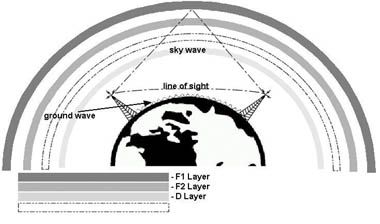 In the picture, you can see that ground-wave propagation takes place as signal travels along the surface of the planet. Line-of-Sight is direct from antenna to antenna. Sky Wave is when the signal bounces off the atmosphere. *Generally speaking* VHF and UHF (and up) (or 50Mhz and up, or 6Meters and shorter wavelengths) are *only* line of sight. When these freqs get into the atmosphere, they punch right through. This is how hams talk to the Shuttle, the Space Station, and use satellites to communicate. HF (below 50Mhz) can travel in all the methods pictured, but the picture kinda over simplifies. Ground wave, for example, does not travel half way around the globe. It goes for a few to several miles, then peters out. Sky wave can also take multiple "hops" where it bounces off the atmosphere, comes down and bounces off the earth and goes back up to the atmosphere for another round. This is what gets you in situations where Joe can hear you in Hungary, but yer buddy 50 miles away can't hear jack. Your sig has jumped over your buddy. ALL radio wave travel (called "Propagation") is dependent upon atmospheric and weather conditions, as well as antenna system setup. Hope this is helpful. Scott |
|
|
OH, USA
|
Posted: 7/28/2006 6:29:34 PM EDT
[#27]
Here is my mad Paint Skillz demonstrating a dipole antenna.
Normally the balun would be secured to the feed point support, but for illustrative clarity, I put it off to the side. 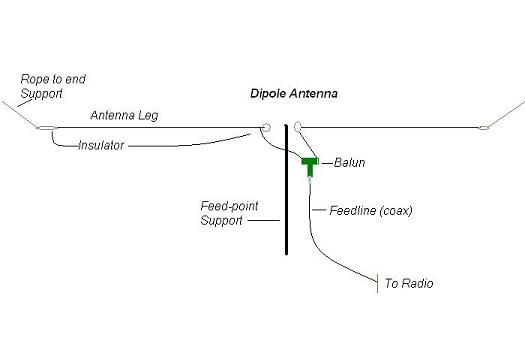
|
|
|
OH, USA
|
Posted: 7/28/2006 6:38:50 PM EDT
[#28]
And here is a Fan Dipole:
 You can stack the legs, or spread them out. That's what I'm attempting to show in the "overhead view." |
|
|
VA, USA
|
Posted: 7/28/2006 8:36:01 PM EDT
[Last Edit: GlockTiger]
[#29]
To help in the comparison between Ham HT's and any other off-the-shelf walkie talkie, here are some benefits of Ham: Range <POWER> -- You get 5 (some models do 6) watts of power, and it's usually selectable to tailor your tradeoff of power output and battery consumption. The Yaesu VX-6 has 4 power settings up to 5 watts. Range <ANTENNA> -- With ham HT's, you are unlimited in the antennas you can hook to them. The stock rubber ducks are traditionally poor, however you just screw in an aftermarket model (made by Comet, Diamond, Opek, MFJ) and instant improvement. Even better, make yourself a roll-up J-pole out of 60 inches of TV Twinlead (radioshack) and some coax cable. A perfect first project for a ham -- J-Pole How-to. You can also use a telescopic 1/2 wave antenna as long as you're careful not to break any connectors. Such antenna options don't exist at all for FRS (FCC forbids) and to get a GMRS radio capable of interchangeable antennas, you'd spend as much as you would on a Ham rig! Band space -- Ham isn't channelized except in rare cases. You pick a frequency and talk. You rarely (I'll even say never) have to search hard for open frequencies on typical VHF/UHF bands. Flexibility -- HT's are readily available that operate on 2 even 3 different VHF/UHF bands. While all Line-of-Sight, they have different properties around buildings & obstructions, so you can choose the best band for the job. Flexibility part 2 -- HT's can use repeaters (we've covered the cons -- we know by now not to rely on repeaters in SHTF). Consider the non-catastrophic applications though. Go hiking in the mountains, break a leg, pull out your HT & hit a repeater (you're on a mountain, so killer LOS, right?). Call for help, tell them your position. VERY likely to get help and get out ok. Flexibility part 3 -- HT's usually have keypads that allow them to be used for phone patches through repeaters, voice-over-IP access (dial up another repeater on the other side of the state -- or globe). You can even do selective calling of other stations and APRS -- where your HT and GPS are interfaced and you transmit your position to someone else (used in SAR). So just in the simplest application, if you implemented Ham HT's for comms at a campout, for instance, you'd have more power, more efficient radiation, and more antenna options (read - base camp could have a roll up jpole strung way up in a tree and maintain comms with dudes roving around the woods) than you'd ever have with just FRS/GMRS alone. |
|
|
|
VA, USA
|
Posted: 7/28/2006 8:41:42 PM EDT
[Last Edit: GlockTiger]
[#30]
For a great antenna to add to your HT, see the J-Pole link in my post above. You can't modify an FRS radio's antenna and you'll rarely find a GMRS handheld radio that has interchangeable antennas (the ones that are probably cost as much as Ham HT's) You can greatly improve your HT's efficiency using what's called a counterpoise (also Tiger Tail). Here is some text borrowed from link:
|
||
|
|
|
Posted: 7/28/2006 9:00:08 PM EDT
[#31]
What happened to Frank, I thought he was going to answer questions ?
|
|
|
|
|
Posted: 7/28/2006 9:19:05 PM EDT
[#32]
I looked at the link on NVIS that IGoPrepared posted ..... it "looks" to me like this antena array is something your going to have to stop and put up not something thats mobile as in walking with it... So basically it's still a crapshoot if you hit the person your wanting to hit in the conditions i asked about.....  I do apreciate the answers though ..... |
||
|
|
|
Posted: 7/28/2006 9:45:57 PM EDT
[Last Edit: KG5S]
[#33]
Yes you will have to put up an NVIS ant and yes it will do what you want it to do because it is skywave prop and not line of sight . Skywave prop will go over the hill like it isn't even there but an NVIS ant is normaly very long. ETA : NVIS is made of wire and you can hang them on just about anything that will support them. You can make a wire ant for any band you want it to work on or if you have an antenna tuner any long piece of wire will work.....I have loaded up chainlink fence's and gutter systems and made them work. How to find the length of wire you need to make a tuned dipole is 468/freq=length in feet you need your wire to be. |
||
|
|
|
Posted: 7/28/2006 10:33:21 PM EDT
[#34]
Guys: QRZ has updated their online Technician test to reflect the current test questions. In past months I could get 70% if I made a half assed attempt to read the question before I clicked the answer button, the the new questions are much easier. I got an 85% fist time out. They say the test battery is the same as what's being used currently, I wonder if the tests were made easier with the change in license requirements, i.e. no code. I used to get hung up on the technical questions that went beyong basic eletronics/volts, amps watts, resistance etc.
www.qrz.com/p/testing.pl |
|
|
|
OH, USA
|
Posted: 7/28/2006 10:35:29 PM EDT
[#35]
The Yaesu ht's with 6 meters and an aftermarket antenna might clear that mountain. If you have any local hams around that might be able to do some testing, that would shed some valuable light on the matter.
just a thought. |
|
|
OH, USA
|
Posted: 7/28/2006 10:37:39 PM EDT
[#36]
every revision is easier than the last...
|
|
|
|
Posted: 7/29/2006 1:16:43 AM EDT
[#37]
Essentially, what you say is true, to a point. My father had a 1.5 watt Yaesu handheld; it was good for about 3/4 mile on the flatlands, using a rubber duck antenna. Yet he could get very good results with a simple roof-mounted J pole antenna; he could talk to hikers in the mountains 20 miles away! Both the increased elevation and the higher-quality antenna were responsible for his success. As a rule of thumb: if you have a choice between increasing your power and getting a better antenna, go with the antenna. An antenna's transmitting performance is reflected in its receiving performance, too, so if you are putting out more power into a poor antenna, you will be unable to hear people coming back to you who you'd be able to hear with a better antenna. To address your question: Your 'China-mart' FRS unit could probably do 6 miles, IF you were both in a clear line of sight situation. This is due to both the power of the transmitter, the quality of the antenna, and the quality of the receiver. But at 6 miles, the signal would probably be pretty weak. (6 miles is stretching things with the FRS frequencies.) |
||
|
|
|
Posted: 7/29/2006 1:21:17 AM EDT
[#38]
Good questions! First of all, though, be clear that changing the antenna on your FRS unit is probably illegal (look thru the documents you got with the unit and you'll probably see that). Best not put the wire on the battery terminal. A 1/4 wave wire dangling from the outside of the antenna connector would be more appropriate. You want the ends of the elements of the antenna to be as close to each other (without actually touching) as possible. I had good luck putting a 1/4 wave wire on the outside of the BNC connector on my Yaesu handheld. And yes, for best results, make it a 1/4 wave on the band your radio is tuned to. |
||
|
|
|
Posted: 7/29/2006 1:26:41 AM EDT
[#39]
In your situation, 2000 feet elevation with woods, etc. between you and your contact, it's near impossible to make such a contact on 2 meters. You would almost have to have a repeater between you. (Some time I intend to talk about a "passive repeater"-- it's a neat subject!) The 40 or 80 meter band might be more appropriate! There are antennas which transmit almost vertically, and depend on a sky-wave reflection, for purely local communicatons. That depends on local weather conditions, though. (Of course, many times there are different conditons which bend "the rules"; there's an earlier post where someone says he's able to contact a city 100 miles away with no repeater! I don't know his exact situation, but, as a rule of thumb, every time someone creates a new 'rule' in physics, someone else comes up with a way around that rule!  ) )
|
||
|
|
|
Posted: 7/29/2006 1:31:15 AM EDT
[#40]
Back in the Cold War, many countries were 'blacklisted' as possible contacts. During the Viet Nam conflict, Vietnamese hams (what few there were) were off limits. This was because the US wanted to give a 'cold shoulder' to those countries. (My opinion.) There were probably also some 'national security' issues there. Be aware, though, that the conditions of your license include the fact that 'free speech' as we know it does not apply! There have been many hams get into hot water over this; it is how they prosecute those who abuse repeaters, etc. |
||
|
|
|
Posted: 7/29/2006 1:37:20 AM EDT
[#41]
As far as the 100-200 mile limit goes: Absolutely! One of the more obscure facts of ham radio is that different frequency bands are useful for different ranges. The 2-meter band is usually considered line-of-sight; however, someone has already pointed out that he's able to do 100 miles on 2 meters without problems. For the distances you are talking about, 10 or 15 meters would be the band of choice. BUT REMEMBER: When using the HF bands, the weather conditons rule. Sometimes it is possible to talk hundreds or even thousands of miles on a particular band, with very little power; other times it is difficult to get outside of your county. Weather conditions rule the (air)waves! I intend to write a short discourse about this sometime. |
||
|
|
|
Posted: 7/29/2006 1:48:33 AM EDT
[Last Edit: FrankSymptoms]
[#42]
Oh, I'm here! I can only get online once a day. And thanks for the other input, guys! I invite everyone who is knowlegible about this subject to share their expertise. Remember, though, that this thread is for those who are new to the subject; we don't want to scare them off-- we want to interest them so they get their licenses! I'd like to start a convention here: when answering a question, quote ONLY the original question, and post your answer in blue as I have been doing. This makes the answers stand out from the questions, and could help make this thread a very valuable resouce when it is archived! |
||
|
|
|
Posted: 7/29/2006 3:46:55 AM EDT
[Last Edit: FrankSymptoms]
[#43]
Here are some random facts re. antennas: 1) the Rubber Duck antennas are actually very poor antennas; their only positive features are that they are short, and they are fairly rugged. The best practical way to rreplace one would be with a 1/4 wave wire antenna (about 19 1/4 inches on the 2-meter band). 2) Directional antennas concentrate the energy in the desirable direction, wasting less energy in unwanted directions. These (usually) look sort of like TV broadcast band antennas: they have 2 or more elements sticking out from the central support. (There are also vertical, single-element antennas which "squish" the Radio Frequency (RF) pattern so it doesn't radiate upward into the atmosphere, wasting energy that way.) 3) The size of an antenna is dependant on the frequency it is used on. A 2-meter antenna is 19 1/4 inches long (this is a quarter wavelength) or if it is a dipole it is 38 1/2 inches long (a little longer than a yard), and is broken in the middle and the coax cable is attached in the middle. For 6 meters, the dipole is about 6 1/2 feet long. A 20 meter antenna is about 32 feet long. So you can see why the higher frequencies (which have the shorter wavelengths) are preferred for mobile and handheld usage. And remember my earlier post: If you want to increase the effectiveness of your transciever, IMPROVE THE ANTENNA FIRST! This includes the simple act of getting it higher off the ground. Altitude means that there are fewer obstructions to absorb radio energy, or to reflect it. If I had a FRS radio (which it is illegal to modify) and wanted to improve its performance on, say, a hike, I'd install an earpiece/microphone with a long cord, and put a PTT switch on a long cord, so I could install the whole unit on the end of a hiking staff to get it 6' or more off the ground! This would improve the capabilities of the radio enormously! Also, I don't think there would be a major outcry if my FRS radio found itself in front of, say, a reflector pointing in the direction of my contact. |
|
|
|
|
Posted: 7/29/2006 4:21:18 AM EDT
[#44]
acman145acp mentioned that he had a tall mountain between him and his contact. Here's some wierd physics that may help him:
There is a physical property known as "knife-edge propagation" that essentially bends a signal around a mountain top! There are a few considerations: The mountain top must be fairly smooth, no ridges or such; The arc of the peak of the mountain must be some multiple of the wavelength to be used (I think its something like 50 wavelengths or so). I first became aware of this in Los Angeles. I could use the 2-meter repeaters on Signal Hill (144.380  ) and on top of the (company formerly known as) TRW, JUST AFTER I had gotten to the north side of the Sepulveda Pass. This pass is perhaps 600-800 feet high. I got into the repeaters I mentioned less than half a mile from the base of the hills! ) and on top of the (company formerly known as) TRW, JUST AFTER I had gotten to the north side of the Sepulveda Pass. This pass is perhaps 600-800 feet high. I got into the repeaters I mentioned less than half a mile from the base of the hills!Here's a Wikipedia link that supports this data: http://en.wikipedia.org/wiki/Knife-edge_effect It's fairly technical though, so it may not help everybody. |
|
|
|
OH, USA
|
Posted: 7/29/2006 8:34:48 AM EDT
[#45]
I disagree completely.
I've not heard that in over 20 years as a ham radio operator... I can't wait to hear your discourse. BTW, What is your experience frank? |
||
|
|
AR, USA
|
Posted: 7/29/2006 12:14:07 PM EDT
[#46]
What are the relative advantages and disadvantages of SSB ?
Why do radio stations use AM and FM rather than SSB? Why do HAMs use SSB? This may be more of a General question, even though I am studying for Technician I was very curious about this. Thank you. |
|
|
SD, USA
|
Posted: 7/29/2006 12:17:11 PM EDT
[#47]
OK, here's a real dumb question. If I originally passed the beginner radio class license many years ago is it still valid or do they have a "shelf life"? I'm interested in getting back into HAM radio after a long hiatus and would like to know where to start my book work.
Thx for any positive responses... |
|
|
OH, USA
|
Posted: 7/29/2006 1:20:14 PM EDT
[#48]
A license expires after ten years. |
|
|
|
|
Posted: 7/29/2006 1:21:28 PM EDT
[#49]
License is good for 10 years and I think there is a grace period of 2 years after it expires. I may be wrong though
|
|
|
|
OH, USA
|
Posted: 7/29/2006 1:42:21 PM EDT
[#50]
You are correct. |
|
|
|

 Win a FREE Membership!
Sign up for the ARFCOM weekly newsletter and be entered to win a free ARFCOM membership. One new winner* is announced every week!
You will receive an email every Friday morning featuring the latest chatter from the hottest topics, breaking news surrounding legislation, as well as exclusive deals only available to ARFCOM email subscribers.

AR15.COM is the world's largest firearm community and is a gathering place for firearm enthusiasts of all types.
From hunters and military members, to competition shooters and general firearm enthusiasts, we welcome anyone who values and respects the way of the firearm.
Subscribe to our monthly Newsletter to receive firearm news, product discounts from your favorite Industry Partners, and more.
Copyright © 1996-2024 AR15.COM LLC. All Rights Reserved.
Any use of this content without express written consent is prohibited.
AR15.Com reserves the right to overwrite or replace any affiliate, commercial, or monetizable links, posted by users, with our own.