


[ARCHIVED THREAD] - Build your own portable power station: An ARFcom tutorial (very pic heavy) (Page 4 of 5)
|
Quoted:
Quoted:
Quoted:
Just took a shot at pricing out all the components including the battery maintainer. Around $260.00 sound about right? Black & Decker PI750AB 750 Watt Power Inverter $73.00 Optima YellowTop Dual Purpose Battery $140.00 Battery Maintainer $30.00 Noco Group 24-31 Snap-Top Battery Box $12.95 MISC: $40.00 If you shop you can get a better deal. I ended up getting those B&D 750w inverters brand new for $30 a piece, shipped. I bought a "blemished" new Deka battery for $120 instead of the usual $180. So you can shave a few more bucks off that bottom line. |
|
Quoted:
Could two of the battery boxes (like the one in OP post) be stacked on top of each other safely? Would you advise against it? (I'd be using two of the 6v sam's club batteries). buy the batteries then buy a box that they will fit in. or get the dimensions of the batteries you want and find a box they fit in. rubbermaid makes several different sized boxes. or you could make your own out of good quality plywood or MDF and put casters on it to make it portable. |
|
if you guys are planning on doing a solar setup with this box, then i suggest you buy your cells at solar-deals.com before saturday night.
3 x 60 Watt Solar Panel Kit - Build 3 Solar Panels with 3x6 Solar Cells (108 pcs) Avg. power output: ~1.6 watt per piece Build up to 3 solar panel in configuration of 36 pcs Use 36 pcs of solar cells to build one solar panel Full solar cell bus bars for soldering & interconnections Excellent spectral response in short and long wavelength Strict measurement of reverse current to avoid hot spot ONLY $129.99 i plan on building a frame using aluminum picture frames 
ETA: Scratch that, im not paying $32 dollars to ship everything |
|
Quoted: Is there an easy way to figure out if a battery is flooded, gelled, or AGM? I was looking at marine/rv batteries at walmart and sears, but they don't appear to indicate the kind of internal construction. Shake it If you hear liquid sloshing it is flooded. Careful I don't mean turn it upside down shake it, just enough to hear. Even though they maybe spill proof you don't want to take the chance. Only way to know between AGM and Gell is to look up manufacturer info. |
|
Quoted:
Quoted:
Is there an easy way to figure out if a battery is flooded, gelled, or AGM? I was looking at marine/rv batteries at walmart and sears, but they don't appear to indicate the kind of internal construction. Shake it If you hear liquid sloshing it is flooded. Careful I don't mean turn it upside down shake it, just enough to hear. Even though they maybe spill proof you don't want to take the chance. Only way to know between AGM and Gell is to look up manufacturer info. Ack! if Gel and AGM require different charging voltages, isn't this an important metric to tell the customers? Also, the DieHard batts they sell at Sears apparently don't have the type listed as part of their specs on the web site. Although, their platinum brand advertise that they are AGM. My assumption would therefore be that the rest are not (and are probably flooded). |
|
Quoted: Then once you look at the platinum series or the Optima brand batteries you have to know if it is a SIL( starting, ignition, lighting) or a deep discharge battery. The construction and the rated rate of discharge is different. Exceeding the rate of discharge and depth of discharge can shorten battery life. To bring this topic back on track for the intended purpose of this box I would use a deep discharge battery either flooded cell or AGM. OEM replacement batteries designed for golf carts, scooter, or trolling motor use would be an excellent fit.Quoted: Quoted: Is there an easy way to figure out if a battery is flooded, gelled, or AGM? I was looking at marine/rv batteries at walmart and sears, but they don't appear to indicate the kind of internal construction. Shake it If you hear liquid sloshing it is flooded. Careful I don't mean turn it upside down shake it, just enough to hear. Even though they maybe spill proof you don't want to take the chance. Only way to know between AGM and Gell is to look up manufacturer info. Ack! if Gel and AGM require different charging voltages, isn't this an important metric to tell the customers? Also, the DieHard batts they sell at Sears apparently don't have the type listed as part of their specs on the web site. Although, their platinum brand advertise that they are AGM. My assumption would therefore be that the rest are not (and are probably flooded). |
|
Quoted:
Quoted:
Then once you look at the platinum series or the Optima brand batteries you have to know if it is a SIL( starting, ignition, lighting) or a deep discharge battery. The construction and the rated rate of discharge is different. Exceeding the rate of discharge and depth of discharge can shorten battery life. To bring this topic back on track for the intended purpose of this box I would use a deep discharge battery either flooded cell or AGM. OEM replacement batteries designed for golf carts, scooter, or trolling motor use would be an excellent fit.
Quoted:
Quoted:
Is there an easy way to figure out if a battery is flooded, gelled, or AGM? I was looking at marine/rv batteries at walmart and sears, but they don't appear to indicate the kind of internal construction. Shake it If you hear liquid sloshing it is flooded. Careful I don't mean turn it upside down shake it, just enough to hear. Even though they maybe spill proof you don't want to take the chance. Only way to know between AGM and Gell is to look up manufacturer info. Ack! if Gel and AGM require different charging voltages, isn't this an important metric to tell the customers? Also, the DieHard batts they sell at Sears apparently don't have the type listed as part of their specs on the web site. Although, their platinum brand advertise that they are AGM. My assumption would therefore be that the rest are not (and are probably flooded). Or marine "deep cycle" trolling battery. |
Once you have selected a battery, get yourself a quality battery tester like the one pictured below. I can’t think of a reason not to have a battery tester. A volt meter can measure the voltage in an SLA or car battery but cannot tell you how much current is available for use. This means that the battery could fail without warning, just when you need it most.

|


|
The Black & Decker inverter is designed for use on your car battery. Input voltage spec is 12,8 VDC with auto shutdown to prevent excessive discharge. In using a deep cycle battery for a backup system or UPS at home (which I assume is the desired results of this thread) voltages can sag to <11 VDC and still be within the the batteries design parameters.
I plan to get something like this for my project. I have a possible line on 2 Marathon M12V70F AGM batteries rated at 72 AH each I hope to get cheap. This is the most economical inverter I have found with a cooling fan to combat the 3100 watt surge capacity. |

|
Quoted:
Household battery backup system.....runs the house throughout the night while your genset rests. http://img.photobucket.com/albums/v488/mr_joshua/DSCN7482.jpg http://img.photobucket.com/albums/v488/mr_joshua/DSCN7488.jpg Would love to hear more about this. Thanks |
|
Just got my battery pack unit done.
Optima D31M battery (75ah), Amazon $201 delivered. Battery box for it from BatteryMart $20ish. Battery Minder 12248 from Rvupgrades.com for $117 delivered 6 Marine cigarette lighter outlets from Parts Express, $42ish. Equus 3721 battery monitor, plugs into cig lighter outlet, Amazon for $12.26 2 terminal strips from Allelectronics.com with jumpers. $5ish. 12ga zip wire wire with a ATC type fuse holder inline from battery to terminal strips. 16ga wires to the individual outlets. Generic crimp on connectors for leads from terminal block to each cig lighter outlet. I used some 3/4" thick wood I had on top of the box to get enough vertical clearance for the cig lighter outlets. I am currently using a 20a fuse inline for now, though the 12ga wire should handle 30a from what I understand. I don't know what the cig lighter outlets can handle (10-12a?) so I am restricting total useage to 20w for now, max 10a in a given outlet to be safe. I'm no experienced electrical person so I'm being conservative.  The terminal block is a big question mark as to what amps it'll handle. Home Depot had a bigger one, but they were $7ish each. The terminal block is a big question mark as to what amps it'll handle. Home Depot had a bigger one, but they were $7ish each.
I may add a small inverter later on, but for now this will do the trick. Pics: Top of box. 
Side view: 
Inside showing terminal blocks and wiring: 
As for transporting the thing, I found a wheeled cooler at Walmart that will do. I wanted to be able to use the unit w/o removing the battery unit from the cooler so I had to get a taller model cooler ($39.95). See here: 
My only complaint about the cooler is that the handle collapses too easily. Walmart did have another cooler that is a bit taller and narrower that has a better handle for $29.95 that I like better but the battery box is a bit too wide for. |
So much for the best laid plans of mice and men. My battery windfall has turned into a deadfall. They are junk and I got them for the right price, free. Off to the recycler's they go. 
billclo, That's a sanitary setup! That's a decent priced for that battery delivered too. |
|
Quoted:
Billclo, What is the green meter in the corner of the first photo? I've not seen one like that before. Equus 3721 battery monitor, plugs into cig lighter outlet, Amazon for $12.26, see here |
|
I decided to go after this project after seeing CJan_NH's success so I did it myself...twice. I built one box for myself and another as a gift for a friend. Since the write-up has already been done, I'll keep mine short on the text and let the pictures do most of the talking. If you want any clarification about what went on, please ask.
My "workspace". The batteries used were Deka 9a31's. Group 31 12v, 100AH AGM batteries. Cost per battery was $105 shipped. 

30amp inline fuse ordered from Powerwerx.com with a splice and ready for a 1/2" ring terminal to be added. 
Here are the alligator clips that came with the inverter. I cut the terminals off in hopes of using them but they were beyond use. I ended up going to home depot and getting 4 square terminals that fit a #4 wire. 
75amp circuit breaker and inverter installed. Because of the uneven surface on the top of the battery box, I picked up a piece of scrap 1/2" plywood from Home Depot. I spray painted it black and used that to mount the inverter to the box securely. I used machine screws and washers/nuts. 
Here is the underside of my battery box. The box has a 4-LED indicator panel that shows the relative voltage of the battery for a quick and easy ID of the charge left in it. There is also a car charger for flexibility. 
Closeup of positive connections between the inverter and circuit breaker. You can see that because the terminal I bought for the #4 wire were out of spec for the inverter, I used a dremel to cut down some plastic around the inverter terminal panel. Those panels have raised plastic on 2 side to keep the factor terminals from moving around too much. 
Getting there... 
Here she is, just about buttoned up. All that is left to do is run the charging pigtail out the front of the box. I will post some pictures of the completed pigtail in a bit 
I use a Battery Tender Plus for keeping the battery topped off. The charging pigtail has powerpole connectors and the battery can be charged by the Battery Tender, a cigarette lighter, another battery/car battery via alligator clips. Hope you enjoyed! Thanks, Chris for helping me out with this build! |

|
Quoted: New egg shipped the DC charger.Quoted: if you want to run a dc device like a phone or a laptop, the AC inverter to a DC wall wart is an unnecessary power drain Don't yet have a dc to dc converter for netbook. Asus Eee pc don't use much any way, the power supply is 40W max. Later will change battery tech to save weight. This will be used in field later. And bump |
|
Quoted:
Quoted:
My "workspace". The batteries used were Deka 9a31's. Group 31 12v, 100AH AGM batteries. Cost per battery was $105 shipped. DeltaUpsilon, Where did you buy the batteries for that price? The deal can be found here in this thread |
| Sorry not trying to be a smarta$$ but for the money of two of these why would you not just get a generator that can go for about 10 hours on a tank of gas and run your whole house? It seems buying a $10 flashlight would be better??? Am I missing something here? |
|
Quoted:
Sorry not trying to be a smarta$$ but for the money of two of these why would you not just get a generator that can go for about 10 hours on a tank of gas and run your whole house? It seems buying a $10 flashlight would be better??? Am I missing something here? I used to have a generator, but got rid of it due to the continuing and constant need for monthly running it, draining the fuel, cleaning this and that, etc. Plus having to store lots of fuel can be iffy due to fire laws. Plus generators are NOISY, which is not what you want when you want to remain low profile. Note that Clan JH's neighbor got real indignant when he wouldn't allow her to use one of his generators and tried to steal it. It could have gotten ugly if she'd been armed. Also, do you want to run that gas-guzzling generator to recharge your cell phone or lantern batteries? I'd rather recharge them from the battery pack and recharge the main pack by whatever means (could be generator, solar, vehicle in a pinch (if you can travel anywhere). |
|
Quoted: Sorry not trying to be a smarta$$ but for the money of two of these why would you not just get a generator that can go for about 10 hours on a tank of gas and run your whole house? It seems buying a $10 flashlight would be better??? Am I missing something here? I don't need to start my very noisy generator just to charge my netbook. |
|
I prefer to save fuel and run the generator only when needed. And I don't think this battery replaces a generator in my situation. The generator will be run a few times a day when I need to run the fridge or freezer or window ac or something else that takes a decent amount of power to run. The generator will probably have some spare capacity and can recharge the battery at that point. At night and during times when the genny is not running I will let the battery recharge little stuff like the laptop or cell phone or rechargable batteries for other stuff. It can also run some led lights or other low draw stuff as well. And the post above mentioning fuel storage is also something I think about. I rent so storing fuel is a bit of an issue. And I like the idea of shutting the generator off and locking it up at night. |
|
Quoted:
I prefer to save fuel and run the generator only when needed.
And I don't think this battery replaces a generator in my situation. The generator will be run a few times a day when I need to run the fridge or freezer or window ac or something else that takes a decent amount of power to run. The generator will probably have some spare capacity and can recharge the battery at that point. At night and during times when the genny is not running I will let the battery recharge little stuff like the laptop or cell phone or rechargable batteries for other stuff. It can also run some led lights or other low draw stuff as well. And the post above mentioning fuel storage is also something I think about. I rent so storing fuel is a bit of an issue. And I like the idea of shutting the generator off and locking it up at night. Exactly the way to do it Biere... |
|
Quoted: Are there commercial units available for those of us that are incapable of building this sort of thing? Xantrex XPower Portable Powerpack 1500 — 1500 Watts, Only $499.99 |
|
Quoted:
Are there commercial units available for those of us that are incapable of building this sort of thing? The Xantrex unit that inop linked to was what originally inspired me to build these for my colleagues-I knew that I could do better than $500. They aren't as hard as you might think to put together-myself and several others would be happy to walk you through whatever help you might need 
|
|
When you have 2 or more batteries hook up parallel, how do you hook up the battery charger and the maintainer? Do you use the positive and negative terminals on one battery or use postive on one battery and the negative on the furthest battery? or does it really matter? Maintainer stays connected all the time and only connect the charger when need to recharge batteries? |
|
I am interested in the answer to the above. I've recently pulled ten 12V/5Ah sealed lead-acid batteries out of UPS boxes that failed because of bad circuit boards. The batteries are fine, and I plan to hook them in parallel. Once I do this, I need to know how to properly hook up a charger/maintainer.
|
|
Quoted:
Quoted:
Are there commercial units available for those of us that are incapable of building this sort of thing? Xantrex XPower Portable Powerpack 1500 — 1500 Watts, Model# 802-1500
Only $499.99
http://www.northerntool.com/shop/tools/product_200313775_200313775 It is a bit low on Storage. "Battery Type 60ah AGM" |
|
Quoted:
When you have 2 or more batteries hook up parallel, how do you hook up the battery charger and the maintainer? Do you use the positive and negative terminals on one battery or use postive on one battery and the negative on the furthest battery? or does it really matter? Maintainer stays connected all the time and only connect the charger when need to recharge batteries? The issue is that battery interconnecting cables have non-zero resistance. If the batteries aren't wired "correctly," when drawing very high current from the bank the batteries will discharge unevenly. The current provided by a battery maintainer is so low however that the uneven cable resistance is irrelevant so it doesn't matter where you connect it. It also probably doesn't matter for a high current charger since the batteries will even out once the charger goes into float mode (low current, comparable to a maintainer). |
|
Quoted:
When you have 2 or more batteries hook up parallel, how do you hook up the battery charger and the maintainer? Do you use the positive and negative terminals on one battery or use postive on one battery and the negative on the furthest battery? or does it really matter? Maintainer stays connected all the time and only connect the charger when need to recharge batteries? Good Info |
|
Quoted:
I am interested in the answer to the above. I've recently pulled ten 12V/5Ah sealed lead-acid batteries out of UPS boxes that failed because of bad circuit boards. The batteries are fine, and I plan to hook them in parallel. Once I do this, I need to know how to properly hook up a charger/maintainer. If you are interested in paralleling 10 batteries, I suggest separating them into to banks (2 sets of five). I raised the same issue several months ago, see picture. It came down to two factors – 
1). The larger the battery bank (say 10 batteries) the imbalance is greater toward the middle. See picture for clarity….. 
2). The same rule applies in reverse for charging - the batteries at the ends are too far out of balance with the batteries located in the middle. It’s also hard labor for your charger. |
|
Quoted:
Quoted:
I am interested in the answer to the above. I've recently pulled ten 12V/5Ah sealed lead-acid batteries out of UPS boxes that failed because of bad circuit boards. The batteries are fine, and I plan to hook them in parallel. Once I do this, I need to know how to properly hook up a charger/maintainer. If you are interested in paralleling 10 batteries, I suggest separating them into to banks (2 sets of five). I raised the same issue several months ago, see picture. It came down to two factors – http://img.photobucket.com/albums/v488/mr_joshua/Slide1-4.jpg 1). The larger the batteray 10 batteries) the imbalance is greater toward the middle. See picture for clarity….. http://img.photobucket.com/albums/v488/mr_joshua/10SE08WDmeasure.jpg 2). The same rule applies in reverse for charging - the batteries at the ends are too far out of balance with the batteries located in the middle. It’s also hard labor for your charger. Another wiring method. 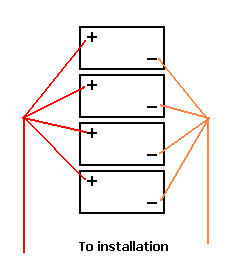
|
|
That does work but please note that all wires from the junction point to the battery must be the same length. |
|
Quoted:
The OP shows a breaker between the battery and inverter. If the inverter has overload protection do you still need the breaker or a fuse? Can the 750 watt inverter overload the battery? The reason for the breaker (or fuse) is to keep from burning down your house if the inverter short circuits or the terminals get shorted somehow. These batteries can source enormous currents that can melt the cables and start fires. The breaker or fuse should be mounted as close to the battery (electrically) as possible. ETA: Overload protection is usually on the inverter's AC output. |