


[ARCHIVED THREAD] - Build your own portable power station: An ARFcom tutorial (very pic heavy) (Page 3 of 5)
|
ETA: Be mindful of heat if your are running your UPS at or near it's max rating with a large external battery. Most smaller UPS units don't have cooling fans, because they weren't intended to run for long periods of time on battery power.
ETAA: Your 750VA UPS is probably equipped with a single 7Ah sealed lead acid battery. When you get into the rackmount and larger units like the ones I pictured, they usually require battery arrays of 48 to 96 volts DC to operate. For obvious reasons this requires a lot of 12v batteries 
[/quote] I did not think about the heat issue. I will have to look in to adding a fan for cooling. the UPS had 2 x 7Ah batterys, Did your UPS 's Charge the larger battery packs OK? or did you use an external charger? |
|
Did your UPS 's Charge the larger battery packs OK? or did you use an external charger?
I had to use external chargers running off generators, because grid power was still down when I was using the external battery packs. Even if grid power was up I would have probably still used an external charger, because the external charger would be faster, as well as more appropriate for properly charging an AGM battery. |
|
Quoted:
Did your UPS 's Charge the larger battery packs OK? or did you use an external charger?
I had to use external chargers running off generators, because grid power was still down when I was using the external battery packs. Even if grid power was up I would have probably still used an external charger, because the external charger would be faster, as well as more appropriate for properly charging an AGM battery. But hooking up the UPS to another lead acid battery would be fine? |
|
Missed this thread last weekend, my power was out.
I was using one of CJAN_NH original boxes with a smal invertor. This man knows his stuff. Didn't really have to get into the battery back up for 17 hours, but was planning on the next day. If the house got colder than the propane heaters could keep up with, I was going to run the furnace off the battery for one or two times to get the temps back up. Of course, the thing is hard wired in and I was going to have to install the receptacles on the romex. I was holding the battery in reserve in case I had to do that. Thanks again These are GTG |
|
Quoted: Quoted: Did your UPS 's Charge the larger battery packs OK? or did you use an external charger? I had to use external chargers running off generators, because grid power was still down when I was using the external battery packs. Even if grid power was up I would have probably still used an external charger, because the external charger would be faster, as well as more appropriate for properly charging an AGM battery. But hooking up the UPS to another lead acid battery would be fine? As long as you did not connect the incoming AC to the UPS. |
|
Quoted:
Quoted:
Quoted:
Did your UPS 's Charge the larger battery packs OK? or did you use an external charger?
I had to use external chargers running off generators, because grid power was still down when I was using the external battery packs. Even if grid power was up I would have probably still used an external charger, because the external charger would be faster, as well as more appropriate for properly charging an AGM battery. But hooking up the UPS to another lead acid battery would be fine? As long as you did not connect the incoming AC to the UPS. So you're saying that you can not use the UPS as a charger for an external lead acid battery? Only as an inverter with the battery as a source? |
|
Quoted: Depending on they type of battery that was originally in the UPS. A Flooded Wet Cell, Asorb Glass Mat, and a Gell type all having different charging program requirements.Quoted: Quoted: Quoted: Did your UPS 's Charge the larger battery packs OK? or did you use an external charger? I had to use external chargers running off generators, because grid power was still down when I was using the external battery packs. Even if grid power was up I would have probably still used an external charger, because the external charger would be faster, as well as more appropriate for properly charging an AGM battery. But hooking up the UPS to another lead acid battery would be fine? As long as you did not connect the incoming AC to the UPS. So you're saying that you can not use the UPS as a charger for an external lead acid battery? Only as an inverter with the battery as a source? |
|
Quoted:
Quoted:
Depending on they type of battery that was originally in the UPS. A Flooded Wet Cell, Asorb Glass Mat, and a Gell type all having different charging program requirements.
So you're saying that you can not use the UPS as a charger for an external lead acid battery? Only as an inverter with the battery as a source? The UPS had a sealed 12v lead acid battery. So I'm assuming that any 12v lead acid battery would be successfully charged if i hook it up to the UPS. How different are the charging program requirements for other battery types? Is it a matter of efficiency? Or will long term use of the wrong charger just damage the battery? Or are we talking dangerous and/or complete destruction of the battery with even limited use of the wrong charger? |
|
Quoted: When you say sealed lead acid battery that is almost a generic term labeled on the outside of some batteries. the best way to determine what type of SLA battery you have it to look up manufacturer specs. It is not a matter of efficiency. It is a matter of extending the life span of the battery as much as possible. Different type of batteries like different charge curves or rates. Some have different float or ending charge voltages. Yes one or two volts can make the difference in battery life. I would not call it a complete visible destruction although I have seen a few exploded batteries. The destruction taking place is a chemical one on the inside of the battery. Even limited use of the wrong charger can shorten the life of the battery.Quoted: Quoted: Depending on they type of battery that was originally in the UPS. A Flooded Wet Cell, Asorb Glass Mat, and a Gell type all having different charging program requirements.So you're saying that you can not use the UPS as a charger for an external lead acid battery? Only as an inverter with the battery as a source? The UPS had a sealed 12v lead acid battery. So I'm assuming that any 12v lead acid battery would be successfully charged if i hook it up to the UPS. How different are the charging program requirements for other battery types? Is it a matter of efficiency? Or will long term use of the wrong charger just damage the battery? Or are we talking dangerous and/or complete destruction of the battery with even limited use of the wrong charger? Take a little time and read this technical document to understand the differences between battery type and how critical charging is. http://www.dekabatteries.com/assets/base/0139.pdf |
|
Quoted:
Quoted:
When you say sealed lead acid battery that is almost a generic term labeled on the outside of some batteries. the best way to determine what type of SLA battery you have it to look up manufacturer specs. It is not a matter of efficiency. It is a matter of extending the life span of the battery as much as possible. Different type of batteries like different charge curves or rates. Some have different float or ending charge voltages. Yes one or two volts can make the difference in battery life. I would not call it a complete visible destruction although I have seen a few exploded batteries. The destruction taking place is a chemical one on the inside of the battery. Even limited use of the wrong charger can shorten the life of the battery.
Quoted:
Quoted:
Depending on they type of battery that was originally in the UPS. A Flooded Wet Cell, Asorb Glass Mat, and a Gell type all having different charging program requirements.
So you're saying that you can not use the UPS as a charger for an external lead acid battery? Only as an inverter with the battery as a source? The UPS had a sealed 12v lead acid battery. So I'm assuming that any 12v lead acid battery would be successfully charged if i hook it up to the UPS. How different are the charging program requirements for other battery types? Is it a matter of efficiency? Or will long term use of the wrong charger just damage the battery? Or are we talking dangerous and/or complete destruction of the battery with even limited use of the wrong charger? Take a little time and read this technical document to understand the differences between battery type and how critical charging is. http://www.dekabatteries.com/assets/base/0139.pdf Thanks for that document. |
|
My AC/furnace unit is external at my house and fed by 220v. I heat with NG and I'd only need to run my blower unit on the furnace. I'm guessing the load would be 220v AC @ 600-700 watts. Would it be feasible to make one of these battery setups to run my NG furnace at night?
If the cost wasn't too prohibitive, I'd think it would be much better to be able to shut the generator down at night and run off battery power. Running the genny all night for only a blower motor seems wasteful in the extreme. Also, has anyone looked at using these:http://www.1000bulbs.com/MR16-Bi-Pin/? At only 12 volts with 3-5 watts draw, they might be a good light (165-180 lumens) to wire up with these battery boxes... |
|
Quoted: Just a note on battery boxes. Someone posted a similar thing here a while ago where they used one of those rolling coolers for a battery system. It was pretty slick. Just a thought. That is a great idea. I still haven't made up my mind on a box for mine yet. Partial to the Kobalt box after giving a good inspection. Now I will have to go check the coolers out. Wondering since they are double wall if a 72 lb battery will flex the container walls much. Two good things off the top of my head about the coolers, insulated to helps control battery temp, double wall so fasteners might not show if walls are strong enough. |
|
Quoted:
My AC/furnace unit is external at my house and fed by 220v. I heat with NG and I'd only need to run my blower unit on the furnace. I'm guessing the load would be 220v AC @ 600-700 watts. Would it be feasible to make one of these battery setups to run my NG furnace at night? If the cost wasn't too prohibitive, I'd think it would be much better to be able to shut the generator down at night and run off battery power. Running the genny all night for only a blower motor seems wasteful in the extreme. Also, has anyone looked at using these:http://www.1000bulbs.com/MR16-Bi-Pin/? At only 12 volts with 3-5 watts draw, they might be a good light (165-180 lumens) to wire up with these battery boxes... Yes, they will work well for you. I'm in the process of evaluating several readily available 12 volt LED bulbs. One is at HD and is for landscape lighting, $24. Single CREE 'CJE' IIRC emitter. The buck power/LED module is easily removed for small custom applications. Drain is about 3/10 amps at 12vdc and the circuit regulates nicely from about 8v to 14v. Another just came out a Sam's and is a 110 vac flood w/ what might be 7 Cree emitters, very bright. $19. ~550 lumens. I'm debating cutting this one open on the lathe. Both of these are the best bang for the buck right now with excellent efficiency that I have found. |

|
Quoted:
Quoted:] When you say sealed lead acid battery that is almost a generic term labeled on the outside of some batteries. the best way to determine what type of SLA battery you have it to look up manufacturer specs. It is not a matter of efficiency. It is a matter of extending the life span of the battery as much as possible. Different type of batteries like different charge curves or rates. Some have different float or ending charge voltages. Yes one or two volts can make the difference in battery life. I would not call it a complete visible destruction although I have seen a few exploded batteries. The destruction taking place is a chemical one on the inside of the battery. Even limited use of the wrong charger can shorten the life of the battery.
Take a little time and read this technical document to understand the differences between battery type and how critical charging is. http://www.dekabatteries.com/assets/base/0139.pdf Thanks for that document. ditto, thanks a lot. |
|
for those that have the 6v golf cart batteries from Sam's club, what size threads are the terminal posts?
also, before i do something stupid, I need to wire two 6v batteries in series to make 12v so that it works w/ the same inverter as the one the OP posted on 1st pg correct? |
|
Quoted:
for those that have the 6v golf cart batteries from Sam's club, what size threads are the terminal posts? also, before i do something stupid, I need to wire two 6v batteries in series to make 12v so that it works w/ the same inverter as the one the OP posted on 1st pg correct? yes, series is how you want them wired. if you increase from 2 to 4 batteries then you will want series/parallel. that will give you 12v and double the AH's of the first 2 batteries. so you would take 4 6v 200AH batteries and you would end up with 12v and 400AH's. if you need guides on how to wire everything up hit up google with series, parallel or series and parallel. everything you need can be found with a quick search with an online search engine. |
|
Quoted: What I don't know about electricity is vast, so I have to ask: Could I use this power-pack to fire up a rural home's water pump to draw well-water? Maybe if you size the inverter to match the demand for the water pump. If you know the pump Horse Power and the pump voltage (pumps are either 115 volts or 230 volts) then the correctly sized inverter can be determined. It may not run very long so you may want some method of capturing all the water you can. Knowing pump size determines inverter size. Knowing inverter size and battery size can determine run time of pump. For longer run time you would need a large capacity battery. |
|
Quoted:
for those that have the 6v golf cart batteries from Sam's club, what size threads are the terminal posts? also, before i do something stupid, I need to wire two 6v batteries in series to make 12v so that it works w/ the same inverter as the one the OP posted on 1st pg correct? 1/4-20 or 5/16/18 nut [wing nut usually supplied] Let me know if you want me to check for sure. |
|
Quoted:
Quoted:
for those that have the 6v golf cart batteries from Sam's club, what size threads are the terminal posts? also, before i do something stupid, I need to wire two 6v batteries in series to make 12v so that it works w/ the same inverter as the one the OP posted on 1st pg correct? 1/4-20 or 5/16/18 nut [wing nut usually supplied] none included w/ mine  I didn't even bother to check...... I didn't even bother to check......
|
|
CJan_NH,
I have a question. Being someone who does not live electronics (but who has the skills to assemble such a box once I have the parts), I don't know what suppliers are reliable with good prices. I had planned on buying as many of the parts as possible online because I don't have the time to do the legwork and drive all over town pricing parts, etc. Can you recommend several suppliers that we could go and get the parts from, and save us the task of sorting through a ton of suppliers that we may not know anything about? I'm not asking you to say buy all the parts from X supplier, but more like X, Y, and Z companies are all reputable with good prices, go check them out. Also, I was looking at a 500w pure sine wave inverter, any recommendations on these for such a project? |
|
Here is a few that I use and trust. Waytekwire has wide selection of electrical products. Del City mostly automotive and truck electrical products. Leans towards repair shops but will do small orders. West Marine higher priced than most but always good stock and carries the unusual items. PowerWerx most amateur radio operators order their electrical needs form these guys. Wide selection of Anderson Power Poles and typical wiring needs. Here is my take on battery chargers. If you think all chargers are all alike then buy direct. You can usually save a few bucks from places like Amazon or online battery stores. I tend to go direct on this type of item. The correct charger assures a long battery life. The support you get in selecting the proper charger makes up for the few extra dollars. Battery Minder offers battery chargers these are just a as good as the Battery Tender you hear recommended. I like these more because they not only change Flooded Cell, and AGM batteries but Gell type as well. Battery Tender this is the one you hear referred to often. They are designed for Flooded Cell and AGM batteries and their market area tends to be automotive related. |
|
Quoted:
CJan_NH, I have a question. Being someone who does not live electronics (but who has the skills to assemble such a box once I have the parts), I don't know what suppliers are reliable with good prices. I had planned on buying as many of the parts as possible online because I don't have the time to do the legwork and drive all over town pricing parts, etc. Can you recommend several suppliers that we could go and get the parts from, and save us the task of sorting through a ton of suppliers that we may not know anything about? I'm not asking you to say buy all the parts from X supplier, but more like X, Y, and Z companies are all reputable with good prices, go check them out. Also, I was looking at a 500w pure sine wave inverter, any recommendations on these for such a project? Most of the stuff can be found in one stop at Walmart and one stop at Auto-zone. |

|
Another question occurs to me. I am looking at the Batteryminder 12248 to charge/maintain the main battery. It cannot use DC power INPUT to charge the battery. I see that the OP on his unit, put in provision for the battery to be recharged via cigarette lighter plug. My question is this: what prevents the unit's battery from being overcharged when being recharged via the cigarette lighter plug?
I would imagine that some sort of DC to DC charge controller would be called for, but am not really sure about this. |
|
Quoted:
Another question occurs to me. I am looking at the Batteryminder 12248 to charge/maintain the main battery. It cannot use DC power INPUT to charge the battery. I see that the OP on his unit, put in provision for the battery to be recharged via cigarette lighter plug. My question is this: what prevents the unit's battery from being overcharged when being recharged via the cigarette lighter plug? I would imagine that some sort of DC to DC charge controller would be called for, but am not really sure about this. unless your running solar then charging with 12v is pointless. this setup is more for plugging in out in the garage and leaving there till needed. if you want to run it off solar then the charge controller that came with the panels or the one you buy will handle charging the batteries and a charger like the batteryminder isnt needed. as for the overcharge question, the battery charger handles that. it detects the voltage and shuts down or going into float charge depending on the model. hope this makes sense. |
|
I have not really finished reading up on battery chargers and battery minders and what not. I already own a big car battery charger with jump start option like what you find in automotive repair garages but I want something for minding the charge all the time. Anyway, I am going to see if there is something that could be using in the vehicle or a camper trailer to keep this portable setup charged up using 12 volt power from the vehicle while driving. I don't really want the 12 volt to always be used unless it was the solar setup someone mentioned, but when traveling or car camping I could see wanting to let the vehicle's power help keep the optima topped off. After dismantling my big jump start pack I am planning to price a new battery for it, but they can be expensive for their size. Overall it has options to run some stuff and be really portable. While this box could be used for parts it is going to waste a lot of parts doing that so for once leaving things stock might be a decent idea. Have to decide what I think of the replacement battery cost though. And this one charges through its cigarrette lighter adapter but I don't have the original plug for it, going to have to run some searches and see what I can learn. I plan to alter a set of my jumper cables with power poles and when I make up the battery box for my optima or whatever I get I will set it up so the power poles can plug in and be used to jump start something that is almost dead. For the most part I kind of figure I can find almost anything on the net, it mostly boils down to me deciding if I want to pay for it. |
|
Biere,
You are right in that charging via the vehicle is strictly not necessary if the battery pack is to be used as an emergency unit only. I had been thinking in the context of coming up with additional uses of the pack to get more use out of it, like taking it tent camping (power for devices), or if there is room in the car for a bugout situation - where I end up might not have power (could camp along the way while camping if needed). Last resort would be to use the pack for jumpstarting a vehicle. I had thought of acquiring solar recharging capability, but first things first. I'm going to build this thing in phases - battery pack w/o inverter (I don't know what I'd use with the inverter, plus it helps spread the cost out), then maybe add a small inverter, or solar recharge capability. I looked at the flexible/fold-upable solar plastic sheets, and wow, are they expensive. But they're alot less bulky/heavy than traditional panels. But the cost per watt is higher. |
|
Ordered up a bunch of parts, should have an update in a week or two...
Optima D31M battery (Amazon had the best price on this bar none) 6 x cig lighter sockets (1 for a voltage plug in gauge, 5 for whatever). battery box (I had to dig around a bit for one that fit the above battery; the first one I looked at was the proper group side for the battery (group 31), when I checked the dimensions of the battery versus the dimensions of the box, it was a no-go... Battery Minder 12248 charger. I decided to skip the inverter for now, and build this thing in phases. Once the battery box arrives I can bring it to the stores and see what toolboxes w/wheels will fit it. |
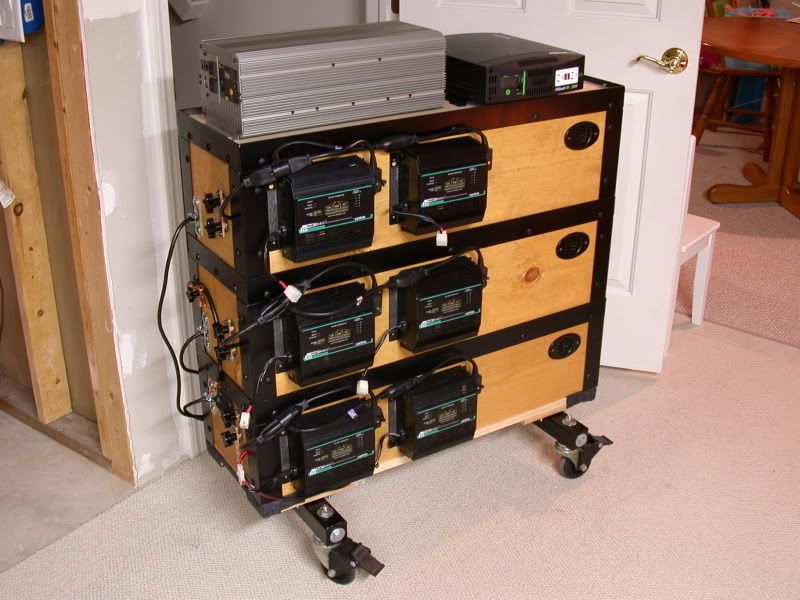

|
Quoted:
Household battery backup system.....runs the house throughout the night while your genset rests. http://img.photobucket.com/albums/v488/mr_joshua/DSCN7482.jpg http://img.photobucket.com/albums/v488/mr_joshua/DSCN7488.jpg Ok, you are going to have to do better than that! Sorry, CJ....but he just won this thread. Details Details!!! |
|
This battery box is on sale at the Bass Pro in Prattville, AL for $39.94.
It incorporates a circuit breaker and has external lugs for power. |
|
Quoted:
Household battery backup system.....runs the house throughout the night while your genset rests. http://img.photobucket.com/albums/v488/mr_joshua/DSCN7482.jpg http://img.photobucket.com/albums/v488/mr_joshua/DSCN7488.jpg Awesome setup! Functional AND mobile. Have you considered hooking up your batteries in a more efficient setup tho? More Efficient Hookup Method |
|
Quoted: Household battery backup system.....runs the house throughout the night while your genset rests. http://img.photobucket.com/albums/v488/mr_joshua/DSCN7482.jpg http://img.photobucket.com/albums/v488/mr_joshua/DSCN7488.jpg You did it now!!! So mean to post pics and not leave details. You know this is ARFCOM. Post Pics and DETAILS! Please  |
|
Quoted: This battery box is on sale at the Bass Pro in Prattville, AL for $39.94. It incorporates a circuit breaker and has external lugs for power. looks like the reviews online aren't too hot for that setup REVIEWS  |
|
Awesome setup! Functional AND mobile.
Have you considered hooking up your batteries in a more efficient setup tho? More Efficient Hookup Method [/quote] You are correct; it could be more efficient in terms of wiring. I chose method #2 as shown in your link. The #2 arrangement is very close to "full balance", I figure the way around the issue is to rotate the outer batteries inward approx every three months. Also, since my loads are very low (say 200 watts) during the overnight hours, the slight imbalance should not adversely affect battery life (provided they are rotated). I'll start a new thread with full details... |
|
Quoted: Awesome setup! Functional AND mobile. Have you considered hooking up your batteries in a more efficient setup tho? More Efficient Hookup Method You are correct; it could be more efficient in terms of wiring. I chose method #2 as shown in your link. The #2 arrangement is very close to "full balance", I figure the way around the issue is to rotate the outer batteries inward approx every three months. Also, since my loads are very low (say 200 watts) during the overnight hours, the slight imbalance should not adversely affect battery life (provided they are rotated). I'll start a new thread with full details... [/quote] Thank you |


|
Quoted:
Quoted:
Just took a shot at pricing out all the components including the battery maintainer. Around $260.00 sound about right? Black & Decker PI750AB 750 Watt Power Inverter $73.00 Optima YellowTop Dual Purpose Battery $140.00 Battery Maintainer $30.00 Noco Group 24-31 Snap-Top Battery Box $12.95 MISC: $40.00 That looks pretty close MateFrio. Here is the specific battery that we use LINK Was there a specific reason you chose the Yellow Optima over the Blue? Looking at their website it seems that the Blue would make more sense. Am I reading it wrong? |
[ARCHIVED THREAD] - Build your own portable power station: An ARFcom tutorial (very pic heavy) (Page 3 of 5)
Join the Community
Your next conversation starts here.
Create your free account to join discussions, share your experience, save topics, and connect with the AR15.COM community.
- Join discussions
- Follow topics and replies
- Connect with fellow enthusiasts
Already a member? Sign in
Stay informed by subscribing to our Newsletter