


Armory Sponsor


Posted: 2/26/2009 11:44:03 PM EDT
|
I've just started reloading .223 and I've seen some of the videos of AR's exploding.
The key seems to be keeping your hand/body parts away from the magazine from what I can tell... After all there's not 'that' much powder in a .223 cartridge. Other than some shrapnel from the magazine well, what else blows up with say a classic case of case separation? Does that charging handle ever get driven back through your skull or eye socket? Please share your first-hand experiences of mahem! Pictures score extra points. |


|
Well, I just happen to have experienced this some 10 years ago. Rifle was a 20" Govt. FNMI barrel on an AR15 lower. Load was 80 grain Sierra MKHPBT with a Win SRP and 23.6 grains of AA 2520. OAL was 2.55" which had about 0.050" freebore. Single loaded but a 20 round USGI mag to catch the bolt.
Rifle was sighted at 300 yards with identical load using LC M193 brass. This was the first load with FC American Eagle, once fired in the same rifle. The first 4 rounds hit about 6" low and in a nice 1/2" group, centered well. The 5th round struck 9" below the group and sounded funny. The bolt was locked forward, the charging handle would NOT budge. Around the ejection port was a coating of brass patina. The magazine was fully stripped and bulged out, it took effort to remove it. The follower was still attached to the spring but the lips were broken. The tabs securing the base plate were straightened out and the base plate was bent in an arc. The rifle could not be cleared so both pins were removed and the upper came off. Damage was noted to the bolt even addembled. A brass drift on the carrier eventually got the bolt out. Here is the remains of the brass: 
The reason the bolt was stuck was the extractor bent into the barrel extension: 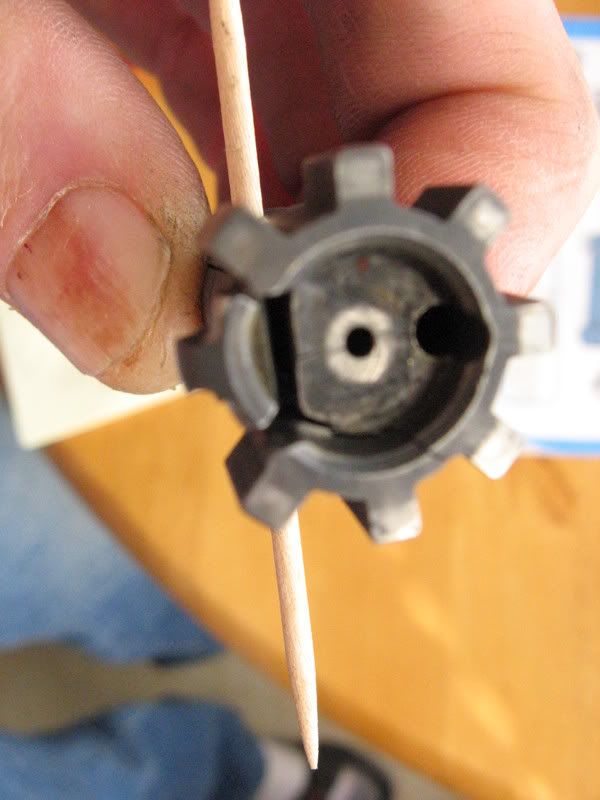
The bolt was split in 2 places. Utterly useless. 
The cause? FC American Eagle brass of 1990s vintage has THIN WEBS. This same load is perfectly safe and accurate with LC brass. Note the two sectioned cases on the end? Those are suspect cases. 
I was DAMN LUCKY. This was NOT over-pressure but case head failure. The identical thing can happen with worn out cases and otherwise safe loads. This is classic head seperation. Pressures that are in the 80,000 PSI range can be DEADLY, even with the AR15. |
Quantum Mechanical Engineer
Ars sine scientia nihil est
Ars sine scientia nihil est
|
Originally Posted By fearme:
I've just started reloading .223 and I've seen some of the videos of AR's exploding. The key seems to be keeping your hand/body parts away from the magazine from what I can tell... After all there's not 'that' much powder in a .223 cartridge. Other than some shrapnel from the magazine well, what else blows up with say a classic case of case separation? Does that charging handle ever get driven back through your skull or eye socket? Please share your first-hand experiences of mahem! Pictures score extra points. Nothing but a little smoke from the action with a case separation. with a case FAILURE, a damaged rifle can and will result. I've had quite a few in the past. 'Borg |

|
Here is another example of damage to the rifle after a bad round. This was NOT a reload. This was Radway Green, headstamp RORG 91. KeithJ and I had communicated via PM at the time, and agreed is was likely a defective case with either a thin web or other flaw. Fire enough rounds and you will find one too.
Magazine was destroyed along with the extractor. Bolt was fine and has fired thousands of rounds since this incident. 


|
"The very atmosphere of firearms anywhere and everywhere restrains evil interference - they deserve a place of honor with all that's good"-- George Washington

|
I've had one ruptured case before. Happened with a .308 load that I was developing for my FAL. Funny thing about it is that both pieces of the brass successfully extracted. I'm thinking that just enough of the case held together during extraction, but both pieces must've parted company while flying through the air.
As I was single loading these with no magazine, there was no noticeable damage anywhere. I later learned upon investigating the cause that my Century L1a1 Sporter had excessive headspace (or, at the very least, by SAAMI gage standards). As far as the FC brass shown in the post above- I just loaded hundreds of FC cases with multiple firings each  . Now I'm scared to death to shoot them. Of course, I'll end up acting in typical fashion- fire them out of my least esteemed rifle the next range session, and leave the brass for the scroungers. . Now I'm scared to death to shoot them. Of course, I'll end up acting in typical fashion- fire them out of my least esteemed rifle the next range session, and leave the brass for the scroungers.  <––––- ballistic safety glasses, not sun glasses <––––- ballistic safety glasses, not sun glasses
|
The inability to distinguish between an abstract idea and material reality appears to be the mark of the American liberal. -Theo Beale
|
Originally Posted By GySgtD:
I've had one ruptured case before. Happened with a .308 load that I was developing for my FAL. Funny thing about it is that both pieces of the brass successfully extracted. I'm thinking that just enough of the case held together during extraction, but both pieces must've parted company while flying through the air.As I was single loading these with no magazine, there was no noticeable damage anywhere. I later learned upon investigating the cause that my Century L1a1 Sporter had excessive headspace (or, at the very least, by SAAMI gage standards). As far as the FC brass shown in the post above- I just loaded hundreds of FC cases with multiple firings each . Now I'm scared to death to shoot them. Of course, I'll end up acting in typical fashion- fire them out of my least esteemed rifle the next range session, and leave the brass for the scroungers. <––––- ballistic safety glasses, not sun glassesThis sounds like a case separation, not a case rupture,, thay are not the same thing. Refer to Keith's post above for a case rupture/failure. 'Borg |
|
Originally Posted By We-rBorg:
Originally Posted By GySgtD:
I've had one ruptured case before. Happened with a .308 load that I was developing for my FAL. Funny thing about it is that both pieces of the brass successfully extracted. I'm thinking that just enough of the case held together during extraction, but both pieces must've parted company while flying through the air.As I was single loading these with no magazine, there was no noticeable damage anywhere. I later learned upon investigating the cause that my Century L1a1 Sporter had excessive headspace (or, at the very least, by SAAMI gage standards). As far as the FC brass shown in the post above- I just loaded hundreds of FC cases with multiple firings each . Now I'm scared to death to shoot them. Of course, I'll end up acting in typical fashion- fire them out of my least esteemed rifle the next range session, and leave the brass for the scroungers. <––––- ballistic safety glasses, not sun glassesThis sounds like a case separation, not a case rupture,, thay are not the same thing. Refer to Keith's post above for a case rupture/failure. 'Borg Mid-case failures are usually non-issues. I have had these and the only symptom was extraction of half of the case which manages to seal quite well. When the case fails AT the web, there is NOTHING to seal the pressure. Brass erodes, forming that brass patina all over as the copper and zinc are vaporized, making for an even easier path for the pressure release. Not all FC brass is suspect which is why I explicitly stated "1990s FC American Eagle". And why I showed sectioned cases along with other range pickups. I have made a gauge from mild steel to measure head thickness. Make it 0.222" in diameter, 2.000" long with 3/16" counterbores on each end so flash hole burrs won't affect measurement. Insert this into a fired case and measure the OAL, the measured amount over 2.000" is the case head thickness. Any case with less than 0.168" is dangerous. The lot of FC cases I had the failure on had samples which were under 0.158". LC cases measure 0.170" and greater. |
Quantum Mechanical Engineer
Ars sine scientia nihil est
Ars sine scientia nihil est

|
@Vly,
First, thanks for the good photo's. Second, three points of interest to me: a. the casing head has extruded itself into the relief for the ejector pin on the face of the bolt. This would normally be interpreted as severe overpressure. b.The primer cup has extruded itself into the firing pin hole, but this can be explained by casing gases pushing the cup back after the casing web failed. c. When you did a "reassembly?" photo showing the relative position of the casing in the chamber, the casing head is way too far up in the chamber. How can this be explained? Normal casing/chamber position for the AR design has the head sticking back out of the chamber about 0.2 inches. [edit]In one photo of the remains, it appears that a "magnum belt" was formed before the web failed. The only place I see where such a belt could be formed is if the round fired out of lock and the belt formed between the space of the bolt and the chamber face. When you did the reasssembly how did the "belt" fit up in the chamber? |
|
Originally Posted By CCW:
@Vly, First, thanks for the good photo's. Second, three points of interest to me: a. the casing head has extruded itself into the relief for the ejector pin on the face of the bolt. This would normally be interpreted as severe overpressure. b.The primer cup has extruded itself into the firing pin hole, but this can be explained by casing gases pushing the cup back after the casing web failed. c. When you did a "reassembly?" photo showing the relative position of the casing in the chamber, the casing head is way too far up in the chamber. How can this be explained? Normal casing/chamber position for the AR design has the head sticking back out of the chamber about 0.2 inches. [edit]In one photo of the remains, it appears that a "magnum belt" was formed before the web failed. The only place I see where such a belt could be formed is if the round fired out of lock and the belt formed between the space of the bolt and the chamber face. When you did the reasssembly how did the "belt" fit up in the chamber? When there is a case failure, the remaining brass will extensively deform, making the appearance of high pressure. But the brass is effectively annealed. Since the brass was extracted from the chamber long after the fact, you can see where it was unsupported. That is a case failure, not excessive pressure. |
Quantum Mechanical Engineer
Ars sine scientia nihil est
Ars sine scientia nihil est
|
Originally Posted By CCW:
@Vly, First, thanks for the good photo's. Second, three points of interest to me: a. the casing head has extruded itself into the relief for the ejector pin on the face of the bolt. This would normally be interpreted as severe overpressure. b.The primer cup has extruded itself into the firing pin hole, but this can be explained by casing gases pushing the cup back after the casing web failed. c. When you did a "reassembly?" photo showing the relative position of the casing in the chamber, the casing head is way too far up in the chamber. How can this be explained? Normal casing/chamber position for the AR design has the head sticking back out of the chamber about 0.2 inches. [edit]In one photo of the remains, it appears that a "magnum belt" was formed before the web failed. The only place I see where such a belt could be formed is if the round fired out of lock and the belt formed between the space of the bolt and the chamber face. When you did the reasssembly how did the "belt" fit up in the chamber? CCW - The photo with the case still in the chamber is not a "reassembly" photo. After I got the bolt removed, the case remained in the chamber ( photo taken at this point), then I knocked the case out with a cleaning rod. The case was not reinserted for photographic purposes. The primer only came out of the case after I knocked the case out of the chamber. As KeithJ states, a case failure will cause the brass to "extrude" as the high pressure gas finds the path of least resistance. As I stated, this was using surplus ammo - Radway Green. I had loaded 10 rounds in the magazine, and was firing from the bench at a 100 yd target to see how accurate the ammo was. After about round 6 I looked through the spotting scope and saw I had a decent group. I then slow fired the remaining 4 shots. The last shot was the one that let go. I had 9 shots in a decent group and 1 shot about 5 -6 inches outside the group, out to the right. I assumed round 10 was the one outside the group. Hope this answers your questions. |
"The very atmosphere of firearms anywhere and everywhere restrains evil interference - they deserve a place of honor with all that's good"-- George Washington


|
Originally Posted By fearme:
I've just started reloading .223 and I've seen some of the videos of AR's exploding. ... After all there's not 'that' much powder in a .223 cartridge. ... Please share your first-hand experiences of mahem! Pictures score extra points. You need to forget that first thought that I highlighted and treat the high pressures we employ with a great deal of respect, no matter whether they come from 2 grains of Bullseye in a .32 ACP or 120 grains of H414 in a .460 Weatherby. The differences in gas volume are great, but the pressures might not be so different (between other examples). On the second comment, this is not General Discussion and this is the wrong place to look for entertaining disasters. However, the comments above are all instructive and you should take full advantage of the experience of others so that you don't have to repeat them in order to learn the same lessons. |
It is not easy to explain Liberty to those that are not familiar with Liberty. Kevin Jamison, on explaining firearm regulation to a Massachusetts lawyer. Jeff City, Mo 18 Apr 13.

Armory Sponsor