


Armory Sponsor
Posted: 11/29/2010 12:37:26 AM EDT
|
Practical Application of Night Vision for Domestic
Law Enforcement & Homeland Security By
Chip Lasky, TNVC Manager, Marketing & Product Development And John Chapman, Director of Training, LMS Defense The purpose of this informational paper is to provide the reader with the strengths and weaknesses of the most commonly available night vision systems when applied to the US domestic law enforcement and homeland security mission. On August 17 and 18, 2010, Chip Lasky and John Chapman conducted a series of tests with the mandate to gather realistic data in order to 1) determine the effectiveness of commonly available nightvision when utilized in real world circumstances; and 2) utilize this data to determine a minimum level of capability appropriate for domestic law enforcement and homeland security missions. The reason for this undertaking is to provide the law enforcement professional a basis for understanding the capabilities and limitations of various image intensifiers on the market. This informational paper is intended to dispel the confusion surrounding the appropriateness of various devices and their associated image intensifier tubes. This article is not meant to address the technical merits or deficiencies in these devices so much as to provide a realistic portrayal of their capabilities in side-by-side comparison. To accomplish these goals, we developed a realistic set of scenarios based on real world circumstances likely to be encountered by the user community. We then utilized the five most common night vision devices covering the three most common image intensifier generations available to the domestic user community to observe these scenarios from the responder’s perspective. Each device was tested in each scenario to gather data in three modes: 1) Passive observation using only the available environment’s ambient light; 2) passive observation using each unit’s internal infrared (IR) Illuminator; and 3) Passive observation using a secondary IR Illuminator (Surefire M1 IR Illuminator). A professional photographer then captured photos through each device in each mode, using the same shutter speed and other camera settings. These camera settings were determined by setting up the camera in the mode and shutter speed most favorable to the device with the tube that gathered the least amount of light (the ATN Viper Gen1+). The need to rapidly and accurately identify threats such as a weapon in a suspect’s hand is overwhelmingly obvious for those going into harm’s way. This was a requisite in developing the scenarios for this article. The idea is to best describe, through photo documentation, the ability to detect and identify threats in accordance with domestic laws of Use of Force. We chose several different locales in which law enforcement personnel are likely to encounter a suspect while using night vision. Photo documentation was collected with a Nikon D700 Digital SLR Camera. Images are shown as-is with no alteration or retouching. Raw data files are available for peer review. The five devices tested were: 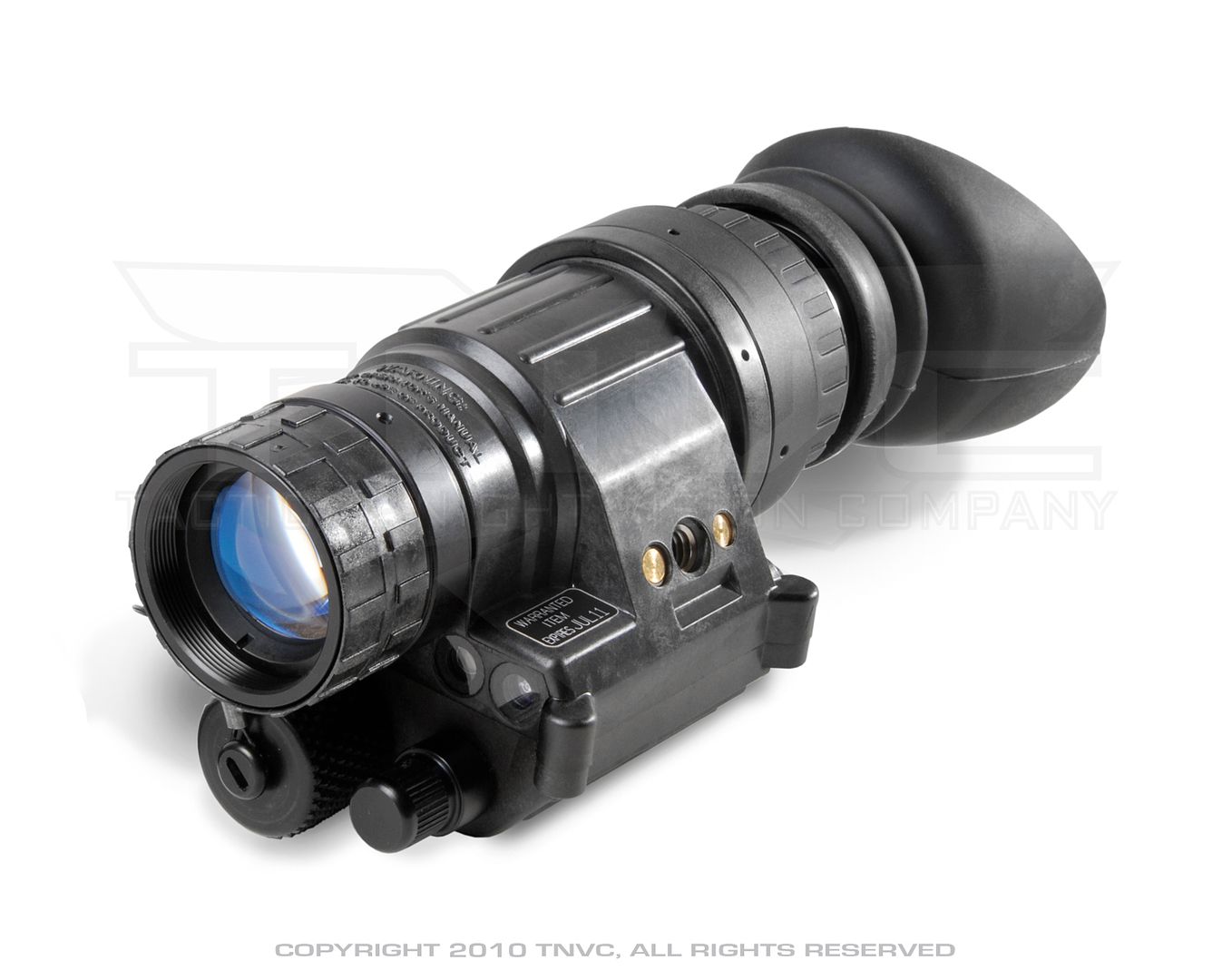
1.ITT PVS-14 Night Enforcer Gen3 PINNACLE Auto-Gated Image Intensifier (ITTE-NEPVS-14-17) •Gen3 U.S. ITT PINNACLE •Resolution: 64-72 lp/mm Typical •Thin-Film •Auto-Gated •Adjustable/ Variable Gain •1x +0.03 Magnification •40º + 2º Field of View (FOV) •F/1.2 Objective Lens •EFL 26mm Ocular Lens •Diopter +4 to -6 •10″ to Infinity Focus 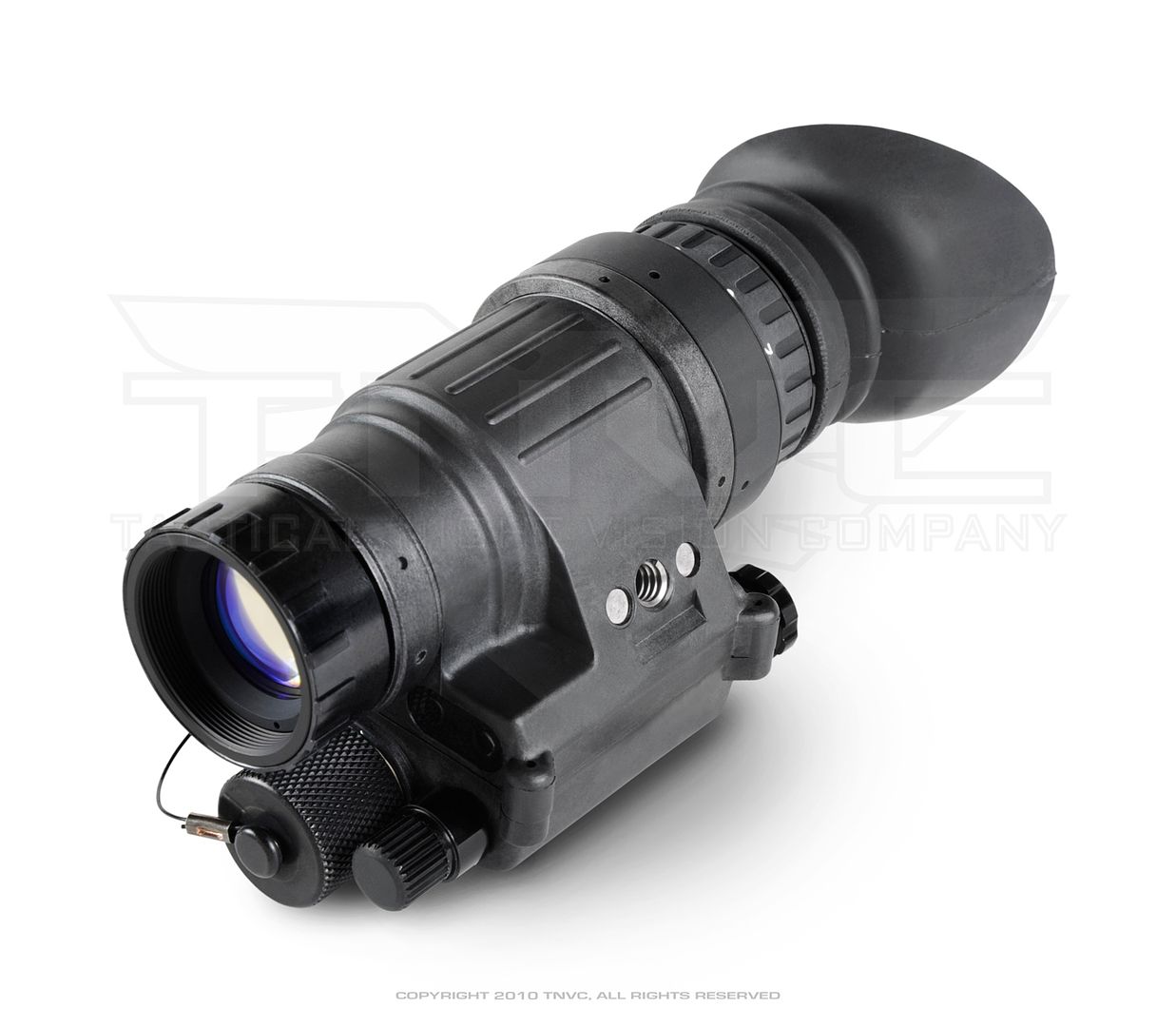
2.Litton (L3) PVS-14 Gen3 Auto-Gated Image Intensifier •Gen3 U.S. Litton Auto-Gated •Resolution: 64 lp/mm Typical •Thin-Film •Auto-Gated •Adjustable/ Variable Gain •1x Magnification •40º Field of View (FOV) •F/1.2 Objective Lens •EFL 26mm Ocular Lens •Diopter +2 to -6 •10″ to Infinity Focus 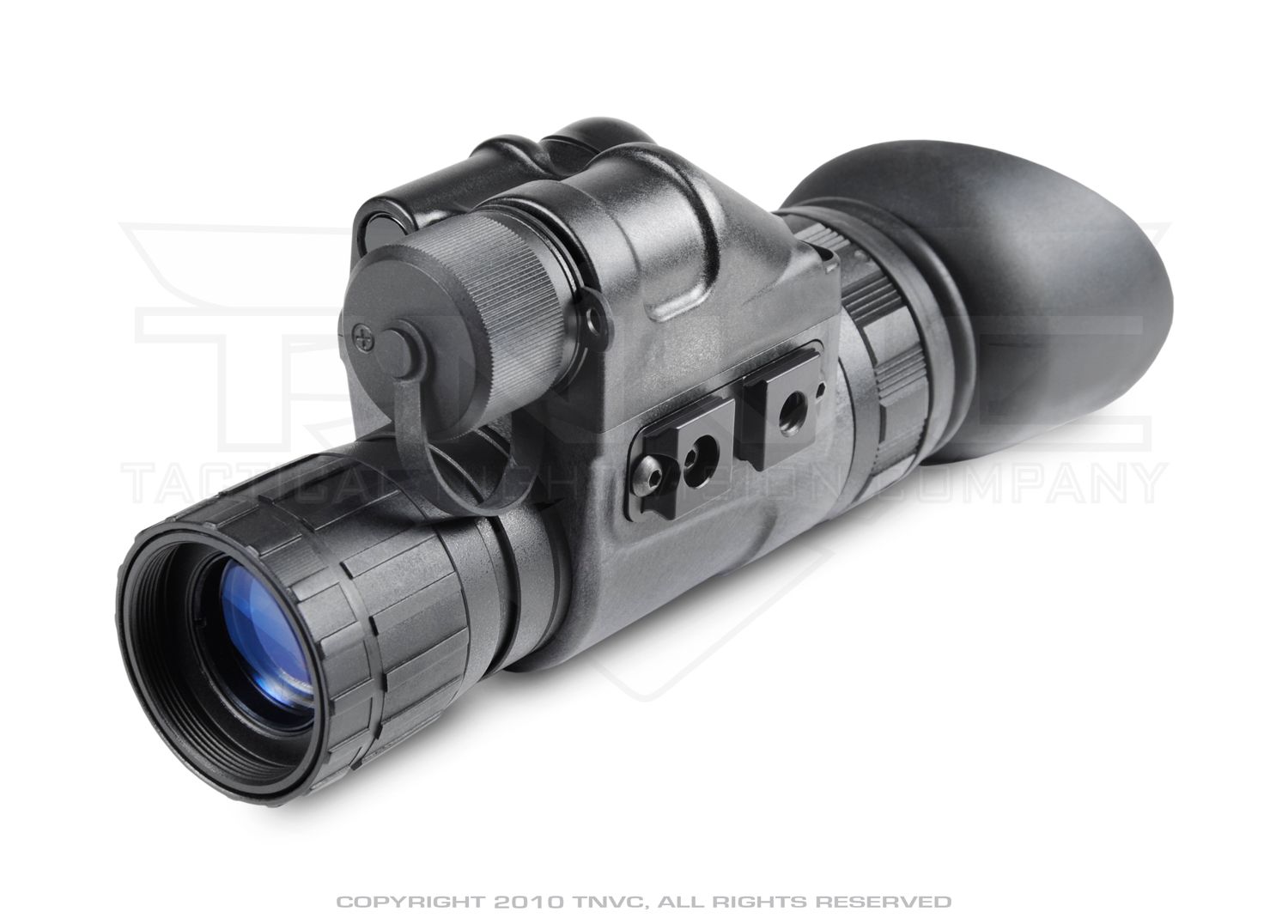
3.GT-14 Gen2 Super High Performance (SHP) Image Intensifier •Gen2 Super High Performance (SHP) •Resolution: 51-64 lp/mm Typical •Non-Filmed •Non-Gated •Automatic Brightness Control •1x Magnification •40º Field of View (FOV) •F/1.2 Objective Lens •EFL 23mm Ocular Lens •Diopter +5 to -4 •10″ to Infinity Focus 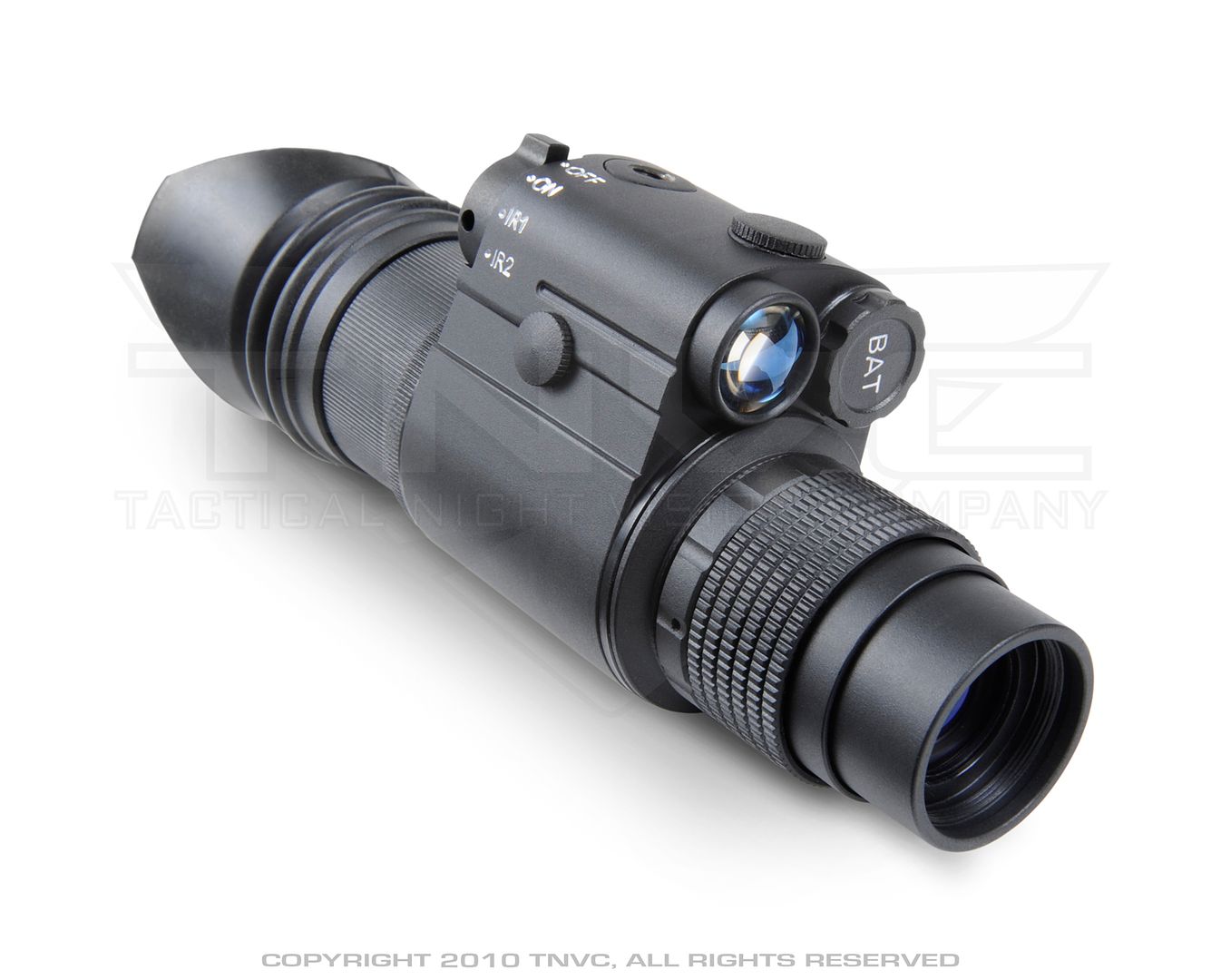
4.D-300 Gen2 MILSPEC Image Intensifier •Gen2+ •Resolution: 28-38 lp/mm Typical •Non-Filmed •Non-Gated •Automatic Brightness Control •1x Magnification •40º Field of View (FOV) •F/1.2 Objective Lens •EFL 25mm Ocular Lens •Diopter +2 to -4 •10″ to Infinity Focus 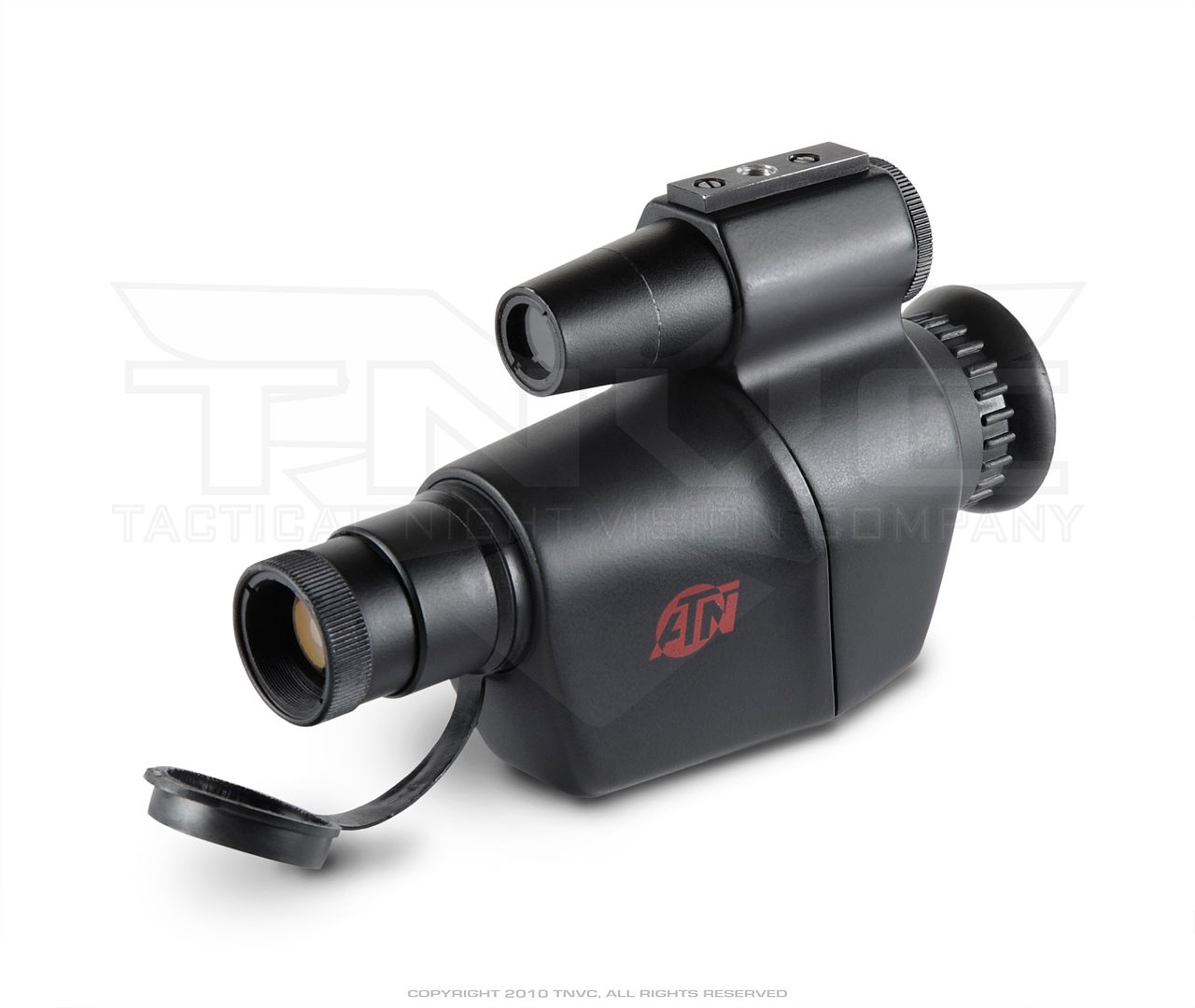
5.ATN Viper Gen1 Image Intensifier (NVG0VIPR10) •Gen1+ •Resolution: 40 lp/mm Typical •Non-Film •Non-Gated •Automatic Brightness Control •1x Magnification •20º Field of View (FOV) •F/1.4 Objective Lens •EFL 35mm Ocular Lens •Diopter +5 to -5 •1 m to Infinity Focus These devices were selected because they can display the various generations and levels within generations of image intensifier technology. The units are all monocular-type and can be hand-held or head-mounted for a hands free capability. Emphasis was placed on individually-operated devices used in a “search and observe” capacity. Test Scenario 1 – Residential Home Basement (Subject at 11 yards) This scenario was designed to simulate the stealth search of a normal residential home, but can be expounded to include commercial and industrial basements and internal rooms. The point of this exercise is to convey the limitations of image intensifier technology. Even the most advanced Gen3 PINNACLE tube requires ambient light. The amount of ambient light is directly proportional to the performance of the device. Basements and other complete no-light environments are often encountered by professionals going into harm’s way. These situations require a more advanced and sensitive image intensifier to aptly resolve details in the image. Even the most powerful device will struggle to gather enough light in a completely dark environment. As with most residential basements, no light source was present when the power to the light fixtures was off. This series of images was displays only the image intensifier by itself and with the aid of a Surefire M1 IR illuminator. ITT PVS-14 Night Enforcer Gen3 PINNACLE Auto-Gated Image Intensifier Without any ambient light or artificial IR light, the PVS-14 Gen3 PINNACLE Auto-Gated image intensifier does not produce any sort of useable image. 
The Gen3 PINNACLE Auto-Gated Image Intensifier is able to gather enough light to provide the user an image when the internal IR illuminator is activated. Because there is no practical ambient light, the image is very dark and loss in resolution hampers the ability to discern detail, even at short distance, but the unit is useable in this condition. Light-colored objects such as the metallic weight bench, step stool, wood joists/wall studs, and the subject’s shirt help to produce some contrast in the image. The subject’s hands can be seen raised around the chest, as if something is being held, but it is difficult to identify a weapon 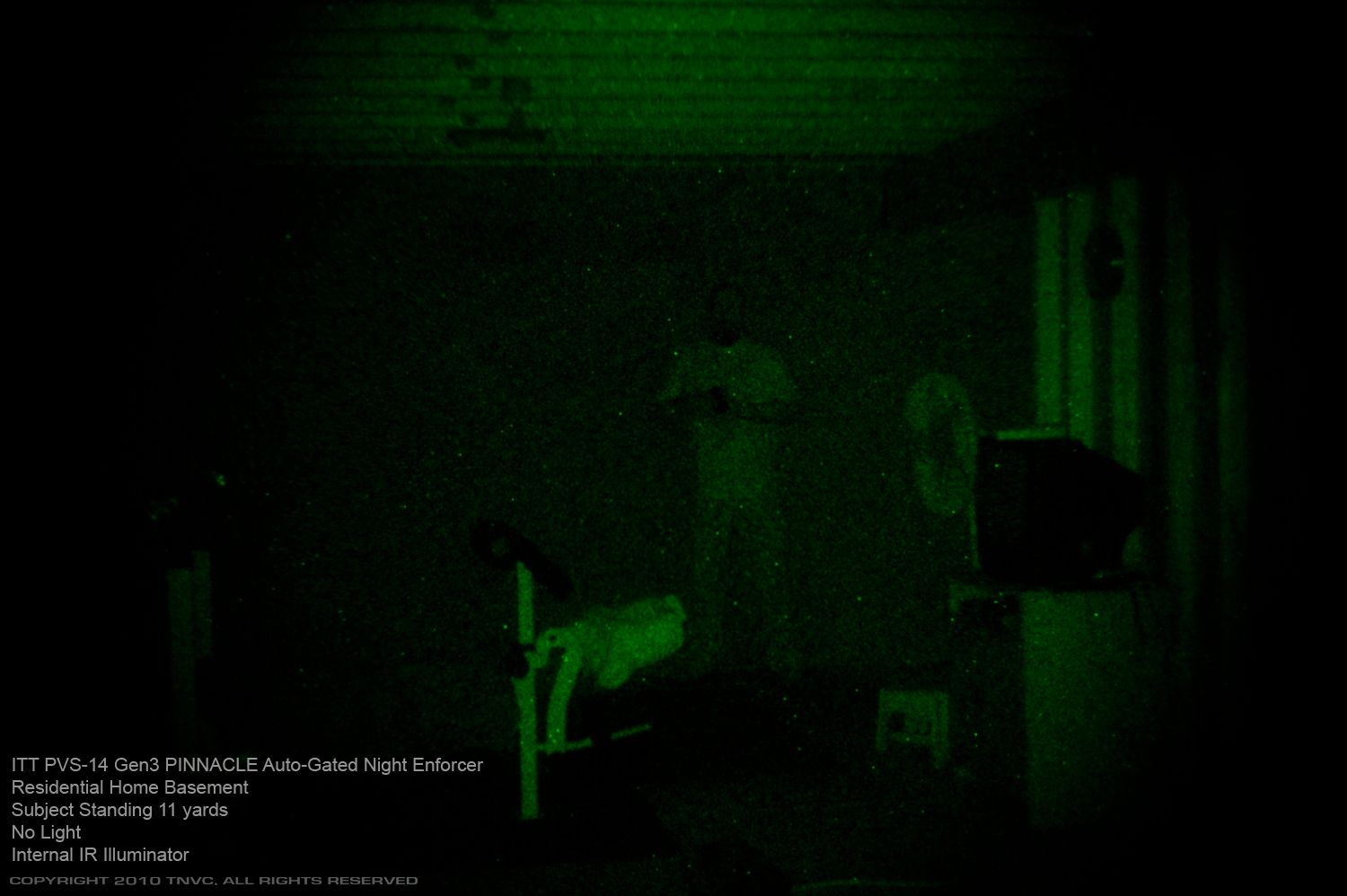
The use of the Surefire M1 Illuminator heavily boosts the performance of the Gen3 PINNACLE Auto-Gated tube. Detail can be easily observed. A handgun is clearly visible in the subject’s hands and facial features are seen enough to actually recognize the person. It is clear the subject is standing in front of a cinder block wall and has an escape route from the room to his left. Furniture and appliances can be made out, including a weight bench, television, area fan. 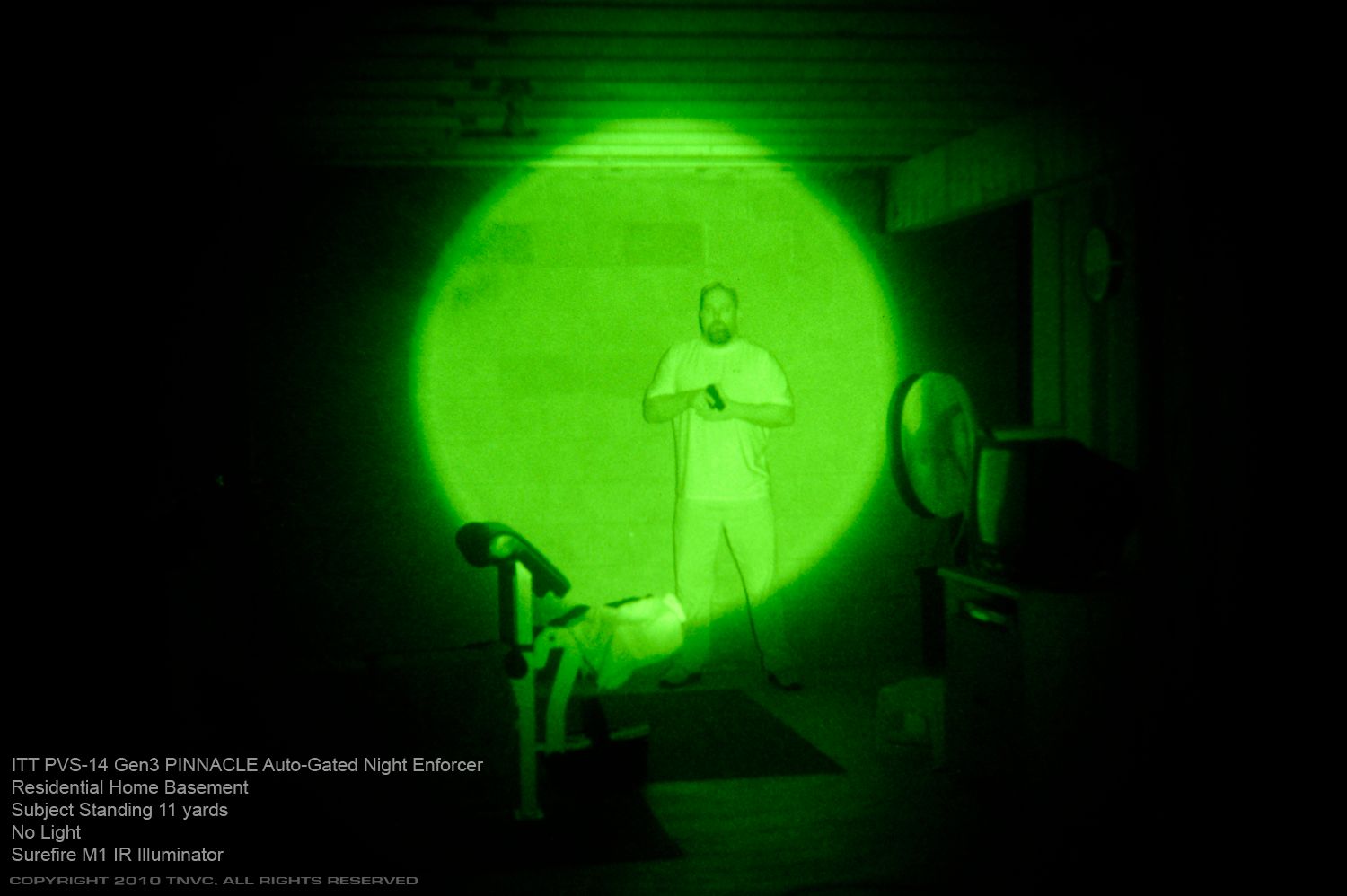
Litton PVS 14 Gen3 Auto-Gated Image Intensifier Without any ambient light or artificial IR light, the PVS-14 Gen3 Litton Auto-Gated image intensifier does not produce any sort of useable image. 
The Litton Gen3 Auto-Gated unit displays a similar image to the upgraded PINNACLE tube when the internal IR illuminator is activated. The subject is visible, but details are unresolved. It cannot be determined if a weapon is present and positive identification of the subject’s facial features cannot be made. Smaller details of the surroundings can be made out for better situational awareness. 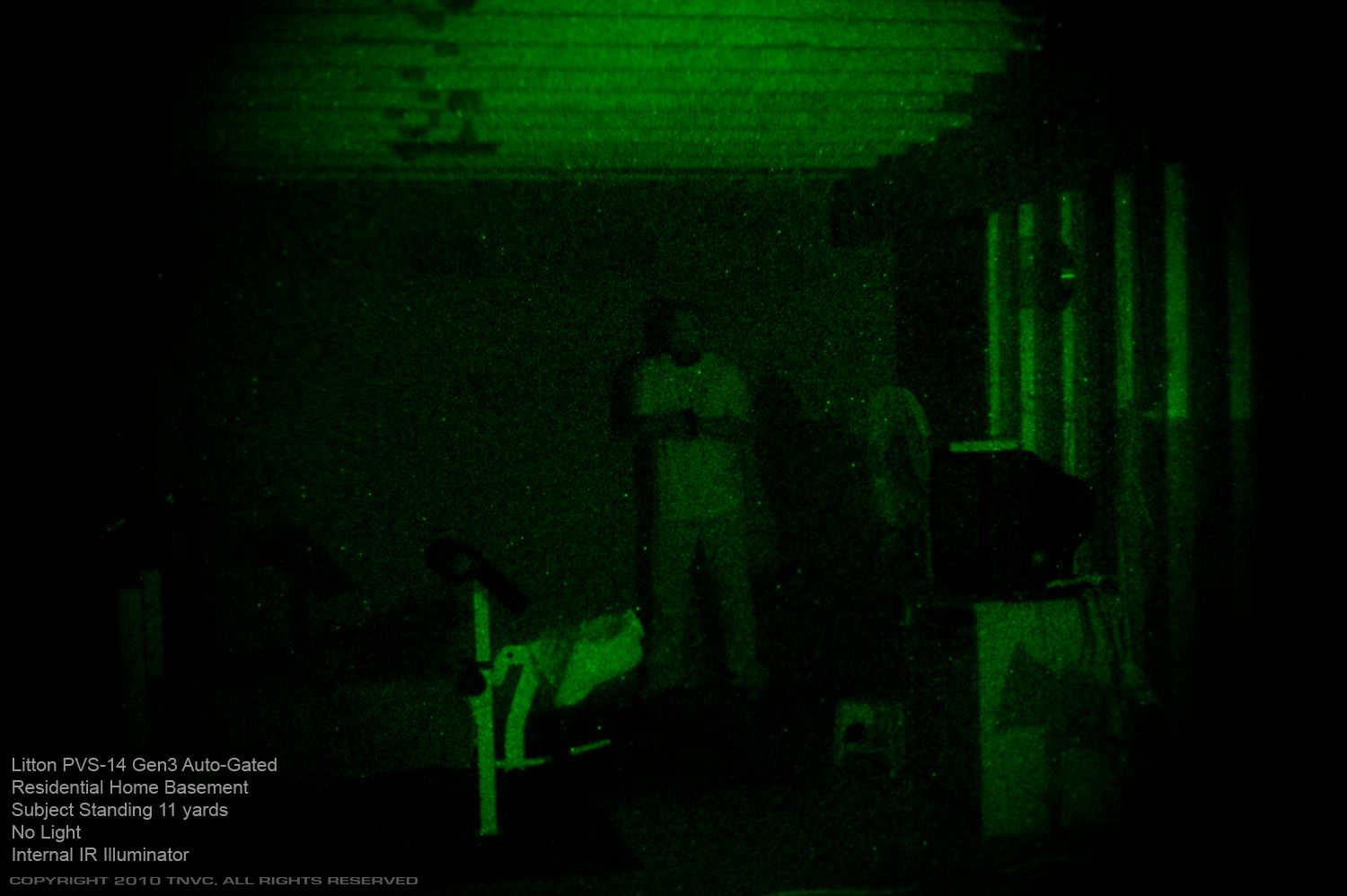
Adding in the Surefire M1 creates a big difference. The subject can clearly be seen, recognized, and a weapon identified. Feature of the room are now clear such as the cinder block wall and opening into a separate room to the subject’s left. 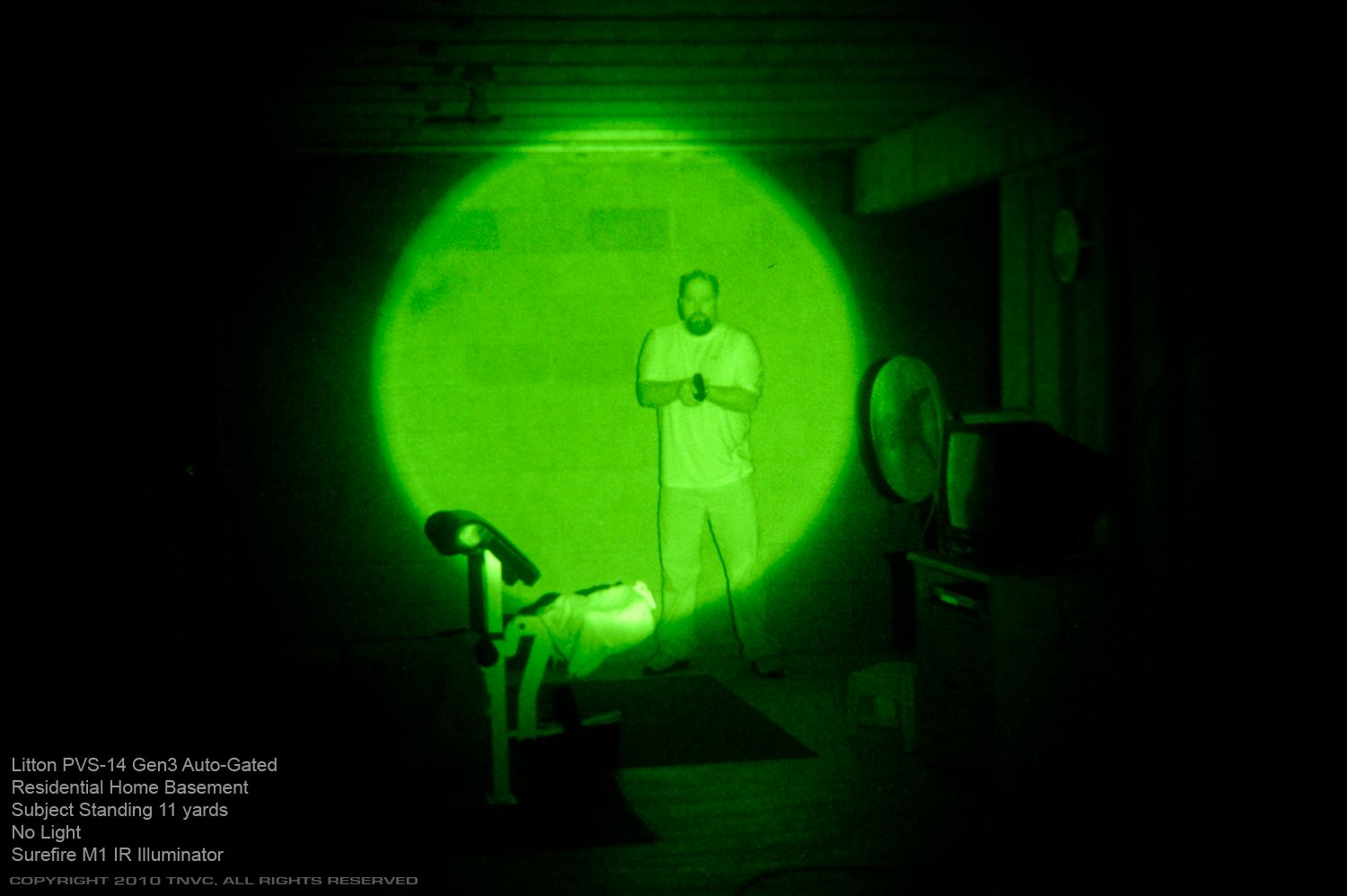
GT14 Gen2SHP Image Intensifier The Gen2 SHP image intensifier is ineffective in total darkness without the use of an IR light source. No details of the subject or surroundings are visible. 
Activating the internal IR Illuminator does not add anything to the image. 
The Addition of the Surefire M1 greatly helps the image quality and resolution. The subject can be clearly seen along with the weapon in his hand. In comparison to the Gen3 devices, this image lacks some fine detail. Edges and contrast are not as crisp. Facial features are visible, but not as clear. Contrast created by the way his shirt hangs is not as crisp, making it somewhat more difficult to identify if he is concealing anything beneath clothing. 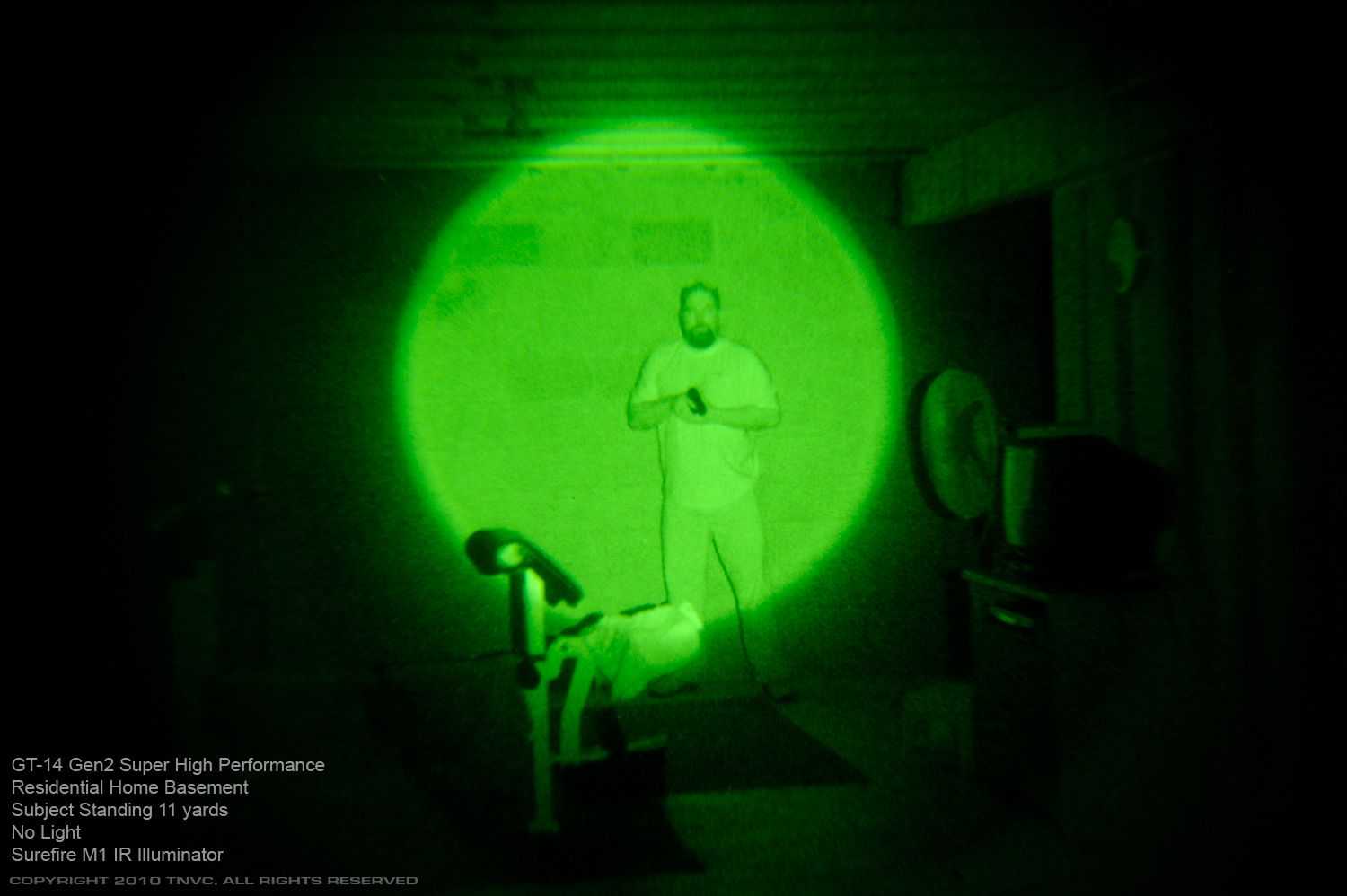
D300 Gen2+ MILSPEC Image Intensifier With no ambient light available, the D-300 Gen2 MILSPEC tube produces no image. 
Turning on the internal IR illuminator produces an image, but it is very faint. The subject can be seen, but details are very vague. Little contrast is produced. The subject appears to be holding something in his hands, but positive ID cannot be made. 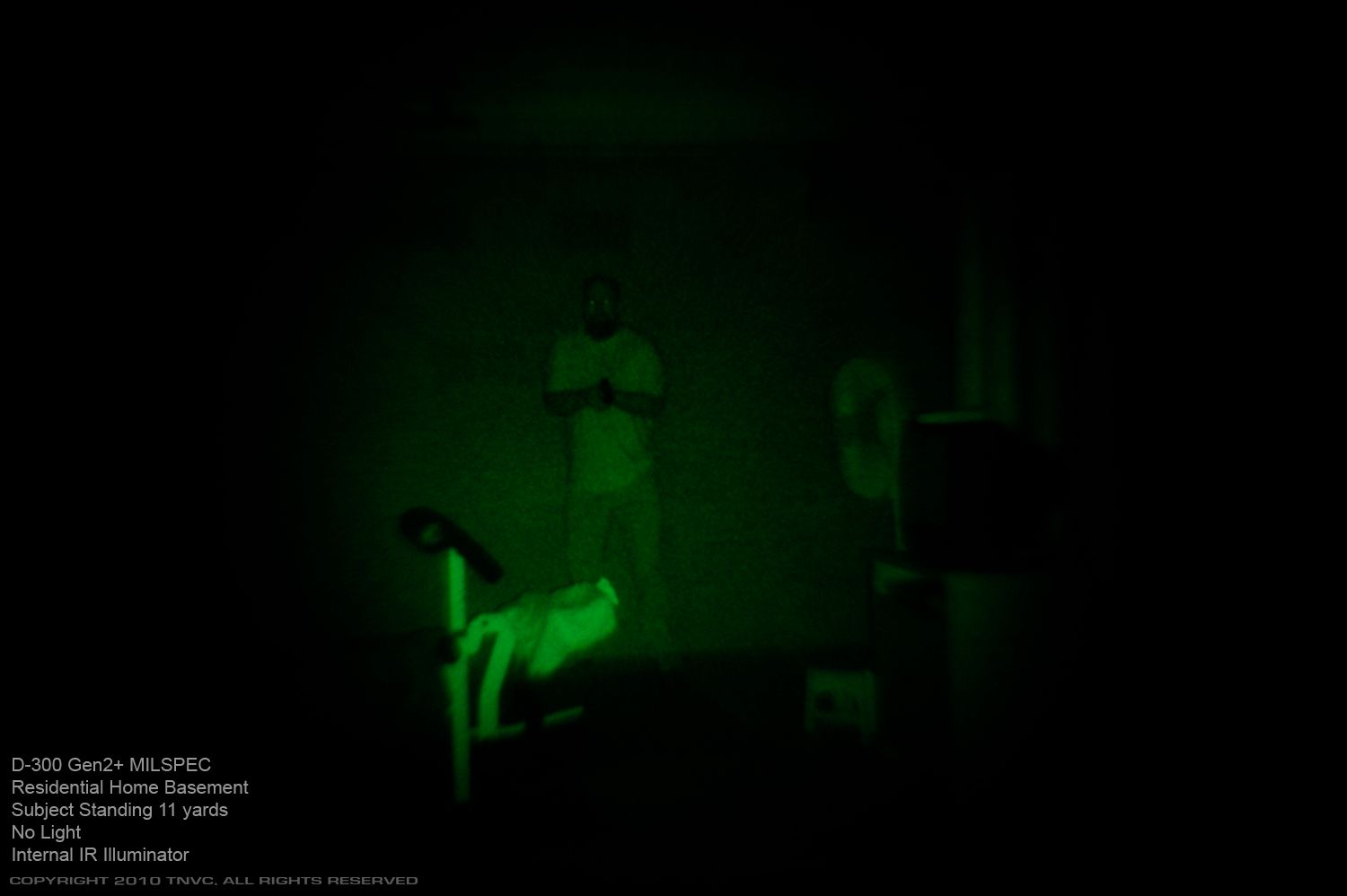
The external IR illuminator drastically upgrades the image. However, it is nowhere close to Gen2 SHP, let alone the Gen3 devices, under the same conditions. Details are very fuzzy and the subject cannot be properly identified. It is a little easier to see the weapon in his hands, but the lack of resolution hampers positive ID. Note the sharp drop-off of any image outside the IR spot light. The lower sensitivity of the Gen2 MILSPEC tube can only resolve details within the IR light. Situational awareness is severely hampered. 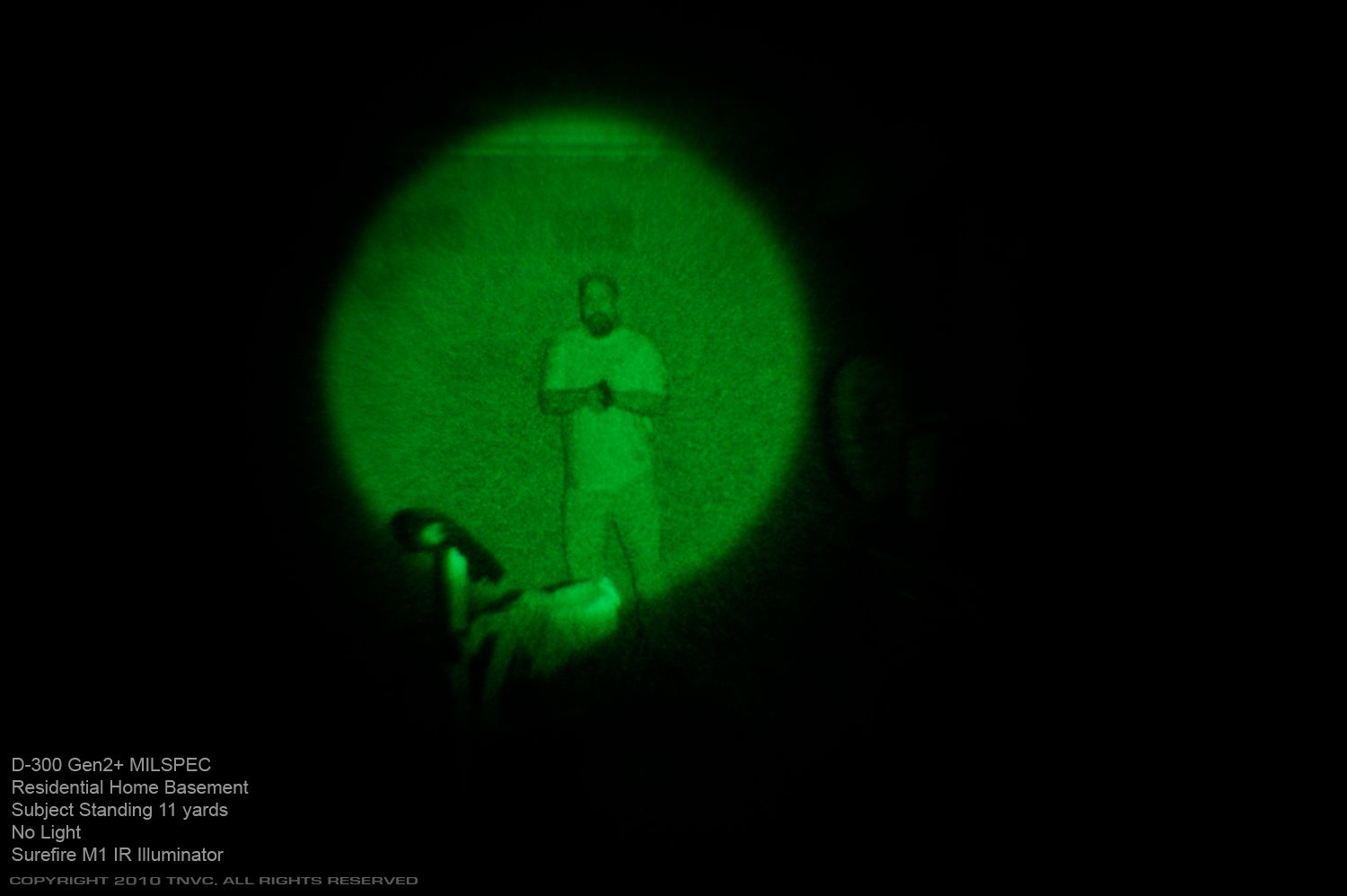
ATN Viper Gen1+ Image Intensifier The Gen1+ image intensifier produces no image on its own, under pitch black conditions. 
Even with the built-in IR illuminator activated, the Gen1+ tube still cannot produce an image under pitch black conditions. 
Surprisingly, the Gen1+ tube will not provide any image even when the Surefire M1 is activated under these conditions. Although the external illuminator is powerful, the relatively weak light-gathering capabilities of the Gen1+ tube cannot bring in enough light to provide any form of usable image. 
Thoughts- As evidenced by the photos, pitch black environments really show the limitations of image intensifiers. Because image intensifier technology relies on the presence of ambient light, even the most advanced unit will not produce an image without the aid of an IR illuminator. Clearly, the latest Gen3 devices’ more sensitive tubes have a distinct advantage over the older technology in terms of image resolution and clarity. An IR light source is required for operating in these conditions and allows the Gen3 devices to produce clear images capable of identifying a subject’s face, the presence of a weapon, and environmental details for better situational awareness. The Gen1+ tube proved absolutely worthless in this evolution. Test Scenario 2 - Open Area Search / Close Range (25 Yards) This scenario was designed to simulate the search of an open area for a subject. The environmental lighting was common to a city park close to the street at night. Conditions were somewhat clear with minimal cloud cover and less than a quarter moon visible. The purpose of this evolution was to best illustrate acquisition ranges of an armed subject in a rural environment through various levels of night vision gear. In contrast to the previous location, this field will display performance when natural ambient light is introduced. ITT PVS-14 Night Enforcer Gen3 PINNACLE Auto-Gated Image Intensifier The Gen3 PINNACLE Auto-Gated tube in the PVS-14 Night Enforcer clearly shows the suspect at 25 yards. His arms can be identified as holding an object (appearing like a pistol) in front of his chest, though positive identification of a weapon cannot be made. The subject can be identified as wearing long pants and a jacket. The light gathering ability of the device produces good contrast, even without the aid of IR illumination. 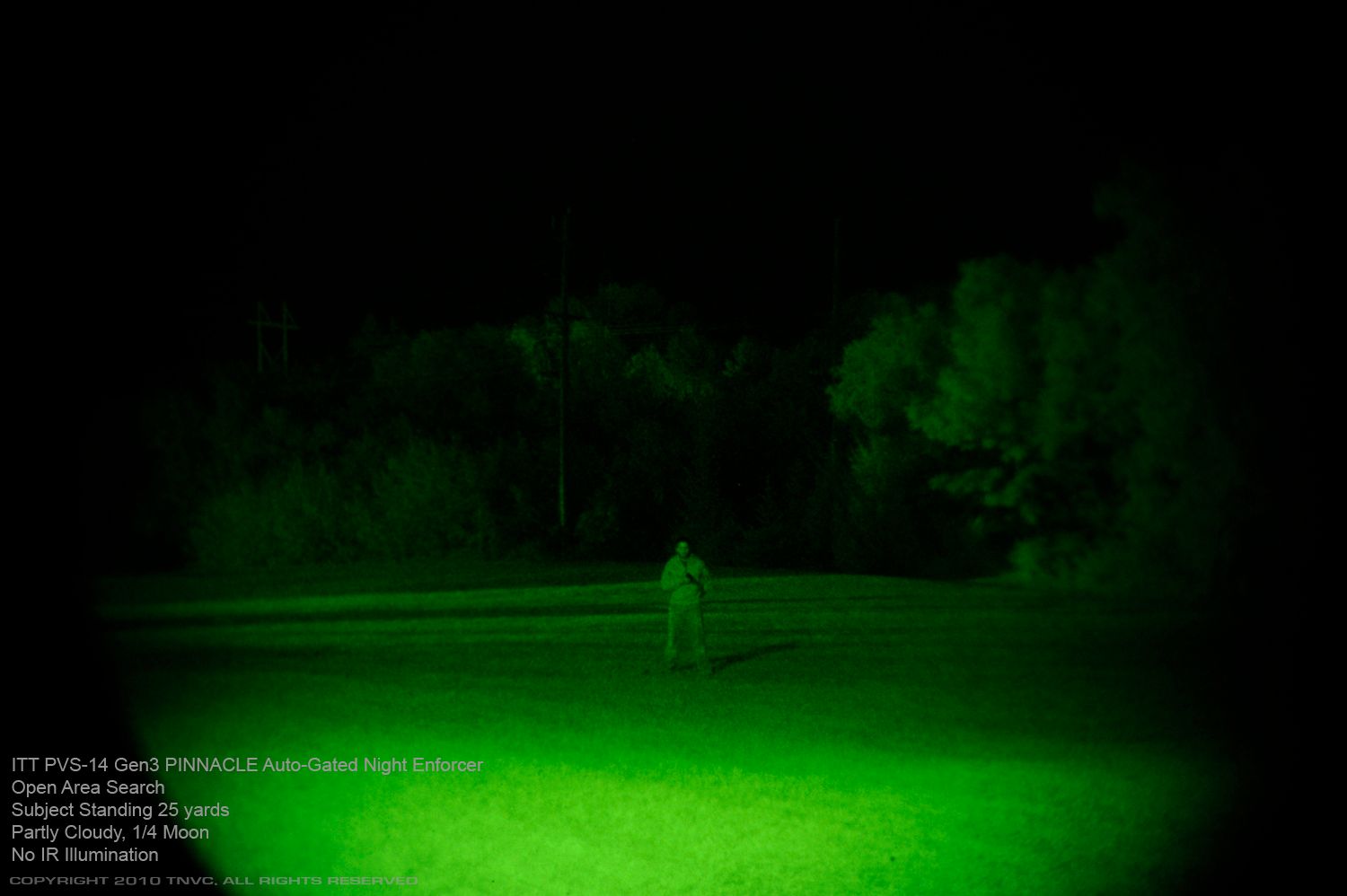
Built-in IR illuminators are generally low power and meant for searching when there is little to no ambient light available. Because of this, the internal IR illuminator of the PVS-14 Night Enforcer has no practical effect on this scenario where decent ambient light is present. 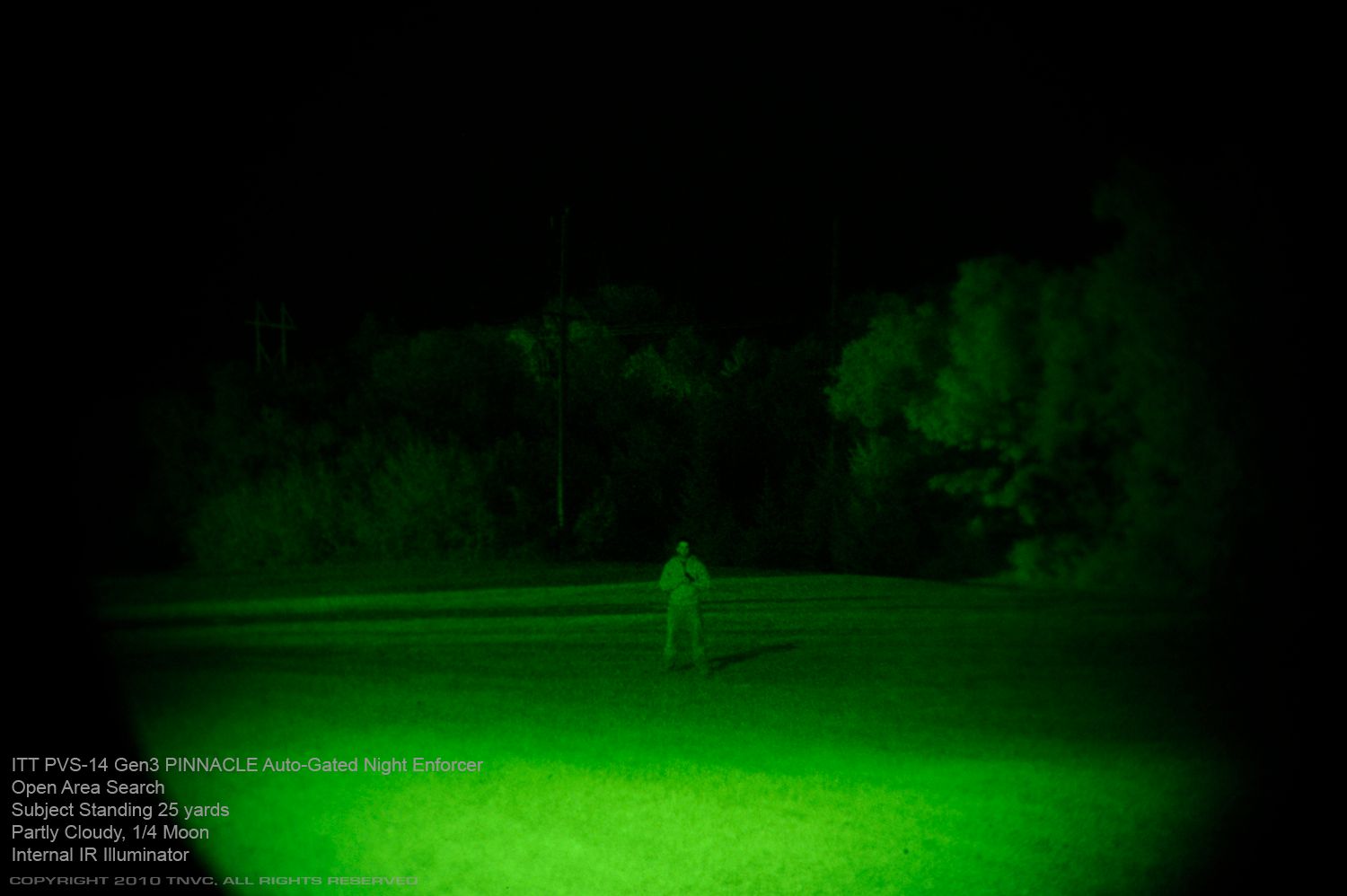
The external Surefire M1 provides enough power to be useful in open space search and observe scenarios. It provides a significant amount of IR reflection on the subject, causing him to greatly contrast with the environment due to the IR reflection. While there is little more detail seen here compared to the image without IR illumination, the subject is much more visible against the far tree line where there is less light. The entire image area appears brighter. 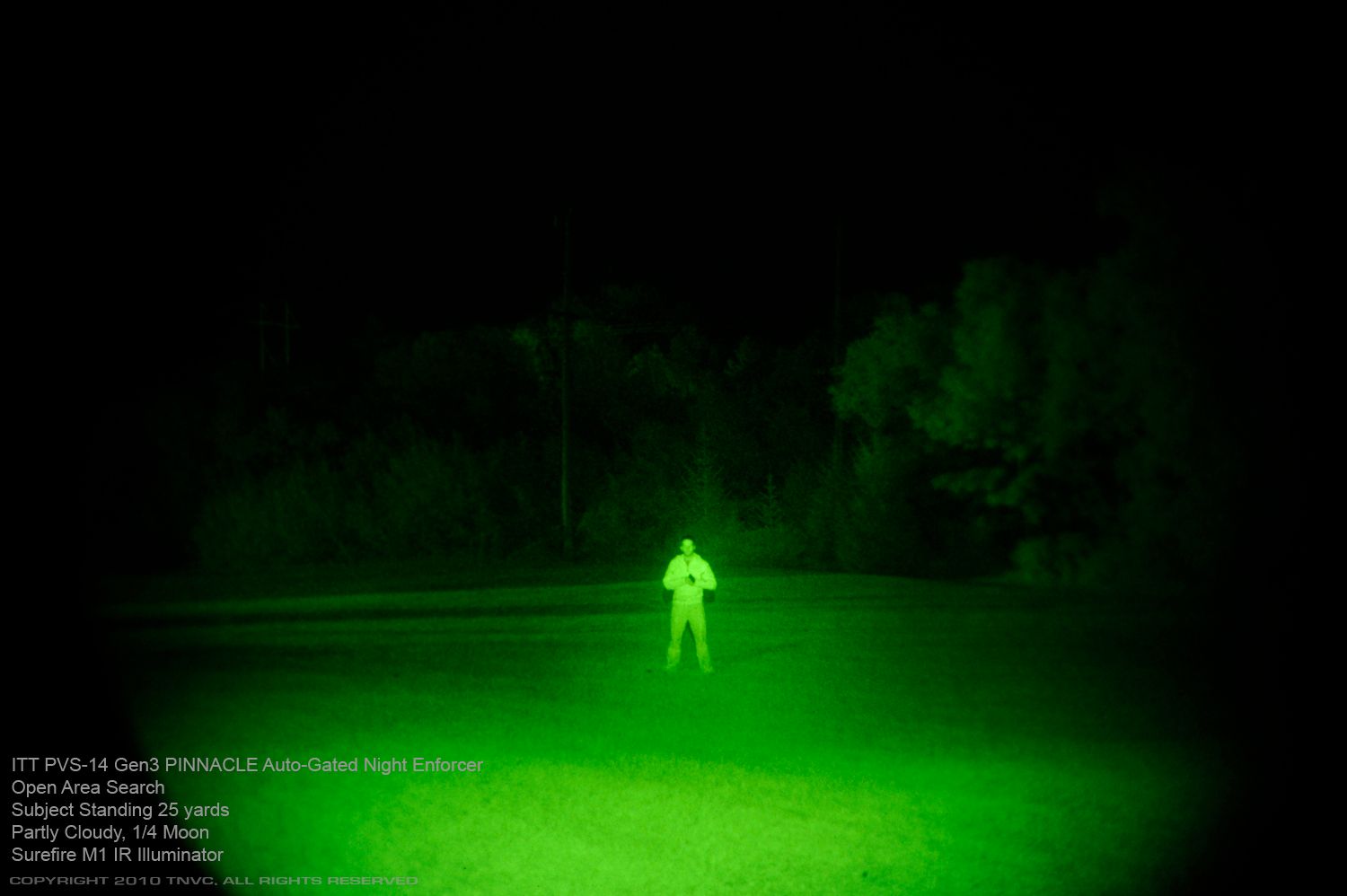
Litton PVS 14 Gen3 Auto-Gated Image Intensifier Without any ambient light or artificial IR light, the PVS-14 Gen3 Litton Auto-Gated image intensifier produces a clean, crisp image of the suspect at 25 yards. Clothing is identifiable as well as the possible presence of a weapon. Decent resolution and contrast is seen all the way back to the tree line. 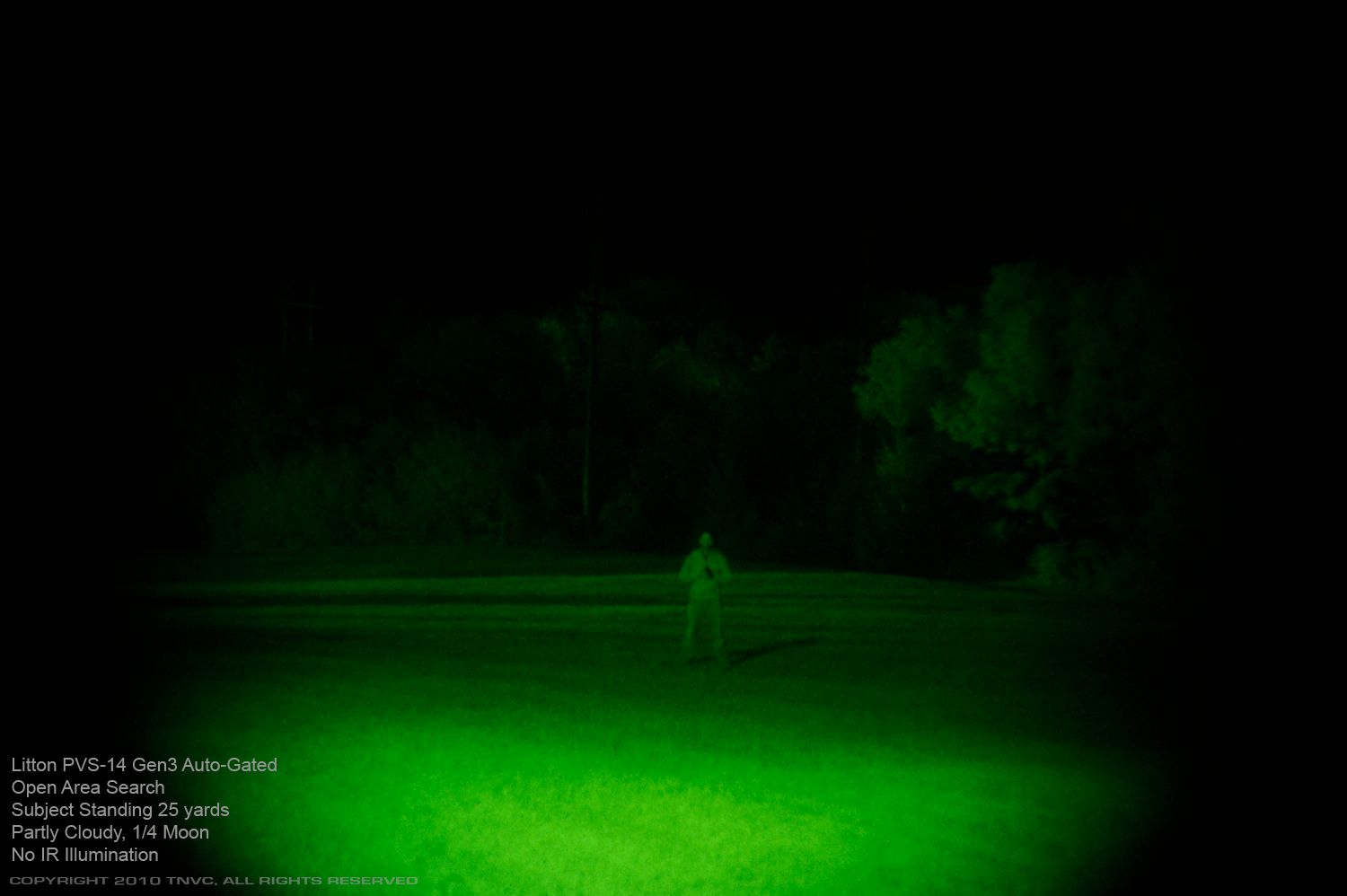
Activating the internal IR illuminator of the Litton Gen3 Auto-Gated unit produces a faint lightening effect of the image. Slightly more contrast can be observed in the subject’s clothing and grass around his feet. But, like the PINNACLE unit, the Gen3 Auto-Gated tube is sensitive enough on its own, that the addition of the IR illuminator amid decent ambient light does little to enhance the image. 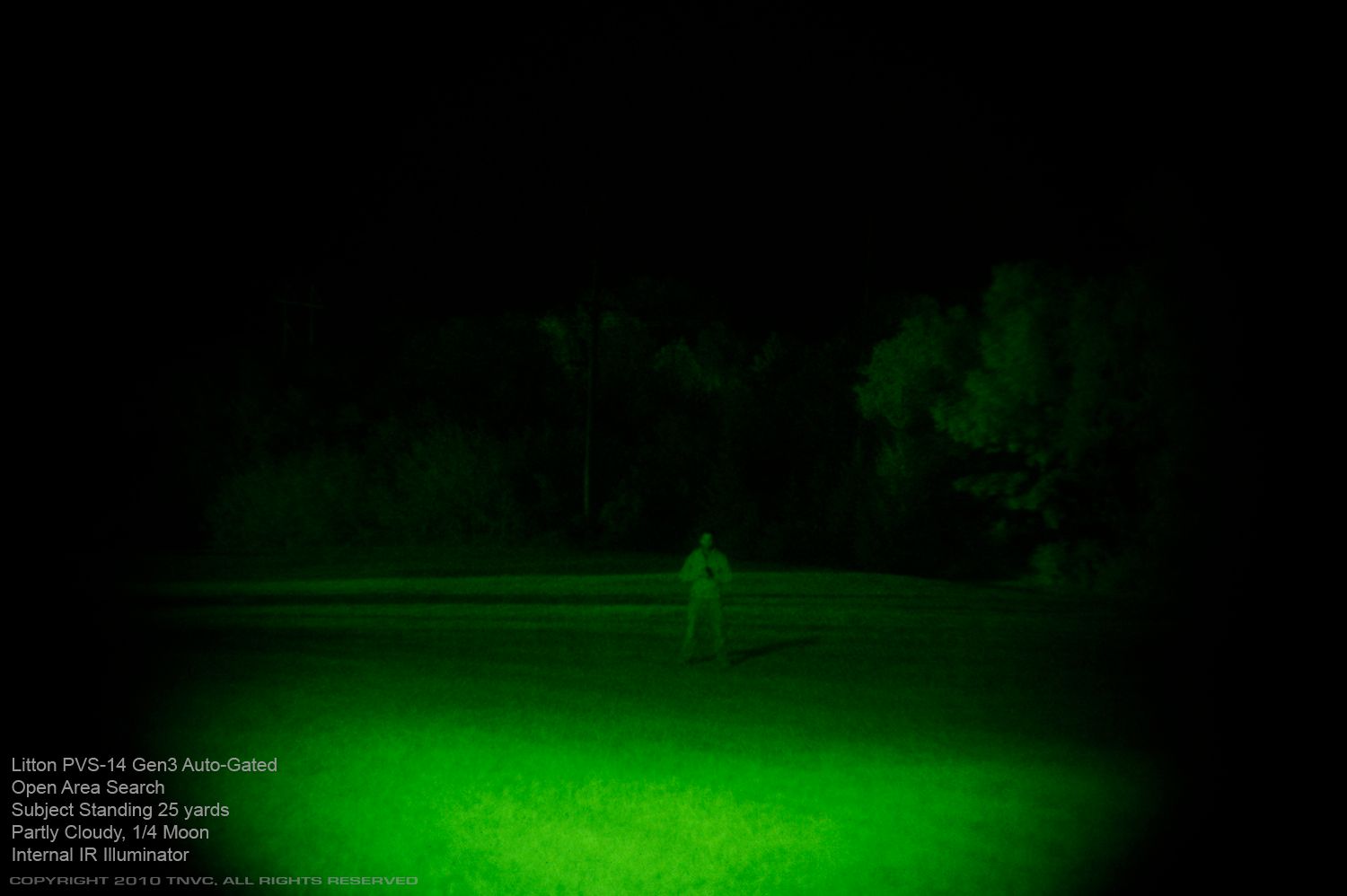
A clear difference is observed when the Surefire Mi Illuminator is used in-conjunction with the Gen3 Auto-Gated device. The subject is heavily lit-up with ample contrast against the darker, far away tree line. 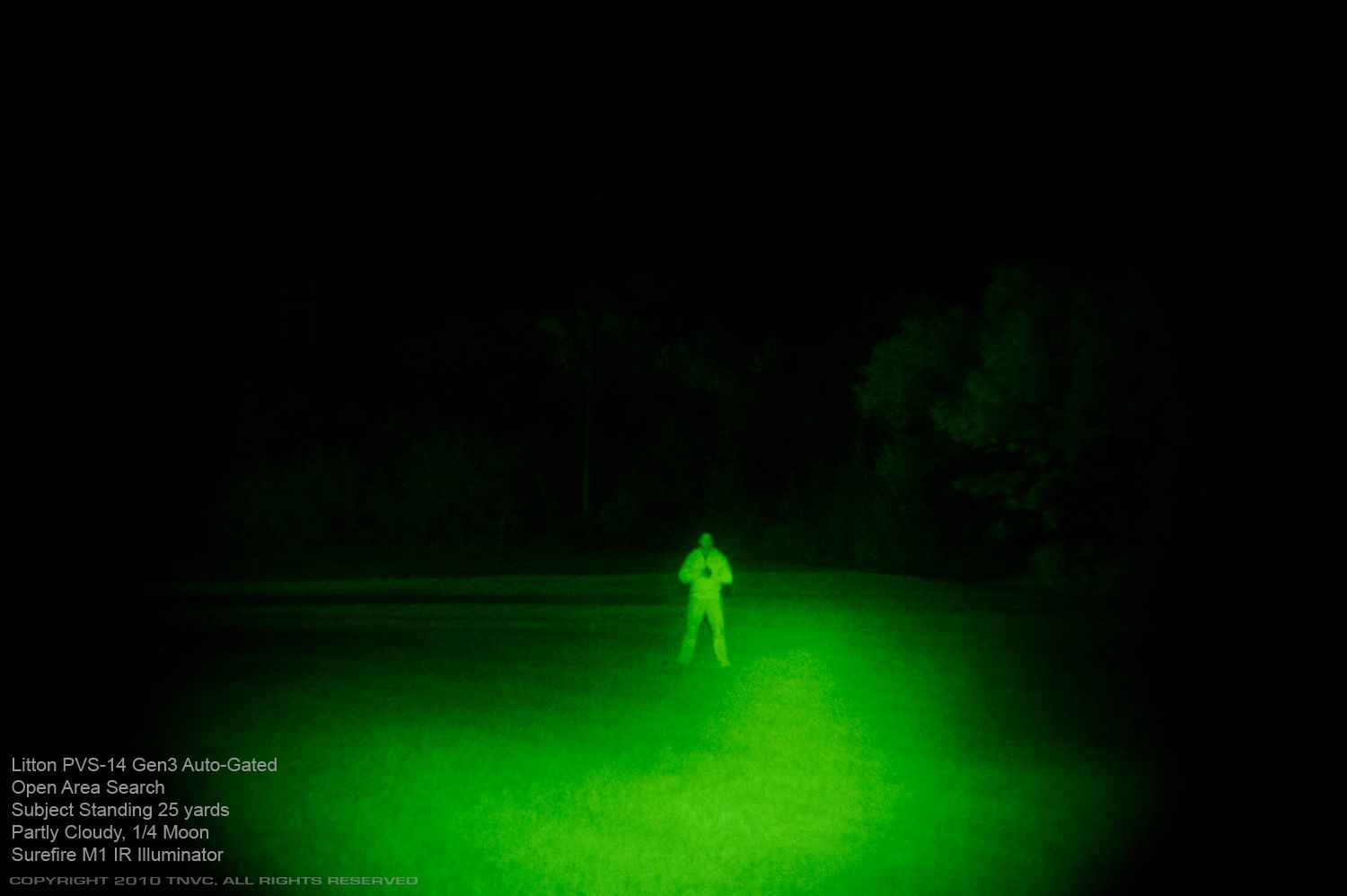
GT14 Gen2SHP Image Intensifier The Gen2 SHP image intensifier produces a decent image that gives the user a view of the subject, but there is no way to identify the presence of a weapon. The far tree line is visible, but like the subject, details are not as crisp as the Gen3 tubes. 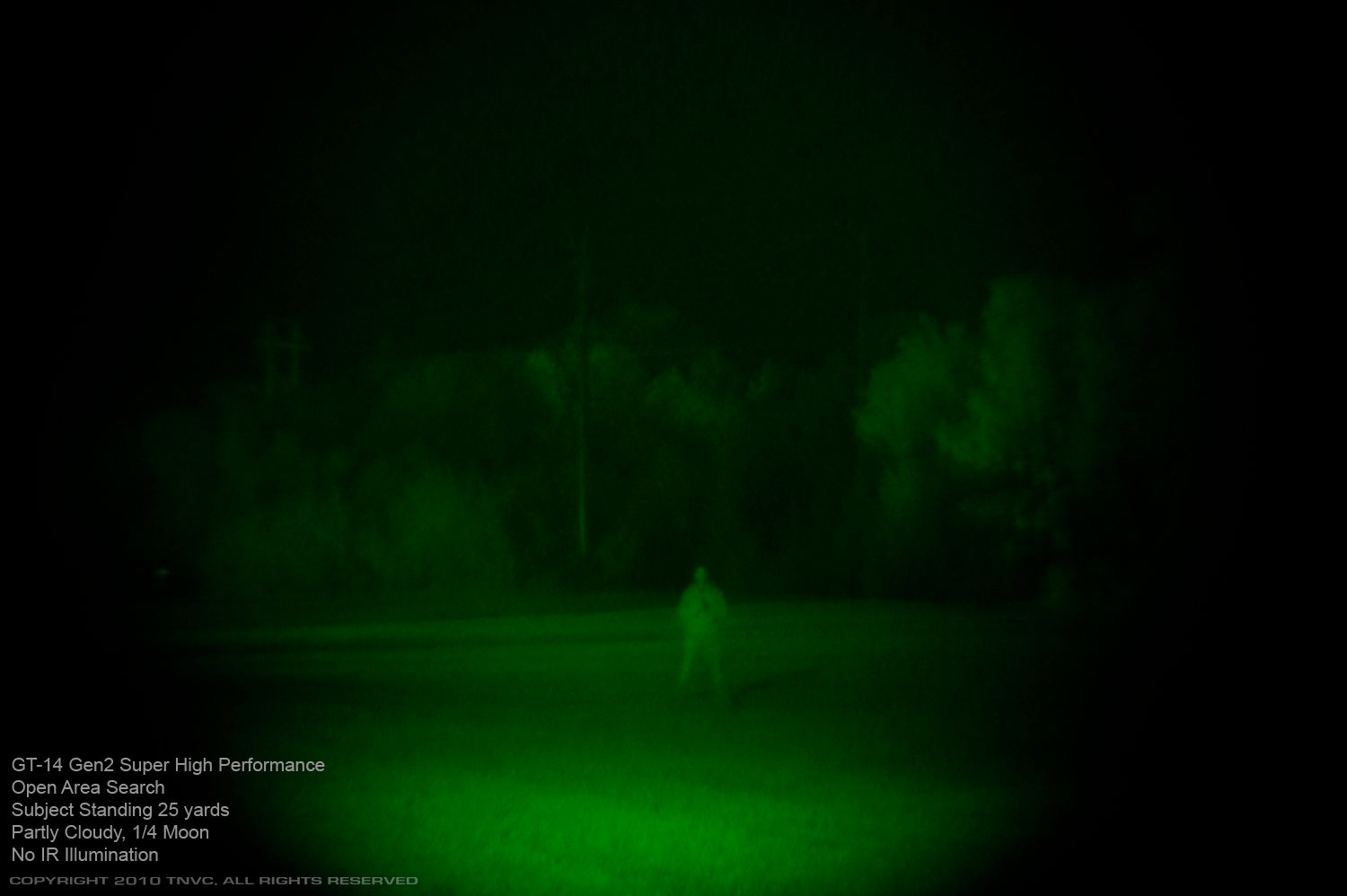
Activating the internal IR Illuminator does not do much for the image in this environment. 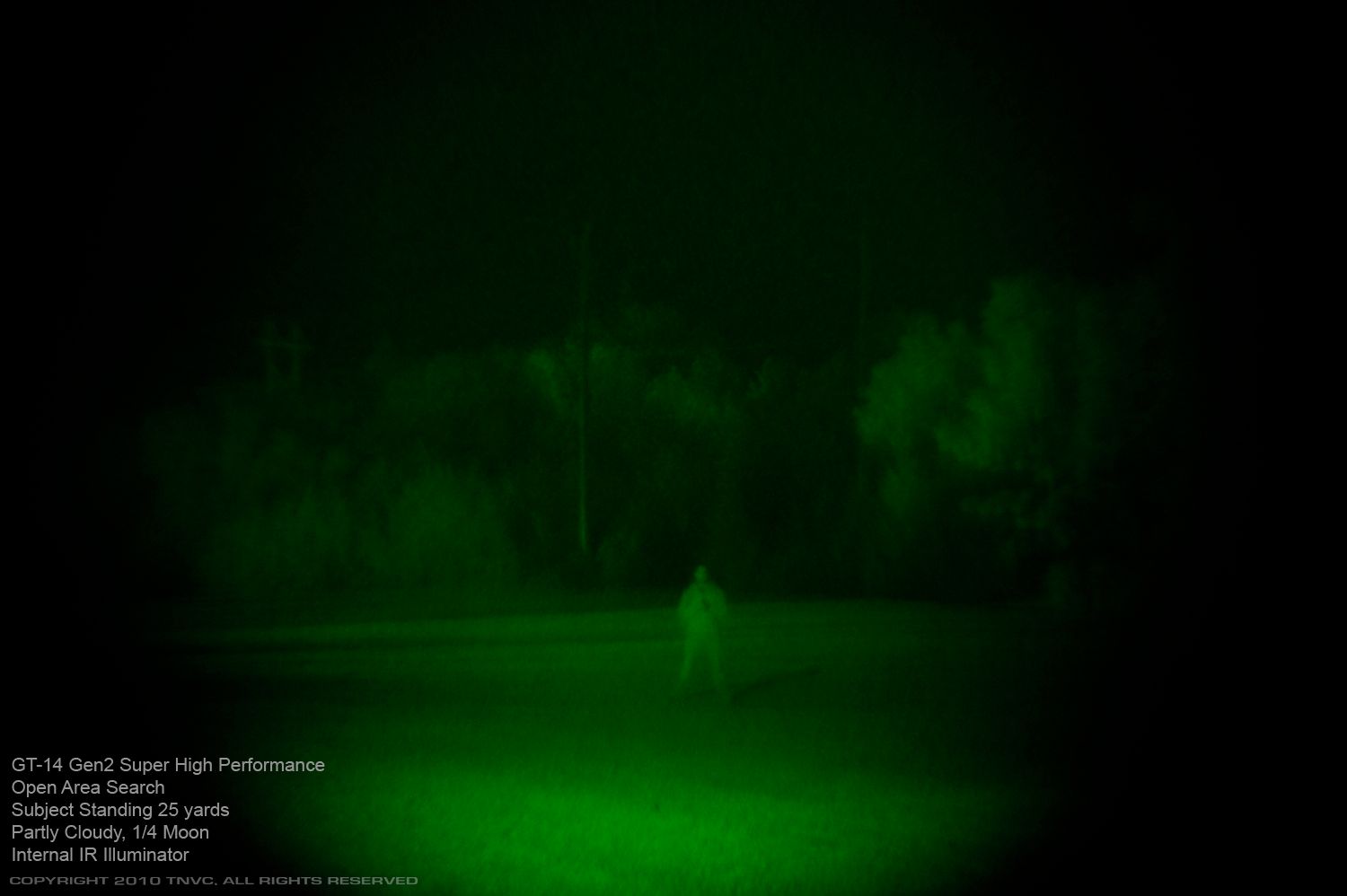
The Addition of the Surefire M1 highlights the subject against the background, but does not help with identifying the weapon. In this case, the illuminator is more useful in picking up the subject. 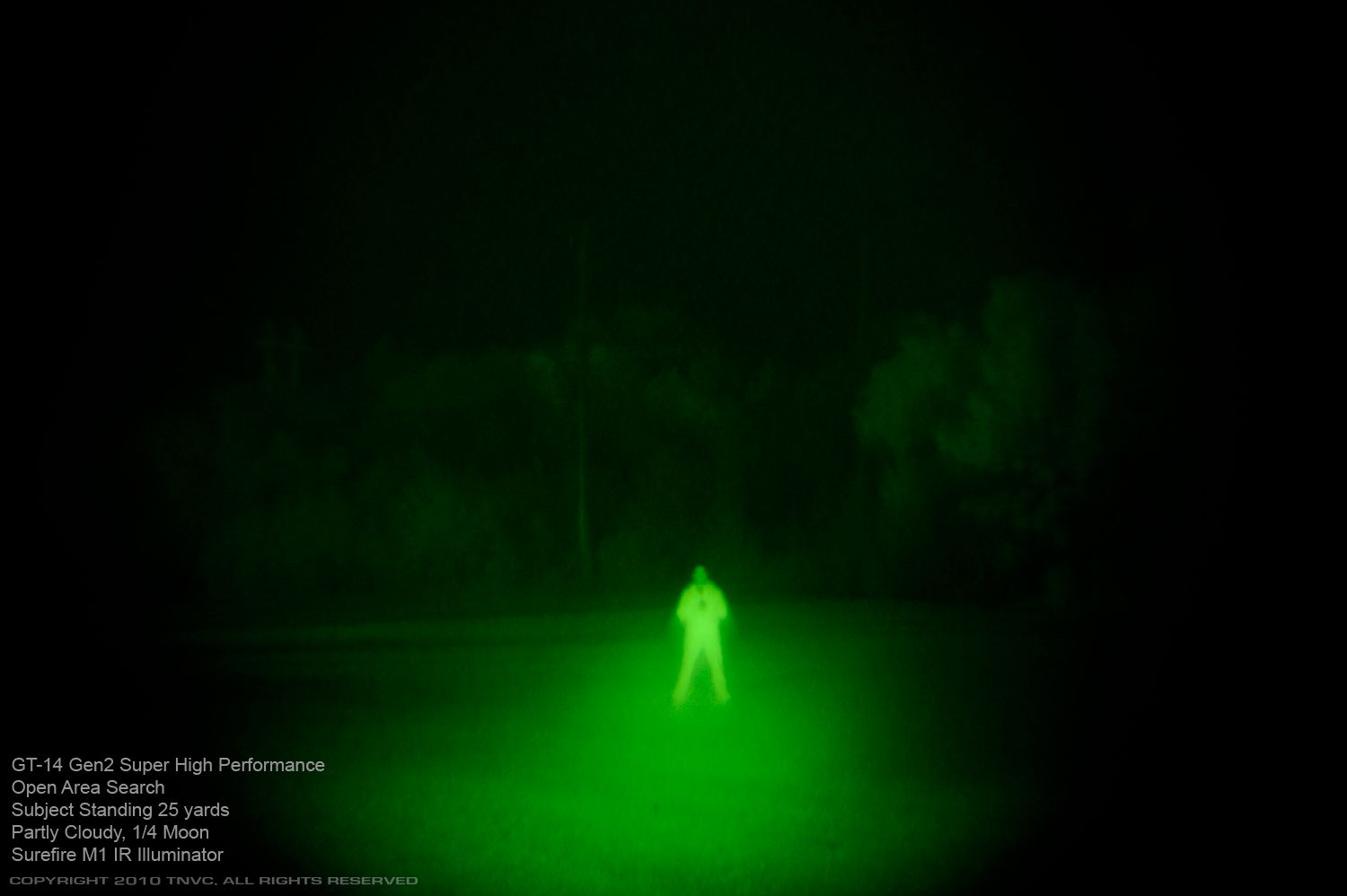
D300 Gen2+ MILSPEC Image Intensifier With no ambient light available, the Gen2 SHP tube still produces a useable image at 25 yards. The resolution is noticeably less than the Gen3 units, but the subject can be easily acquired in the image. Though, when comparing the image to Gen3 units, the Gen2 SHP is obviously darker because of the lesser amount of light able to be gathered. Edge-to-edge clarity is also observed in that the outer zone of the image is noticeably fuzzier and less defined than the Gen3 units. The contrast is also significantly reduced with less definition in the subject and the far tree line. The subject can be seen standing. It is difficult to tell hand placement. The dark swatch in front of the subject’s chest could be a camera or other dark object; or it could be a weapon. The lack of definition/contrast would hamper an officer’s ability to identify a possible threat from this distance. 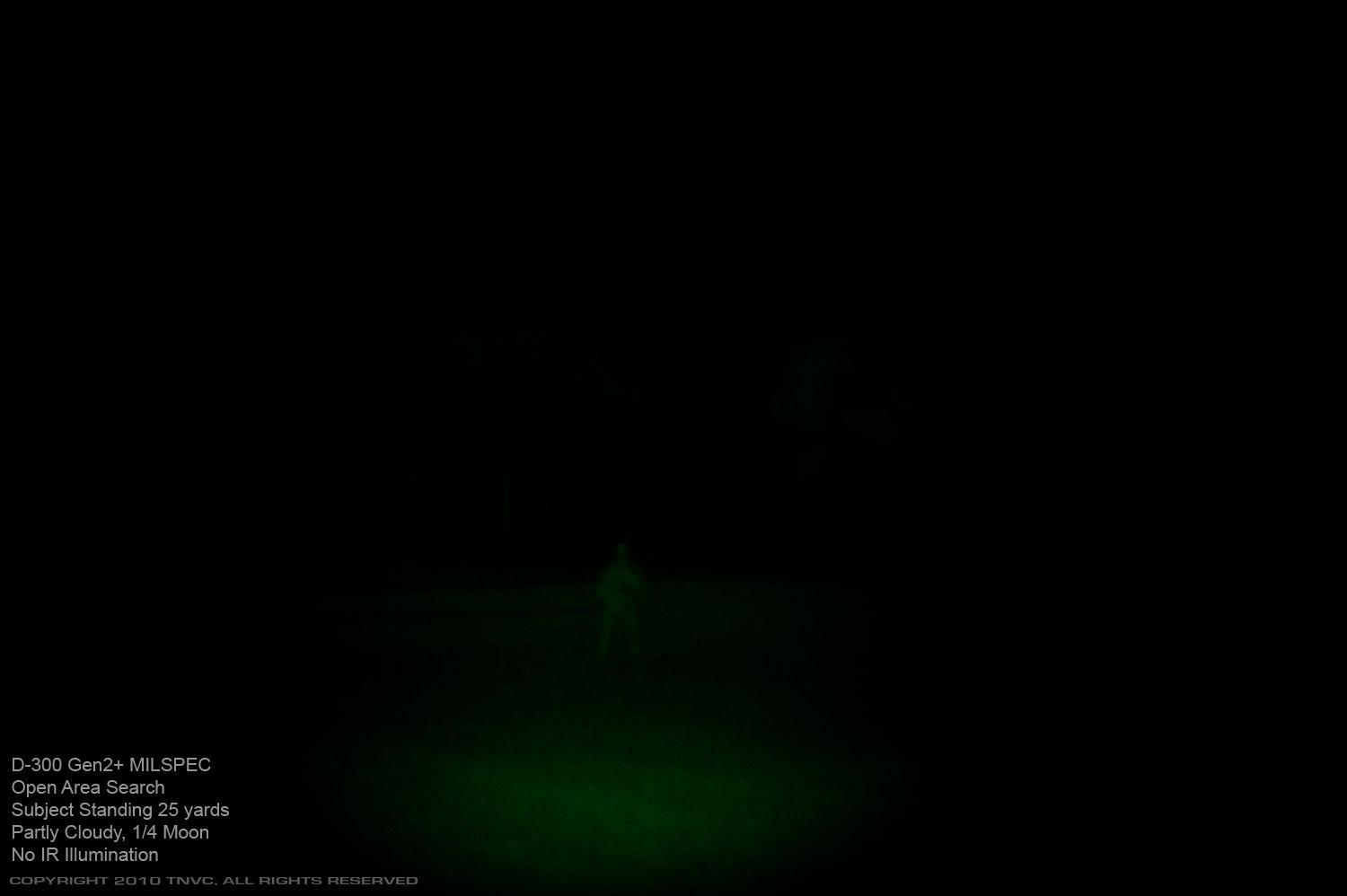
Turning on the internal IR illuminator adds no noticeable benefit to the image. 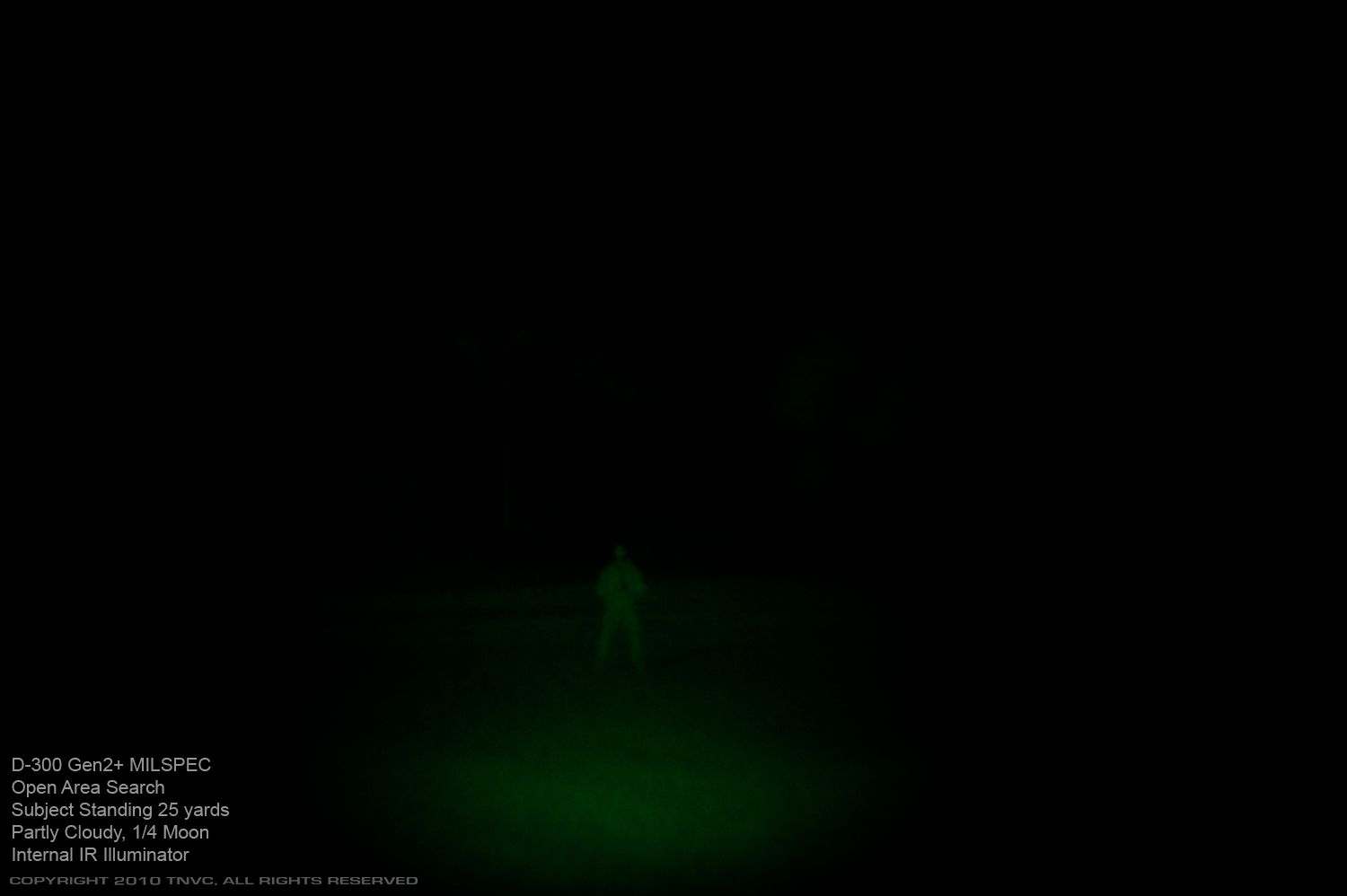
The external IR illuminator helps to “ping” the subject, drastically contrasting him against the background environment. At the same time, it can be seen that the surrounding environment is perceived darker because the image intensifier is working to resolve the illuminated portion of the image. The subject washes out. 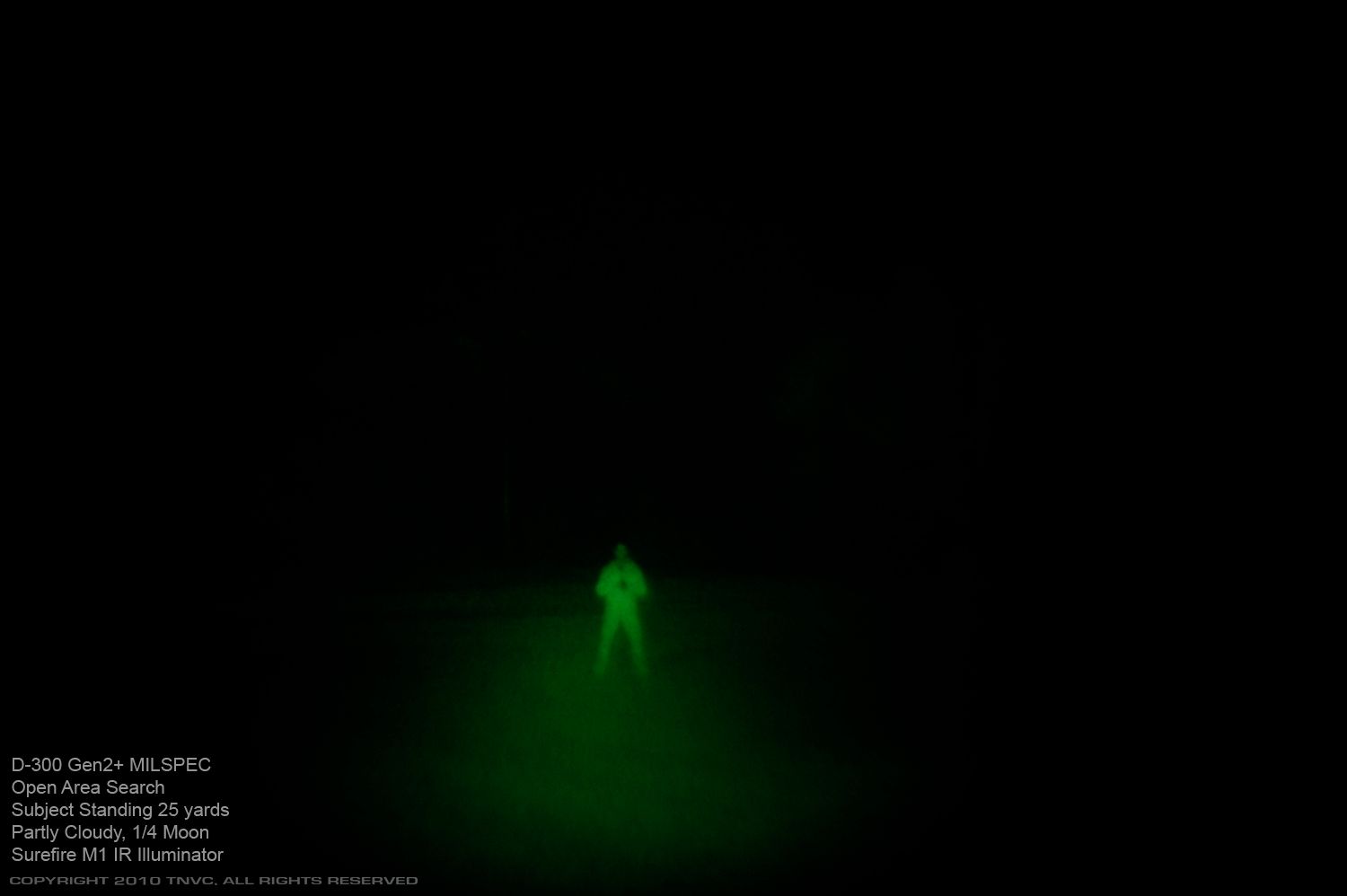
ATN Viper Gen1+ Image Intensifier The Gen1 tube fails completely to deliver any image whatsoever. Even under good ambient light conditions, the subject at 25 yards is completely shrouded in darkness. This would leave a law enforcement professional blind of all intents and purposes, even at close distance. 
The built-in IR illuminator did not add any value to the image. It is still completely dark with no details discernable. 
Not even the additional illumination from the Surefire M1 can provide enough light for the Gen1 tube. 
Test Scenario 3 – Open Area Search / Long Range (50 Meters) This is the same scenario and location as the previous except the subject has moved back 50 yards from the image intensifier. ITT PVS-14 Night Enforcer Gen3 PINNACLE Auto-Gated Image Intensifier The Gen3 PINNACLE Auto-Gated tube easily gathers enough light to quickly acquire the subject at 50 yards. High contrast allows details to be resolved such as the suspects bent elbows which raise his hands in front of his chest. However, at this distance, a weapon in hand is not identifiable. The subject can be seen wearing long pants and a jacket, but facial features cannot be seen. A relatively good view of the tree line can be observed. Bushes and trees are easily identified and a good understanding of the surrounding environment is achieved, greatly improving situational awareness. 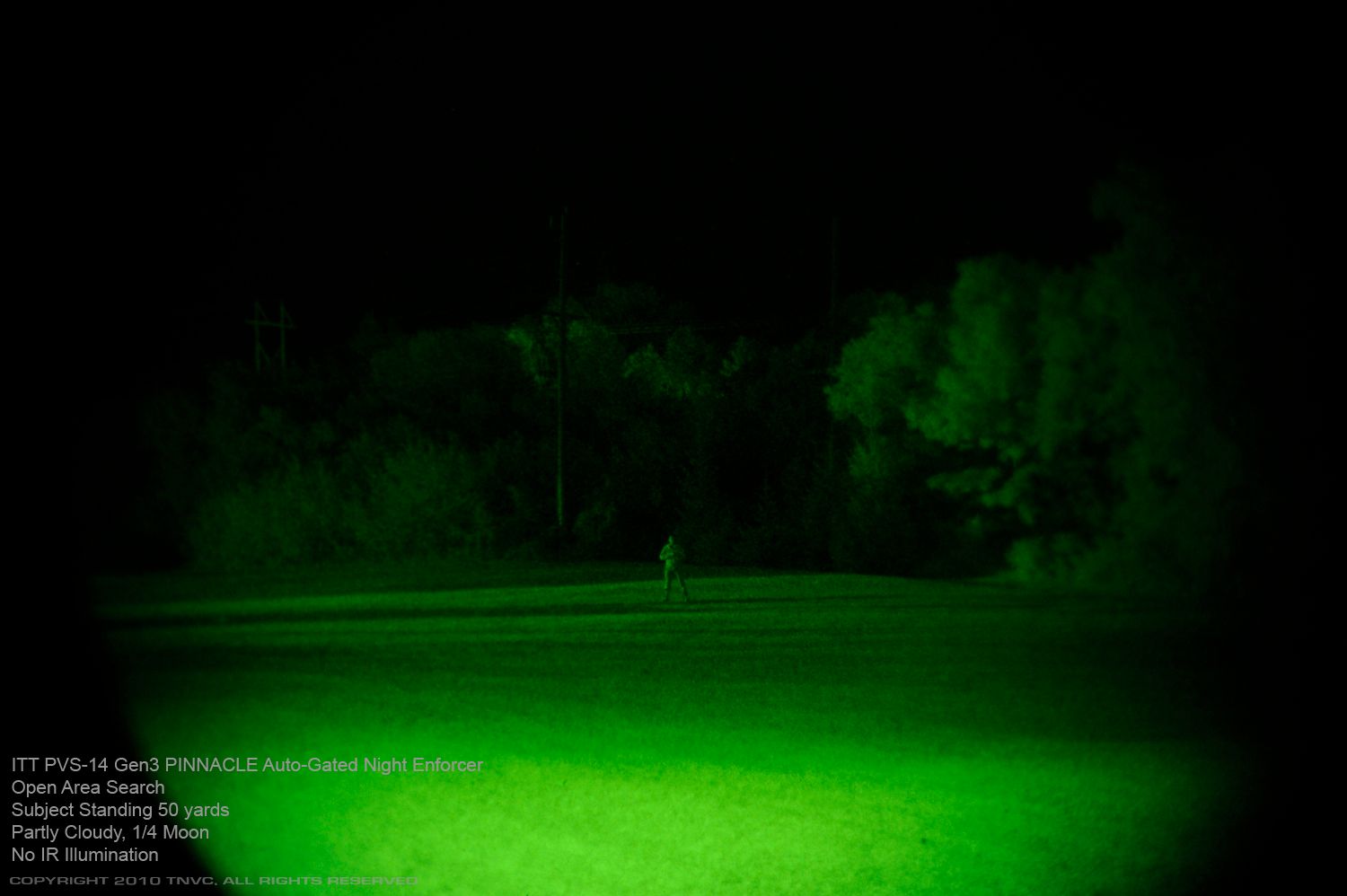
At this distance, the built-in IR illuminator does not add anything to the image quality. Neither the subject nor the surroundings are affected. 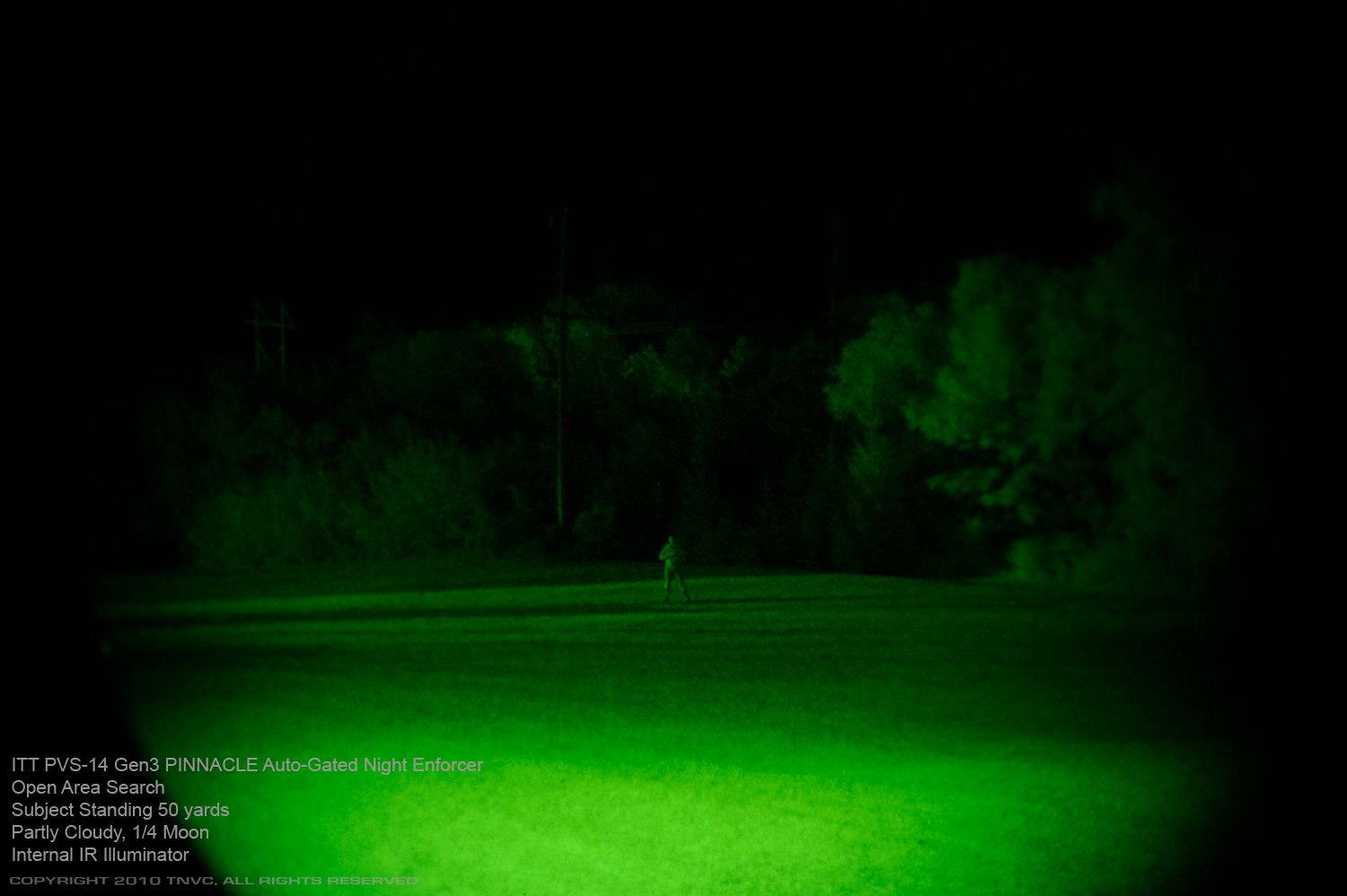
The Addition of the Surefire M1 clearly lights up the subject, causing him to have an almost glowing effect against the surrounding environment. While details become slightly washed out due to the reflection of the IR light, the subject is able to be rapidly acquired at this distance. 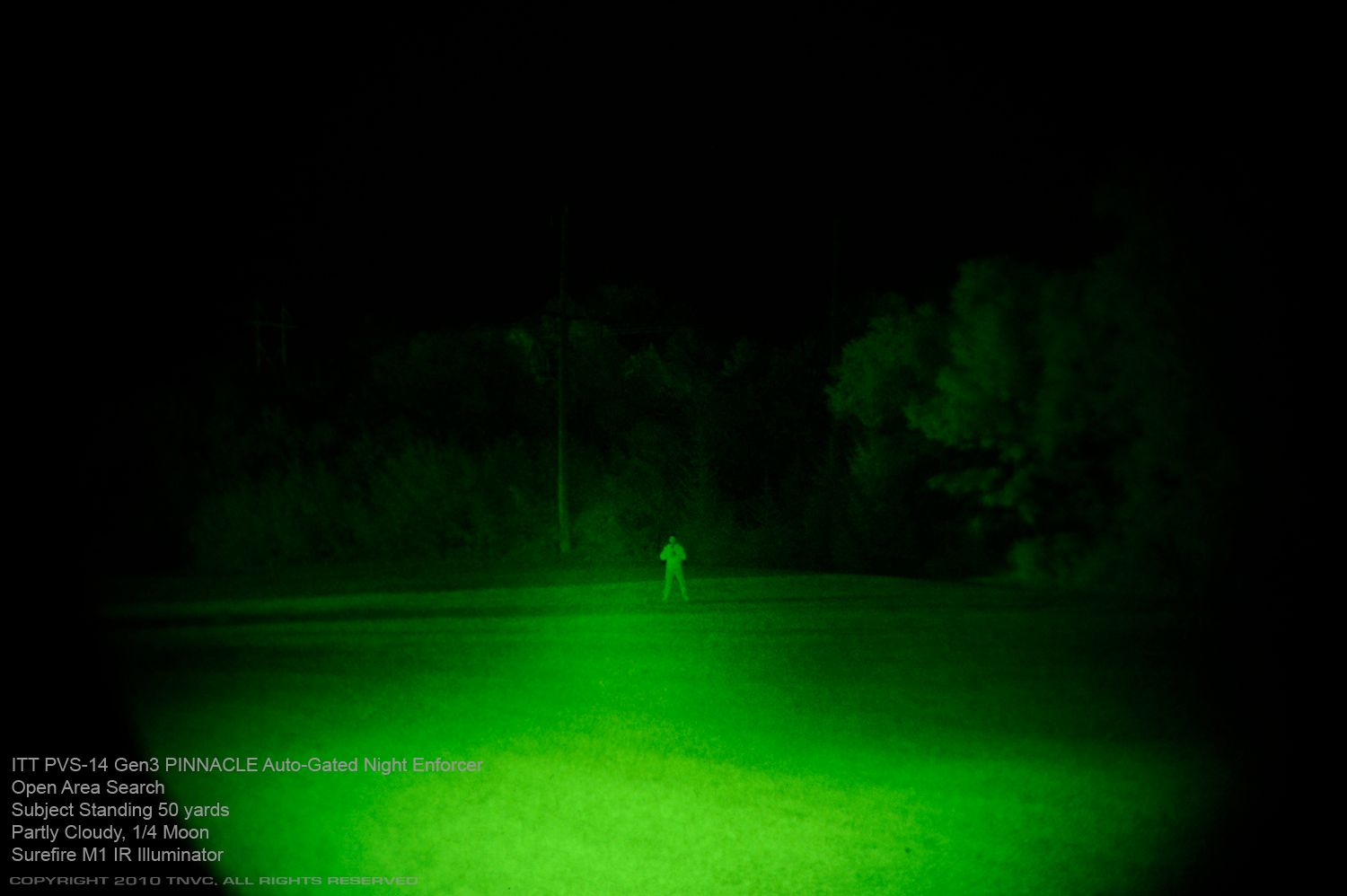
Litton PVS 14 Gen3 Auto-Gated Image Intensifier Like the ITT unit, the Litton Gen3 Auto-Gated tube performs well on its own, easily acquiring the subject at 50 yards. The image is slightly darker overall compared to the PINNACLE unit, but enough detail is available to resolve that a single figure is standing in the open with a tree line in the background. Enough contrast is present to decipher the subject’s hands in front of his chest, though the presence of a weapon is uncertain. 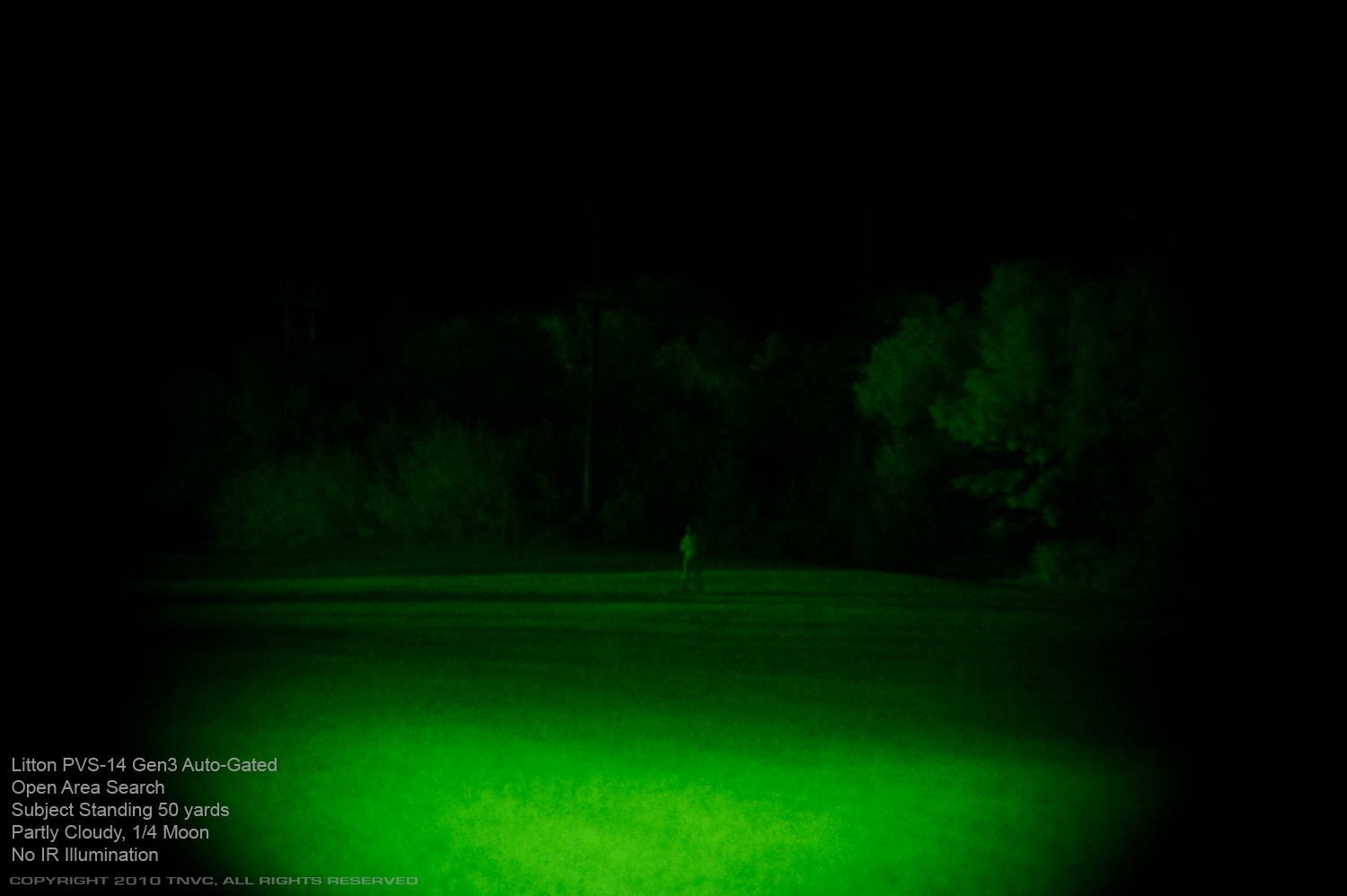
The built-in IR illuminator is not able to provide useful information to the image. The tree line and subject display slightly more contrast. 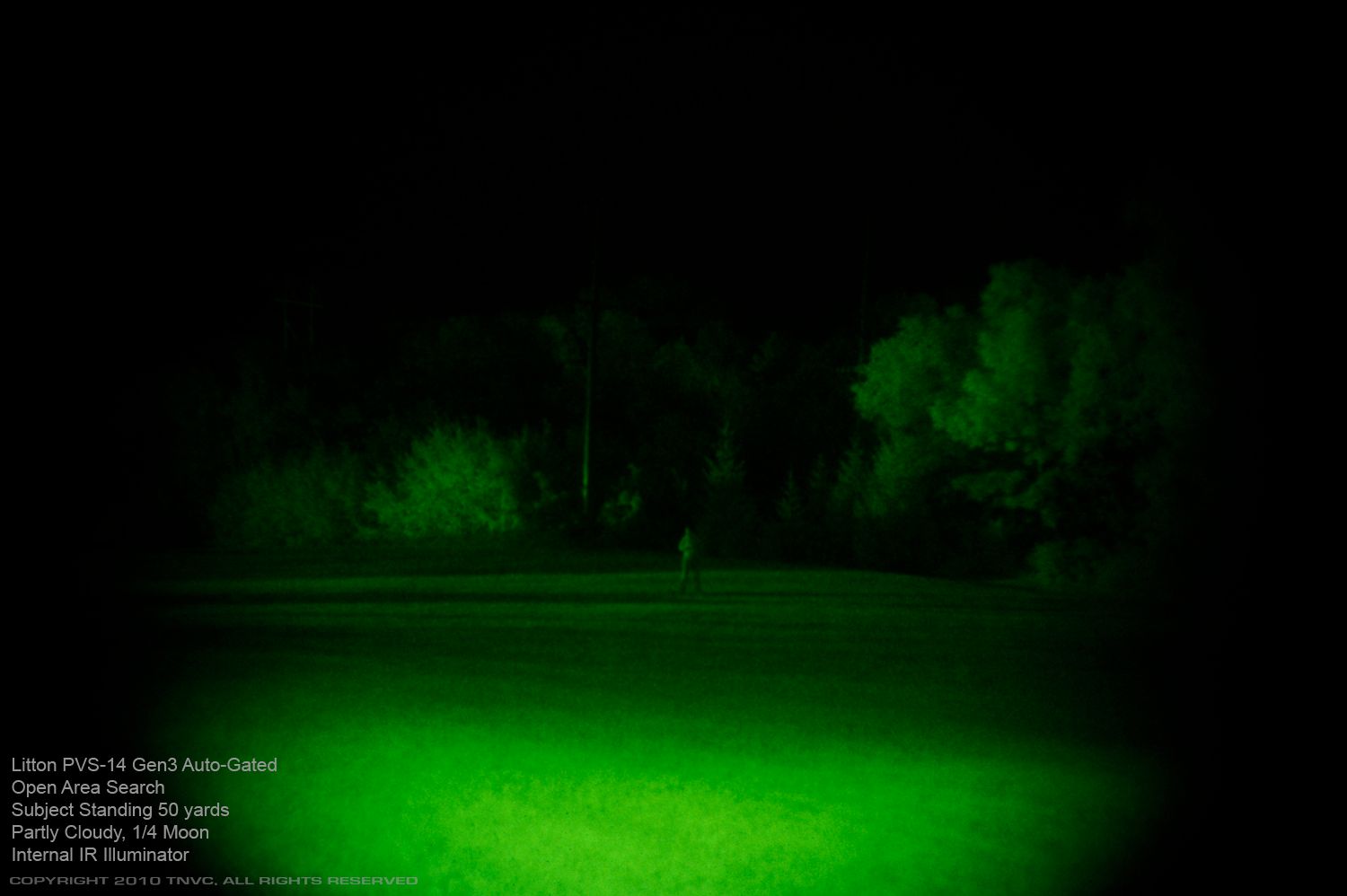
Like the PINNACLE unit, the Litton Gen3 Auto-Gated tube is helped by the introduction of an external IR light source. While the subject is displayed much brighter against the background, the surrounding area is darkened because of the unit’s focus on the lighter subject. A darker object is more noticeable in the subject’s hands, but it cannot be identified at this distance. 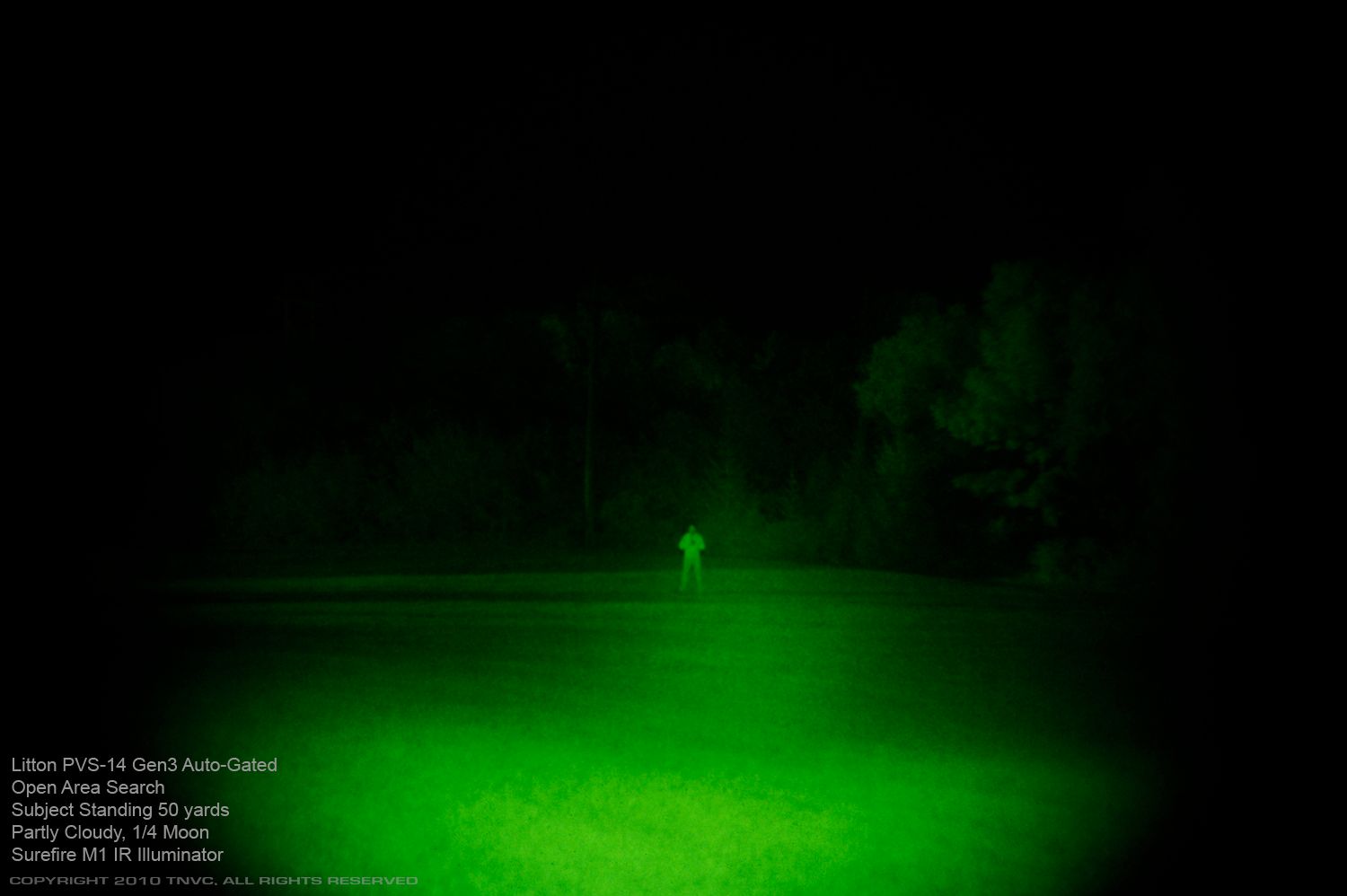
GT14 Gen2SHP Image Intensifier At 50 yards, the 1x Gen2 SHP tube begins to show some signs of struggle when resolving details. The subject appears much fuzzier than in the Gen3 devices. However, the subject can still be acquired and is visible against the tree line. The lesser contrast of the Gen2 SHP tube will require the user to concentrate on the scan a little harder because it might be easier to lose the subject during rapid scanning. The lack of contrast also affects the ability to identify the subject’s posture. While he is clearly standing in the open, his arms, and more importantly: hands cannot be identified. He could have his arms folded, hands in pockets, or holding something in front of his torso. 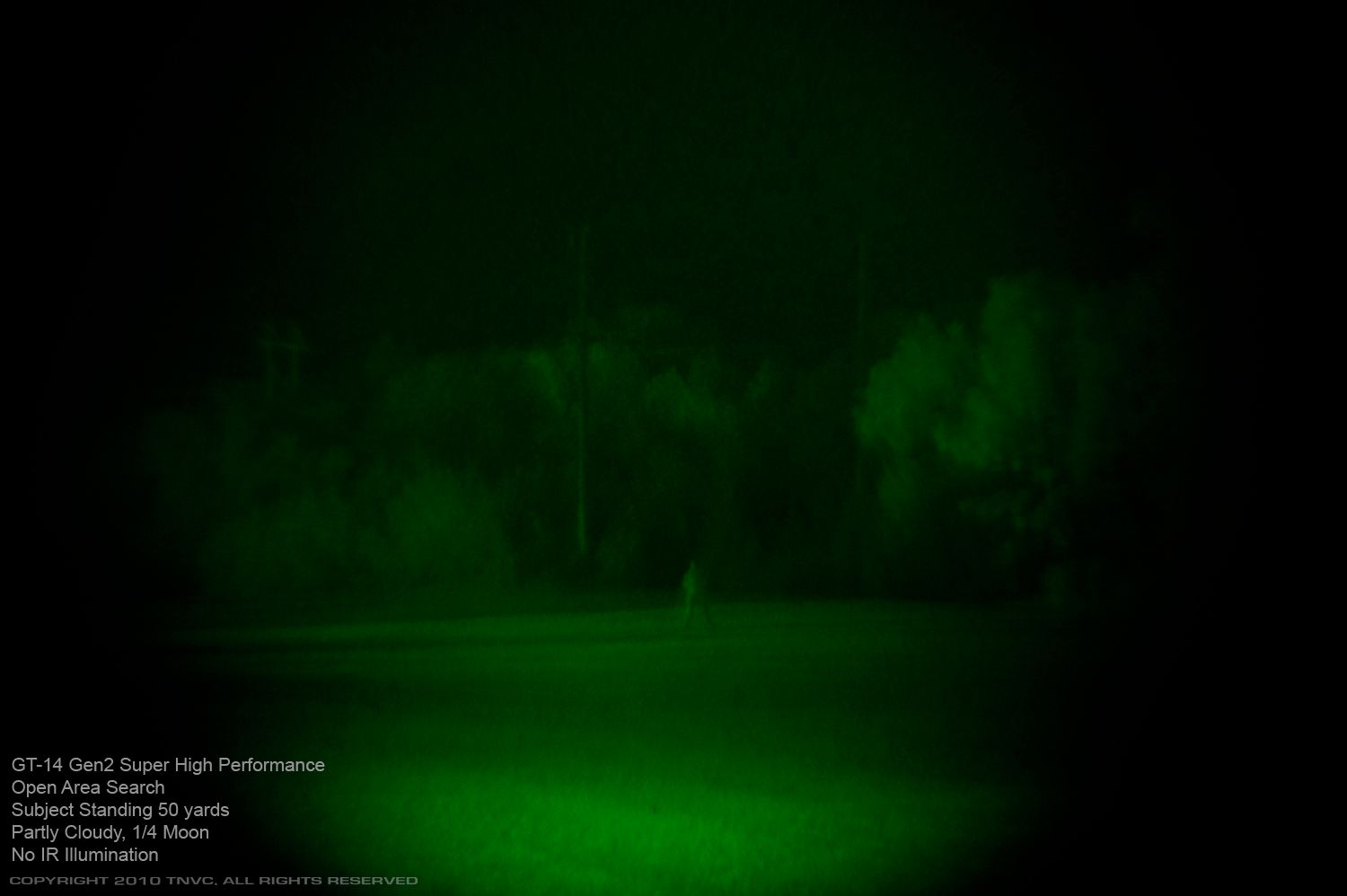
At this distance, the built-in IR illuminator does not add anything to the image quality. Neither the subject nor the surroundings are affected. 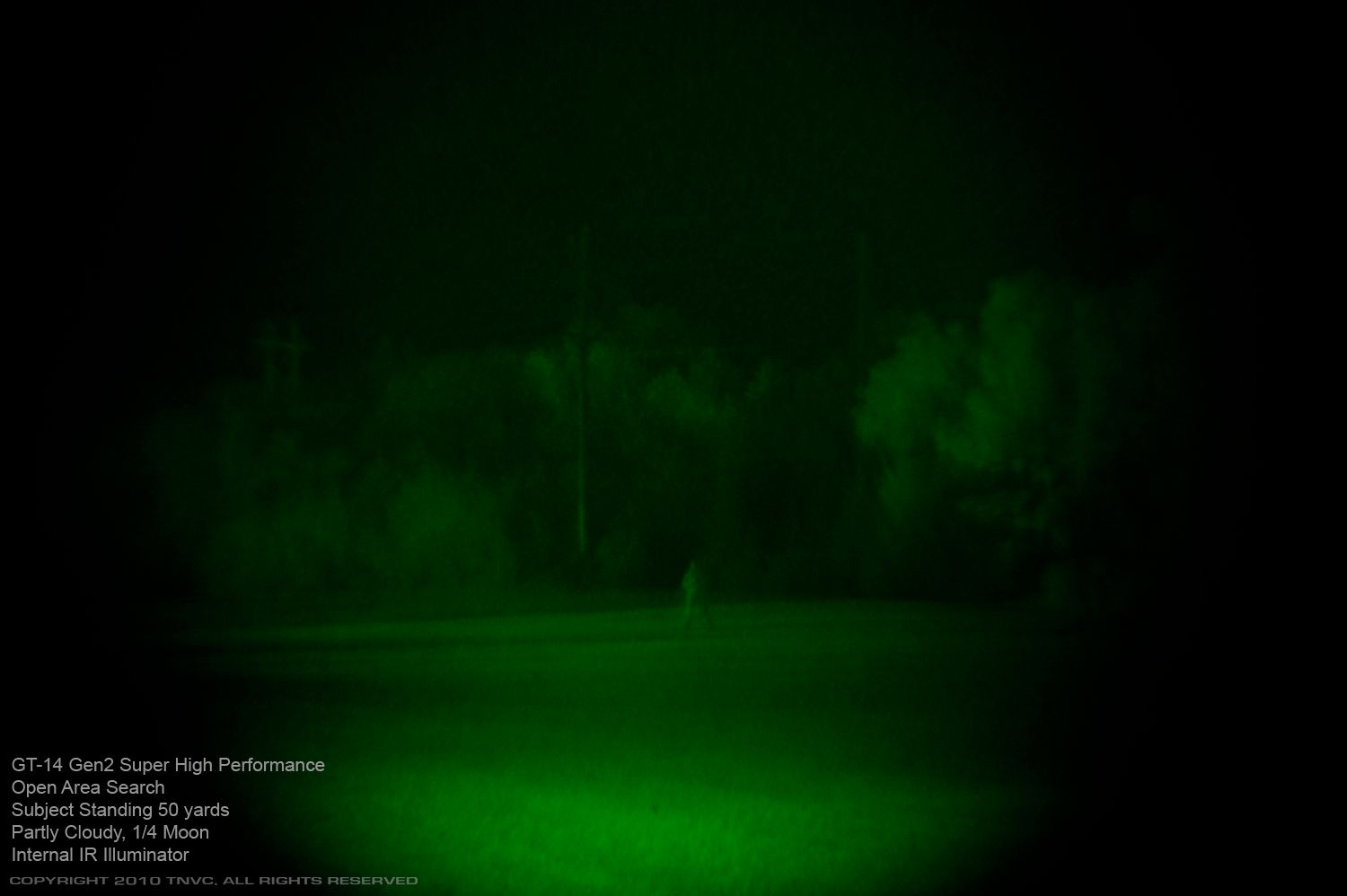
The Addition of the Surefire M1 clearly lights up the subject, causing him to have an almost glowing effect against the surrounding environment. However, it also highlights the lack of contrast and detail able to be resolved with the Gen2 SHP tube. The subjects are no more identifiable, nor are his hands. It is impossible to determine if he has a weapon. The lack of contrast in the image allows more of the light to visible around the environment. The subject does not contrast as much as in the Gen3 units, so image appears to slightly flatten. 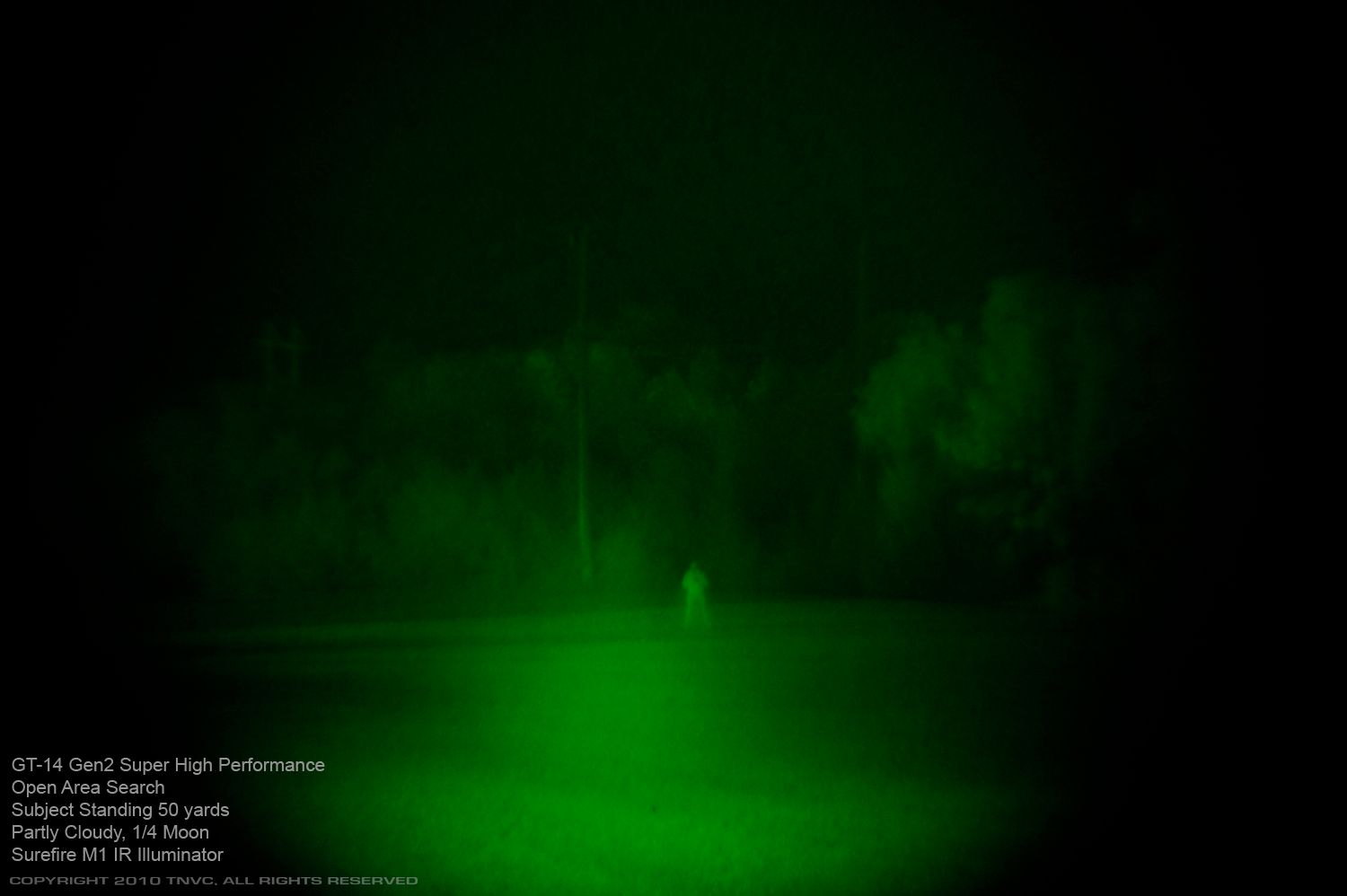
D300 Gen2+ MILSPEC Image Intensifier The Gen2+ MILSPEC tube is at its limit in this scenario. On its own, the image intensifier can barely resolve the subject. Even then, a closer study is needed to determine that it is, indeed, the subject. Since no other details are visible on the ground, the user could assume that the subject is in a field, but situational awareness is severely hampered because other objects, such as the tree line cannot be seen. The image is very dark due to the limited amount of light gathered by the tube. 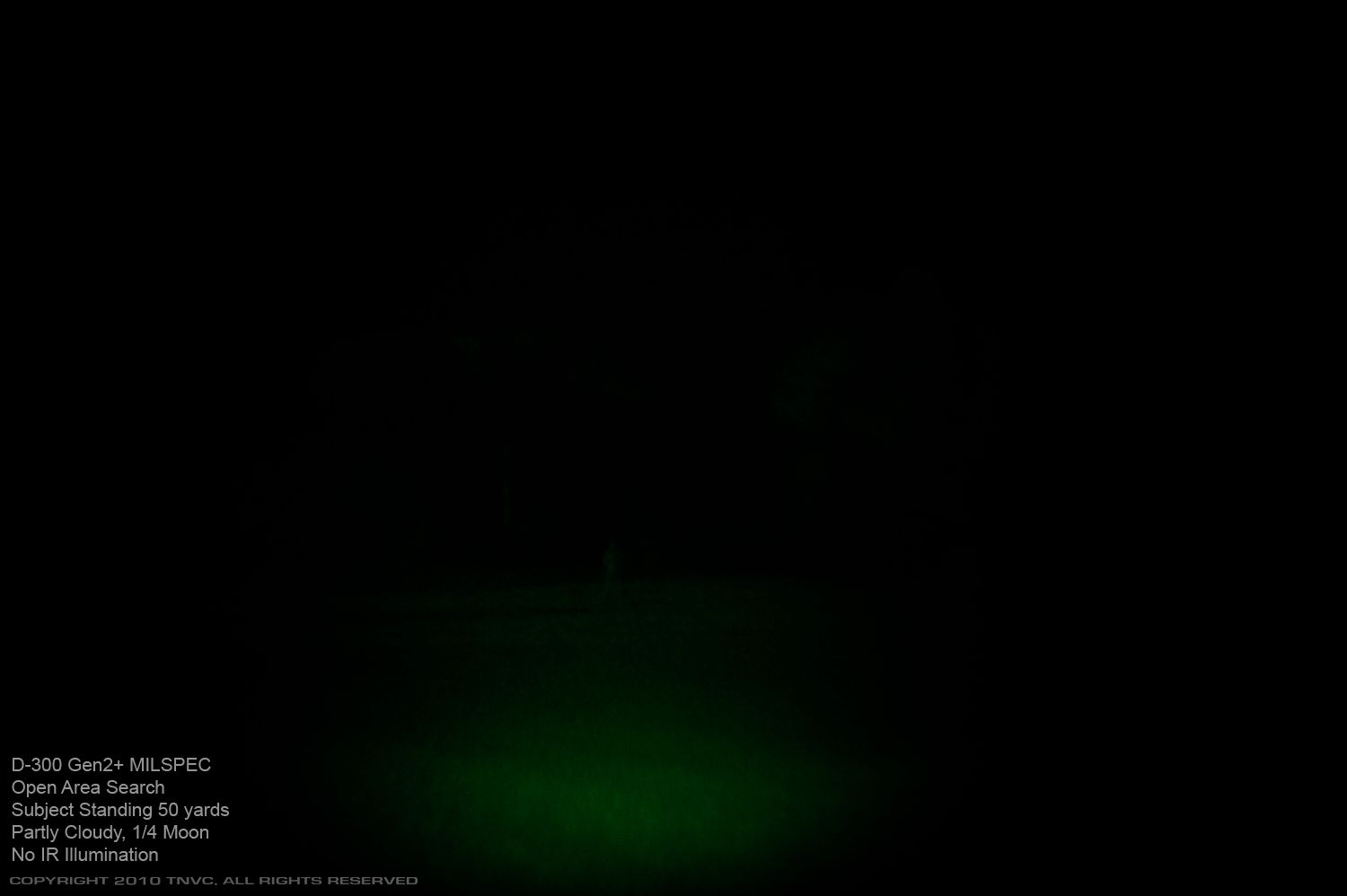
The built-in IR illuminator adds a slight amount of light to the image, but not enough to provide any usable information to the user. 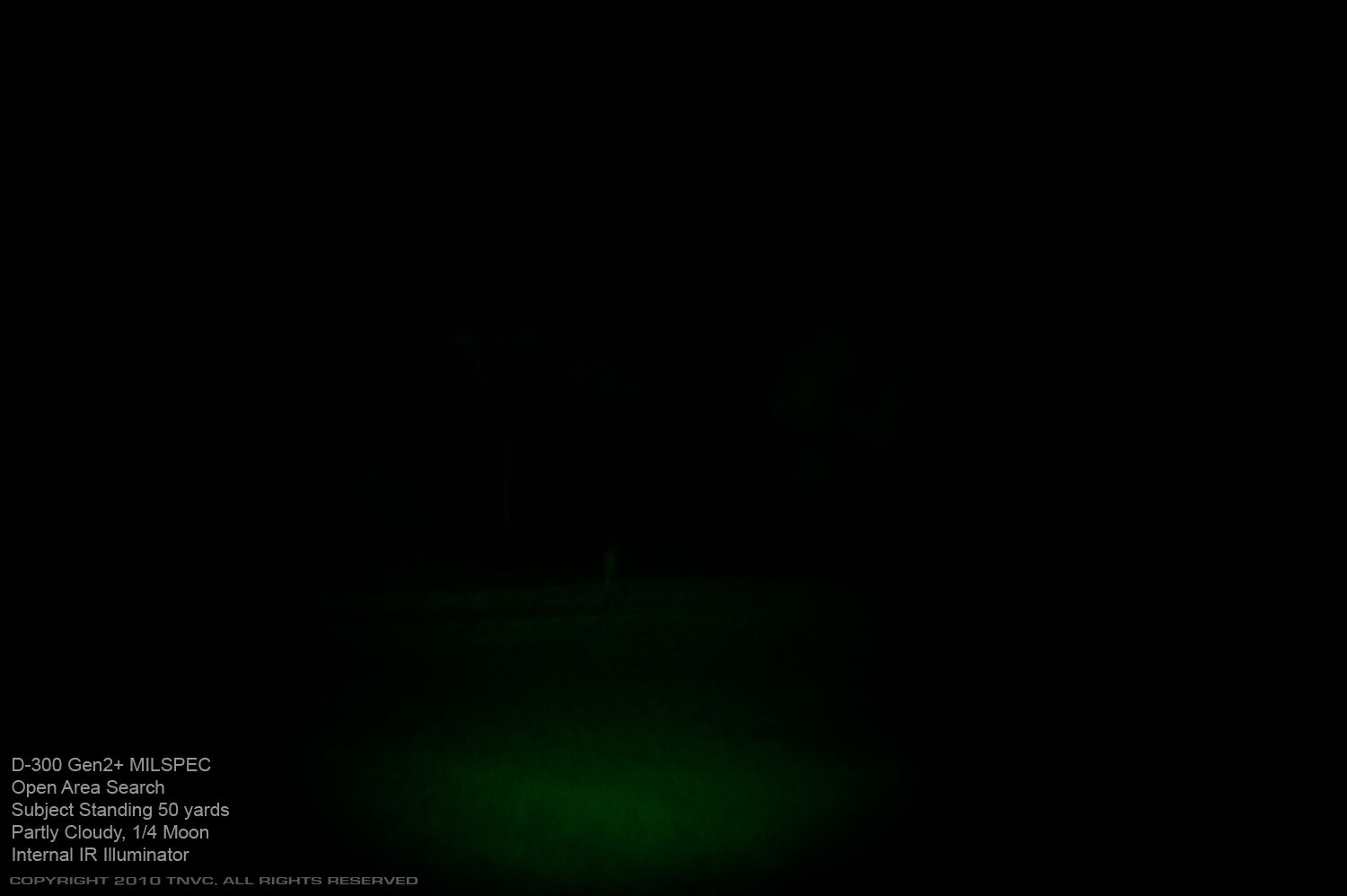
Only after the addition of the Surefire M1 can the subject be acquired. While the image is still quite dark, the subject contrasts with the black background. However, there is little detail seen and the subject’s actions cannot be identified. His outline is fuzzy and the most information available is that he is standing. It is impossible to identify the presence of a weapon and situational awareness is further hampered by the lack of detail in the environment. 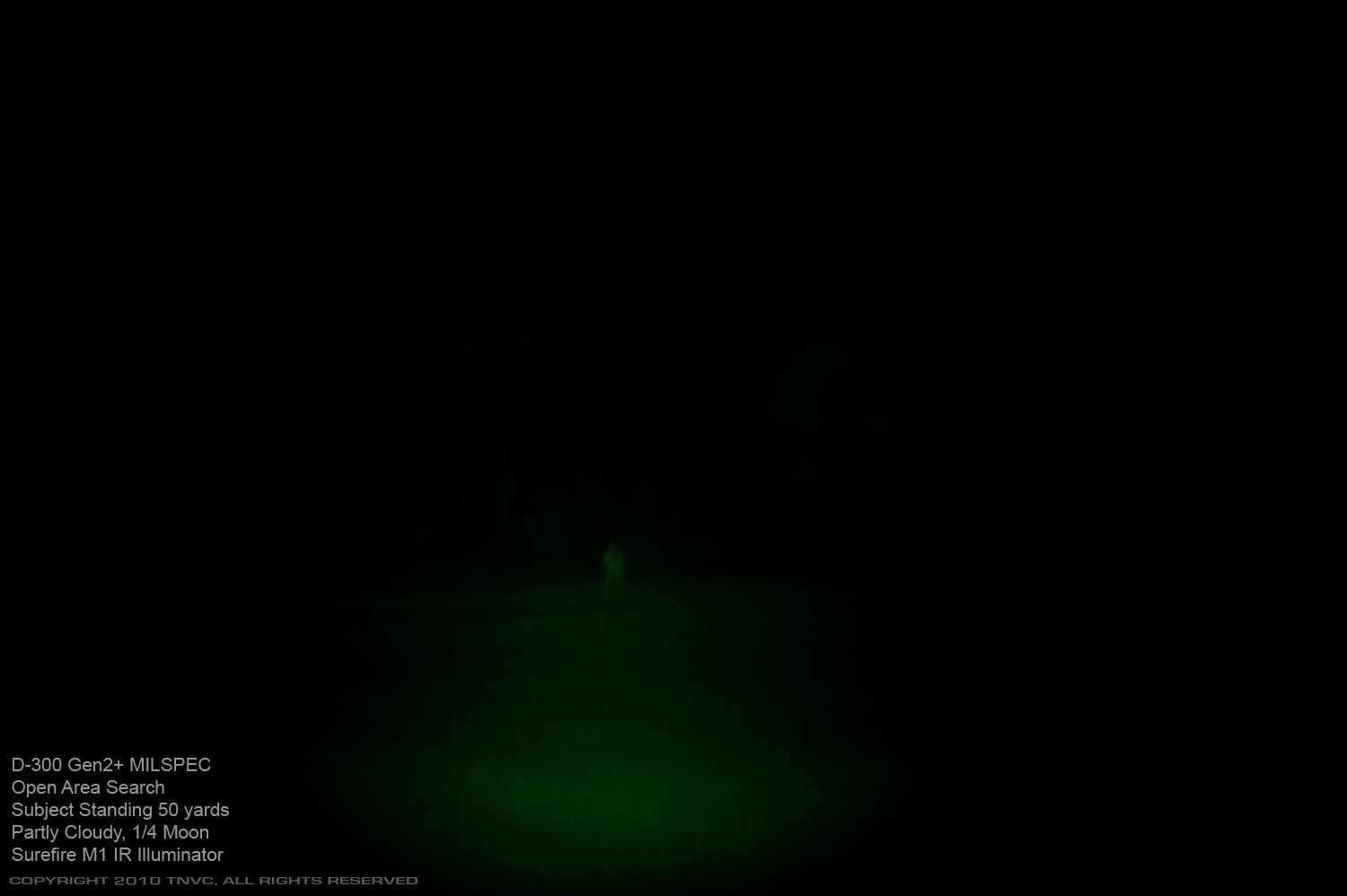
ATN Viper Gen1+ Image Intensifier The Gen1 tube fails completely to deliver any image whatsoever. Even under good ambient light conditions, the subject at 50 yards is completely shrouded in darkness. This would leave a law enforcement professional blind of all intents and purposes, even at close distance. 
The built-in IR illuminator did not add any value to the image. It is still completely dark with no details discernable. 
Not even the additional illumination from the Surefire M1 can provide enough light for the Gen1 tube. 
Test Scenario 4 – Open Area Search / Long Range (100 yards) This is the same scenario and location as the previous except the subject has moved back 100 yards from the image intensifier. ITT PVS-14 Night Enforcer Gen3 PINNACLE Auto-Gated Image Intensifier The Gen3 PINNACLE Auto-Gated tube produces an image of the subject at 100 yards, though details of his posture are unidentifiable. Note the subject is partially camouflaged by the shadows of the surrounding foliage. A quick glance might not discover his presence. A humanoid figure can be seen, however the placement of his hands and the presence of a weapon cannot be determined. The tube provides good resolution with the ability to maintain situational awareness of the surrounding area. 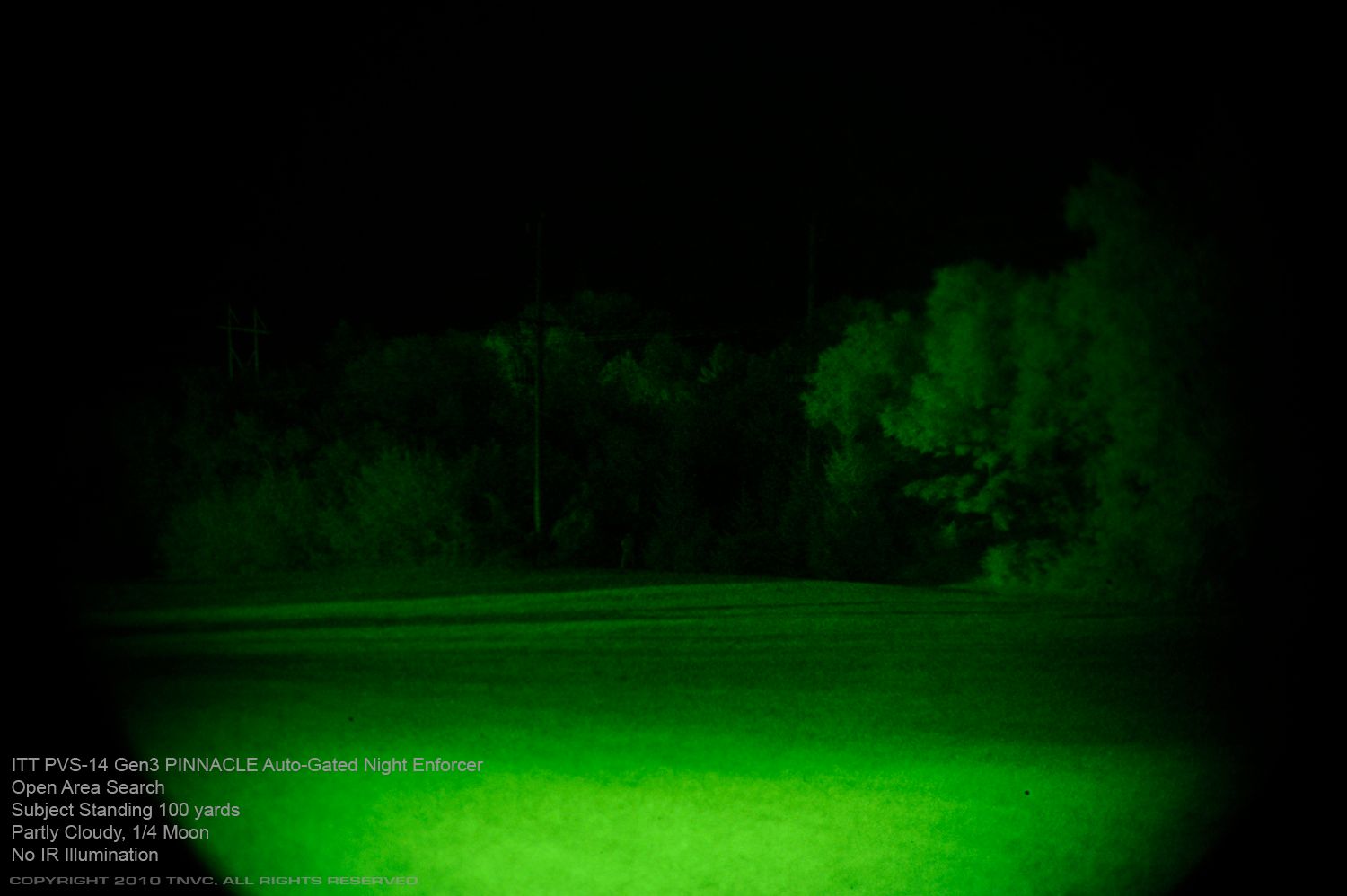
At this distance, the built-in IR illuminator’s performance is limited. Because there is not a main subject to focus on, the illuminator provides a somewhat flat view of the scene. It “fills-in” some of the shadowed areas, making them appear a bit brighter. This aids in viewing the subject because the surrounding foliage shadows are evened out. The subject’s hands, still are not visible, neither is the presence of a weapon. Note how the use of the built-in illuminator creates a fuzzier-appearing image because it flattens the shadows. 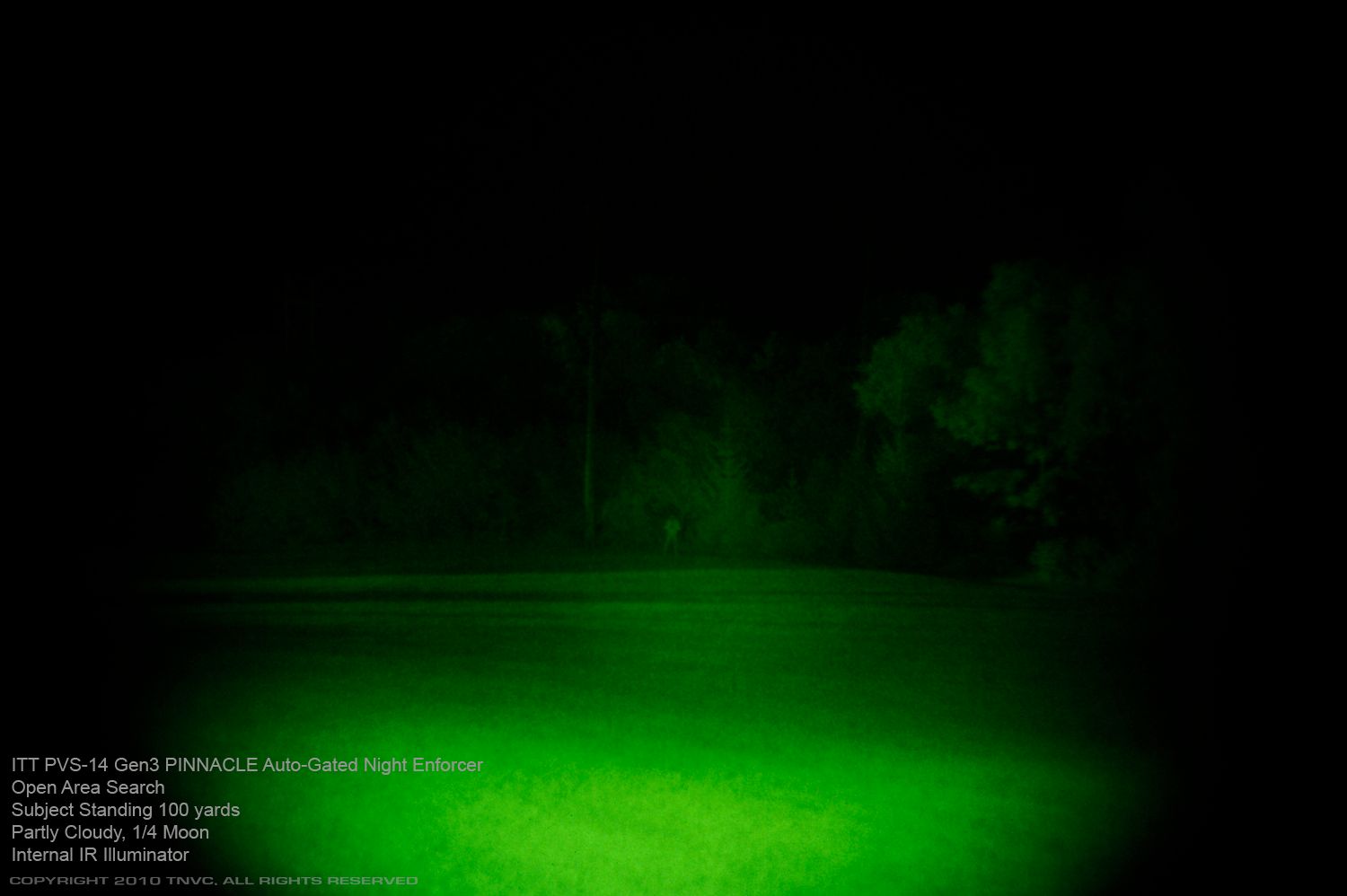
Using the Surefire M1 creates a definite advantage in this search at this distance. The more powerful illuminator helps locate the subject by making him appear much lighter against the foliage background. Detail is better resolved with the subject’s arms visibly bent at the elbow. This shows the user that the subject is holding something in his hands. 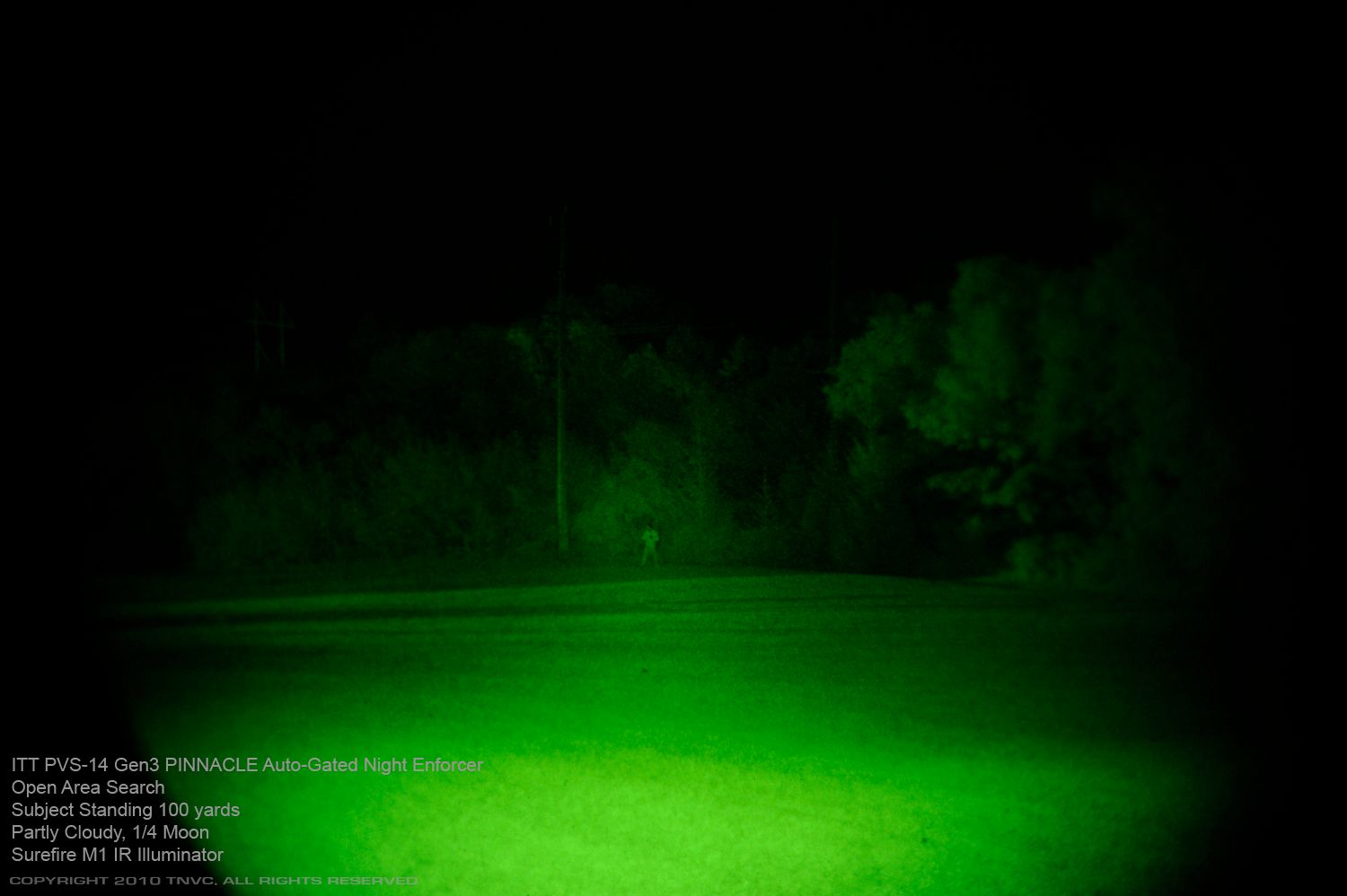
Litton PVS 14 Gen3 Auto-Gated Image Intensifier The Litton Gen3 Auto-Gated tube creates shows a limitation in this scene because it is does not produce as bright an image as the PINNACLE unit. The heavy foliage creates a lot of shadow which heavily obscures the subject, making him almost impossible to see. In this situation, an additional IR light source is required. 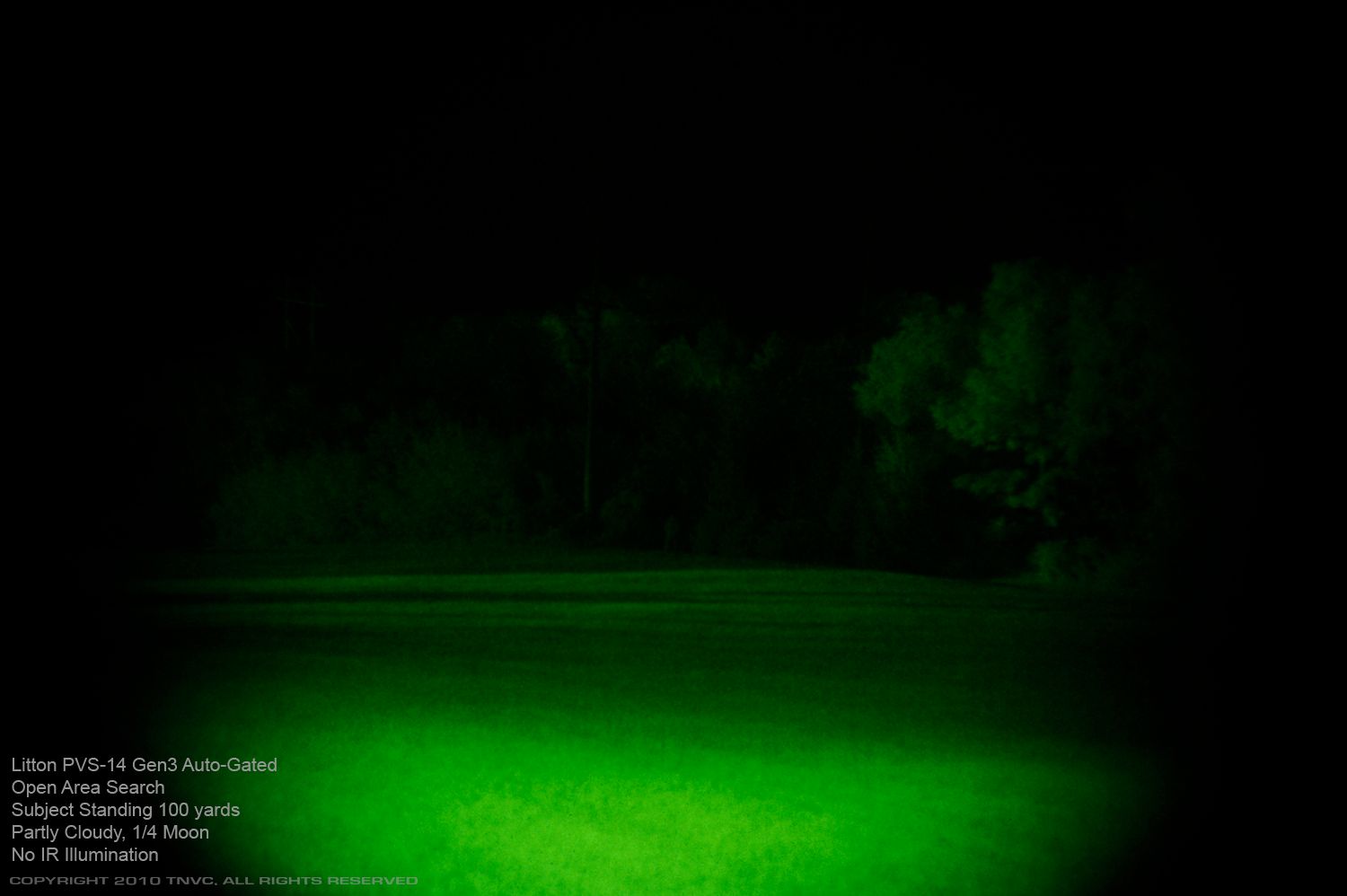
The addition of the built-in IR illuminator does little at this distance. Again, the light gathering limitations of the Gen3 Auto-Gated tube hamper the ability to resolve the subject against the foliage. However, the illuminator does provide a slightly brighter image and the subject does stand out a bit more against the tree line. The definition of his right shoulder, arm, and leg can be seen. However, the details of his posture are unidentifiable. 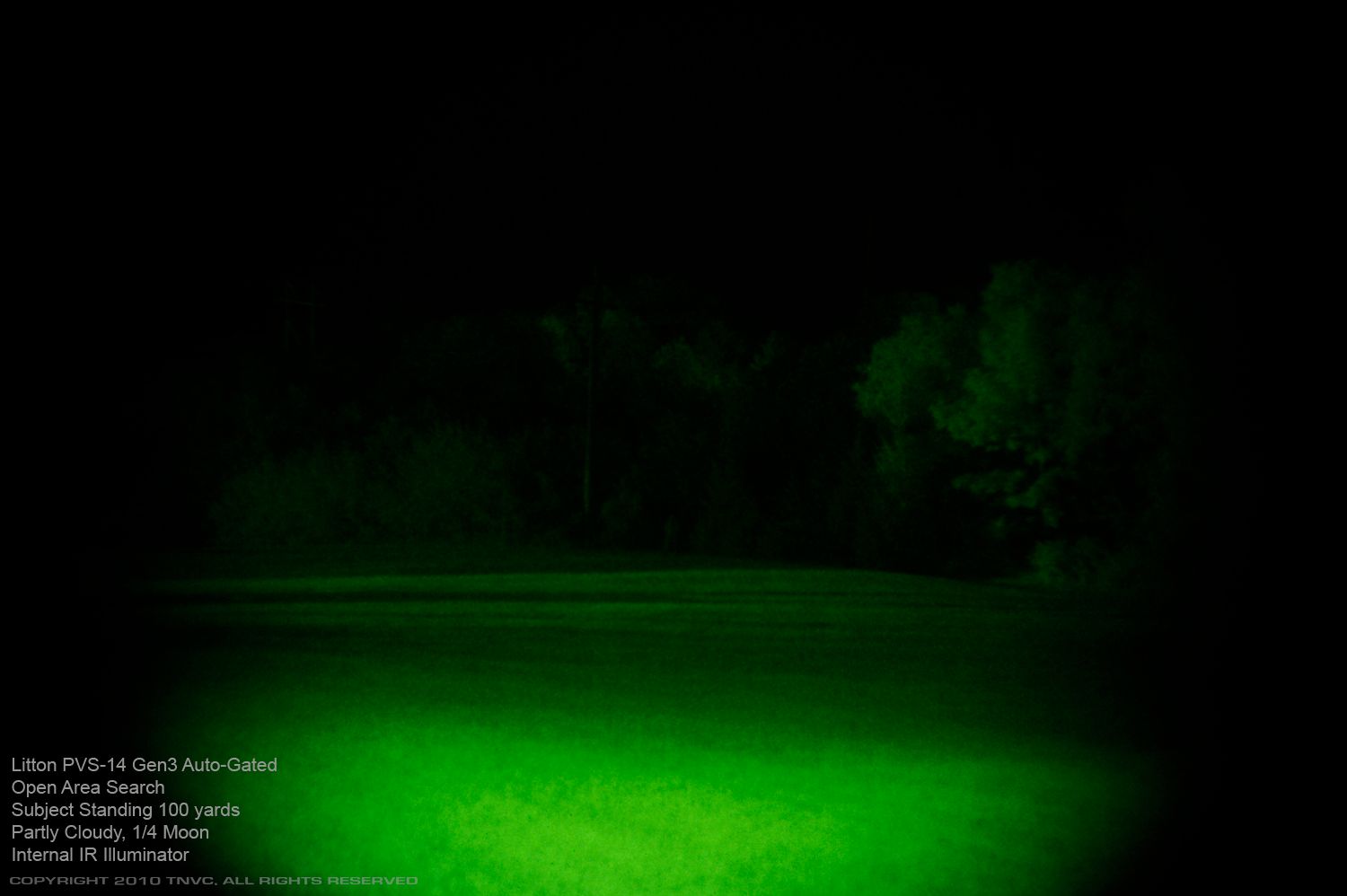
Using the Surefire M1 creates a definite advantage with this image intensifier. The image seems to flatten a bit because shadows are lightened. The subject can be clearly seen at this distance, though the details of his posture are not resolved. He is standing, but the user cannot see the positioning of his hands. Of particular note, however, is the ability to maintain situational awareness with the Gen3 tube’s light-gathering abilities. The surrounding area is still visible and secondary subjects or threats could be identified if present. 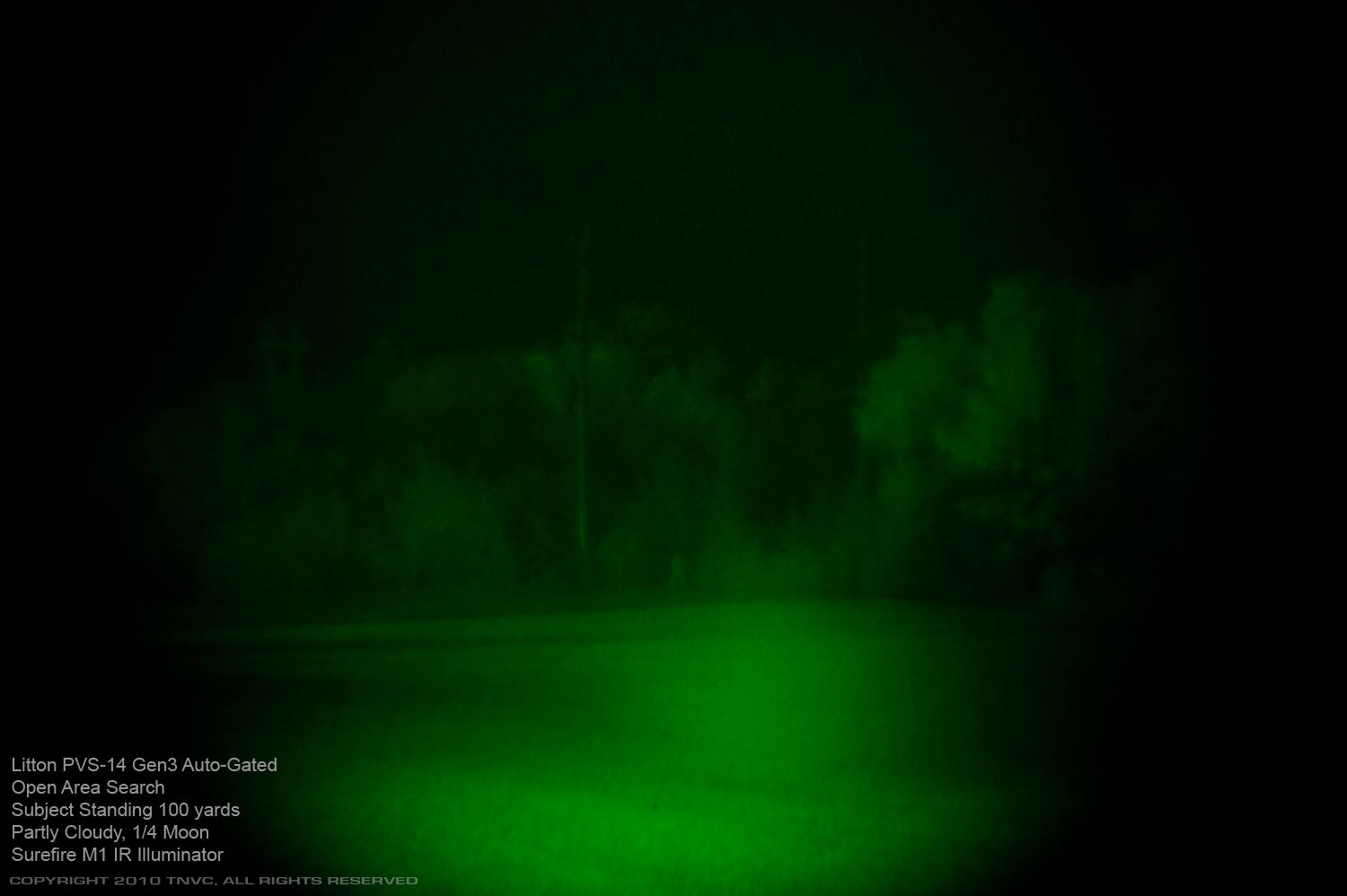
GT14 Gen2SHP Image Intensifier The Gen2 SHP tube produces a full image at this distance. The far tree line is visible, though the subject is partially obscured by the shadows, making it more difficult to detect his presence. It is impossible to determine whether or not a weapon is present. The fine detail seen in the Gen3 tubes is lesser in the Gen2 SHP unit. While it still performs admirably, the overall image is darker and details are grainier. 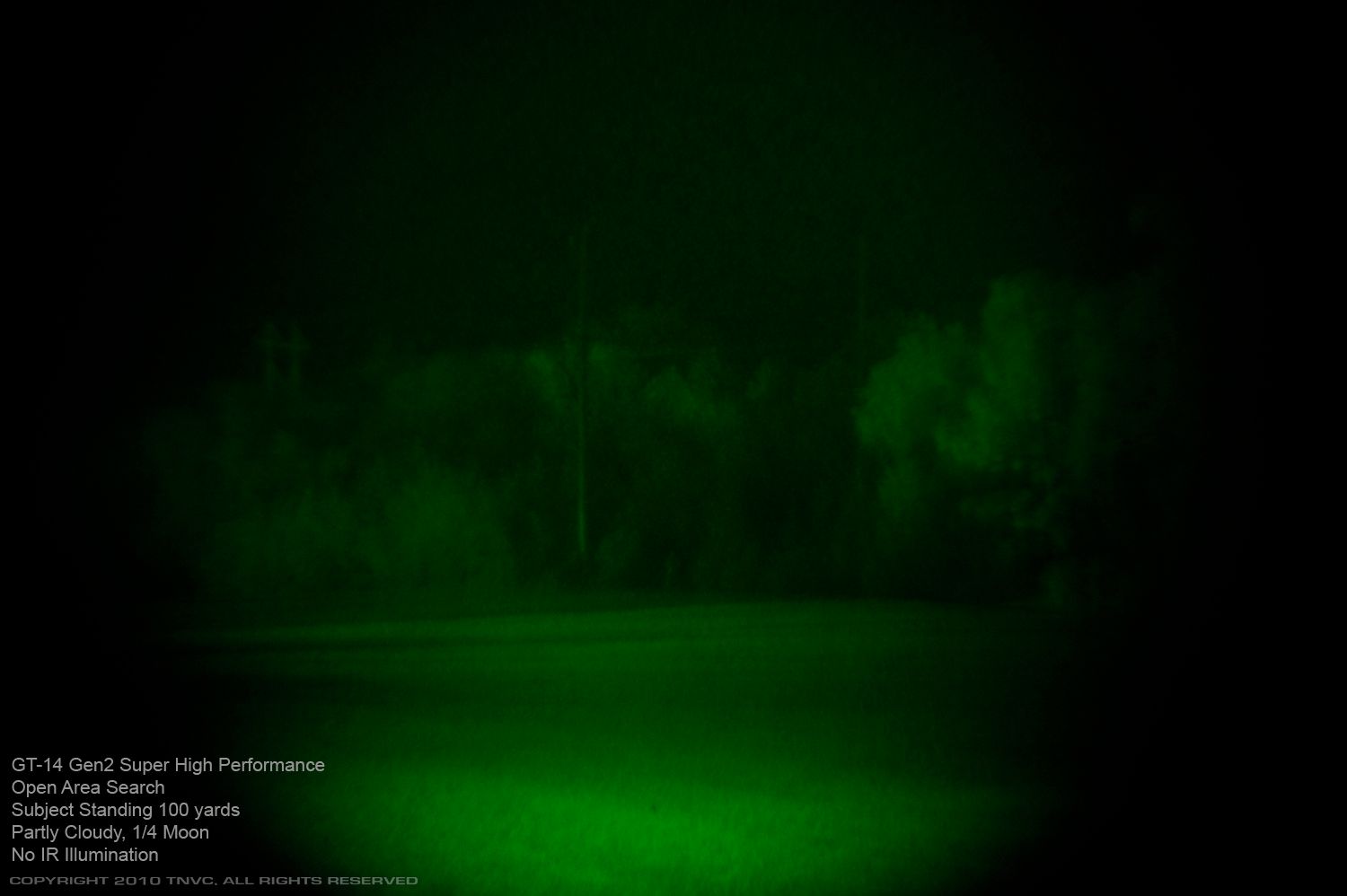
The addition of the built-in IR illuminator does little to aid the image at this distance. A slight brightening is detected, but the tube is fighting for light and requires additional illumination. 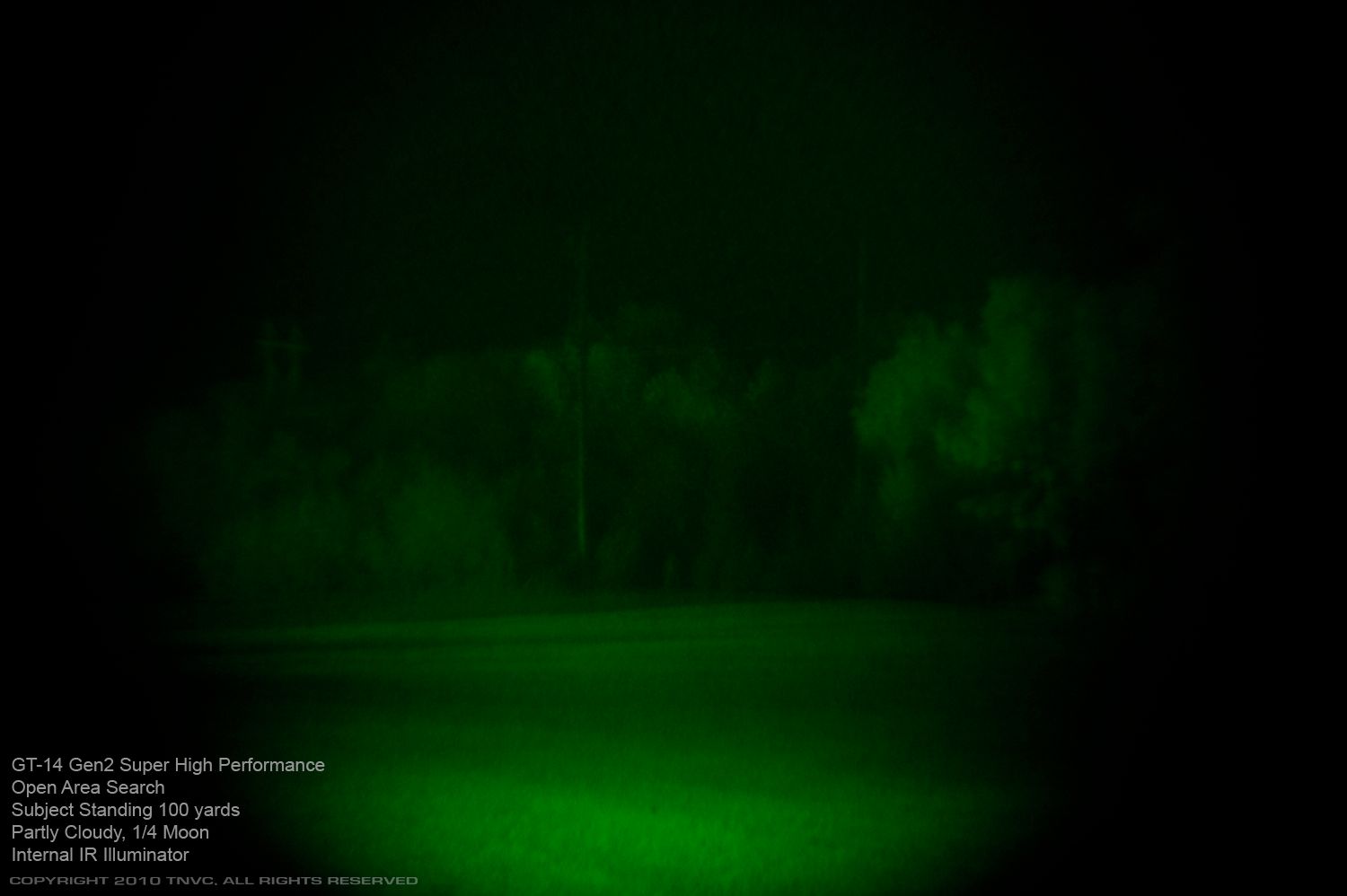
The subject can now be seen against the tree line with the introduction of the Surefire M1. Though resolution is fuzzy, it is possible to detect a man-sized subject at this distance. Details cannot be made out at this distance with this tube, so it is impossible to determine if the subject has a weapon. 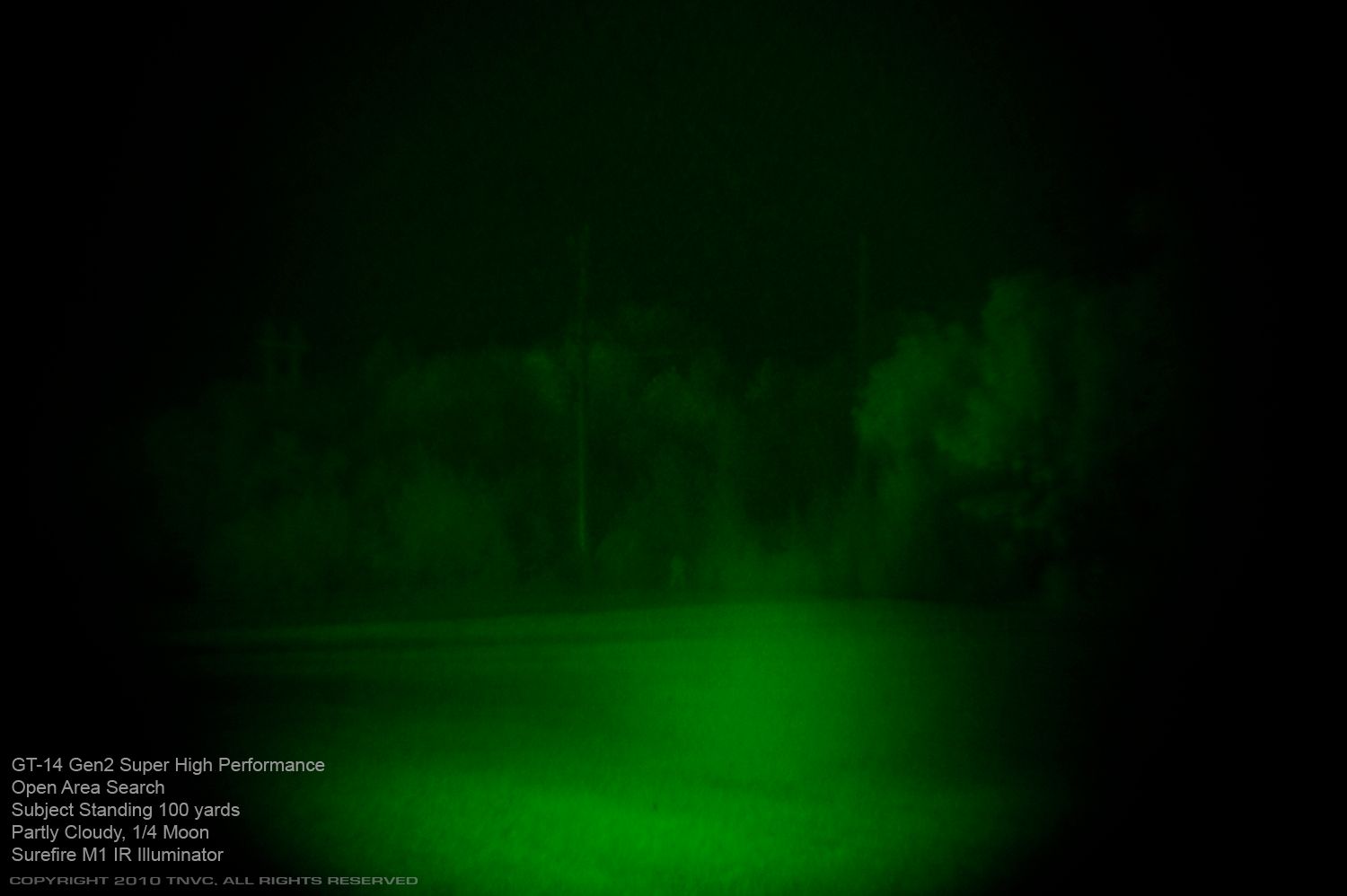
D300 Gen2+ MILSPEC Image Intensifier The Gen2+ MILSPEC tube has reached its limitation at this distance. There is no way to identify the subject at 100 yards. The foreground grass is visible. 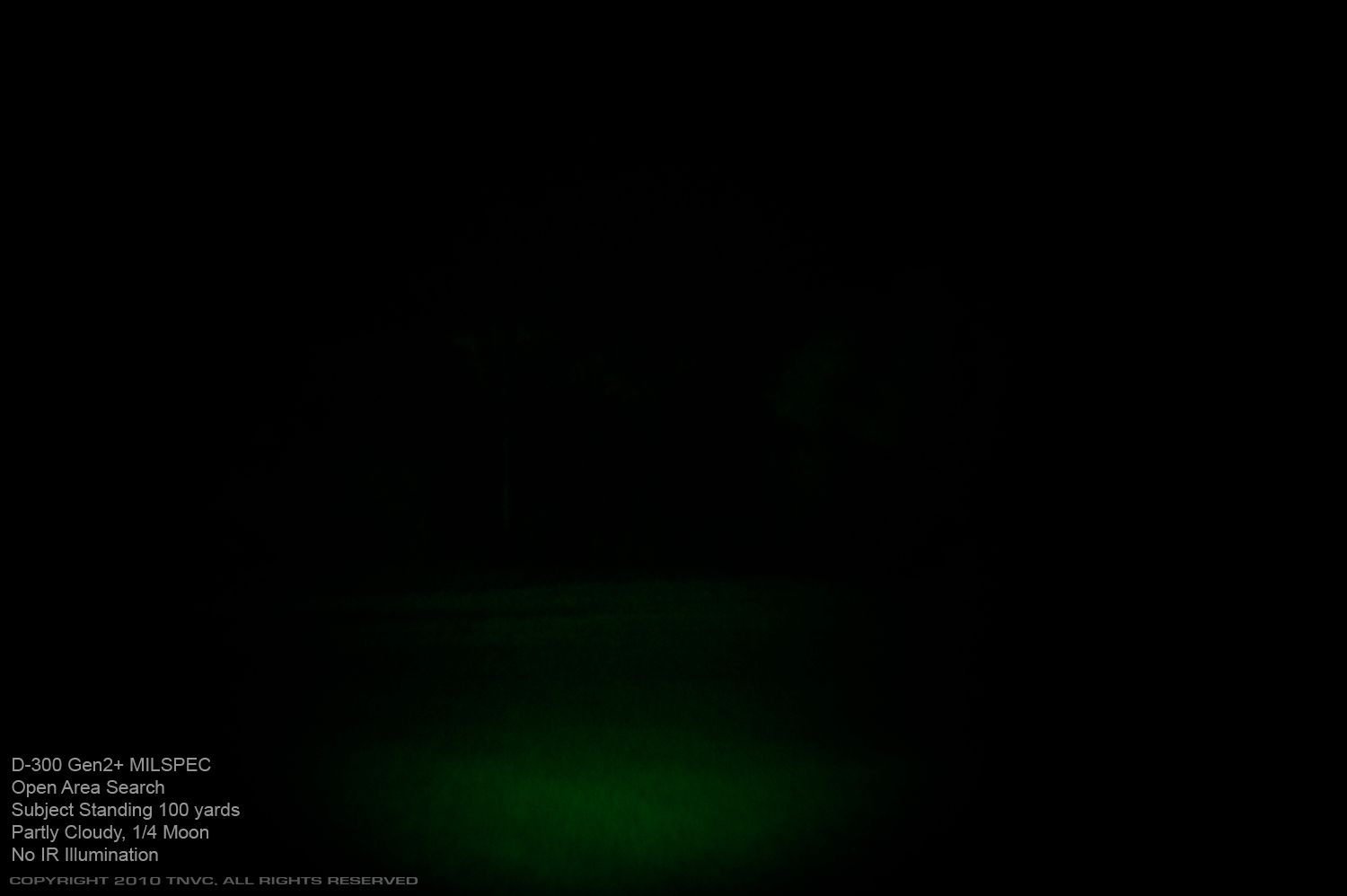
The addition of the built-in IR illuminator does little more than slightly brighten the appearance of the grass. The subject at 100 yards is still not visible. 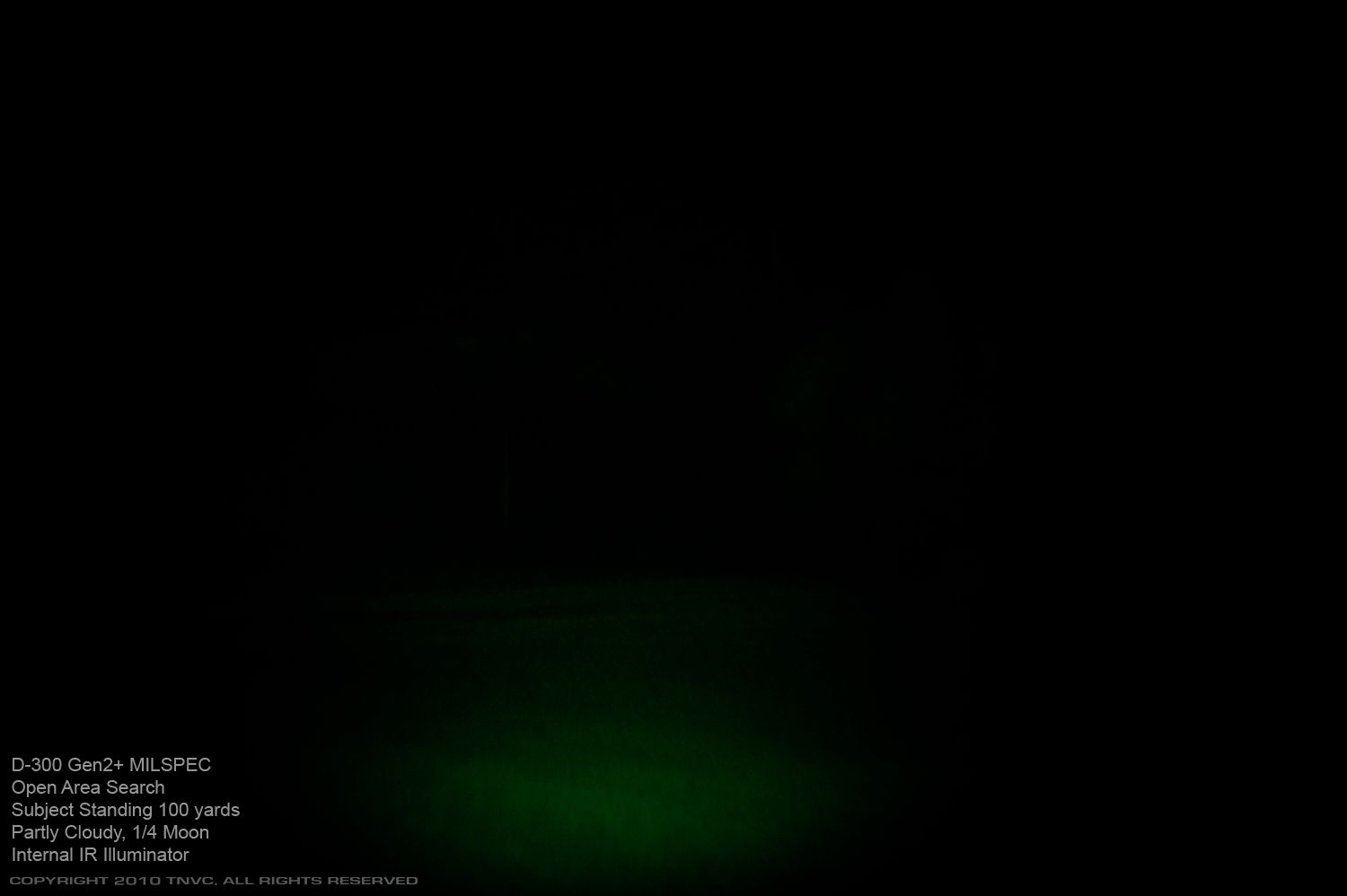
Using the Surefire M1 adds the slightest bit of help. But, the tube is clearly at its performance limits. The subject can just barely be made-out, but it is impossible to identify him as the subject rather than part of the environment. 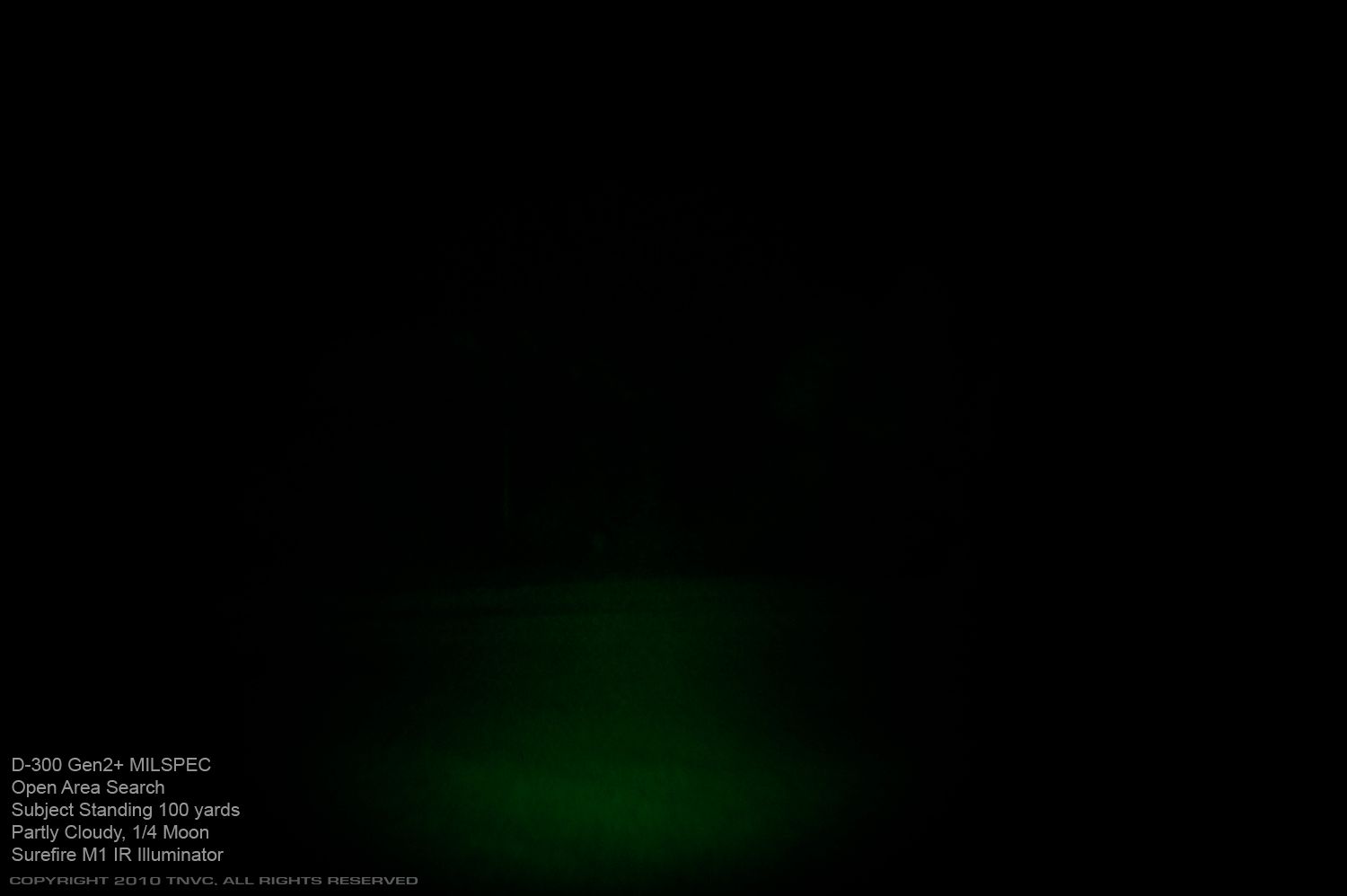
ATN Viper Gen1+ Image Intensifier The Gen1 tube fails completely to deliver any image whatsoever. Even under good ambient light conditions, the subject at 100 yards is completely shrouded in darkness. This would leave a law enforcement professional blind of all intents and purposes, even at close distance. 
The built-in IR illuminator did not add any value to the image. It is still completely dark with no details discernable. 
Not even the additional illumination from the Surefire M1 can provide enough light for the Gen1 tube. 
Thoughts- This scenario provides a good indication of image intensifier performance capabilities. One of the biggest concerns professionals have when using night vision equipment is the distance at which they can detect, acquire, and identify a threat. This evolution clearly displays these abilities and limitations. Conditions were not perfect due to partial cloud-cover, which helped to show what these image intensifiers can do in real-world scenarios. It is quite evident that the older generation tubes provide less performance. In a law enforcement situation, this can mean the difference between life and death. The lower light-gathering abilities of the Gen2+ MILSPEC and Gen1+ tubes would be too dangerous for serious field work because they offer almost no advantage to the officer. Situational awareness is gone. The Gen3 units performed admirably with the ability to acquire the subject while still maintaining situational awareness. Details are easily resolved and detection capability is good out to 100 yards, even with the tricky foliage background. This evolution also underlines the importance of a separate, high power IR illuminator. Test Scenario 5 – Warehouse Search / Close Range (10 Yards) This scenario was designed to test the devices in a CQB environment in an open floor plan warehouse, as is common in an industrial building search. Environmental lighting was minimal, as would be the case during non-business hours, and is present from the open loading dock lights in the back. ITT PVS-14 Night Enforcer Gen3 PINNACLE Auto-Gated Image Intensifier The subject is very clearly seen with facial features identifiable as well as the presence of a weapon. Surrounding details of the environment are visible. The high performance of the PINNACLE tube creates great contrast and allows for extremely high resolution. 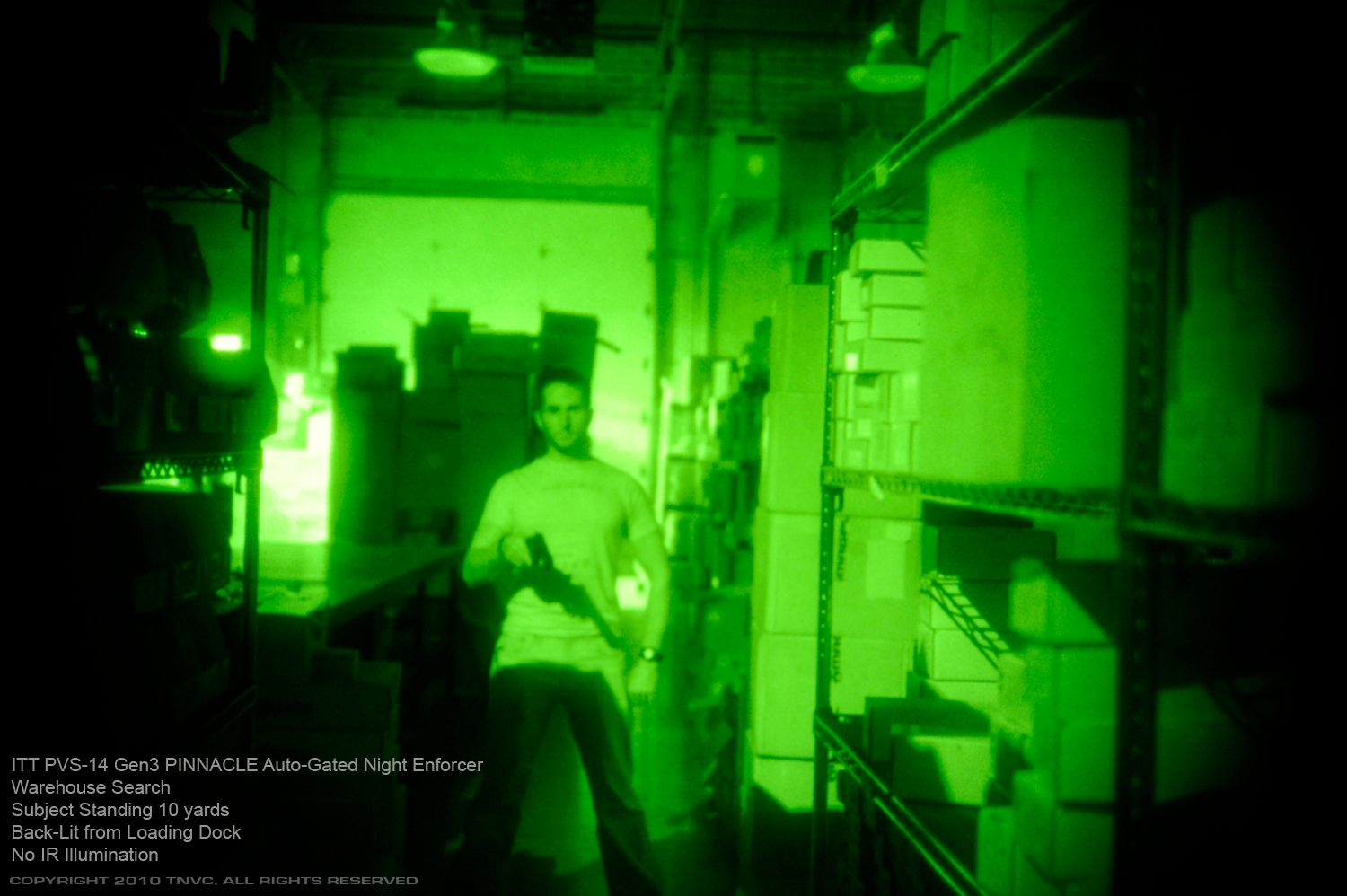
The built-in IR illuminator does not offer much assistance in this scenario. The image is slightly brighter, but sufficient ambient light is already present. 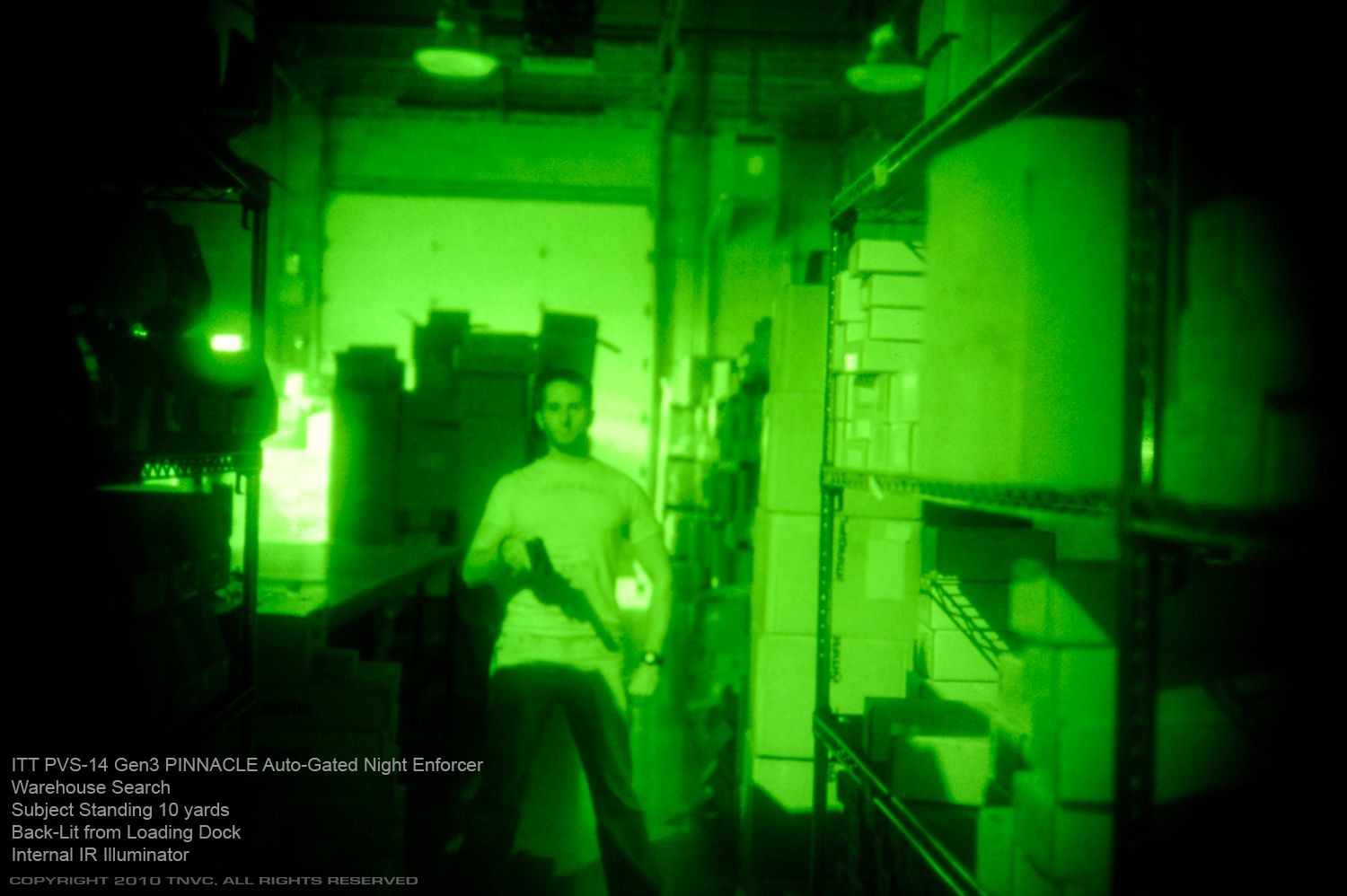
The addition of the Surefire M1 helps to better illuminate the scene. While it is necessary for this scenario, it can be seen how the storage bins are not visible on the left side of the image. The focus of the illuminator is reflected off the subject’s light-colored shirt, eliminating shadows on his body. This helps to back-light the weapon, making it more quickly identifiable. 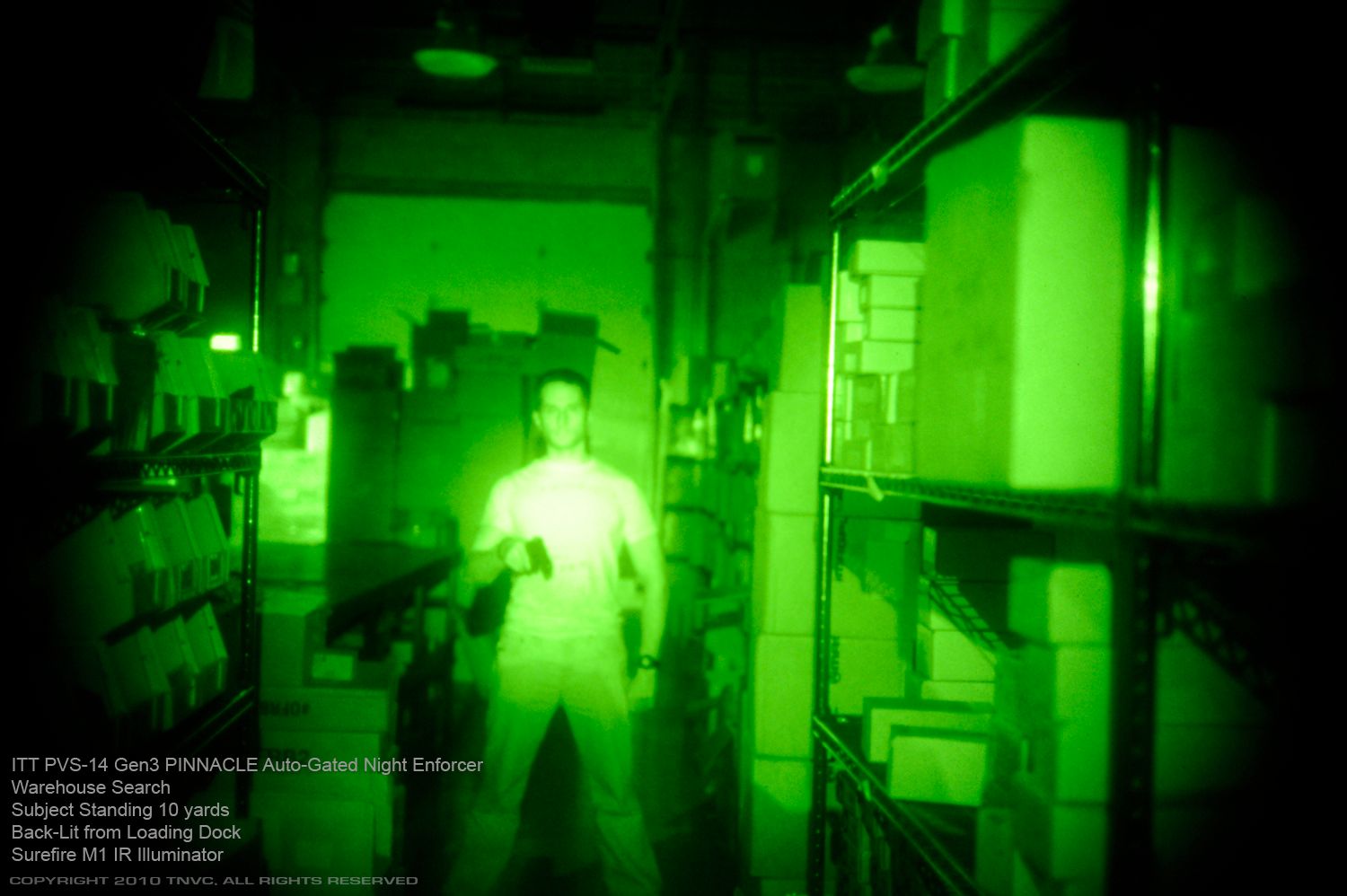
Litton PVS 14 Gen3 Auto-Gated Image Intensifier The Gen3 Auto-Gated tube performs well, quickly acquiring the subject and detecting the weapon. Compared to the Gen3 PINNACLE tube, the Litton Auto-Gated unit appears slightly darker. This is more readily seen in the surrounding environment. Note the boxes stacked on the shelves appear to be slightly less resolved. Facial features are still identifiable 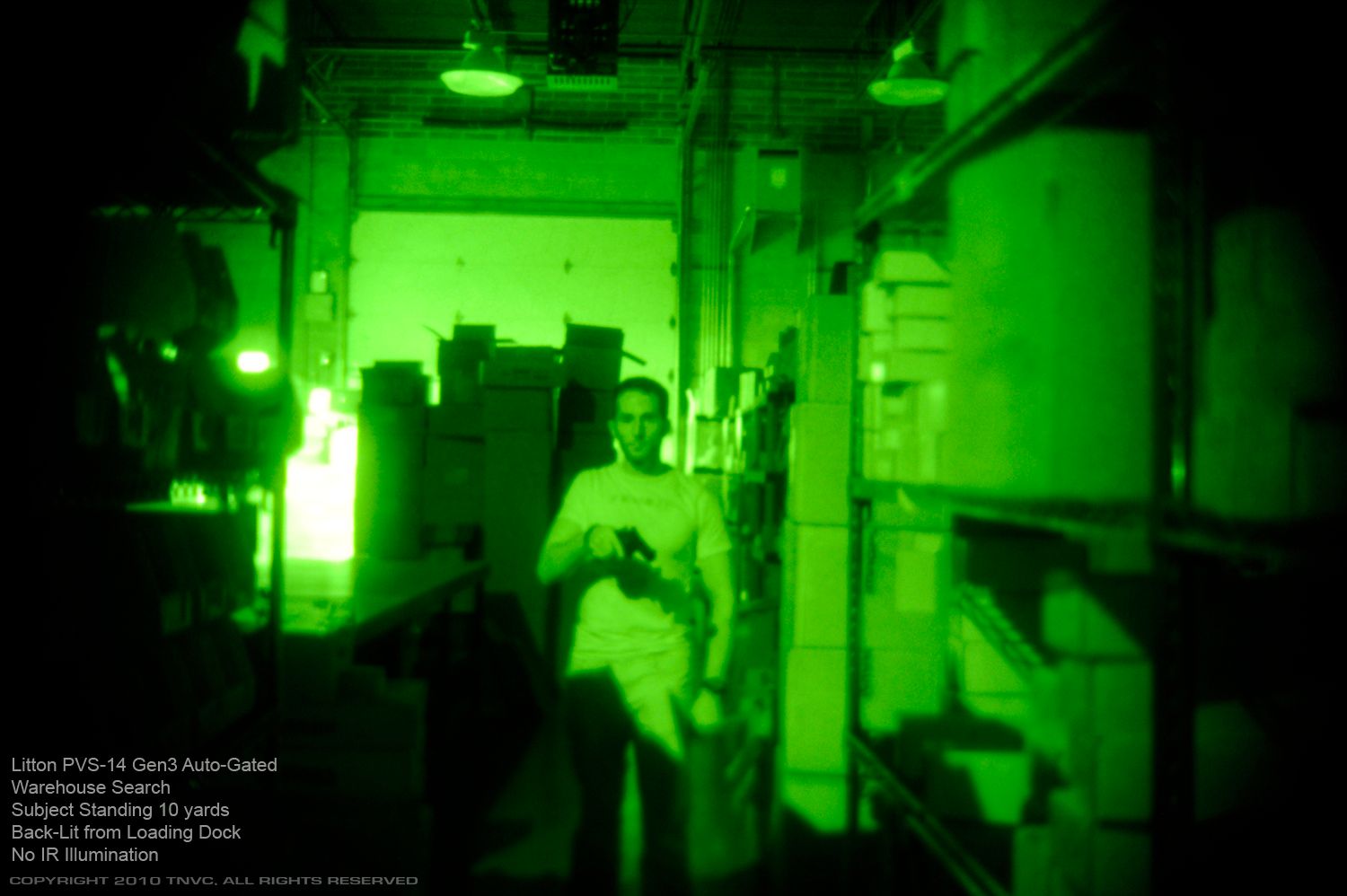
The built-in IR illuminator did not add any value to the image. 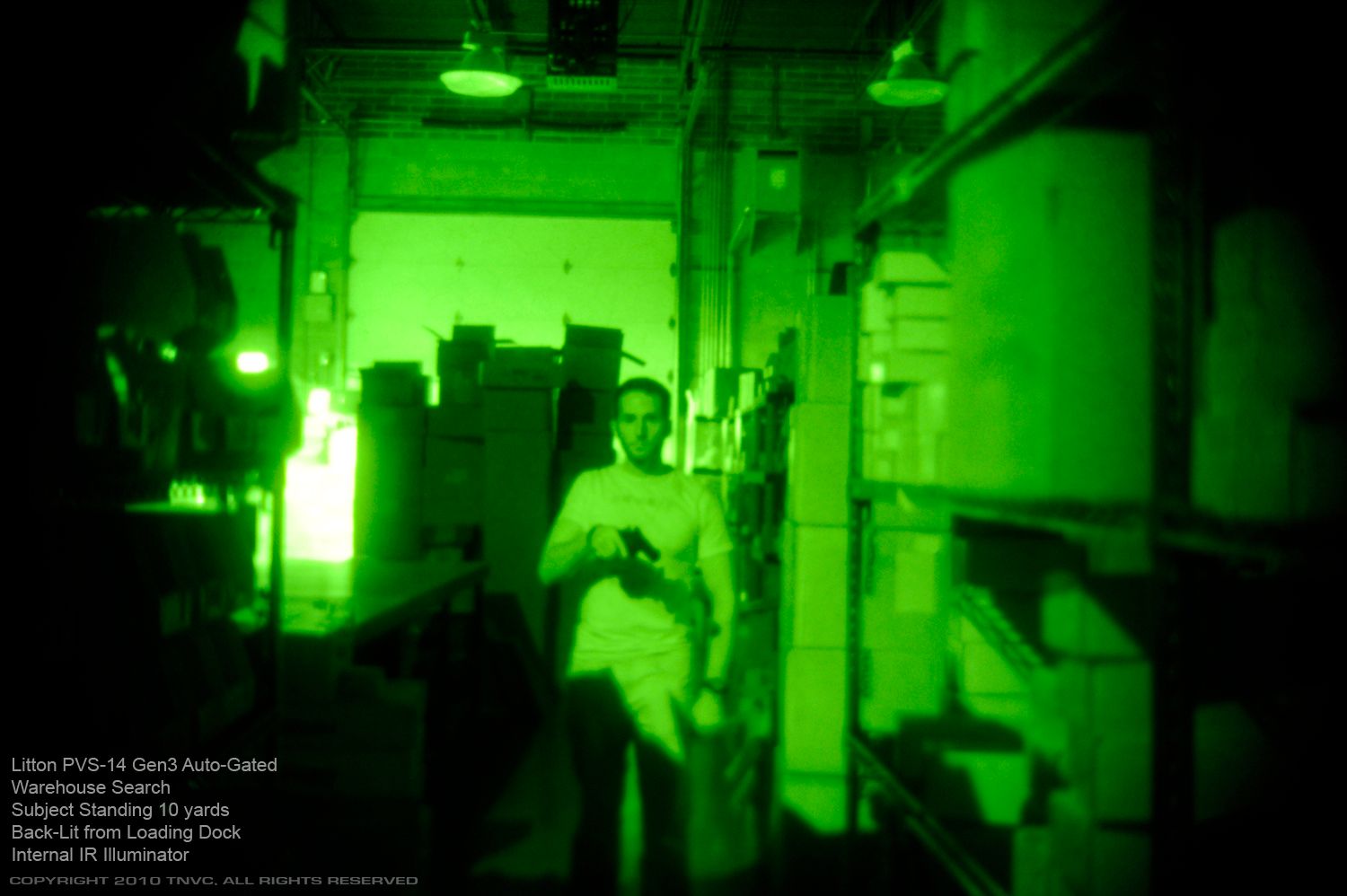
The scene is better illuminated with the Surefire M1, allowing the storage bins to be better seen. Shadows on the subject’s shirt are gone, allowing the weapon to be back-lit and more quickly identified. 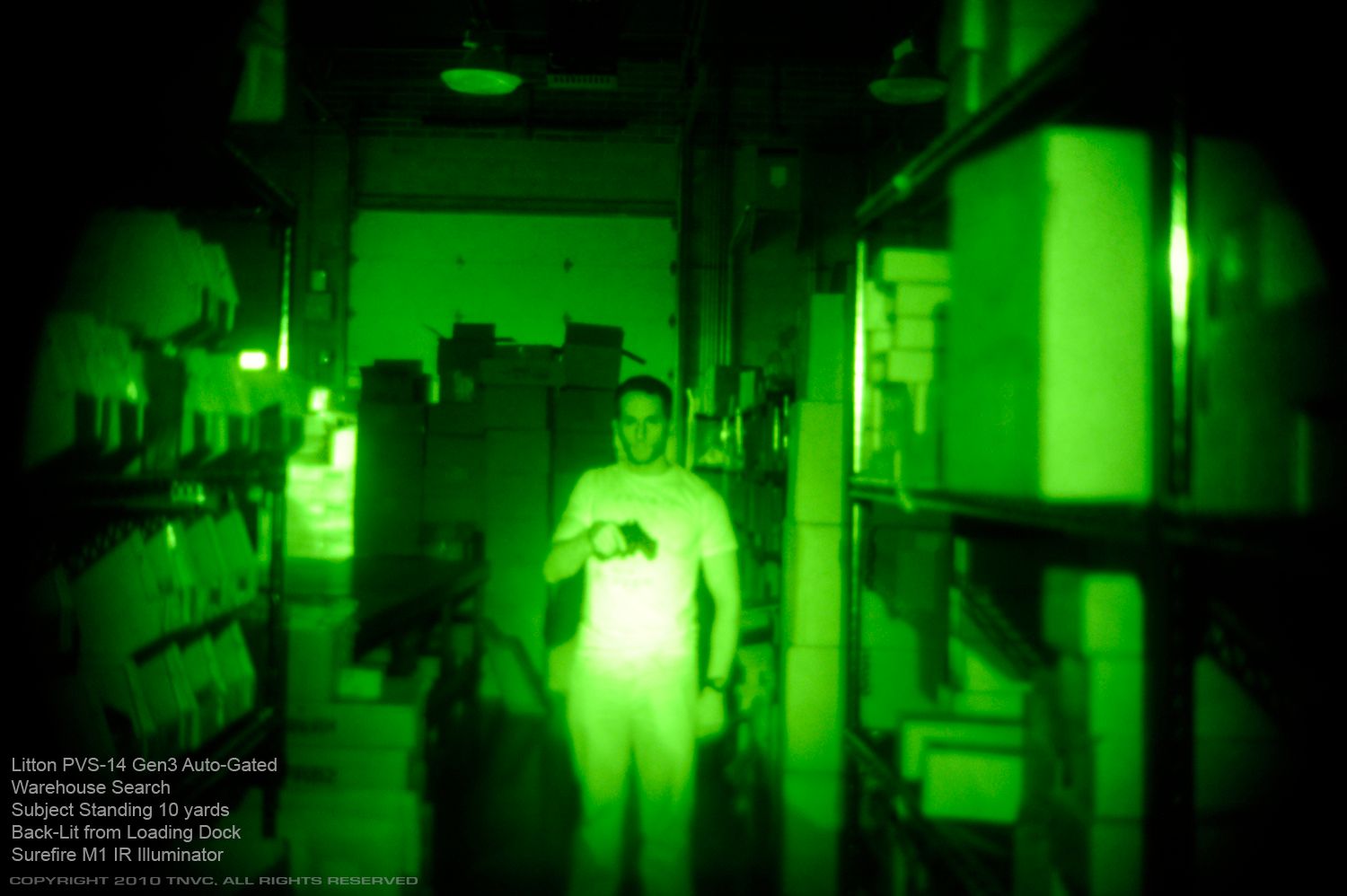
GT14 Gen2SHP Image Intensifier The Gen2 SHP tube provides a good image with good resolution under these conditions. The subject is clearly identified through facial features and the presence of a weapon is certain. The surrounding environment is well resolved. 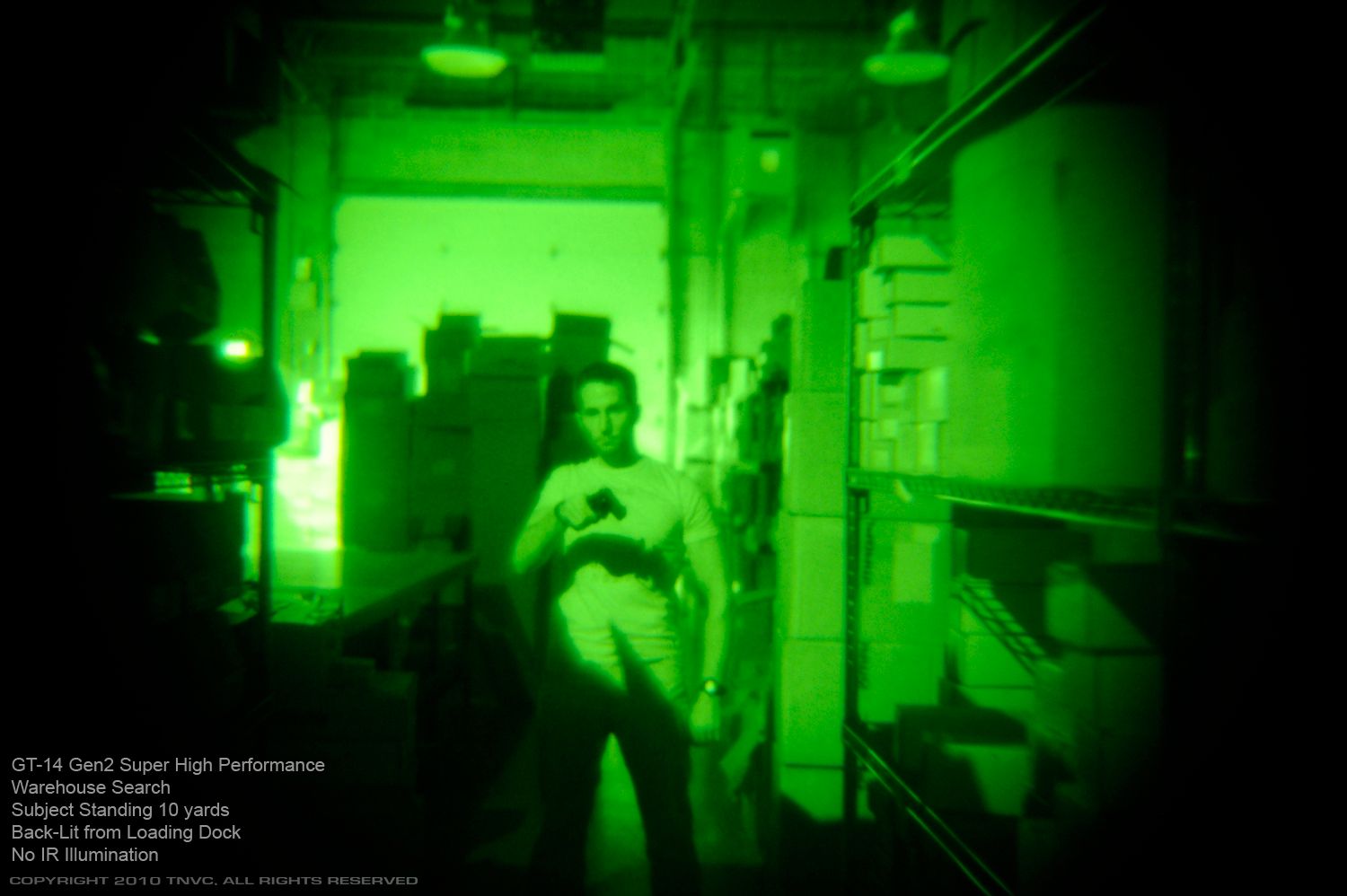
The built-in IR illuminator did not add any value to the image. 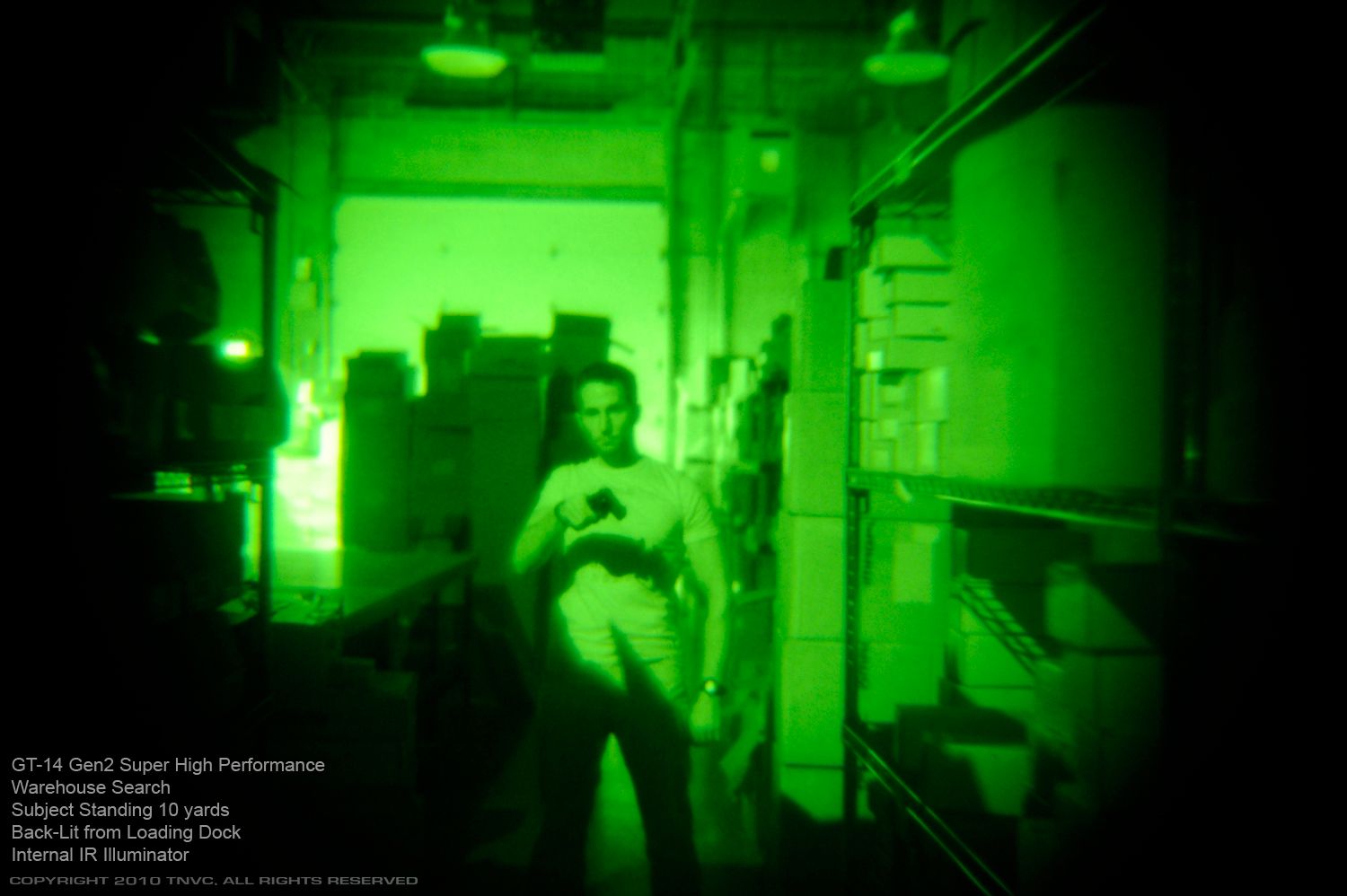
While the image is definitely brighter with the addition of the Surefire M1, it is also noticeably flatter in appearance. This is especially seen in the subject. The Gen2 SHP tube struggles to resolve some detail after the infusion of light. The weapon is still visible, though it is somewhat more blurry. 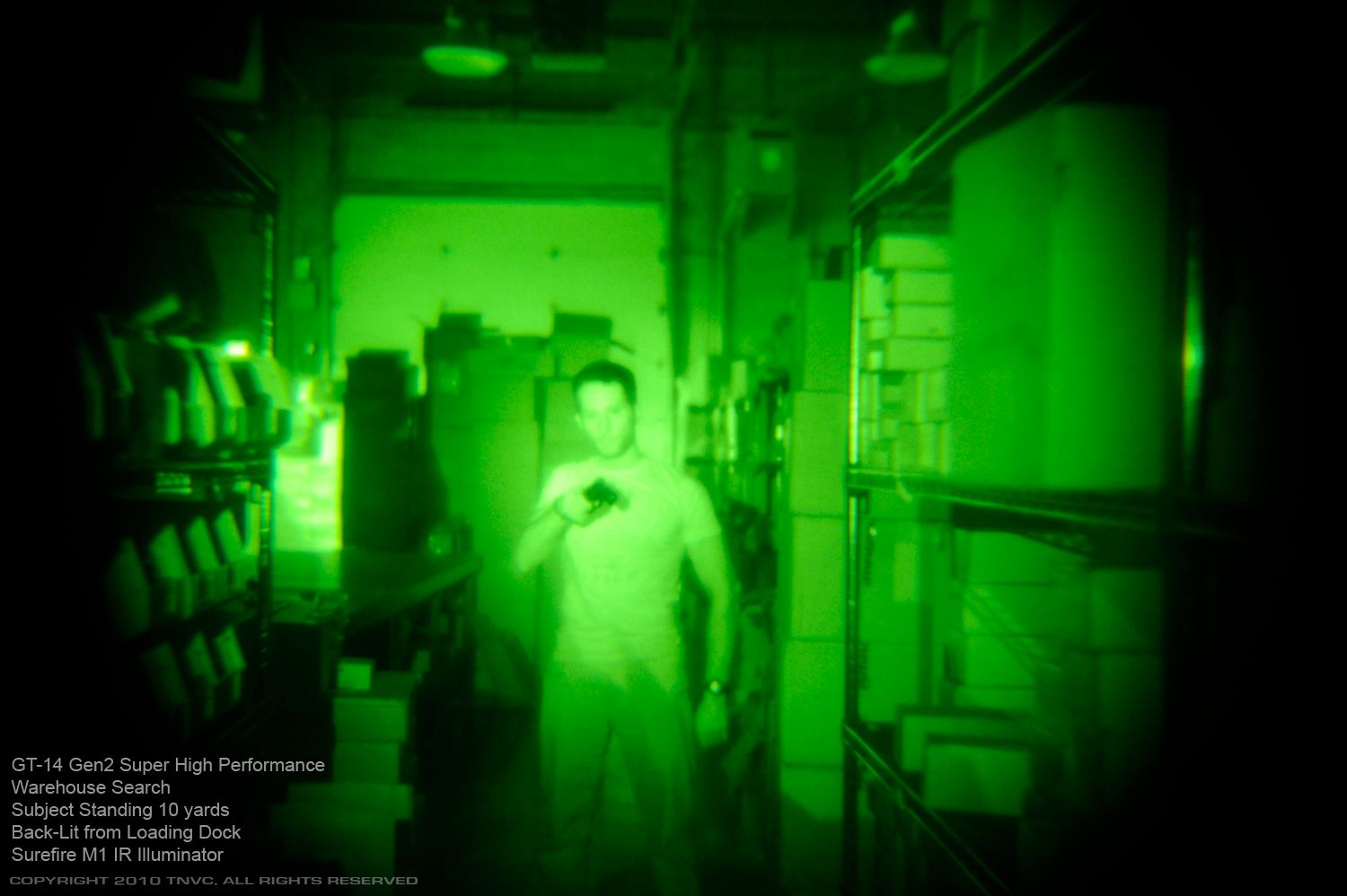
D300 Gen2+ MILSPEC Image Intensifier The Gen2+ MILSPEC tube produces a significantly darker image than even the Gen2 SHP. The subject is visible and facial features can be recognized. However, the under-powered tube struggles to provide additional data. For a professional conducting a search, this begins to border on dangerous because the surrounding environment is not nearly light enough to detect additional threats. 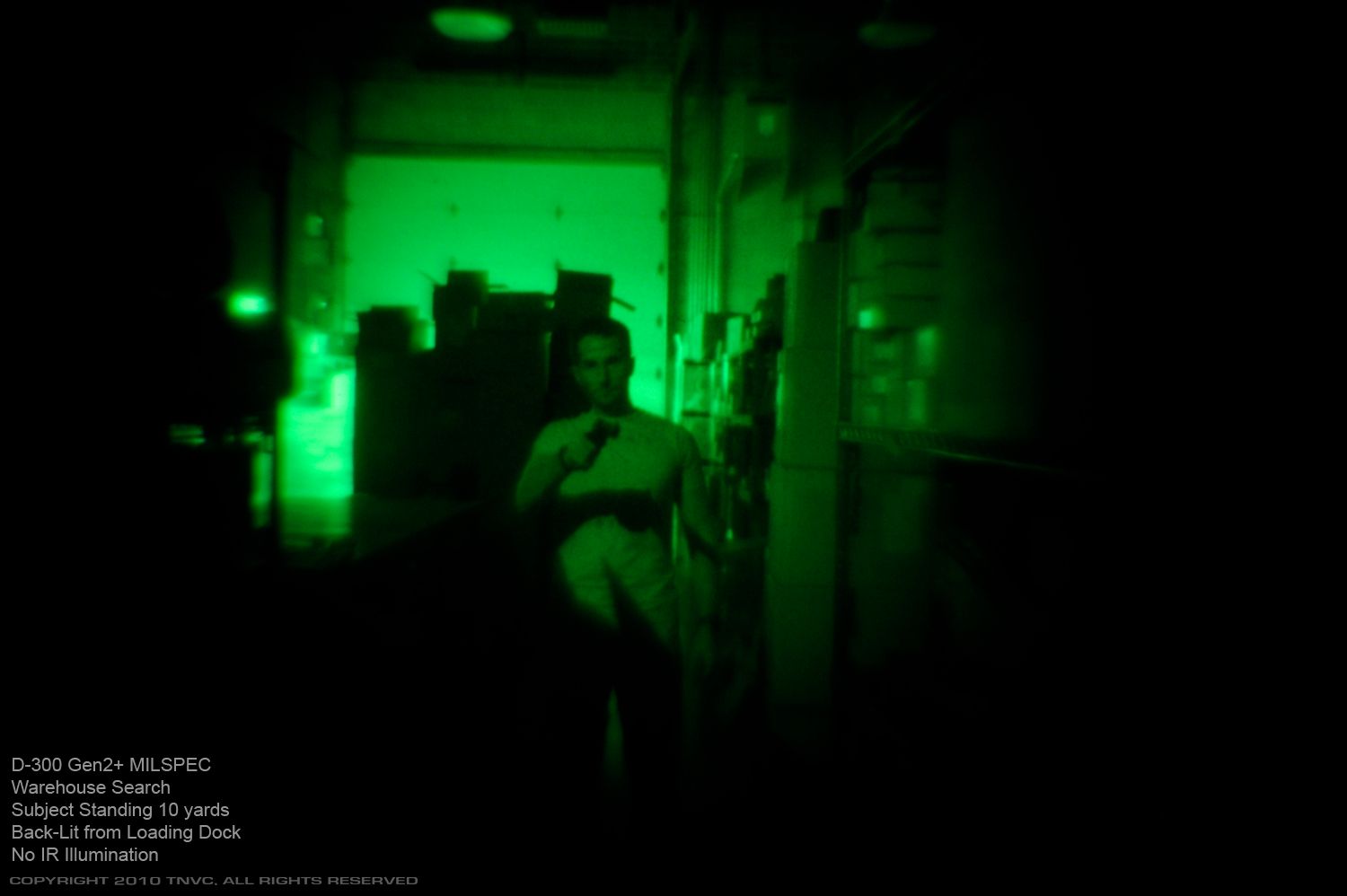
The built-in IR illuminator does little to the image. IR reflection is seen in the subject’s eyes, but no practical benefit is achieved. 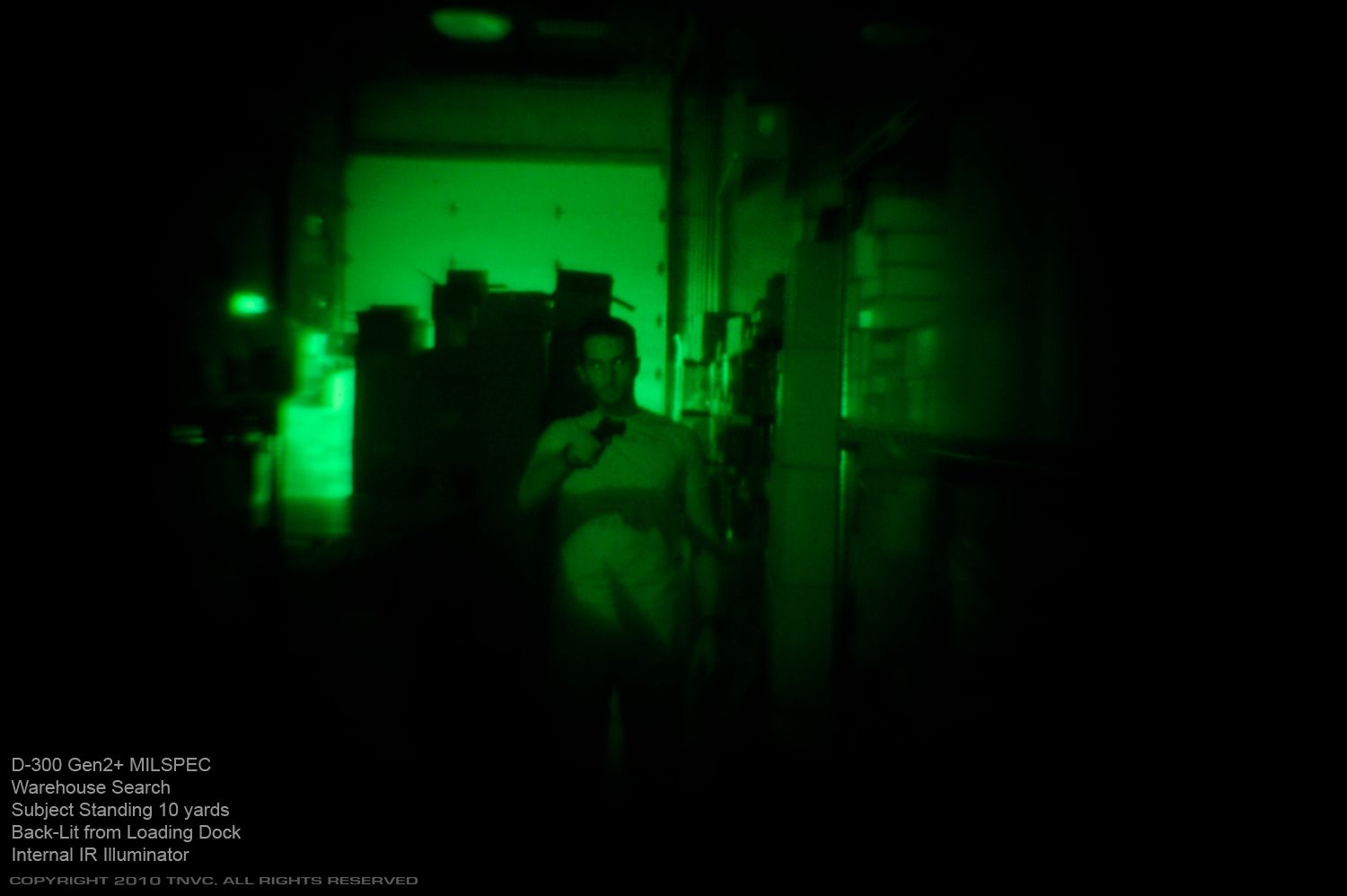
An external, higher-power IR illuminator is almost mandatory in this scenario with the Gen2+ MILSPEC tube. The subject is more clearly defined and the presence of the weapon is quite visible. The added light “pops” the subject from the surrounding environment. Resolution of the surrounding environment drops off quickly and it is still dark, making the detection of additional threats difficult. 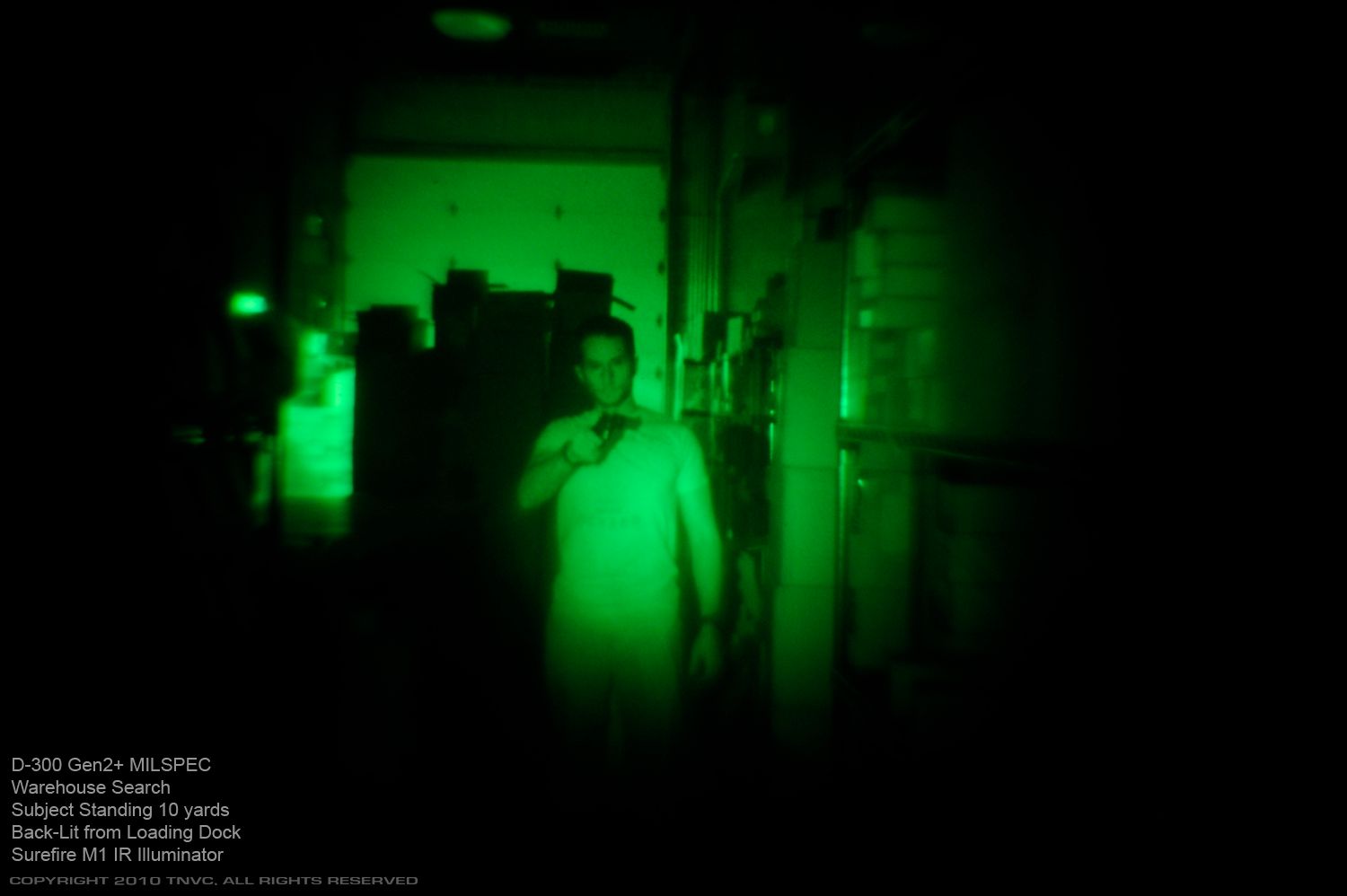
ATN Viper Gen1+ Image Intensifier The Gen1 tube is helped by the light from the loading dock, but provides a very dark image in the foreground. The subject is visible, though quick detection is hampered by the performance of the tube. The weapon is visible, but closer study of the image is required to see it. Facial features are unidentifiable and a quick glance might not detect the subject at all. In a fast-paced situation, the performance of Gen1 obviously creates too much room for hesitation. 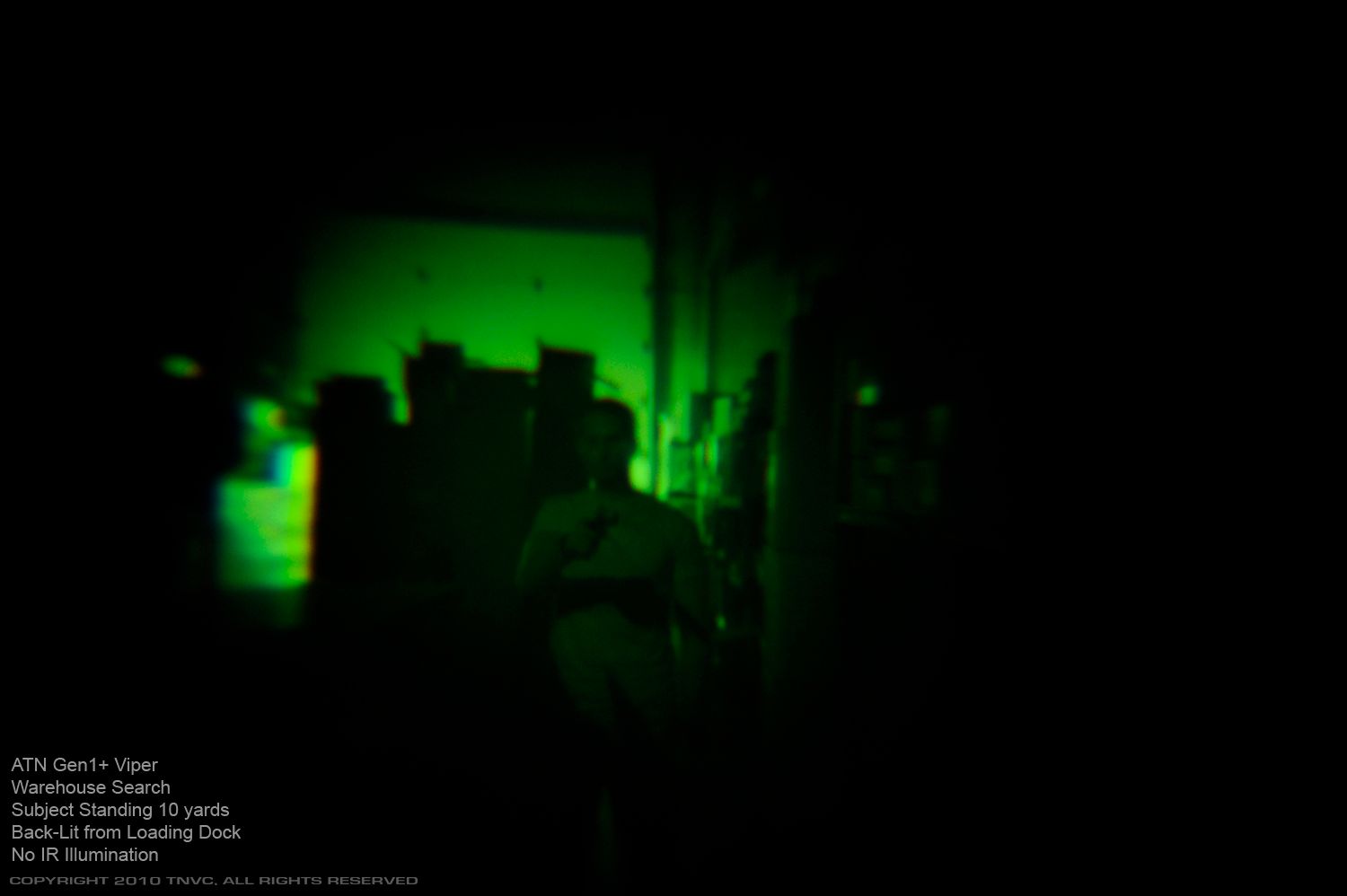
The built-in IR illuminator helps the performance of the Gen1+ tube in this scenario. The subject can be more clearly seen as well as the presence of the weapon. The image is still very dark and details are not readily resolved. 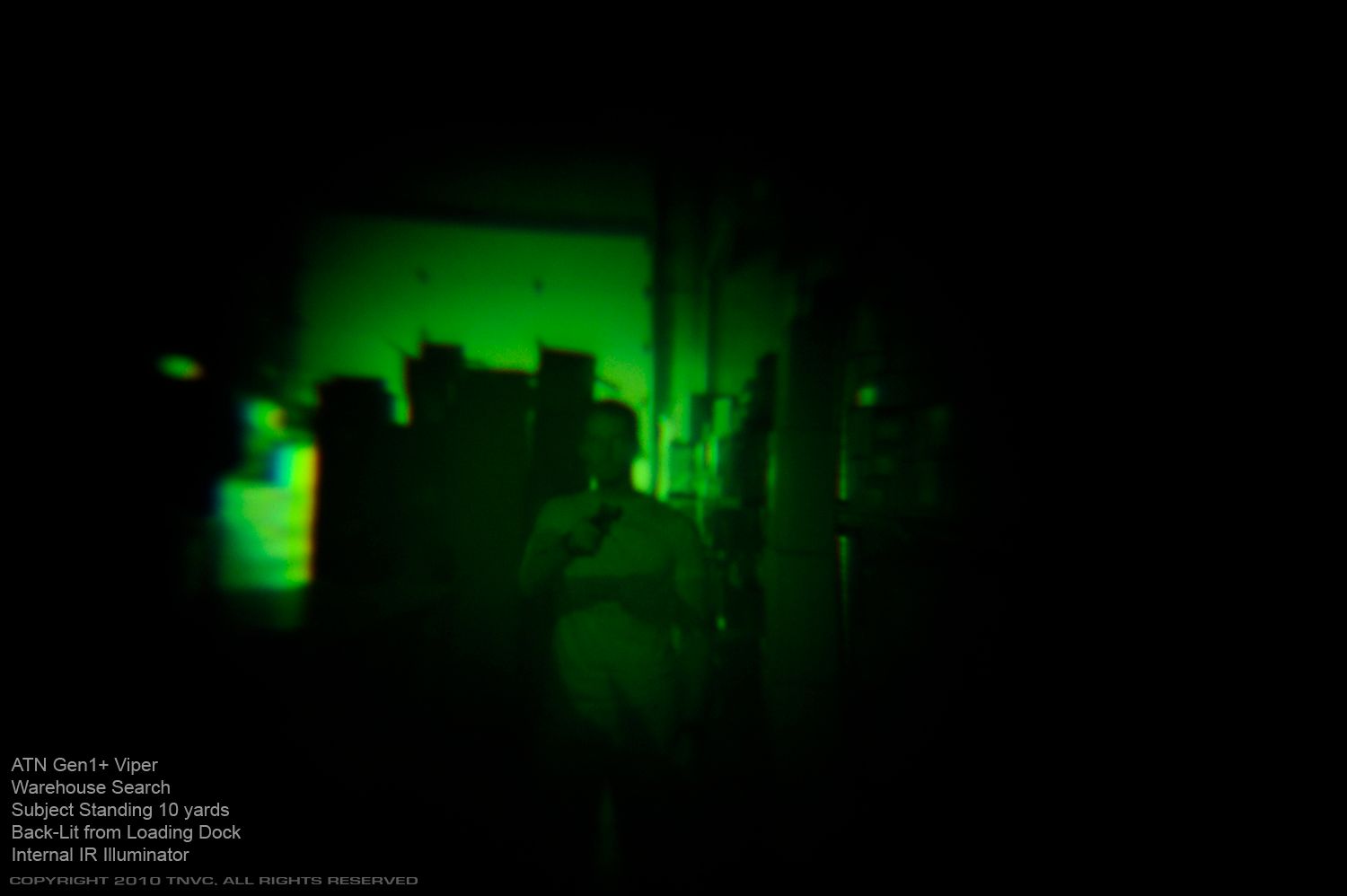
Adding a more powerful external IR illuminator definitely helps the Gen1+ unit. The subject is more clearly seen, as well as the presence of a weapon. Facial features are unrecognizable. The surrounding environment is a bit lighter and easier to understand, though the presence of additional threats would still be hard to determine. 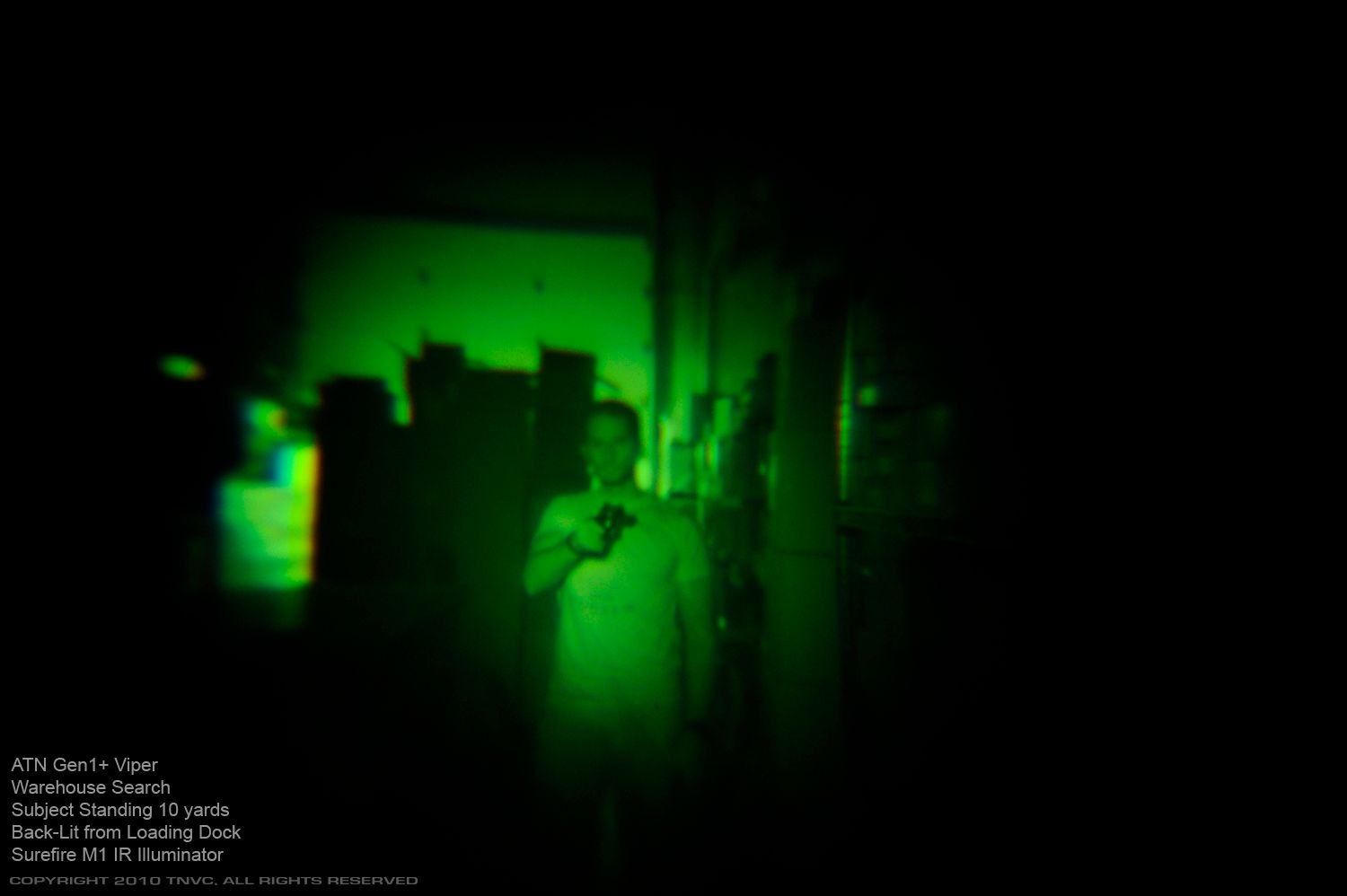
Test Scenario 6 – Warehouse Search / Medium Range (20 Meters) This scenario was designed to test the devices in a CQB environment in an open floor plan warehouse, as is common in an industrial building search. Environmental lighting was minimal, as would be the case during non-business hours. The subject is shown close to a storage rack as if trying to achieve some concealment. ITT PVS-14 Night Enforcer Gen3 PINNACLE Auto-Gated Image Intensifier The Gen3 PINNACLE Auto-Gated tube readily acquires the subject and provides a good view of the surrounding environment. Details are resolved and the presence of a weapon is identified. 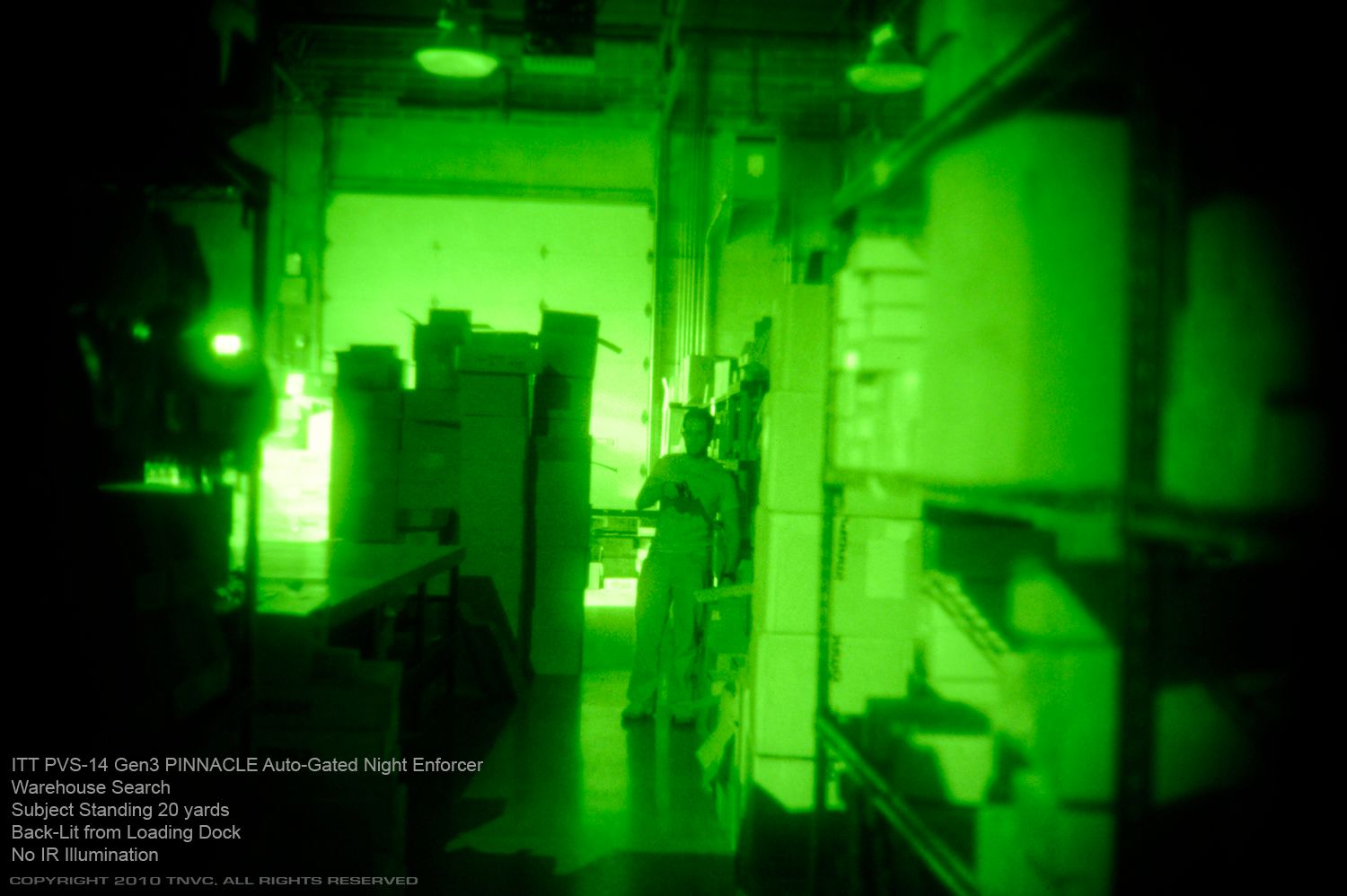
The built-in IR illuminator did not add any value to the image. The back-lit warehouse overpowers the illuminator. 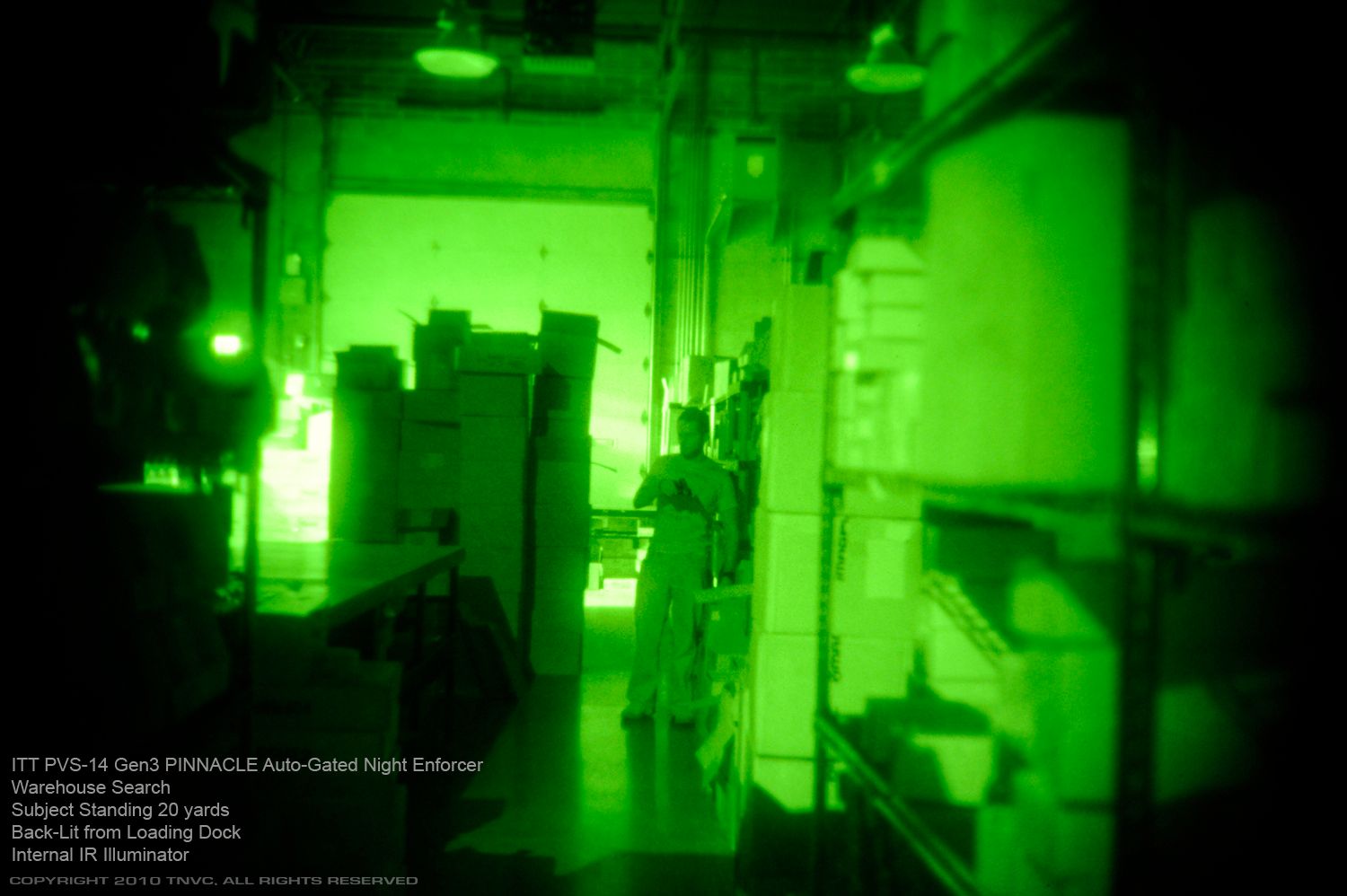
The Surefire M1 provides a boost to the foreground lighting. The shelves are more lit up, but more importantly, the subject’s weapon really stands out against his body. Facial features are also recognizable because of the forward light source. 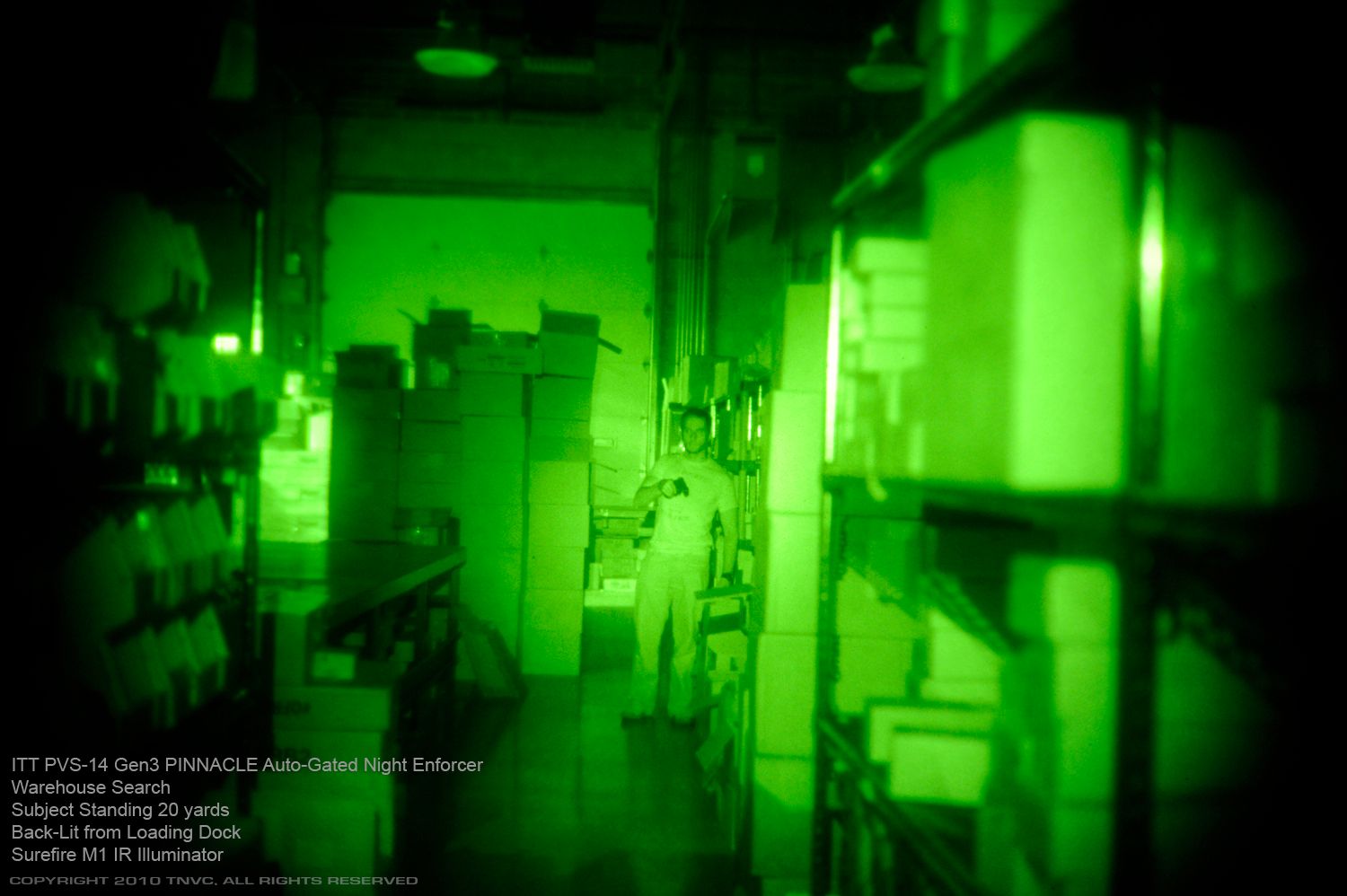
Litton PVS 14 Gen3 Auto-Gated Image Intensifier The Gen3 Auto-Gated unit is a bit darker than the PINNACLE tube. While detail is still resolved, the subject appears darker. The weapon is visible. 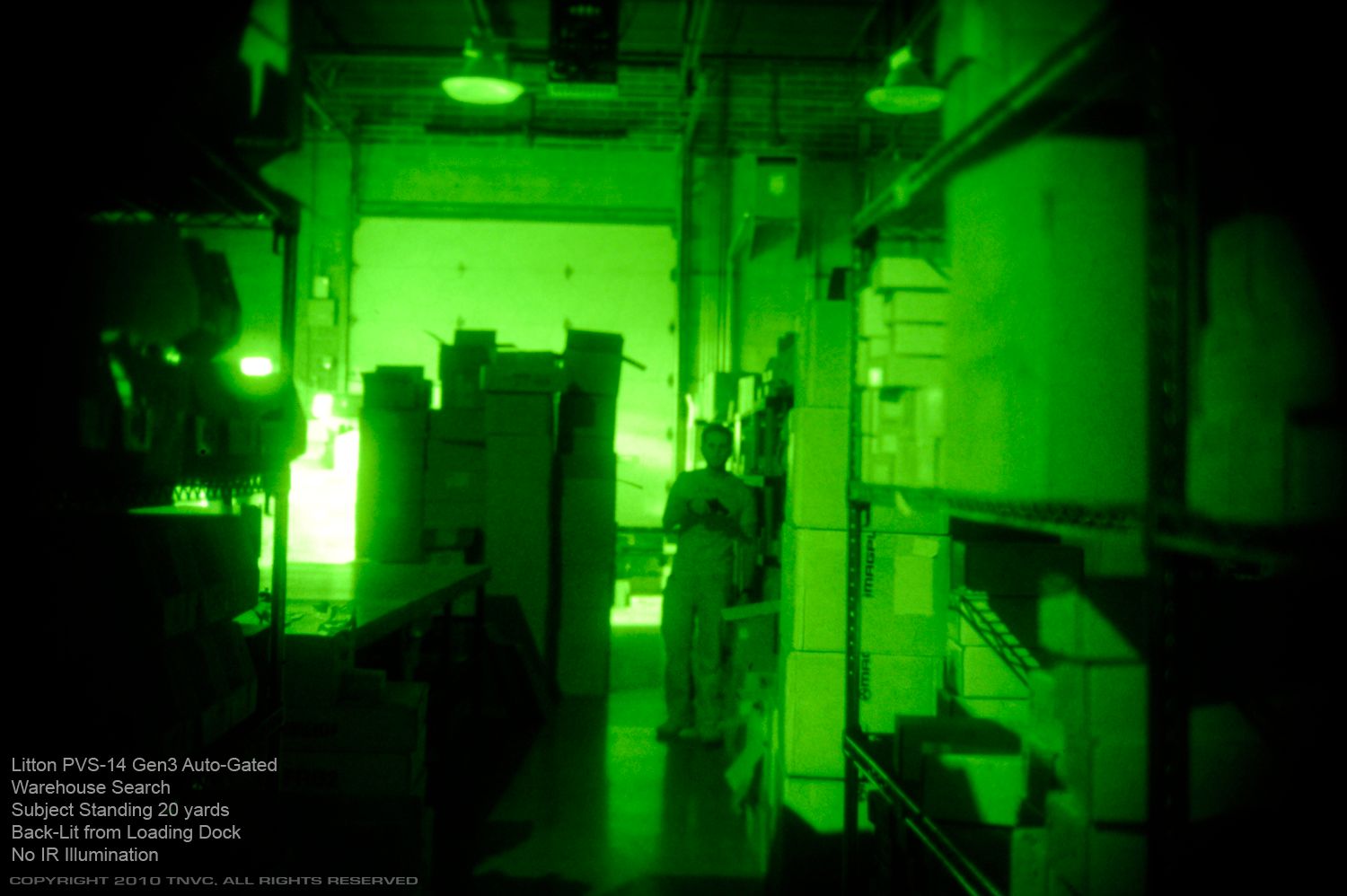
The built-in IR illuminator brightens the image, giving the user a better view of the subject and weapon. 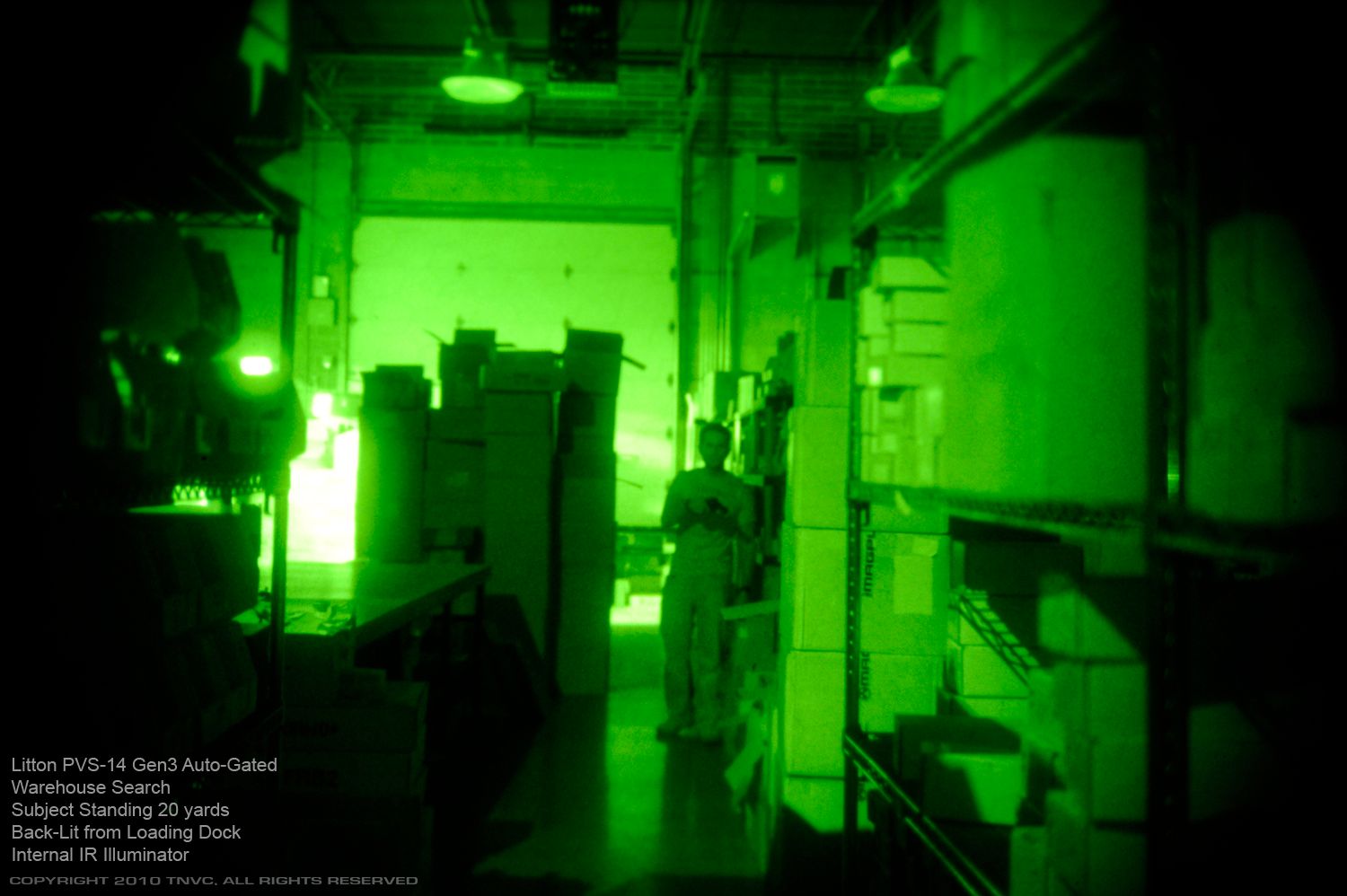
More detail is visible in the environment with the addition of the Surefire M1. The subject clearly stands out and the weapon is very visible against his shirt. 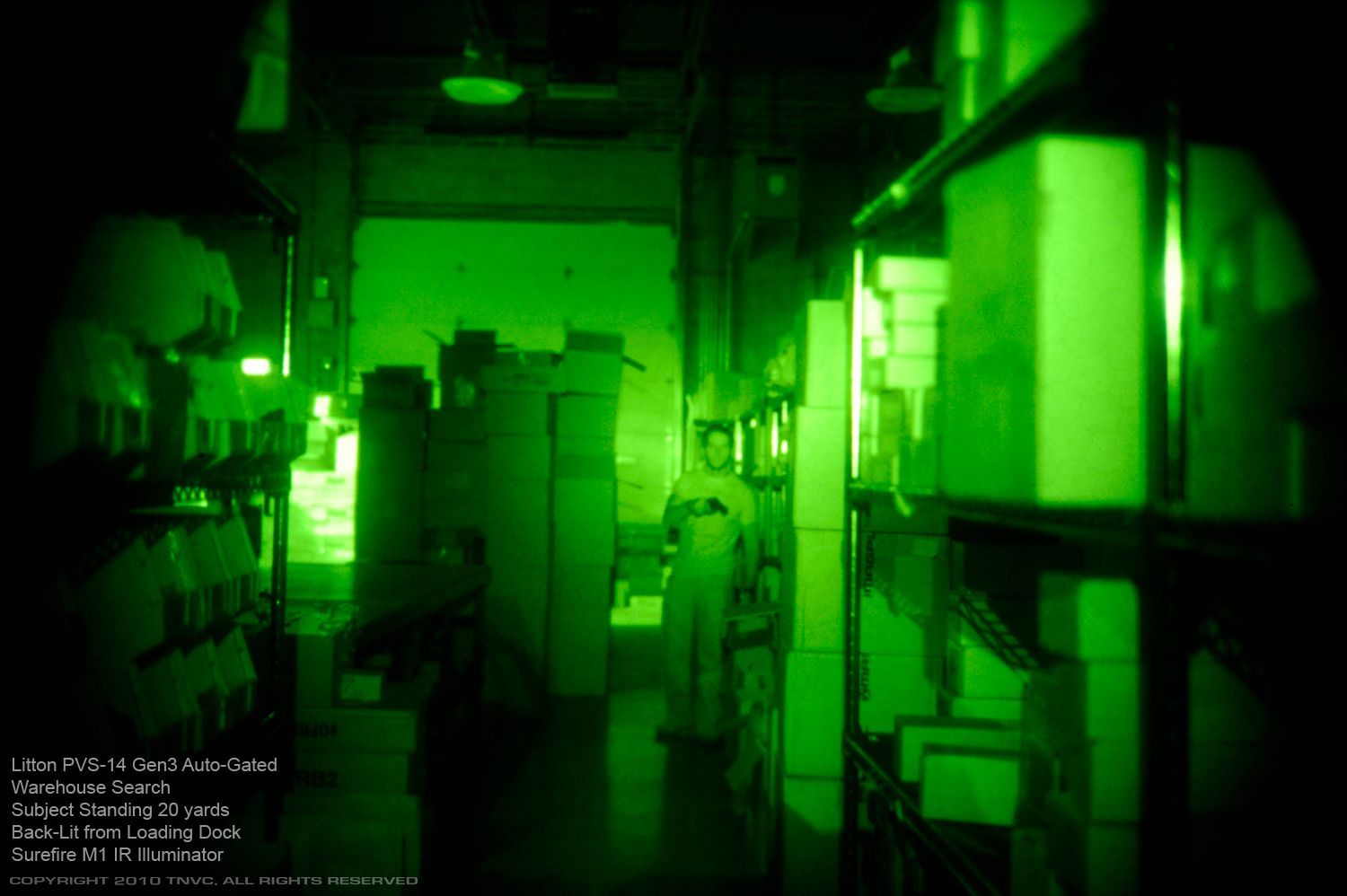
GT14 Gen2SHP Image Intensifier The Gen2 SHP tube performs well in this scenario because of the decent amount of light from the loading dock. The subject is visible, but the weapon is not immediately detected because of less resolution. A second glance will acquire the weapon. Overall, the image shows less-crisp lines and details than the Gen3 units. 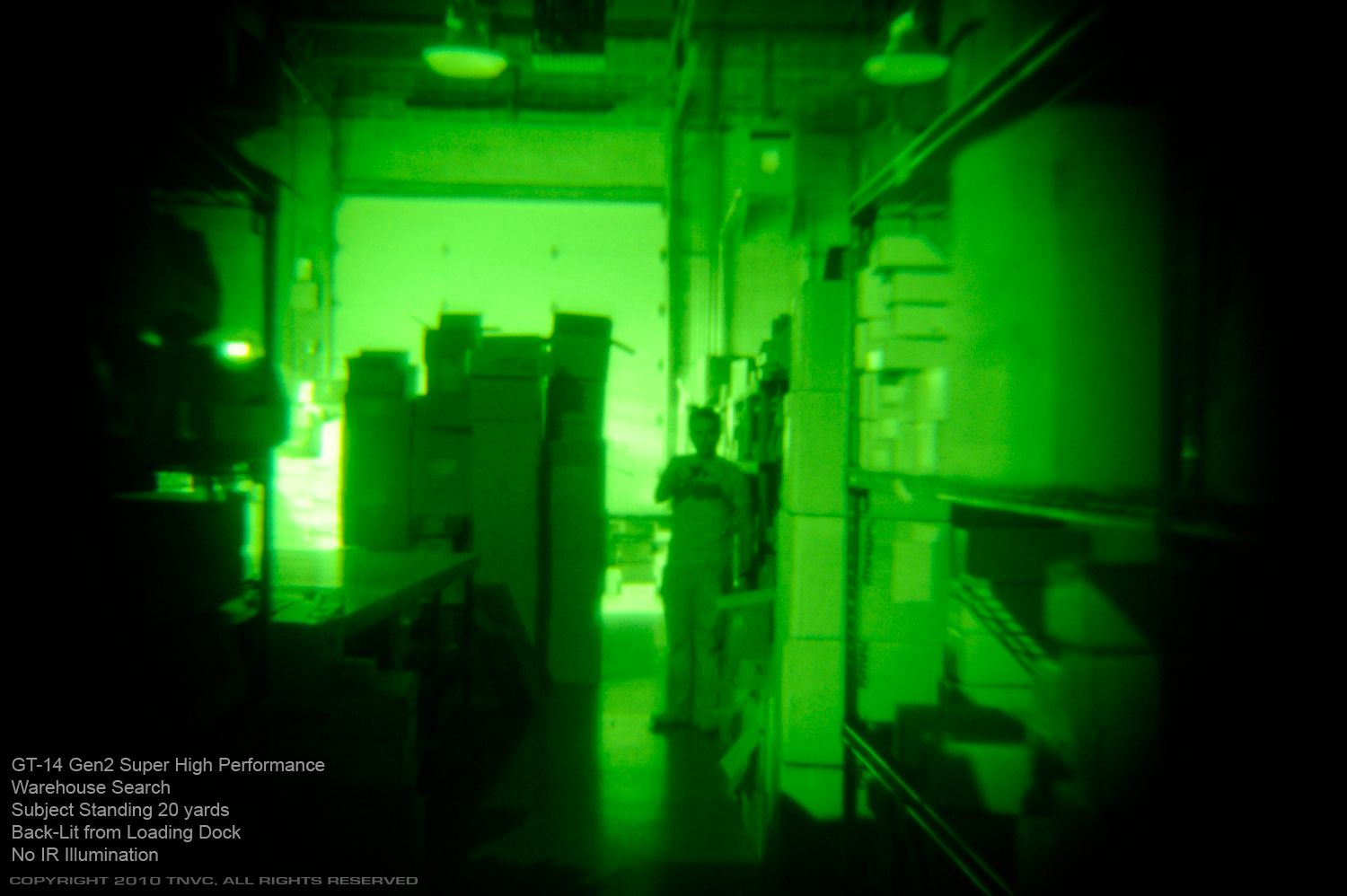
The built-in IR illuminator did not add much value to the image. It is a little lighter, but the practical application is marginal. 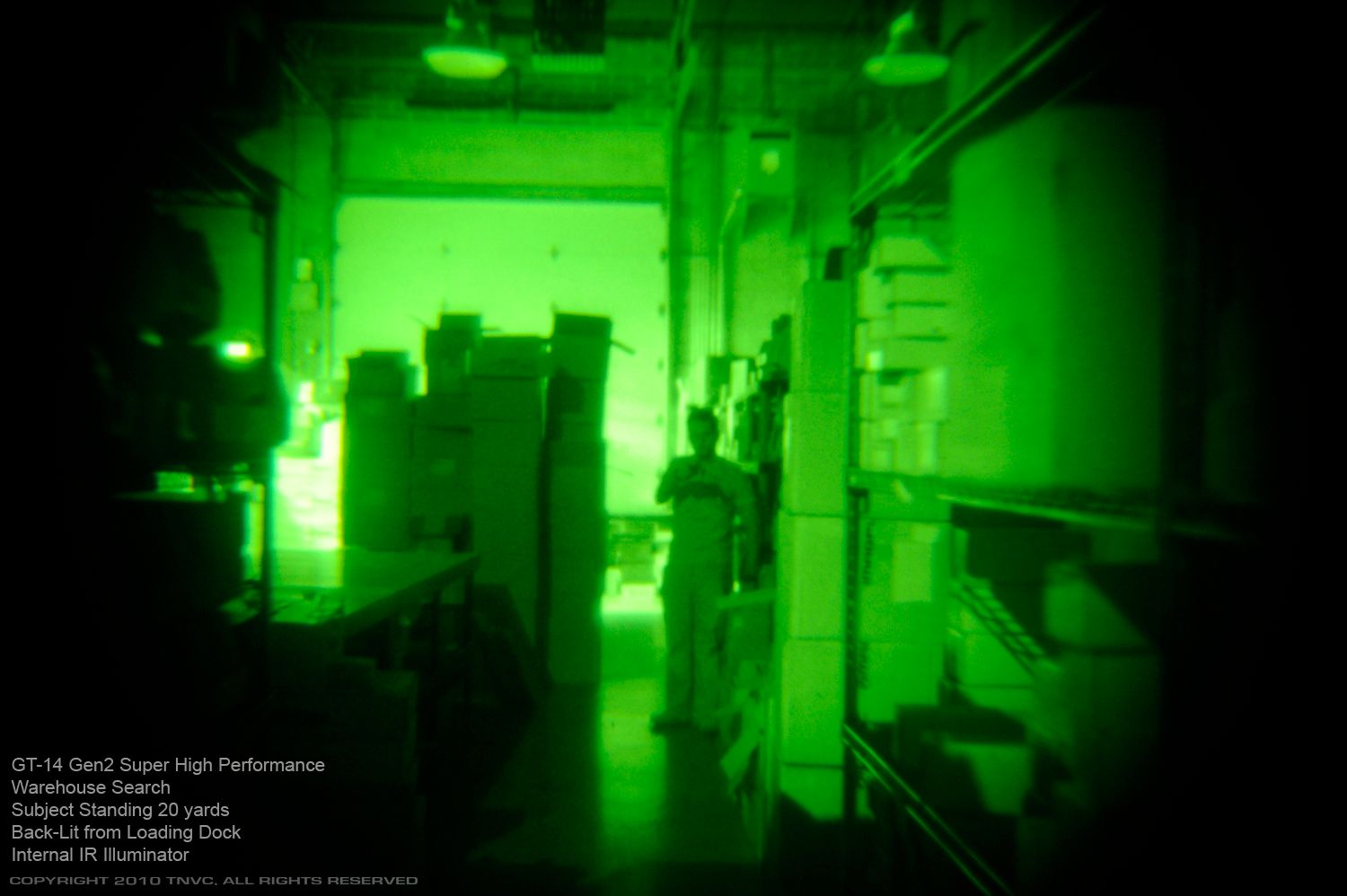
The Surefire M1 provides more light for the unit and makes the subject stand out against the background. The weapon is more visible against the subject’s shirt. 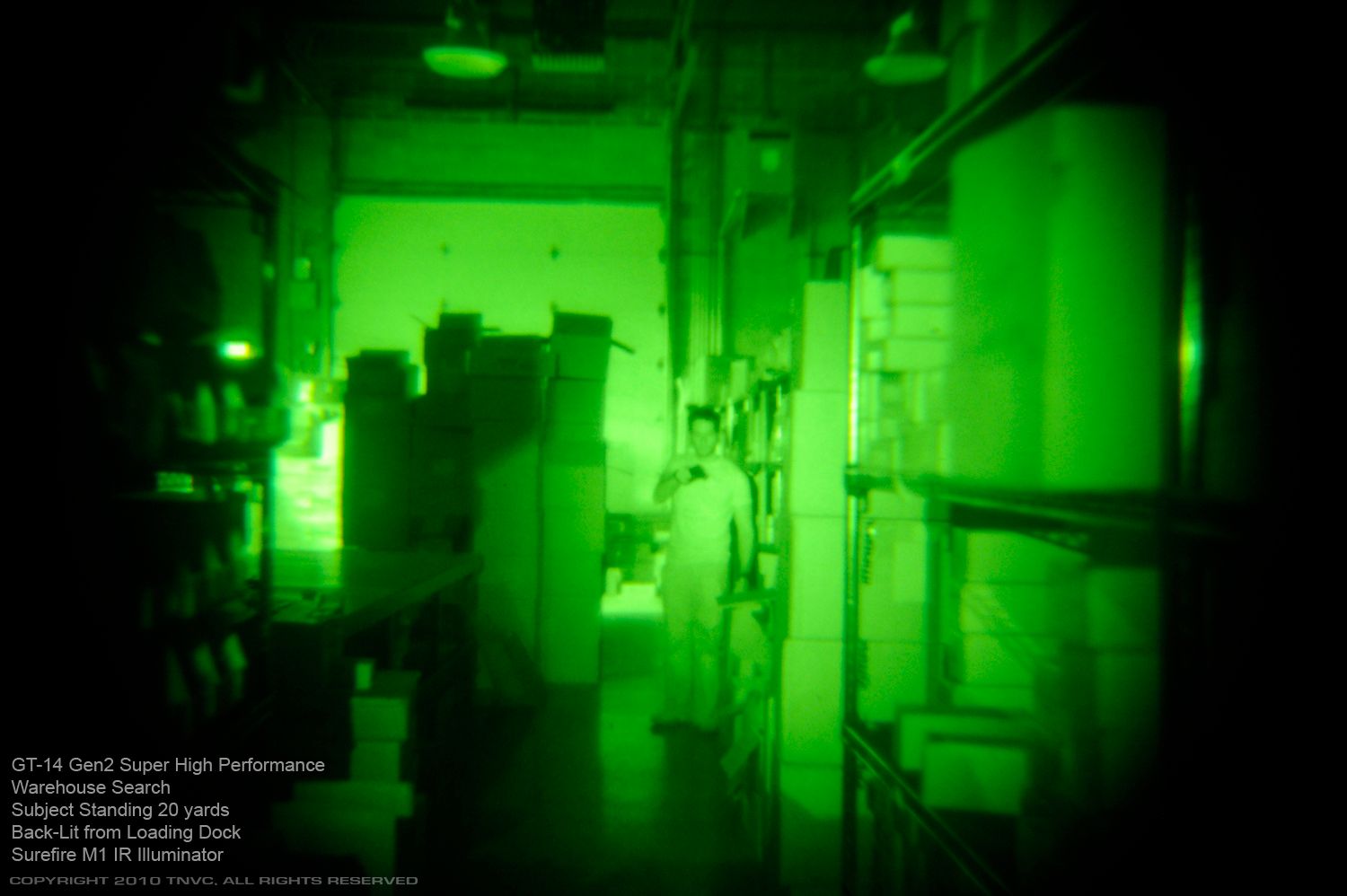
D300 Gen2+ MILSPEC Image Intensifier The Gen2+ MILSPEC tube shows serious limitation in this scenario. The subject and foreground are completely silhouetted with no discernable detail. The subject can be acquired, but that is as far as the Gen2+ tube will go. It is impossible to see enough detail to identify the presence of a weapon, so the user has no idea of the threat level. 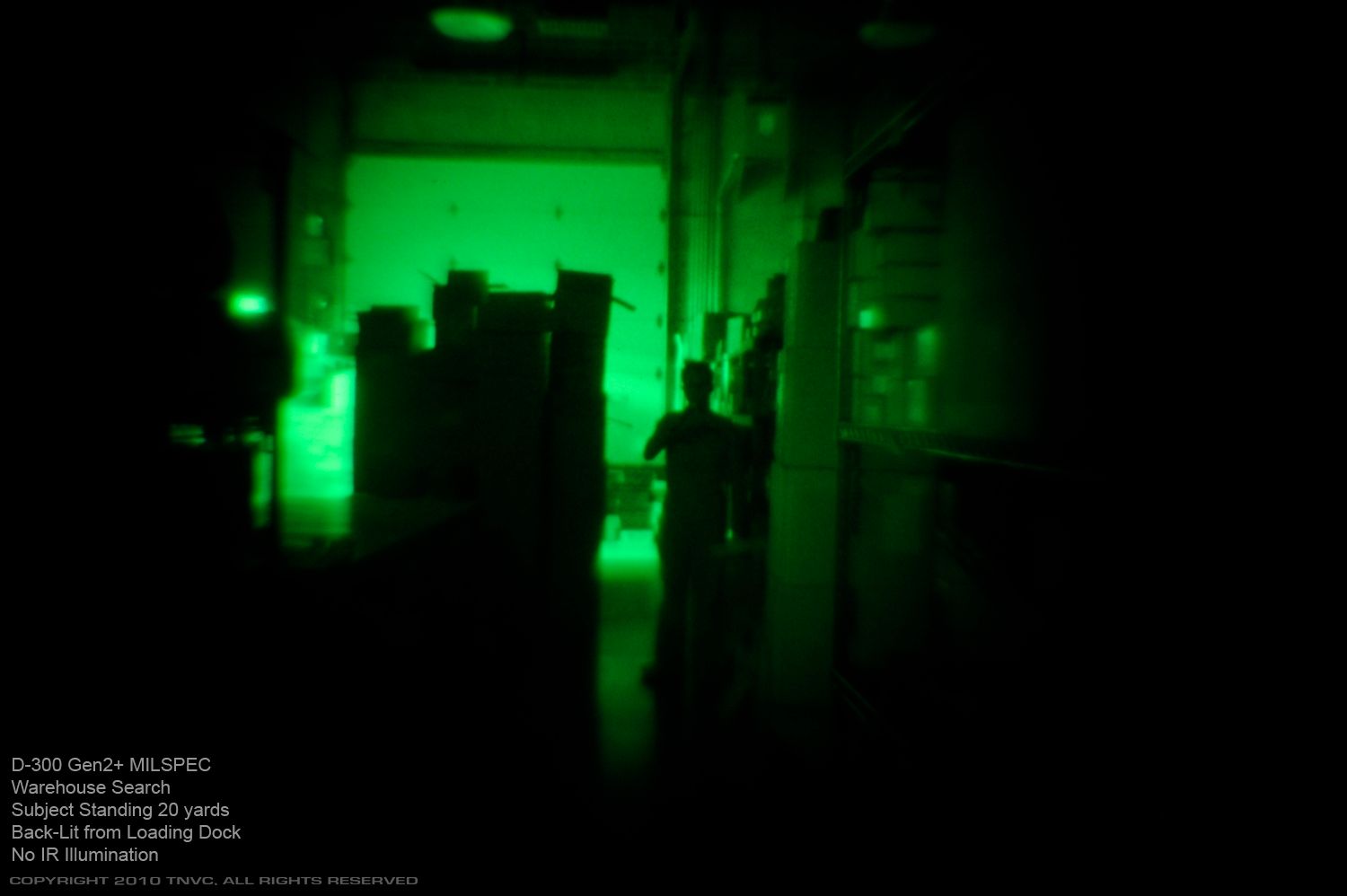
The built-in IR illuminator did not add any value to the image. It is negligibly lighter. 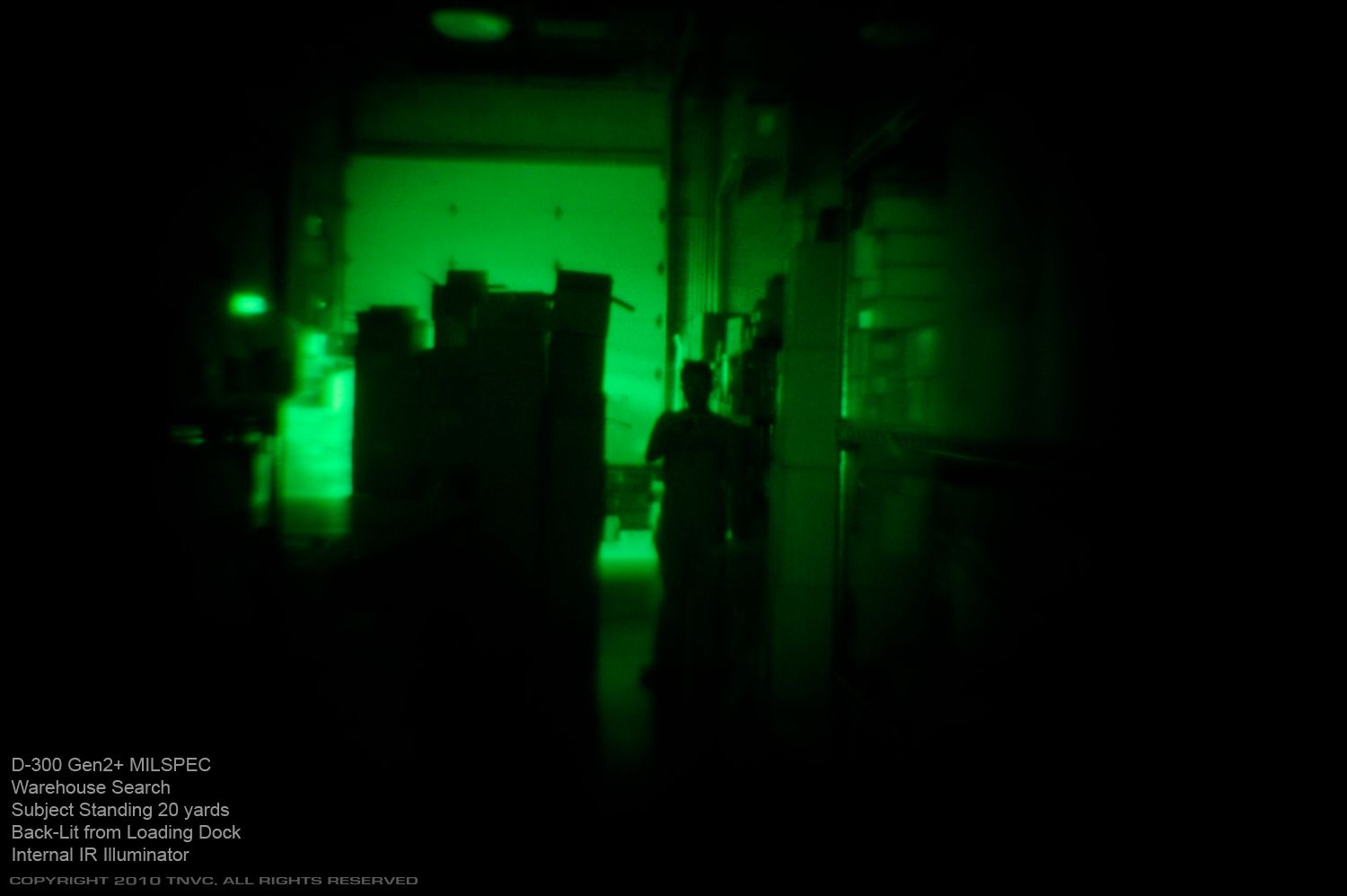
The additional higher-power illuminator is required for any useable image with the Gen2+ image intensifier. Even then, the limited capabilities of this tube produce a dark image. The subject is visible, along with the presence of a weapon. However, the image is too dark to detect any additional threats, limiting the user’s situational awareness. 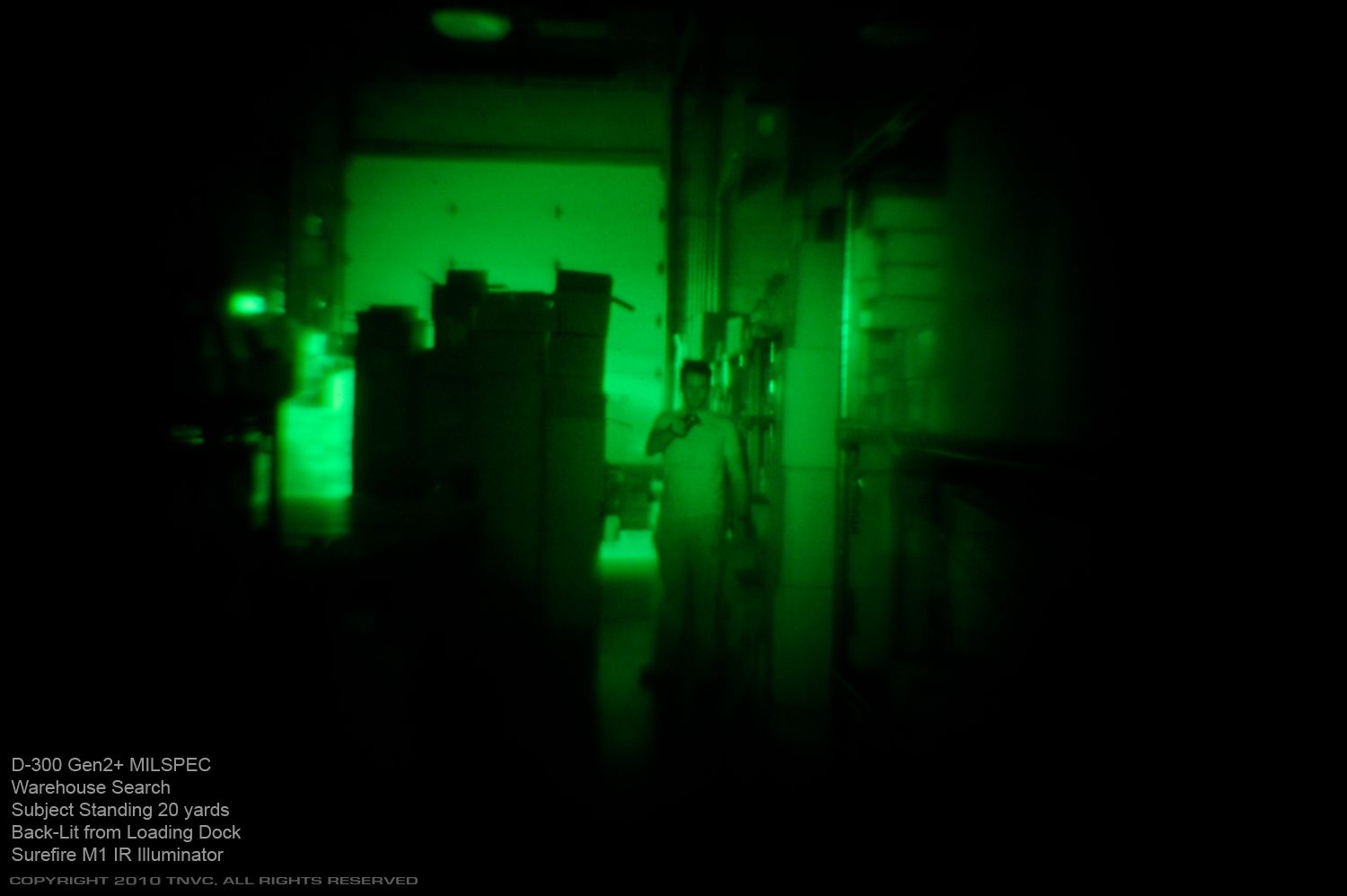
ATN Viper Gen1+ Image Intensifier The Gen1+ tube fails to deliver any useable image. The resolution is very poor and the image is completely back-lit, providing no detail of the subject. It is impossible to determine the threat level. 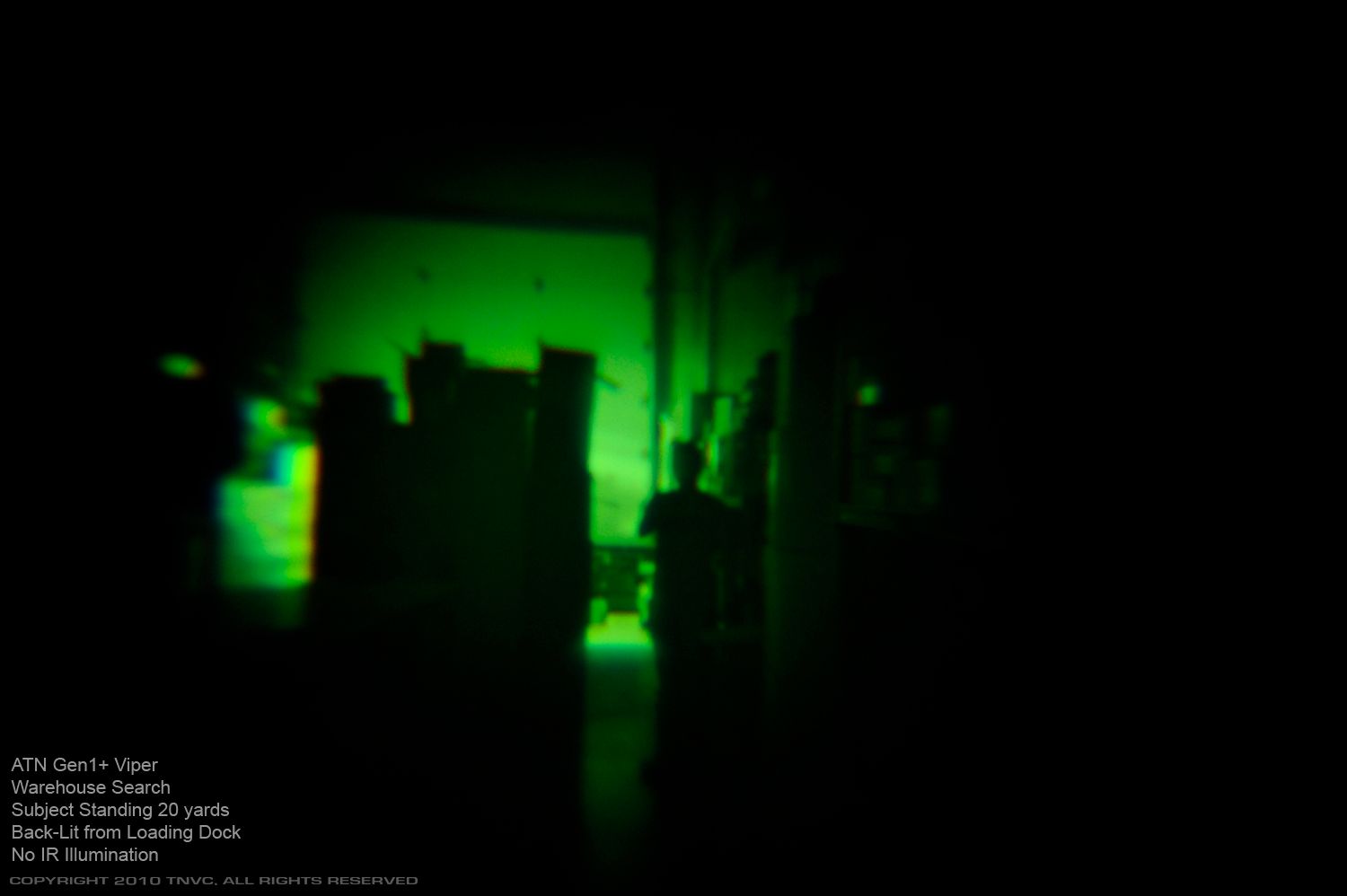
The built-in IR illuminator did not add any value to the image. It is negligibly lighter. Very faint detail can be seen in the image, but the weapon is still not detected. 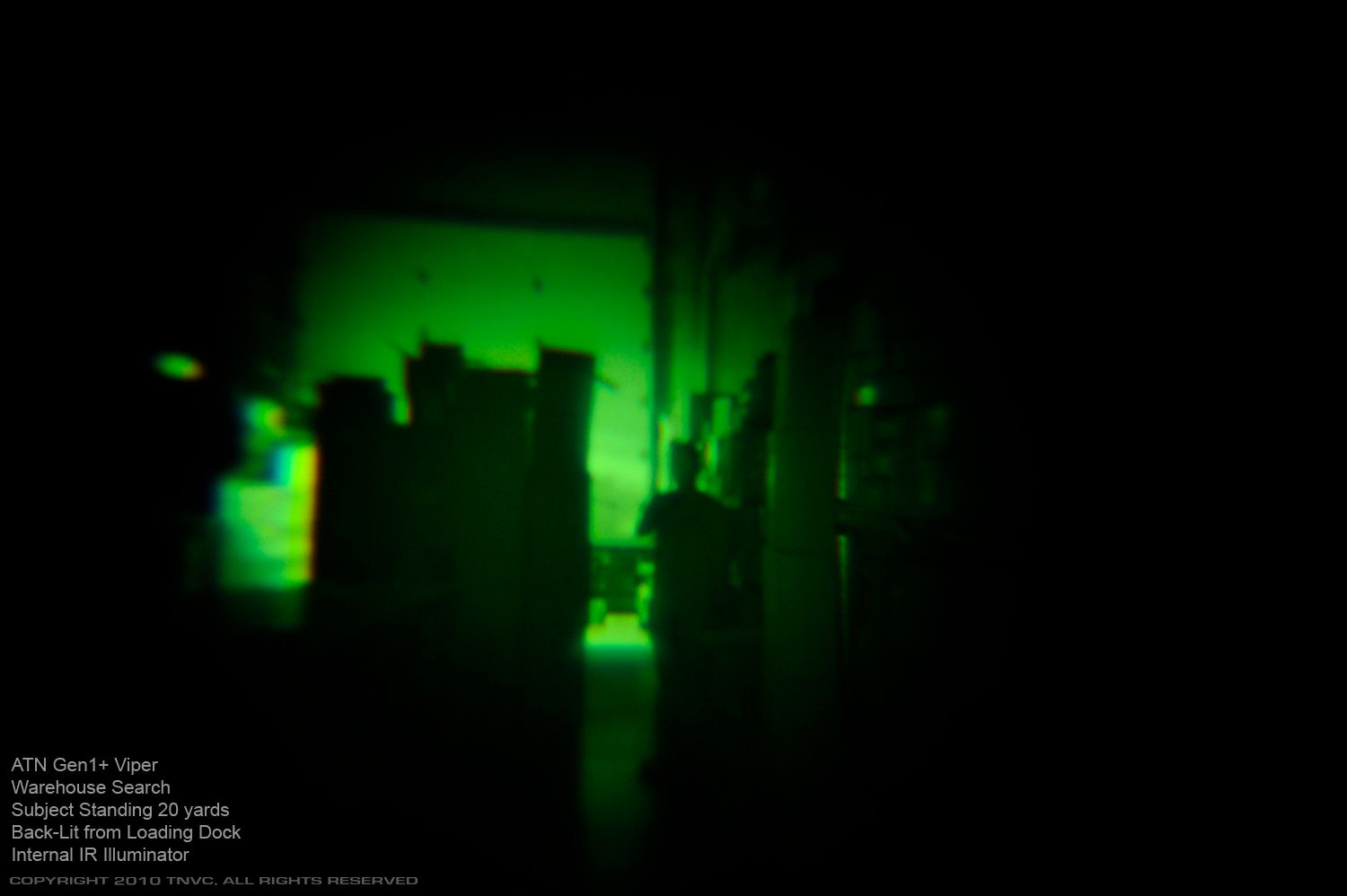
The additional higher-power illuminator is required for any useable image with the Gen1+ tube. However, the lack of resolution is still so apparent, that it is difficult to acquire the weapon. 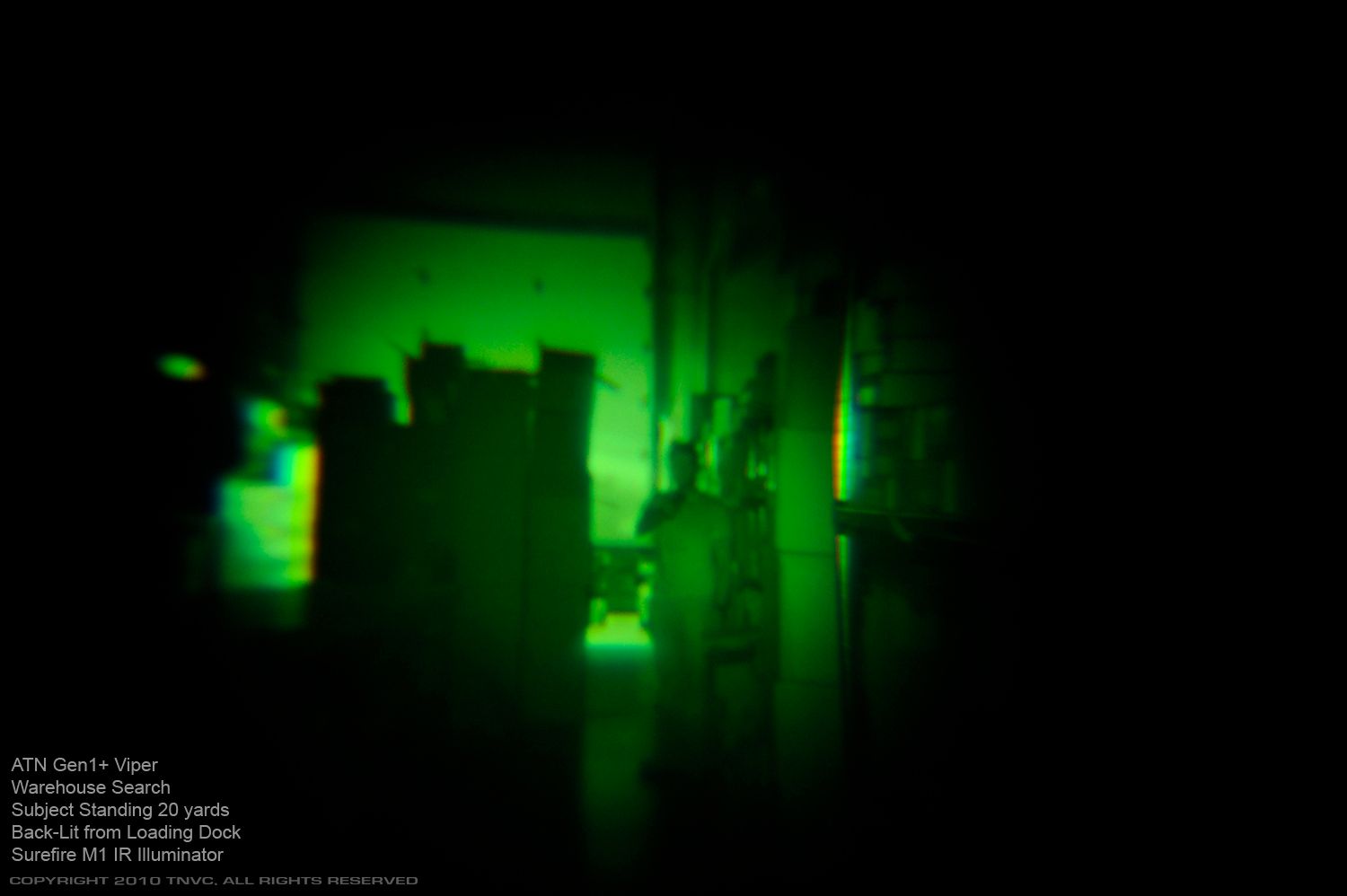
Thoughts- This exercise illustrates a common scenario for law enforcement professionals. There was ample ambient light from the loading dock. As expected, the Gen3 units performed extremely well, providing high resolution images that immediately acquired the threat. The Gen2 SHP still performed well, though there was a noticed lower resolution. The Gen2+ and Gen1+ failed to produce any real useable information. The photos prove that they are borderline dangerous for professional use. Test Scenario 7 – Parking Lot Search This scenario was designed to test the equipment in a common patrol application, searching a parking lot for a hiding subject. Environmental lighting was minimal, as would be the case in an industrial parking area during non business hours. ITT PVS-14 Night Enforcer Gen3 PINNACLE Auto-Gated Image Intensifier The Gen3 PINNACLE Auto-Gated tube clearly acquires the subject behind the vehicle. The environment details are shown clearly. The subject is partially obscured and in shadow behind the vehicle. A weapon is partially visible in his hand. 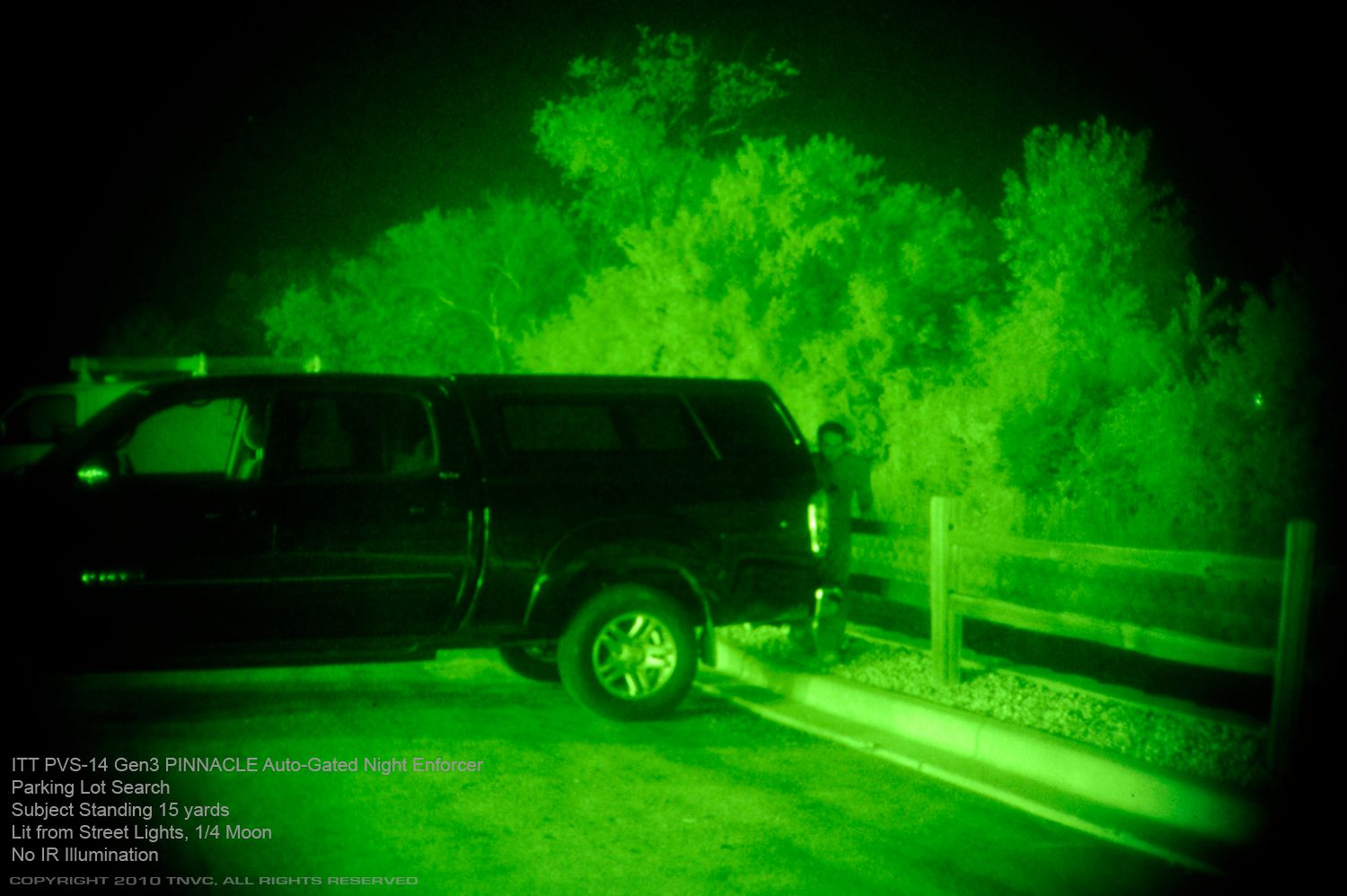
The built-in IR illuminator did not add any value to the image. It is negligibly lighter. 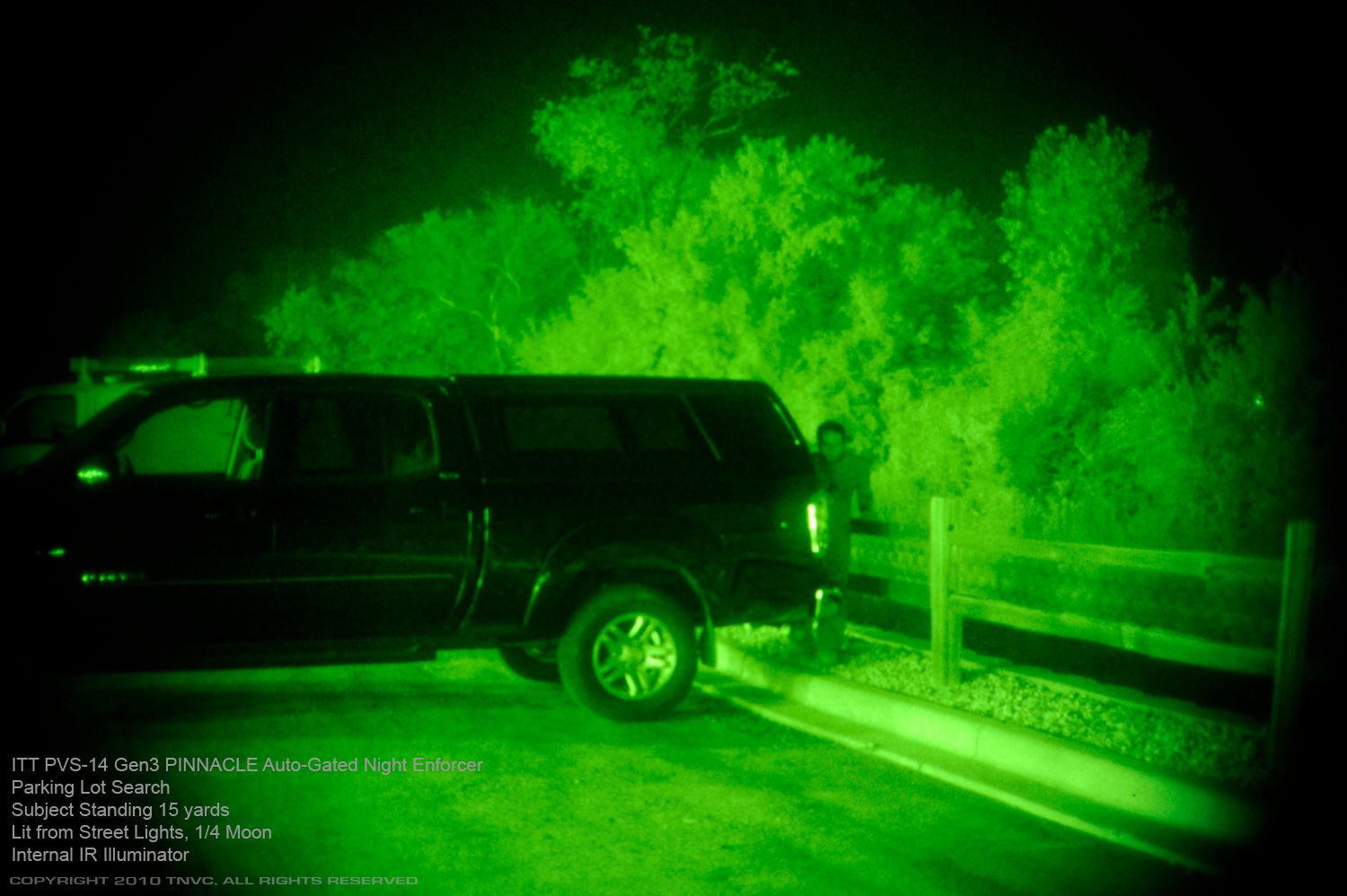
The additional higher-power illuminator heavily brightens the image. The IR light reflects off the subject so much that he appears to glow. However, shadows are completely illuminated. The weapon clearly contrasts against the lighter shirt. 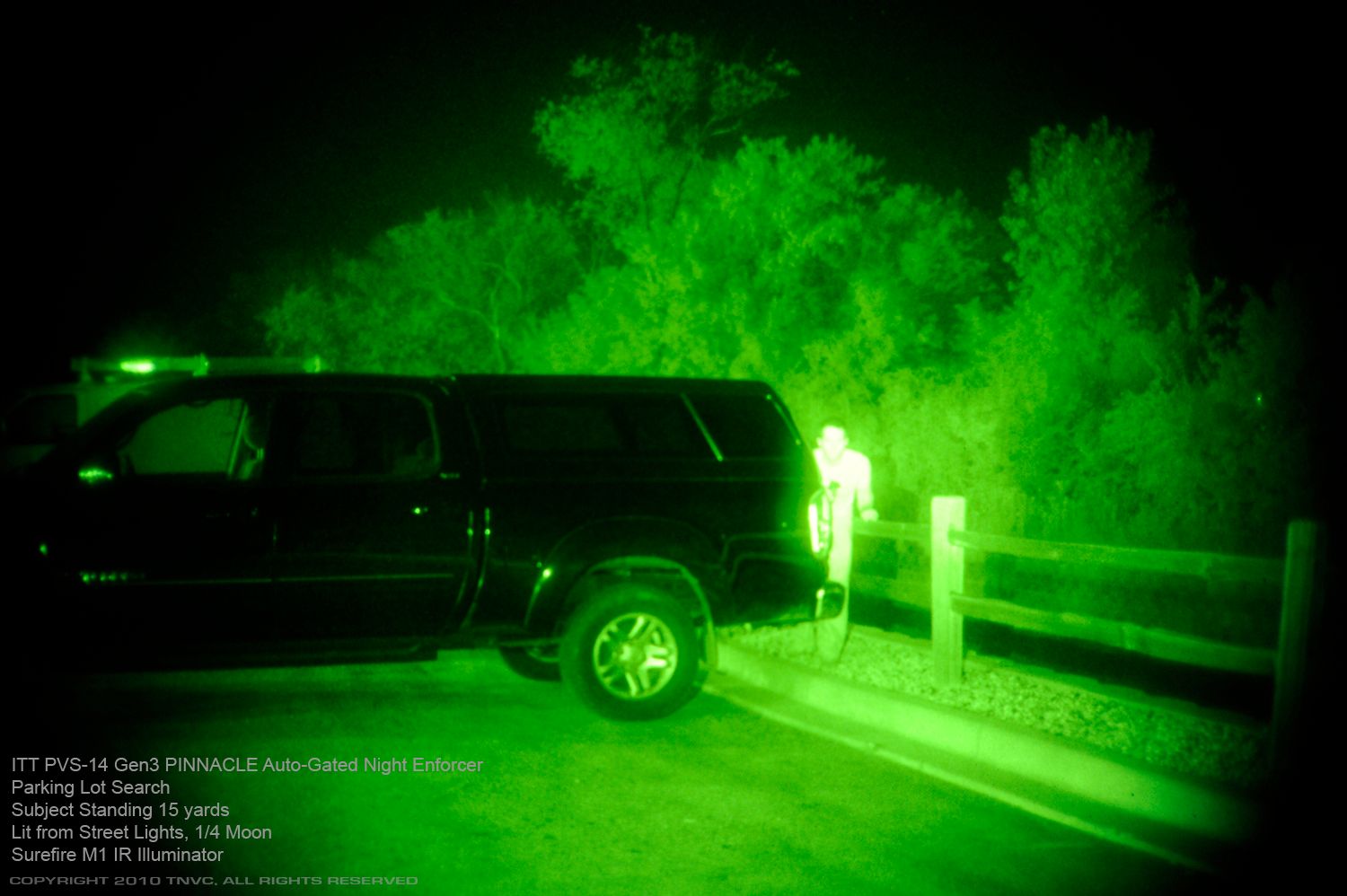
Litton PVS 14 Gen3 Auto-Gated Image Intensifier As with the PINNACLE unit, the Litton Gen3 Auto-Gated tube clearly shows the scene with the subject behind the vehicle, holding a weapon. 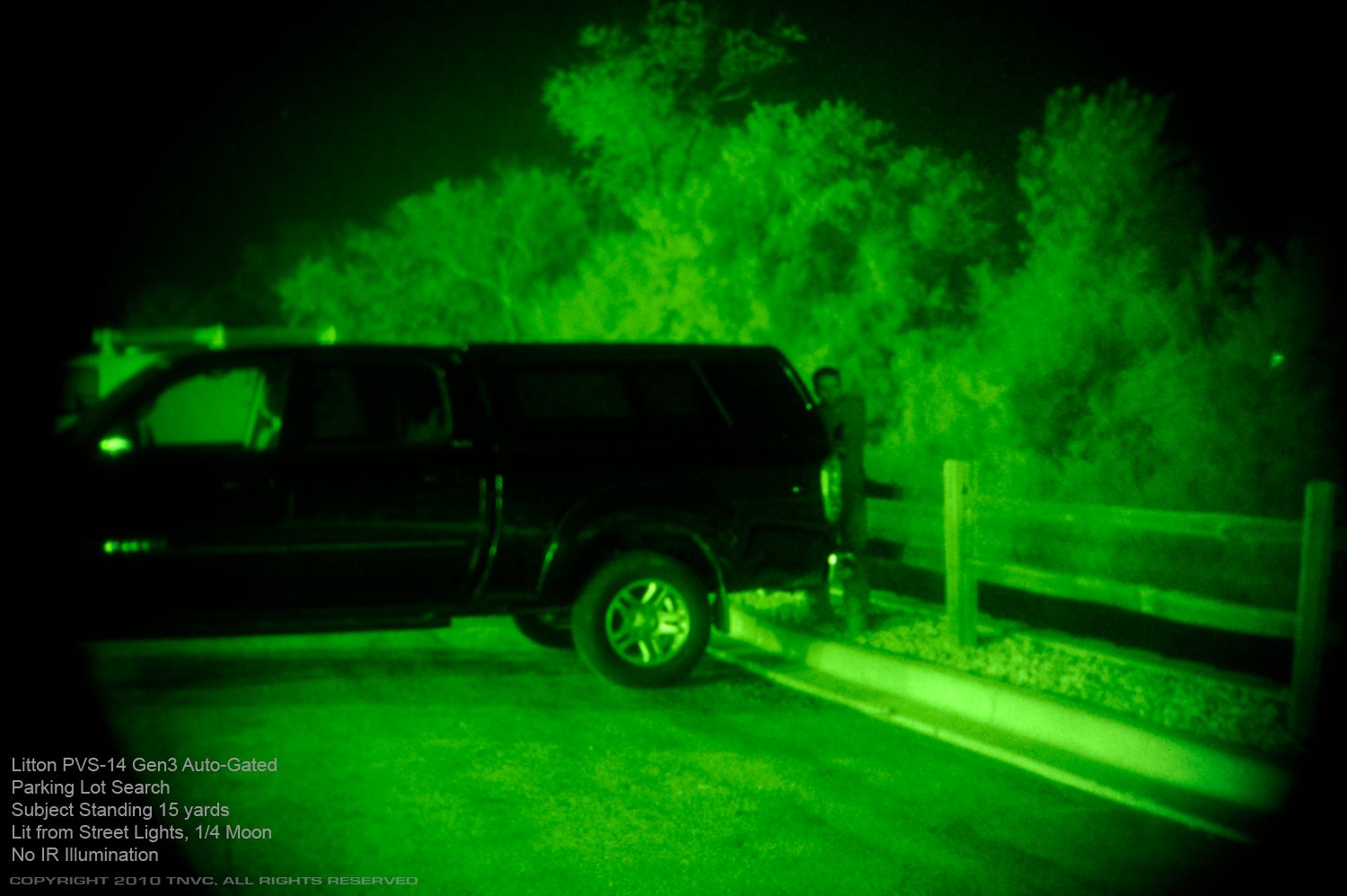
The built-in IR illuminator did not add any value to the image. It is negligibly lighter, with some IR reflection on the tail light. 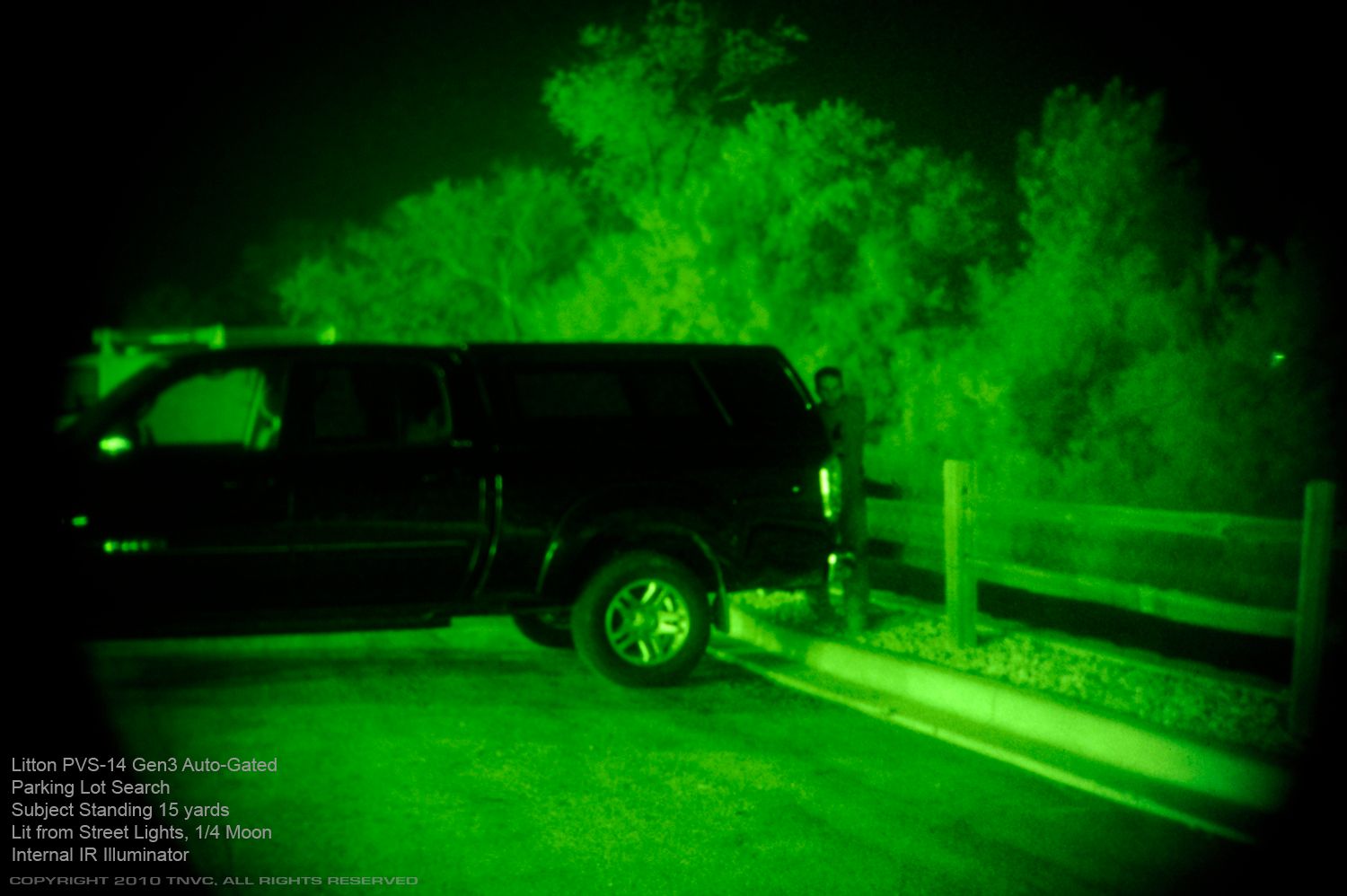
The additional higher-power illuminator heavily brightens the image. The IR light reflects off the subject so much that he appears to glow. However, shadows are completely illuminated. The weapon clearly contrasts against the lighter shirt. 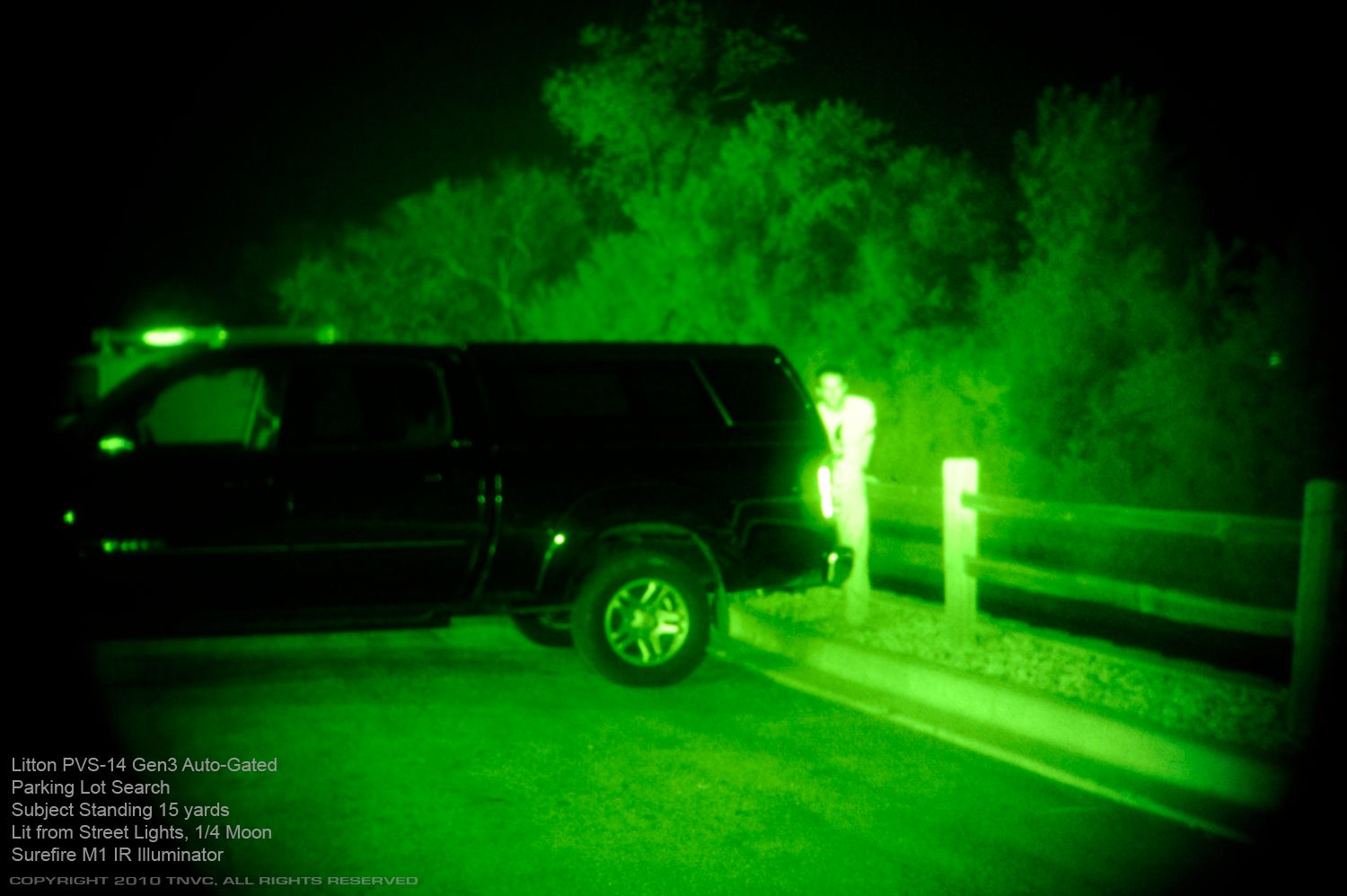
GT14 Gen2SHP Image Intensifier The Gen2 SHP tube does a good job of displaying the image. There is less resolution than with the Gen3 units, but the image is still useable, clearly showing the subject behind the vehicle with a weapon. 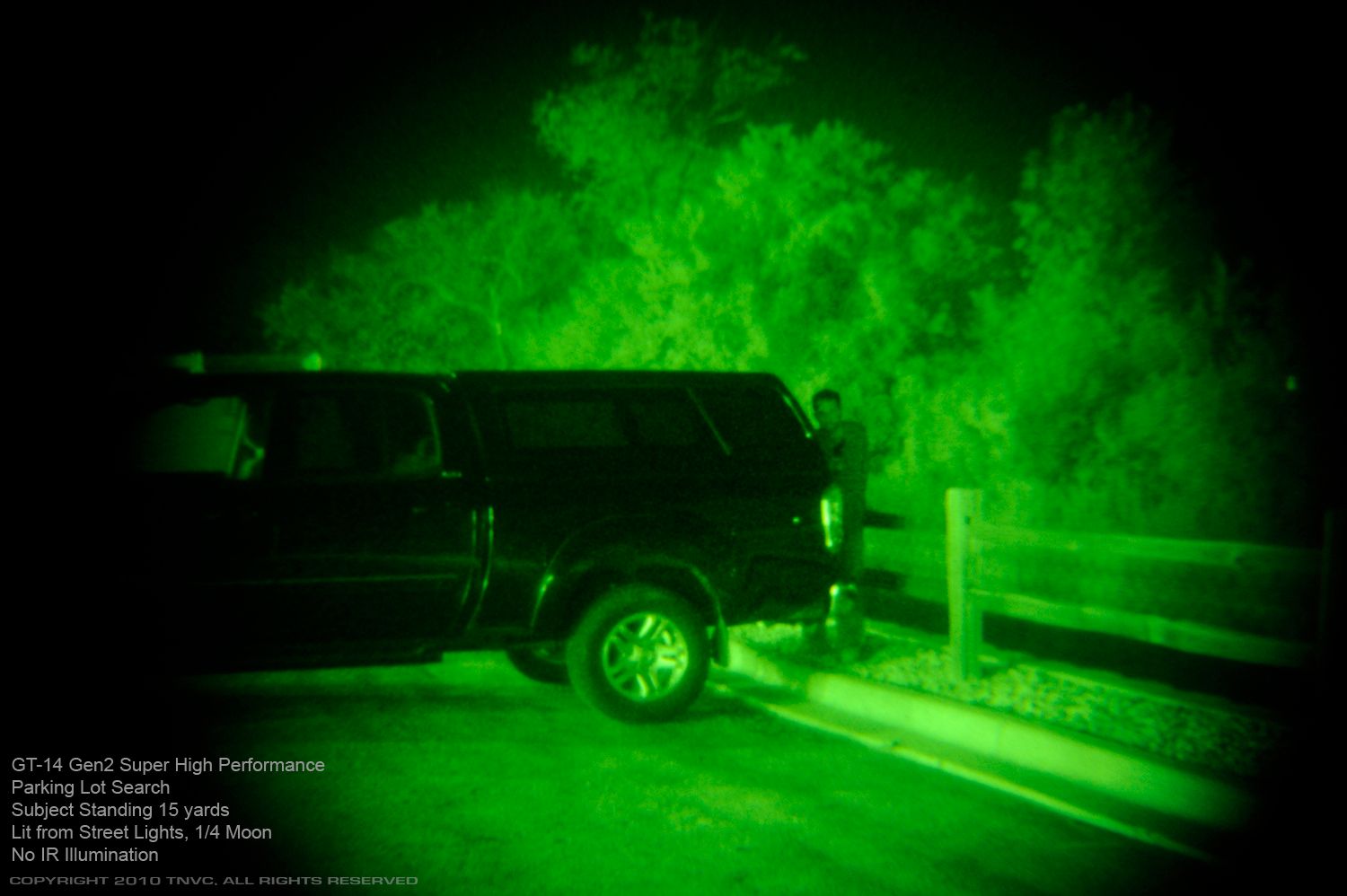
The built-in IR illuminator did not add any value to the image. It is negligibly lighter. 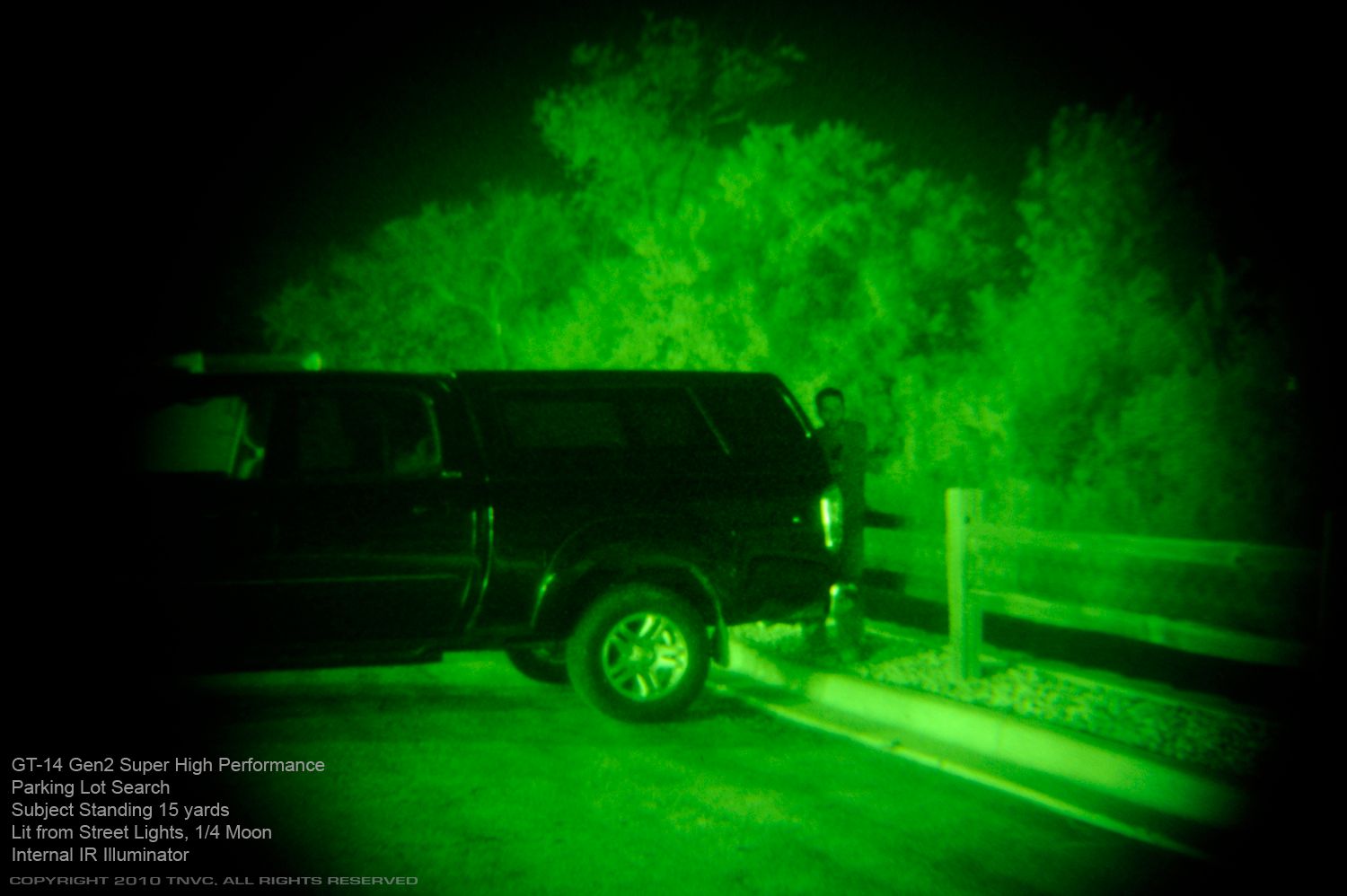
The additional higher-power illuminator brightens the shadows, revealing the subject more. The weapon is clearly seen against the subject’s shirt. 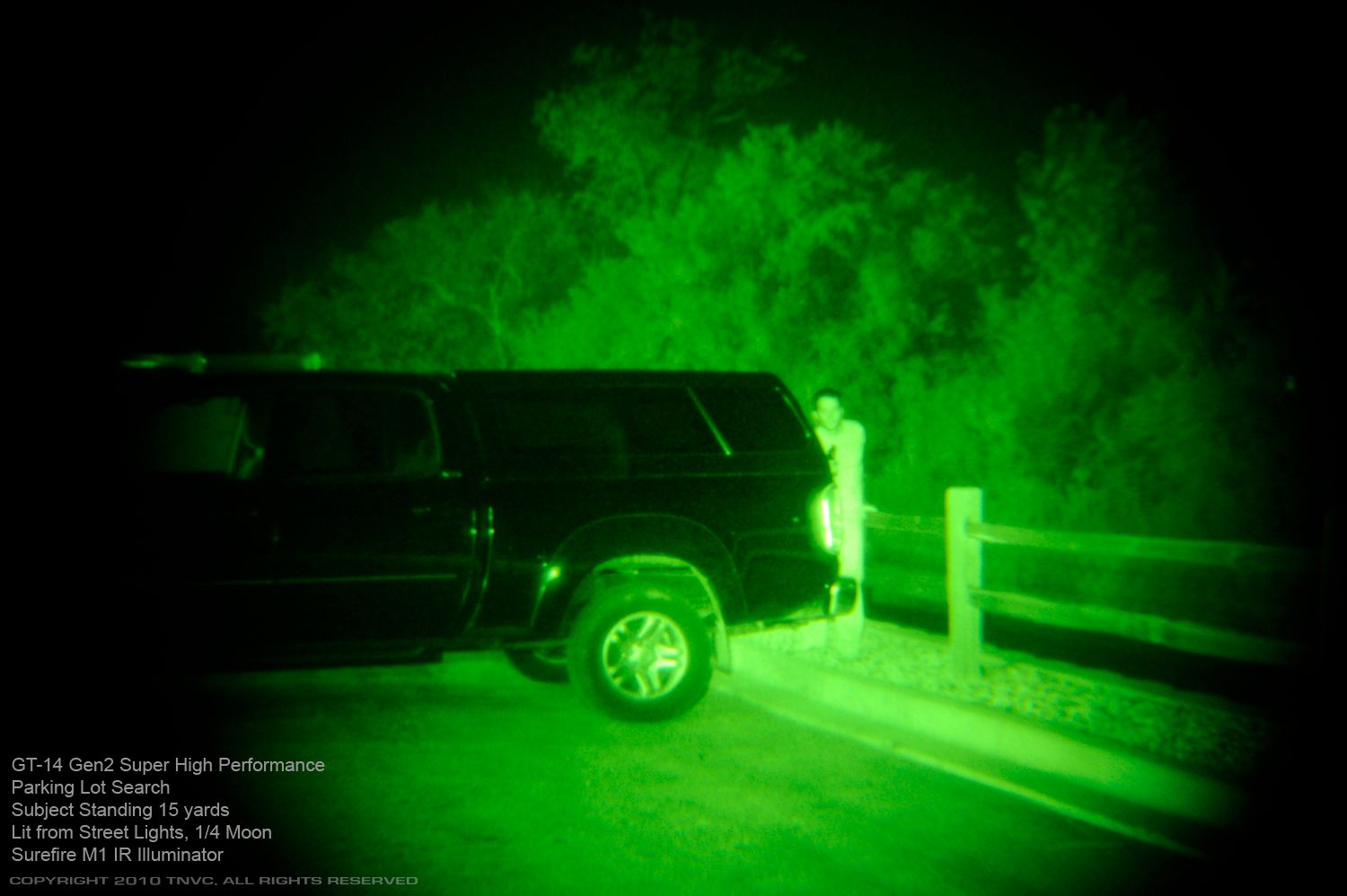
D300 Gen2+ MILSPEC Image Intensifier The Gen2+ unit displays a very dark image. Details of the dark vehicle are indistinguishable. The light rims are easily seen. The subject is almost completely obscured behind the vehicle, making it almost impossible to acquire him. 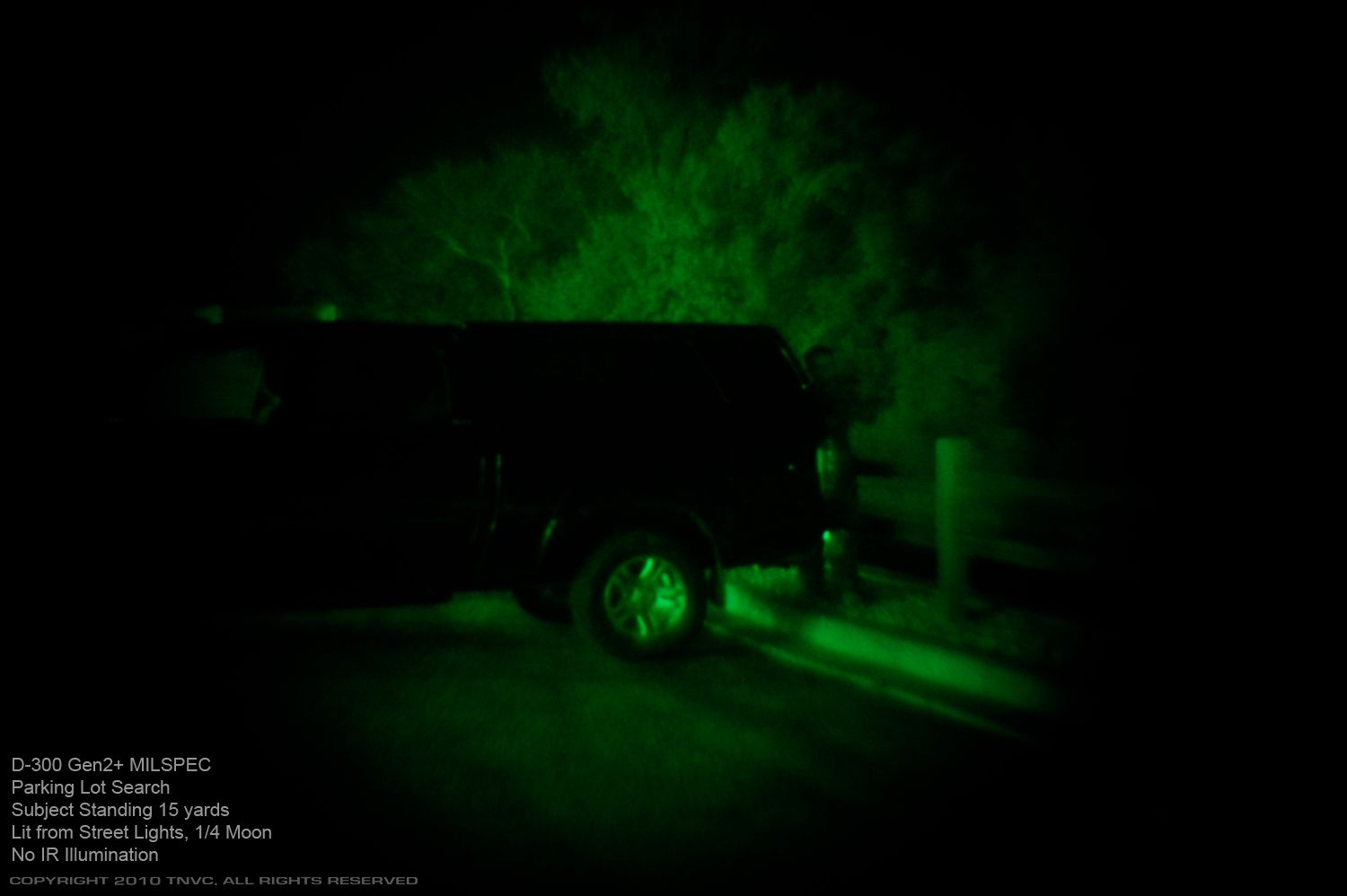
The unit detects a reflection of IR light from the tail light when using the built-in illuminator. This inadvertently draws the user’s eye to that location where the subject is partially visible. The weapon is undetected. 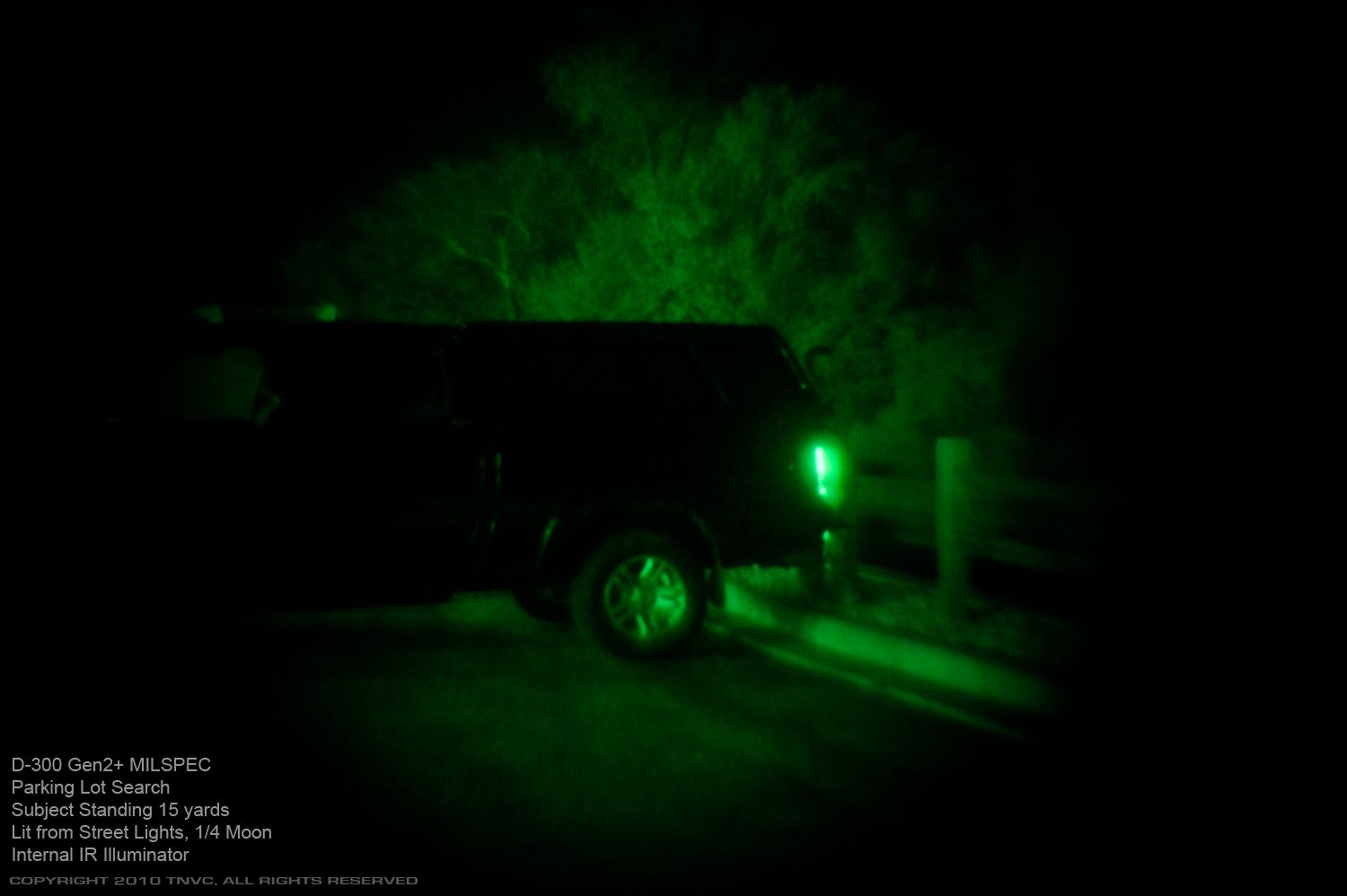
The additional higher-power illuminator is required to observe the subject and see the presence of a weapon. Other details are still much obscured because of the relatively poor light-gathering abilities of the Gen2+ tube. 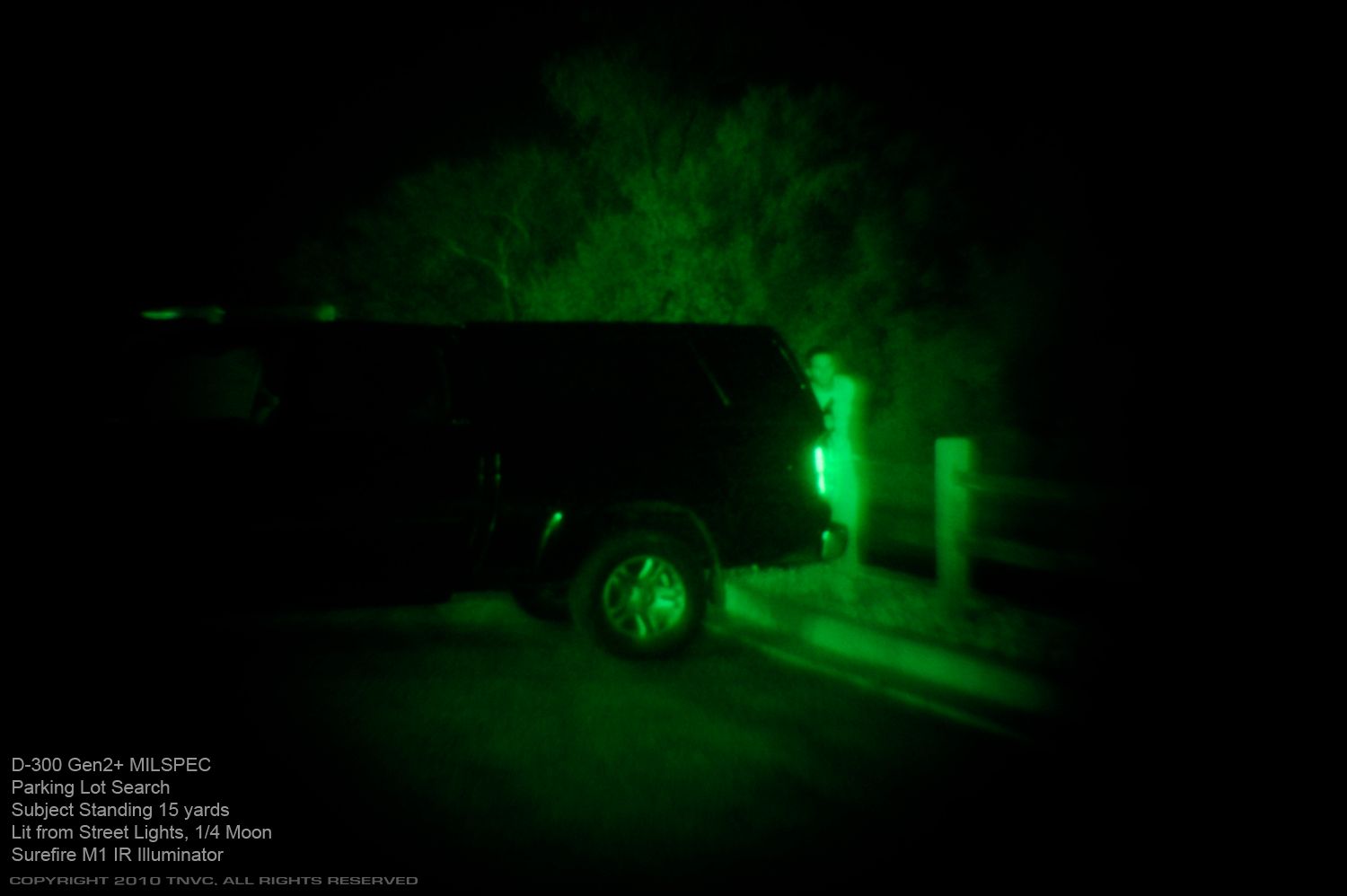
ATN Viper Gen1+ Image Intensifier The Gen1+ unit produces no image without the addition of an IR light source. It is too weak to use the loading warehouse lights in the distance. 
The built-in IR illuminator did not add any value to the image. All that can be seen is the reflection of IR light from the tail light, but it still does not produce enough light to see the subject. 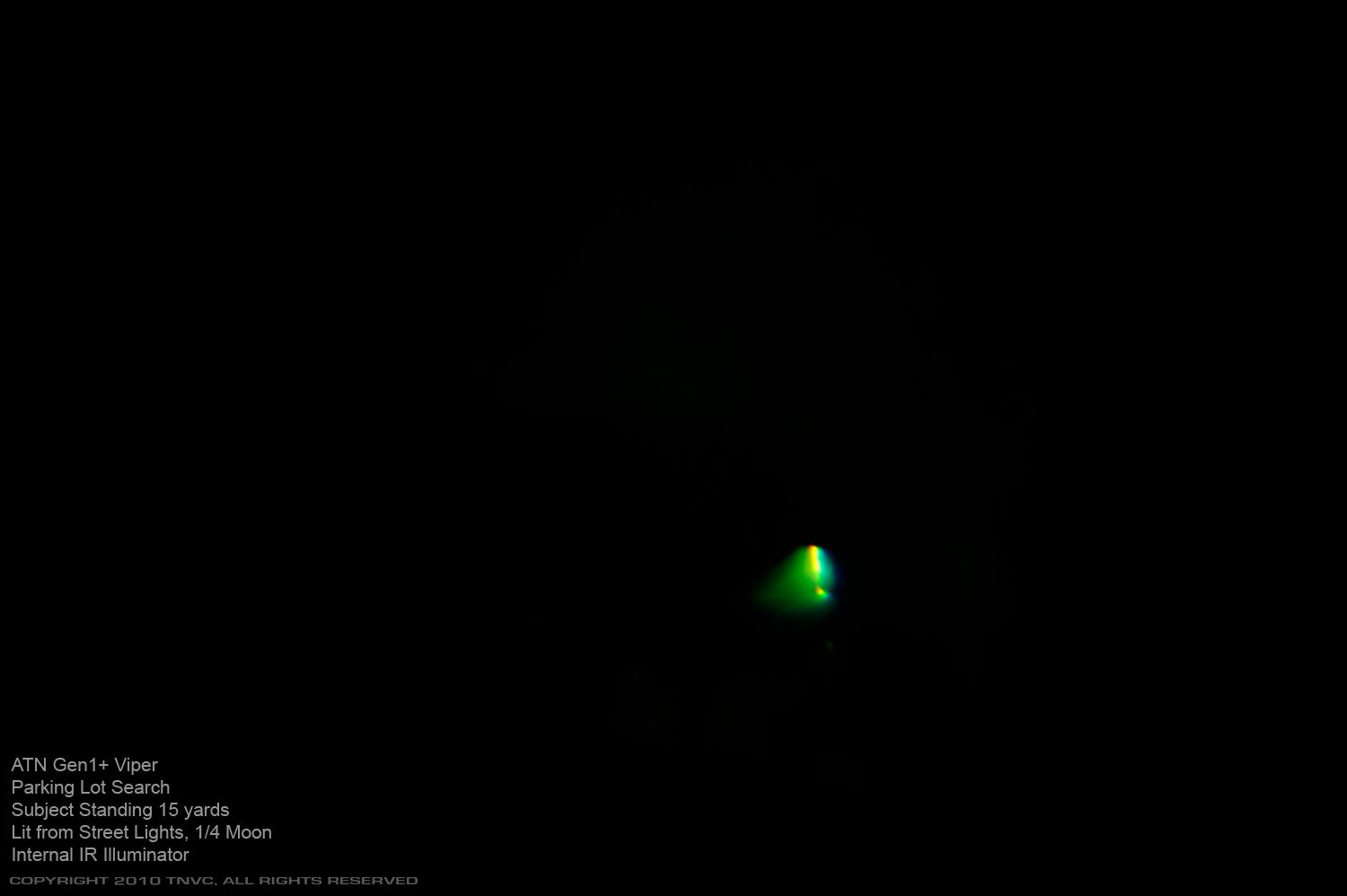
The additional higher-power illuminator cannot help the Gen1+ tube much. It still does not have enough light to resolve an image. The subject is barely visible behind the vehicle, but there is not enough of an image to properly acquire him or identify a threat. 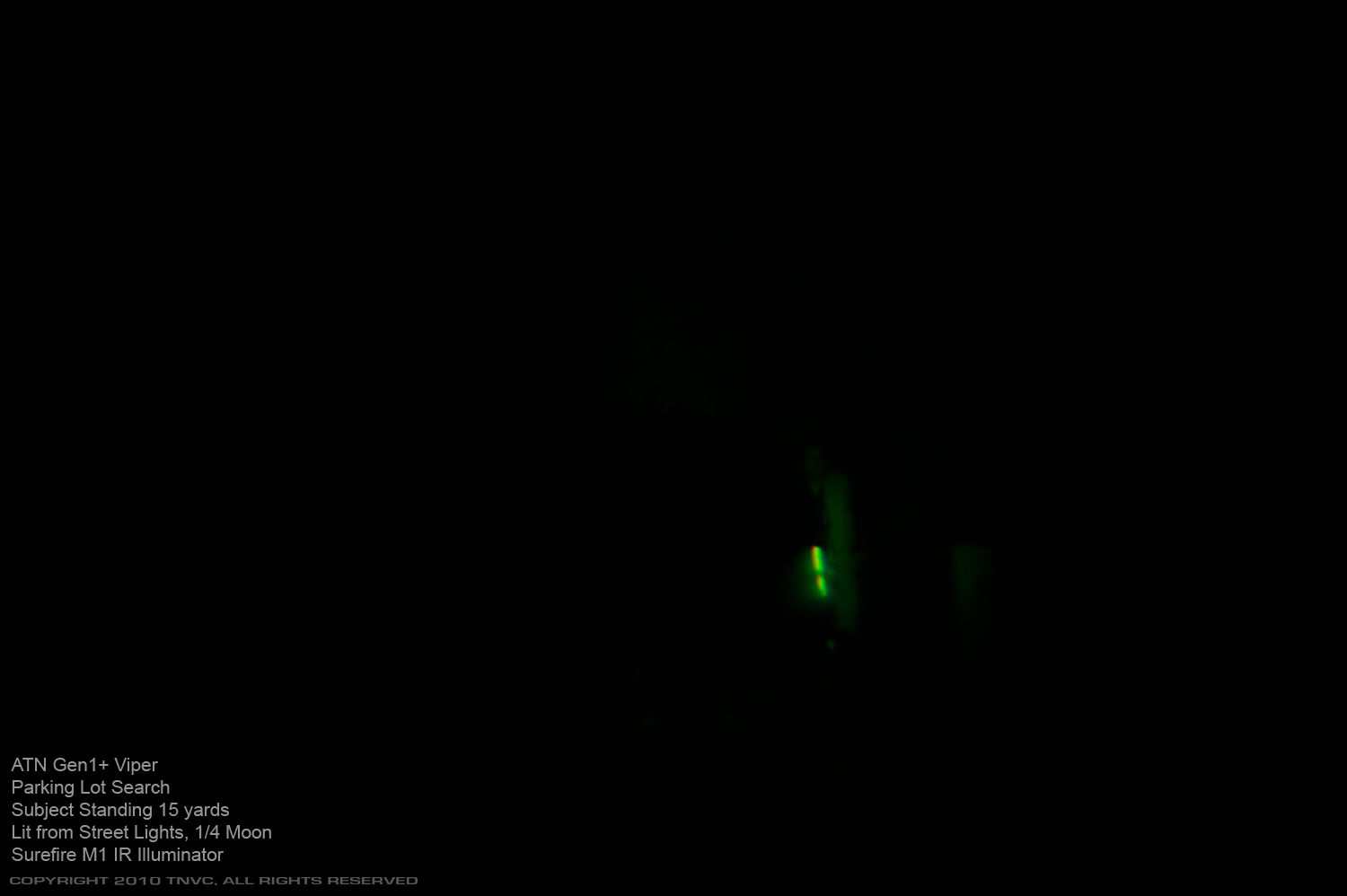
Thoughts- Again, the Gen3 PINNACLE, Gen3 Auto-Gated, and Gen2 SHP performed well with the Gen2 SHP providing a darker, but still useable image. Searching a parking lot is a common scenario for law enforcement. The low-performing Gen2+ and Gen1+ units proved incapable of properly acquiring the subject and identifying the threat. Test Scenario 8 – Loading Dock Search This scenario was designed to simulate the search of a loading dock or truck yard for hidden subjects of devices. The environment was well-lit, which as you can see in the photos, actually works against all but the highest quality image intensifiers due to the high level of contrast created by the dark shadows under the vehicle. A quick search of the area might not detect the subject under the truck cab. ITT PVS-14 Night Enforcer Gen3 PINNACLE Auto-Gated Image Intensifier The scene is brightly lit from the loading dock lights. The truck is well-illuminated, but the light source creates heavy shadow under the cab. Even so, the Gen3 PINNACLE Auto-Gated tube detects something under the cab, just before the wheel. While the subject is not completely acquired, the mere detection offers more information and will alert the officer to a possible danger. The rest of the scene is well-lit with crisp detail, giving the officer good situational awareness. 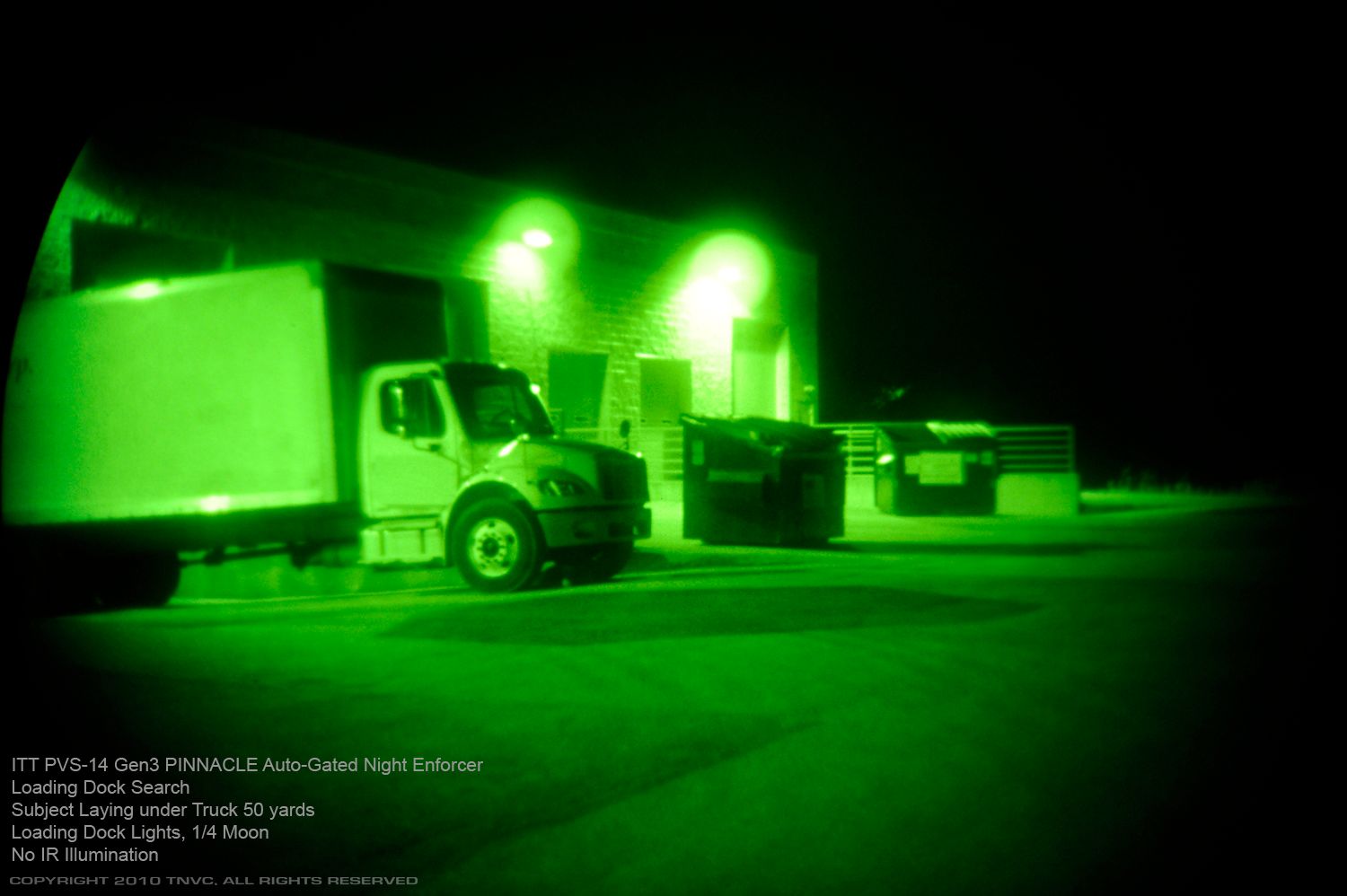
The built-in IR illuminator does not add much to the scene, though it does slightly illuminate the area under the cab. 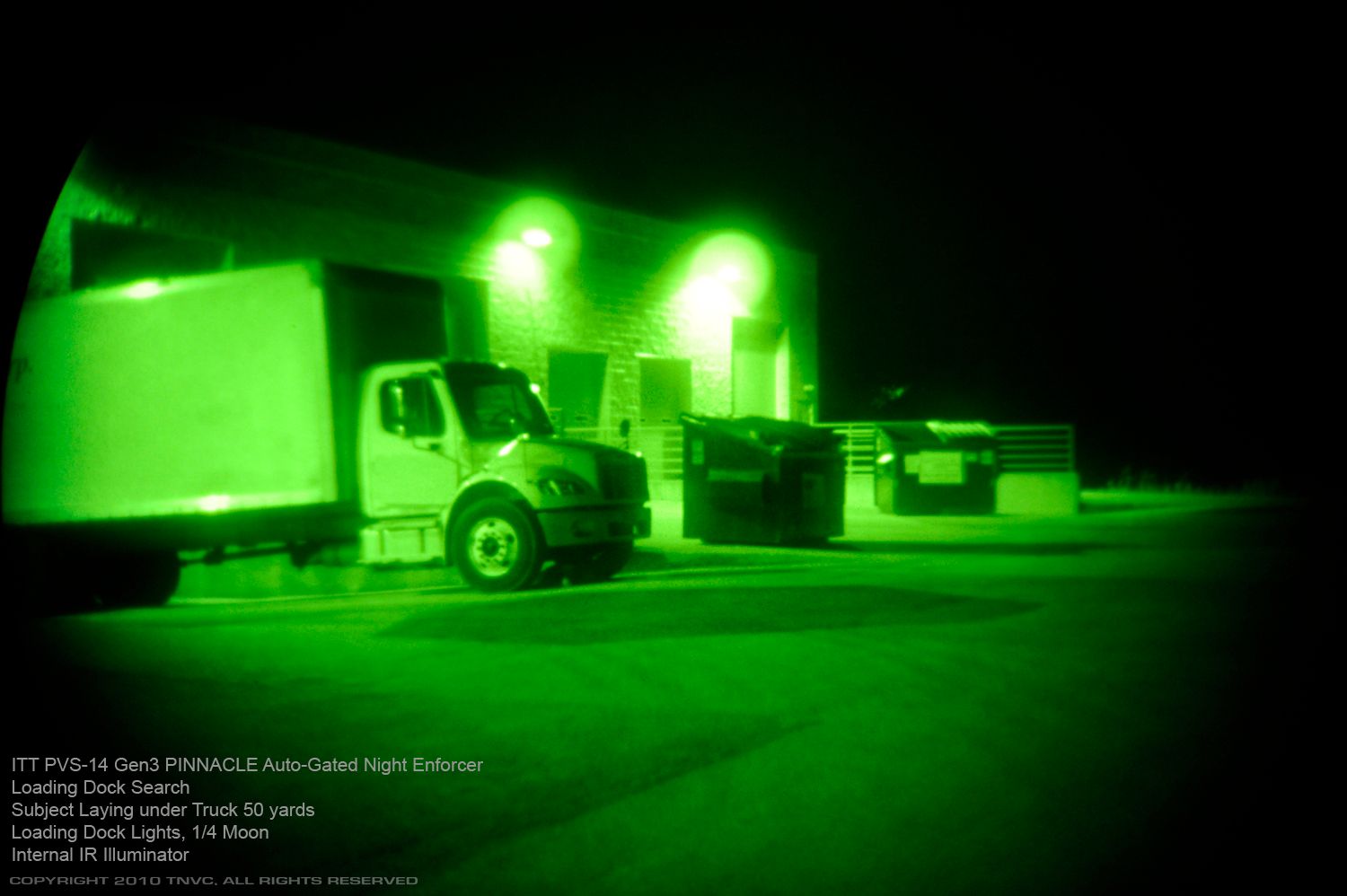
Using the additional IR illuminator, the subject is clearly seen lying under the cab. This is a tough scenario to acquire a threat, making it all the more dangerous. While a weapon cannot be identified, the officer will at least know someone is hiding under the vehicle. The highly sensitive Gen3 PINNACLE Auto-Gated tube has enough information to acquire the subject and identify his head and clothing. 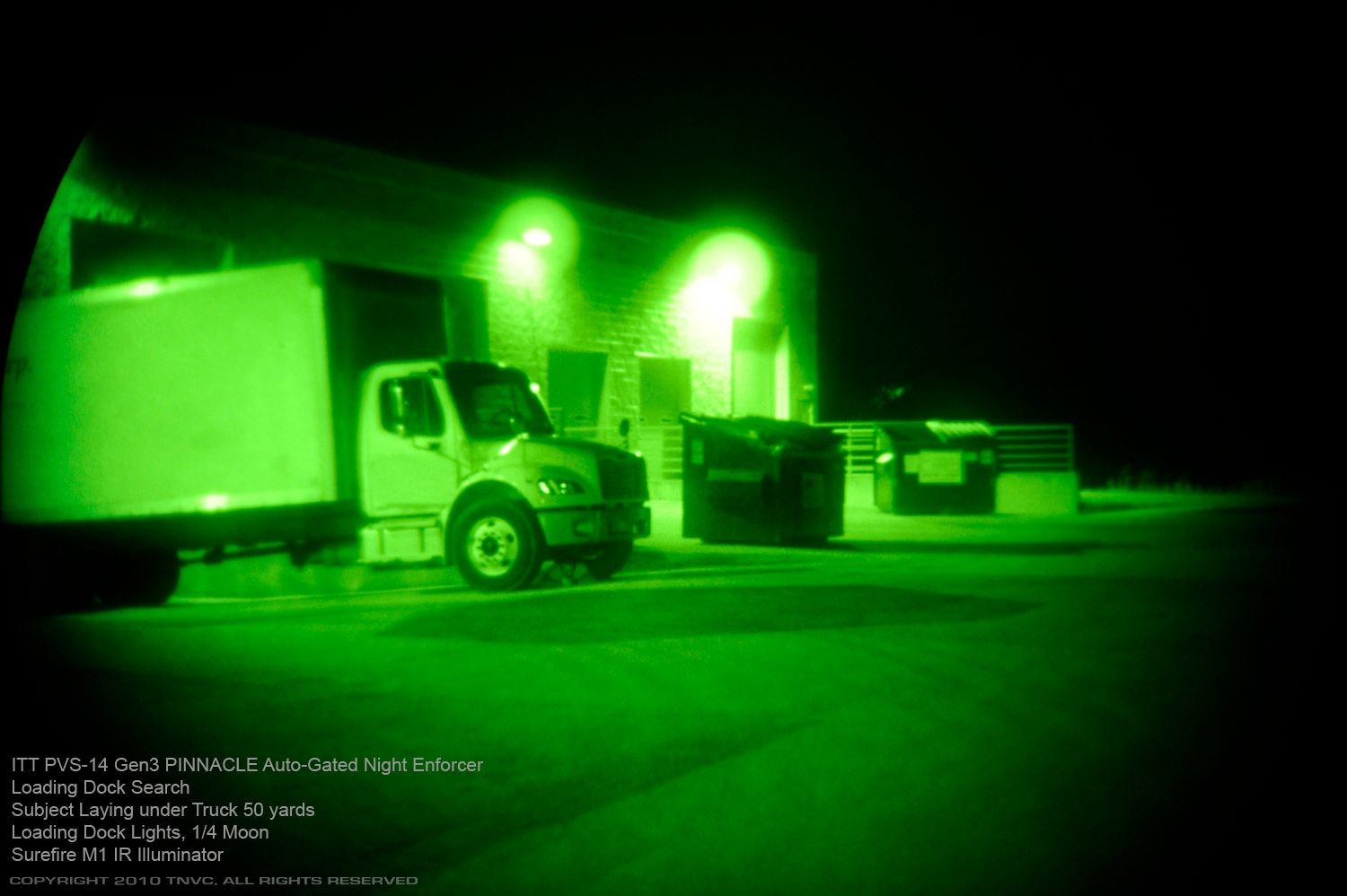
Litton PVS 14 Gen3 Auto-Gated Image Intensifier This scenario highlights the difference between the Standard Litton Gen3 Auto-Gated tube and the ITT Gen3 PINNACLE Auto-Gated tube. The Gen3 Litton Auto-Gated unit is not as capable of providing as bright an image as the PINNACLE unit. The image appears to have more contrast because the shadow areas are darker. This can lessen situational awareness, but overall, the image is good and a clear view of the area is achieved. However, the main detriment in this scene is the heavy shadowing under the truck. The prone subject is completely in shadow. Unlike the PINNACLE unit where something could at least be identified under the cab, the Litton Gen3 Auto-Gated unit produces no warning of a possible danger due to its inability to gather as much light as the PINNACLE unit. 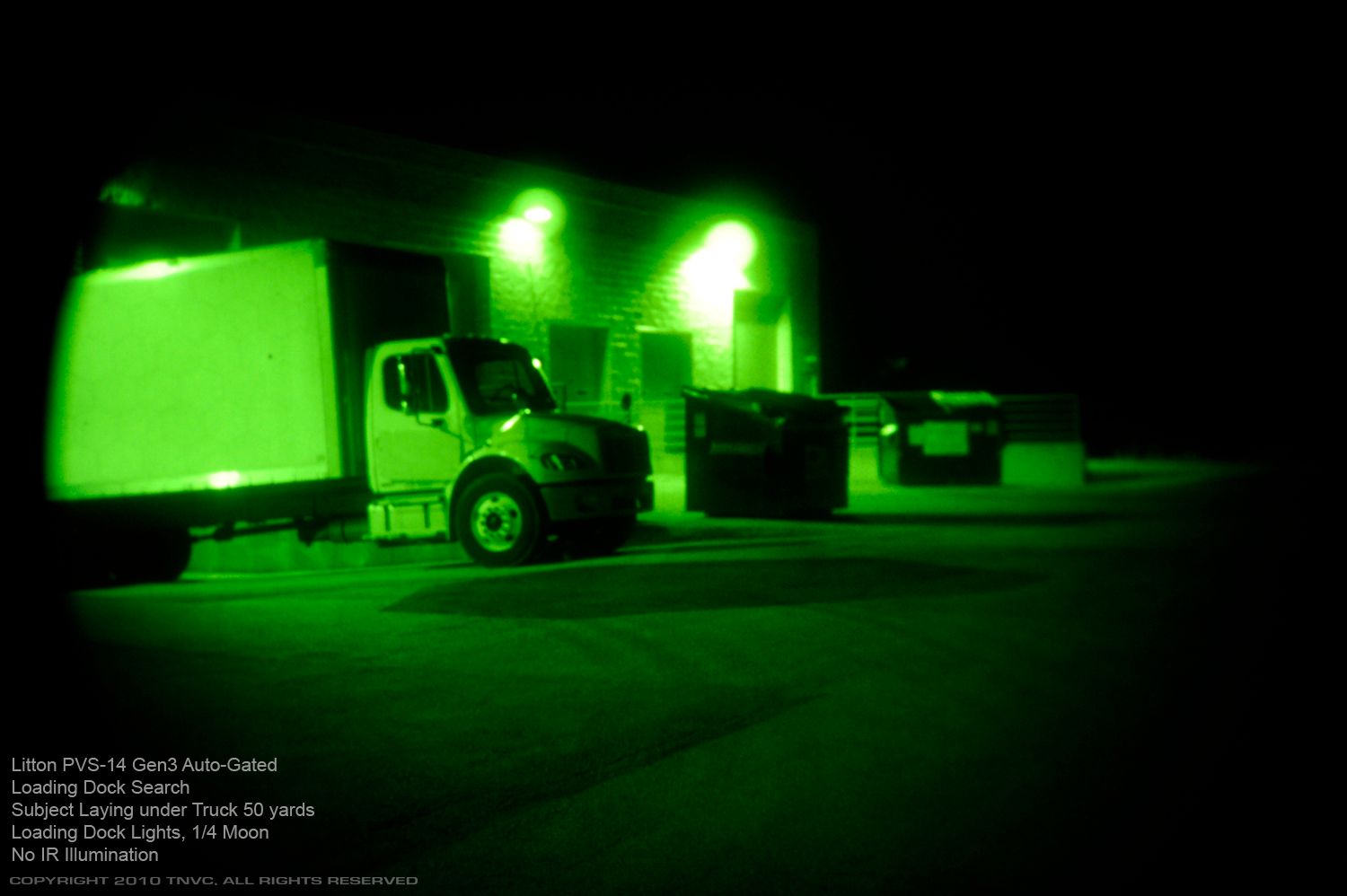
The built-in IR illuminator did not add any value to the image. It is negligibly lighter. The subject beneath the cab is still invisible. 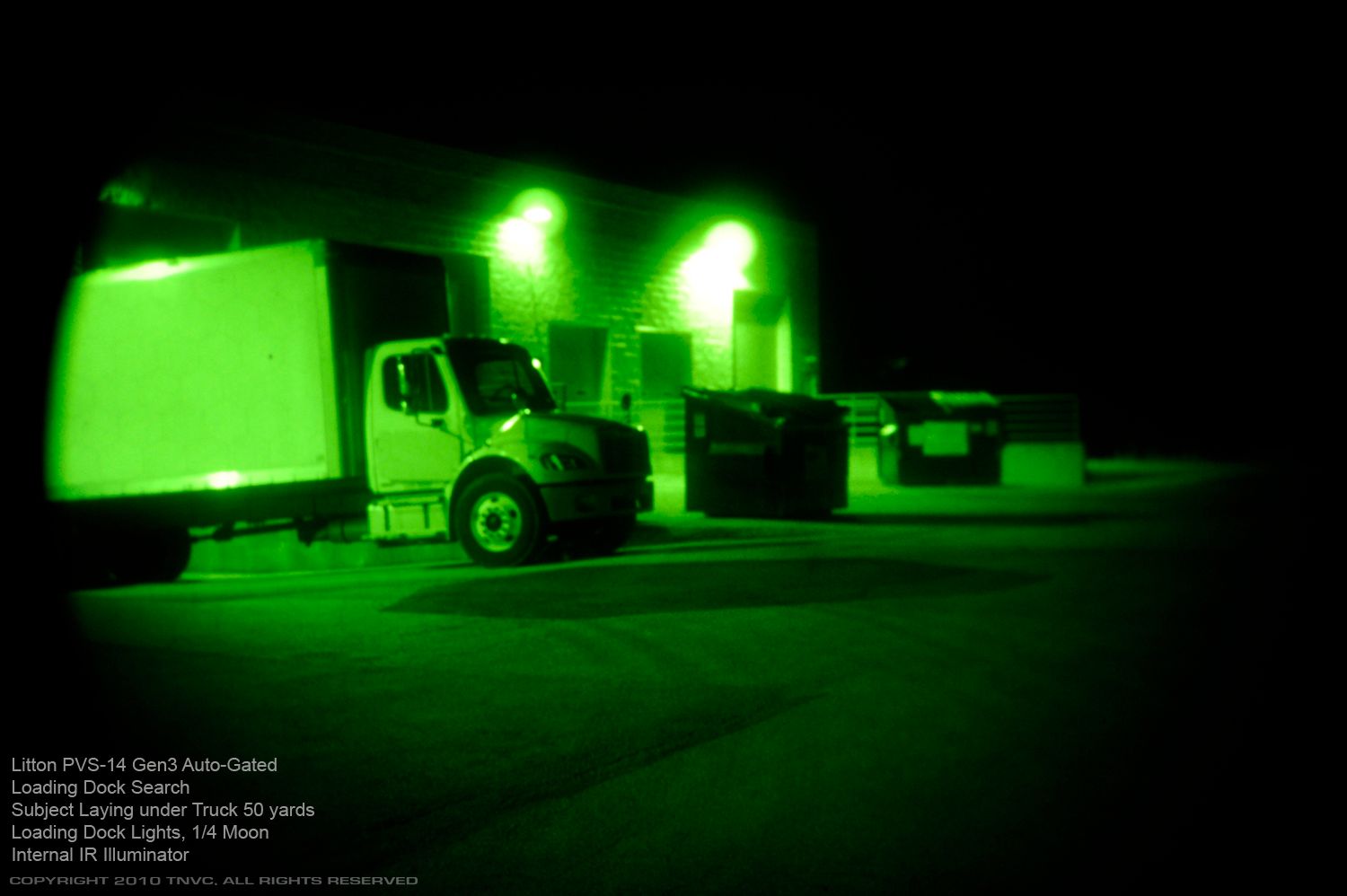
The additional higher-power illuminator begins to make the subject visible beneath the cab. However, the level of brightness seen here, with the Surefire M1 is almost the same as the naked image through the PINNACLE unit. But, at least the subject is visible to the officer and appropriate action can be taken. 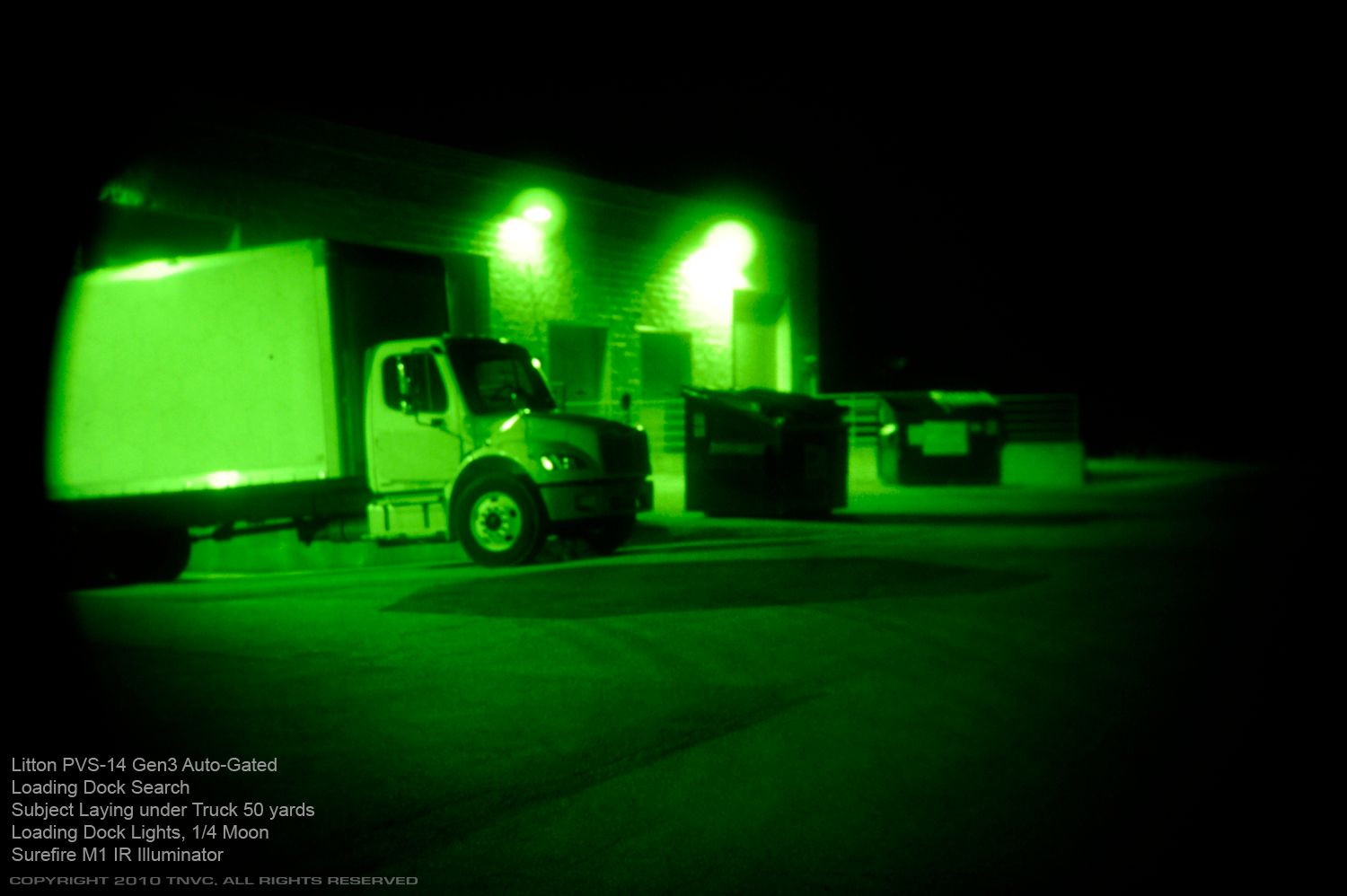
GT14 Gen2SHP Image Intensifier With the amount of available ambient light, the Gen2 SHP tube performs very similar to the Gen3 Auto-Gated unit. It produces an arguably lighter image. The main difference is the resolution and edge-to-edge clarity. While the image is bright, providing good situational awareness, the edges and definition of objects are noticeably fuzzier than the Gen3 units. The subject under the cab is barely visible, but the image is bright enough that something can be detected. 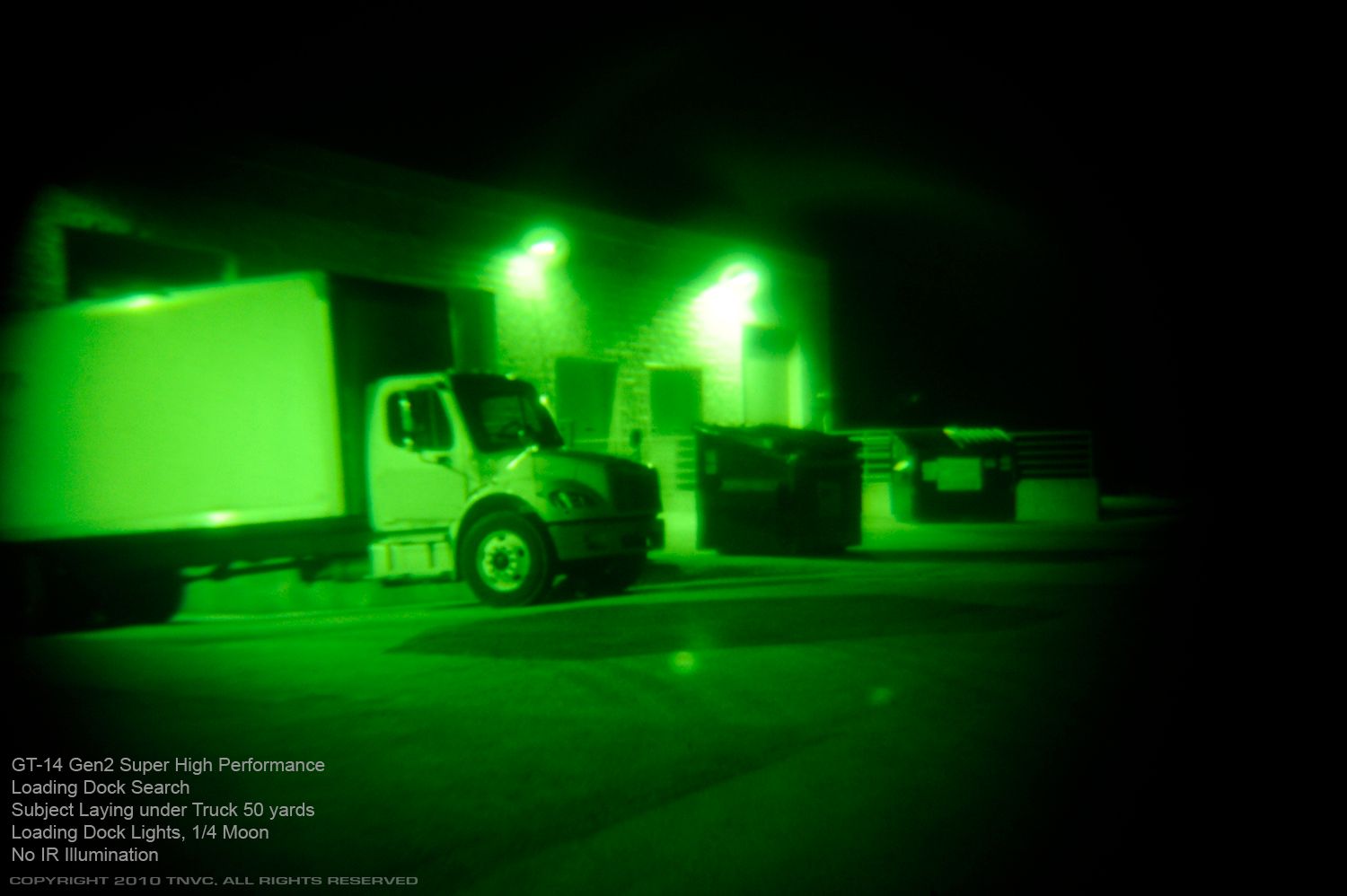
The built-in IR illuminator did not add any value to the image. It is negligibly lighter. 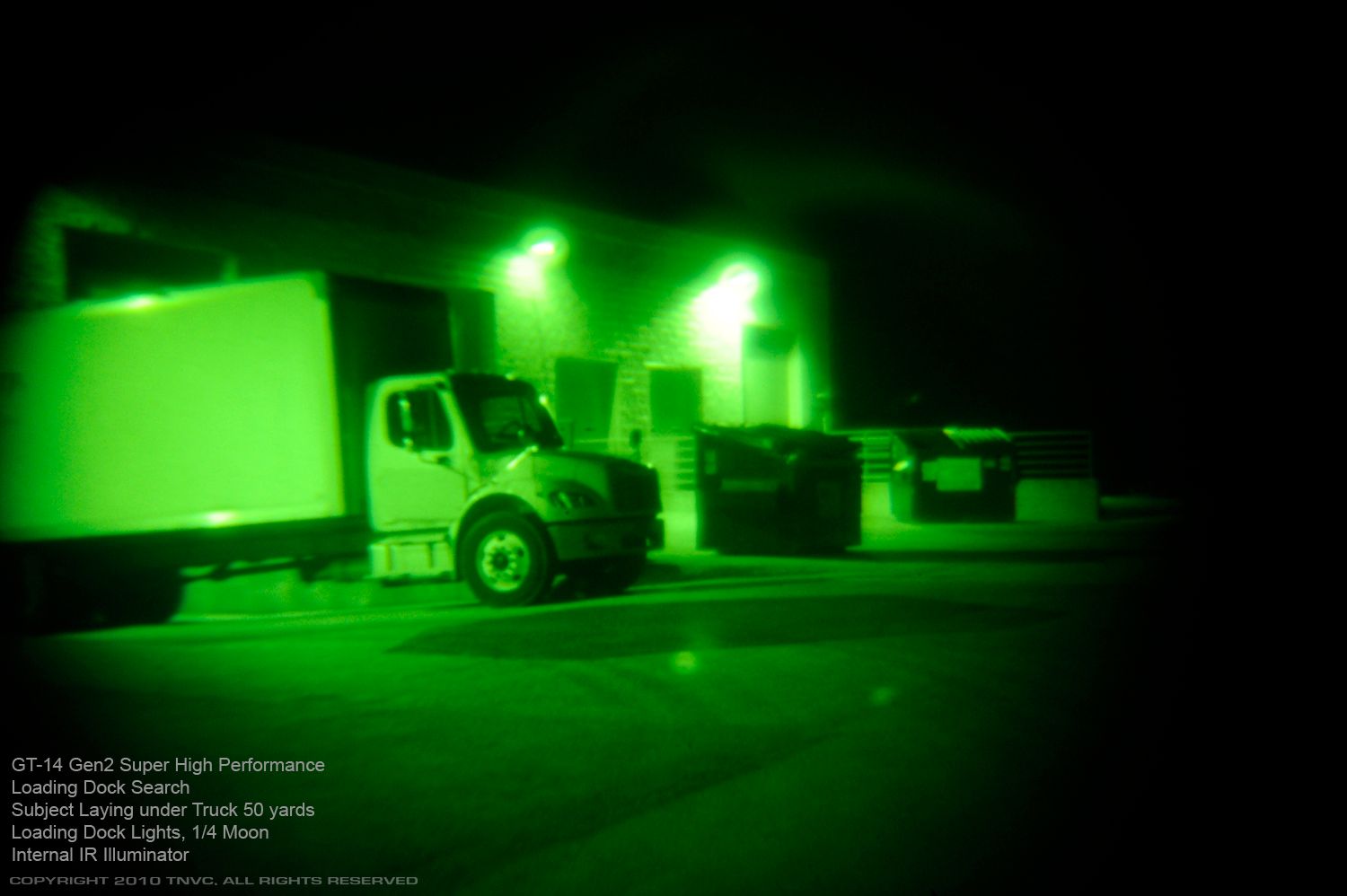
The additional higher-power illuminator makes the subject more visible under the cab. In this case, it is safe to say the separate IR illuminator is required for acquiring the subject. 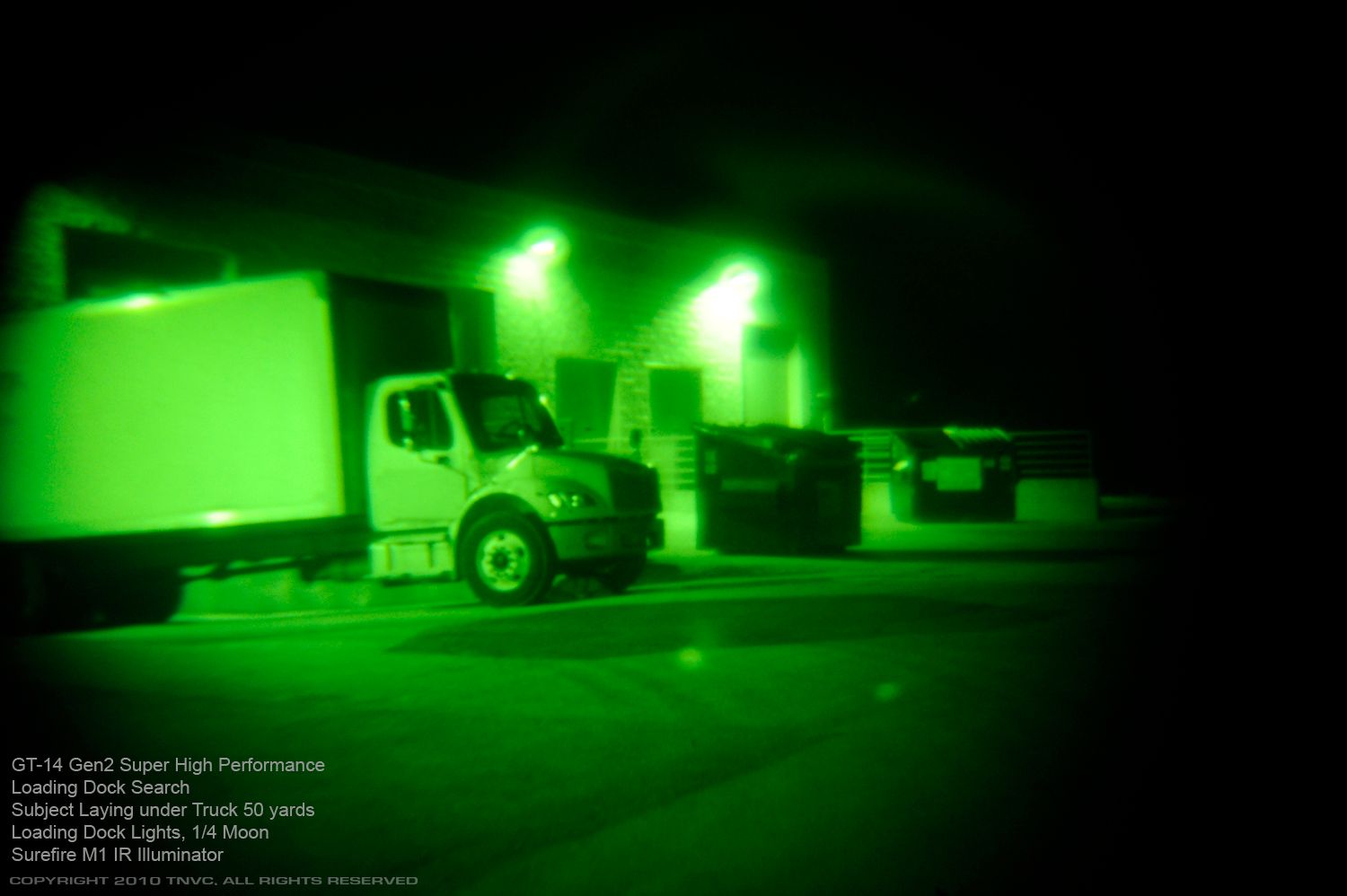
D300 Gen2+ MILSPEC Image Intensifier The Gen2+ tube produces an image that can identify the truck, dumpsters, and rear loading dock. Details are dark and resolution is relatively poor. The bright lights of the loading dock greatly help the image. The subject under the cab cannot be seen. 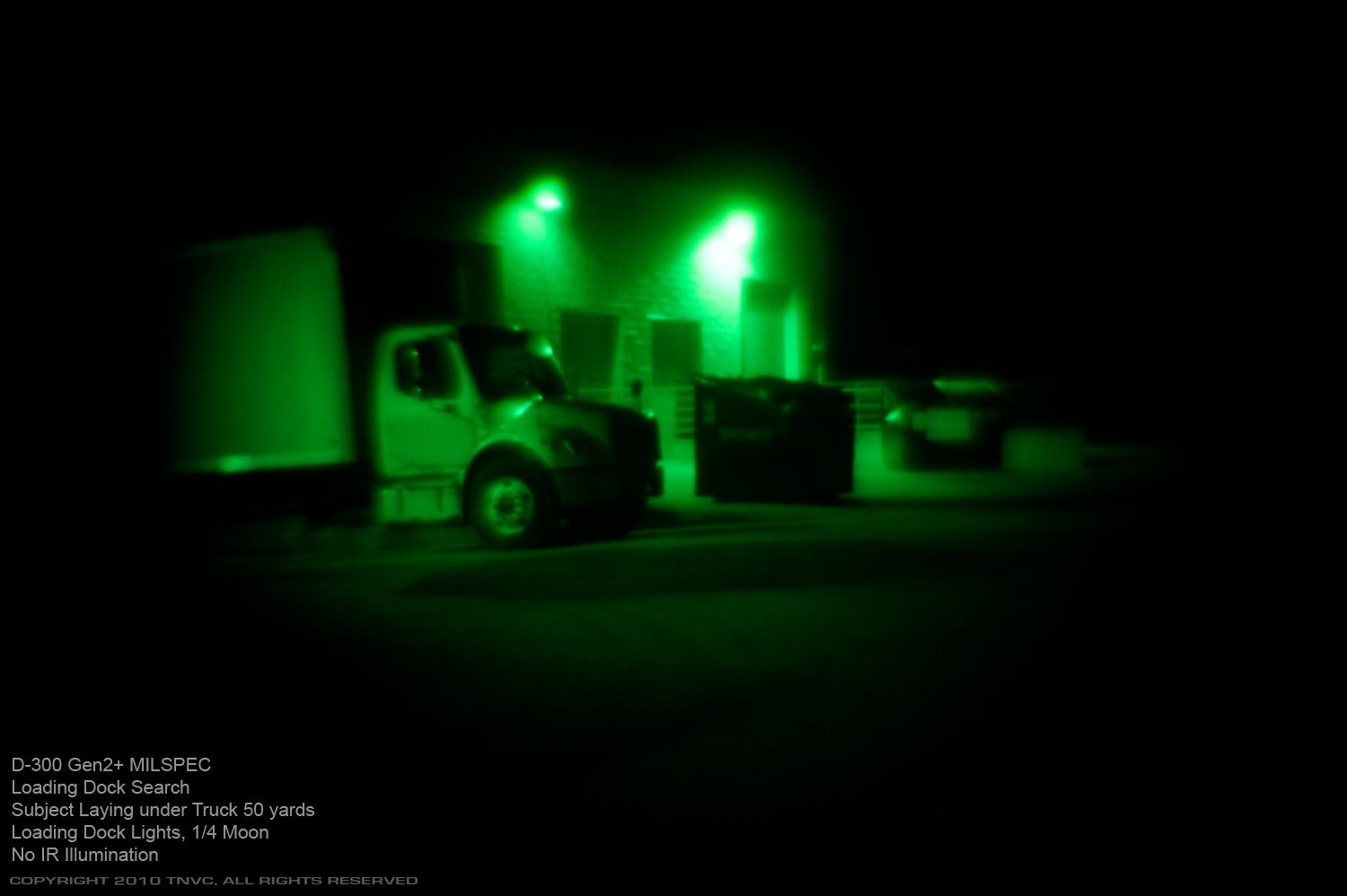
The built-in IR illuminator did not add any value to the image. 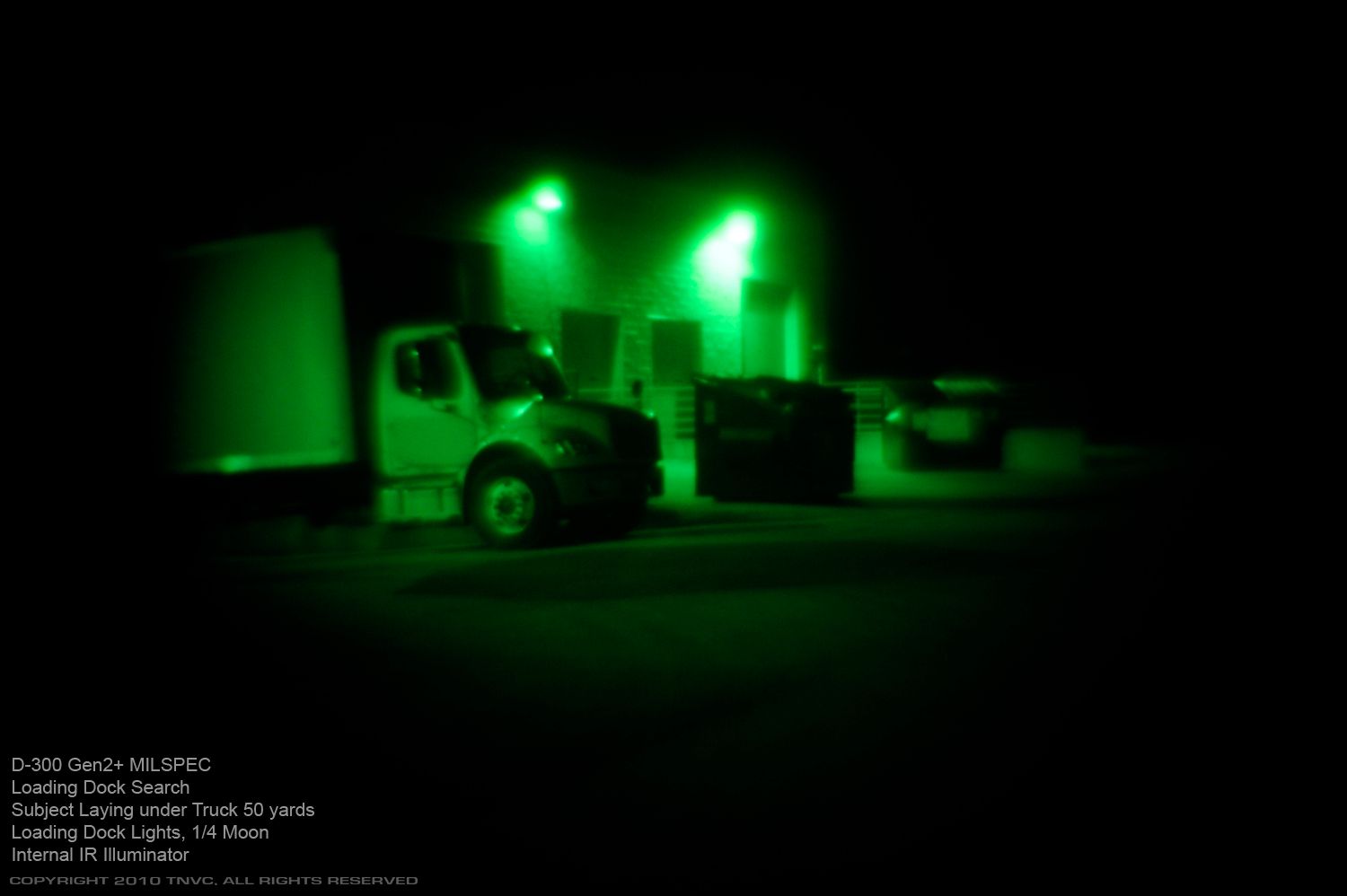
Even with the separate IR illuminator, the subject under the truck is not visible. The area is brightened slightly, but the Gen2+ tube cannot process enough light to acquire the subject in the heavy shadows. 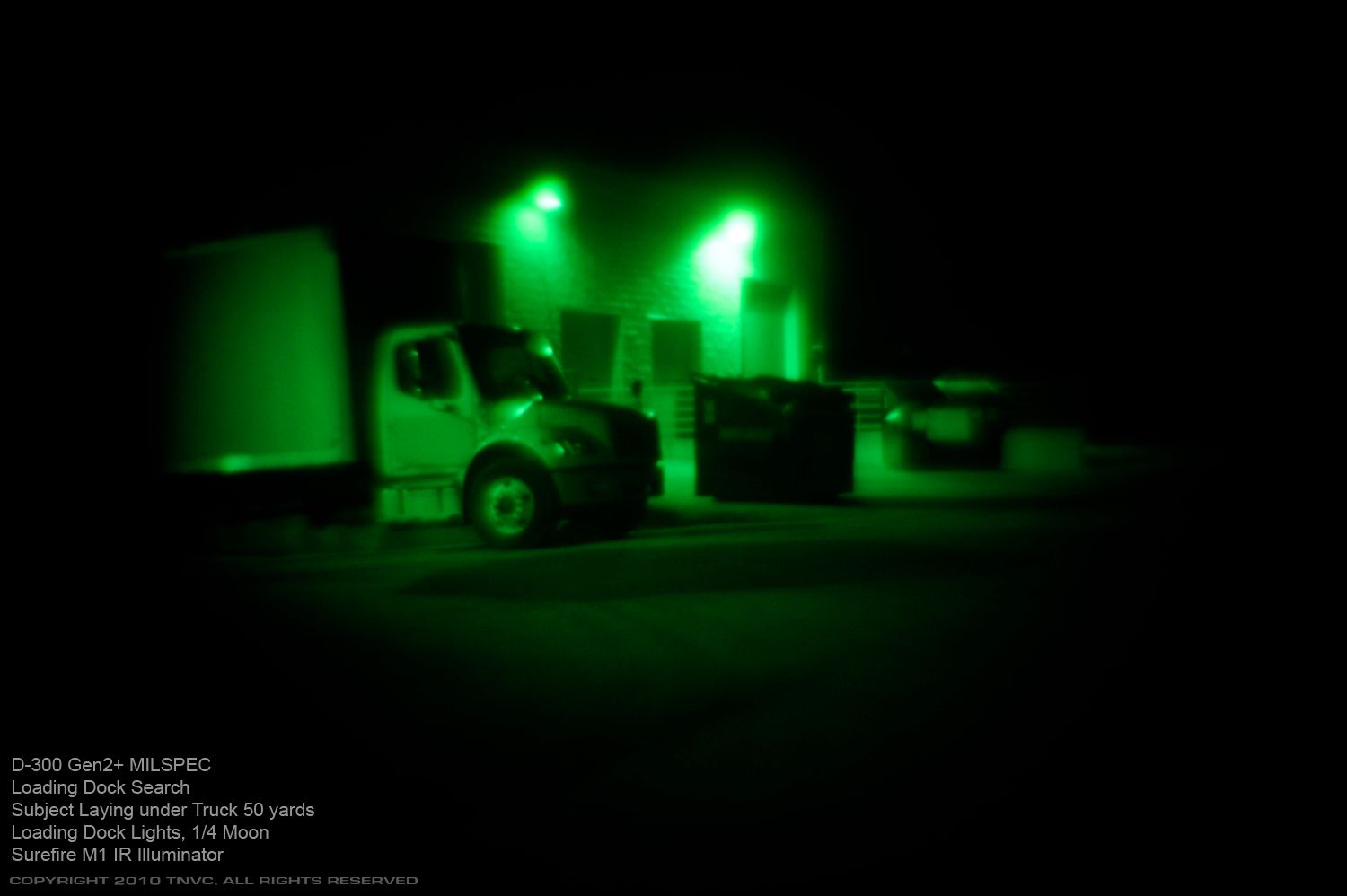
ATN Viper Gen1+ Image Intensifier The Gen1 tube produces an overly-bright image due to the heavy blooming from loading dock lights. The Gen1+ tube cannot deal with these lights and creates an awkward, fish-eye image at this distance. Situational awareness is severely hampered by the blooming, causing the extreme halos and distortion. The shadow under the truck is still concealing the subject. 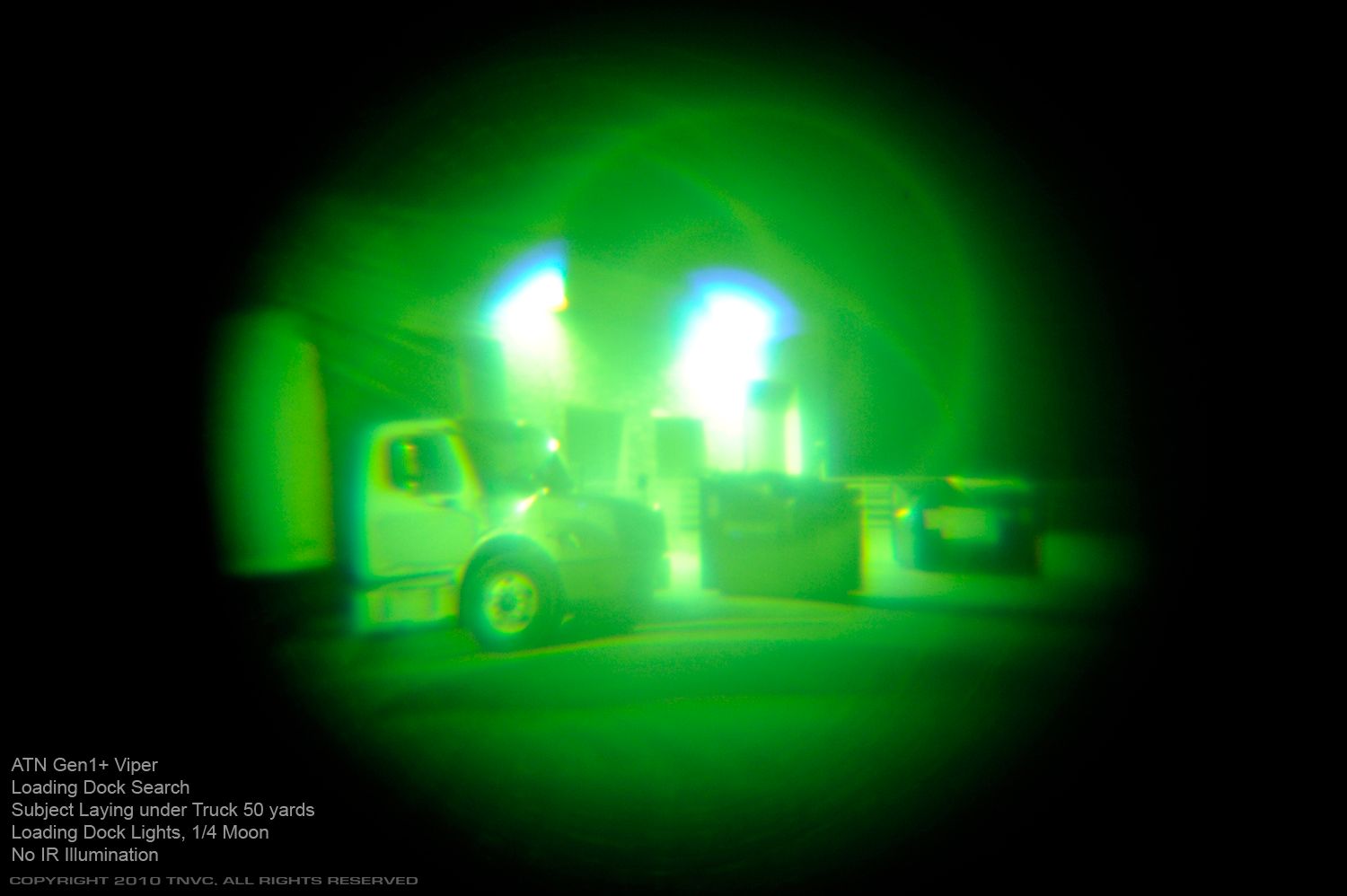
The built-in IR illuminator did not add any value to the image. 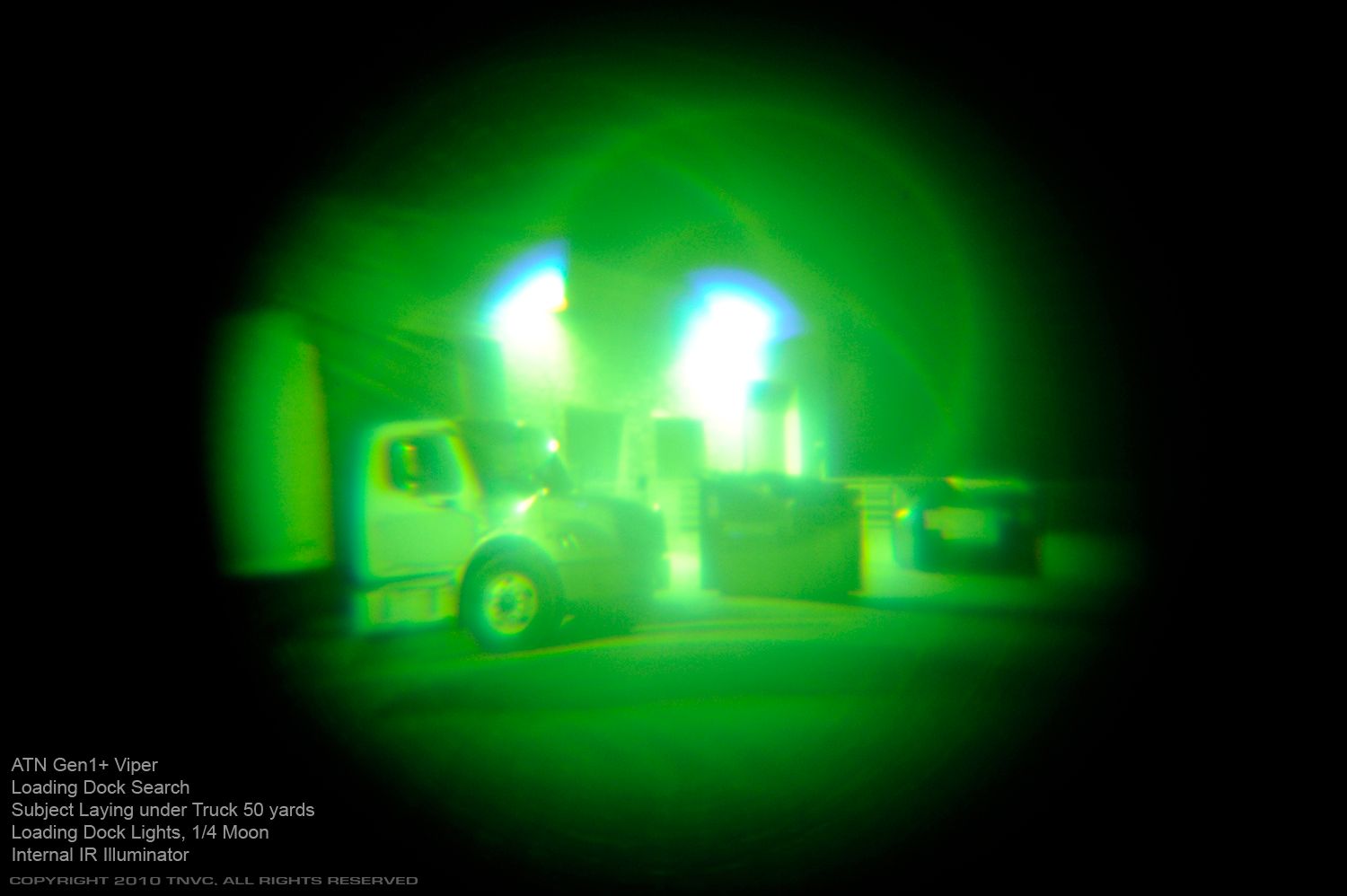
The additional higher-power illuminator does not add any useable information to the image due to the heavy halo blooming created by the loading dock lights. The subject is still hidden from view. 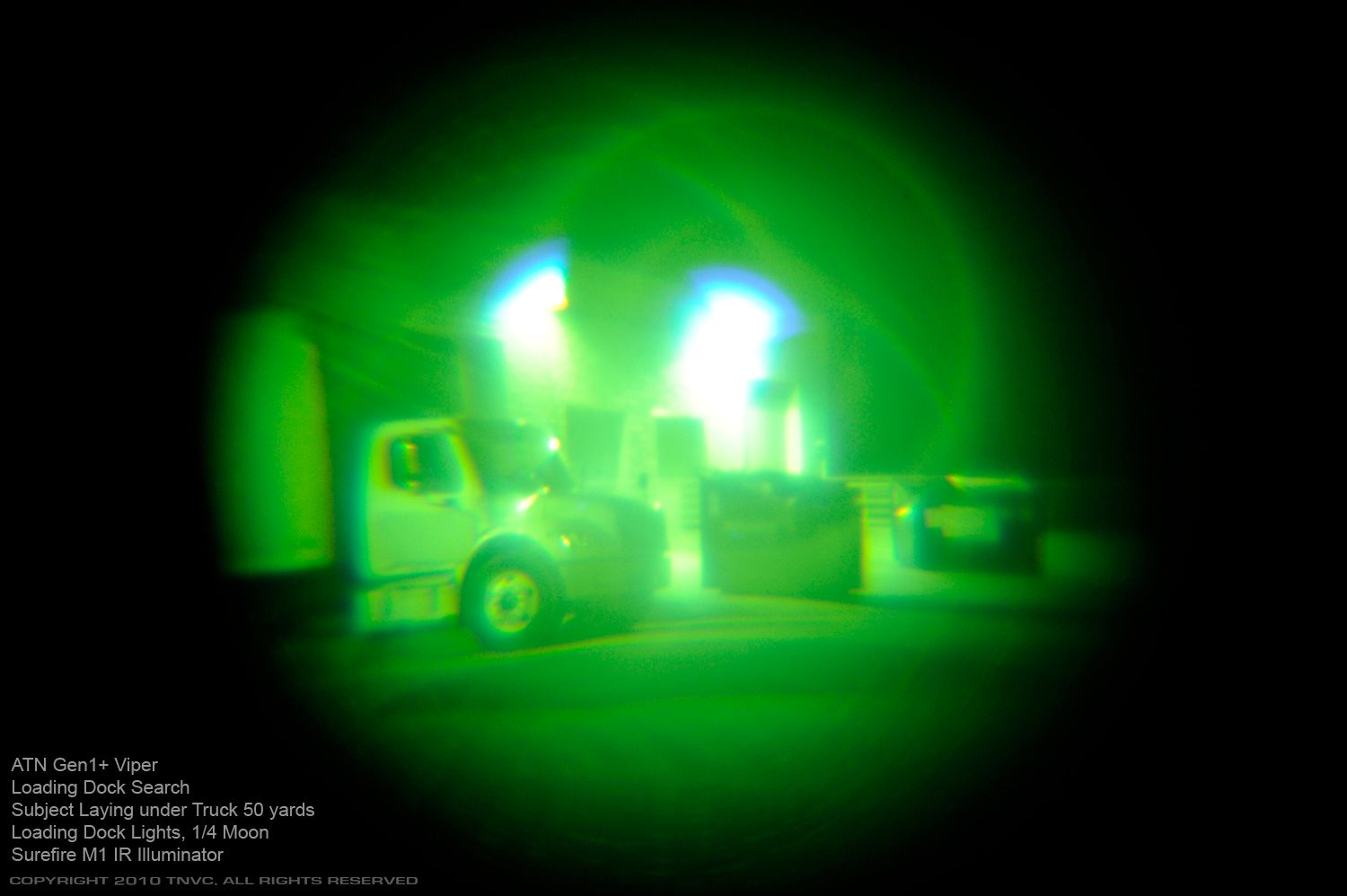
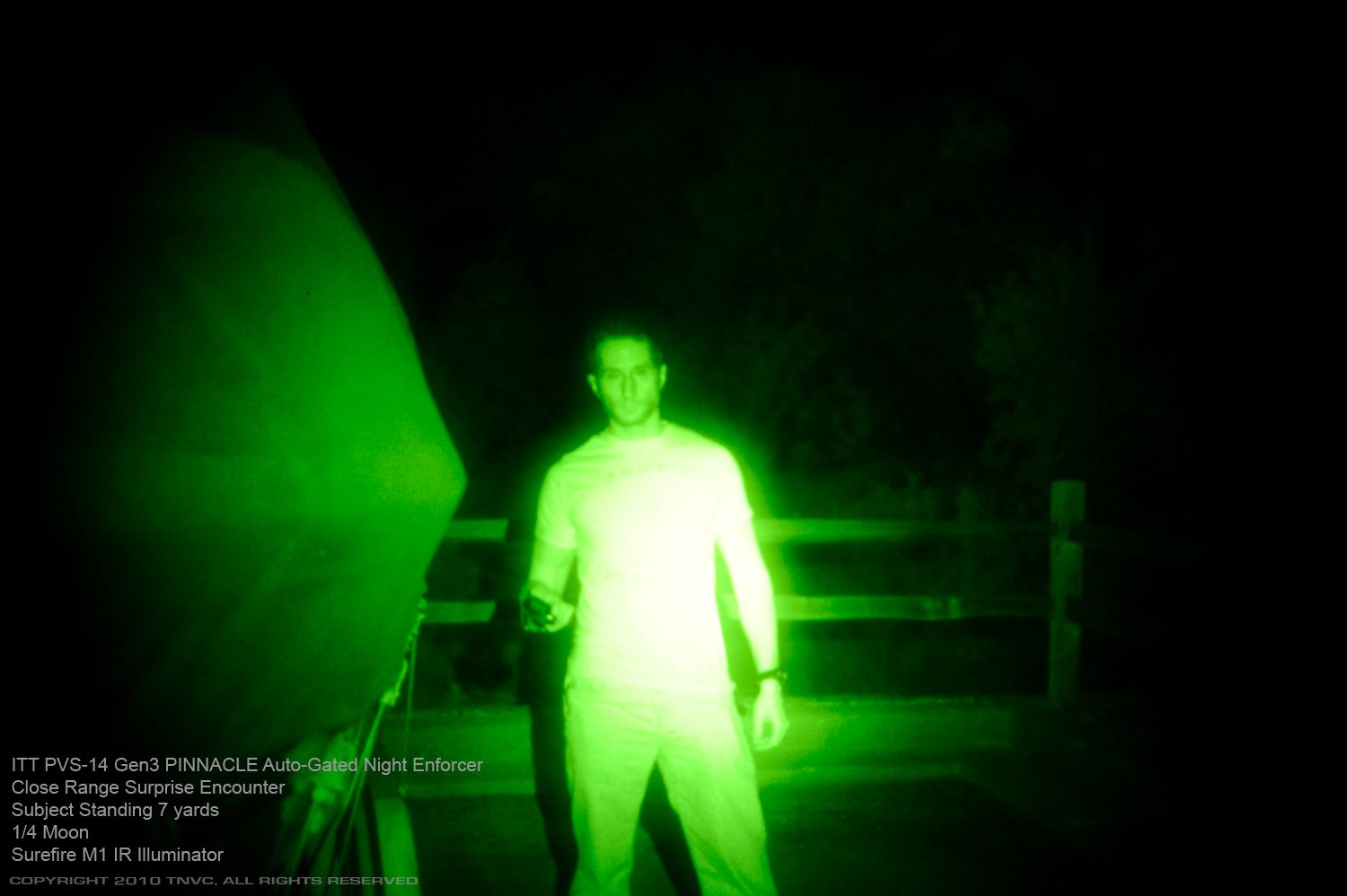
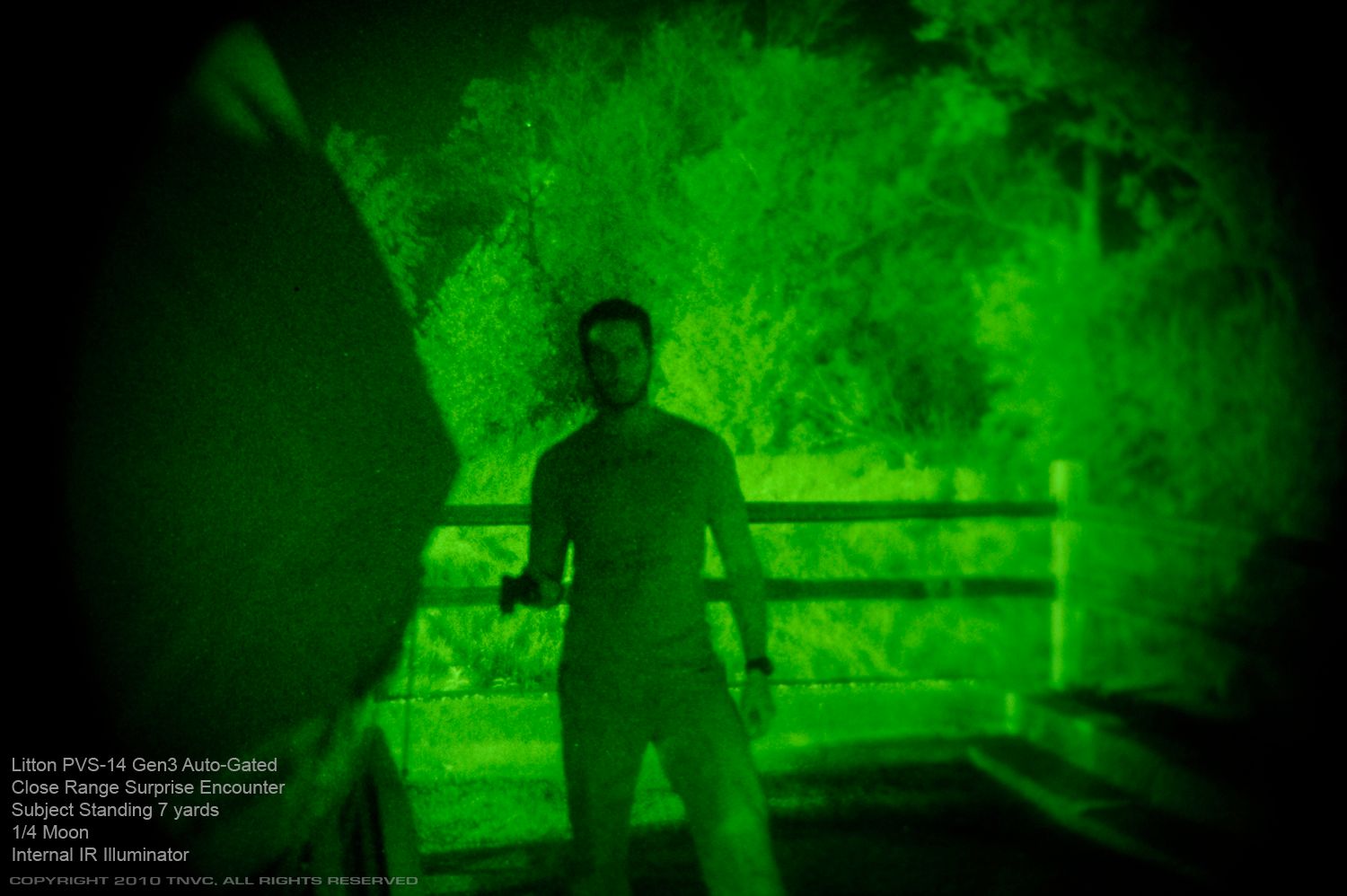
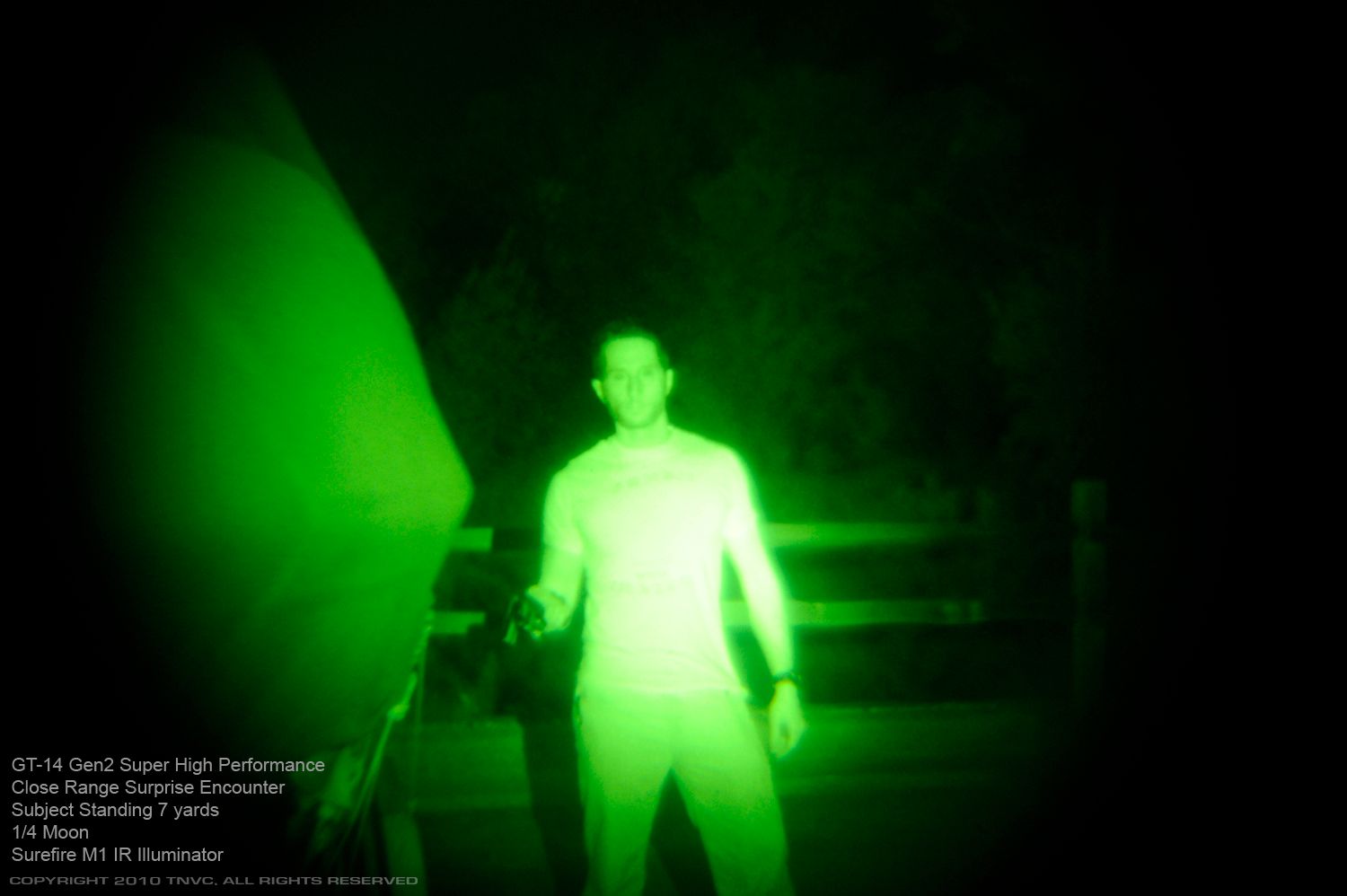
Thoughts- This evolution brings to light the advantage of the Gen3 PINNACLE Auto-Gated tube. Its ability to gather and process more light is exemplified by its detection of the subject under the truck cab, even without the aid of an IR illuminator. This is a key factor because bad guys like to hide in shadows. An officer’s night vision device needs to be able to detect the subject in these extreme dark conditions. Also of note is the ability of the Gen3 and Gen2 SHP units to deal with halo and bloom. This scenario has the viewer looking directly into light sources. As illustrated with the Gen2+ and Gen1+, the light sources create a blooming effect. This is especially noticed in the Gen1 unit which has no provision for dealing with this condition and creates a heavily distorted (almost dangerous) image. Test Scenario 9 – Close Range Surprise Encounter This scenario was developed to determine the ability of the user to determine the threat level of a subject encountered by surprise in an environment with very little ambient lighting. It is important for an officer to quickly determine if a threat exists and needs to be engaged with deadly force. Mistaken identity shootings occur too often when an officer believes a subject is armed and it turns out they had something else in their hand. This scenario has the officer walking around a corner and being confronted by an individual. ITT PVS-14 Night Enforcer Gen3 PINNACLE Auto-Gated Image Intensifier The first photo shows the subject holding a cell phone in his right hand. It is readily identifiable and would be a no-shoot situation. The second photo shows the same subject with a pistol in his hand. This is also easily identified. The bright images show all details. 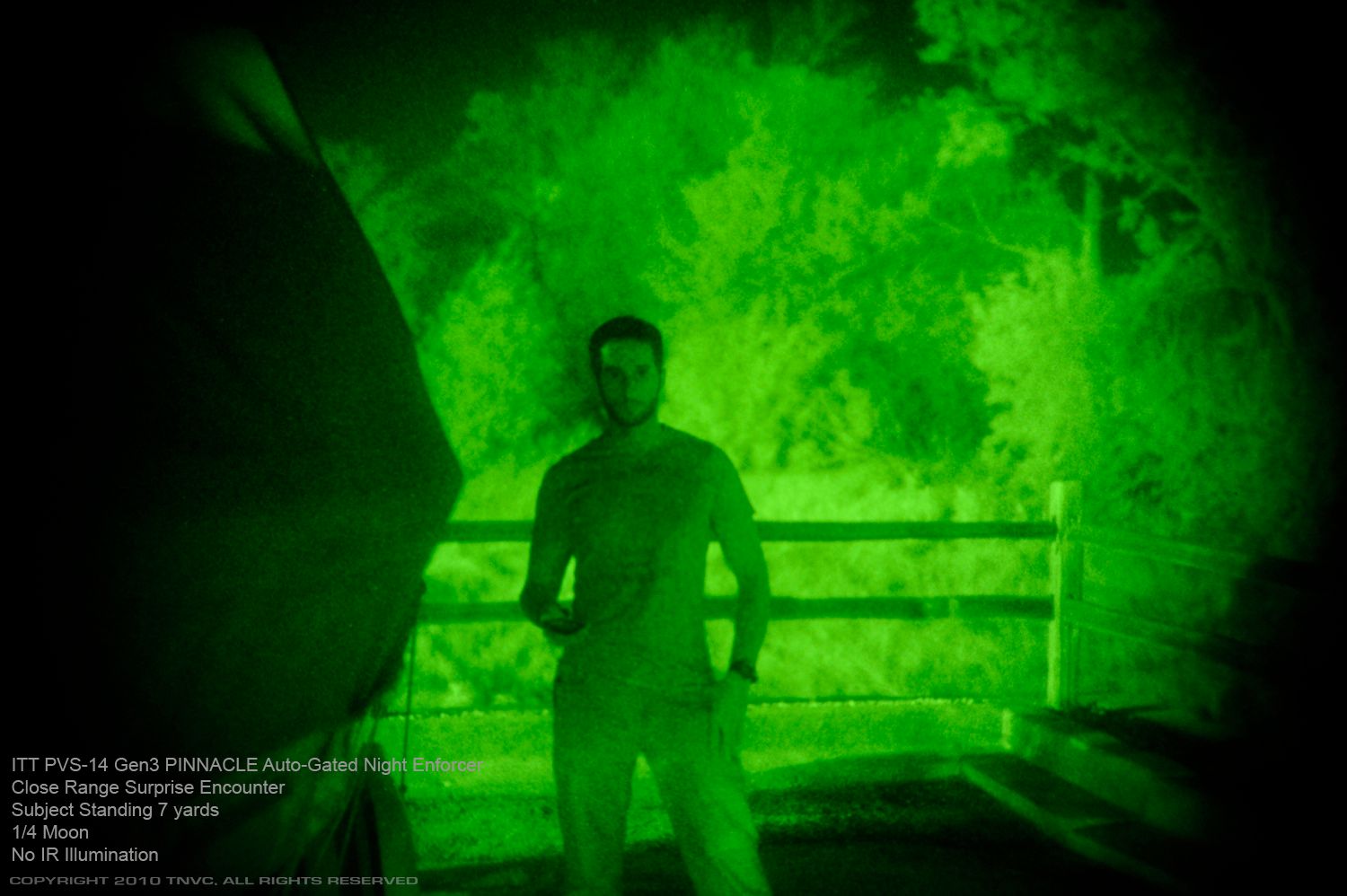
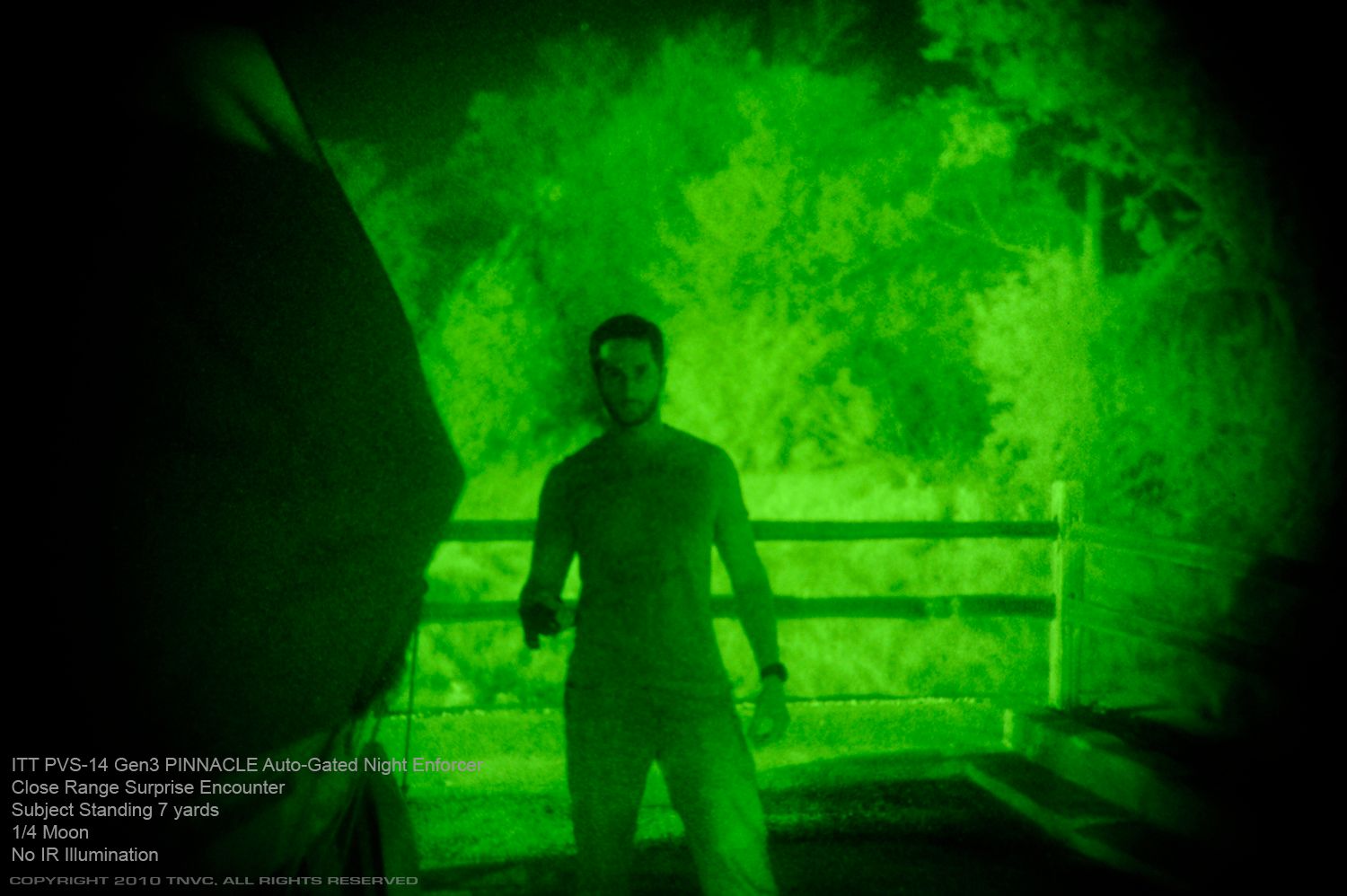
At close range, the built-in IR illuminator flattens some of the background foliage. The subject is clearly identified. The only real difference is that the subject’s eyes are reflecting the IR light. Both the cell phone and gun are easily identified. 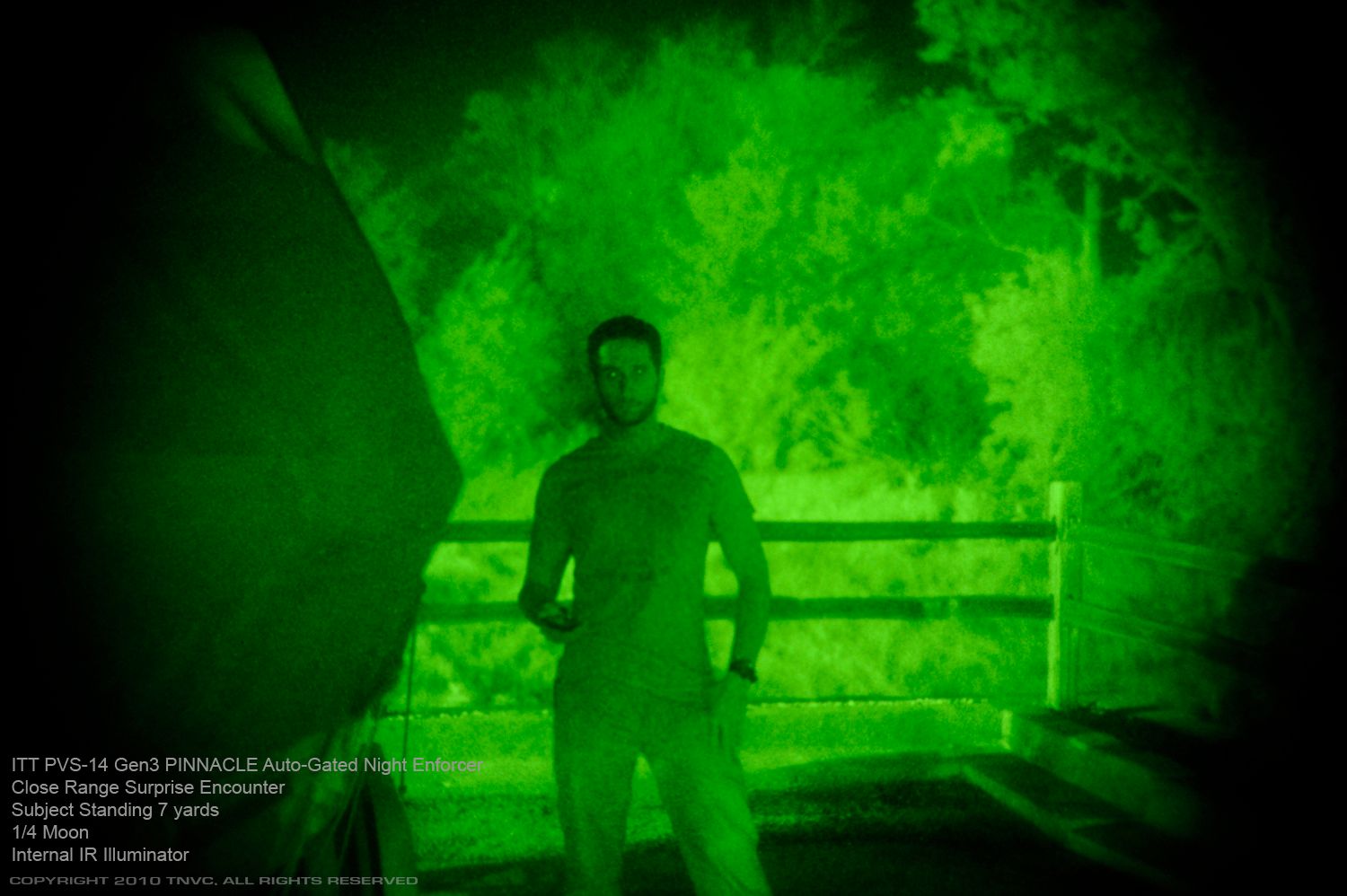
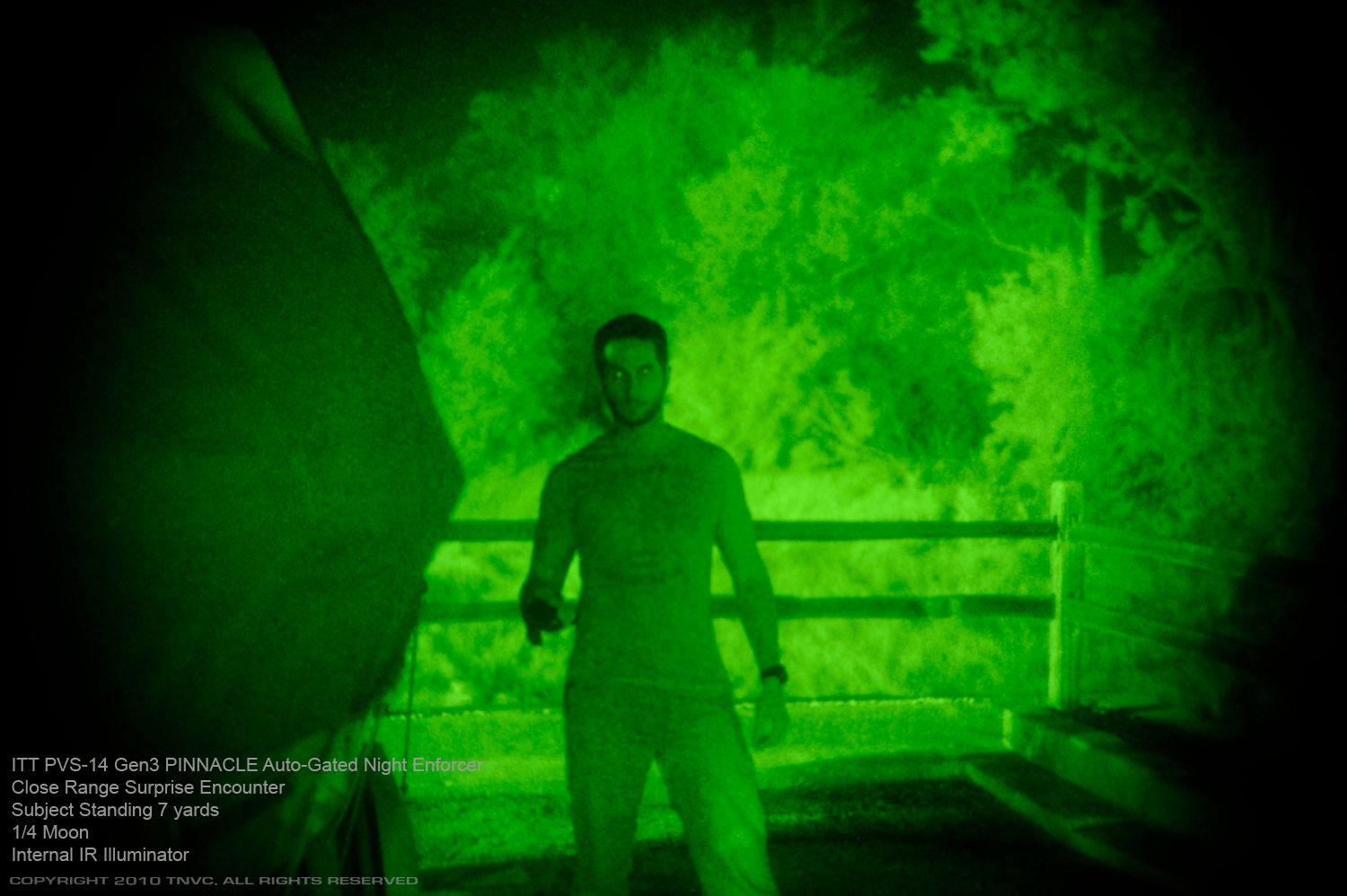
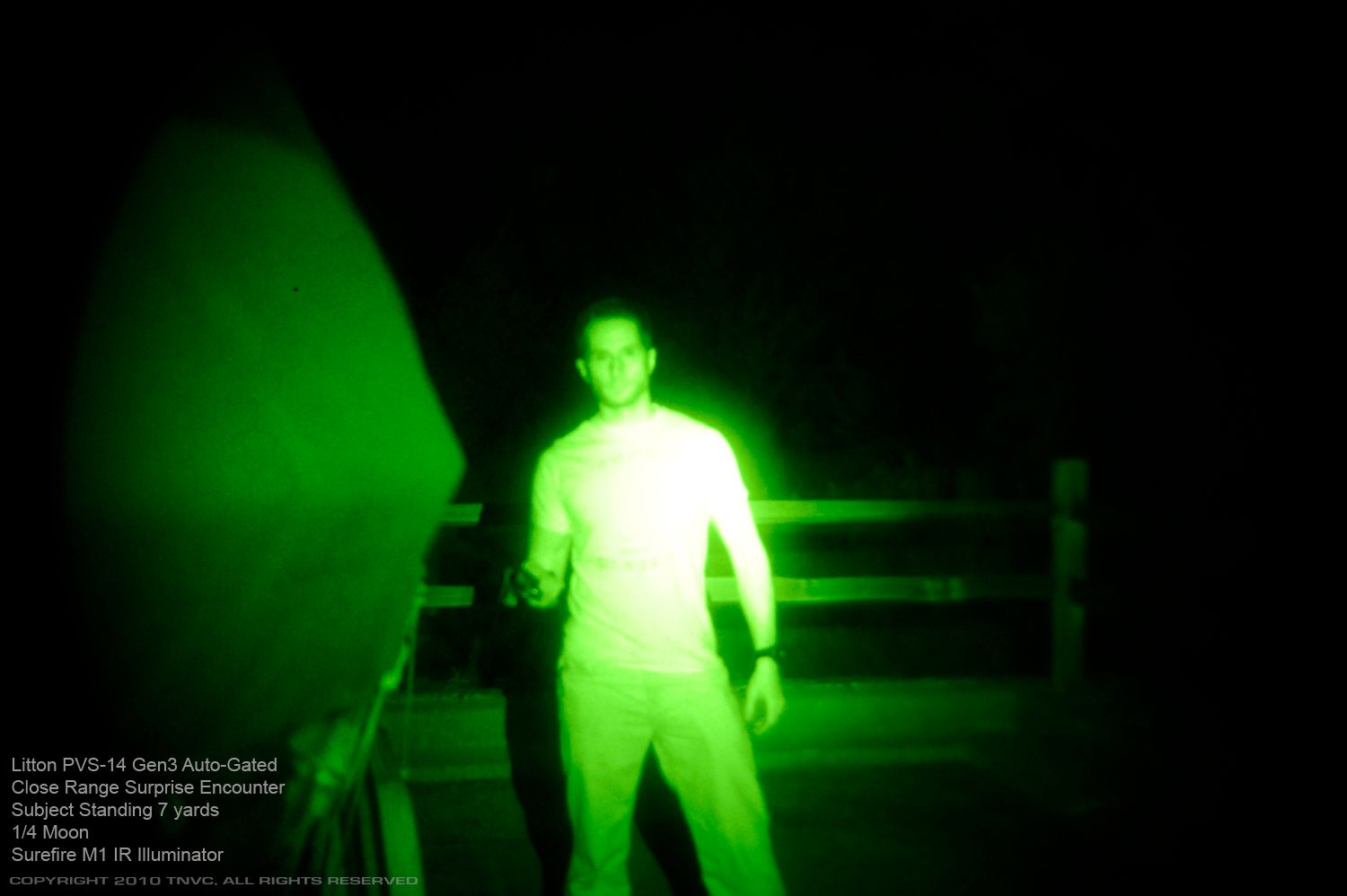
The Surefire M1 is almost too bright for this application. The heavy illumination bounces of the subject’s clothing, eliminating details of his shirt. The subject’s facial features are easily recognized along with the cell phone and pistol. Note how the IR light tends to focus on the subject and the background foliage goes dark. At this distance, the illuminator actually somewhat hampers the user’s situational awareness. 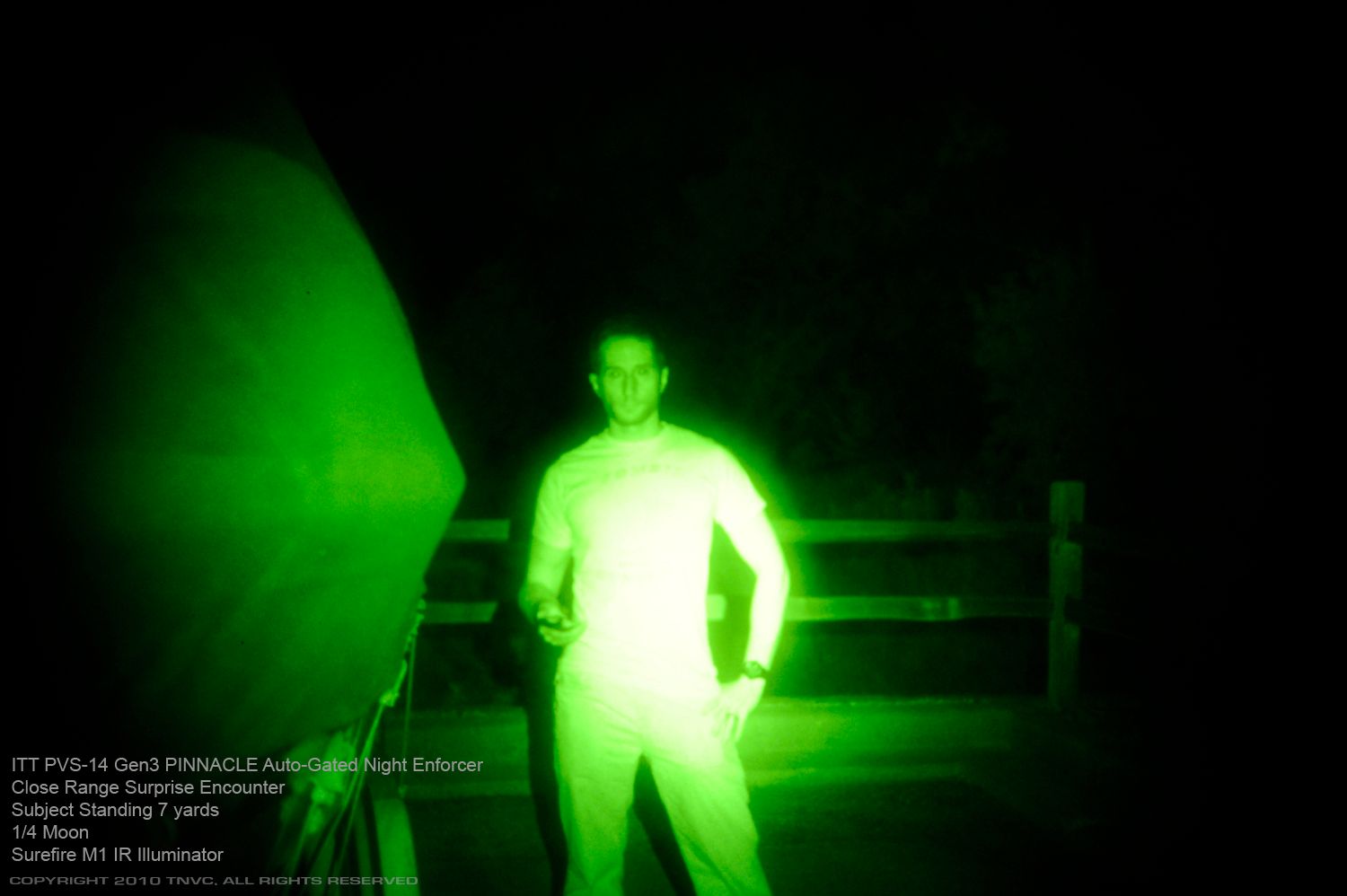
Litton PVS 14 Gen3 Auto-Gated Image Intensifier As with the PINNACLE unit, the Litton Gen3 Auto-Gated tube clearly shows the subject and identifies the cell phone of the pistol. The image is slightly darker than the PINNACLE unit, but still readily useable. 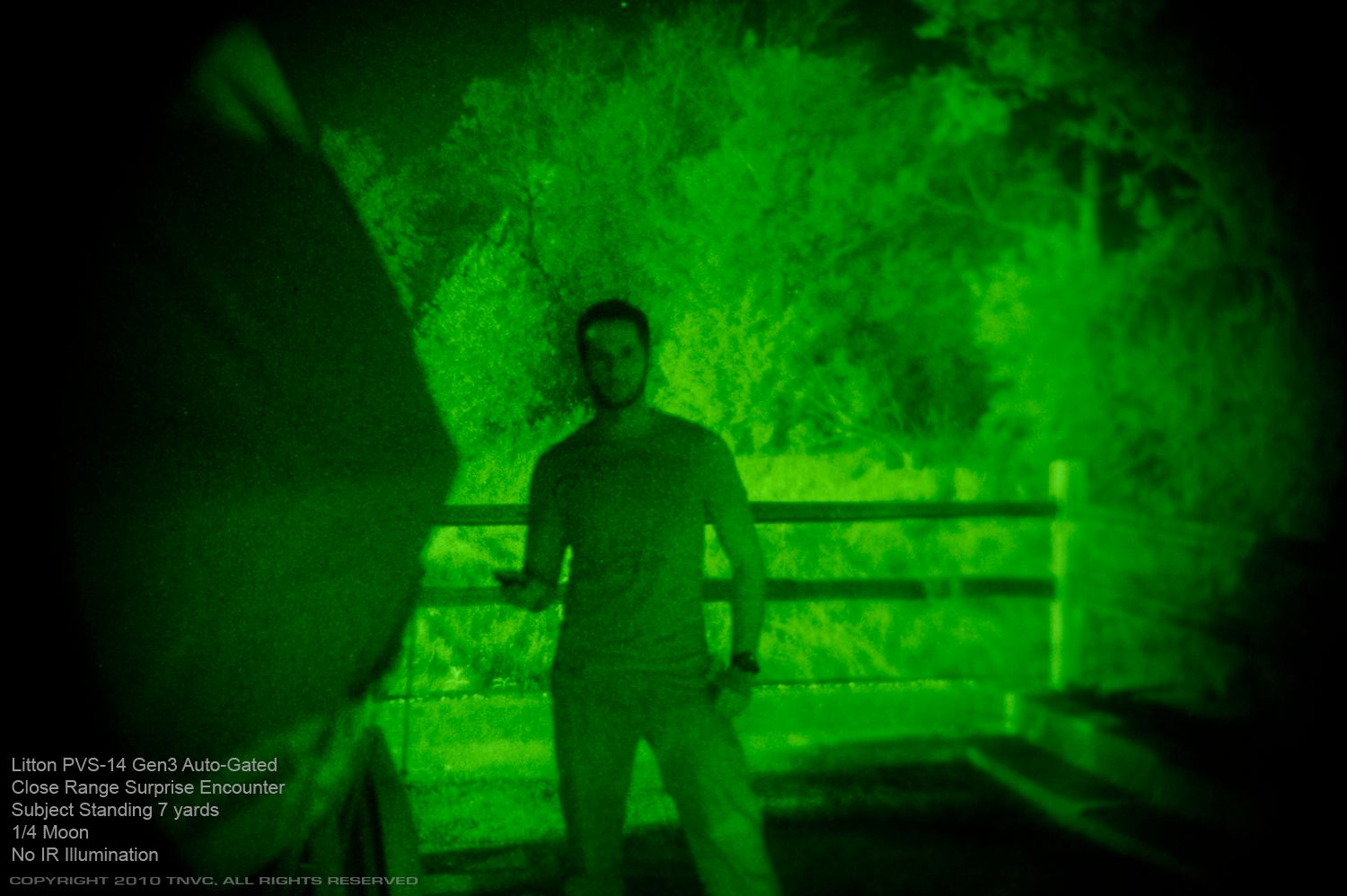
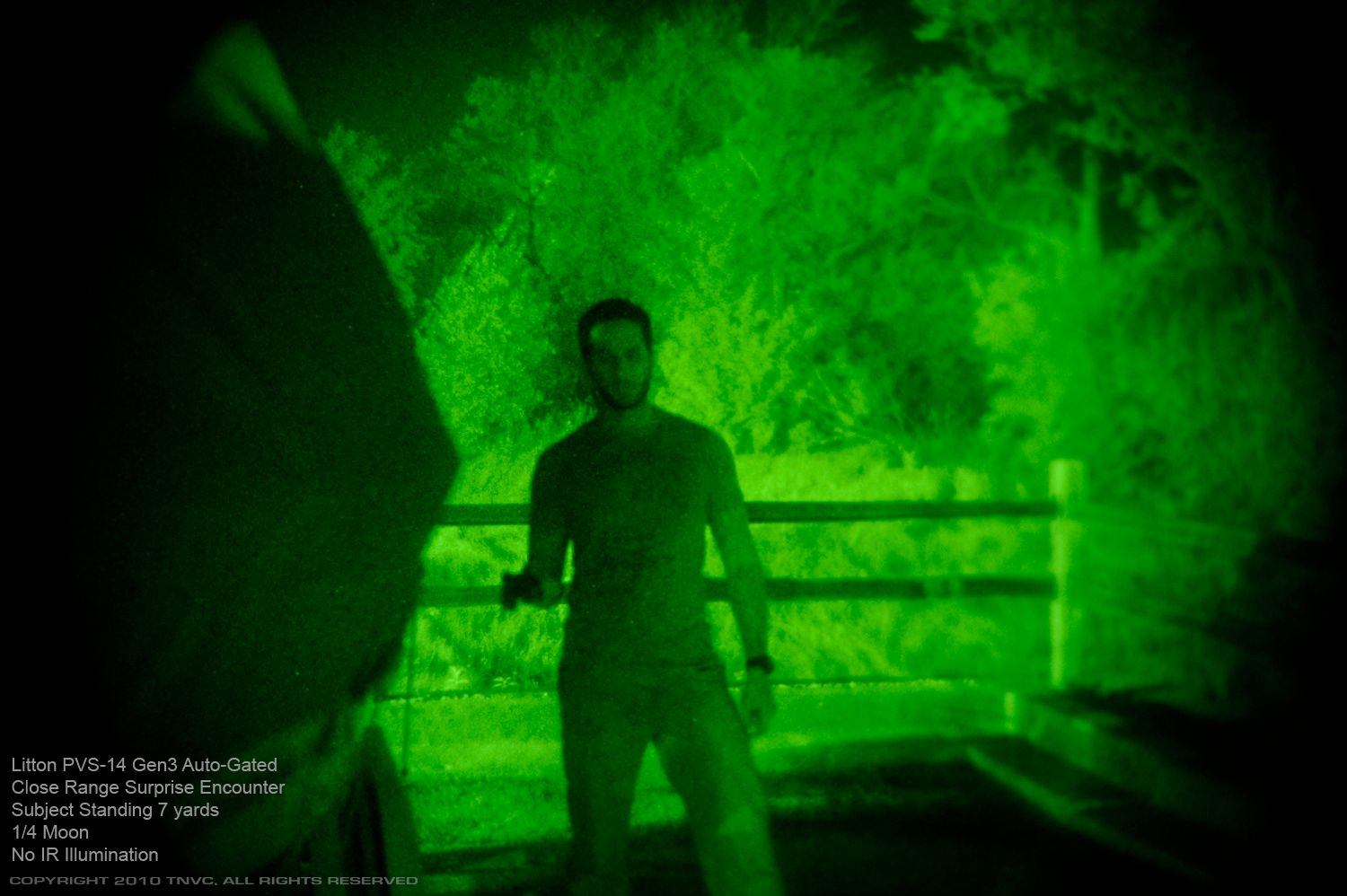
Again, the built-in IR illuminator does little more than flatten some of the contrast in the images. The subject’s eyes reflect the IR light. The objects in his hands are easily identified. 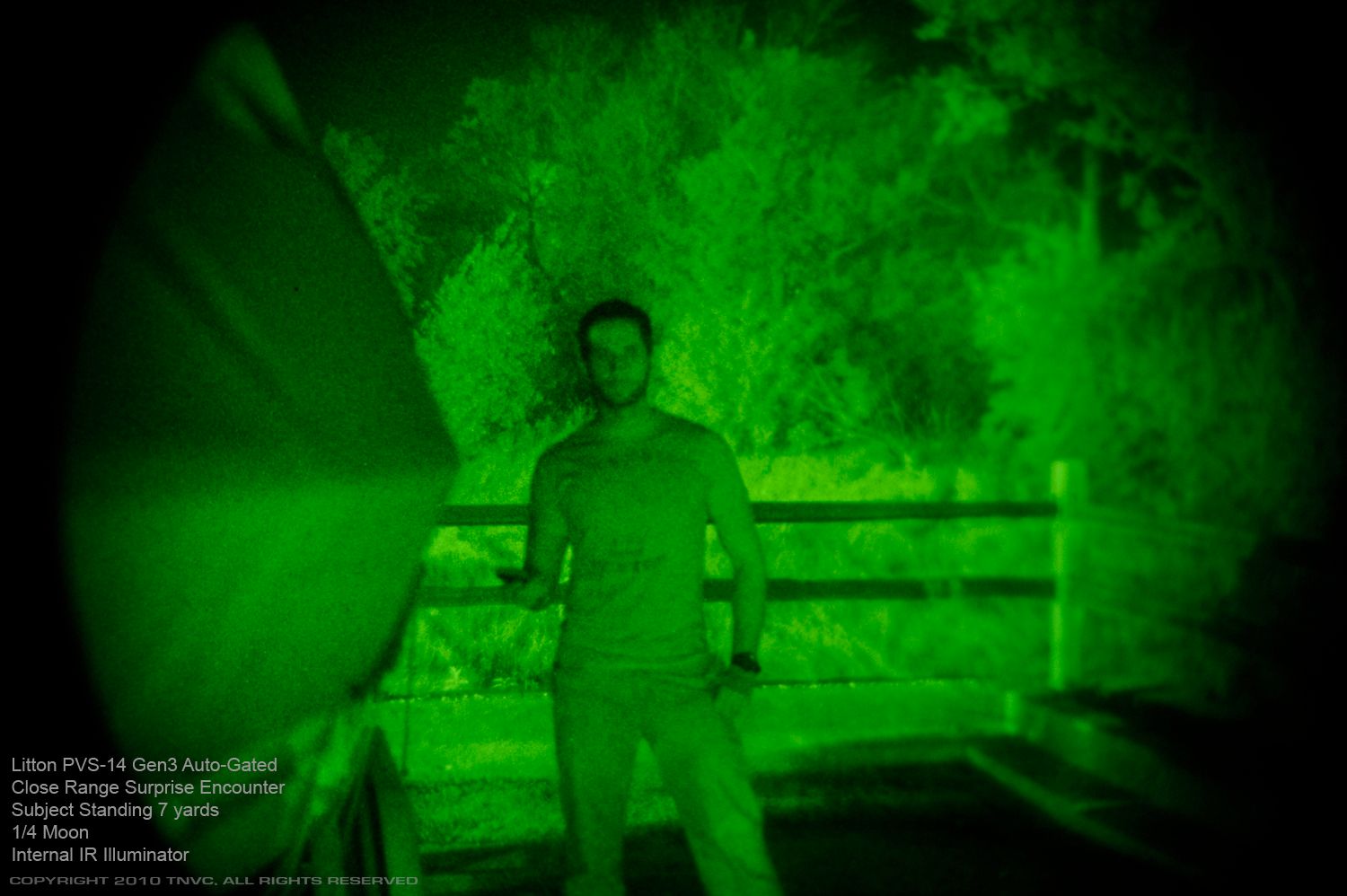
The Surefire M1 focuses the IR light on the subject, creating a hot spot on the torso. The image is not as bright as the PINNACLE, which causes a little less recognition of the hands. The cell phone is harder to read compared to the pistol. 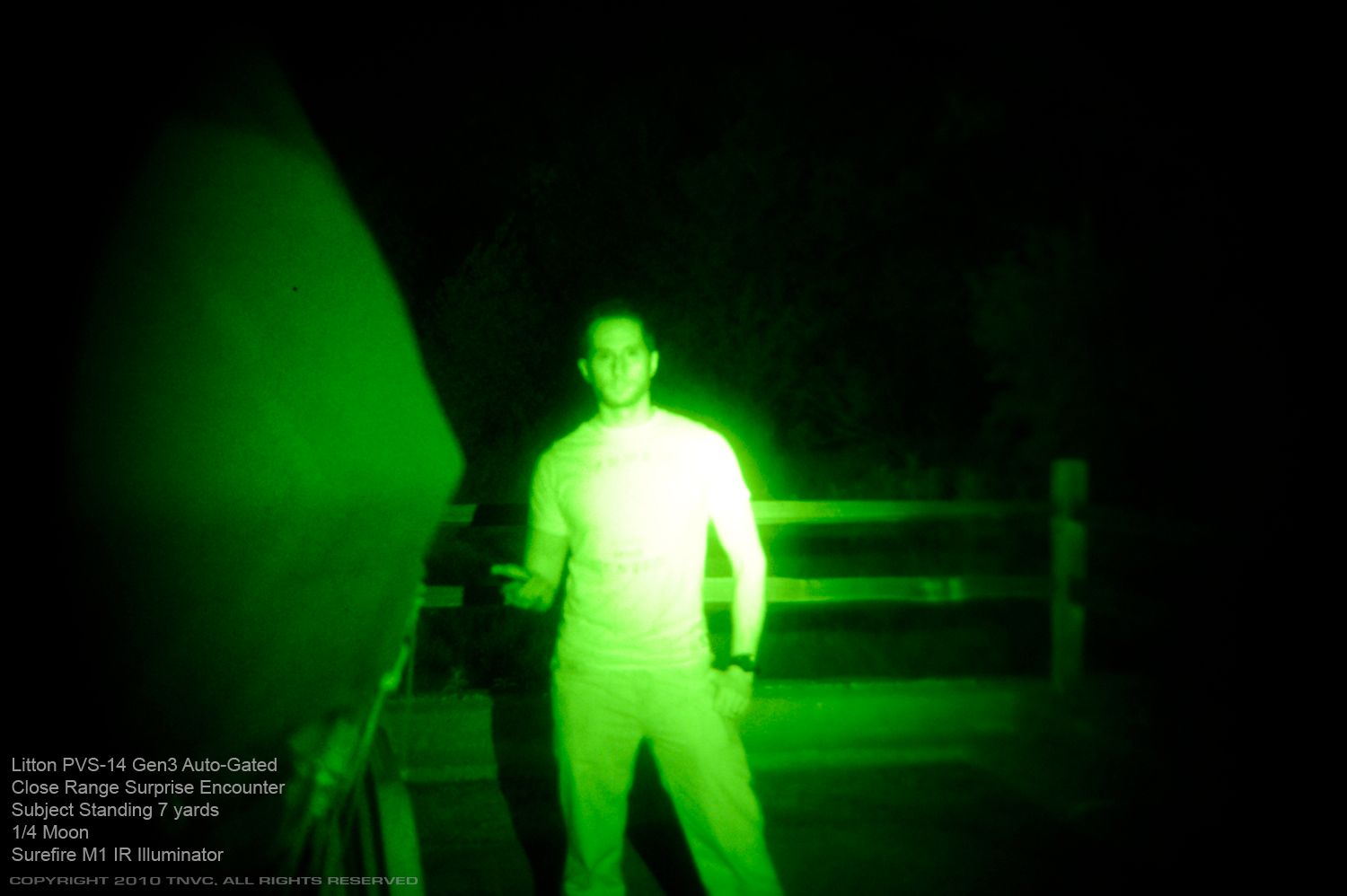
GT14 Gen2SHP Image Intensifier The subject can be clearly acquired. However, the lower resolution causes the cell phone or pistol to be identified by shape rather than detail. That said, the gun is still easily resolved and a quick shoot/no-shoot determination can be made. 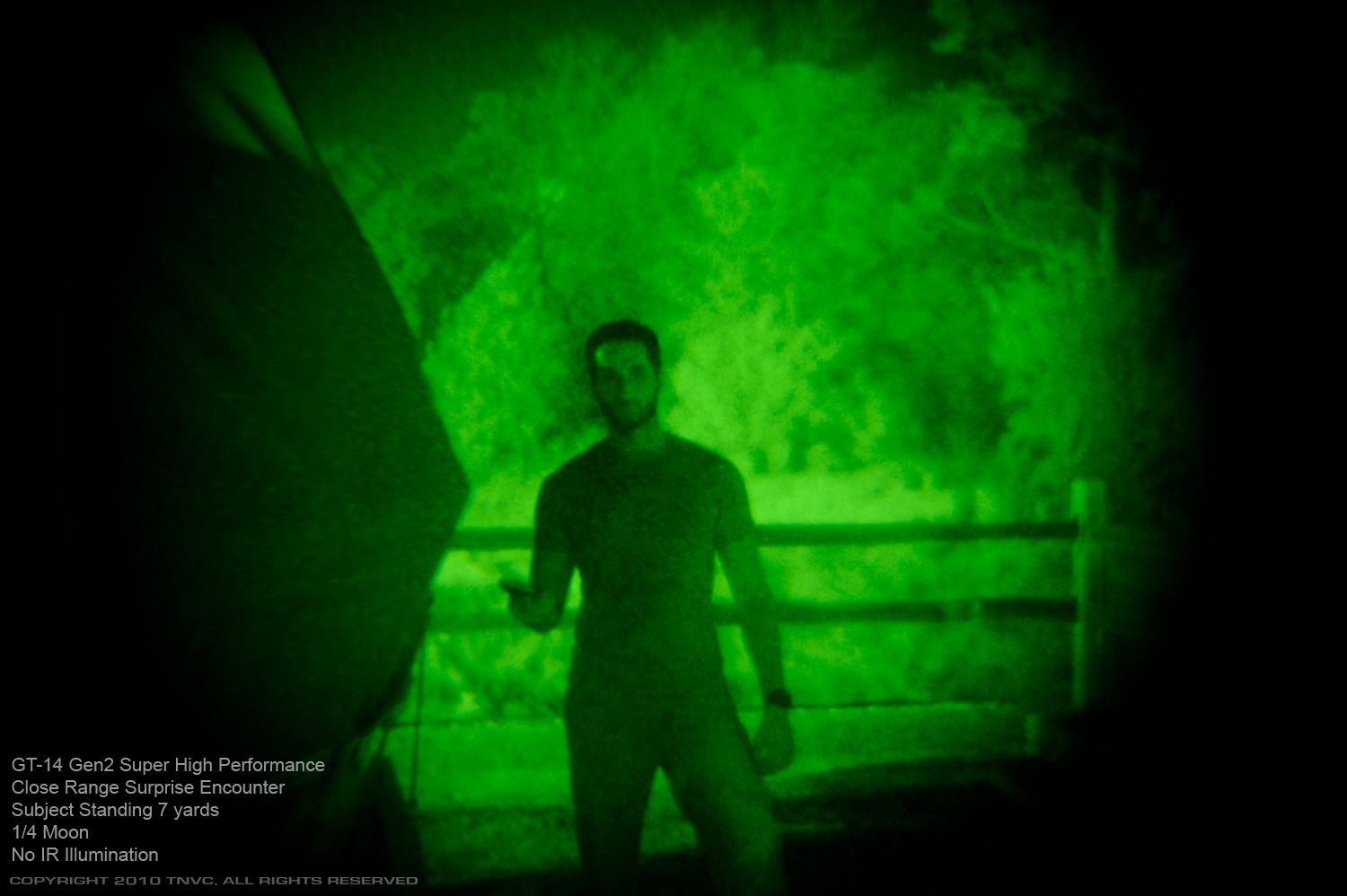
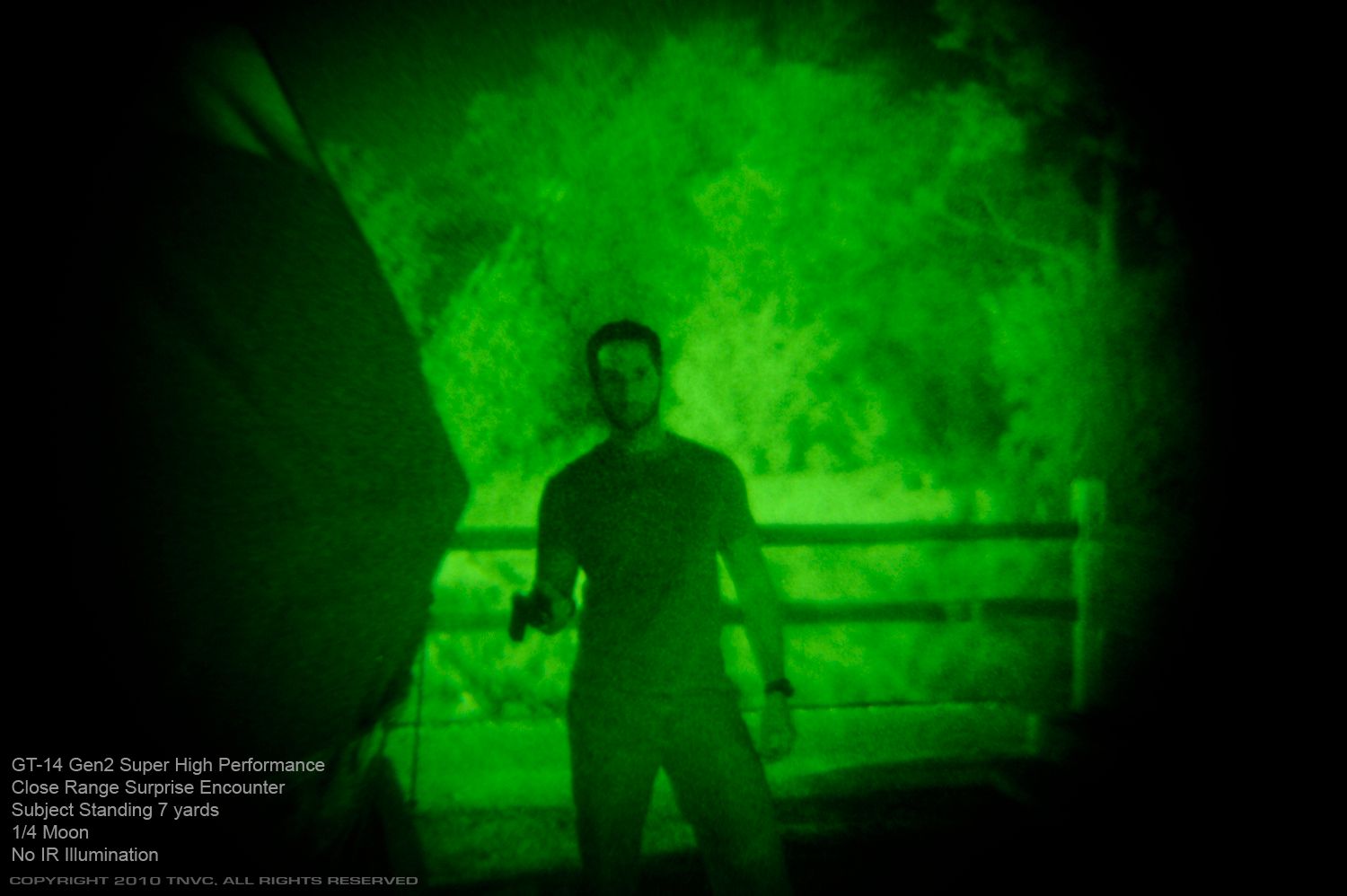
The built-in IR illuminator did not add any value to the image. 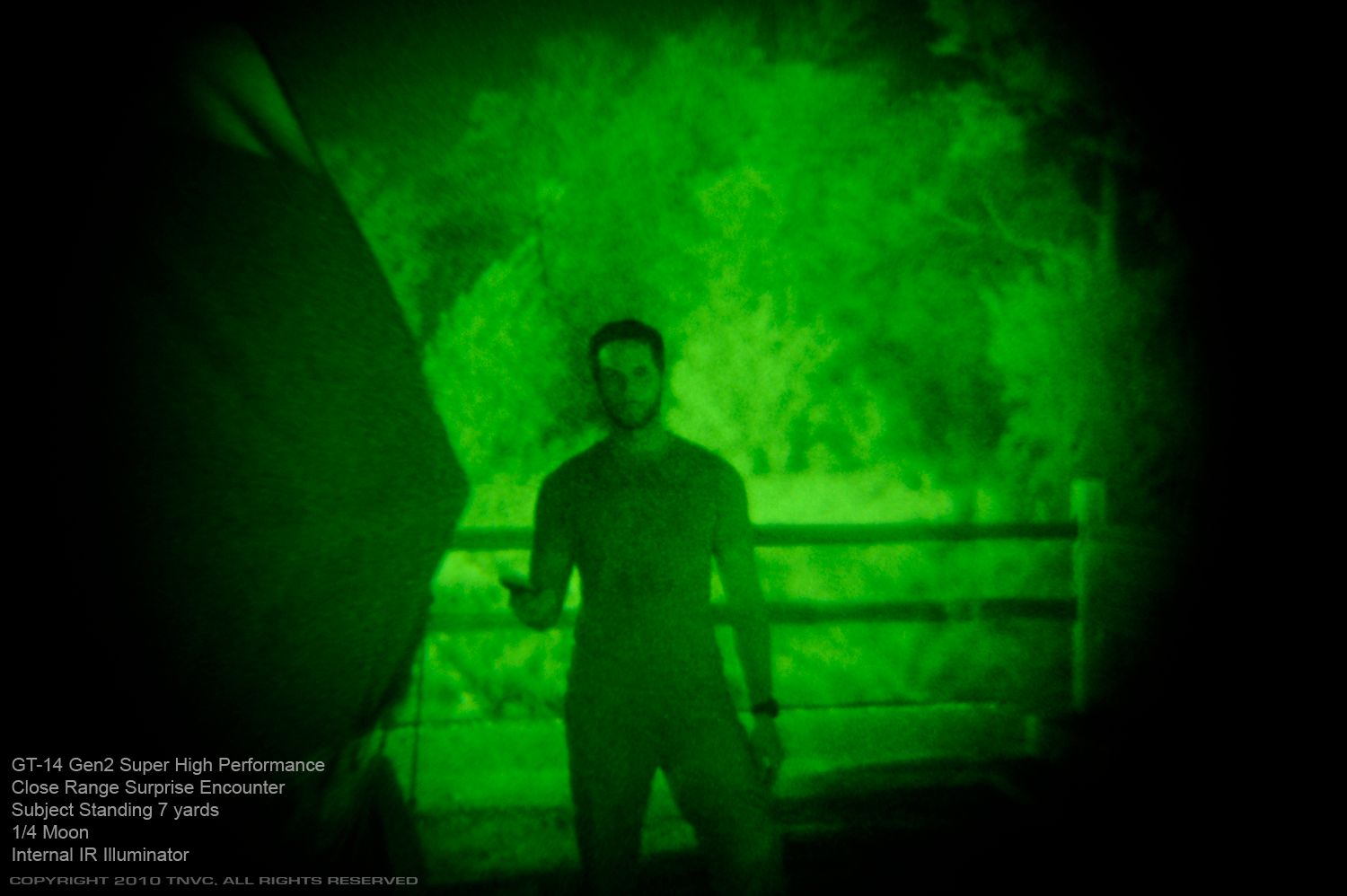
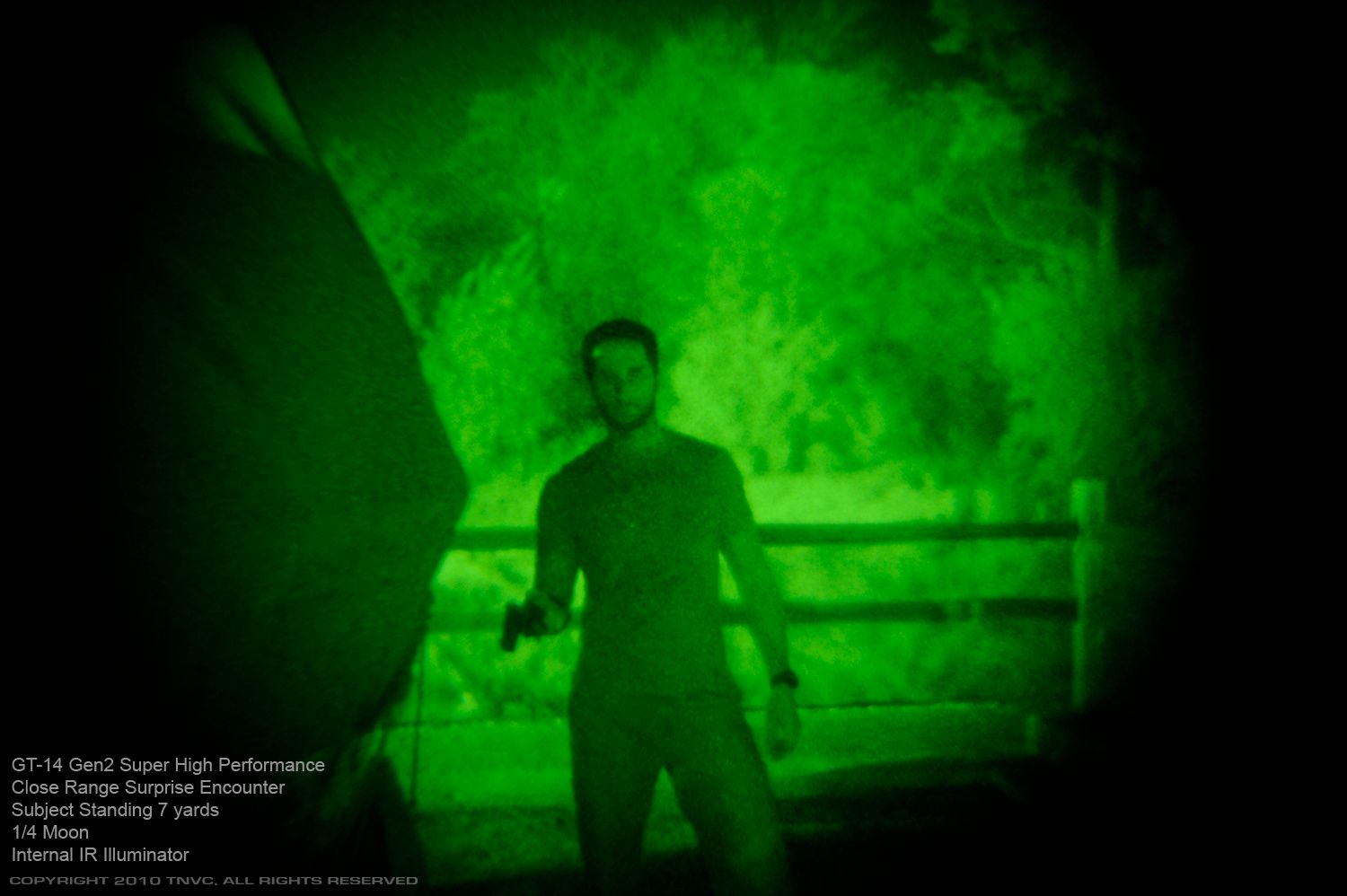
The Surefire M1 blooms considerably at this range. The surrounding details begin to fade, but the subject’s hands are still quite visible. The loss of resolution in the Gen2 SHP tube begins to show. 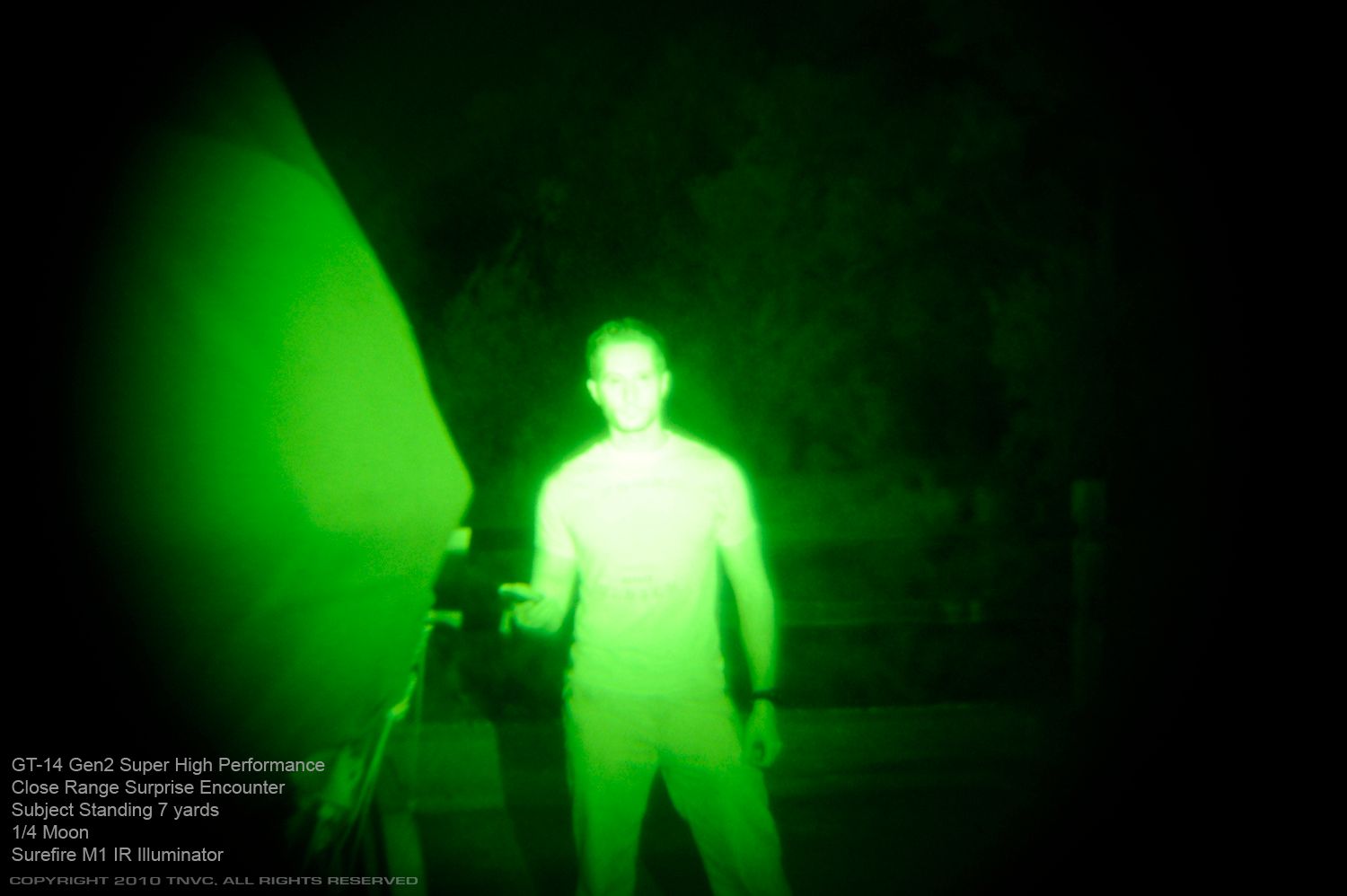
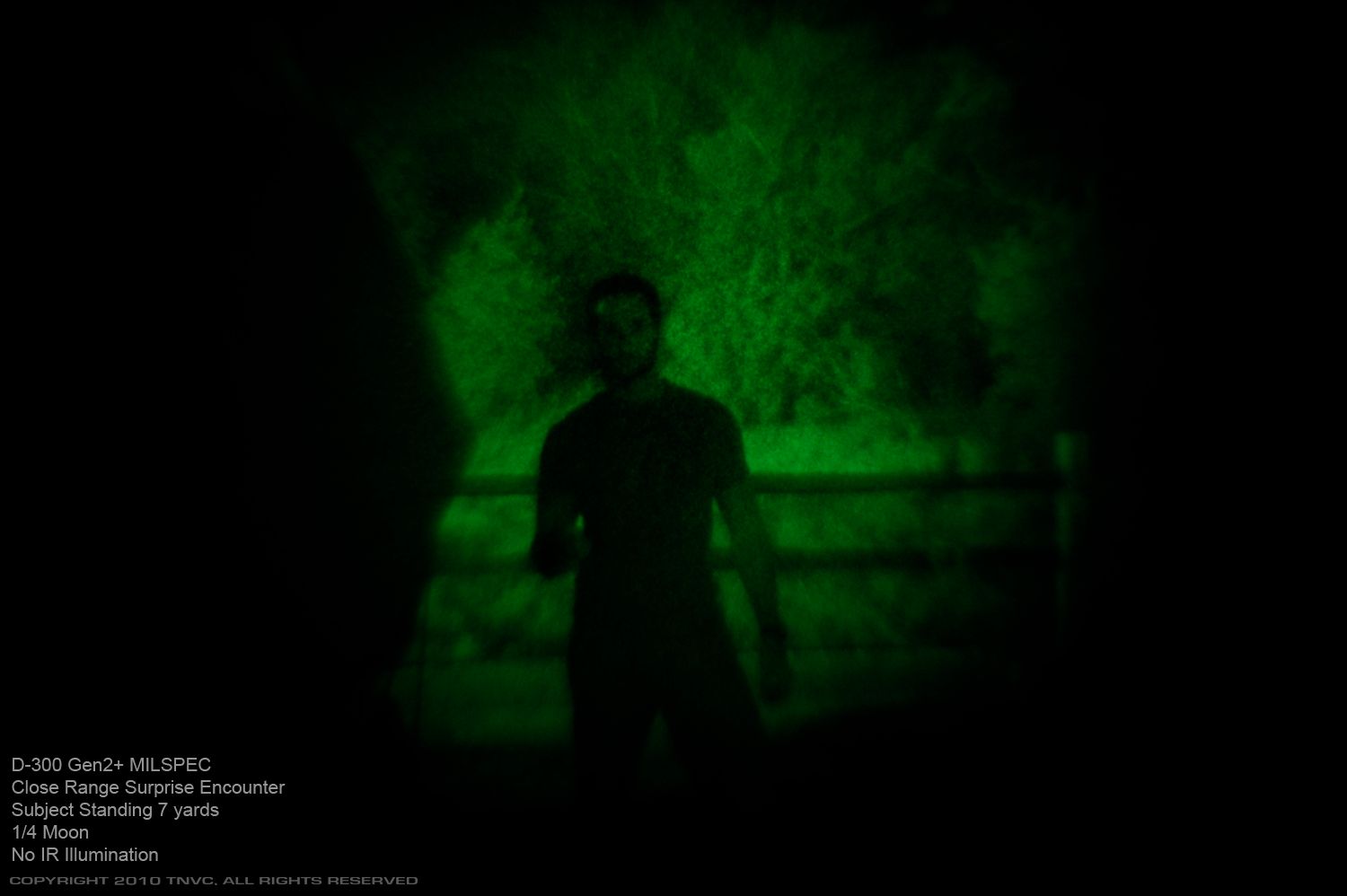
D300 Gen2+ MILSPEC Image Intensifier The Gen2+ tube really struggles with the lack of ambient light. The silhouette of the subject can be made out against the lighter background, but details are not available because of the Gen2+ tube’s poor light gathering ability. The subject is obviously holding something in his right hand, but the object cannot be resolved. This situation could result in catastrophe because rapid shoot/no-shoot response cannot be made. 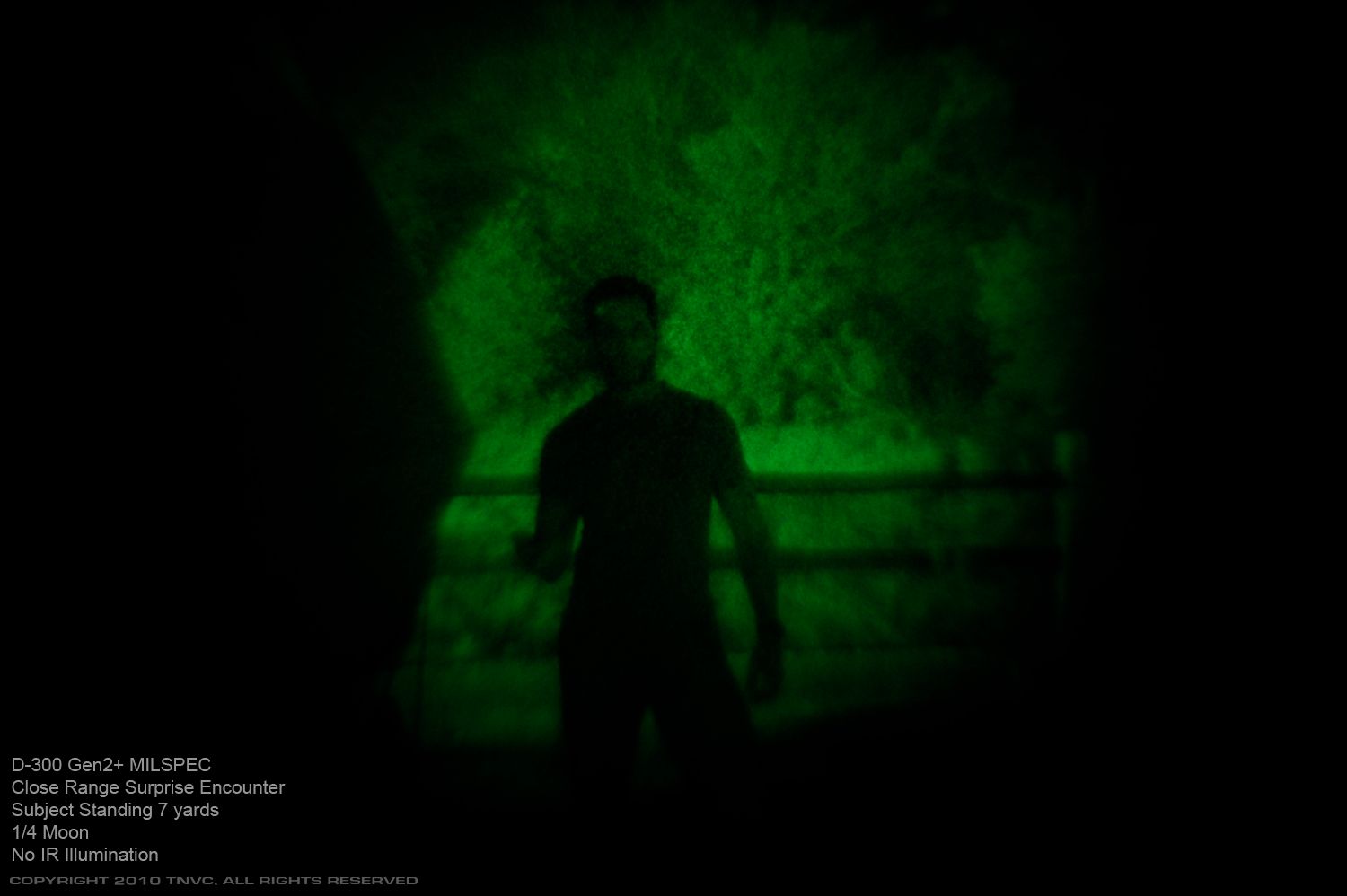
The built-in IR illuminator aids in creating detail in the subject’s face and shirt because they are lighter color and soak up most of the light. The subject’s hands and the surrounding area are almost completely blacked out. Again, this creates danger because the presence of a threat is not immediately identified. 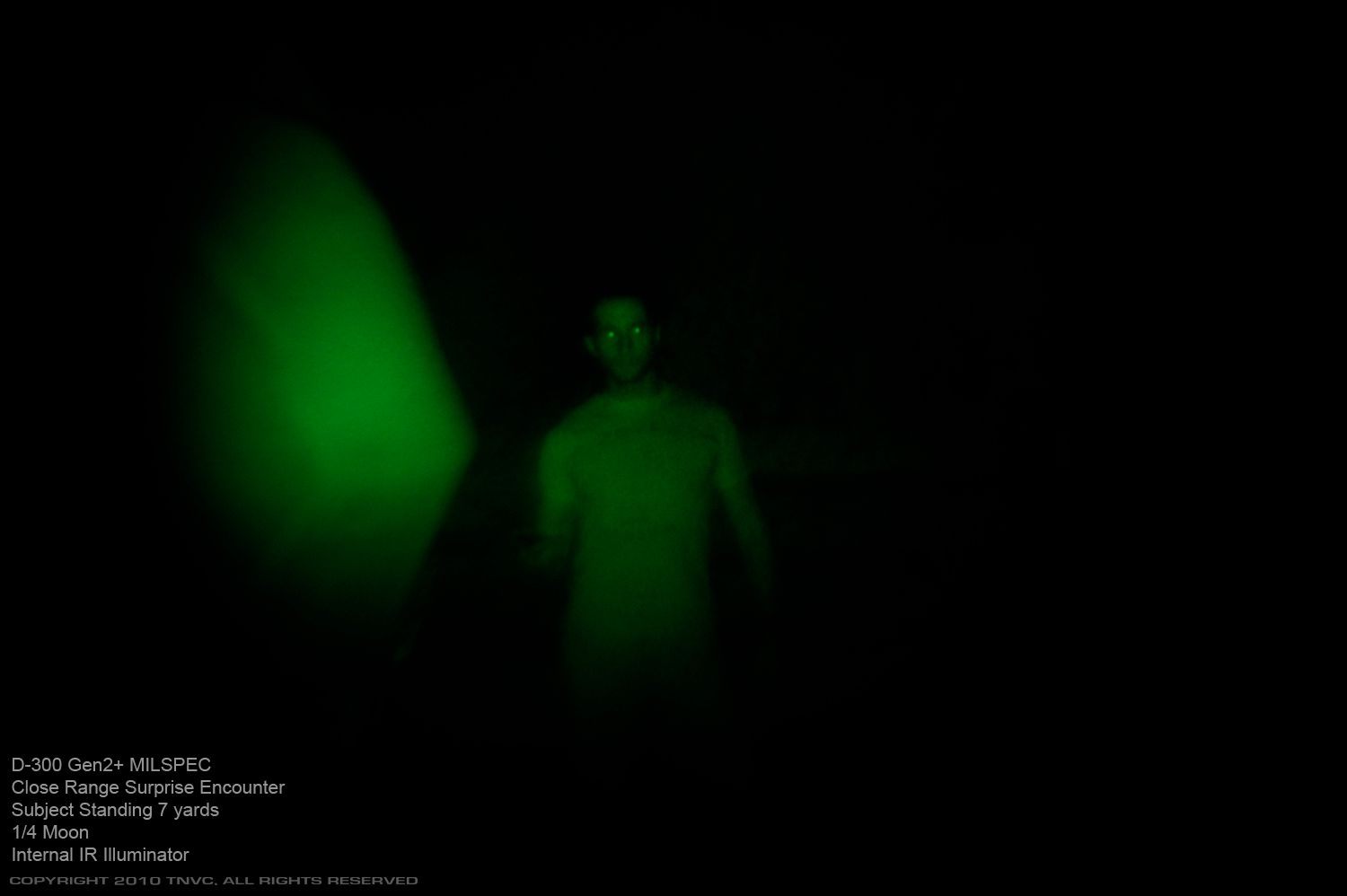
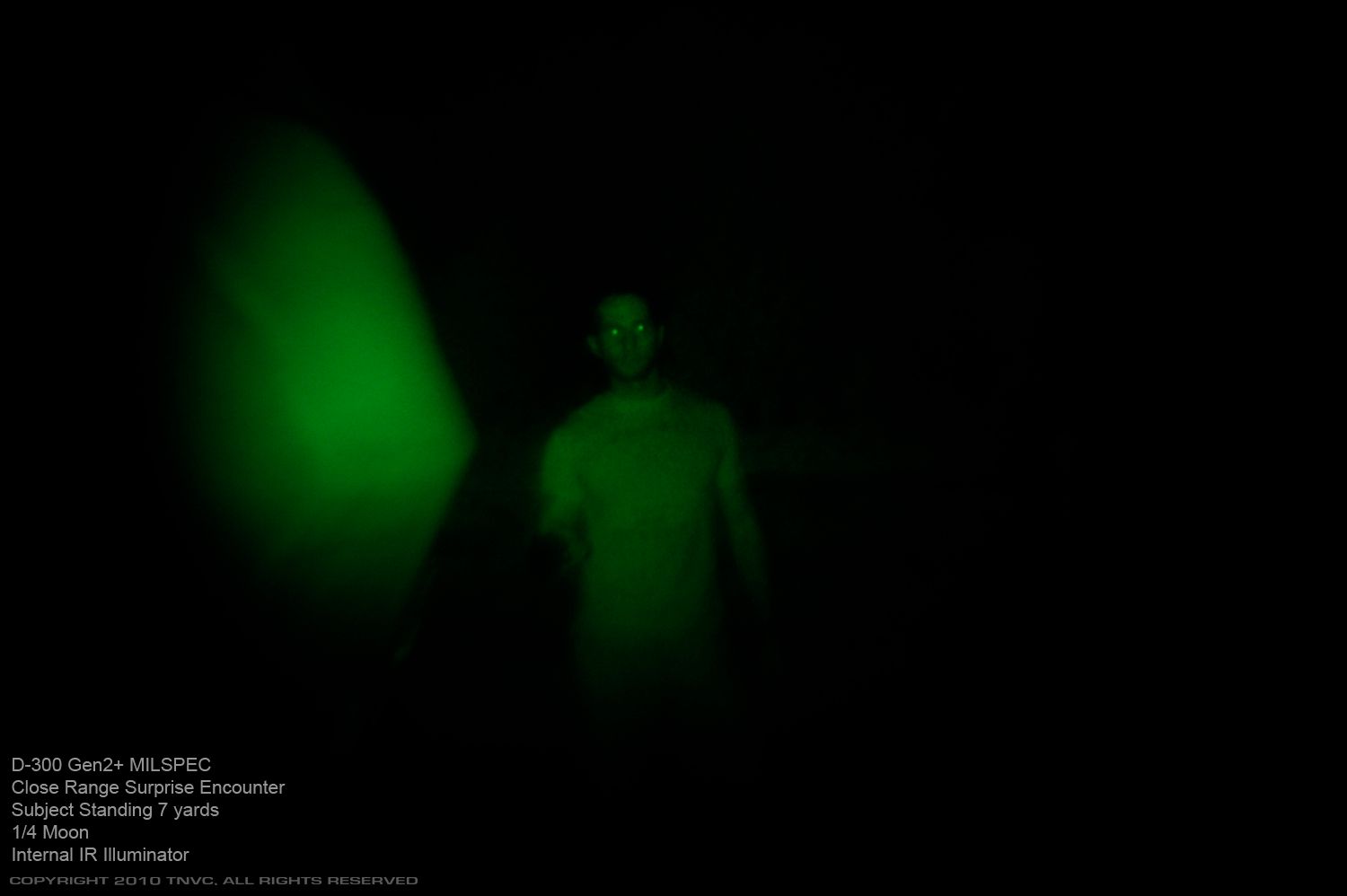
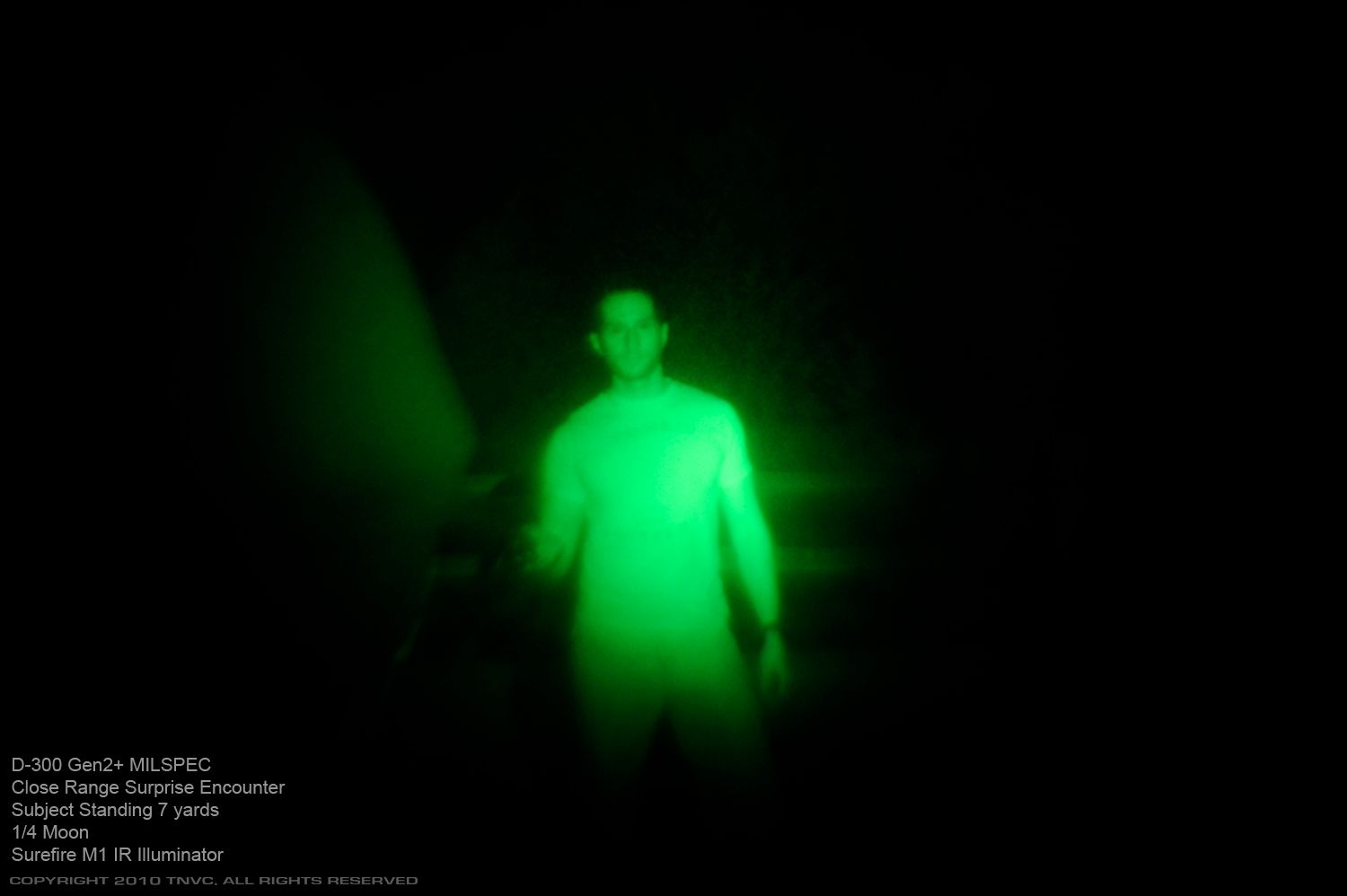
The additional higher-power illuminator provides more definition to the subject. While the IR light seemed to wash out the subject in the other devices, the Gen2+ tube cannot gather nearly as much light. The low resolution makes features appear fuzzy. The Gen2+ tube can only focus on the exact area of IR illumination, so the hands fall off the image. Even with the Surefire M1, the presence of a threat cannot be determined. 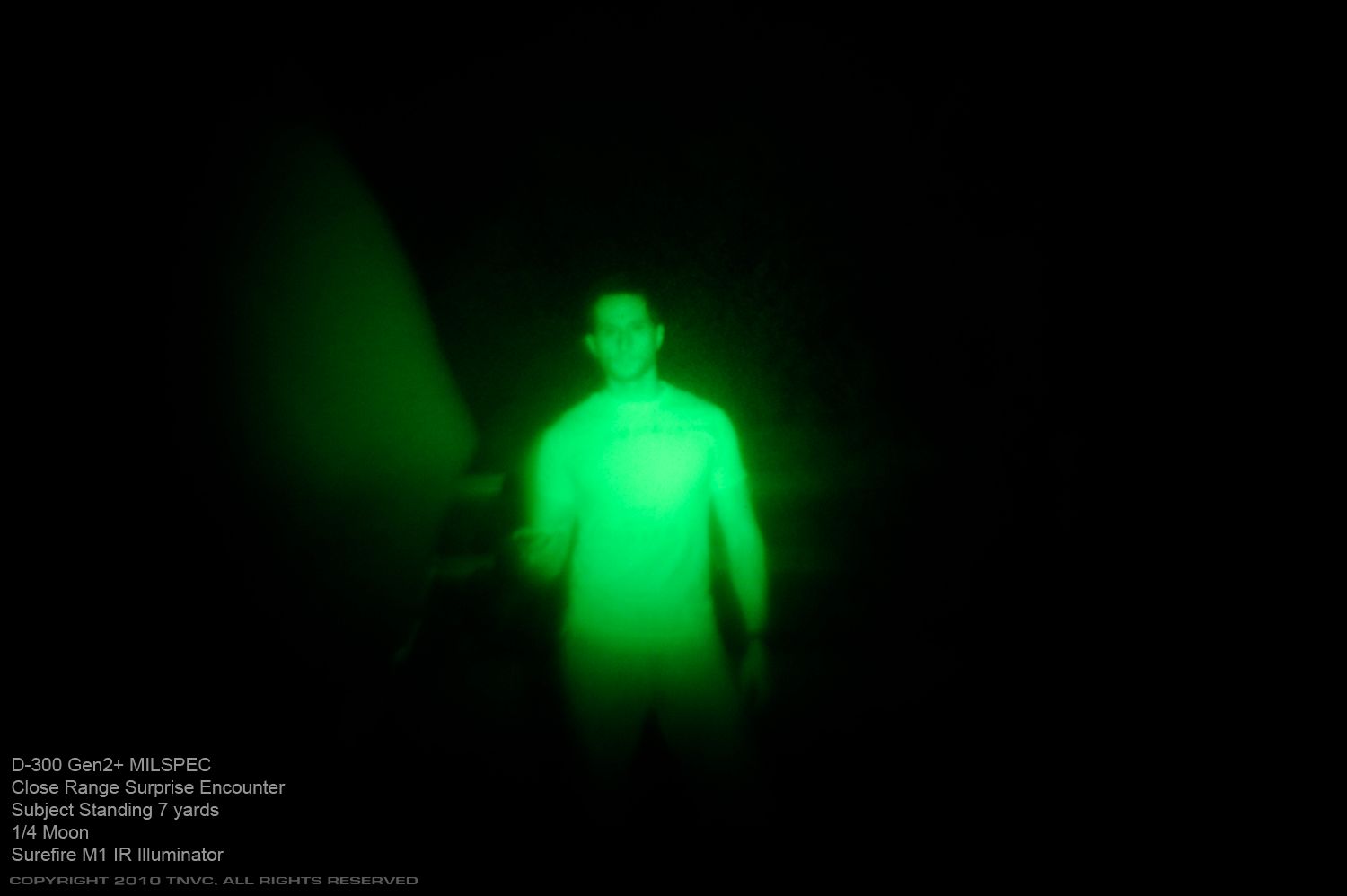
ATN Viper Gen1+ Image Intensifier The Gen1+ unit does not have enough light to create any image. The subject and surrounding environment cannot be seen. 

The built-in IR illuminator did not add any value to the image. 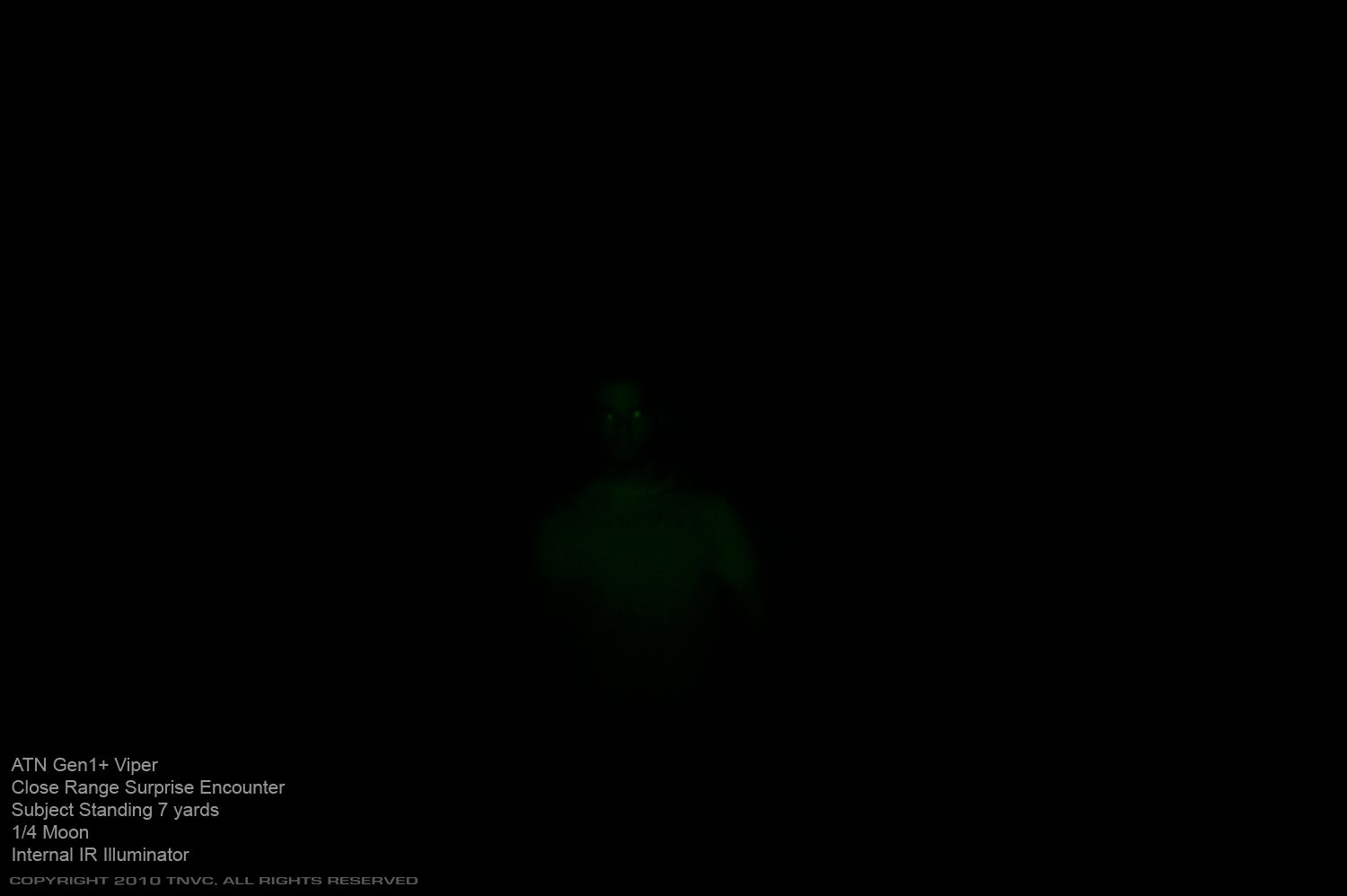
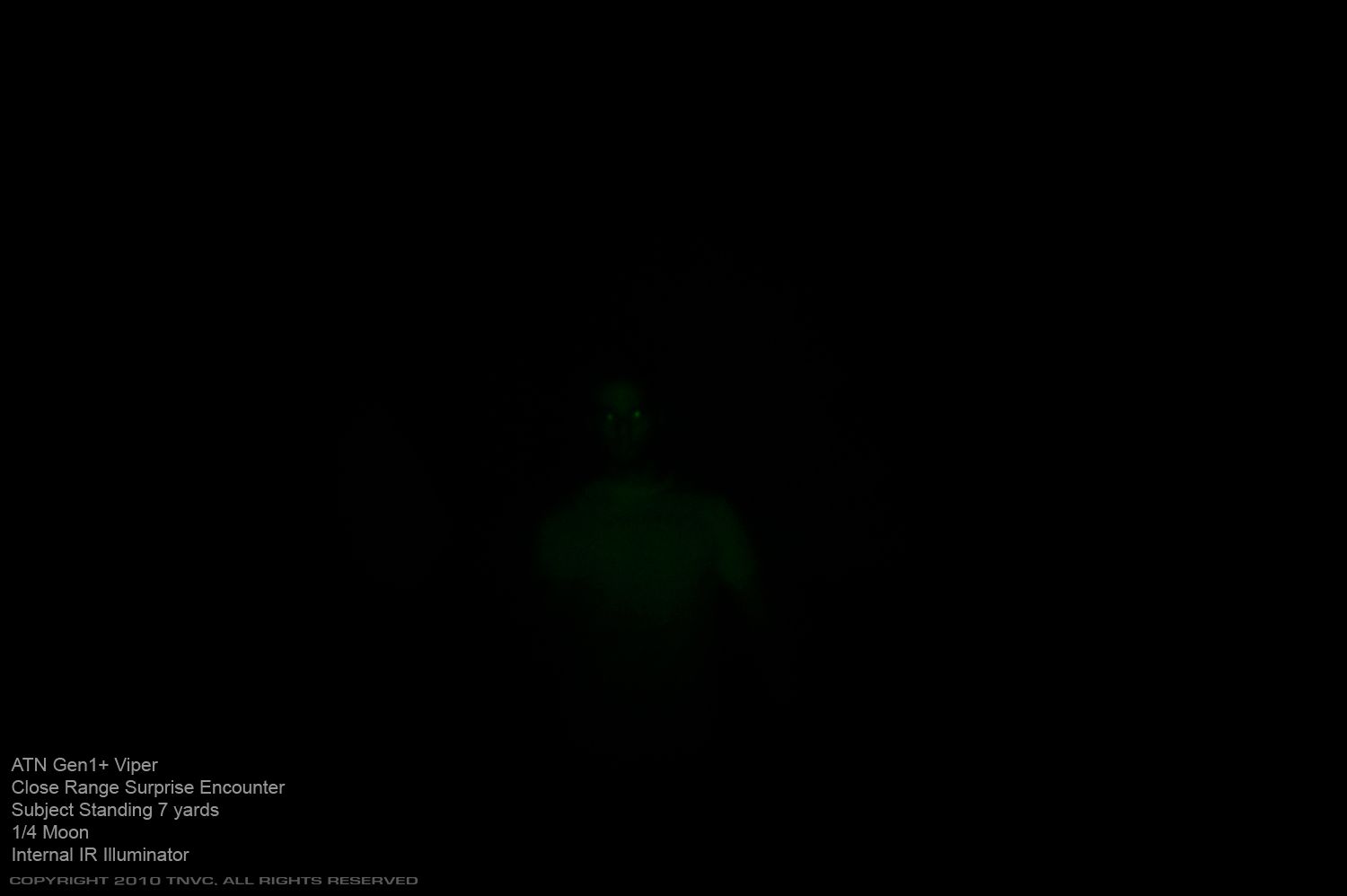
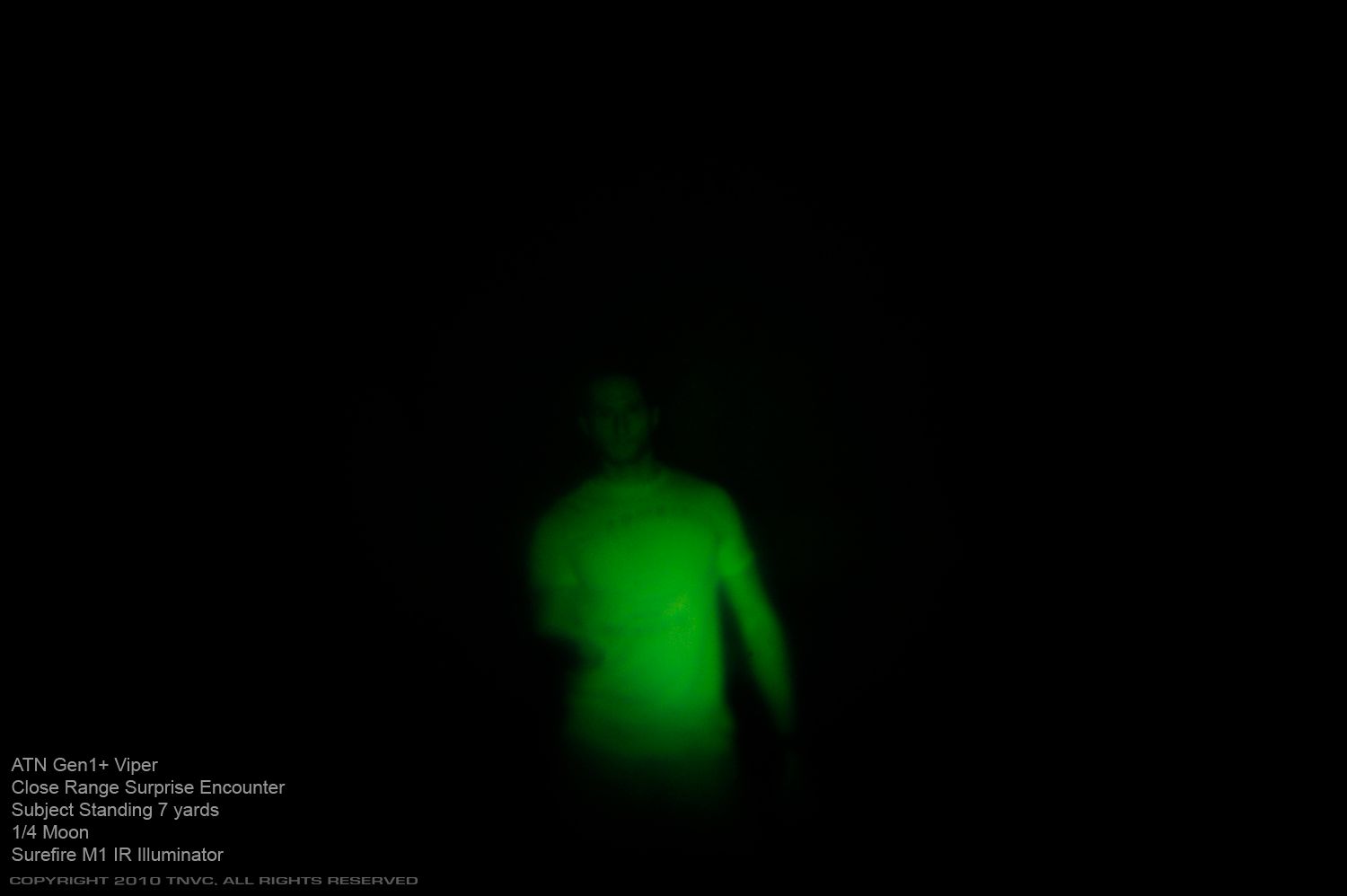
The additional higher-power illuminator at least allows the subject to be seen through the Gen1+ device. Resolution is poor and facial features are somewhat obscured. The subject’s hands cannot be seen, so it is unknown whether or not a threat exists. 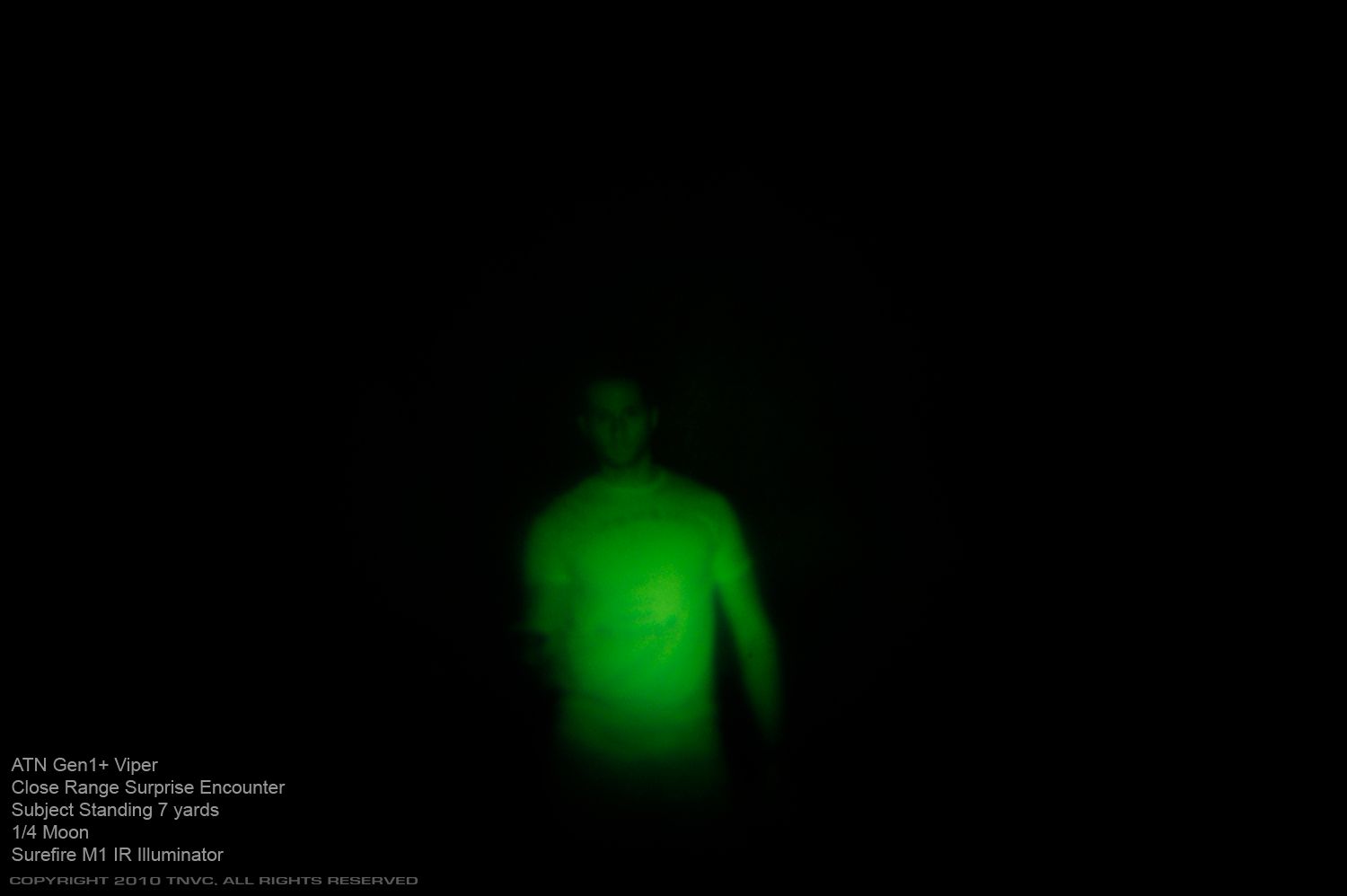
Conclusions Based on the test data documented above, it is the authors’ professional recommendation that only Gen3 night vision, such as the ITT PVS-14 Gen3 PINNACLE Auto-Gated Night Enforcer or the Litton Gen3 Auto-Gated PVS-14) be utilized for domestic law enforcement and homeland security taskings. This conclusion is based on the need for responders to be able to identify threats rapidly in reasonable circumstances, with a high degree of probable accuracy. Data clearly illustrates the short-comings of the Gen1 and Gen2 image intensifier tubes. While sufficient for hobbyist application, LE work requires a much higher level of performance. The lack of brightness and resolution found in the Gen1 and Gen2 tubes isolates the operator from his surroundings. Situational awareness is severely compromised. As seen in the photos, the lower-end tubes produce very dark images that keep the user from seeing the environment. They had a hard time identifying the subject, let alone any other possible threats. With today’s advances in night vision technology, there is no reason for a professional to settle for lesser performance. IR illuminators should be taken into account when reviewing the images. In some instances, an IR illuminator was absolutely required for the night vision device to resolve an image. Today, criminals are acquiring night vision as well. While IR illuminators are able to drastically improve the image, anyone else looking through night vision sees them too. So, a constantly active IR illuminator is akin to a big bullseye on the officer’s head to anyone else observing them through night vision. Suffice to say an image intensifier that requires an active IR illuminator to produce a useable image should be avoided. Night vision devices are not magic. They greatly enhance the operational capabilities of the modern law enforcement professional, but they have limitations. As seen in the first scenario (residential basement with no ambient light), even the latest generation image intensifier was rendered practically useless without artificial infrared light. Once the illuminator was activated, the Gen3 devices produced obviously superior images. But, the illuminator was required in that environment. Professionals need to constantly train with their night vision devices to maintain proficiency and be aware of their limitations. The images presented here do a good job of illustrating the capabilities of the various devices. However, it should be noted that photographic representation of night vision images is never completely accurate and always reproduces a slightly degraded quality. While these images are close, the operator’s view will always be better. Another subject worth mentioning is the quality of the optic being purchased. Regardless of the tube’s capabilities, the system still has to function. We should note the ATN Viper’s built-in IR illuminator did not work out of the box. It is evidenced by the photos, that a Gen1 tube requires an IR illuminator to provide any kind of useable image. The built-in illuminator required us to turn on and off the system several times before it would function. After that, it would only work intermittently. Night vision represents a critical component of an officer’s ability to meet and engage today’s threats. Law Enforcement officers, departments, units, and agencies need to be well aware of the technology’s capabilities and limitations when employing night vision in a social setting. They also need to be well aware of the various levels of technology available when making purchase decisions. |
|
Thanks TNVC... great to see the entire line-up! That's a lot of work!
It looks like these two pictures were mixed up and labeled differently. It's clearly the Gen 2 picture, but one of them is labeled as the Litton PVS-14. PVS14ag_4_3.jpg @ http://i53.photobucket.com/albums/g64/clasky/ARTICLES/NV_Gen/PVS14ag_4_3.jpg GT14_4_3.jpg @ http://i53.photobucket.com/albums/g64/clasky/ARTICLES/NV_Gen/GT14_4_3.jpg I haven't had a chance to review it all, but I'll let you know if I see anything else. Thanks again! |

|
Excellent work there Chip ! :) And the best thing about ATN is that the batteries are optional because unless you have a full moon, they don't do much :) So think how much power you can save! Actually, a great comparison - Thankyou for sharing... I've been waiting to see this for a LONG time and you didn't disappoint... And I thought the D300 hung in there pretty well, though knowing photos I suspect that your eyes still did quite well with the D300? Anyway, a great review and comparison, thanks :) David
|
 Just kidding...
|
Quoted:
Excellent work there Chip ! :) And the best thing about ATN is that the batteries are optional because unless you have a full moon, they don't do much :) So think how much power you can save! Actually, a great comparison - Thankyou for sharing... I've been waiting to see this for a LONG time and you didn't disappoint... And I thought the D300 hung in there pretty well, though knowing photos I suspect that your eyes still did quite well with the D300? Anyway, a great review and comparison, thanks :) David The D300 held its own, but is obviously out-classed by the newer tubes. We chose the D-300 to show off a regular Gen2+ tube because the 300 uses excellent PVS-5 optics, allowing us to get the most performance out of the intensifier. But, as you can see, the tube is still not up to the task of anything outside "close range." John "Chappy" Chapman made the comment: "Dude, your D300 sales are going to suck after this." while we were in the field. But, it is necessary for us to show this data so we can stay true to our business model: We always tell it like it is, without bias so our brothers can have the best equipment available when going into harm's way. The D300 is still a good unit, and I would still use it if nothing else was available, but the Gen2+ tube has very limited application and our customers need to know it. The article also goes to show the complete ineffectiveness of Gen1. Yes, cameras will slightly degrade a night vision image, but honestly; the Gen1 tube did not look any better than what you see here. Gen1 is a toy for your kids. Period. Buying it for anything more serious than that is a waste of money and using it for professional work is almost tantamount to public endangerment. |
|
Thanks for all the kind words guys. A lot of credit also needs to go to John Chapman of LMS Defense. This was a joint project and Chappy put in a lot of time and effort to bring this to fruition. He is a hell of a guy and I highly recommend seeking out LMS for training.
LMS Defense As a preview of things to come, we are going to be starting on our second article (yes, we are working on a series) that talks about and compares clip-on night sights. This will be complete with through the tube pics and live fire shooting results. Stay tuned. |
|
Quoted: Any digital NV comparison yet? That was one of Vic from TNVC's first reviews... http://www.ar15.com/forums/topic.html?b=6&f=18&t=223494 The xenonics stuff was better than most digital equipment out there... and it still wasn't much good when it counted. Probably the fairest review on digital tech anywhere on the web. Military grade digital is not available to civilians yet... It's even barely available to the military! Give it a year or so - :) Regards David. |

 ?
?
|
Quoted:
Great post. How would thermal be under these situations? In pitch black conditions, they can't be beat for detection. What they lack overall is resolution compared to I2 especially for facial recognition which may be key for LEO types in some situations. Even the hybrid systems are not quite there yet to give you the best of both worlds, but they're getting there. |
|
Chip, Thanks for all the great info. Do you have comparison images with the ITT NEPVS-14-17 and the Surefire V2 illuminator vs the Surefire M1? Victor had mentioned he uses the V2 and I want to see how it compares to the M1 due to V2's the higher IR output. Would the V2 be too bright in a 7-10yd encounter? Do you think the M1 is more versatile at various distances due to its lower output? |
 Awesome comparison! THat was a lot of work. Thank you.
|
Quoted:
Chip, Thanks for all the great info. Do you have comparison images with the ITT NEPVS-14-17 and the Surefire V2 illuminator vs the Surefire M1? Victor had mentioned he uses the V2 and I want to see how it compares to the M1 due to V2's the higher IR output. Would the V2 be too bright in a 7-10yd encounter? Do you think the M1 is more versatile at various distances due to its lower output? I like the V-Series lights and have one mounted on my work gun. It is a nice system and has a higher output than the M1. The reason we chose to work with the M1 in the photos is because the longest distance was 100yds. The V-Series lights would perform the same as any weapon IR Illuminator at close distance. It washes out some details. For what it's worth, my work attire has an M1 mounted on the helmet and a PEQ-15A & M952V mounted on the gun. |
|
Quoted:
What is effective illumination range of the M952V vs the TNVC ELR Torch-V? How does their illumination output compare? The Effective range of the V-Series is around 150yds. It will reach out further, but in our field tests, 150 was the maximum for full usage. The ELR TorchV will adjust out to 450yds, usable and 500yds max. |
| After looking at all the pics, there is likely a degradation in the quality of what the human eye would see compared to what comes through the camera. I assure you my D300 2nd gen looks much better in similar scenarios that are presented in this post. My 1PN34 Russian Gen 1 Weapons scope even looks as good or better than some of the D300 pics. If this is the case I'm sure the Gen 3's look even better in real life also. |
|
Quoted:
After looking at all the pics, there is likely a degradation in the quality of what the human eye would see compared to what comes through the camera. I assure you my D300 2nd gen looks much better in similar scenarios that are presented in this post. My 1PN34 Russian Gen 1 Weapons scope even looks as good or better than some of the D300 pics. If this is the case I'm sure the Gen 3's look even better in real life also. 1000% agree with you. We've said it for years around here with all the through the tube pics we take...The camera NEVER can do justice to what the real image looks like, especially in regards to Gen 3 stuff. |
|
This seems more of a camera fail than a gen 1 fail. In 1999 I bought a cheap nasty 200 dollar gen 1 monocular that had giant black specs in the lenses but it let me see very well out to 50 meters and even gave me a picture at 125 meters a bit better than what I see when I shine a 250 lumen M3 combat light into the tree line at the edge of my property (which is admitedly not much but enough to see if there are coyotes or bears running around back there, which is what I used it for). While the performance varied with the degree of ambient moon light (I live in a very very rural area), it never failed to show me something I found useable.
I've used Gen 3 and it's phenomenal and clearly superior to Gen 1 but the Gen 1 stuff does not show total blackness outdoors under any conditions I've ever experienced, particularly if you are using a powerful IR flashlight!! That's just ridiculous, and if no one else wants to say it, I will. Gen 1 commercial stuff may not be great, in fact many of you would probably say it sucks compared to Gen 3, but it's still quite useable and much better than the naked eye. When I was a ground pounder in the late 80s all we had was gen 1 and it was just like the cheap crappy thing I bought 12 years ago and it gave us an amazing advantage at night. I remember someone lost one and they locked down the entire base for hours until they found it. All that for what you can get for 200 bucks today. For god's sake I can see better without any night vision under a 1/4 moon outside than the images posted for Gen 1 (and maybe even some of the gen 2s!) and even commerical Gen 1 lights up the night in a way someone who's never used NV would not believe. |
|
Quoted:
This seems more of a camera fail than a gen 1 fail. In 1999 I bought a cheap nasty 200 dollar gen 1 monocular that had giant black specs in the lenses but it let me see very well out to 50 meters and even gave me a picture at 125 meters a bit better than what I see when I shine a 250 lumen M3 combat light into the tree line at the edge of my property (which is admitedly not much but enough to see if there are coyotes or bears running around back there, which is what I used it for). While the performance varied with the degree of ambient moon light (I live in a very very rural area), it never failed to show me something I found useable. I've used Gen 3 and it's phenomenal and clearly superior to Gen 1 but the Gen 1 stuff does not show total blackness outdoors under any conditions I've ever experienced, particularly if you are using a powerful IR flashlight!! That's just ridiculous, and if no one else wants to say it, I will. Gen 1 commercial stuff may not be great, in fact many of you would probably say it sucks compared to Gen 3, but it's still quite useable and much better than the naked eye. When I was a ground pounder in the late 80s all we had was gen 1 and it was just like the cheap crappy thing I bought 12 years ago and it gave us an amazing advantage at night. I remember someone lost one and they locked down the entire base for hours until they found it. All that for what you can get for 200 bucks today. For god's sake I can see better without any night vision under a 1/4 moon outside than the images posted for Gen 1 (and maybe even some of the gen 2s!) and even commerical Gen 1 lights up the night in a way someone who's never used NV would not believe. Bill, I think you are confusing two types of tubes. The Gen 1 you were using is what we call a cascade tube. Basically 3 Gen 1 tubes linked together. They are very usable and can be pretty good. This is the type of tube used in a PVS-2. The commercial Gen 1 produced today is only single stage and is purely junk made in Russia. Gen 1 of today is not even close to the gen 1 scopes you used back in the day. Two different animals altogether. 
|
|
Quoted:
Quoted:
This seems more of a camera fail than a gen 1 fail. In 1999 I bought a cheap nasty 200 dollar gen 1 monocular that had giant black specs in the lenses but it let me see very well out to 50 meters and even gave me a picture at 125 meters a bit better than what I see when I shine a 250 lumen M3 combat light into the tree line at the edge of my property (which is admitedly not much but enough to see if there are coyotes or bears running around back there, which is what I used it for). While the performance varied with the degree of ambient moon light (I live in a very very rural area), it never failed to show me something I found useable. I've used Gen 3 and it's phenomenal and clearly superior to Gen 1 but the Gen 1 stuff does not show total blackness outdoors under any conditions I've ever experienced, particularly if you are using a powerful IR flashlight!! That's just ridiculous, and if no one else wants to say it, I will. Gen 1 commercial stuff may not be great, in fact many of you would probably say it sucks compared to Gen 3, but it's still quite useable and much better than the naked eye. When I was a ground pounder in the late 80s all we had was gen 1 and it was just like the cheap crappy thing I bought 12 years ago and it gave us an amazing advantage at night. I remember someone lost one and they locked down the entire base for hours until they found it. All that for what you can get for 200 bucks today. For god's sake I can see better without any night vision under a 1/4 moon outside than the images posted for Gen 1 (and maybe even some of the gen 2s!) and even commerical Gen 1 lights up the night in a way someone who's never used NV would not believe. Bill, I think you are confusing two types of tubes. The Gen 1 you were using is what we call a cascade tube. Basically 3 Gen 1 tubes linked together. They are very usable and can be pretty good. This is the type of tube used in a PVS-2. The commercial Gen 1 produced today is only single stage and is purely junk made in Russia. Gen 1 of today is not even close to the gen 1 scopes you used back in the day. Two different animals altogether.
What about the crappy Russian thing I bought for 200 in 1999? That is what I am describing above. Also I thought that cascade devices were very big? The thing we were using in Ft. Irwin in 1988-89 was fairly small. I'm not saying that Gen 1 isn't vastly inferior to Gen 2 or 3, just that unless it's gone way downhill since since I bought that cheap monocular in 1999, it certainly isn't all black even with an IR illuminator on. The pics of the the Gen 1 in this review are simply ridiculous. If you turn on even a small IR illuminator in a pitch black basement you are going to get tons of light. There are videos on youtube of gen 1s in action and while they are not great they are certainly not black screens. |
|
Quoted:
Quoted:
Quoted:
This seems more of a camera fail than a gen 1 fail. In 1999 I bought a cheap nasty 200 dollar gen 1 monocular that had giant black specs in the lenses but it let me see very well out to 50 meters and even gave me a picture at 125 meters a bit better than what I see when I shine a 250 lumen M3 combat light into the tree line at the edge of my property (which is admitedly not much but enough to see if there are coyotes or bears running around back there, which is what I used it for). While the performance varied with the degree of ambient moon light (I live in a very very rural area), it never failed to show me something I found useable. I've used Gen 3 and it's phenomenal and clearly superior to Gen 1 but the Gen 1 stuff does not show total blackness outdoors under any conditions I've ever experienced, particularly if you are using a powerful IR flashlight!! That's just ridiculous, and if no one else wants to say it, I will. Gen 1 commercial stuff may not be great, in fact many of you would probably say it sucks compared to Gen 3, but it's still quite useable and much better than the naked eye. When I was a ground pounder in the late 80s all we had was gen 1 and it was just like the cheap crappy thing I bought 12 years ago and it gave us an amazing advantage at night. I remember someone lost one and they locked down the entire base for hours until they found it. All that for what you can get for 200 bucks today. For god's sake I can see better without any night vision under a 1/4 moon outside than the images posted for Gen 1 (and maybe even some of the gen 2s!) and even commerical Gen 1 lights up the night in a way someone who's never used NV would not believe. Bill, I think you are confusing two types of tubes. The Gen 1 you were using is what we call a cascade tube. Basically 3 Gen 1 tubes linked together. They are very usable and can be pretty good. This is the type of tube used in a PVS-2. The commercial Gen 1 produced today is only single stage and is purely junk made in Russia. Gen 1 of today is not even close to the gen 1 scopes you used back in the day. Two different animals altogether.
What about the crappy Russian thing I bought for 200 in 1999? That is what I am describing above. Also I thought that cascade devices were very big? The thing we were using in Ft. Irwin in 1988-89 was fairly small. I'm not saying that Gen 1 isn't vastly inferior to Gen 2 or 3, just that unless it's gone way downhill since since I bought that cheap monocular in 1999, it certainly isn't all black even with an IR illuminator on. The pics of the the Gen 1 in this review are simply ridiculous. If you turn on even a small IR illuminator in a pitch black basement you are going to get tons of light. There are videos on youtube of gen 1s in action and while they are not great they are certainly not black screens. Bill, the only Gen 1 the US military ever used was the cascade tube. What you used in Ft Irwin was most likely Gen 2. The US military has never fielded a single stage Gen 1 tube. I can't speak for what you used of Russian origin but they had tubes that were two and 3 stage cascade. Not all were huge tubes. They even have early Russian Gen 2. Not sure what year the Russians came out with Gen 2. |
|
Quoted:
It is not my intention to argue with you, but the crappiest Gen 1 tube on the market will never show the human eye a pitch black screen under 1/4 moon light. It may show that to a camera, but that's not nearly the same thing. Did not think we were having an argument. I was just trying to shed some light (pun intended)  . But yes you're right and some of the reason it is so dark is due to the camera and I suspect the wavelength and type of illuminator used. That said, today's single stage commercial gen 1 tubes are really junk. In truth I would much rather have cheap digital over Gen 1 commercial. . But yes you're right and some of the reason it is so dark is due to the camera and I suspect the wavelength and type of illuminator used. That said, today's single stage commercial gen 1 tubes are really junk. In truth I would much rather have cheap digital over Gen 1 commercial. 
|
|
Well you've made me curious.
I've ordered an ATN night cougar XT on amazon for 540 bucks, it's a gen 1 goggle set with head gear. I don't plan to keep this, unless it surprises me, but I'm curious to see if 11 years of progress means the gen 1 of today is worse than the gen 1 of 1999. I'll let you know how it works and how it compares to the Gen 3 monocular I used a couple of years ago. If you're right that it's total junk I'll be out 20 bucks for shipping. |
|
Quoted:
Well you've made me curious.
I've ordered an ATN night cougar XT on amazon for 540 bucks, it's a gen 1 goggle set with head gear. I don't plan to keep this, unless it surprises me, but I'm curious to see if 11 years of progress means the gen 1 of today is worse than the gen 1 of 1999. I'll let you know how it works and how it compares to the Gen 3 monocular I used a couple of years ago. If you're right that it's total junk I'll be out 20 bucks for shipping. Post us some pics when you get it in. I would also like to see if any improvement has been made. I don't think you will be impressed but time will tell.
|
|
Quoted: Well you've made me curious. I've ordered an ATN night cougar XT on amazon for 540 bucks, it's a gen 1 goggle set with head gear. I don't plan to keep this, unless it surprises me, but I'm curious to see if 11 years of progress means the gen 1 of today is worse than the gen 1 of 1999. I'll let you know how it works and how it compares to the Gen 3 monocular I used a couple of years ago. If you're right that it's total junk I'll be out 20 bucks for shipping. Yes, the Gen1 of today are a LOT worse than the Gen1 of 10 years ago... And the Gen1 of ten years ago was a lot worse than Gen1+... I know everyone calls their Gen1 a Gen1+ now, but true Gen1+ has very little distortion ( it's distortion corrected ) and extended sensitivity into the IR region so works well with illuminators. The tubes look VERY different. I don't think anything Yukon or ATN sell is true Gen1+ but I could be wrong. Anyway, I gave up on Gen1 on a dark night... I could see a car quite well with my eyes, but the Gen1 was just black... Completely black.. Even to my own eyes. Well, except for the occasional ion-strike in the middle of the screen. There comes a point where Gen1 just doesn't work effectively anymore. Some of the photography examples are just really dark - but TNVC does not alter it's photography. What the camera sees is what they publish. If you take their images and put them in photoshop and adjust the brightness, you will see the picture emerge and eventually resemble something that Gen1 looks like to your eye. As for conditions? Within a city, Gen1 usually works quite well, because it's never really dark in a modern city. You can find one my my "city" comparisons here:  This is a lot different from TNVC's comparison, but then I never did a Gen1 Rural comparison, because out in the country, mostly I just got a black screen like TNVC photo's so given the circumstances, the photo's may be closer to reality than you realize. Not all Gen1 is so poor - I have a few different cascade tubes which are Gen1 and a small one compares to Gen2 while the bigger ones compare to Gen3. I've been teaching people how to build their own cascade scopes for years and most are pretty happy with them. Anyway, I look forward to your comparison. If you can get pics, please take note of the time of day, general darkness ( eg, moon, clouds, etc ) and whether you adjust the image or exposure times :) I'd really like to see how you go - :) Regards David |
|
Okay, these are pretty bad. They are NOT anywhere near as good as the CHEAP 200 dollar gen 1 scope I bought in 1998/99. What the hell has happened to the market???
Are there any real gen 1 tubes on the market these days??? Cheap ones like the ones they used to have, but one that actually work?? I tried taking pictures but the camera could not see more than a black screen, so the pictures in the review are accurate as far as what the camera sees but the eye sees a lot more. The night cougars make no whining sound, the image is pale green and not the bright green I remember from my old cheap monocular (as well as the one I used in the army), and they really are barely better than the naked eye once acclimated to darkness. You do see a lot more, a LOT more than the naked eye, but it's not clear enough to make it worthwhile, hence not much better. For example, I have a long gravel driveway and it curves about 75 meters from where I was standing. With my eyes I could barely make it out within 25 meters while with the Night Cougar I could see the road almost to the bend. However, it was very pale and without much detail. So if there were a bear coming up the road, these things would let me see it, but not much about it. So they are not completely useless, but the fish bubble effect and the loss of peripheral vision are unacceptable for the small bonus in vision you get. The IR illuminator makes a big difference out to 25 meters, it lets you see pretty clearly, but then so does a flashlight. With the IR illuminator on, you can see quite well, if distorted, in total darkness (like a windowless basement), so the pictures in this review are still wrong (but it IS what the camera sees...at least the cheap camera I was using, maybe whoever took those pics needs a better camera?). That said, you guys have made a believer out of me, these current gen 1 commercial devices are toys at best. I'm sending this thing back. |
|
Quoted: Okay, these are pretty bad. They are NOT anywhere near as good as the CHEAP 200 dollar gen 1 scope I bought in 1998/99. What the hell has happened to the market??? Are there any real gen 1 tubes on the market these days??? Cheap ones like the ones they used to have, but one that actually work?? I tried taking pictures but the camera could not see more than a black screen, so the pictures in the review are accurate as far as what the camera sees but the eye sees a lot more. The night cougars make no whining sound, the image is pale green and not the bright green I remember from my old cheap monocular (as well as the one I used in the army), and they really are barely better than the naked eye once acclimated to darkness. You do see a lot more, a LOT more than the naked eye, but it's not clear enough to make it worthwhile, hence not much better. For example, I have a long gravel driveway and it curves about 75 meters from where I was standing. With my eyes I could barely make it out within 25 meters while with the Night Cougar I could see the road almost to the bend. However, it was very pale and without much detail. So if there were a bear coming up the road, these things would let me see it, but not much about it. So they are not completely useless, but the fish bubble effect and the loss of peripheral vision are unacceptable for the small bonus in vision you get. The IR illuminator makes a big difference out to 25 meters, it lets you see pretty clearly, but then so does a flashlight. With the IR illuminator on, you can see quite well, if distorted, in total darkness (like a windowless basement), so the pictures in this review are still wrong (but it IS what the camera sees...at least the cheap camera I was using, maybe whoever took those pics needs a better camera?). That said, you guys have made a believer out of me, these current gen 1 commercial devices are toys at best. I'm sending this thing back. I really hate seeing good money spent on this type of kit - I hope you don't have any problems getting them returned. I think the Gen1 of old you are referring to is "Cascade Tube Technology" which uses multiple stages to achieve amplification. Here's an example - Gen1 on the left, all passive but there's a lot of light in the area anyway. Then Gen1 keeps up with all the other tubes and shows just how far the technology got before they stopped making it. 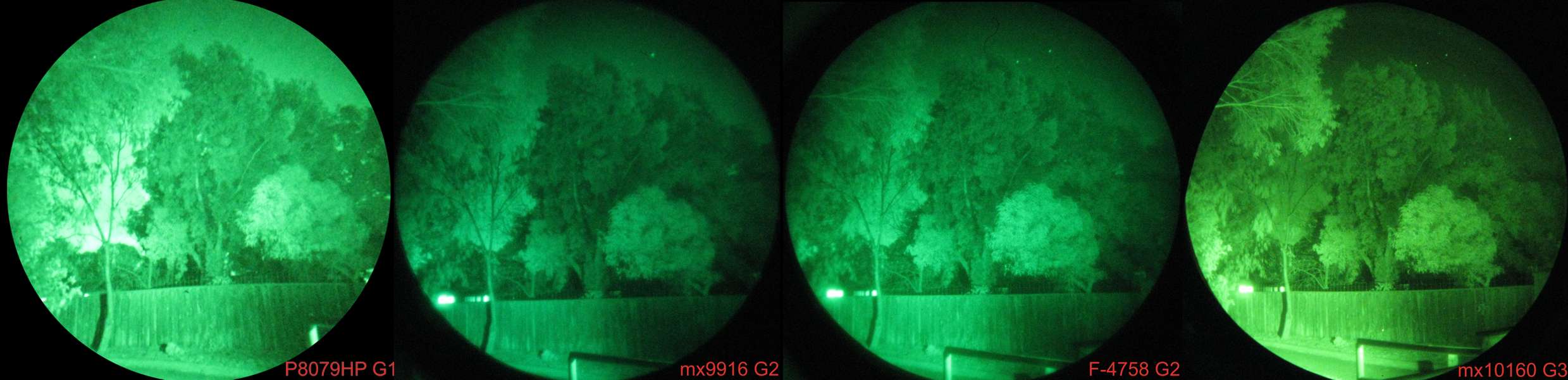 :) If you're wanting to make one of these, you can still buy the tubes secondhand, though most come from the UK. The good news is that the UK Gen1 Cascade tubes are much better than American tubes. Regards David |
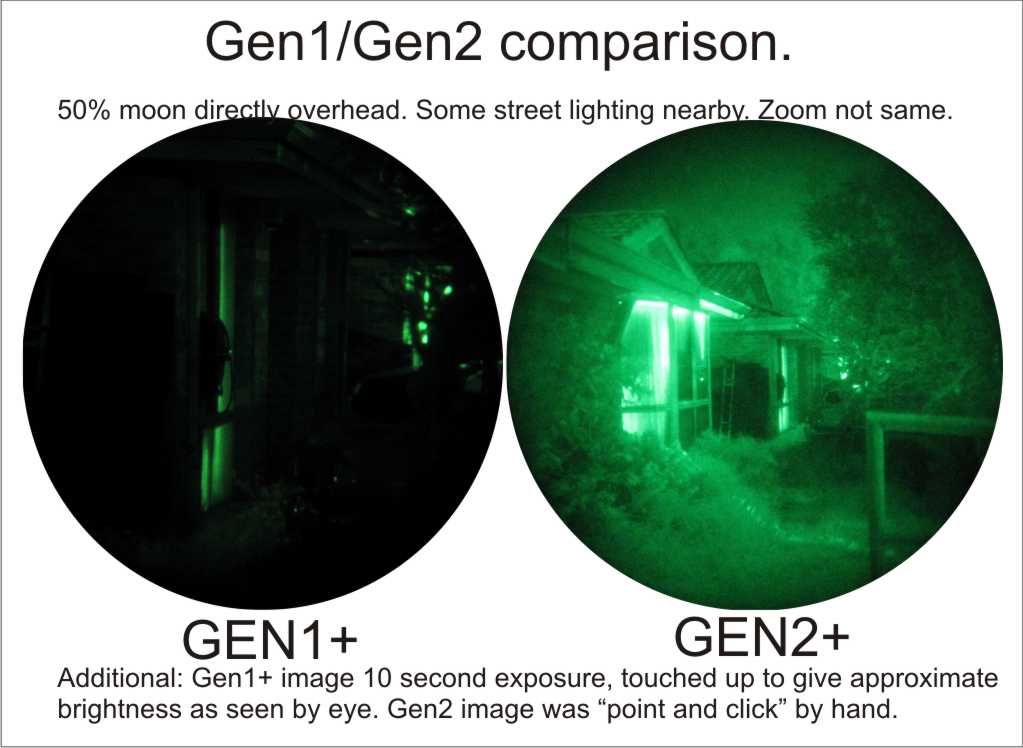

Armory Sponsor
Join the Community
Your next conversation starts here.
Create your free account to join discussions, share your experience, save topics, and connect with the AR15.COM community.
- Join discussions
- Follow topics and replies
- Connect with fellow enthusiasts
Already a member? Sign in
Stay informed by subscribing to our Newsletter