


AR Sponsor
Ammunition review - HEAVY OTMs (Page 1 of 2)

Posted: 11/17/2008 11:10:44 AM EDT
[Last Edit: Zhukov][Edited]
|
Since this thread covers more than one manufacturer, I won't be adding a poll here. Feel free to post your personal experiences with any ammo that fits the overall description below. This is a catch-all post for discussion of heavy (68gr+) OTM ammo such as: * Hornady 75gr OTM * HSM 75gr OTM * 77gr loads such as Mk262 * Wolf 75gr * Prvi 75gr * etc. THIS IS A REVIEW THREAD, NOT A DISCUSSION THREAD. PLEASE KEEP YOUR POSTS CONFINED TO YOUR OWN PERSONAL EXPERIENCE WITH THIS AMMO. The type of information I'm looking for is something along the following: * Ammunition used * Muzzle velocity (if you have it) * Your rifle (barrel length/twist rate) * Bullet accuracy * Does the bullet fragment (water tests or references to ballistic gelatin data) * Reliability problems * Anything else that's useful to know |
Daddy loves you. Now go away.
|
AIM graciously sent me a small sample of ammo to evaluate, so this is this post will include some data that may be of use for you guys. This first report won't include any shooting data; I haven't had time to go to the range yet. Instead, I pulled 10 bullets, weighed the powder and bullets, measured the bullets and loaded ammo, and took some pics. The loaded ammo looks pretty much like any other Wolf ammo: Grey polymer coating, primer sealant, no neck sealant:  Pulling the bullets showed that they are definitely bi-metal, as they were strongly attracted by a magnet. I plan to shoot these into some water jugs to determine if they will fragment. As You can see, the bullet is not a true OTM round as the bottom of the bullet exposes the lead:  For comparison, the bullet on the left is a Hornady 75gr OTM bullet, T1 variant. The bullet looks a little weird because it was tarnished a little having been left in the garage for a few months. Here's the view of a sectioned bullet:  Nothing much to say - it reminds me of the 62gr Silver Bear I sectioned several years ago. Minimal cavity for the hollow point. That bullet did fragment, however, so we'll have to see if this one does as well. The powder is a short-cut extruded:  On to the data. Powder weight 21.1 21.1 21.3 21.3 21.0 21.0 21.1 21.1 21.3 21.2 HIGH: 21.3 LOW: 21.0 E.S.:0.3 AVG:21.15 StdDev: 0.12 I thought the powder charge is fairly consistent, pretty much what I would expect from factory ammo - maybe a little better even. The weight of the powder charge indicated a pretty fast burning powder. Based on the chronograph results I've seen so far would put this powder somewhere around Alliant Reloader 7, maybe even faster. This is speculation though. Bullet weight 74.0 74.7 74.3 74.0 73.5 74.2 73.7 73.2 73.9 73.8 HIGH: 74.7 LOW: 73.2 E.S.:1.5 AVG:73.93 StdDev: 0.42 The variance in bullet weight is definitely more than I expected. An extreme spread of 1.5gr. Bullet length 0.939 0.941 0.948 0.945 0.939 0.940 0.947 0.949 0.948 0.940 HIGH: 0.949 LOW: 0.939 E.S.:0.010 AVG:0.9436 I don't have one of those little tools that allow you to measure the length of the bullet from a specific spot on the ogive, so this is the overall length of the bullet only. The ES of 0.010" is very good, about the same as Hornady 75gr OTM. Loaded ammo length 2.238 2.233 2.240 2.241 2.240 2.247 2.241 2.238 2.240 2.244 HIGH: 2.247 LOW: 2.233 E.S.:0.014 AVG:2.2402 The average length of 2.240 will not present a problem for loading these into a standard AR mag. 2.260" is the max length for a .223 round to fit into a magazine. The ES of 0.014" is about on par with the variation on the length of the bullet itself, and I would say that seating depth is very uniform. I finally had a chance to do some informal testing on this ammo using some water jugs to test fragmentation. I know there was one other person that shot the ammo into water-filled antifreeze jugs, and no fragmentation was noted. I'm not sure of the distance involved. I had 6 milk cartons to play with, and I thought 3 lined up would be enough; I was wrong. It turns out that the ammo did appear to fragment. The distance of the shot was 15 feet:  As you can see, the tip of the bullet is gone, and the lead core was pushed out. There were a few lead fragments left in the bottom of the milk jug. I *think* I found these in the second jug, but I'm not sure. The first jug had a near punctate entrance and exit hole, the third jug appeared to have been shredded somewhat - it would agree with the fragmentation I saw. Unfortunately, I should have used more jugs. Oh well. The second shot was pretty much like the first, although I found the lead core on this one:  Notice the jacket fragment stuck on the surface of the milk jug. Here is a closeup of the fragments of what I was able to find. The piece of jacket stuck in the plstic was the very tip of the bullet BTW:  The ammo did fragment in this particular test, but I caution anyone to extrapolate too much from this test. Even though I saw the bullet fragment, I would expect the fragmentation distance to be fairly short. This is just my best guess; steel jackets are inherently tougher, and even a slight loss of velocity might mean that the bullet wouldn't fragment. If I collect a few more water jugs, I might try some longer distances. The second unknown is: when the bullet does fragment, how soon does it do so? If the yaw cycle starts too late, it may not be a good choice. Silver Bear 62gr JHP gave me the same results when I tested it years ago, but the same caveats apply. The only way to find out for sure would be to shoot some ballistic gelatin to eliminate the unknowns. But one thing is certain: In the words of O_P - shooting stuff is fun! |
Daddy loves you. Now go away.


|
(repost)
HSM 5.56 Ammo Comparison There is now a third, commercially available 5.56mm cartridge being loaded to NATO pressures using a “heavy” OTM bullet on the market; the other two being Hornady’s 75 grain 5.56 TAP load and the Black Hills 77 grain MK262 load. HSM (The Hunting Shack) has begun loading Hornady’s 75 grain OTM bullet with cannelure (the T1C as it has come to be referred to here at AR15.com) to NATO pressures. The round is loaded using ball powder and has crimped and sealed primer pockets. It also has a heavy collet crimped case neck and an asphalt sealant is used at the case neck. The load is designated as the 5.56-17T. HSM is also producing another load using Hornady’s T1C bullet, designated as the 223-17T. This load also uses ball powder but is loaded to a velocity in between their NATO pressure load and the SAAMI pressure Hornady TAP FPD load. The particular lot of this load that I received has a lighter collet crimp than the 5.56-17T load and does not use the asphalt sealant at the case neck. Nor does it have crimped or sealed primer pockets. It has been stated that the primer pockets will be crimped and sealed on future loadings. asphalt sealant 
cannelures 
case neck crimps 

primer pockets 


Since the 5.56-17T load is considered to be an alternative round for Hornady’s 5.56 TAP, I decided to do an accuracy and chronograph comparison between the two. While I was at it, I also included the 223-17T load in the comparison as well. Chronographing was done using an Oehler 35-P chronograph with “proof screen” technology. All velocities listed are muzzle velocities as calculated from instrumental velocities using Oehler’s Ballistic Explorer software. Three different Colt barrels were used in chronographing: a 14.5” M4, a 16” light-weight profile and a 20” government profile. barrels 
The chronograph data. 
Accuracy testing of the new rounds will begin shortly and the results posted ASAP. Atmospheric conditions Temperature: 74 degrees F Humidity: 69% Barometric pressure: 30.09 Elevation: 950 feet above sea level Skies: overcast, Jupiter rising |
All hail Jeanne Assam!
|
(repost)
HSM 5.56-17T Accuracy Testing As explained previously in this thread, normally when I evaluate the accuracy of a particular load I use one of my stainless steel Krieger barrels as the test vehicle. However, since this test involves the NATO pressure 5.56-17T load I did not want to risk pressure issues by firing a NATO pressure load in a match chambered, tightly rifled barrel. Therefore, I chose one of my Colt 20” HBARs to use as the test vehicle. This barrel is free-floated and even though it has a NATO chamber and chrome lining, it is capable of shooting 10-shot groups from 100 yards that hover right around 1.00”. 
Testing of the HSM 5.56-17T load was conducted following my usual method of accuracy evaluation. Three 10-shot groups were fired at 100 yards from a bench-rest. All ten shots in each group were included in the measurements. Prior to firing the test rounds, I fired a 10-shot group from 100 yards using one of my standard hand-loads; a Sierra 55 grain BlitzKing with a muzzle velocity of approximately 3000 fps. This group measured 1.06”. This is typical of the accuracy this barrel is capable of producing. I have fired a total of five control loads from this barrel throughout the testing for this thread. Those groups measured 1.05”, 1.06”, 1.10”, 1.00” and 1.06”. I believe this demonstrates the capabilities of this barrel rather well. Here is a pic of the group fired using the control load. 
The three 10-shot groups of the 5.56-17T load fired from 100 yards and used for analysis measured, in order of firing: 1.81” 1.76” 2.04”. These three groups were over-layed on each other using the RSI Shooting Lab software program to form a 30-round composite group. The mean radius (explained here) of this composite group measured 0.58”. In an effort to validate these results and give the 5.56-17T load ample opportunity to prove itself, I fired two additional 10-shot groups from 100 yards that measured 1.67” and 2.11”. All five of the 10-shot groups were over-layed on each other to form a 50-round composite group. The mean radius for this 50-round composite group measured 0.57”. This is a pic of the smallest group from the 5.56-17T load. 
For comparison, the 30-round composite group created from three 10-shot groups of Hornady’s 5.56 TAP ammunition fired from the same Colt HBAR had a mean radius 0.46”. Here are the composite groups side-by-side. 
To give you an additional perspective, the mean radius of a 30-round composite group of IMI M193 fired from the same Colt barrel was 0.72”. 
I’ll be posting the results of the accuracy testing of the 223-17T load soon. Molon |
All hail Jeanne Assam!
|
(repost)
HSM 223-17T Accuracy Report Accuracy testing for HSM’s 223-17T load was conducted in the same manner as for the 5.56-17T load. Three 10-shot groups were fired from 100 yards for evaluation. All ten shots of each group were included in the measurements of the groups. The shooting was done at 100 yards from a concrete bench like the one pictured below. The same Colt 20” HBAR that was used in testing the 5.56-17T load was used as the test vehicle in order to give a fair comparison to the 5.56-17T load. The barrel.
The bench. 
The free-float tube of the rifle was rested on a Sinclair rest, while the stock of the rifle rested on a Protektor rabbit ear bag. I used a modified Sinclair fore-end stabilizer that attached to the Picatinny rail on the free-float tube to help the rifle track better in the rest. The LMT lower used as the test mule houses a Geissele Match Rifle 2-stage trigger that breaks at 1.5 pounds! The buttstock has a 3.5 pound lead weight added to it. The Sinclair rest. 

The fore-end stabilizer. 
The rabbit ear bag. 
For sighting I used a Leupold 45 X 45mm Competition Series scope with adjustable parallax. Wind conditions on the range were monitored using a “Wind Probe” produced by Gene Beggs (of bench-rest competition notoriety.) Leupold 45 X 45mm scope. 
The "Wind Probe." 

Shooting was done at a slow pace in order to closely monitor the wind conditions and to reduce eye/shooter fatigue. The Colt 20” HBAR used in testing is capable of shooting 10-shot groups from 100 yards that hover right around one inch. Throughout the testing for this thread, I have obtained a total of five 10-shot control groups fired from this barrel at 100 yards using hand-loaded Sierra bullets. The five groups measured as follows: 1.05” 1.06” 1.10” 1.00” 1.06”. The composite mean radius for the control groups measured 0.32”. 223-17T The three 10-shot groups fired from 100 yards using the 223-17T load measured as follows: 1.47” 1.72” 1.75”. Here is a pic of the smallest 10-shot group obtained. 
The three groups were over-layed on each other using the RSI Shooting Lab software program to obtain a 30-round composite group. The mean radius of the 30-round composite group measured 0.52”. In an effort to validate these results and give the 223-17T load ample opportunity to prove itself, I fired two additional 10-shot groups. Those groups measured 1.86” and 1.57”. All five groups were over-layed on each to form a 50-round composite group. The mean radius for the 50-round composite group measured 0.53”. For comparison, a 30-round composite group formed by over-laying three 10-shot groups of Hornady’s 75 grain TAP FPD load fired from the same Colt barrel had a mean radius of 0.37”. Here are those two composite groups pictured next to each other. 
Here are the 30-round composite groups from the 5.56-17T load and the 223-17T next to each other for comparison. 
Lastly, here is an image showing the best 10-shot group from each load placed side-by-side for comparison. 
|
All hail Jeanne Assam!

|
All credit review for this post belongs to MOLON. I merely pasted his review in this post with his permission - Z. Hornady 75 grain 223 TAP versus 75 grain MATCH  Hornady’s 75 grain BTHP Match ammunition (part #8026) is loaded with the same 75 grain boat-tail hollow point bullet that is available from Hornady as a reloading component (part #2279). The case mouth of the Match load has a slight taper crimp on it which puts a small crease in the bullet itself. The Hornady 75 grain 223 TAP load (part #80265) uses the same 75 grain BTHP bullet as the Match load with the addition of a cannelure. Unfortunately, the cannelured version of this bullet is not available (to the general public) as a reloading component.   Previous lots of both the Match and 223 TAP load have been charged with a short-cut, charcoal colored extruded powder, while the most recent lots that I have purchased (including the ones used in this test session) are charged with a greenish/yellowish colored short cut, extruded powder resembling those powders found in the Hodgdon lineup of powders. Both loads use traditional brass cases and the caseheads from both loads are head-stamped “Hornady 223-REM” and neither load appears to have sealed nor crimped primers. The case mouth of the 223 TAP load is crimped into the cannelure of the bullet.   previous powder  recent powder  Chronograph testing was done using an Oehler 35-P chronograph with "proof-screen" technology. All strings of fire consisted of 10-shots each. All velocities listed below are muzzle velocities, as calculated from the instrumental velocities using Oehler’s Ballistic Explorer software program.   Accuracy testing was performed using my 24” Krieger barreled AR-15. Shooting was done from a bench-rest at 100 yards. All groups were 10-shot groups. Prior to testing the Hornady ammunition, I fired a 10-shot control group using handloaded 55 grain Sierra BlitzKings. That group had an extreme spread of 0.63”.  Starting with the Hornady 75 grain 223 TAP load, I fired five, 10-shot groups from 100 yards and used the best three groups for analysis. Those three groups had extreme spreads that measured: 1.17” 0.87” 1.05” for a 10-shot group grand average of 1.03”. The three 10-shot groups were over-layed on each other using RSI Shooting Lab to form a 30-shot composite group that had a composite mean radius of 0.32”. best 10-shot group of 75 grain 223 TAP  In the same manner described above, I obtained three 10-shot groups of the Hornady 75 grain Match load. The extreme spreads of those groups measured: 0.89” 1.03” 1.16” for a 10-shot group grand average of 1.03”! Over-laying those three groups on each other using RSI Shooting Lab yielded a 30-shot composite group with a mean radius of 0.36”. best 10-shot group of 75 grain MATCH  For additional comparison, I obtained three 10-shot groups from 100 yards using hand-loaded Hornady 75 grain BTHP bullets. The extreme spreads of those groups measured: 0.78” 0.71” 0.52” for a 10-shot grand average of 0.67”. The mean radius formed from over-laying those three groups on each other was 0.23”. best 10-shot group of hand-loaded 75 grain BTHP  Here’s a pic of the composite groups side by side for comparison.  Lastly, in a tribute to the Internet Commando, I fired two, 3-shot groups in a row from 100 yards using the control load. Both groups were sub-QUARTER-minute-of-angle.   Here's a compilation of the 100 yard accuracy testing results of all the factory loaded ammunition tested for this thread that uses a Hornady 75 grain BTHP bullet.   |
Daddy loves you. Now go away.
|
All credit review for this post belongs to MOLON. I merely pasted his review in this post with his permission - Z. MK262 comparison As far as I am aware, the only other 5.56mm NATO pressure round loaded with a “heavy” OTM bullet besides the Hornady 5.56 TAP round (that is currently commercially available) is the Black Hills MK262 load. One can’t help but wonder how the two compare. The MK262 round is currently loaded with the Sierra 77 grain MatchKing bullet with a cannelure. Looking through my chronograph records shows that the MK262 round has a slightly higher velocity compared to the 5.56 TAP round when fired from a 20” NATO chambered barrel and nearly identical velocities when fired from both 16” and 14.5” barrels. The overall standard deviations of both loads are also quite similar.  The external ballistics of the two loads are virtually indistinguishable out to 250 yards. The conservative ballistic coefficients used for the graph and tables below were derived by testing at 200 yards by Rick Jamison.    I tested the accuracy of the Black Hills MK262 load using the same Colt 20” HBAR that was used to test the Hornady 5.56 TAP load. This barrel is NATO chambered, chrome lined and has a 1:7” twist and has repeatedly proven to shoot very well for a factory barrel. (While a match barrel, with say a Wylde chamber, might produce tighter groups than this barrel, the idea here was to test the MK262 load for its relative accuracy compared to the 5.56 TAP load.) The testing was done from a bench-rest at 100 yards. My usual procedure of obtaining three, 10-shot groups from 100 yards and overlaying those groups on each other using the RSI Shooting Lab software program was continued with this test. The previous control loads fired from the Colt HBAR using a standard handload with a 77 grain Sierra MatchKing had a mean radius of 0.32” for the 30-round composite target. The 30-round compostite target from the MK262 load produced a mean radius of 0.42”. For comparison the mean radius of the previous 30-round composite target from the 5.56 TAP load was 0.46” giving the MK262 load a very slight edge in accuracy. The 10-shot groups measured: Control load––-1.05”, 1.07”, 1.10” MK262––––––––-1.20”, 1.34”, 1.37” 5.56 TAP––––––1.16”, 1.38”, 1.45”  |
Daddy loves you. Now go away.
|
All credit review for this post belongs to MOLON. I merely pasted his review in this post with his permission - Z. Hornady's 75 Grain Practice Ammunition Hornady’s 75 grain practice ammunition uses a Berdan primed, steel case instead of a brass case to reduce the cost of the loaded cartridge. The round uses Hornady’s 75 grain BTHP bullet with a cannelure (referred to as the T1C here on AR15.com.) The round is charged with ball powder and has a muzzle velocity similar to Hornady’s 75 grain TAP FPD. Fired from my 20” Colt government profile barrel with a NATO chamber, a 10-shot string had an average muzzle velocity of 2,646 fps with a standard deviation of 9 fps.   The steel case employs the heaviest amount of bullet-pull I have ever encountered in a 223 Remington case. I was unable to remove a bullet from the case using Dillon’s kinetic bullet puller, so I chucked a Lee collet bullet-puller into my reloading press and attempted to pull the bullet. I still couldn’t get the bullet out of the case! At that point, I had to resort to more primitive means to get the bullet out of the case.  I tested the accuracy of the 75 grain practice round following my usual procedures. Using a free-floated 20” Colt HBAR and shooting from a bench-rest from 100 yards, I obtained three 10-shot groups and over-layed them on each other using RSI Shooting Lab. The 30-round composite group had a mean radius of 0.47”. While not as accurate as Hornady’s 75 grain TAP FPD, accuracy was on par with the 75 grain 5.56 TAP load.  |
Daddy loves you. Now go away.
|
All credit review for this post belongs to MOLON. I merely pasted his review in this post with his permission - Z. Black Hills 75 grain Match HP Ammunition: blue box versus red box  The difference between Black Hills’ red box and blue box ammunition lies primarily with the brass case. Red box ammunition is newly manufactured using virgin brass. Blue box ammunition is referred to as “remanufactured” because is uses once fired brass that has been resized. This enables Black Hills to sell the blue box ammunition at a reduced price compared to their red box ammunition. Black Hills’ 75 grain Match HP (hollow point) ammunition is loaded with Hornady’s 75 grain BTHP Match bullet with a cannelure (referred to as the "T1C" here on AR15.com) and both the red box and blue box loads have a crimp at the case mouth. Both loads are charged with “ball powder.” The nominal OAL for the red box cartridges ran around 2.245” and for the blue box cartridges it was closer to 2.250".     The cases used in the red box ammo have sealed primers and the headstamp of most lots of this load read “BHA 223 MATCH.” These virgin cases have a nominal length of 1.755”. The cases used in the blue box load tend to be a mix of once fired Lake City and Winchester brass. The military primer crimps has been removed by the reaming method. The blue box loads do not have sealed primers.   Black Hills does not perform a “trim to length” operation on the resized cases used in the blue box ammunition. As a result, many of the cases are longer than the SAAMI recommended maximum length of 1.760”. Several of the cases that I measured had a length of 1.775”. This could potentially cause problems in a barrel with a minimum length chamber, though no malfunctions of any kind were experienced during the testing of this ammunition. (Using a Sinclair chamber length gauge, I determined the chambers of my Colt barrels have a length of 1.780”.) Both loads were chronographed using four different length barrels. All of the Colt barrels used in testing have a NATO chamber and a 1:7” twist. The 24” Krieger barrel has a 5.56 Match chamber and has a twist rate of 1:7.7”. On their web-site, Black Hills advertises a muzzle velocity of 2,750 fps for these loads, but they do not state the barrel length associated with this velocity. An Oehler 35-P chronograph with “proof screen technology” was used in testing. All velocities listed are muzzle velocities obtained from the instrumental velocities using Oehler’s Ballistic Explorer software. Strings of fire consisted of 10 rounds each.  While chronographing the Black Hills loads through the 24” Krieger barrel, I also chronographed three of Hornady’s SAAMI pressure, 75 grain loads that use the T1C bullet for comparison.  Coming soon: 100 yard accuracy comparison. atmospheric conditions: Average temperature- 80 degrees F Humidity - 48% Barometric pressure – 29.04 Elevation- 960 feet above sea level For additional comparison, I also fired the Black Hills loads side-by-side with some of the Hornady 75 grain SAAMI pressure loads from the 20” Colt A2 barrel.  100 yard Accuracy Evaluation of Black Hills 75 grain MHP: red box versus blue box. As previously discussed in this thread, the primary difference between Black Hills' red box and blue box ammunition lies with the brass case. Red box ammunition uses virgin brass, while blue box ammunition uses once fired brass that has been resized. Both the red box and blue box 75 grain Match hollow point loads use the Hornady 75 grain BTHP bullet with a cannelure and both have crimped case necks. Both loads are charged with “ball” powder and with the two lots of this ammunition that I chronographed the blue box load ran an average of 50 fps faster than the red box. Accuracy testing of both loads was done from a bench-rest at 100 yards. The test-vehicle was an AR-15 with a 24” stainless-steel Kreiger VarMatch barrel, with a 1:7.7” twist, installed on a LaRue Tactical Stealth upper receiver. A Leupold Competition Series Scope was used for sighting. No malfunctions of any kind were experienced during testing.  Prior to testing the Black Hills ammunition, I obtained three 10-shot groups of a control load consisting of hand-loaded Sierra 55 grain BlitzKings (at a distance of 100 yards of course.) Those three groups had extreme spreads of: 0.537” 0.57” 0.69” for an average extreme spread of 0.599”. The three 10-shot groups were overlayed on each using RSI Shooting Lab to obtain a 30-shot composite group that had a mean radius of 0.19”. Best 10-shot group of the control load.  Following the same procedures used with the control load, three 10-shot groups of the Black Hills red box 75 grain MHP fired from 100 yards were obtained. Their extreme spreads measured: 0.96” 1.00” 1.04” for an average extreme spread of 1.00”. As with the control load, the three 10-shot groups from the red box ammunition were overlayed on each other to obtain a 30-shot composite group with a mean radius of 0.32”. In the same manner as above, three 10-shot groups of the blue box 75 grain MHP were obtained from 100 yards with extreme spreads of: 1.11” 1.16” 1.16” for an average extreme spread of 1.14”. Those three 10-shot groups overlayed on each other had a mean radius of 0.37”. Here are the 30-shot composite groups side-by-side for comparison.  The best 10-shot groups from the Black Hills 75 grain MHP loads.  Lastly, for the Internet Commandos in our audience, I fired a 3-shot group of the red box 75 grain MHP from 100 yards. That group measured 0.276”.  Here’s a repost of some of the chronograph data for the Black Hills loads. |
Daddy loves you. Now go away.
|
All credit review for this post belongs to MOLON. I merely pasted his review in this post with his permission - Z. 100 Yard Accuracy Evaluation of Prvi Partizan 75 grain Match Ammunition.  The Prvi Partizan 75 grain match ammunition uses an open-tip-match bullet very similar in configuration to Hornady’s 75 grain BTHP bullet used in Hornady’s TAP line of ammunition and in Black Hills’ 75 grain MHP line of ammunition. The Prvi Partizan (PPU) bullet has a nominal length that runs approximately 0.010” – 0.015” shorter than the Hornady bullet. The PPU 75 grain bullet does not have a cannelure, but the case mouth on this load does have a slight collet crimp on it which puts a slight crease in the bullet.   The PPU 75 grain match load uses Boxer primed brass cases and is charged with “ball” powder. Neither the primer nor the case mouth have sealant and the primer is not crimped. Previous chronographing of this load through multiple barrel lengths shows it to run an average of 127 fps slower than the Black Hills 75 grain MHP load.    I have read some statements recently that claim the PPU 75 grain bullet was designed to shoot well through 1:9” twist barrels, yet none of those making these statements have provided any scientific evidence to support this claim. According to the Greenhill formula, the optimal twist for the PPU 75 grain bullet is 1:7.6”. From a 1:9” twist barrel, the PPU 75 grain match bullet has a gyroscopic stability factor (GSF) of less than 1.25 for all velocities. It is generally accepted that a rifle bullet should have a GSF of 1.5 to 2, with 1.25 being the least acceptable GSF. Gyroscopc stability factor from a 1:9" twist barrel.  Gyroscopic stability factor from a 1:7.7" twist barrel.  The test-vehicle for this evaluation was an AR-15 with a 24” stainless-steel Kreiger VarMatch barrel, with a 1:7.7” twist, installed on a LaRue Tactical Stealth upper receiver. A Leupold Competition Series Scope was used for sighting. No malfunctions of any kind were experienced during testing.  Following my usual protocol for accuracy evaluation, shooting was done from a bench-rest at 100 yards. Three 10-shot groups were obtained using the PPU 75 grain match load. Those three groups had extreme spreads that measured: 0.66” 0.92” 1.14” for an average extreme spread of 0.91”. The best 10-shot group from 100 yards.  The three groups from above were overlayd on each other using RSI Shooting Lab to obtain a 30-shot composite group. The mean radius of this composite group was 0.29”. For comparison, this composite group is pictured below next to a composite group of the Black Hills 75 grain red box MHP load as well as a composite group of one of my handloads.  Chronograph Data for Prvi Partizan 75 grain Match Ammunition Chronograph data was obtained using an Oehler 35-P with "proof screen" technology. All velocities listed are muzzle velocities as calculated from instrumental velocities using Oehler's Ballistic Explorer. All strings of fire consisted of 10 shots each. Three different barrel lengths were used in testing: 20", 16" and 14.5". All barrels were of Colt manufacture, with chrome lining, NATO chambers and 1:7" twists.  atmospheric conditions: Average temperature- 83 degrees F Humidity - 64% Barometric pressure – 30.04 Elevation- 960 feet above sea level Prvi Partizan 75 grain Match; Velocity Update Here's a little update on the velocity aspect of the PPU 75 grain Match load. One can't help but wonder if Prvi Partizan has been listening to its customers. About the only complaint anyone has had with this load is that it has a lower muzzle velocity than the Hornady or Black Hills 75 grain loads. I recently chronographed the latest lot of the PPU 75 grain Match load that I have on hand and from a 20" Colt A2 barrel it is running approximately 117 fps faster than the original lots of this ammo that I chronographed!  |
Daddy loves you. Now go away.
|
All credit review for this post belongs to MOLON. I merely pasted his review in this post with his permission - Z. Wolf 75 grain HP  As I’m sure you all know, Wolf is now distributing a 223 Remington, 75 grain hollow point version of their metal cased, “bi-metal” jacketed bullet ammunition. While the 75 grain bullet does indeed have an open tip at the meplat, it is not exactly a typical hollow point design as the base of the bullet is also open, with exposed lead, as in the configuration of a full metal jacketed bullet.  While I’m sure you’ll bring up exceptions to my next statement, the odds are, that if you are using 223 Remington Wolf metal cased ammunition, you’ll probably be firing it from a chrome lined, NATO chambered barrel. For this reason I chose to evaluate the accuracy of the Wolf ammunition using just such a barrel. Accuracy testing was performed at a distance of 100 yards shooting from a concrete bench. The free-float tube of the rifle rode in a Sinclair Windage Bench Rest and the stock of the rifle was stabilized in a Protecktor bunny-ear bag. Wind conditions were continuously monitored using a Wind Probe. The barrel used as the test vehicle was a 20” Colt HBAR with a 1:7” twist and as mentioned has chrome lining and a NATO chamber. This barrel has repeatedly demonstrated the ability to fire 10-shot groups from 100 yards that hover just above 1 MOA in extreme spread when using match grade ammunition. Sighting was performed using a Leupold VARI-X III with a mirage shade attached. Magnification was set to 25X and the scope was adjusted to be parallax free at 100 yards.  Immediately prior to testing the 75 grain Wolf ammunition, I fired a 10-shot control group from 100 yards with the above set-up using factory loaded Hornady 223 Remington 75 grain TAP ammunition. That 10-shot group had an extreme spread of 1.1”.  In order to remove as much of the human variable from the process as is reasonably possible and to give the Wolf ammunition ample opportunity to prove itself, I fired five, 10-shot groups of the Wolf ammunition from 100 yards and used the smallest three of those groups for evaluation. Those three groups had extreme spreads of: 5.5” 4.5” 5.7” for an average extreme spread of 5.2” The three groups were over-layed on each other using RSI Shooting Lab to form a 30-shot composite group which had a mean radius of 1.47”. For comparison, three 10-shot groups of Hornady’s steel cased 75 grain “practice” ammunition previously fired from this same barrel at 100 yards had an average extreme spread of 1.45”. The three 10-shot groups of the Hornady practice ammunition over-layed on each other to form a 30-shot composite group had a mean radius of 0.49”.  Here's a pic of the smallest Wolf 75 grain HP group.  At one point during firing, I experienced a stoppage. Locking the bolt back to examine the chamber area, I discovered a fired case stuck in the chamber and observed that the extractor had torn throuh the case head. The case had to be tapped out of the chamber using a cleaning rod inserted from the muzzle. This is the only time that I have ever had a case stick in the chamber of any of my AR-15s.  |
Daddy loves you. Now go away.
|
All credit review for this post belongs to MOLON. I merely pasted his review in this post with his permission - Z. Silver State Armory 77 grain OTM  Silver State Armory is now producing a 5.56mm NATO pressure, 77 grain OTM load with velocities on par with the Black Hills MK262 load. This makes SSA the fourth commercial ammunition manufacturer to currently offer a 5.56mm heavy OTM round loaded to NATO pressure; the other three being Black Hills (MK262), Hornady (5.56 TAP) and HSM (5.56-17T). The SSA 77 grain load comes in simple brown boxes with nothing more than a “5.56” designation on it to give you a clue as to what’s inside the box. There is no indication of the bullet weight found anywhere on the box. This round is loaded with a 77 grain Sierra MatchKing without a cannelure.  The cartridge is charged with ball powder. The primers are crimped in place, although some of the crimps are so shallow that I needed magnification to see them. The primers are not sealed. As mentioned, the bullet does not have a cannelure, but there does appear to be a slight taper crimp on the case mouth that leaves a small indentation on the bullet. There is no sealant at the case mouth.    The SSA 77 grain load was chronographed using an Oehler 35-P chronograph with “proof screen” technology. All velocities listed are muzzle velocities, as calculated from instrumental velocities using Oehler’s Ballistic Explorer software program. All strings of fire consisted of 10 shots each. Colt barrels in the lengths of 20”, 16” and 14.5’ were used as the test vehicles. All barrels used were chrome lined, NATO chambered and have 1:7” twists. Atmospheric conditions were recorded using a Kestrel 4000. Temperature: 74 degrees F Humidity: 58% Barometric pressure:30.15 in Hg Elevation: 950 feet above sea level    The SSA 77 grain cartridges had a nominal length of approximately 2.250”. All rounds used in this test session fed, fired, extracted and ejected without any malfunctions. There was definite primer flattening noted on the fired caseheads, but no significant ejector or extractor brass flow marks.  Finally, here’s the data!  At one point during the test session I noticed an unexpected visitor on the range. The big guy pictured below was sitting on the berm about 10 feet above the target frame watching me.  Accuracy Report Following my usual procedures, an accuracy evaluation of the Silver State Armory 77 grain OTM NATO load was conducted shooting from a concrete bench at a distance of 100 yards. The test vehicle used for this evaluation was a Noveske barreled RECCE. The 16” Noveske Recon barrel is made of stainless steel and has the 5.56 Noveske Match Mod 0 chamber, a 1:7" twist and polygonal rifling. The barrel is free-floated in a LaRue Tactical railed handguard.   The fore-end of the RECCE was rested in a Sinclair Windage Bench Rest with the aid of a modified Sinclair fore-end stabilizer. The butt-stock was stabilized in a Protektor bunny-ear bag. Sighting was accomplished using a Leupold VARI-X III with a mirage shade attached. Magnification was set at 25X and the scope was adjusted to be parallax free at 100 yards. The lower receiver used during testing has a Geissele match rifle trigger in it.   Atmospheric conditions were recorded on a Kestrel 4000. Skies were sunny and the winds were breezy. Wind conditions were continuously monitored using a Wind Probe which was positioned approximately 33 yards from the muzzle. Temperature: 77 degrees F Humidity: 51% Barometric pressure: 29.87 inHg Elevation: 950 feet above sea level   Prior to firing the SSA 77 grain load, I fired a 10-shot control group from 100 yards using a hot hand-load seated with Sierra 77 grain MatchKings (the same bullet used in the SSA load). That group had an extreme spread of 0.97”.  Three 10-shot groups of the SSA 77 grain OTM NATO load were fired from 100 yards using the described set-up. Those groups had extreme spreads of: 1.92” 1.60” 2.03” for an average extreme spread of 1.85”. Those three groups were over-layed on each other using RSI Shooting Lab to form a 30-shot composite group. The mean radius of the composite group was 0.54”. For comparison, three 10-shot groups of Hornady’s 75 grain 5.56 TAP previously fired from the same Noveske barrel had extreme spreads of: 1.03” 1.42” 1.20” for an average extreme spread of 1.22”. The 30-shot composite group formed by over-laying those three groups on each other had a mean radius of 0.37”. The composite groups of the two different loads are shown below for visual comparison.  Lastly, for the Internet Commandos in our viewing audience I fired a 3-shot group of the SSA 77 grain load from 100 yards. That group had an extreme spread of 0.80”.  |
Daddy loves you. Now go away.
|
All credit review for this post belongs to MOLON. I merely pasted his review in this post with his permission - Z. Hornady 5.56 TAP versus TAP FPD For those interested in Hornady's 75 grain TAP loads, here are the results of a side by side chronograph test of Hornady’s 75 grain 5.56 TAP round (NATO pressure) and their SAAMI pressure 75 grain TAP FPD (For Personal Defense) round. The TAP FPD comes in a “black box” and uses “black nickel” plated cases. The TAP 5.56 comes in a “red box” and has brass cases with crimped primers and uses the new “T2” 75 grain bullet. Both bullets have a cannelure and both rounds have a crimped case neck. The ammunition.   The cartridges.  The headstamps. Note the 5.56 round has a crimped in primer.  The 5.56 TAP uses ball powder...  ...and the TAP FPD uses a short cut extruded powder.  The bullet on the left is a virgin 75 grain BTHP sold as a reloading component. The bullet in the center is pulled from a TAP FPD round and the bullet on the right is the new “T2” bullet pulled from a round of the 5.56 TAP.  The tests were conducted using an Oehler 35P chronograph with "proof screen" technology. All strings of fire for this report consisted of 10 rounds each unless otherwise noted. All of the velocities listed in this report are MUZZLE velocities and were calculated from the instrumental velocities using Oehler’s Ballistic Explorer software. The ballistic coefficients used for this study are estimates extrapolated from Hornady’s exterior ballistics tables for these two loads. If anyone has more precise ballistic coefficients for these loads please feel free to post them. The three different barrels used in testing were: A Colt 14.5” M4 barrel A Colt 16” light weight profile barrel A Colt 20” government profile barrel All of the barrels used are chrome lined, NATO chambered and have 1:7” twists.  Here is a table showing the muzzle velocities of each load from each of the three different barrels, along with a column showing the difference in velocities between the two loads.  If you read the fine-print in the above table you'll notice that the results for the 20” barrel were obtained using 20-shot strings of fire. This was part of a test to determine the validity of using 10-shot strings of fire when chronographing. I fired a 10-shot string of each load using the 20” barrel and then a 20-shot string of each load and compared the results. For the TAP FPD the difference in the average velocity between the 10 and 20 shot strings was ONE foot per second and the standard deviations were the same! With the 5.56 TAP the difference in average velocities between the 10 and 20 shot strings was only five fps and the standard deviations only varied by one foot per second. I think this shows quite nicely the validity of using 10-shot strings for chronographing.  The Hornady 75 grain bullets are considered to have a fragmentation threshold of 2200 fps +/- 50 fps. Based on the conservative figure of 2250 fps the table below shows the range (in yards) at which fragmentation can be expected to occur for the two loads being tested. It also shows the gain (in yards) before reaching the fragmentation threshold for the 5.56 TAP load.  On my next trip to the range I will be conducting an accuracy comparison between these two loads. I’ll post those results as soon as they are available. For additional comparison, I chronographed a few other factory loads “of interest.” Here are the results.  Lastly, for all the O.C.D. types, here are the atmospheric conditions during testing: Temperature- 84 degrees F Humidity - 53% Barometric pressure – 30.02 Elevation- 960 feet above sea level Winds – variable Skies – partly cloudy, Jupiter aligned with Mars Here is the revised fragmentation range table using the ballisitic coefficient of .352 for both the "T1" and "T2" bullets. The fragmentation threshold of 2,250 fps is used with my original muzzle velocities along with Standard Atmospheric Conditions.*  *Stand Atmospheric Conditions for ballistics. Altitude: Sea level Barometric pressure: 29.53 inches Hg Temperature: 59 degrees F Relative humidity: 78 percent Accuracy Results - part 1 Normally when attempting to determine the accuracy (technically the precision) of a particular load, I use one of my stainless steel Krieger barrels for testing. However, since part of this test involves the 5.56 TAP round loaded to NATO pressures, I was just not willing to risk pressure issues from firing a NATO pressure load through one of my match chambered, tightly rifled Krieger barrels. I could have used a Krieger barrel for the SAMMI pressure 75 TAP FPD load and a different barrel for the 5.56 TAP load, but I felt this would have given an unfair advantage to the TAP FPD. Therefore I decided to test both loads from a NATO chambered barrel. What I was most interested in gleaning from this test was the relative accuracy of the two loads compared to each other anyway. It has been my experience that NATO pressure loads tend not to shoot as accurately as loads that are downloaded by 150 to 200 fps (depending on the bullet weight.) I have a 20” Colt HBAR with a 1:7” twist that shoots relatively well for a factory barrel that is chrome lined and NATO chambered. The barrel is free floated and is capable of shooting 10-shot groups from 100 yards that hover right around one inch.  All shooting for this test was done at 100 yards from a benchrest with the rifle resting on front and rear bags. (Remember, I’m trying to test the accuracy of the ammunition and not particularly my shooting skills.) As a control for this test, before firing the TAP ammunition, I obtained three 10-shot groups using Sierra 77 grain MatchKings. (In an effort to reduce the human error involved in this test, I actually fired four 10-shot groups of each load and used the best three for analysis.) The three 10-shot groups using the Sierra 77 grain MatchKings measured: 1.05” 1.07” 1.10”. Here is a snapshot of one of the 77 SMK groups.  Now here’s the good part. I obtained three 10-shot groups of the Hornday 75 grain TAP FPD load and the three groups measured: 1.08” 1.15” 1.18”. Here is a snapshot of one of the 75 TAP FPD loads.  Next I overlayed the three 10-shot groups from each load on each other using the RSI Shooting Lab software program and obtained 30-round composite targets for each load. The mean radius of the 77 SMK control load measured 0.32” and the mean radius for the 75 TAP FPD load measured 0.37”! I consider this to be excellent accuracy for a factory load, especially from a chrome lined, NATO chambered barrel. (See this thread for an explanation of the “mean radius.”) Here are the 30-round composite targets for comparison.  Tomorrow I will be testing the 5.56 TAP load and I’ll post the results as soon as I get a chance. Accuracy Results – part 2 Proceeding in the same manner as described in part 1, I conducted an accuracy evaluation of the 5.56 TAP load. Remember, all groups fired consisted of 10 shots each and were fired from 100 yards from a bench rest. For this portion of the test, I fired a 10-shot group using the control load with the Sierra 77 grain MatchKing that measured exactly 1.00”. This is the smallest group obtained with the control load, with the largest being 1.10”. This group along with the three groups fired in part 1 of this test gives us four 10-shot groups of the control load fired from 100 yards that have an extreme variance of only 1/10th of an inch! (1.00”, 1.05”, 1.07”, 1.10”) I think this gives a pretty good indication of the capabilities/limitations of the barrel being used for testing and did not think that any more control groups were necessary. Here’s a snapshot of the control load.  Now for the really good part. I obtained three 10-shot groups of the 5.56 TAP load that measured: 1.16” 1.38” 1.45”. For comparison the three 10-shot groups of the TAP FPD load from part 1 of the test measured: 1.08” 1.15” 1.18”. Here is a snapshot of the smallest 5.56 TAP group.  I compiled a 30-round composite target from the 5.56 TAP groups and measured the composite mean radius. The mean radius for the 5.56 TAP load was 0.46" while the mean radius for the TAP FPD load was 0.37". While the 5.56 TAP load is clearly not quite as accurate as the TAP FPD load (and we are only talking about a difference of 0.37” from the smallest FPD group to the largest 5.56 group at 100 yards in this test), I think the 5.56 load shows excellent accuracy for a NATO pressure load. As I stated earlier, it has been my experience that NATO pressure loads do not shoot nearly as accurately as loads that run 150-200 fps slower. Here are the 30-round composite targets for comparison.  For my next trip to the range I am thinking of conducting a "stability test" for the TAP loads. Stability Test – final results After testing the TAP loads at 50 yards for signs of instability I continued the testing from 100 yards. As stated in the preliminary results post, this test uses a Colt 16” HBAR with a 1:9” twist and is chrome lined and NATO chambered. Before getting to the results I’d like to mention a couple of points as suggested by wyv3rn. First of all, not all 1:9” twist barrels are exactly one turn in nine inches. Some might be slightly faster, such as a 1:8.8” twist and some might be slightly slower, such as a 1:9.2” twist. The point being that your 1:9” twist barrel might be a little different than mine and therefore your stability results may also differ from mine. Secondly, rotational stability is influenced by ambient temperature. A round that is stable on a nice sunny summer day might not be so in the middle of winter. On to the test results. Before firing the TAP rounds, I obtained a 10-shot control group using Sierra 52 grain MatchKing bullets. The group measured 1.01” and had a mean radius of 0.36”. This group is a fine example of the accuracy this barrel is capable of as I have duplicated these results numerous times in the past with this barrel. Here is a pic of the control group.  First up for the TAP loads was the TAP FPD load. You may recall this load showed excellent accuracy when fired from a 1:7” twist barrel. Using the Colt 16” barrel with the 1:9” twist I obtained three 10-shot groups from 100 yards that measured: 1.28” 1.65” 1.76”. For comparison the three 10-shot groups of the TAP FPD load fired from the 1:7” twist barrel measured: 1.08” 1.15” 1.18”. Using my usual procedure of overlaying three 10-shot groups on each other using RSI Shooting Lab software I obtained a 30-round composite target of the rounds fired from the 1:9” twist barrel. The mean radius for this target was 0.48”. By comparison, the mean radius of the 30-round composite target for the TAP FPD load fired from the 1:7” twist barrel was only 0.37”. This shows a definite increase in group size for the rounds fired from the 1:9" twist barrel.  Next, following the same procedures, I obtained three 10-shot groups of the 5.56 TAP load through the 1:9” twist barrel that measured: 1.44” 1.90” 2.06”. For comparison the three 10-shot groups obtained from the 1:7” twist barrel measured: 1.16” 1.38” 1.45”. As before, 30-round composite targets were compiled to compare the mean radii. The mean radius from the 1:9” twist barrel measured 0.54” while the mean radius from the 1:7” twist barrel measured 0.46”. Again we see an increase in group size for the rounds fired from the 1:9” twist barrel. (Keep in mind that the control group from the 1:9” twist barrel was right on par with the control groups from the 1:7” twist barrel.)  All the bullet holes from both TAP loads were typically rounded bullet holes. There was no sign of key-holing whatsoever. However, with both the TAP FPD and the 5.56 TAP we are seeing an obvious increase in group size when fired from the 1:9” twist barrel (although in practical terms the increase in group size is less than one inch from the smallest TAP FPD group fired from the 1:7" twist barrel to the largest 5.56 TAP group fired from the 1:9" barrel at 100 yards.) Obviously, test results from just one barrel with a 1:9” twist don’t prove anything and it could be that my barrel just doesn’t like the 75 grain bullets. However, I think the results suggest that the TAP rounds were only marginally stabilized in the 1:9” twist barrel under the ambient conditions and that is the reason for the decrease in accuracy compared to the 1:7” twist barrel. Feel free to post your conclusions. Atmospheric conditions: Temperature: 76 degrees F Relative humidity: 39% Barometer: 30.19 Elevation: 960 feet above sea level |
Daddy loves you. Now go away.
|
Recent ballistic gelatin testing of popular rounds:
223 Privi Partizan 75 gr OTM, velocity=2468 fps from a 16" barrel: Penetration in bare gel Neck Length Max temporary cavity Recovered Diameter Recovered Length Recovered Weight %fragmnentation 5.56 mm Hornady 75 gr T2 TAP OTM, velocity=2689 fps from a 16" barrel: Penetration in bare gel Neck Length Max temporary cavity Recovered Diameter Recovered Length Recovered Weight %fragmnentation 5.56 mm BH 77 gr Mk262 Mod1 OTM (SMK), vel=2700 fps from a 16" barrel Penetration in bare gel Neck Length Max temporary cavity Recovered Diameter Recovered Length Recovered Weight %fragmnentation DocGKR's comments: "The Hornady 75 gr was the most impressive loading in bare gel––evenmore so than the numbers illustrate and it was extremely consistent..." |
Daddy loves you. Now go away.
|
General Zhukov-
I think you will find that the Cor-Bon 77-gr SMK 5.56mm load at 2800 fps (thru a 20" 1/9 barrel) compares favorably in spec terms to the MK262 and should be added to your short list of known 5.56mm 77-gr SMK loads. Surprisingly, it was only $15.95 a box/20 at Ammo to Go as of earlier this week and they still had some in stock. Cor-Bon also offers a 69-gr SMK load that is 3000 fps thru the same 20" 1/9 barrel and is also considered a 5.56mm loading. I bought a bunch of this stuff earlier this week for only $14.95/20 from the same source (ATG) and this once should also be added to your "Heavy OTM" list. Respectfully, capt.john/phoenix27 |
|
Molon,
In reference to your assertion that a 1-9" not stabilizing the Prvi 75 Gr OTM. This is NOT scientific, and they are only 3 shot groups. They were shot with a Remington SPS tactical, 20" barrel 1-9" twist: <a href="http://s476.photobucket.com/albums/rr124/fdkay/?action=view¤t=1-21-200930623PM.jpg" target="_blank"><img src="http://i476.photobucket.com/albums/rr124/fdkay/1-21-200930623PM.jpg" border="0" alt="grp 2"></a> <a href="http://s476.photobucket.com/albums/rr124/fdkay/?action=view¤t=1-21-200930712PM.jpg" target="_blank"><img src="http://i476.photobucket.com/albums/rr124/fdkay/1-21-200930712PM.jpg" border="0" alt="grp 1"></a> They do appear to be stabilized. Of course individual barrels are unique. This rifle does NOT like the 68 grain Black Hills match load. |
| I have a 16" Colt barrel with a 1:9" twist that averages 1.6" for 10-shot groups of 75 grain OTM loads at 100 yards. My only point is that a 1:9" twist is theoretically not appropriate for the 75 grain OTM match loads and if you haven't thoroughly evaluated your 1:9" barrel with these loads, you may find out at the worst moment that you really should have used a tighter twist. |
Member of the General Population
|
Originally Posted By Molon:
I have a 16" Colt barrel with a 1:9" twist that averages 1.6" for 10-shot groups of 75 grain OTM loads at 100 yards. My only point is that a 1:9" twist is theoretically not appropriate for the 75 grain OTM match loads and if you haven't thoroughly evaluated your 1:9" barrel with these loads, you may find out at the worst moment that you really should have used a tighter twist. Concur. Of course you should do that with any load. When the wind isn't blowing 25miles an hour down here, I'll get to the range some more. It was a handload with mixed range brass, 24.5 grains of varget and Winchester primers. |

I'll try to kick your ass and fail.
Joined:
Mar 2008
Posts:
2687
EE: 100% (60)
 WA, USA
|
ALL DATA IN THIS POST BELONGS TO MOLON. I am merely re-posting it in this review thread to save him the time and effort. Nosler 77 grain BTHP  In 2003, Nosler introduced their 77 grain Custom Competition BTHP bullet as an obvious competitor to the 77 grain Sierra MatchKing. The shape and ballistic coefficient of the Nosler bullet is very similar to that of the Sierra MatchKing. The Nosler bullet does have one major difference from the Sierra MatchKing; it is constructed using the thinner J4 copper jacket. I recall an early Nosler advertisement for their Custom Competition bullet that included a phrase saying the bullet was “ideal for military and law enforcement,” hinting at the possibilities of improved fragmentation due to the thinner J4 jacket. Thanks to the works of Dr. G.K. Roberts and B&T Ammo Labs, we know that the 77 grain Nosler bullet loaded to mil-spec velocities has superior terminal ballistic properties to that of the 77 grain Sierra MatchKing loaded in MK262. The terminal ballistic properties of the 77 grain Nosler bullet loaded to mil-spec velocities rival that of the Hornady 75 grain 5.56 TAP load. Unfortunately, there are no ammunition manufacturers currently loading the 77 grain Nosler to mil-spec velocities.  Courtesy of Dr. G.K. Roberts  Courtesy of B&T Ammo Labs The Nosler 77 grain Custom Competion bullet is typically sold without a cannelure, however Nosler occasionally releases the bullet with a shallow cannelure similar to the one found on the 77 grain SMK loaded in MK262. The cannelured version of the 77 grain Nosler will be the focus of this report.    For the first phase of testing, I hand-loaded the cannelured version of the 77 grain Nosler BTHP to a typical SAAMI velocity (approximately 2600 fps from a 20” Colt barrel) to establish an accuracy baseline. No case mouth crimp was applied at this phase. As per my usual protocol, accuracy testing was conducted from a concrete benchrest at a distance of 100 yards. The forend of my Krieger barreled AR-15 rested in a Sinclair Windage Benchrest, while the stock of the rifle rode in a Protektor bunny-ear rear bag. A Leupold Competition Scope was used for sighting. Wind conditions were monitored using a Wind Probe.  Three 10-shot groups were obtained which had extreme spreads of: 0.797” 0.827” 0.812” for a 10-shot group average of 0.812”. The three groups were over-layed on each other using RSI Shooting Lab to form a 30-shot composite group. The composite group had a mean radius of 0.26”. This test shows that the Nosler bullet itself is capable of consistent sub-MOA accuracy at 100 yards when fired from a semi-automatic AR-15.   For the second phase of testing, I safely worked up a load for the 77 grain Nosler BTHP to a nominal muzzle velocity of 2800 fps from a 20” barrel using a non-canister grade military powder which has a velocity-to-powder-charge ratio that is very close to that of the powder used in MK262. (In previous testing, I found that the average muzzle velocity from seven different lots of Hornady 5.56 TAP was 2808 fps from a 20” barrel.) No case mouth crimp was used in this phase of testing either. Since my Krieger barreled AR-15 has a 5.56mm Match chamber that is “a little too tight” for mil-spec pressure loads, I used my AR-15 with a 20” Noveske DCM barrel for this phase of testing. This Noveske barrel has the “Noveske Match Mod 0 chamber which is designed to offer 100% reliability while retaining maximum possible accuracy. The chamber body is slightly larger than the 5.56mm NATO minimum, but within the 5.56 NATO tolerance. The throat is redesigned for proper bullet alignment with the axis of the bore. This chamber was developed to fire MK262 Mod 1 on AUTO in hot environments."  Accuracy testing using the Noveske barreled AR-15 and Nosler 77 grain BTHP at a muzzle velocity of 2800 fps was conducted in the same manner as described above in the first phase of testing. Three 10-shot groups were obtained from 100 yards. Those groups had extreme spreads of: 0.880” 0.857” 0.845” for a 10-shot group average of 0.860”. These groups were over-layed on each other using RSI Shooting Lab to form a 30-shot composite group which had a mean radius of 0.29”.   For the final phase of testing I added a taper crimp to the case mouth of the previously described load used in phase two. A 10-shot string of this load fired over the Oehler 35-P chronograph from my 20” Novekse barrel had a muzzle velocity of 2801 fps with a standard deviation of 12 fps. Three 10-shot groups fired from 100 yards from the 20” Noveske DCM barrel had extreme spreads of: 1.033” 0.914” 1.241” for a 10-shot group average of 1.063”. As before, the three groups were over-layed on each other using RSI Shooting Lab to form a 30-shot composite group. The mean radius for the composite group was 0.31”.  Previous accuracy testing of the 75 grain Hornady 5.56 TAP load from my 16” Noveske barreled AR-15 produced a 10-shot group average of 1.22” at a distance of 100 yards with a 30-shot composite group mean radius of 0.37”. As previously mentioned the 77 grain Nosler BTHP has terminal ballistic properties on par with the TAP load. This testing shows that the 77grain Nosler BTHP bullet loaded to a muzzle velocity of 2800 fps, is capable of accuracy that is slightly better than that of the TAP load.   |
Daddy loves you. Now go away.
What if Atlas shrugged?
What if Atlas shrugged?
|
I would like to add some info about the Silver State Armory 77gr OTM ammo. It appears that they are now using a Sierra Matchking 77gr with a cannelure. I just purchased 320 rounds this week. The brass used is Lake City brass manufactured this year with the Nato headstamp. The markings on the brass are LC 09 and Nato headstamp. I shot a box of twenty today from 100 and 200 yards. My setup is as follows:
16" ADCO Chrome-lined barrel with A2 FH. LaRue 11.0" Handguard CMT Upper with Denny's Guns Supper Duty bolt carrier group Bushmaster Lower with Jewel Trigger and MIAD grip MagPul CTR Stock with 9MM buffer. Aimpoint CompM3 in a LaRue Mount Harris Bipod I shot a five shot group at 100 yard and a 10 round group at 200 yards. Both groups were shot laying prone off of the bipod with the rear stock supported by my shoulder and my left hand. All rounds fed and ejected with zero problems. 5 shot group at 100 yards was 1" and the 10 shot group at 200 yards was just under 2". Muzzle velocities were not measured but must have be very close to SSA's advertised 2690 fps from a 16" barrel. Based on my iPhone ballistics calculator using SSA's advertised velocities, the impact points at 100 yard and 200 yards were as predicted. This is a very accurate, powerful round. |

|
Here are some recent MVs from a lot of Prvi 75gr OTM purchased in late May 2009:
66deg, 66% humidity, 900ft ASL, using a CED M2 chronograph at 10' from the muzzle ––––––––––––––––––––––––––––––––––––––––––––––––––––––––––– 14.5" Sabre Defence 1:7: 2499 2492 2488 2474 2487 2482 2450 2457 2477 2440 AVG: 2475 SD: 18.5 ES: 59 ––––––––––––––––––––––––––––––––––––––––––––––––––––––––––– 12.5" Global Tactical Operator 1:7: 2392 2381 2427 2389 2408 2402 2388 2405 2418 2406 AVG: 2402 SD: 13.6 ES: 46 ––––––––––––––––––––––––––––––––––––––––––––––––––––––––––– 11.5" BCM 4150CMV C/L 1:7: 2350 2321 2330 2329 2365 2299 2334 2329 2342 2332 AVG: 2333 SD: 16.5 ES: 66 ––––––––––––––––––––––––––––––––––––––––––––––––––––––––––– This is pretty much on par with Molon's latest Prvi results, accounting for the cooler temps and normal lot variations. |
Scepticism is an exercise, not a life; it is a discipline fit to purify the mind of prejudice and render it all the more apt, when the time comes, to believe and to act wisely. -- George Santayana
Never mistake a clear view for a short distance.
Never mistake a clear view for a short distance.


| I shot a deer last year with red box hornady 75 grain tap, not the .556 version. The shot was right at 100 yards and it was a quartering towards shot. The shot entered behind the front shoulder and did not strike any bone upon entry. The projectile traveled just in front of the diaphragm until just before it exited. It punctured the diaphragm, struck one rib on the way out and exited. The deer ran about 20 yards and laid down where it was dispatched with a second shot to the head, which curiously did not exit. Upon butchering the animal there was a small entrance wound as one would expect with about a two inch hole for the exit wound. I did not find any bullet fragments inside, but I was not extremely careful while checking for them either. The size of the exit leads me to believe that some fragmentation occurred, but not violent extensive fragmentation. This was from an 18" barrel. |
"Ya'll can go to hell, I'm going to Texas"

| I shoot the PRVI 75 out of a 1:8 SS 24" AR and the accuracy is as good as the Hornady TAP (silver case) that I purchased. I can shoot the PRVI cheaper and just as accurate so I'm sticking w/ it. It is true match ammo which I was very skeptical to say the least before trying it. |
|
Originally Posted By DrBackJack: <This is a REVIEW thread only. Please start another thread to discuss other topics - Z> What happen to my review? Cheers for being strict on people who are off topic, but why remove my review? <Because you didn't provide what I would call a review. If you have any questions, IM me. - Z> |

|
I have been meaning to test out heavier bullets in my Smith for a while, but bad weather lately has made range trips tough.
Like a lot of folks, I'd kind of believed the mantra of 1:9 not being any good for heavier bullets, not enough stability... I don't have any real need for heavier stuff, but figured I'd give it a try to see what the results were in my particular rifle. Barrels vary, results vary, different bullet designs vary, it was worth a little testing. Short version: 55grn M193 - 2.7" ten rounds 69grn - 2.35" 10 rounds 75grn - 2.35" 10 rounds - No signs of key holing I did a bunch of handload testing today and figured I'd toss in Prvi Partisan's 69grn and 75grn match stuff to see how it compares and see if the 75grn would stabilize. For giggles I also fired ten rounds of their M193 which I have found to be very reliable but not particularly accurate in the past. 100 yards, wind varied from the left but never more than a few mph. The rifle is a SW MP15 ORC with 1:9 chrome lined barrrel. Lower is a cav arms mk2 with mixed lpk, trigger tuned by me and using JP yellows for a smooth and short clean trigger pull of about 4lbs. I used a bench, but the rest was a backpack, not formed sandbags. Scope is a 4-12 Bushnell run at 12x. The stock handguards have been replaced with DD Omega 7" but that's the only change on the upper. It has a little over 1k of 5.56/223 through it, and several thousand 22lr's. For a baseline of what I am capable of using the same rest, on a similar day, I put 5 rounds into a group you could cover with a nickle at 200 yds using my benchrest rifle with a 4x lyman from the 50's. So I am fairly confident that the groups represent a fair indication of what the SW will do with this ammo. Obviously I would not expect similar results from a standard production AR barrel, but it had been a while since I've done this type of shooting and I wanted to make sure I wasn't going to be a significant handicap on the results. 55grn M193 - 2.7 inches, main group was 1.75 with two off to the left opening it up, 10 rounds fired. About what I expected from reports here. 69grn "Match" - Group 1 - 0.9" but only 3 rounds fired, this was the first group after sighting in and was just what was left from the 5 I'd initially loaded. Group 2 - 2.35 Inches? sheesh. I honestly do not know what to think. I expected much better. Ten rounds fired, pretty random clustering. From the spread it is possible I had more wind than I thought for part of this group, 4 rounds are slid about 1 inch right to make their own group. 75grn "Match" - 2.35 inches. Again, I'd expected better. Ten rounds, fairly wide spread. Most importantly for my purposes, NO KEYHOLING. It appears that the 75grn was at least stable enough to punch circular holes at 100yds from this gun. I did shoot the remainder of the box later and managed to ring a 5"x10" steel plate once at 200 using a microdot and no magnification and send some bowling pins flying. These rounds had a lot more effect on the pins than other ammo seemed to. Boxed hole on the first image was part of sighting in, remaining three rounds on that target were 69 grain OTM PPU using the box as point of aim and about 1moa height adjustment to push the impact point downward. Right hand target is the PPU M193, the upper left and middle were the 75 grain PPU OTM and 69 grain PPU OTM respectively. 

|

|
that was my thought as well. a lot of the premium defensive and hunting ammo is 75-77 and 2 or 3 moa is acceptable for me in self defence roles, longest sight line in the house or on the property is a lot less than 100 yards.
as long as it feeds reliably and goes in with the right end forward performance should be fine. I will report back after getting some supplies for heavy handloads. Posted Via AR15.Com Mobile |
|
I got my 65grain SP game kings and 75grain hornady match bullets in yesterday and loaded up 10 of each in time for a quick range trip today before the weather closes in again.
Loads were with mixed brass but all trimmed to length and nothing too old or brand new. Primer - Rem 7 1/2 br Powder - Varget Press is a Dillon RL550B and I'm using the standard powder measure but weighing each case then reweighing to get the powder drops consistent. All drops are within 0.05grain, my scale doesn't read past tenths. The rifle is still my Smith and Wesson M&P ORC upper on the cav arms lower. 4-12x Bushnell scope and an improvised rest. This is a 1:9 chrome lined barrel. My only change to the upper is swapping the DD Omega rails in place of the stock handguards. 65grain Game Kings with 25 grains of Varget, overall length 2.23" Group size is roughly 1.25" ignoring a called flier when I goofed. From the look of the group I wouldn't be surprised if it would have been a much tighter group with a better rest, I generally knew as the shot went downrange whether it would be right or not. Still, for a first load I'm happy with the results 75grain hornady hpbt match with 24.5 grains of Varget, overall length 2.25" Group size is roughly 1.4" but consistent, throwing out one or even two holes won't significantly change group size. Most importantly from the perspective of using this bullet in this rifle, the holes show no sign of instability. Several people suggested this bullet to me as one of the shorter 75's that would stabilize better in a 1:9 and they appear to have been correct. I'm going to try again at 200 and see what happens but it looks promising. I'm with Molon, in general I would not expect a 75 grain to stabilize well in a 1:9, but some of the more compact designs will do better than longer bullets, and some barrels do better than others. I've never checked my actual twist rate on this barrel so when I get to cleaning in a bit I'll check and add that in here. I'll also see about posting target images. |
|
Ok, so I took a bit longer than planned to for part two of that post.
A one interesting thing learned since. My barrel is closer to 1:10 than 1:9 measured by the turn rate of a cleaning rod with both brush and patches. my cat messed up the targets but careful inspection didn't show any signs of out of round holes. After finding out about the slower than rated twist I'm rather surprised, but pleased. I'll check at 200 yards next time I'm at the range, it's certainly possible the relatively short range isn't allowing a mild lack of stability to show. I should have my 1:8 BCM barreled upper this weekend as well, so hopefully weather permits testing results with that as well. I'll also do a very subjective test and compare how distinct hits sound and look on steel plate that can swing. The plate is at 200, and regular 55 grain ammo pretty much has no audible results from the shooter's position and depending on hit location the plate hardly moves. A similar test on hanging bowling pins at 50 yards should be fun too. :) Not very scientific, but fun. |
|
I tested the exact same 75 grain load in the new upper. 1:8 twist stainless BCM middy barrel. This is a mid/heavy barrel. There is an FSC556 comp on the end.
Results were essentially identical. I'm actually a bit disappointed, overall results for this new upper are not that great. Groups ranged from 1.5 to 2 inch at 100 yards with loads from 55 to 75 grains. That's not horrible, but I'd hoped for better. I'm going to redo some of the loads, both good and bad, with a bi-pod and then a more solid rest to see if it was just me or some other outside factor. I'll also run some factory match ammo through it. These were not individually weight charges so it's possible the variation was influenced by changes in velocity. I also did NOT give any real rest time for the barrel. It went from one load to the next within a minute or so. I fired twenty rounds at the start to warm it up and pre-foul it a bit for consistency so even the first test string was a warm barrel. It will be interesting to test without this, doing slow fire and letting it cool between sets. ETA- I got impatient so I did some more tests today (4/4/10) Again with the 1:8 stainless 16" middy with FSC556 comp. The wind was acting up but mostly in line with the bullet's path so at 100 yards I don't expect much effect. I was letting the barrel cool between sets this time. 75 grain hornady bthp match gave multiple 10 round groups between 1.25 and 1.5. The 65 grain game king spbt had slightly larger groups but still improved and I didn't get a chance to try as many variations of this bullet. Given my wiggle factor with an improvised rest this is about as tight as I can probably manage for ten rounds. I might have to break down and get a new rest and bags. Interestingly, the accuracy seems to follow velocity for this bullet more than any other factor other than my shooting. Benchmark powder rather than varget made little change at the same velocity, but varget has a higher velocity window with known safe loads. I'll have to check out some other options but those two were all I had for 223. The other significant factor is fairly obvious but also easily ignored unintentionally. Seating depth on AR's tends to be limited more by our magazines than anything else with heavier bullets. I seated most of my loads in this test batch to 2.26 and saw a distinct improvement over otherwise identical loads at shorter lengths. I'm not interested in single shot loads, so I won't bother testing even longer, but I WILL be doing some tests on other bullet profiles. OAL is fine and dandy for feeding, but a different bullet profile can change how far the bullet actually jumps before engaging the rifling and I'm going to have to look at some less pointy bullets maybe. 
I don't have the full data handy for this set handy but I'll add it tomorrow along with pics of some targets. This set's out of the cat's way. 65gk - 25.5 varget - 2.21oal - 1.6 65gk - 25.5 varget - 2.25oal - 1.5 65gk - 25.0 varget - 2.25oal - 2.0 (main group 0.9) / 1.35 65gk - 24.5 varget - 2.25oal - 1.75 / 1.25 (different trips) 75hdy - 24.5 varget - 2.25oal - 2.0 (first trip) 75hdy - 24.5 varget 2.26 - oal - 1.65 / 1.4 (cool barrel, more recent) 65gk - 24.8 varget - 2.26oal - 1.65 75hdy - 25.0 varget - 2.26oal - 1.25 75hdy - 22.5 Bench - 2.26oal - 1.4 65gk - 22.5 Bench - 2.26oal -1.5 I tried 23.5 grains of varget with the 75 grain bullet but for some reason I can't find the results. It wasn't particularly impressive but was also a shorter OAL load. I'm honestly starting to think my improvised rest is the major factor with some of these. There's too much wiggle and with ten shot strings it's pretty likely to have "wiggled left and shot was already going to drift left naturally as part of the group" for example. I went rest shopping at Midway and was happy to find that they DO have some less expensive rests these days. I ordered one along with a box of hornady 75grain match to use as a comparison with my loads. http://www.midwayusa.com/viewproduct/?productnumber=682659 If it's as good as the reviews indicate it'll be perfect for me. Nice and simple but effective. I've got stuff that works as rear bags with a real rest so that's covered. |
|
Pics as promised, sorry for the delay.
#1 is 75 grain Hornady, 24.5grains of Varget, 2.26 oal, 1.4" group #2 is 75 grain hornady, 25 grains of Varget, 2.26 oal, 1.25" group #3 is 65 grain Sierra soft point Game King, 25 grains of Varget, 2.26 oal, 1.35" group #5 is 75 grain Hornady, 22.5 grains of Benchmark, 2.26 oal 1.4" group 


The X on the last one is from a called flier when the guy next to me started firing again just as the trigger was about to break, I twitched and blew the shot. Still a lousy group but no need to penalize the load for my mistake. I can't wait to try out the new rest, but it looks like not till mid next week. Just fooling around at home shows a significant improvement in steadiness but I'll have to see how that translates at the range. It's been a while since I used one, I'd forgotten what a difference it made. –––––––––––––––––––– ETA Yesterday was the day to try out the new rest and a bunch of Benchmark powder loads. I also compared with Hornady 75gr Match. Bullet––––––––Powder–––––wt––––––-oal––––group 1. 75hdy––benchmark ––––22.5––––2.265––1.5 2. same load –––––––––––––––––––––––––1.5 5. 60 Varmint––benchmark ––-24––-2.26––1.25 (cut out all the other 60 and 55 grain loads, just left the one 60 because that was the best of the day) Hornady 75grain Match First group––1.5 Second group––1.75 Wind was fairly strong but I managed to do most of the shots in lulls, but without a wind gauge. I also didn't have time to let the barrel completely cool between sets, but I did keep it from getting untouchably hot and it's a mid weight so I doubt heat was a significant factor. I think my conclusion is that one or all of the following are true: 1. Molon is significantly better at this kind of shooting than I am. 2. Molon has sigificantly more appropriate equipment for this type of testing. (that wind gauge is definitely on my list for the future) 3. Shooting is fun, even load testing. It doesn't help that I'm using basic Lee dies, including the seating die. I might have one of the more serious reloaders from the club make up a batch of the better loads using their more precise equipment and see if it changes anything. I was happy to see that my loads are right about the same point as the factory match loads though. Some better, some worse. My conclusions specifically related to the 75 grain OTM's are that they work well in the 1:8 BCM stainless 16" barrel out to at least 100 yards. They're not as good in the 1:9.5 barre on my S&W upper but still perfectly acceptable for social purposes within 100yards. The groups are better than I can probably hold while offhand, stressed, and using a red dot or buis. My targets show similar point of impact vertically between my handload with 22.5grains of benchmark and the Hornady match. I can't be 100% sure, but the horizontal appears to be the same as well. I'd adjusted 1/2" right between my 75gr handloads and the point I got to the factory ammo and that is about the difference on the target. |
|
ALL CREDIT FOR THIS POST BELONGS TO MOLON - I AM MERELY REPOSTING IT IN THIS SECTION - Z. MK318 Mod 0 (Federal T556TNB1)  The SOST projectile loaded in the MK318 Mod 0 cartridge has a nominal weight of 62 grains and a nominal length of 0.87”. It is constructed with a copper base and a small, non-bonded lead core in the ogive section of the bullet. Due to this higher copper to lead ratio, the MK318 Mod 0 projectile is longer than a traditional copper jacketed/lead core projectile of the same weight, but is still slightly shorter than an M855 projectile.   While it is often stated that the SOST projectile used in MK318 Mod 0 is similar to the Federal Trophy Bonded Bear Claw, the form of the SOST projectile more closely resembles that of Federal’s Trophy Bonded Tip projectile (without the tip of course.) As previously mentioned, the MK318 projectile does not have a bonded core.     The loaded MK318 Mod 0 cartridge has a nominal OAL of 2.20". The projectile does not have a cannelure per se, but the case mouth is crimped into the top relief band. The cartridge is sealed at the case mouth, however not with the asphalt sealant typically found on military ammunition. The primers are sealed and crimped. The casehead is stamped "FC 10". The cartridge is charged with ball powder.   A typical copper jacketed/lead core FMJ bullet will have a specific gravity of approximately 10.2. Due to its higher copper to lead ratio construction, the MK318 Mod 0 projectile has a lower specific gravity of 9.4. When fired from typical AR-15 barrel lengths with a 1:9” twist rate, MK318 Mod 0 will have a gyroscopic stability factor of approximately 1.3.  When fired from typical length barrels with a 1:7" twist rate, MK318 Mod O will have a gyroscopic stability factor of approximately 2.2.  MK318 Mod 0 Chronograph Data Chronographing of the Mk318 Mod 0 ammunition was conducted using an Oehler 35-P chronograph with "proof screen” technology. All velocities listed below are muzzle velocities as calculated from the instrumental velocities using Oehler’s Ballistic Explorer software program. All strings of fire consisted of 10 rounds each.   Each round was single-loaded and cycled into the chamber from a magazine fitted with a single-load follower. The bolt locked-back after each shot allowing the chamber to cool in between each shot. This technique was used to mitigate the possible influence of "chamber-soak” on velocity data. Each new shot was fired in a consistent manner after hitting the bolt release. Atmospheric conditions were monitored and recorded using a Kestrel 4000 Pocket Weather Tracker.  Atmospheric conditions: Temperature: 75 degrees F. Humidity: 47%. Barometric pressure: 29.97 inches of Hg Elevation: 950 feet above sea level Two different barrel lengths were used in obtaining velocity data; a 14.5” Colt M4A1 barrel and a 20” Colt M16A2 barrel. Both barrels have NATO chambers, are chrome lined and have 1:7” twist rates. Both barrels have low round-counts on them. M4A1 barrel.  M16A2 barrel.  For comparison, the MK318 Mod 0 ammunition was fired in sequence with two different brands of 62 grain M855 ammunition. The firing order for both barrels was as follows: 1.A 10-shot string of Winchester Ranger M855 2.A 10-shot string of MK318 Mod 0 3.A 10-shot string of IMI M855 Finally, the data:   The Crane Warfare Centers' publication, "U.S. Navy Small Arms Ammunition Advancements” reported that MK318 was "optimized” for the MK 16 with a 14 inch barrel and claimed it has a velocity of 2925 fps at 15 feet from the muzzle (presumably from said 14 inch barrel.) The lot of Federal T556TNB1 (MK318 Mod 0) that I chronographed from the Colt 14.5” M4A1 barrel would have a velocity of approximately 2889 fps at 15 feet from the muzzle (at standard atmospheric conditions.) Accuracy Evaluation of MK318 Mod 0 An accuracy (technically, precision) evaluation of the MK318 Mod 0 ammunition was performed following my usual protocol. This accuracy evaluation used statistically significant shot-group sizes and every single shot in a fired group was included in the measurements. There was absolutely no use of any Group Reduction Techniques (e.g. fliers, target movement, Butterfly Shots). The shooting set-up will be described in detail below. As many of the significant variables as was practicable were controlled for. Also, a "control group" was fired from each barrel used in the evaluation using match-grade, hand-loaded ammunition; in order to demonstrate the capability of the barrel. Pictures of shot-groups are posted for documentation. All shooting was conducted from a concrete bench-rest from a distance of 100 yards (confirmed with a laser rangefinder.) The barrels used in the evaluation were free-floated. The free-float handguards of the rifles rested in a Sinclair Windage Benchrest, while the stock of the rifles rested in a Protektor bunny-ear rear bag. Sighting was accomplished via a Leupold VARI-X III set at 25X magnification and adjusted to be parallax-free at 100 yards. A mirage shade was attached to the objective-bell of the scope. Wind conditions on the shooting range were continuously monitored using a Wind Probe. The set-up was very similar to that pictured below.  The Wind Probe. In order to establish a working baseline for the intrinsic accuracy of the 62 grain SOST projectile itself, when fired from a semi-automatic AR-15, I worked-up a SAAMI pressure hand-load with pulled MK318 bullets and fired a 10-shot group of that load from a Krieger barreled AR-15 from a distance of 100 yards. The Krieger barrel has a 1:7.7” twist rate. Prior to firing the 62 grain SOST hand-load, I fired a 10-shot control group consisting of hand-loaded 62 grain Berger hollow points. The extreme spread for the control group measured 0.66”.  The extreme spread of the 10-shot group of the 62 grain SOST hand-load measured 1.9”.    Since MK318 Mod 0 is intended for use as a combat round, I used AR-15s with chrome-lined, NATO chambered barrels for this accuracy evaluation. As previously mentioned, it is reported that MK318 was "optimized” for a 14 inch barrel, so it seemed only fitting to evaluate MK318 from a similar length barrel. The first test vehicle used in this accuracy evaluation was a 14.5” Colt M4A1 barrel. The barrel was free-floated with a Daniel Defense Omega rail. (I was not able to use the mirage-shade with this barrel, due to the original standard front sight base on it.) A previous accuracy evaluation of this M4A1 barrel demonstrated that this barrel is capable of excellent accuracy for a chrome-lined, NATO chambered barrel. That evaluation can be viewed here: The Colt M4A1 SOCOM Barrel   A control group fired from the M4A1 barrel using hand-loaded 62 grain Berger hollow-point projectiles had an extreme spread of 1.13”.  Three 10-shot groups of the MK318 were fired from the Colt M4A1 barrel from the previously described bench-rest set-up. The extreme spreads of those groups measured: 2.91” 3.22” 2.70” for a 10-shot group average extreme spread of 2.94”. The three 10-shot groups were over-layed on each other using RSI Shooting Lab to form a 30-shot composite group. The mean radius of this composite group was 1.02”. (For those of you not familiar with the mean radius, I've posted an explanation of it in the third post of this thread.) The smallest 10-shot group of MK318 fired from the Colt M4A1 barrel is shown below.  The next test vehicle was a 16” Colt HBAR with a 1:9” twist. This is the same barrel found on the Colt 6721 Tactical Carbine. This barrel is one of the most accurate "out of the box” chrome-lined, NATO chambered barrels that I’ve evaluated. The barrel was free-floated with a LaRue Tactical handguard.  A 10-shot group from this barrel fired using hand-loaded Sierra 52 grain MatchKings had an extreme spread of 0.98”.  Three 10-shot groups of the MK318 fired from the Colt 6721 barrel produced the following extreme spreads: 2.98” 2.85” 2.89” for a 10-shot group average extreme spread of 2.91”. These three groups were also over-layed on each other to produce a 30-shot composite group with a mean radius of 0.82”. The smallest 10-shot group of MK318 fired from the Colt 6721 barrel . . .  The third barrel used to evaluate the accuracy of MK318 was a 20” Colt HBAR with a 1:7” twist, chrome-lining and a NATO chamber. The barrel is free-floated with a PRI handguard.  A 10-shot group from this barrel fired using hand-loaded 55 grain Sierra BlitzKings had an extreme spread of 1.18”.  Three 10-shot groups of the MK318 fired from the 20” HBAR had extreme spreads of: 2.70” 2.49” 3.24” for a 10-shot group average extreme spread of 2.81”. As before, the three 10-shot groups were over-layed on each other to form a 30-shot composite group that produced a mean radius of 0.91”. The smallest 10-shot group of MK318 fired from the 20” HBAR . . .  A summary of the results from this evaluation are shown below.  Lastly, for the Internet Commandos in our viewing audience, here’s a pic of a sub-MOA group of the MK318 fired from the 16” Colt HBAR from 100 yards; a cherry-picked 3-shot group that is.   continued in next post . . . |
Daddy loves you. Now go away.
|
ALL CREDIT FOR THIS POST BELONGS TO MOLON - I AM MERELY REPOSTING IT IN THIS SECTION - Z.  MK318 Mod 0 is also available to the general public in a "brown box” version. This version is labeled with the Department of Defense Identification Code of AB49. - V e l o c i t y - C o m p a r i s o n - Following the same chronographing procedures outlined in the first post of this thread, I compared the velocities of T556TNB1 "white box” MK318, to that of AB49 "brown box” MK318. The two versions were fired "back to back” from three different barrel lengths:  14.5” Colt M4A1 (the same barrel used for the first post)  16” Colt light-weight barrel, 6520  20” Colt M16A2 (a different barrel than the one used for the first post). All three barrels are chrome-lined and have NATO chambers and 1:7” twist rates. The velocities listed below are muzzle velocities as calculated from the instrumental velocities using Oehler’s Ballistic Explorer. Atmospheric conditions. Temperature: 72 degrees F Humidity: 68.1% Barometric pressure: 30.02 inches of Hg Elevation: 950 feet above sea level  - A c c u r a c y - C o m p a r i s o n - Using the same 20” Colt HBAR, described in the original accuracy evaluation in this thread, as the test vehicle, I performed an accuracy evaluation of the AB49 "brown box” MK318 ammunition. The evaluation was conducted from a bench-rest at 100 yards in the same manner as previously described. Prior to firing the AB49 ammunition, a 10-shot control group of hand-loaded, match-grade 55 grain Sierra BlitzKings was fired from 100 yards. That group had an extreme spread of 1.00”.  Three 10-shot groups of the AB49 fired from 100 yards had extreme spreads of: 3.26” 3.42” 3.31” for a 10-shot group average extreme spread of 3.33”. The mean radius for the 30-shot composite group was 0.98”. The accuracy results are summarized and compared to those of T556TNB1 below.  The smallest 10-shot group of AB49.  |
Daddy loves you. Now go away.
|
Edit: should have posted this as a new post.
Took my Mk 12 out a few days ago and shot some Hornady 75gr TAP FPD and Mk262 (BH cosmetic seconds) Rifle: 18" Douglas SS match grade SPR profile 1:7 twist, free floated Wilde chamber Shot through Ops Inc 12th model can at 100yd Hornady 75gr TAP FPD: 5-shot (I know, should be more) 
4-shot (ran out of ammo––used it to sight the rifle in with) 
Chrono'd all 20 shots (some were used in the beginning to sight the rifle in at 100yd) High=2650 Low=2599 Ave=2623 ES=51 SD=15 Switched to Mk262: 5-shot groups 

10-shot group 
Chrono'd 19 of the 20 shots High=2830 Low=2737 Ave=2793 ES=93 SD=21 Sorry I don't have Molon's software or time to calculate mean radius for these groups, but the Mk262 was not what I was expecting both accuracy-wise or velocity/consistency-wise. I was a bit disappointed. |


|
<No need to bump - it's marked as "Do Not Archive" and is linked to from within the Ammo Review thread. - Z> |
"I kicked the burning terrorist so hard in the balls that I tore a tendon in my foot."
--Alex McIlveen, Scottish cab driver describing his actions during an attempted terrorist attack at the Glasgow airport in 2007.
--Alex McIlveen, Scottish cab driver describing his actions during an attempted terrorist attack at the Glasgow airport in 2007.

|
This is not an accuracy post but a bullet effectiveness post. I have a friend that has been borrowing one of my ARs to hunt with the past three years. I hunt on his family land. The first year we hunted with it 223 hunting ammo was not on hand so I grabbed what I thought was the next best thing for him to hunt with. I grabbed some PRVI Match 75 gr which also happens to be of BTHP design. A fragmenting bullet. I know not the best hunting bullet.
My friend was using a Spikes 16 inch, M4 profile, 1:7 twist M4 clone. Sighting was using a Aimpoint CompM4 with 2 moa dot. To date he has shot 8 deer with none running more than 20 yards. Several were DRTs. This season we were finally able to recover one of the bullets as the rest were pass throughs. Here are pics of the recovered bullet. 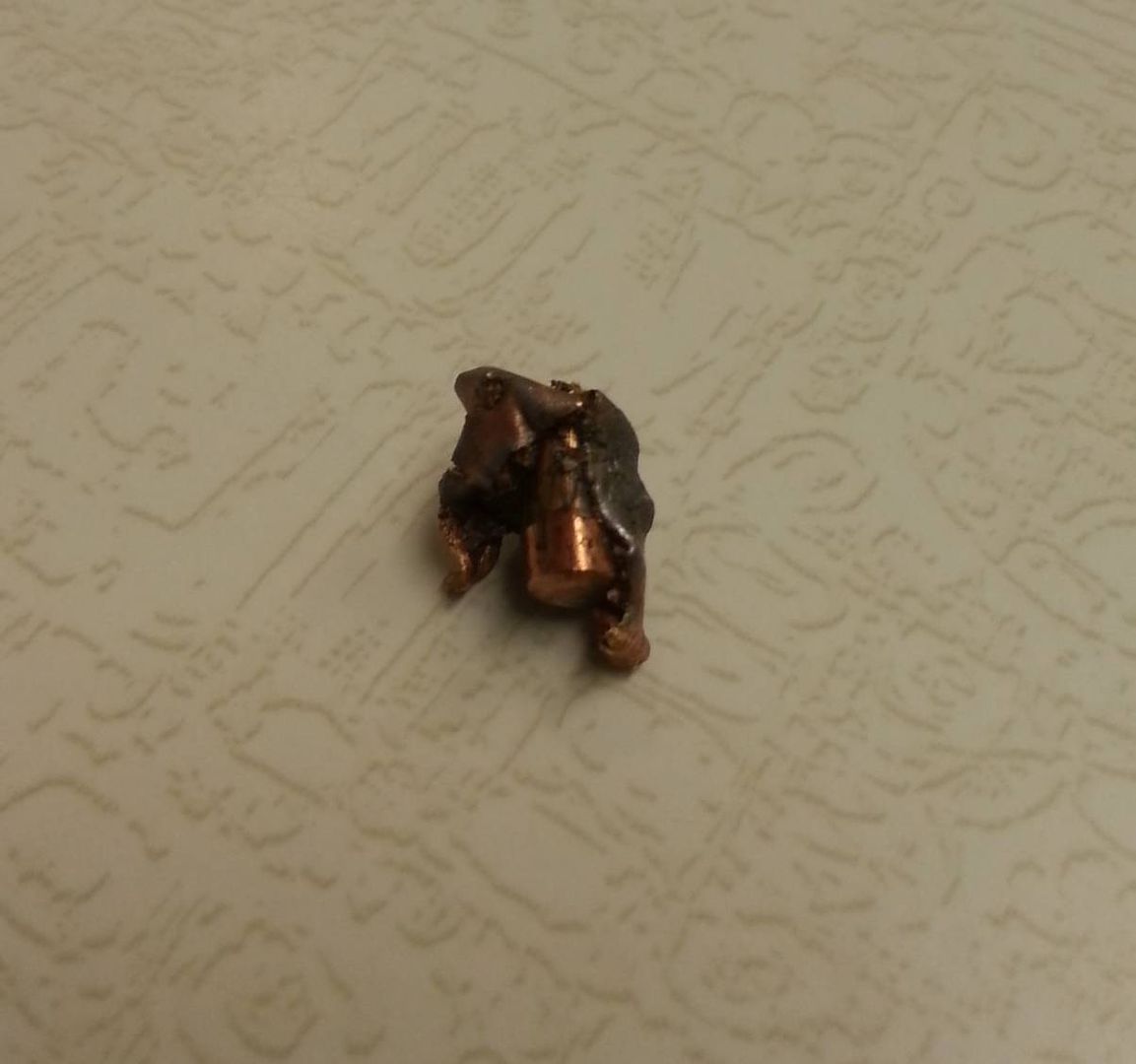
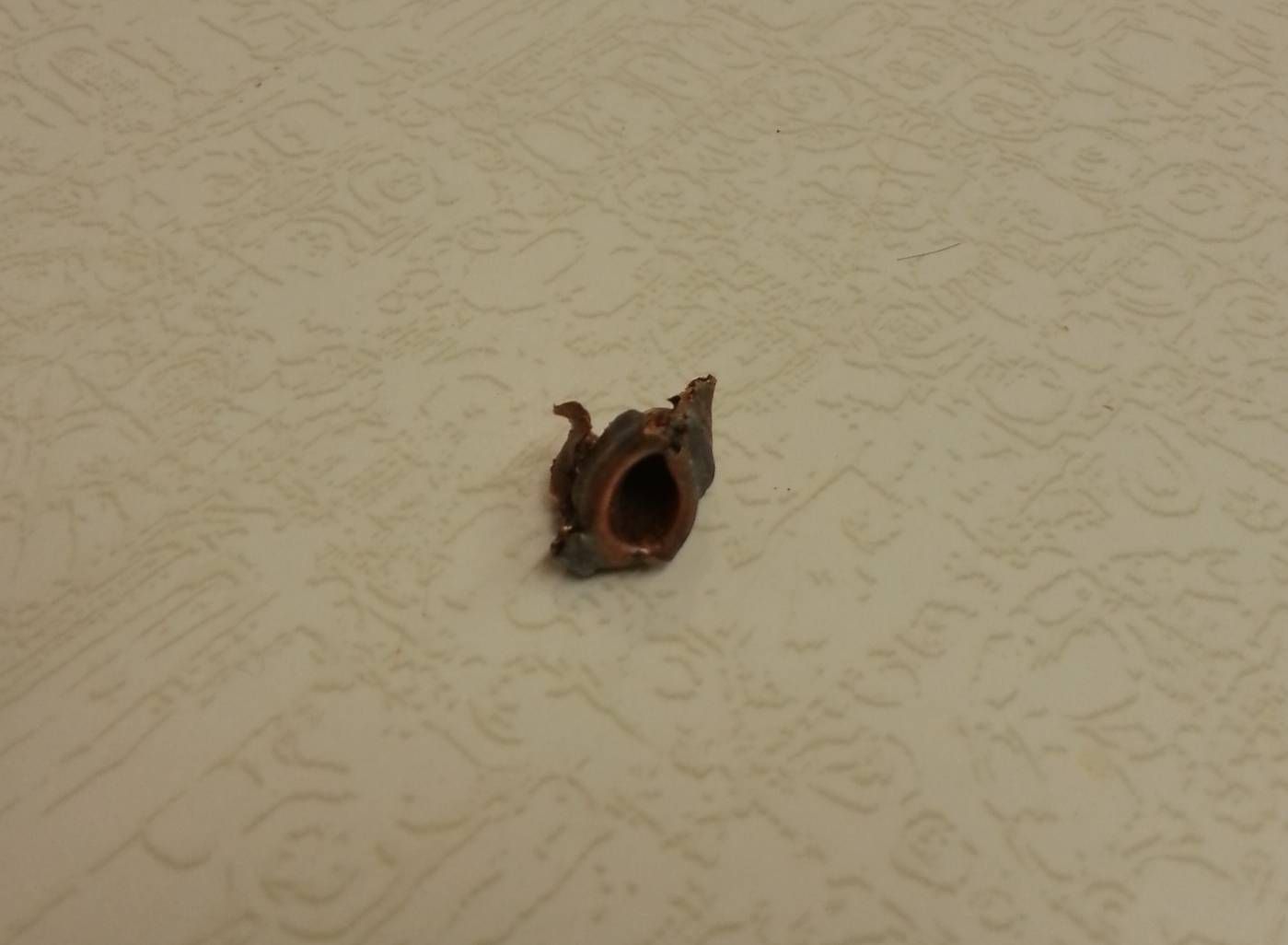
This was an 80 yard shot. As you can see the bullet fragmented some and mushroomed some as well. The lead core completed separated from the casing. The shot was a shoulder shot on a young buck. The round completely passed through one side and the casing was found in the opposite shoulder. However at first it appeared to be a pass through as the opposite shoulder appeared to have a large exit wound. Upon processing the deer we found the casing embedded as found here. So the assumption is the molten lead core continued on through to cause the exit wound. Velocity is unknown however PRVI match is known to be a little slow. |
"We the people are the rightful masters of both Congress and the courts, not to overthrow the Constitution but to overthrow the men who pervert the Constitution." - Abraham Lincoln
|
I have been using the Hornady red box (of 50) 75 grain moly coated match ammo since it first came out back in 1993 (I think). A long time anyhow.
It chronographs right around 2700 fps from a stainless steel 1-9 twist 20 inch barrel. And about 2590 fps from a 1-9 16 inch Bushmaster Both NATO chamber. I reload this bullet with BLC-2 and can get safely 2850 fps from a 20 inch or about 2720 fps from a 16 inch. This equals T2 in my rifles. Ive shot alot of coyotes at night with the standard velocity 75 grain ammo. It fragments reliably out to 150 yards which corresponds to Molons predicted results. Past 150 yards the coyotes dont react nearly as dramatically as at close range. Two hits for humane kill fairly normal at "long" range. Which is why I am beginning to use hand loads. I seldom shoot over 200 yards at night, so the little bit of extra velocity seems to work! this is very accurate ammo. I have shot it out to 900 yards and it is stable. |
| We (and sorry but I am unable to specify who 'we' are) have fired in excess of 500K rounds of Mk 262 the last few years, through a number of different weapons types, including M4s. Unfortunately I am at home on holidays and do not have access to detailed chronograph results. If anybody wants I can fill them in later . To date there has been not one single documented complaint or failure report with Black Hills Mk 262. Accuracy (when the shooter does his part of course) is sub-MOA. Jeff Hoffman and his people at Black Hills have always been extremely helpful. |

|
Originally Posted By DaveBNZ:
We (and sorry but I am unable to specify who 'we' are) have fired in excess of 500K rounds of Mk 262 the last few years, through a number of different weapons types, including M4s. Unfortunately I am at home on holidays and do not have access to detailed chronograph results. If anybody wants I can fill them in later . To date there has been not one single documented complaint or failure report with Black Hills Mk 262. Accuracy (when the shooter does his part of course) is sub-MOA. Jeff Hoffman and his people at Black Hills have always been extremely helpful. If you get it later, I would be interested in seeing some velocities with barrel lengths other than 14.5, if any. Sure the 5.56 T2 TAP is a little hotter, but the BH MK262 is much more accurate out of my guns. Inside my house neither speed nor accuracy will matter much, but it is nice knowing if I need to hit a "varmint" at 300 yards I could. Both are very good cartridges. |
Cruz/Paul 2016
Ammunition review - HEAVY OTMs (Page 1 of 2)
AR Sponsor