


Armory Sponsor

Posted: 6/3/2015 10:19:28 AM EDT
|
From here: http://forums.thecmp.org/showthread.php?t=166831&page=4
Apparently eliminating the dust residue in the necks is actually a bad thing - because it causes metal/metal galling, that was slightly lubricated by the dust before. (Edit to ad: giving decreased accuracy performance, vs the smooth seating and launching of a "dusty" neck) Man that's a real downer if true. Anyone else tested this? |
|
Wet tumbled cases definitely require slightly more force to resize. Dillon also advises against wet tumbling for a similar reason. I would theorize it might strain brass slightly more over time as a result. Try and resize wet tumbled larger pistol brass (like 44 or 454, you'll barely notice with small stuff) vs plain dirty brass in carbide dies and tell me you can't tell a difference.
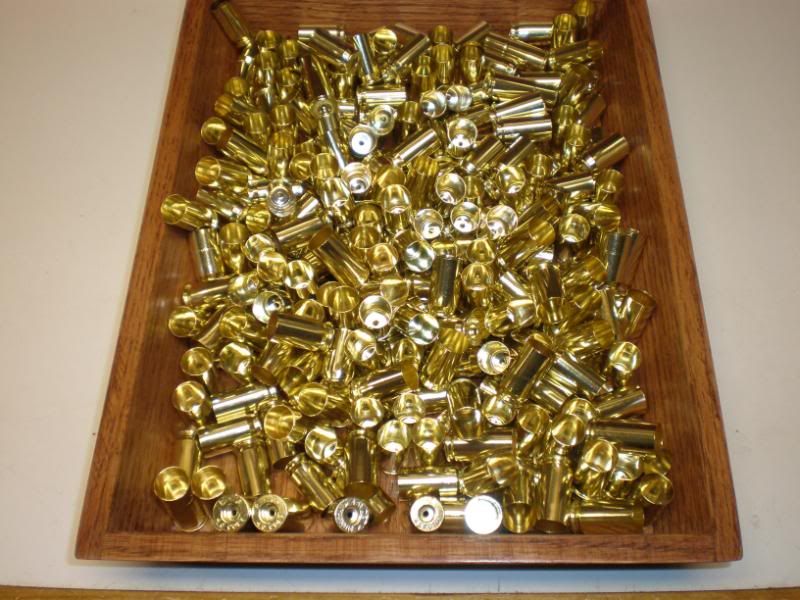
I am not a fan of wet tumbling and find it extra pointless work to make brass shiny for no performance gain. The only valid use I have seen for it is reduction of lead dust, but that isn't an issue in a well ventilated area. Regardless, any perceived damage to the brass is probably very slight. Do what you want and what makes you happy. As I said I have never seen a reason to actually wet tumble, so I don't. If shiny brass is important enough to you that you're willing to put up with the extra labor and potential extra lube, go for it. |
|
Quoted:
I do not think I am going to lose any sleep over this. "If" it were an issue, a little lubrication applied properly would fix the whole "problem". I like clean brass. Exactly. I wet tumble. The extra work is minimal considering my press is spotless pretty much at all times. I lube my cases with homebrew lanolin spray when I resize rifle, so no change there. I lube my pistol cases lightly with One-Shot when I load them. That addresses the lube issues, whether they are real or just perceived to maybe be an issue. |
Yes, because that little bit of dust is going to make all the difference when pressing in dissimilar metals at 100's of PSI in a press for a distance of a fraction of an inch, or firing it at thousands of degrees and tens of thousands of PSI. Sure. Okay. Whatever... 
Obviously neck flaring, and annealing, case lube, and other factors like setback and headspace in the gun it's actually fired in, are going to have infinitely more impact on neck life than "dust". |
|
I haven't heard about the lack of "dust" causing the issue. I heard it was an issue of wet tumbling weakening the brass via leaching zinc out of the brass alloy. |
|
Quoted:
Yes, because that little bit of dust is going to make all the difference when pressing in dissimilar metals at 100's of PSI in a press for a distance of a fraction of an inch, or firing it at thousands of degrees and tens of thousands of PSI. Sure. Okay. Whatever...
Obviously neck flaring, and annealing, case lube, and other factors like setback and headspace in the gun it's actually fired in, are going to have infinitely more impact on neck life than "dust". I think the explanation is the bullet galls upon seating. |

|
Quoted:
Unfortunately, it's looking like maybe it isn't. Here's a more detailed article... http://bulletin.accurateshooter.com/2013/05/ultrasonic-cleaning-case-neck-friction-and-bullet-seating/ Quoted:
Quoted:
Utter nonsense. V Unfortunately, it's looking like maybe it isn't. Here's a more detailed article... http://bulletin.accurateshooter.com/2013/05/ultrasonic-cleaning-case-neck-friction-and-bullet-seating/ That link refers to tumbling with an ultrasonic cleaner and is not about wet tumbling. Either way, sometimes I just want to quit logging on to the internet anymore. 
|
|
Quoted:
That link refers to tumbling with an ultrasonic cleaner and is not about wet tumbling. Either way, sometimes I just want to quit logging on to the internet anymore.
Quoted:
Quoted:
Quoted:
Utter nonsense. V Unfortunately, it's looking like maybe it isn't. Here's a more detailed article... http://bulletin.accurateshooter.com/2013/05/ultrasonic-cleaning-case-neck-friction-and-bullet-seating/ That link refers to tumbling with an ultrasonic cleaner and is not about wet tumbling. Either way, sometimes I just want to quit logging on to the internet anymore.
Same principle - completely scouring the neck clean is the item in question, regardless if that's done via ultrasound or wet steel pins. This whole thing bugs the crap out of me, because I spent money and went to a lot of effort learning how to do wet tumbling and figuring out how that execution works best for me in my setting. There's a lot of foul water handling, pins that want to run away, etc, so it takes a bit to figure how that all should be done in ones household. I finally got all that down, and was starting to make beautiful brass with reasonable effort/handling on my part. Only to be learning now that wait, this is going to make worse ammo? I want to believe this is wrong, but the more I dig, the worse it's looking. |
OMG: 
The solution to this horrible problem is to go back to dry tumbling. New brass (and newly made ammo, for that matter) is obviously a no-no, because there's nothing cleaner than new brass. Of course, we don't have a controlled, double blind, microscopic, measured target and chronographed study to scientifically say one technique is better or worse than the other, do we. All we have is the anecdotes of people on the interweb. My own personal anecdotal experience says there is no difference in my shooting with either method. But then, I'm an offhand shooter, hardly ever on the bench. |
|
Quoted:
Same principle - completely scouring the neck clean is the item in question, regardless if that's done via ultrasound or wet steel pins. This whole thing bugs the crap out of me, because I spent money and went to a lot of effort learning how to do wet tumbling and figuring out how that execution works best for me in my setting. There's a lot of foul water handling, pins that want to run away, etc, so it takes a bit to figure how that all should be done in ones household. I finally got all that down, and was starting to make beautiful brass with reasonable effort/handling on my part. Only to be learning now that wait, this is going to make worse ammo? I want to believe this is wrong, but the more I dig, the worse it's looking. Quoted:
Quoted:
Quoted:
Quoted:
Utter nonsense. V Unfortunately, it's looking like maybe it isn't. Here's a more detailed article... http://bulletin.accurateshooter.com/2013/05/ultrasonic-cleaning-case-neck-friction-and-bullet-seating/ That link refers to tumbling with an ultrasonic cleaner and is not about wet tumbling. Either way, sometimes I just want to quit logging on to the internet anymore.
Same principle - completely scouring the neck clean is the item in question, regardless if that's done via ultrasound or wet steel pins. This whole thing bugs the crap out of me, because I spent money and went to a lot of effort learning how to do wet tumbling and figuring out how that execution works best for me in my setting. There's a lot of foul water handling, pins that want to run away, etc, so it takes a bit to figure how that all should be done in ones household. I finally got all that down, and was starting to make beautiful brass with reasonable effort/handling on my part. Only to be learning now that wait, this is going to make worse ammo? I want to believe this is wrong, but the more I dig, the worse it's looking. Have you noticed actual worse performance? If not, I wouldn't worry about it. It doesn't matter what the subject is, someone on the internet has something bad to say about it. |
|
Quoted:
So, what about loading new brass? eta- we're talking about inside the neck when seating the bullet, right? The cure for the problem with new brass is, naturally, to gather up a lot of range brass and carefully remove the neck dust from the old brass and very delicately deposit it inside the neck of the new brass. This shouldn't take more than 12 minutes of tedious work for each cartridge. Or, you can do what I do. Discount this "neck dust" business as total BS and continue wet tumbling as usual. |
|
I wet tumble to remove rough edge after I dillon trim. I only do that with plinking brass which is most of my brass. Its a huge time savor. the extra cleanliness of the brass is probably not all that important. I hate dealing with rinsing it so if dry tumbling could remove sharp edges enough, I would switch back.
|
|
Quoted:
How about I seat some bullets in dry and wet-tumbled examples of the same brass tonight and post close-up pics? That's basically what they did in this article on the topic. I'm seeing people laughing at internet hearsay about this, yet the articles and analysis I'm reading seem better researched and documented than the counterclaims I'm seeing from people stating it's BS. http://bulletin.accurateshooter.com/2013/05/ultrasonic-cleaning-case-neck-friction-and-bullet-seating/ 
Yes it's ultrasonic in this case. And yes, it's the same thing - complete removal of everything from the neck. 

One thought, I just use simple liquid hand soap when I've been wet tumbling, as I don't keep lemishine around. It will amaze you how much one drop of soap will foam up after 3 hours in a wet tumbler. And how many rinses it takes to get it to stop. So I have to wonder about that. Another poster here scoffed (or maybe he was serious) that that was the answer. Might he actually be right? I want to keep wet tumbling. But if means I'm going to be throwing a 9 at 600 when it could have been a 10, that's a problem for me. These articles and experiences are being reported by F-Class and 1000 yard shooters, and it is not encouraging. At 100 yards, no, you're not going to see it. At 1000 yards, I now have at least 2 reports of people seeing it, and one of those claiming others have seen it too. So does it matter at 600? Don't know. How best to address it? Don't know. It seems to me, the right additive at the right dose during the wet tumble, may complete address it. But I'm not sure what this is. 1 drop of hand soap coupled with only 1 rinse after that's dumped? Not sure... Here's a question, is there anything in hand soap that we know is a bad residual to leave inside a case? Maybe Frankfort or Dillon already researched this and have the answer? |
|
Quoted:
That's basically what they did in this article on the topic. I'm seeing people laughing at internet hearsay about this, yet the articles and analysis I'm reading seem better researched and documented than the counterclaims I'm seeing from people stating it's BS. As on response from the article, think about what happens to the bullet jacket as it goes down the bore at 3000fps.
|
|
Quoted:
I think the explanation is the bullet galls upon seating. Quoted:
Quoted:
Yes, because that little bit of dust is going to make all the difference when pressing in dissimilar metals at 100's of PSI in a press for a distance of a fraction of an inch, or firing it at thousands of degrees and tens of thousands of PSI. Sure. Okay. Whatever...
Obviously neck flaring, and annealing, case lube, and other factors like setback and headspace in the gun it's actually fired in, are going to have infinitely more impact on neck life than "dust". I think the explanation is the bullet galls upon seating. I don't think that's a valid explanation. Galling is a result of friction and adhesion and I don't think simply seating a bullet and then firing that bullet would be enough contact to create galling. It's my understanding its a result of extended friction as seen with bearing and races or any metal surfaces that rub agaimst each other. I know the first big accusations against wet tumbling is the metal pins work harden the brass making it brittle. |
|
I did my own little test to see if seating bullets in wet tumbled brass causes galling. I couldn't see any. Maybe some really fine scratches, you had to really look for.
The biggest change I saw was if I crimped the case at all. Then what you see is right at the rim where there is some scraping due to the simultaneous seating and taper crimp. This would happen regardless of a little carbon from previous shooting. No crimping leaves a bullet in fine shape. Can't hardly tell it was seated. This was using 45ACP IMI match cases, some wet tumbled, some new, and FMJ bullets. Resized, then mouth belled using Hornady PTE. |
|
I wet tumble-
1- I process the brass with a water-soluble lube. Brass goes straight from the press into the tumbler and 2 hours later, brass is clean as new. Quicker and better results than vibratory cleaning. 2- I don't have to manually clean primer pockets 3- Citric acid (Lemishine) passivates brass and therefore helps prevent corrosion. I have brass that has been stored for about 7 years now and looks like the day I did it. 4- The pulled bullet pictured was a victim of poor brass prep, not copper/brass galling. One of my rules of reloading is that pulled bulets look the same when they come out as when they went in. Proper neck tension and case mouth prep will ensure this happens- and yes, my pulled bullets show no such DAMAGE. |
|
I get striations on bullets pulled from both dry and wet-tumbled cases. The wet-tumbled striations look different, but are of a similar depth to those from a dry-tumbled case. Neither are ANYWHERE close to penetrating the jacket, and neither are at all comparable to what is done to the bullet by rifling. Based on the directionality of the marks, it appears to be something that doesn't happen during seating, but rather during pulling. If I have time later today, I will cut a case neck from a seated bullet to see. I will upload pics later.
I will say that based on the scale and nature of these marks, I find it unlikely that they would have a measurable affect on accuracy unless you're at the super-sub-MOA level. I estimate the marks to be no deeper than perhaps 0.0005". If I can get some time on the microscope at work, I'll see if I can take some good pictures with a scale. |
|
....... snip .............
One thought, I just use simple liquid hand soap when I've been wet tumbling, as I don't keep lemishine around. It will amaze you how much one drop of soap will foam up after 3 hours in a wet tumbler. ................. snip.... I use a little dollop of gel detergent intended for automatic dish washers, plus a little sprinkle of Lemishine. The dishwasher gel seems to do the job without much foaming. |
|
As stated earlier, mix in some turtle wash and wax. The brass is noticeably smoother from the coating. No, it has never affected my loads negatively in any way.
I use a mixture of W&W and dawn with 1/3 being W&W. I started using it after the post about brass shavings while loading pistol rounds. I now use it for both pistol and rifle. I'm not sure if it fixes the issue at hand but I imagine the extra lubricity would be a good substitute for the missing dust layer. |
|
Quoted:
As stated earlier, mix in some turtle wash and wax. The brass is noticeably smoother from the coating. No, it has never affected my loads negatively in any way. I use a mixture of W&W and dawn with 1/3 being W&W. I started using it after the post about brass shavings while loading pistol rounds. I now use it for both pistol and rifle. I'm not sure if it fixes the issue at hand but I imagine the extra lubricity would be a good substitute for the missing dust layer. I've been afraid to use any process that leaves wax or lubricant on the exterior of my brass. IMO, brass needs to adhere to the chamber walls during firing to prevent excessive thrust on the bolt face. This is why it is recommended to have a dry chamber when shooting a firearm. |
|
Quoted:
As stated earlier, mix in some turtle wash and wax. The brass is noticeably smoother from the coating. No, it has never affected my loads negatively in any way. I use a mixture of W&W and dawn with 1/3 being W&W. I started using it after the post about brass shavings while loading pistol rounds. I now use it for both pistol and rifle. I'm not sure if it fixes the issue at hand but I imagine the extra lubricity would be a good substitute for the missing dust layer. Thank you, this is very helpful reply. I think this is a good approach. As others state, I'm beginning to suspect this is more of an issue with the sub-MOA crowd; the type who are also turning necks. That said, if the only thing one needs to change is a small modification to the additives during tumbling, why not? If you don't mind my asking, about how much dish soap and how much Turtle W&W are you adding to the drum? |
|
Quoted:
I've been afraid to use any process that leaves wax or lubricant on the exterior of my brass. IMO, brass needs to adhere to the chamber walls during firing to prevent excessive thrust on the bolt face. This is why it is recommended to have a dry chamber when shooting a firearm. Quoted:
Quoted:
As stated earlier, mix in some turtle wash and wax. The brass is noticeably smoother from the coating. No, it has never affected my loads negatively in any way. I use a mixture of W&W and dawn with 1/3 being W&W. I started using it after the post about brass shavings while loading pistol rounds. I now use it for both pistol and rifle. I'm not sure if it fixes the issue at hand but I imagine the extra lubricity would be a good substitute for the missing dust layer. I've been afraid to use any process that leaves wax or lubricant on the exterior of my brass. IMO, brass needs to adhere to the chamber walls during firing to prevent excessive thrust on the bolt face. This is why it is recommended to have a dry chamber when shooting a firearm. I've read that as well, and it does make sense. Yet, lubricants are all over the place in a firearm and ammo, and I imagine a great number of rounds are fired under such circumstances. Indeed, the French MAS .308 rifle requires oil to be sprayed on the ammo in order to function reliably. To me, the trade-off is worth it for match loads. To a 3-gunner or other blaster, probably not. |
|
Quoted:
Meh, I find wet tumbling to be pretty pointless anyway. YMMV. For pistols - I agree. I run a progressive, and am not about to decap first, then wet tumble, then run through the progressive. I dry tumble, call it good, and ka-chunk ka-chunk churn out pistol rounds. Wet tumbling that without removing the primer, means wet primer pockets, and I just don't trust them to be fully dry since there's no airflow down there. So I don't bother with pistol brass. But for rifles, I suggest you try it a few times. It's not the super clean that's the value. The value there is: 1) the primer pockets. If the residue is not removed, you'll occasionally have to crush a primer in there to get it flush. Removal is IMHO the single highest lead exposure of the entire reloading process (because that's the highest concentration of the most dangerous digestible lead salts). And hand removal means scraping and dust off that stuff. It's also just a PITA to do. Failure to uniformly remove pocket residue greatly increases the risk of a high primer, IMHO. 2) The inside of the neck. Most people like one-stuck, and that's fine. For me, I've had multiple nightmares and wore out a stuck case remover with that stuff. I just use wet lubes and a roller, including inside the neck. A wet system is the only system that will scour out glumps of residual wet lube out from under the shoulder. Dry tumblers require "churn" to work. There is no "churn" with the media inside the casing, and it's been proven that they don't clean the inside worth a hoot. That affects volume and results in case-wall debris in your loaded ammo. Not a big deal most times, but not exactly a plus. 3) Flash hole media. One great way to get a hang-fire is to have a piece of media stuck in your flash hole. The steel pins in wet tumblers won't stick in there. Though be aware, they can wedge across the width of the casing, and so an inspection is still needed. 4) Range pick-ups. You can get some fugly brass if you do range pickups. more importantly, it can have dirt and other crap in it, that maybe dry tumble removed, maybe not. In a wet tumbler, you know darned well that case is clean - so clean it's hard to tell the difference. I do range pickups when they are there, so this has value to me. I tried it a few times. At first it was a PITA, but after you figure out the nuances of all the processing, it gets pretty easy, and you'll quickly find you much prefer it to dry tumbling. Shooters and reloaders in particularly are about the most curmudgeonly change-hater's you'll ever meet - yet most who try wet tumbling switch to it permanently. I bet there's a reason for that. Hence this thread - I don't want to switch back to dry tumbling - I'm looking for method changes that let me continue to wet tumble. And so far, there are some pretty encouraging suggestions on that. |
|
Quoted:
What if I use wash and wax for my soap  A little film is always there to protect the brass from tarnishing, and I am sure adds a little lubricity. If it is an issue still why not dip the neck in talc before loading? A little film is always there to protect the brass from tarnishing, and I am sure adds a little lubricity. If it is an issue still why not dip the neck in talc before loading?Been waiting to see if anyone would post this info. Been Wet Pin cleaning since Oct last year. Did notice more resistance when case forming and belling the pistol brass. Read about using Armor All Wash and Wax instead of Dawn. I have used it a couple of times, and it does reduce the amount for resistance. I will continue to use the wash and wax plus Lemishine. Zinc leeching? Can happen when too much Lemishine is used. Supposedly you can tell because the cases turn slightly pink. Haven't seen myself, but I did read it on the Interwebs. I have a 650 with a lee universal decapper die only. I can run 500 cases in 20 minutes or so. I always decap before wet tumbling. Having a clean primer pocket is a side benefit, the main reason is to speed drying. If the case does not completely dry, and you store it in a plastic container, with a lid, you will end up with brass that contains water spots. I found this out when I got a good buy on 10K needle cleaned 9mm brass that still had the spent primer, it was stored in Zip-Lock bags and was not completely dry. Had to re-clean all of it. After depriming. 9mm takes the longest to dry. YMMV |
|
Quoted:
For pistols - I agree. I run a progressive, and am not about to decap first, then wet tumble, then run through the progressive. I dry tumble, call it good, and ka-chunk ka-chunk churn out pistol rounds. Wet tumbling that without removing the primer, means wet primer pockets, and I just don't trust them to be fully dry since there's no airflow down there. So I don't bother with pistol brass. I throw them in the oven for 10 or 15 minutes on low. |
|
Quoted:
That's basically what they did in this article on the topic. I'm seeing people laughing at internet hearsay about this, yet the articles and analysis I'm reading seem better researched and documented than the counterclaims I'm seeing from people stating it's BS. http://bulletin.accurateshooter.com/2013/05/ultrasonic-cleaning-case-neck-friction-and-bullet-seating/ http://accurateshooter.net/Blog/jayneck02.jpg Yes it's ultrasonic in this case. And yes, it's the same thing - complete removal of everything from the neck. http://accurateshooter.net/Blog/jayneck04.jpg http://accurateshooter.net/Blog/jayneck05.jpg One thought, I just use simple liquid hand soap when I've been wet tumbling, as I don't keep lemishine around. It will amaze you how much one drop of soap will foam up after 3 hours in a wet tumbler. And how many rinses it takes to get it to stop. So I have to wonder about that. Another poster here scoffed (or maybe he was serious) that that was the answer. Might he actually be right? I want to keep wet tumbling. But if means I'm going to be throwing a 9 at 600 when it could have been a 10, that's a problem for me. These articles and experiences are being reported by F-Class and 1000 yard shooters, and it is not encouraging. At 100 yards, no, you're not going to see it. At 1000 yards, I now have at least 2 reports of people seeing it, and one of those claiming others have seen it too. So does it matter at 600? Don't know. How best to address it? Don't know. It seems to me, the right additive at the right dose during the wet tumble, may complete address it. But I'm not sure what this is. 1 drop of hand soap coupled with only 1 rinse after that's dumped? Not sure... Here's a question, is there anything in hand soap that we know is a bad residual to leave inside a case? Maybe Frankfort or Dillon already researched this and have the answer? Quoted:
Quoted:
How about I seat some bullets in dry and wet-tumbled examples of the same brass tonight and post close-up pics? That's basically what they did in this article on the topic. I'm seeing people laughing at internet hearsay about this, yet the articles and analysis I'm reading seem better researched and documented than the counterclaims I'm seeing from people stating it's BS. http://bulletin.accurateshooter.com/2013/05/ultrasonic-cleaning-case-neck-friction-and-bullet-seating/ http://accurateshooter.net/Blog/jayneck02.jpg Yes it's ultrasonic in this case. And yes, it's the same thing - complete removal of everything from the neck. http://accurateshooter.net/Blog/jayneck04.jpg http://accurateshooter.net/Blog/jayneck05.jpg One thought, I just use simple liquid hand soap when I've been wet tumbling, as I don't keep lemishine around. It will amaze you how much one drop of soap will foam up after 3 hours in a wet tumbler. And how many rinses it takes to get it to stop. So I have to wonder about that. Another poster here scoffed (or maybe he was serious) that that was the answer. Might he actually be right? I want to keep wet tumbling. But if means I'm going to be throwing a 9 at 600 when it could have been a 10, that's a problem for me. These articles and experiences are being reported by F-Class and 1000 yard shooters, and it is not encouraging. At 100 yards, no, you're not going to see it. At 1000 yards, I now have at least 2 reports of people seeing it, and one of those claiming others have seen it too. So does it matter at 600? Don't know. How best to address it? Don't know. It seems to me, the right additive at the right dose during the wet tumble, may complete address it. But I'm not sure what this is. 1 drop of hand soap coupled with only 1 rinse after that's dumped? Not sure... Here's a question, is there anything in hand soap that we know is a bad residual to leave inside a case? Maybe Frankfort or Dillon already researched this and have the answer? Looking at those pics, it looks like a rifle case, and a pistol bullet??? Is someone trying to make point by using bad evidence, maybe I don't know... Also wet tumbling would smooth, and reduce high spots/ridges, etc... But if you are really anal about it, coat your bullets with a talc/alcohol mix, then seat them. Non existant problem fixed 
|
| The arguments I've heard have nothing to do with the bullet being damaged, but rather that the neck tension/bullet release upon firing is more consistent with the carbon fouling present inside the necks. Supposedly having sizing lube present inside the necks is also detrimental in this regard. |
|
Well if it only shows up for long distance shooting that's why I'd doesn't affect the vast majority of us.
I have started to decap before wet tumbling: it speeds up the drying a lot, and I got jealous of those sparkling primer pockets. But it did add a step. Doing it on a progressive with just the decapping die makes it as painless as it can be. I use gloves since the cases are dirty. |
| I use a RCBS sonic cleaner for 50 BMG, 308 and 40 S&W. Interesting story about sonic cleaners. Guess I will try the moly dry lube just to see if any difference. But I do use a corn cob tumbler to shine my brass. Would the corn cob take care of the dust in the neck or better to try moly dry lube? Only been reloading 8 months so still learning. I was planning on getting into wet tumbling shortly. Now am reconsidering it. |
|
Quoted:
The arguments I've heard have nothing to do with the bullet being damaged, but rather that the neck tension/bullet release upon firing is more consistent with the carbon fouling present inside the necks. Supposedly having sizing lube present inside the necks is also detrimental in this regard. Interesting argument.....how much carbon fouling is in factory new case necks? We'd better quit buying new ammo. 
I have to admit that ultra squeaky clean necks are harder to push an expander button through, and only the ultra slick RCBS lube pad sized my ultra-blinged LC 762 brass without deformation.......HOWEVER.....I found that running it for a while in some clean corn cob before sizing helped a lot. The corn leaves a white film that's quite slick.....or is that another wives tale. Again, do factorys add carbon fouling to new brass so that when loaded it will shoot accurately? If you believe that, then maybe you'd buy my New Mexico ocean front property......it's cheap!
Dryflash 3, I'll not be slowing down soon either....you just have to adjust a little to live with bling. It's great medicine for tired old eyes as long as you don't stare to long and burn the retinas. |
|
Quoted:
Interesting argument.....how much carbon fouling is in factory new case necks? We'd better quit buying new ammo.
I have to admit that ultra squeaky clean necks are harder to push an expander button through, and only the ultra slick RCBS lube pad sized my ultra-blinged LC 762 brass without deformation.......HOWEVER.....I found that running it for a while in some clean corn cob before sizing helped a lot. The corn leaves a white film that's quite slick.....or is that another wives tale. Again, do factorys add carbon fouling to new brass so that when loaded it will shoot accurately? If you believe that, then maybe you'd buy my New Mexico ocean front property......it's cheap!
Dryflash 3, I'll not be slowing down soon either....you just have to adjust a little to live with bling. It's great medicine for tired old eyes as long as you don't stare to long and burn the retinas. Quoted:
Quoted:
The arguments I've heard have nothing to do with the bullet being damaged, but rather that the neck tension/bullet release upon firing is more consistent with the carbon fouling present inside the necks. Supposedly having sizing lube present inside the necks is also detrimental in this regard. Interesting argument.....how much carbon fouling is in factory new case necks? We'd better quit buying new ammo.
I have to admit that ultra squeaky clean necks are harder to push an expander button through, and only the ultra slick RCBS lube pad sized my ultra-blinged LC 762 brass without deformation.......HOWEVER.....I found that running it for a while in some clean corn cob before sizing helped a lot. The corn leaves a white film that's quite slick.....or is that another wives tale. Again, do factorys add carbon fouling to new brass so that when loaded it will shoot accurately? If you believe that, then maybe you'd buy my New Mexico ocean front property......it's cheap!
Dryflash 3, I'll not be slowing down soon either....you just have to adjust a little to live with bling. It's great medicine for tired old eyes as long as you don't stare to long and burn the retinas. Gee I thought we used handloads to out shot factory loads
|
Armory Sponsor
Join the Community
Your next conversation starts here.
Create your free account to join discussions, share your experience, save topics, and connect with the AR15.COM community.
- Join discussions
- Follow topics and replies
- Connect with fellow enthusiasts
Already a member? Sign in
Stay informed by subscribing to our Newsletter