


Posted: 9/2/2011 9:01:16 PM EDT
|
Some may have followed my RO topics and posts the past 5 years or so.
Recently we added a small/compact RO system to the container [mounted it to the wall under the sink] and I'd like to mention a couple things that might be useful to others particularly in light of the recent emergencies where having a simple, inexpensive and reliable RO system could make as much potable great tasting water that you could expect to need on a daily basis. Small compact counter-top RO sysem ~$60 ebay 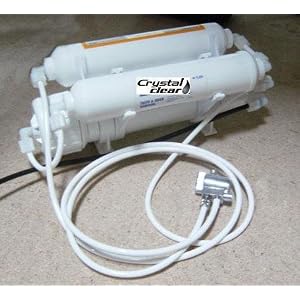
First, the RO membrane that typically looks like this 
and fits into a housing that looks like this 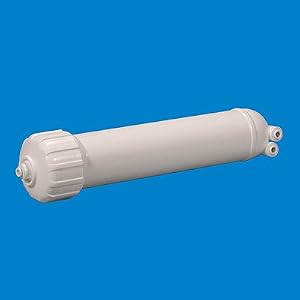
...are now usually TFC or Thin Film Composite. The TFC kind is all I can commonly find any more in the box stores, etc and so we can probably expect in a bad situation where we might want to quickly put together an expedient RO system, the Cellulose Acetate membrane [that's the same fit and more tolerant to chlorine and that I found could operated at lower water pressure input] won't be available, only the TFC will likely be available. [The TFC membrane is NOT tolerent to much concentration of chlorine and a carbon prefilter is absolutely necessary] [Note the 1/4" quick connect fitiings in the picture above, they make hooking up and changing tubing a breeze] The TFC membrane requires significant pressure, some measurements I took suggest anything greater than 40 psi works and 55 psi and higher gives a nice flow [which is in reality a trickle]. The RO membrane is the limiting factor in RO water 'purifying' [I use the term purify loosely here] and they are available from about 15 to 100 gallons per day rate in the style pictured above. Cost on ebay for GE mfg units is as low as $25 and doesn't seem to be too significant as to flow rate chosen. I had a 50 gallon/day membrane in the container until today and to fill up the 26 oz gatoraid bottles I keep around to drink from all the time, my SO found that to be too slow since our other systems have 100 g/day membranes. And she's spoiled... So today I changed it out, only took a couple minutes and the flow is much better. Prior to installing the RO system [that I had been putting off] I was running either a Sawyer .2 [they did not stand up to the 40 psi pressure from our supply tank and the black housing after ~3 months cracked and leaked] and more recently a Daulton ceramic candle in a standard 10" filter housing that has worked great for about 1 1/2 years with no attention.. Both the Sawyer and the Daulton ceramic have good flow at 40 psi and we have never gotten sick from using them [in series with a sediment filter and carbon block filter] running close to 800+ gallons of tap water hauled here and stored for up to over a year with no treatment in poly tanks open to atmosphere. The pump we used previously was a H-F 12 volt 40 psi insectcide sprayer pump from on a 20 gallon tank, $79, and over the past few years we've only worn one out -a couple weeks ago hense the motivation to get the RO hooked up that my SO was always bugging me to do. We used that tank too but it was too small and was a PITA to keep filled so went to a used 40 gallon RV water tank. The 40 psi pump had to changed out for a higher pressure pump after the 40 psi pump failed and to enable the RO function. There are many to choose from, a good common RV 1.3 GPM 60 psi pump will cost about $100 and Northern has a very nice sprayer/genral purpose pump with internal pressure switch on ebay that is rated at 60 psi at ~1 GPM for $60. Tip, some of the RV pumps that cost more have a bypass feature and the adjustments are not well documented, I cranked in the lower adj on a Shurflo pump to kill the 'bypass' feature and adjusted the upper Allen set screw to get the shut off pressure I wanted,to 65 psi [there's a nonadjustable differential pressure -start pressure of about 15 psi]. So the Flojet RV pump works well in this application. The Northern pump would be simpler and in fact we are using one for the shower/toilet/instant water heater/bowl rinse, etc, system and if necessary, with the addition of a length of 3/8" line, in a few seconds we could have the RO system fed from an entirely redundant water supply [the 130 gallon tank in the Solar Collector] -at 60 psi. The next issue is that you don't want the pump cutting on and off all the time while you run your RO filling up a container. I connected a small $35 hot water tank expansion tank [accumulator, Google] to the pump's output and the pump charges the tank to ~65 psi and the tank provides water to the RO for maybe 5 minutes before the pump needs to run again. One of the drawbacks to RO -especially to us if we weren't 'creative' since we have to haul/scavenge water  is that there is about a 50% bypass of wash water that most folks just let run down the drain. is that there is about a 50% bypass of wash water that most folks just let run down the drain.
I use an alternative solution to the wash water in that I put a valve after the wash flow restrictor and simply block the flow. I've asked my SO to every few days to open it and give the filter a wash during a 1/2 gallon or so of production. That water isn't wasted because when we changed the pump, I also ran a return 3/8 line back to the tank and connected the wash water to it. Now, please note––- the carbon block filter, sediment filter, and the ceramic filter are all under ground at the 40 gallon tank with the pump and, INLINE and AHEAD ––-of the RO filter [that CONSISTS of another set of sediment, carbon, RO membrane and carbon filters ––-pretty much overkill and I may remove some of them because some are arguably not needed/redundant]. Sounds pretty complicated huh??  It's really simple actually, or I wouldn't have done this. It's really simple actually, or I wouldn't have done this.
My testing shows all those extra filters don't affect the flow rate in a material way. The water we use for most potable use, cooking, dish washing, tooth brushing, etc, is from a small gooseneck RO type faucet on the sink and that water is only processed through the ceramic etc filters down at the pump and fed through 3/8" tubing. The RO system is Tee'd off that feed. This is getting longer than I planned and I'm still not done. But, if folks are interested in doing this they're going to read it, the rest, well they aren't and won't. Summarizing, most RO membranes are TFC, not tolerant to chlorine, need carbon in front, need 60+ psi. 60 psi is easy to get from a small 12 volt source, only a few amps are needed for brief periods to process a few gallons a day. Getting tired, will try to add more later. Meantime, see the topic in the following post for more info. Having a RO system and some good PRE-filters could come in real handy for folks in the path of some of the recent and forecast storms. I know I sure would want [and have[ this capability. |
|
Still reading the original through again. Figure this winter I will get into some of this, I don't have a water system for what will be a home made camper/toy hauler but I am looking at one big enough I could see having black and grey water tanks and fresh water tank and I want to set it up so I could use this if I wanted to do so. I rent so having a setup that is mine is the main goal. I basically will just set up the pump and what not around what these filters need to work and what not. I have the gravity filter covered and will probably buy another one just to have around but I can see where these might be nice to have as some small towns let their infrastructure go bad and you may not always know about a boil order or something. |

|
A heads up.
The RV Shurflo pump we're using to get 60 psi for the RO [if we were just using the ceramic filter as per 2 weeks ago we'd be happy with 40 psi] started acting up yesterday. The hysteresis that I mentioned in the top post being about 15 psi, i.e. the pump kicks on maybe around 45 psi and cuts off around 60 or 65 psi, well all of a sudden the pump doesn't kick on till around 30 psi. There's no obvious way to adjust the differential. I'll try to tho... The result is that when running the RO making water, the pressure will gradually drop to around 40 psi and the RO output slows greatly and essentially the lower the pressure the less water [from the accumulator tank] and the the process drags out for a long long time. The immediate solution is to either turn on the RO waste bypass valve and allow that to flow draining down the accumulator tank [also a sorta slow process] or open the faucet directly from the ceramic filter but that wastes water. Or just turn on the faucet and fill the RO jug with some un-RO'd water until the pump comes on. Actually that's the easiest. So the long term solution is going to be to replace the Shurflow RV pump with the Shurflow pump without the bypass and other features from Northern Tool avail on ebay for $59. |
|
One more thought tonight.
Actually using RO isn't necessary unless you want to drink water with really low TDS. Think about the food you eat, if you put a spoonful into your RO container, the TDS would immediately jump right up. On the other hand, if your water had lead, flourine, viruses or whatever in it and you didn't want to drink it, then RO is the way to go. It will filter way more stuff to a molecular lever that most any other filter can even begin to approach. Since it's inexpensive and easy [and fun for me  ] to impliment, and I want to reduce my consumption of lead, flourine, etc, -I do. ] to impliment, and I want to reduce my consumption of lead, flourine, etc, -I do.
If you want to get bacteria and cysts out and some of the dissolved impurities, then the ceramic candle/Sawyer type fine filter along with a carbon block filter is another solution, one that's worked well for us for ~2 years here. I measured the TDS of the unfiltered raw tap water from the tanks here that's a year+ old and it tests about 150 ppm. The carbon filter + ceramic candle water tests ~50 ppm. It would be the same substituting the Sawyer. Including the RO system, the same water tests around 20. In summary, you have a lot of inexpensive avenues to 'purify' your water in a 'moderate' quantity application and with available, compact and relatively inexpensive equipment, the choice depends on the water and your preferences. |
|
Quoted:
One more thought tonight. Actually using RO isn't necessary unless you want to drink water with really low TDS. Think about the food you eat, if you put a spoonful into your RO container, the TDS would immediately jump right up. A spoonful would not be necessary. A drop would do it, depending on what it is. On the other hand, if your water had lead, flourine, viruses or whatever in it and you didn't want to drink it, then RO is the way to go. An RO will not remove fluorine gas, but it will remove fluorides. It will filter way more stuff to a molecular lever that most any other filter can even begin to approach. It is not really a filter in the first place. There are molecular sieve type membranes that are actually filters. For practical proposes, it can be considered a filter for suspended particles. Since it's inexpensive and easy [and fun for me ] to impliment, and I want to reduce my consumption of lead, flourine, etc, -I do.
If you want to get bacteria and cysts out and some of the dissolved impurities, then the ceramic candle/Sawyer type fine filter along with a carbon block filter is another solution, one that's worked well for us for ~2 years here. I measured the TDS of the unfiltered raw tap water from the tanks here that's a year+ old and it tests about 150 ppm. Are you using some kind of pen type conductivity meter? The PPM readings on them are an approximation based on the ionic content of the water. They do not sense any of the suspended stuff in the water like silica or organics that are not ionic in nature. The carbon filter + ceramic candle water tests ~50 ppm. It would be the same substituting the Sawyer. Including the RO system, the same water tests around 20. You are probably reading the dissolved CO2 in the water which forms carbonic acid. RO generally does not remove dissolved gases. In summary, you have a lot of inexpensive avenues to 'purify' your water in a 'moderate' quantity application and with available, compact and relatively inexpensive equipment, the choice depends on the water and your preferences. They are not perfect but an RO with a sediment prefilter and a carbon filter somewhere in the line (just where depends on the type of membrane) will take out the nasties you are likely to encounter. |