


[ARCHIVED THREAD] - The Chicken Wing (Page 1 of 2)
Posted: 4/16/2012 9:32:38 AM EDT
|
Do any branches currently advocate/train the chicken wing?
DOJ friend is adamant that it remains an acceptable practice. I'm a lifetime civvi, so I didn't argue with my buddy, but I thought the practice was outdated. |
|
Quoted:
20 years LE, and I own a rifle training company. http://bhtcorps.com I have only heard the chicken wing used in a pejorative context. Ask him what advantages he believes it provides. There are plenty of downsides to it. ––Fargo007 Thanks Fargo. I figured as much. I've tried it with various rifles for giggles, but failed to see the point. Does it offer any advantages in a non-tactical sense. i.e. competition shooting? |
|
I'm not aware of any advantage whatsoever to the chicken wing technique.
I don't believe NRA shooters do this either, although I will point out that arena is not a good place to draw influence from where defensive or tactical shooting is the primary goal. We do see it creep up from time to time and address it. Some shooters have habits ingrained in them from many many years of shooting with an incorrect technique. It can be extremely difficult to re-train away from something like this. ––Fargo007 |
|
It depends on the context of the question and whether or not you're referring to olympic style off hand or the method used with a bladed Weaver stance.
No reasonable argument can be made that it is not an effective method of shooting a rifle (effective in terms of hitting the target) and despite the fact that the term has become a modern day pejorative. I have a good friend who attended a VSM AK class with one of LAV's regional instructors and not only was he the top shooter in the class but he also kept pace (drill-for-drill) with the instructor while "gasp and blasphemy", shooting an AK from a bladed Weaver stance. OTOH, an argument can certainly be made that it has been supplanted by the method of both the support and firing arms cranked downward due to the contemporary constraints and necessity of hard armor as worn by most modern military infantry. But how that "necessity" translates to the civilian context remains a mystery to me. Pick up an M1 Garand, an M14 / M1A, or a 1903A3, etc. and try to shoot them like an AR / AK with a squared up stance with their rather long LOP. I'm a civilian. I like shooting other rifles in addition to AR's and AK's and I prefer one common, universal method, Chicken Wing? Bladed Weaver? Yea, that's me. Do you know the genesis of the VFG or the basis and rationale for the degree of "bend" in the support arm of the Weaver stance? If I told you, you'd piss yourself laughing. |
Oh you gotta spill the beans on that one! I would love to hear that.  The weaver bend, I would have thought came from the firing shoulder being set back. The weaver bend, I would have thought came from the firing shoulder being set back.
Yes, a fighting rifle can be shot effectively with the chicken wing, and I have seen people who shot that way do very well, but that leaves a few things unconsidered. The problems with the chicken wing aren't about hit probability. They mostly stem from the protruding horizontal elbow, the space it creates between the arm and the body, and the unnatural bend at the wrist. I acknowledge these are principally defensive/tactical considerations and would apply less to a civilian shooter. ––Fargo007 |
|
Quoted:
Oh you gotta spill the beans on that one! I would love to hear that. The weaver bend, I would have thought came from the firing shoulder being set back.Not something I would disclose publicly but if we ever cross paths, buy me a beer and I'll spill it. Yes, a fighting rifle can be shot effectively with the chicken wing, and I have seen people who shot that way do very well, but that leaves a few things unconsidered.
The problems with the chicken wing aren't about hit probability. They mostly stem from the protruding horizontal elbow, the space it creates between the arm and the body, and the unnatural bend at the wrist. I acknowledge these are principally defensive/tactical considerations and would apply less to a civilian shooter. I'm struggling with the "unnatural" bend at the wrist because the wrist seems to have more natural "horizontal" movement than "vertical". In fact, on the vertical axis, the wrist can actually bend upward the slightest amount and mostly bends downward whereas it can bend an equal amount (left or right) on the horizontal axis. IMO, the entire debate regarding stance and weaver vs. iso, etc. is much ado about nothing. I would argue that since it is impossible to scientifically measure the results between either school of thought given the realities of gunfight dynamics, that even if you allow that competition shooters universally use some form of iso, and it seems to edge out weaver in terms of pure speed, that the difference in a real gunfight is negligible. It's Col. Coopers "preoccupation with insignificant increments" argument. I never try to force an iso shooter to adopt weaver in classes I teach. But the denigration weaver has received in the last decade or so is totally misrepresented IMO. |
|
Quoted:
I can tell you from experience that in High Power, the extreme CW technique (pointing your elbow up at a 45 degree angel) helps created a deeper pocket for the rifle to sit in. This is used for newer shooters though, and only in the standing position. Yes it does. Which BTW helps to mitigate the effect (impact) of recoil from heavy calibers. |
|
Maybe for mitigating the discomfort of the recoil, but that's about all. Deep in the shoulder pocket is exactly where you DON'T want a rifle set up for tactical/defensive use. The further you have the rifle off the centerline of your body, the more off target laterally you are going to wind up after the recoil impulse fades. Again, for civilian style shooting where there is no follow-up shot and you are single-loading, that's not an issue.
A better arena to look at is practical competition which is speed/accuracy based. The CW does not appear there, and the competitors invited to work with tier 1 military units just aren't shooting that way or teaching it to our guys. The wrist isn't very strong when bent at 90 degrees and it isn't as easy to manipulate the safety on an AR that way, and it's virtually impossible to do so with a Kalashnikov. Not to even discuss retention, or all the bad stuff that can happen if a stacked teammate hits that horizontal elbow, it bumps a door frame, or it needlessly obstructs the view of everyone behind someone doing that. Try switching to support shoulder with the chicken wing and see how effective it is versus the squarer stance that is taught almost everywhere today. See how fast you can get sights on target, how symmetrical you are, and how quickly you can achieve it. Again, we are talking about different kinds of shooting with different goals and methods. The original question was the chicken wing in a tactical environment. I can't speak to how appropriate it is in the HP or similar worlds, but it's definitely a no-go for people in uniform. I actually love the chicken wing, and it does appear in a respectable place in tactical environments - after the shift is over, and accompanied by a couple Samuel Adams' to wash it down. 
––Fargo007 |
|
Well - the thread got a slow start, but I appreciate the discussion.
I am a life-long hunter, but have only gotten into "fun" guns in the last 10 years. 99% percent of my hunting involves some sort of rested position - stand, steady sticks, tree, etc. I never force shots. My mil/leo friends have uniformly encouraged a squared up stance with the modern black guns. I think I'll pull out a mosin this weekend and put a few through it "wing" style! Thanks again for sharing your thoughts. Keib |
|
Well.. Chicken Wing is proper form for shotgun sports. Trap, Skeet, Sporting Clays etc. And for bird hunting. And even if your medium to big game centerfire hunting, Chicken WInging it isn't really a disadvantage, unless you're suddenly trying to lean on a tree with your trigger arm, and it's now all in your way.
My theory is that there are many, many shooters who, even if they don't shoot competitively, have duffed in a work, or gun club league, or have shot a few dozen rounds of clay pigeon games, or from hunting from boats, blinds or tree stands, or even just from a rifle bench, or shooting prone at a range where the table (or the ground) forces your arm out away from the body... and it's the only muscle memory they have |
|
Quoted:
Quoted:
Is your priority speed and follow-up, or steady position and recoil absorption? Speed is attained primarily by consistently mounting the weapon from low ready to sights on target. It matters not what stance is used. You body position for sights on target would indeed have an effect. A more traditional offhand stance requires far more movement to acquire than popping up form low ready into a more "tactical" position. There is also the question of speed of follow-up shots. However, there are more stable positions for situations where time is not so sensitive, or positions more appropriate for weapons with more recoil. These threads always remind me of these tales: http://www.snopes.com/weddings/newlywed/secret.asp |
|
Quoted:
Quoted:
Quoted:
Is your priority speed and follow-up, or steady position and recoil absorption? Speed is attained primarily by consistently mounting the weapon from low ready to sights on target. It matters not what stance is used. You body position for sights on target would indeed have an effect. A more traditional offhand stance requires far more movement to acquire than popping up form low ready into a more "tactical" position. There is also the question of speed of follow-up shots. However, there are more stable positions for situations where time is not so sensitive, or positions more appropriate for weapons with more recoil. On a square range with a shot timer? Maybe. In the home, on the street or on a battlefield? I remain unconvinced there is a "measurable" difference. |
|
Quoted:
Quoted:
Quoted:
Quoted:
Is your priority speed and follow-up, or steady position and recoil absorption? Speed is attained primarily by consistently mounting the weapon from low ready to sights on target. It matters not what stance is used. You body position for sights on target would indeed have an effect. A more traditional offhand stance requires far more movement to acquire than popping up form low ready into a more "tactical" position. There is also the question of speed of follow-up shots. However, there are more stable positions for situations where time is not so sensitive, or positions more appropriate for weapons with more recoil. On a square range with a shot timer? Maybe. In the home, on the street or on a battlefield? I remain unconvinced there is a "measurable" difference. You lost me. I thought you just said stance didn't matter. What is the "measurable" difference comment referring to? |
|
Quoted:
Quoted:
Quoted:
Quoted:
Quoted:
Is your priority speed and follow-up, or steady position and recoil absorption? Speed is attained primarily by consistently mounting the weapon from low ready to sights on target. It matters not what stance is used. You body position for sights on target would indeed have an effect. A more traditional offhand stance requires far more movement to acquire than popping up form low ready into a more "tactical" position. There is also the question of speed of follow-up shots. However, there are more stable positions for situations where time is not so sensitive, or positions more appropriate for weapons with more recoil. On a square range with a shot timer? Maybe. In the home, on the street or on a battlefield? I remain unconvinced there is a "measurable" difference. You lost me. I thought you just said stance didn't matter. What is the "measurable" difference comment referring to? Speed. My point is that the squared up stance came about due to "necessity" being the "mother of invention" with respect to the reality that most modern infantry now wear hard armor. The technique requires a butt stock with a shorter LOP than the fixed A2 and IIRC, it had more to do with maximizing the frontal protection hard armor provides vs. any other advantage. I am simply stating that IMO, its "other" advantages (such as speed) are more theoretical. And while they "may" be measurable on a square range with a shot timer, that they (the other advantages) do not transfer significantly in the real world. Not enough to convince me to change my style of shooting since as a civilian, I do not wear hard armor in my every day life. I fully acknowledge that my opinion is just that, an opinion. And I have not undertaken any "field studies" to support my position except for one data point, that of my buddy, whose performance in a VSM AK class I mentioned in a previous reply. I failed to mention in that reply that he is in his sixties and has diabetes which has affected his visual acuity. Moreover, since we can't measure these advantages in real world scenarios, I am also of the opinion that these "other advantages" are basically "assumed" due to their preeminence in the world of competition. I'm not trying to convince anyone to adopt weaver or "chicken wing". Or waste our time arguing that it is "better" than "modern iso / squared up stance". I doubt either "can" be proven "decidedly" superior to the other in the real world (the hard armor issue notwithstanding). What I cannot tolerate is the denigration that "weaver / chicken wing" has received over the last decade or so by many who have never used it. And I am not implying that you or anyone else participating in this thread fall into that category. 
|
|
Quoted:
Quoted:
Quoted:
Quoted:
Quoted:
Quoted:
Is your priority speed and follow-up, or steady position and recoil absorption? Speed is attained primarily by consistently mounting the weapon from low ready to sights on target. It matters not what stance is used. You body position for sights on target would indeed have an effect. A more traditional offhand stance requires far more movement to acquire than popping up form low ready into a more "tactical" position. There is also the question of speed of follow-up shots. However, there are more stable positions for situations where time is not so sensitive, or positions more appropriate for weapons with more recoil. On a square range with a shot timer? Maybe. In the home, on the street or on a battlefield? I remain unconvinced there is a "measurable" difference. You lost me. I thought you just said stance didn't matter. What is the "measurable" difference comment referring to? Speed. My point is that the squared up stance came about due to "necessity" being the "mother of invention" with respect to the reality that most modern infantry now wear hard armor. The technique requires a butt stock with a shorter LOP than the fixed A2 and IIRC, it had more to do with maximizing the frontal protection hard armor provides vs. any other advantage. I am simply stating that IMO, its "other" advantages (such as speed) are more theoretical. And while they "may" be measurable on a square range with a shot timer, that they (the other advantages) do not transfer significantly in the real world. Not enough to convince me to change my style of shooting since as a civilian, I do not wear hard armor in my every day life. I fully acknowledge that my opinion is just that, an opinion. And I have not undertaken any "field studies" to support my position except for one data point, that of my buddy, whose performance in a VSM AK class I mentioned in a previous reply. I failed to mention in that reply that he is in his sixties and has diabetes which has affected his visual acuity. Moreover, since we can't measure these advantages in real world scenarios, I am also of the opinion that these "other advantages" are basically "assumed" due to their preeminence in the world of competition. I'm not trying to convince anyone to adopt weaver or "chicken wing". Or waste our time arguing that it is "better" than "modern iso / squared up stance". I doubt either "can" be proven "decidedly" superior to the other in the real world (the hard armor issue notwithstanding). What I cannot tolerate is the denigration that "weaver / chicken wing" has received over the last decade or so by many who have never used it. And I am not implying that you or anyone else participating in this thread fall into that category. This isn't entirely correct. The modern stance/position is taught to civilian defensive shooters universally. Regardless of whether or not they wear armor. It was not born out of necessity due to body armor. It evolved, and still does, because it is a superior technique where tactical and defensive carbine shooting is at issue. Why? It provides MEASURABLY faster follow-up shots, and thereby a measurable decrease in recoil effect during the firing of the shots. The ergonomics of the human body are such that recoil, like electricity, endeavors to get to the ground. If you have the rifle wholly over one foot but not the other, is there any question that recoil is going to produce instability? It does not over-invest to one side, limiting mobility and reaction time like the deep shoulder pocket/chicken wing does. Take these two GARDEN VARIETY tactical shooting skills that any trained shooter can demonstrate proficiency with, and try them with the deep shoulder pocket/chicken wing. Forget for a moment about the risk of negligent discharges in an LE/MIL stack situation.... 1 - Try to shoot on the move that way. 2 - switch to support shoulder and shoot that way. I don't think it is finished evolving, but it is definitely not going backwards anytime soon. I have been running practical rifle matches for over six years, and I have never seen someone shooting this way make the middle of the pack, no less the top 5. Why try to shoot a garand or 03/a3 in a modern stance? It wasn't designed for it. They just did not know then what they know today. The M4, the Kalashikov and many others are designed to be shot this way though. Holding out a sixty year old diabetic with waning eyesight's account of success with a chicken wing'ed AK might not be the steadiest soap box to stand on. I look at it from the other side - had he listened to the instructor and used correct technique, he might have not only kept pace, but actually surpassed him. ––Fargo007 |
|
Quoted:
This isn't entirely correct. The modern stance/position is taught to civilian defensive shooters universally. Regardless of whether or not they wear armor. I know it is. It was not born out of necessity due to body armor. It evolved, and still does,
On this I disagree. The "timeline" of its evolution suggests otherwise. because it is a superior technique where tactical and defensive carbine shooting is at issue.
According to whom? Why? It provides MEASURABLY faster follow-up shots, and thereby a measurable decrease in recoil effect during the firing of the shots. The ergonomics of the human body are such that recoil, like electricity, endeavors to get to the ground. If you have the rifle wholly over one foot but not the other, is there any question that recoil is going to produce instability?
I want to re-emphasize two points. One: While it is "probably" measurably faster on a square range with a shot timer, it probably isn't measurably faster in my home or in my back yard, thus it is it worthwhile to me to change? Two: Let's go back to the M1 Garand for a moment. With its long LOP you can't shoot it from a squared up stance. I have never seen what might be termed "poor" recoil control from a .30 rifle when shot "chicken winged" so I reject the argument of superior recoil control. It does not over-invest to one side, limiting mobility and reaction time like the deep shoulder pocket/chicken wing does.
Been training formally since 1996 and the "mobility" argument is not "new". And it is as nearly impossible to quantify as most other issues. Take these two GARDEN VARIETY tactical shooting skills that any trained shooter can demonstrate proficiency with, and try them with the deep shoulder pocket/chicken wing. Forget for a moment about the risk of negligent discharges in an LE/MIL stack situation....
1 - Try to shoot on the move that way. 2 - switch to support shoulder and shoot that way. You're going to have to further explain the matter as it regards an LE/MIL stack because I've attended many classes over the years doing simulators and room entry / clearing and I cannot recall there ever being an issue. Shooting on the move is a separate and distinct skill set. Switching to support side? Again, I'm not sure I understand the context. I don't think it is finished evolving, but it is definitely not going backwards anytime soon. I have been running practical rifle matches for over six years, and I have never seen someone shooting this way make the middle of the pack, no less the top 5.
Throughout this entire thread I have never stated at any time that the modern iso, squared up stance is not an effective way to shoot. I have also never stated it was inferior to weaver. I will state for the record that IMO, it IS an effective shooting method. I joined this discussion simply to offer an alternative opinion to that current orthodoxy. And part of my opinion includes the challenge that while it may be measurably faster on a square range with a shot timer, that based on my formal training experiences dating back to 1996, that I don't think it transfers significantly enough in my home or in my back yard, as a civilian who does not wear hard armor. Holding out a sixty year old diabetic with waning eyesight's account of success with a chicken wing'ed AK might not be the steadiest soap box to stand on.
All I can say is it happened and that it lends credibility to my argument that squared up iso doesn't bring enough to the table to justify changing my style of shooting as a non armor wearing civilian. |
|
.....because it is a superior technique where tactical and defensive carbine shooting is at issue. According to whom? Army, USMC, USAF, Navy, USCG, Every LE Agency, and every training company working with carbines. The same who have spent a lot of money on ammo and training to determine that the chicken wing / deep shoulder pocket comes from a doctrine of wooden rifles, and is not as effective. I want to re-emphasize two points. One: While it is "probably" measurably faster on a square range with a shot timer, it probably isn't measurably faster in my home or in my back yard, thus it is it worthwhile to me to change? Two: Let's go back to the M1 Garand for a moment. With its long LOP you can't shoot it from a squared up stance. I have never seen what might be termed "poor" recoil control from a .30 rifle when shot "chicken winged" so I reject the argument of superior recoil control. Superior recoil control is a primary asset of the squared stance. Try it with a 12 gauge shotgun. This is the way tactical shotgunning is taught. NOT with a trapshooting/chickenwing stance. You are free to reject it, but physics and a shot timer will say otherwise. With a squared stance you have more spinal column backing up the recoil of the rifle as opposed to moving it to the extreme edge of the body. I don't understand the italicized part of your statement. You seem to acknowledge that the chicken wing is slower "on the range" when held up to technical comparison, but somehow it's going to be faster in some other venue? Been training formally since 1996 and the "mobility" argument is not "new". And it is as nearly impossible to quantify as most other issues. It's extremely easy to quantify it. Mobility == "on the move" You cannot effectively shoot on the move with the deep shoulder pocket / chicken wing technique. Being able to shoot on the move is a necessary tactical rifle skill. Shooting on the move includes being able to move multidirectionally. Forward, back, and lateral to the target. Once somebody attempts this with the deep shoulder pocket / chicken wing stance, they realize it is dramatically ineffective. You're right that the mobility argument is not new, but it is demonstrably valid. Another part of it is being able to switch to the other shoulder and shoot effectively. Cornering in both directions is a necessary skill. DSS/CW shooters have a famously difficult time with this. Those using a modern stance can achieve fluency and symmetry with this technique. I have never seen someone CW'ing it get it right. You have to move the rifle butt to the extreme other side of your shoulder carriage, and switch your feet. I only have to move it to the other side of the sternum. My feet can stay where they are. I posted these two challenges to the DSS/CW because they are necessary tactical rifle skills which become nearly impossible to master without using a proper stance. They are not separate, distinct, or avoidable. Movement is PRIMARY, and should always be a huge consideration in defensive/tactical training. I pointed these two out because they are often the two things that convince DSS/CW shooters to take a fresh look at maintaining "the way they've always done it." So we agree that the modern stance is measurably faster. Being able to shoot on the move and mastering ambidextrous shooting are pretty nice things to put in your toolbox, but you can't get there from here with the DSS/CW. I still say the 60 year old diabetic would have done even better using a proper stance. The genesis of that whole thing is out of step with common sense to me - I mean - why shell out all that coin to train with a former delta force operator with a seriously respectable background like that, and then expressly NOT do what he says? There have been things I have changed my mind about as an instructor over the years, and I constantly examine things critically and prove them out. If you would like to take a fresh look at this, I think we are not too far from each other. I could set some drills up that I think will tease out what I'm talking about a lot easier than all this keyboard hacking. I would still like to hear that explanation you hinted about anyway. 1st round of the official 'post-training debrief' is on me. ––Fargo007 |
|
I know I won't sway anyone's opinions here, but there arn't any timers on the battlefield, so I will defer to how the top competitors are doing things. As the recent USPSA multigun nationals proved Daniel Horner is tops in tac optics, and Jerry can still shoot even though he is an old guy. Take a look at these videos and tell me that CW and a bladed stance are no good for rifle/shotgun.
Army Marksmenship Unit on rifle and shotgun Jerry on proper stance If you don't want to listen cause he's been around the block and shot more than I could dream of, fine but he will still beat you, me and most everyone else on the range. |
|
Quoted:
I know I won't sway anyone's opinions here, but there arn't any timers on the battlefield, so I will defer to how the top competitors are doing things. As the recent USPSA multigun nationals proved Daniel Horner is tops in tac optics, and Jerry can still shoot even though he is an old guy. Take a look at these videos and tell me that CW and a bladed stance are no good for rifle/shotgun. Army Marksmenship Unit on rifle and shotgun Jerry on proper stance If you don't want to listen cause he's been around the block and shot more than I could dream of, fine but he will still beat you, me and most everyone else on the range. Thanks for posting those. Go to 3:17 and watch Horner shoot the poppers with the rifle. Note the non-use of the chicken wing. I do believe in what Jerry says: "Perception means nothing, the score on the target is where you want to be." He has a very long LoP rifle in that video. I point out that he's not using the chicken wing which was the topic of this thread in the first place. Here's Chris Costa of magpul using a modern stance with a 12 gauge shotgun. Where'd the recoil go??? http://www.youtube.com/watch?v=IyjmAwkhfY4 Here's another one where the chicken wing is discussed, although he's referring to CW'ing the support arm. This video addresses some of the issues with the chicken wing. I said before that it is almost impossible to shoot well with the DSP/CW on the move, and he addresses that in here too. Observe also the recoil control at the end of the video. http://www.youtube.com/watch?v=tYjitNIEmzw Jerry is a top shooter, no doubt. There are plenty of other voices out there on the other side of the issue like Larry V, Kyle DeFoor, Jeff Gonzales, Travis Haley who are just as loud 'n clear. The difference is that these folks own training companies, and along with every military and LE agency are teaching the chicken wing as something to be avoided. Cover is an additional issue. You cannot corner left without your elbow leading the way. I used to shoot this way myself, being issued my first AR in 1986. That's how we were taught, and that's how guns were made back then. It is yet another thing that I changed my mind about a long time ago, after putting it to the test and trying it and clearly seeing the quantifiable advantages for myself. Again, try comparing times/scores in these drills using the DSS/CW and the modern stance. 1 - Shooting on the move (forward, back, lateral L, R) 2 - Switching to support shoulder. ––Fargo007 |
|
I guess I have different view on how much elbow constitutes CW. With an AR or any other pistol grip long gun you don't need to raise your firing hand elbow much for me to call CW. With a standard grip like on the m2 they were using a high elbow is much more natural. Also the support side elbow was raised rather than tucked in tight for quick transitions the same reason it is far out on the handgaurd instead of at the magwell.
I'm not sure exactly the length on Jerry's stock but I doubt it is longer than the A2. The only times I've shot on the uncles dime it has been with an A2. In competition I use a a1 stock. Those guys you have listed have made a name for themselves in the tactical training world, but I don't see them on the leader boards in 3 gun. It maybe I don't pay much attention to them, or they don't like playing games. But like I said earlier the battlefield doesn't carry a shot timer and only measures who lives and who dies. And when it comes to that there are a lot bigger factors to deal with than if someone raised their elbow or tucked it in. I have yet to see switching to support side in a match so I don't worry about it. When it does I will probably just lean out still on my strong side, as it will be faster. If I am in combat I would be switching side to keep more of my body behind cover. So that would imply I am already behind cover and I can take as much time as needed. Next time I get a chance I will try it in a drill and update the thread. But I don't get to the range much and I don't practice shooting on the move so my times probably won't be consistent. And if the are all over the place then it won't be quality data. |
|
Those guys you have listed have made a name for themselves in the tactical training world, but I don't see them on the leader boards in 3 gun. It maybe I don't pay much attention to them, or they don't like playing games. But like I said earlier the battlefield doesn't carry a shot timer and only measures who lives and who dies. And when it comes to that there are a lot bigger factors to deal with than if someone raised their elbow or tucked it in. That's my point in listing them - that those guys made a name for themselves downrange. ON the battlefield. They are telling guys that are headed into harms way to use a modern stance. At the end of the day it's about living up to our potential. If all the experts and all the evidence out there says you can be faster, more flexible, and more accurate across a variety of circumstances, that to me says it's time to set the suitcase of a preconceived notion down. I'm glad I did, and I am a better and more well rounded shooter for doing so. I will definitely change my mind about other things too. I don't know what they are yet, but when something is shown to work better and I can prove it to myself, it's a done deal. ––Fargo007 |
|
Quoted:
Do any branches currently advocate/train the chicken wing? DOJ friend is adamant that it remains an acceptable practice. I'm a lifetime civvi, so I didn't argue with my buddy, but I thought the practice was outdated. I eat them pretty regularly. I like mine smoked instead of fried (coated with mustard, then some of my dry rub) and then butter and Franks Red Hot for the sauce.... |
|
Quoted:
Quoted:
Do any branches currently advocate/train the chicken wing? DOJ friend is adamant that it remains an acceptable practice. I'm a lifetime civvi, so I didn't argue with my buddy, but I thought the practice was outdated. I eat them pretty regularly. I like mine smoked instead of fried (coated with mustard, then some of my dry rub) and then butter and Franks Red Hot for the sauce.... Back to GD lil camper. 
|
|
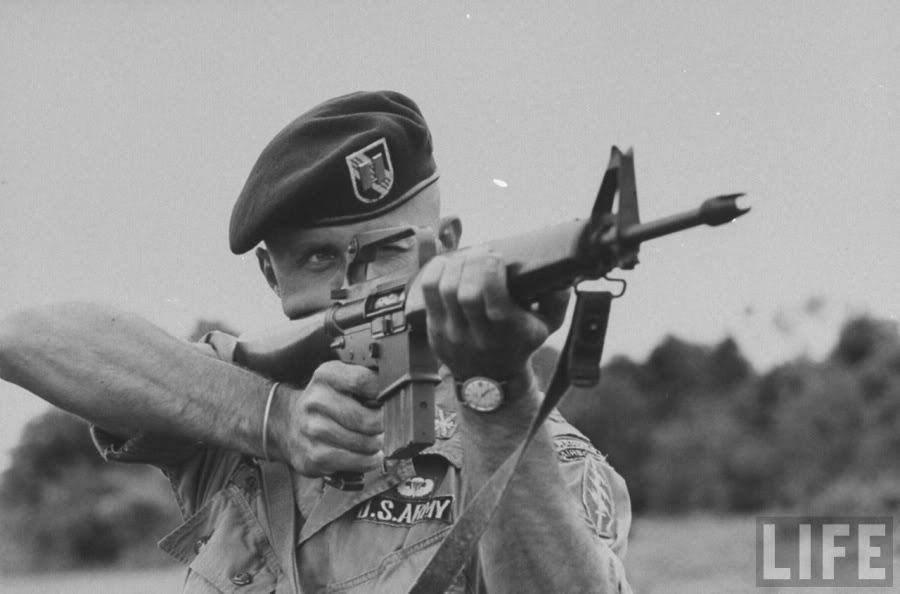
Quoted: Quoted: 20 years LE, and I own a rifle training company. http://bhtcorps.com I have only heard the chicken wing used in a pejorative context. Ask him what advantages he believes it provides. There are plenty of downsides to it. ––Fargo007 Thanks Fargo. I figured as much. I've tried it with various rifles for giggles, but failed to see the point. Does it offer any advantages in a non-tactical sense. i.e. competition shooting? In its proper time and place, yes, it does. Many service rifle team (.mil and not) members still find it useful. While my AR-15 doesn't recoil as heavy as my AR-10/M1A/various '03's/etc., I still do it, out of consistency. When done with bone support (support-side upper arm tight against the ribcage, to create a shelf for the rifle) it doesn't need to be 15o above parallel with the deck (as the Life photo of SF captain on pg.1 shows), but just enough to be comfortable through an offhand string, and still hold the toe of the rifle stock in one place. http://www.youtube.com/watch?v=ncBPtChn4ME MSgt Julia Watson, at Camp Perry, Aug 2011, shooting offhand... 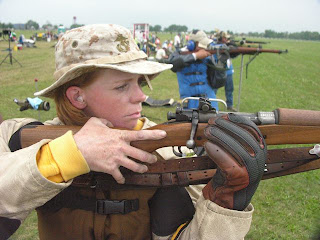 using a borrowed '03, for a 100-X2:  We could also delve into the efficacy of using one of these to make a loop or hasty sling as a shooting aid, to good effect: We could also delve into the efficacy of using one of these to make a loop or hasty sling as a shooting aid, to good effect: |
|
Quoted:
Quoted:
Quoted:
20 years LE, and I own a rifle training company. http://bhtcorps.com I have only heard the chicken wing used in a pejorative context. Ask him what advantages he believes it provides. There are plenty of downsides to it. ––Fargo007 Thanks Fargo. I figured as much. I've tried it with various rifles for giggles, but failed to see the point. Does it offer any advantages in a non-tactical sense. i.e. competition shooting? In its proper time and place, yes, it does. Many service rifle team (.mil and not) members still find it useful. While my AR-15 doesn't recoil as heavy as my AR-10/M1A/various '03's/etc., I still do it, out of consistency. When done with bone support (support-side upper arm tight against the ribcage, to create a shelf for the rifle) it doesn't need to be 15o above parallel with the deck (as the Life photo of SF captain on pg.1 shows), but just enough to be comfortable through an offhand string, and still hold the toe of the rifle stock in one place. http://www.youtube.com/watch?v=ncBPtChn4ME MSgt Julia Watson, at Camp Perry, Aug 2011, shooting offhand... http://2.bp.blogspot.com/-az1QlQXPeWk/TkLC86xuIqI/AAAAAAAAEDw/-Mitmh5lAw4/s320/DSCN4259.jpg using a borrowed '03, for a 100-X2: http://3.bp.blogspot.com/-CO03m-Ke4C4/TkLC9FoGDeI/AAAAAAAAED4/K9qrKgh-alc/s320/DSCN4250.jpg We could also delve into the efficacy of using one of these to make a loop or hasty sling as a shooting aid, to good effect:
http://www.rguns.net/Graphics/GunParts/Rifle/AR15/OD-CottonSling.jpg To go really old school, you have to use the leather 1903 sling. |
|
Quoted: Quoted: Quoted: Quoted: 20 years LE, and I own a rifle training company. http://bhtcorps.com I have only heard the chicken wing used in a pejorative context. Ask him what advantages he believes it provides. There are plenty of downsides to it. ––Fargo007 Thanks Fargo. I figured as much. I've tried it with various rifles for giggles, but failed to see the point. Does it offer any advantages in a non-tactical sense. i.e. competition shooting? In its proper time and place, yes, it does. Many service rifle team (.mil and not) members still find it useful. While my AR-15 doesn't recoil as heavy as my AR-10/M1A/various '03's/etc., I still do it, out of consistency. When done with bone support (support-side upper arm tight against the ribcage, to create a shelf for the rifle) it doesn't need to be 15o above parallel with the deck (as the Life photo of SF captain on pg.1 shows), but just enough to be comfortable through an offhand string, and still hold the toe of the rifle stock in one place. http://www.youtube.com/watch?v=ncBPtChn4ME MSgt Julia Watson, at Camp Perry, Aug 2011, shooting offhand... http://2.bp.blogspot.com/-az1QlQXPeWk/TkLC86xuIqI/AAAAAAAAEDw/-Mitmh5lAw4/s320/DSCN4259.jpg using a borrowed '03, for a 100-X2: http://3.bp.blogspot.com/-CO03m-Ke4C4/TkLC9FoGDeI/AAAAAAAAED4/K9qrKgh-alc/s320/DSCN4250.jpg We could also delve into the efficacy of using one of these to make a loop or hasty sling as a shooting aid, to good effect:http://www.rguns.net/Graphics/GunParts/Rifle/AR15/OD-CottonSling.jpg To go really old school, you have to use the leather 1903 sling. Ohhhh... I can SO rock the 1903 sling. |
|
Quoted:
Quoted:
Quoted:
Do any branches currently advocate/train the chicken wing? DOJ friend is adamant that it remains an acceptable practice. I'm a lifetime civvi, so I didn't argue with my buddy, but I thought the practice was outdated. I eat them pretty regularly. I like mine smoked instead of fried (coated with mustard, then some of my dry rub) and then butter and Franks Red Hot for the sauce.... Back to GD lil camper. Your sarcasm meter obviously needs help.... |

|
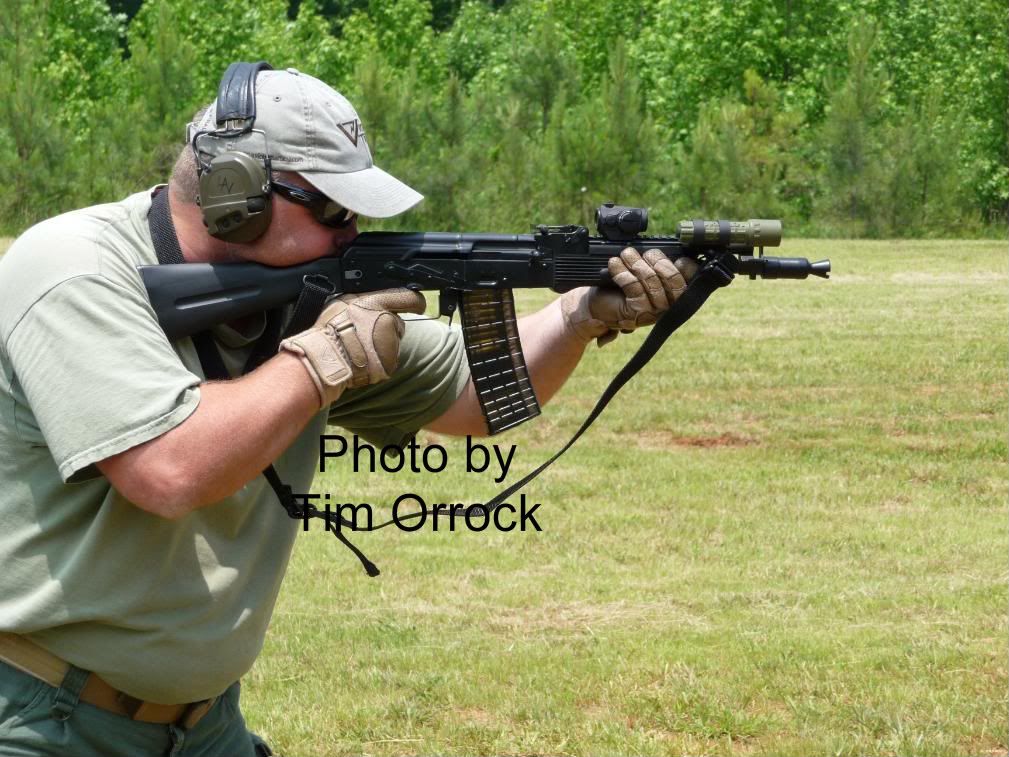
Quoted:
after reading this thread, I found some pictures of an older guy shooting an AK. This guy would seem to be the kind of guy who "grew up on" the weaver stance. Tony, what's wrong with his stance? is it really that far off? I wouldn't assume that just because someone is older that they grew up on weaver. It could be that someone who is currently 40+ years old has just started formal training and given the predominance of modern iso instructors teaching these days, he is thus more likely to have learned modern iso rather than weaver in his first course. At face value, I don't think there is anything wrong with his form but the target tells the tale. If you would google "weaver stance" images, I'm sure you'd find an example of the classic, picture perfect weaver stance. However, due to individual physique and build, there really is no standard. There will always be one or more students who will require a bit of tweaking to address issues with form (stance) that may impact POI. Once a student learns reset, follow through and acquires a proper and consistent grip, and begins to tear the center out of the target, I'm not going to force them into a "picture perfect" weaver stance. At the end of the day, some of my students end up in more of a modern iso stance than weaver and if their performance is solid, I don't force them to change. I tried to articulate my position on this matter in an earlier reply but it may not have gotten through some of the emotion present in this thread. Let me state again for the record that IMO, modern iso is an effective shooting stance. It works. My bottom line is that in my personal experience, I don't think it brings enough value to warrant changing my style of shooting (to modern iso). Is it "faster" than weaver? I'd have to acknowledge that it probably is or it wouldn't dominate the world of competition. How much faster is at the core of the issue and more to the point, how much faster will the advantage be in the context of a gunfight, with its many, many variables. I simply don't think it is faster "enough". Regarding the matter of speed in the context of the combat triad, it was established more than thirty years ago that marksmanship (with speed as one of its components) was the least significant leg of the triad after mindset and gun handling (weapon manipulation). It is on that basis that "I" have decided that I am not willing to invest the time and resources into learning a new style of shooting that will not bring enough improvement to justify the "cost". With regard to the issue(s) of mobility that Fargo raised in one of his previous replies, I can only respond that we have been shooting on the move and employing turns in simulators for decades using the weaver stance and yes, I can most certainly keep my firing hand elbow "up" with the rifle in the shoulder pocket while shooting on the move. Regarding the video of Chris Costa shooting a SG in the same manner as an M4 or sub-gun with the buttstock on his collar bone, I have two comments. Either he is using 7 1/2 shot "soft ball" clay bird loads or he is ten times the man I am. Try running an entire 2 or 3 day SG training course without armor as he is while using 00 buckshot and full power slugs. I don't think anyone could finish the course unless they're a masochist. This all comes full circle to how unlikely it is that a home owner will be wearing hard armor in their home or back yard at 3am in the morning. For the first thirty years of private sector firearms training Col. Cooper, Clint Smith, Louis Awerbuck and Larry Mudgett et al taught thousands of students to defend themselves (and many did) using weaver / CW. I still maintain that the acceptance of modern iso in the .mil and LE developed primarily as a result of the use of hard armor so as to maximize frontal torso protection. And that was a good thing. But don't try to sell me on the fact that modern iso's "other advantages" have completely overtaken weaver because I've been doing this stuff since 1996 and I know it isn't true. |
| come on, do you seriously push weaver as a better stance to new students? why don't any of the other former gunsite instructors teach it? or rather, why do they teach the modern stance primarily? if it is better on the shot-timer, then it must certainly be better "in a gunfight". can you honestly say that on average the measurable time differences when switching targets and between shots don't matter? i think you'd be doing students a great injustice to deny them the stance that has dominated the tactical world, if you are instructing them in a tactical course. |
|
Quoted:
Quoted:
Do any branches currently advocate/train the chicken wing? DOJ friend is adamant that it remains an acceptable practice. I'm a lifetime civvi, so I didn't argue with my buddy, but I thought the practice was outdated. I eat them pretty regularly. I like mine smoked instead of fried (coated with mustard, then some of my dry rub) and then butter and Franks Red Hot for the sauce.... |
|
Regarding the video of Chris Costa shooting a SG in the same manner as an M4 or sub-gun with the buttstock on his collar bone, I have two comments. Either he is using 7 1/2 shot "soft ball" clay bird loads or he is ten times the man I am. Try running an entire 2 or 3 day SG training course without armor as he is while using 00 buckshot and full power slugs. I don't think anyone could finish the course unless they're a masochist. It's not on his collar bone, unless he is doing it incorrectly. Our Day & Night shotgun Q-course was 60 rounds. 50 rounds Hornady TAP 00 buck and 10 slug. I shot it this way at least twice a year for 15 of the 20 years I was in. First with an 870 and then with a 14" Benelli. With, and without soft or hard body armor with equal ease. Before that I shot deep shoulder pocket / chicken wing style. It is easier to shoot a tactical shotgun the way he is demonstrating, and this is the way modern tactical shotgun is taught now. Even if that was birdshot, you have to acknowledge that the effects of recoil on the shooter and the muzzle are just gone. Besides, you can clearly see that he is using high brass. Come on bro - You know civilian scattergun courses are just not going to have students firing 00 buck and slugs for three days straight.
––Fargo007 |
|
Quoted:
Regarding the video of Chris Costa shooting a SG in the same manner as an M4 or sub-gun with the buttstock on his collar bone, I have two comments. Either he is using 7 1/2 shot "soft ball" clay bird loads or he is ten times the man I am. Try running an entire 2 or 3 day SG training course without armor as he is while using 00 buckshot and full power slugs. I don't think anyone could finish the course unless they're a masochist. It's not on his collar bone, unless he is doing it incorrectly. Our Day & Night shotgun Q-course was 60 rounds. 50 rounds Hornady TAP 00 buck and 10 slug. I shot it this way at least twice a year for 15 of the 20 years I was in. First with an 870 and then with a 14" Benelli. With, and without soft or hard body armor with equal ease. Before that I shot deep shoulder pocket / chicken wing style. It is easier to shoot a tactical shotgun the way he is demonstrating, and this is the way modern tactical shotgun is taught now. Even if that was birdshot, you have to acknowledge that the effects of recoil on the shooter and the muzzle are just gone. Besides, you can clearly see that he is using high brass. Come on bro - You know civilian scattergun courses are just not going to have students firing 00 buck and slugs for three days straight.
––Fargo007 and if you watch the shotgun video (which i have) he explains a great technique to mitigate recoil. it would seem that Tony is vehemently resisting any modern techniques. |
|
Quoted:
come on, do you seriously push weaver as a better stance to new students? No I don't. I tell students that while we teach weaver, that modern iso and other iterations of iso also work well. While iso is without a doubt an effective shooting stance, we feel weaver is a better "fighting" stance (more stable) given that in the civilian context, contact distance threats are a much more likely possibility and as such, one can better "blend" H2H and the firearm. why don't any of the other former gunsite instructors teach it? or rather, why do they teach the modern stance primarily?
Who specifically? Here is a panteo production excerpt of a Louis Awerbuck video. Sure looks like weaver to me. Scroll down to the bottom of the page to find a photo of (I assume) Stacey Mudgett. Sure looks like weaver to me. if it is better on the shot-timer, then it must certainly be better "in a gunfight".
Really? How do you know? This is THE issue IMO. You guys (modern iso advocates) are in the enviable position of not being able to prove that there is a linear correlation in a gunfight. You simply assume. I have REPEATEDLY stated that while I acknowledge it is probably faster on a square range, that there are so many unanticipated variables in a gunfight that these "advantages" diminish greatly given the realities of a gunfight (e.g. adrenalin dump, fear, loss of fine motor control, the BG interrupting my OODA cycle, etc., etc.). can you honestly say that on average the measurable time differences when switching targets and between shots don't matter?
This is a specious argument at best because no one has ever answered the question "how fast is fast enough". Has there EVER been a documented case where a good guy failed because he wasn't "fast" enough? Do you not subscribe to the long held belief that mindset and gun handling are of primary importance and that marksmanship (and speed) are the least significant because the shooting problem per se in a given gunfight is usually not that difficult? i think you'd be doing students a great injustice to deny them the stance that has dominated the tactical world, if you are instructing them in a tactical course.
Was I not clear when I emphasized REPEATEDLY throughout this thread that I am simply trying to offer an alternative opinion to the modern iso orthodoxy as it relates to the non-armor wearing civilian experience? |
|
Quoted:
Regarding the video of Chris Costa shooting a SG in the same manner as an M4 or sub-gun with the buttstock on his collar bone, I have two comments. Either he is using 7 1/2 shot "soft ball" clay bird loads or he is ten times the man I am. Try running an entire 2 or 3 day SG training course without armor as he is while using 00 buckshot and full power slugs. I don't think anyone could finish the course unless they're a masochist. It's not on his collar bone, unless he is doing it incorrectly. The first two shot strings you get a good view of his torso. It looks very much to me like the buttstock is placed at or near his collarbone, at least well inside the shoulder pocket. Is that not correct technique if one was wearing body armor? Here's Chris Costa of magpul using a modern stance with a 12 gauge shotgun. Where'd the recoil go???
http://www.youtube.com/watch?v=IyjmAwkhfY4 Come on bro - You know civilian scattergun courses are just not going to have students firing 00 buck and slugs for three days straight.
I know but you still engage in multiple shooting exercises using full power ammo. I don't want (or need) that felt recoil impulse striking my collarbone or upper pectoral muscle. And for the record, I have a high threshold for pain. I have attended SG courses and with a buttstock with a proper LOP, in the shoulder pocket, you will not feel any recoil. I gotta repeat myself again. I'm not claiming that the methods you use are not effective. They are. But I see an obsession with speed gripping the training industry and while there is nothing wrong with that in and of itself, I am simply of the opinion that in the civilian experience, a well trained weaver shooter, chicken wing and all, is just as qualified to prevail against a threat as a well trained modern iso shooter, all else being equal. Fractions of a second are important in competition which is why speed matters in that venue. A cool head and superior tactics carry the day in gunfights. |
|
I know but you still engage in multiple shooting exercises using full power ammo. I don't want (or need) that felt recoil impulse striking my collarbone or upper pectoral muscle. And for the record, I have a high threshold for pain. I have attended SG courses and with a buttstock with a proper LOP, in the shoulder pocket, you will not feel any recoil. I don't disagree that you can absorb recoil in the shoulder pocket, but the "gunfight" doesn't stop there. Absorbing the discomfort of the recoil really doesn't matter. What DOES, is control. This stance is about absorbing the recoil as a means to controlling the firearm throughout as many shots as necessary. Don't watch the shoulder to judge effective recoil control, watch the muzzle, and later the target. The DSP/CW can absorb the feeling of the recoil, but across the full span of considerations, it simply cannot equal this. I posted that our Q-Course was 60 rounds of Hornady TAP and slugs. This ain't baby food. Before you criticize this technique, maybe you should get some instruction on it and go out and give it a try and some serious study? I've shot both ways, so I am not criticizing the DSS/CW from afar. Truth be told, shooting pistol, my left elbow is still bent a little.
This is a specious argument at best because no one has ever answered the question "how fast is fast enough". Has there EVER been a documented case where a good guy failed because he wasn't "fast" enough? You keep reducing this to be solely about speed, but it's not. It's about control. Speed is a by-product of that control. I'm going to answer this once and for all. You need to be faster and more accurate than your opponent. It is not hard to imagine that a good guy would state that he would have loved to shoot faster and more accurately. There is no such thing as "enough." Training isn't a destination, it's a journey. I'll get to that. I can tell you that the maxim "you fight how you train" is 100% true. I agree that tactics are important, as well as being able to place shots on target for effect. Shot placement is what wins. We are definitely seeing "mindset" differently though..... The notion that somehow it's okay to stop short of one's full potential or choose techniques that obstruct that development because they have reached a plateau that is "good enough" to succeed in a romantic, hypothetical deadly force situation is foreign to me. I swam my best ever Combat Swimmer's Stroke 500Y yesterday at 08:34. I remember how thrilled I was when I broke under 10:00, which is a competitive time for 19-20 year olds. Should I have stopped with the 10:05, or the 09:58? I don't want to be strong enough, but stronger. I don't want to shoot "good enough" but better. I don't want to succeed, I want to prevail. That's mindset to me. ––Fargo007 |
|
This stance stuff, from my limited perspective, is more about marketing than control or speed.
Starting with natural fighting stance, and adopting a general attitude of finding out what works for you, dominates the discourse I see on the receiving end. If you are going to condemn one technique as opposed to merely teaching another, you're going to have to have much stringer arguments than "that's what the cool kids playing 3-gun are doing." Your mileage may vary. Some offers may be prohibited in some areas. Use only as directed. |
|
fargo hit the nail right on the head. the increase in speed while using modern iso comes from the increase in control, and increased felt recoil mitigation.
and there is no such thing as "fast enough". slow is smooth, smooth is fast. the smoother you shoot, with more control, the faster your follow up shots are. more follow up shots, higher chance of exsanguination or CNS hits. bad guy drops faster. If Col. Cooper were still alive, i'm sure he'd be using and teaching modern iso. Furthermore, just because they're a civilian don't assume that they're unarmored. the type of individuals who are taking tactical weapons handling courses are exactly the type of civilians who WOULD be armored. |
|
Quoted:
Please characterize what that explanation is. I haven't seen the video but I'm interested in hearing about it. ––Fargo007 i can't find a good video of it, but he employs a "push/pull" method. with the shotgun firmly in the pocket you pull in with your hand on fire control at 30% and push out with your support hand at 70%. this is just as you're firing, not always while shouldering the shotgun. |
|
Quoted:
I know but you still engage in multiple shooting exercises using full power ammo. I don't want (or need) that felt recoil impulse striking my collarbone or upper pectoral muscle. And for the record, I have a high threshold for pain. I have attended SG courses and with a buttstock with a proper LOP, in the shoulder pocket, you will not feel any recoil. I don't disagree that you can absorb recoil in the shoulder pocket, but the "gunfight" doesn't stop there. Absorbing the discomfort of the recoil really doesn't matter. What DOES, is control. This stance is about absorbing the recoil as a means to controlling the firearm throughout as many shots as necessary. Don't watch the shoulder to judge effective recoil control, watch the muzzle, and later the target. The DSP/CW can absorb the feeling of the recoil, but across the full span of considerations, it simply cannot equal this. I did take note of the muzzle when I watched the video. It does control recoil well and I do not dispute that fact. But so does weaver. Before you criticize this technique, maybe you should get some instruction on it and go out and give it a try and some serious study?
I'm not criticizing it as a technique. I've never criticized it. I've stated again and again that it is an effective method of shooting. What I take issue with is the unjustified criticism weaver has suffered in recent years. That is the sole reason I participated in this thread. I refer you to my second reply in this thread: I never try to force an iso shooter to adopt weaver in classes I teach. But the denigration weaver has received in the last decade or so is totally misrepresented IMO.
You keep reducing this to be solely about speed, but it's not.
No I do not. Every time I engage someone in this topic it is they who tell me how they can prove it with a shot timer. It's happened several times in this very thread. It's about control. Speed is a by-product of that control.
Yes it is. Controlling the recoil impulse contributes to speed. I'm going to answer this once and for all. You need to be faster and more accurate than your opponent. It is not hard to imagine that a good guy would state that he would have loved to shoot faster and more accurately. There is no such thing as "enough." Training isn't a destination, it's a journey. I'll get to that.
The notion that somehow it's okay to stop short of one's full potential or choose techniques that obstruct that development because they have reached a plateau that is "good enough" to succeed in a romantic, hypothetical deadly force situation is foreign to me. Here is where we differ in our respective points of view. I think there is such a thing as "fast enough". As a civilian I need to be fast enough to overcome 98% of the criminal element in this world who may attack me during the course of my daily life. I am quite confident I am there. Even the old gunsite standards are adequate even though they are not as difficult as the MEUSOC CoF or the Air Marshall qual, etc. Now that I am "there", where do I go from "there" with my limited time and training budget? Answer: Instead of trying to improve my marksmanship and speed by fractions of a second by switching from weaver to modern iso, I'd rather put that time to better use learning H2H skills because as a civilian, the firearm will probably not be my best, first option. I don't disparage anyone trying to improve their shooting ability but if you focus on shooting ability to the exclusion of the civilian reality, IMO you are doing yourself a disservice. If you have unlimited time and the discretionary budget to do it all, by all means go for it. IMHO, once you reach the state of unconscious competence with the firearm, time and money is better spent with guys like Steve Tarani and South Narc. Edits in red. |
|
Quoted:
fargo hit the nail right on the head. the increase in speed while using modern iso comes from the increase in control, and increased felt recoil mitigation. and there is no such thing as "fast enough". slow is smooth, smooth is fast. the smoother you shoot, with more control, the faster your follow up shots are. more follow up shots, higher chance of exsanguination or CNS hits. bad guy drops faster. If Col. Cooper were still alive, i'm sure he'd be using and teaching modern iso. I've answered most of this in my reply to fargo. Furthermore, just because they're a civilian don't assume that they're unarmored. the type of individuals who are taking tactical weapons handling courses are exactly the type of civilians who WOULD be armored.
IMO, the "civilian experience" implies sudden and unanticipated attack. Examples are getting mugged in a parking garage or in your driveway as you exit your car coming home late at night. Or, at the very least, a noticeable offensive posture in someone on the street which cannot be addressed until an attack is initiated else the victim may be viewed by eyewitnesses as the aggressor. And in the home there would be the noise / ruckus associated with a forced break-in, most probably late at night requiring a rapid response in a sleepy, bleary-eyed condition. Under any of these circumstances, I seriously doubt any civilian is going to have the time or opportunity to don armor. Its a ridiculous notion. |