


Posted: 12/17/2011 5:22:42 AM EDT
|
Hey all, trying to get started in photography. I've had a nice Canon T3 SLR for a little while but just got around to starting to use it. Plus, my buddy just gave me Adobe Lightroom, so I've been messing with that program. Let me know what you think of these photos I took yesterday. Be honest too, I want real feedback.
Thanks!! 

|
Foster, I hear you are the unofficial official FDCC photographer? Haha well you don't mind if I come to the Janurary FDCC match to shoot pictures do you? I would shoot as well, but I can't afford the ammo right now... 
Don't want to step on your toes! And thanks! |
|
Quoted:

Composition doesn't look thought out (floor boards at a weird angle, lots of nothing going on in the upper right hand corner). On-camera flash making hot-spots on every rounded surface (receiver extension, upper receiver, surefire, aimpoint, and a few on the lower). Then there is the big hot-spot at the bottom of the frame. The direct flash also flattens details like the roll mark and other engravings on the lower. Maybe you should invest in a couple of lamps or strobes? Personally, I don't care for images that are sepia tone for no good reason.  I like it. Maybe a little noisy but I think it is composed well enough (fills the frame etc.). I'm not sure where the focus is supposed to be but it looks like your camera chose the floor on the lower left. Maybe a little longer exposure with the CCD set to a lower sensitivity and smaller aperture to get more detail. Or maybe manually focused somewhere interesting like the "Glock" logo with the same narrow depth of field? Still –– better photos than I've taken in a long time. |
|
Quoted:
Composition doesn't look thought out (floor boards at a weird angle, lots of nothing going on in the upper right hand corner). On-camera flash making hot-spots on every rounded surface (receiver extension, upper receiver, surefire, aimpoint, and a few on the lower). Then there is the big hot-spot at the bottom of the frame. The direct flash also flattens details like the roll mark and other engravings on the lower. Maybe you should invest in a couple of lamps or strobes? Personally, I don't care for images that are sepia tone for no good reason. I like it. Maybe a little noisy but I think it is composed well enough (fills the frame etc.). I'm not sure where the focus is supposed to be but it looks like your camera chose the floor on the lower left. Maybe a little longer exposure with the CCD set to a lower sensitivity and smaller aperture to get more detail. Or maybe manually focused somewhere interesting like the "Glock" logo with the same narrow depth of field? Still –– better photos than I've taken in a long time. Thanks ruertar! Yeah I'm still learning all about my camera so I definetly need to work on a few things. Plus, I just had surgery on my left shoulder the other day so I didn't have another hand to manually focus the lens lol. I agree with the bottom picture though that the camera seemed to pick the lower left of the screen to focus on, and I definitely should have focused on the Glock logo. Thanks a bunch! Hopefully I'll be able to make it down to CFDCC soon, once I can use my arm again! |
|
Quoted:
Foster, I hear you are the unofficial official FDCC photographer? Haha well you don't mind if I come to the Janurary FDCC match to shoot pictures do you? I would shoot as well, but I can't afford the ammo right now...
Don't want to step on your toes! And thanks! I am merely just another guy at Fdcc I don't set policy. As long as the RO's are cool with it and you understand it is a live range I don't have any issue with it at all..intact the more the merrier I say...plenty of folks who go take waaaaay better photos than I can muster up...I just get very lucky every once in a while 
|
|
Take your guns outside and take pics. You can't beat the light mother nature has to offer at times. I have a bunch of pics on the blog in my sigline. Most are taken with no flash, just outside. I would take it easy on the "artsy" tones you're adding to the shots. |
 lol
lol
|
Check out Photography-on-the.net. It's Canon-centric and has many sub-forums on the different aspects of photography, as well as many excellent tutorials for the beginner.
I like your first shot. Decent composition, decent focus. As was said above, natural light makes a huge difference. Taking the picture right the first time is way better then trying to manipulate it into 'right' via Lightroom or Photoshop. I can't recall if the T3 has LiveView or not, but it's a powerful feature for learning to compose. Set your camera to manual mode and play with your exposure settings to see what looks best. Also, when shooting overhead at short distance (like putting your gun on the floor and taking a picture standing over it), anything over F/8 isn't going to get you a lot more detail, and the longer exposure times are more likely to bring camera shake into the picture, paradoxically reducing your sharpness at higher aperture. I'd stick to F/5.6 or F/8 for most of your work, up to F/11 or F/16 if it's really bright and sunny. 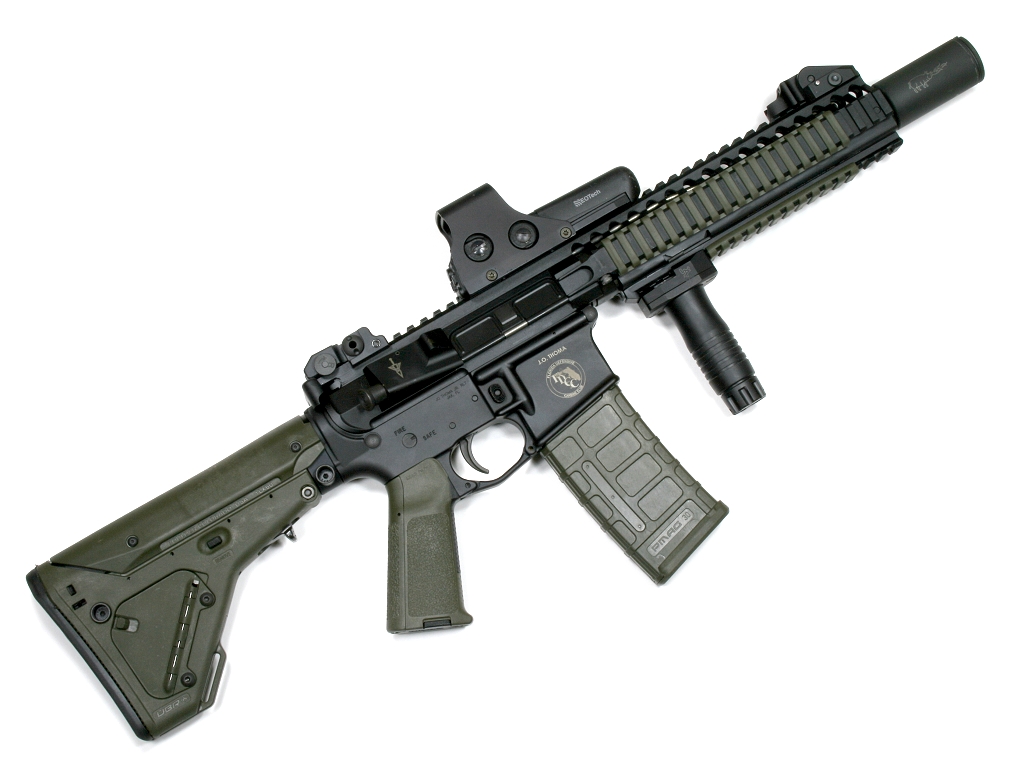
Gun is sitting on a piece of white poster board on the kitchen floor, with natural light coming through the window. Exposure is set two stops higher then recommended by the meter, to get the over-white background look. The light meter incorporated in your camera has a hard time with sharp black-and-white contrast, and will tend to render it gray unless you purposefully over-expose. Shooting in RAW also allows you to manipulate the shot in Digital Photo Pro by about two stops at the expense of some noise. Fosters is an excellent photographer and a good person to seek advice from while out at FDCC. |
|
Quoted: Take your guns outside and take pics. You can't beat the light mother nature has to offer at times. I have a bunch of pics on the blog in my sigline. Most are taken with no flash, just outside. I would take it easy on the "artsy" tones you're adding to the shots. This is very good advice. I would add that you might want to pay attention to the focus, the focus in the pic of the AR is not quite right. |
|
Nice looking AR you got there JohnnyEgo!! Good picture too, im liking the pure white background. Thanks for the advice as well.i realy do need to sit down and mess with the apeture... other than pointing, manually focusing, and taking the picture, ill admit i dont really know much more about how my camera works.
Thanks Banditman, i hadnt noticed that about the first picture until you pointed it out and i definetly agree! When i make it over to the FDCC shoots i will make sure i introduce myself. I talked to Martin for a little at one of the CFDCC shoots and learned some good tips on taking videos. |
|
Best advice I wish someone gave me in the very beginning is just, take pictures! Dont worry to much about aperture this, or exposure that. It is a little overwhelming at first, or at least I felt that way. Just take the camera with you where ever you go and just snap some pictures. See what looks good compensation-wise. I dont find myself that often using full manual mode, sometimes to just to much to think about. As you find out your style and what type of angles you like then slowly work into adjusting aperture and exposure. Check out http://www.kenrockwell.com/tech.htm He has some great reading material. Another thing I never knew it the beginning is that not every picture will turn out perfect. That is the beauty of digital media, we can just delete whatever comes out looking like crap and then keep shooting! Im no pro and just like photography in my free time so take my post with a grain of salt! Good luck and feel free to message me!
|

|
I just snagged a XSi and 2 kit zooms that is very similar. As said before I would shoot RAW and fine tune exposure and WB in the software. Mine only shoots JPEG's on auto so I shoot manual. For macro and long exposures use the live view/mirror lock up for best results. To augment the kit zoom you might consider the very inexpensive (around $100) yet remarkably sharp 50mm 1.8 "plastic fantastic" prime lens. Good lens for shooting guns and lower light shots.http://usa.canon.com/cusa/consumer/products/cameras/ef_lens_lineup/ef_50mm_f_1_8_ii
Have you taken and processed any HDR shots yet? Used conservatively it can help bring out extra detail in the highlights and more importantly the shadows. |
|
Quoted:
I just snagged a XSi and 2 kit zooms that is very similar. As said before I would shoot RAW and fine tune exposure and WB in the software. Mine only shoots JPEG's on auto so I shoot manual. For macro and long exposures use the live view/mirror lock up for best results. To augment the kit zoom you might consider the very inexpensive (around $100) yet remarkably sharp 50mm 1.8 "plastic fantastic" prime lens. Good lens for shooting guns and lower light shots.http://usa.canon.com/cusa/consumer/products/cameras/ef_lens_lineup/ef_50mm_f_1_8_ii Have you taken and processed any HDR shots yet? Used conservatively it can help bring out extra detail in the highlights and more importantly the shadows. No I have not... but I need to! I'm still trying to figure out how to use my camera lol. |

|
Where in Florida are you?
Ive been shooting with a Nikon D40X slr for awhile and while I admit I am NO pro photographer I can help you with the basics to help you improve your skills I live in South Florida in the Plantation/Ft lauderdale area and always enjoy meeting fellow gun enthusiasts Shoot me a message and even if you arent close maybe I can help you out with a few questions you may have |
| Best advice I have seen so far is...just take pictures...lots of em...I take close to 1500 pictures per Fdcc shoot...occasionally I get 5-10 good ones outta that...my camera is far more capable than I could hope to be...but without trying and trying often you'd never know |
|
Quoted:
Best advice I have seen so far is...just take pictures...lots of em...I take close to 1500 pictures per Fdcc shoot...occasionally I get 5-10 good ones outta that...my camera is far more capable than I could hope to be...but without trying and trying often you'd never know And this is my problem with digital photography ... Thanks to digital, people shoot instead of thinking out there shots. Statistically anyone can get a good photo sooner or later. OP I asked you the question I did earlier because it has everything to do with learning photography. When your not burning film and paying for developing/prints it's easy to compensate for qualitative shots with quantitative shooting. Anyone new into photography needs to first understand shutter speeds, f-stops, ISO and how each affects exposure. Also, understanding how they affect depth of field, focus, grain, and noise to name a few. After these are fully understood, you can start playing around with composure with principles such as the rule of thirds. I have a minor in Photography and currently teach it. I actually force my students shooting digital to a limited number of shots per shoot. This forces them to really think about there photographs before hitting the shutter release. And most important, get a good tripod and shutter remote. Use it every time you can. NEVER shoot in the auto mode. Shoot either M, S, or A. Get into the habit of telling your camera what to do versus letting it decide for you how the photo should look. Setup shots inside your house to practice the principles I mentioned. This way you understand how they affect a shotand you can decide how you want the photo to look before you release the shutter. |
|
Quoted: Quoted: Best advice I have seen so far is...just take pictures...lots of em...I take close to 1500 pictures per Fdcc shoot...occasionally I get 5-10 good ones outta that...my camera is far more capable than I could hope to be...but without trying and trying often you'd never know And this is my problem with digital photography ... Thanks to digital, people shoot instead of thinking out there shots. Statistically anyone can get a good photo sooner or later. OP I asked you the question I did earlier because it has everything to do with learning photography. When your not burning film and paying for developing/prints it's easy to compensate for qualitative shots with quantitative shooting. Anyone new into photography needs to first understand shutter speeds, f-stops, ISO and how each affects exposure. Also, understanding how they affect depth of field, focus, grain, and noise to name a few. After these are fully understood, you can start playing around with composure with principles such as the rule of thirds. I have a minor in Photography and currently teach it. I actually force my students shooting digital to a limited number of shots per shoot. This forces them to really think about there photographs before hitting the shutter release. NEVER shoot in the auto mode. Shoot either M, S, or A. Get into the habit of telling your camera what to do versus letting it decide for you how the photo should look. Setup shots inside your house to practice the principles I mentioned. This way you understand how they affect a shotand you can decide how you want the photo to look before you release the shutter. I agree to a point, but I have learned a lot about moon, sunset and sunrise shots by taking many pics at different exposures. I think reviewing the pics afterwards will give a lot of insite to the shooter. Worked for me anyway. |
|
Quoted:
Quoted:
Quoted:
Best advice I have seen so far is...just take pictures...lots of em...I take close to 1500 pictures per Fdcc shoot...occasionally I get 5-10 good ones outta that...my camera is far more capable than I could hope to be...but without trying and trying often you'd never know And this is my problem with digital photography ... Thanks to digital, people shoot instead of thinking out there shots. Statistically anyone can get a good photo sooner or later. OP I asked you the question I did earlier because it has everything to do with learning photography. When your not burning film and paying for developing/prints it's easy to compensate for qualitative shots with quantitative shooting. Anyone new into photography needs to first understand shutter speeds, f-stops, ISO and how each affects exposure. Also, understanding how they affect depth of field, focus, grain, and noise to name a few. After these are fully understood, you can start playing around with composure with principles such as the rule of thirds. I have a minor in Photography and currently teach it. I actually force my students shooting digital to a limited number of shots per shoot. This forces them to really think about there photographs before hitting the shutter release. NEVER shoot in the auto mode. Shoot either M, S, or A. Get into the habit of telling your camera what to do versus letting it decide for you how the photo should look. Setup shots inside your house to practice the principles I mentioned. This way you understand how they affect a shotand you can decide how you want the photo to look before you release the shutter. I agree to a point, but I have learned a lot about moon, sunset and sunrise shots by taking many pics at different exposures. I think reviewing the pics afterwards will give a lot of insite to the shooter. Worked for me anyway. Exposure is only one minor component to the shots you are talking about. What part do you disagree with? |
|
Quoted: Quoted: Exposure is only one minor component to the shots you are talking about. What part do you disagree with? When I say exposure I mean all the settings. I disagree about limiting the #'s of shots taken when learning. Also shooting in Auto mode is not a bad thing either. |
|
Btw, just for those who are curious, I still shoot a medium format TLR. I run Tri-X 400 pulled to 100 through it. I develop my own film and make my own prints. My current focus, and has been for almost 10 years, is very long exposures.
I also still shoot 35mm with the same film mentioned above. I do own a D7000 that I tend to use for work and more mainstream stuff. My son, who just turned six, got a D70s for Xmas. He shoots more than I do and has been doing so for almost a year. He is actually quite good, I call him my little Lartique ... ETA: a photo my son took at 5 ... http://www.facebook.com/photo.php?fbid=10150388764663697&l=31d265b326 |
|
Quoted:
Quoted:
Quoted:
Exposure is only one minor component to the shots you are talking about. What part do you disagree with? When I say exposure I mean all the settings. I disagree about limiting the #'s of shots taken when learning. Also shooting in Auto mode is not a bad thing either. That will work for the casual photographer but not someone interested in taking photography to the next level. Shooting in auto mode gets the camera to choose for you how the photographs will look. That's the job of the photographer, not the camera. Also, when you limit your shots, like those who have been shooting for years like myself were forced to back in the day, you tend to think more about how you want your photographs to look before releasing the shutter. When you know you have 3000 photos before you need to switch memory cards, you tend to be careless with your shots. |
|
Quoted:
Good read 
http://www.engadget.com/2011/12/27/engadget-primed-what-is-aperture-and-how-does-it-affect-my-pho/ Not bad ... I really like. I'm going to have to forward this to my kids ... Here is a power point I use as a very basic primer for a club I run. http://photoclub.stbhs.org/docs/Photography-Class-Introduction.pdf |
|
Quoted: Quoted: Quoted: Quoted: Exposure is only one minor component to the shots you are talking about. What part do you disagree with? When I say exposure I mean all the settings. I disagree about limiting the #'s of shots taken when learning. Also shooting in Auto mode is not a bad thing either. That will work for the casual photographer but not someone interested in taking photography to the next level. Shooting in auto mode gets the camera to choose for you how the photographs will look. That's the job of the photographer, not the camera. Also, when you limit your shots, like those who have been shooting for years like myself were forced to back in the day, you tend to think more about how you want your photographs to look before releasing the shutter. When you know you have 3000 photos before you need to switch memory cards, you tend to be careless with your shots. I understand where you are coming from, but learning while shooting film did limit you by cost alone. I think Digital is a benefit because you can experiment more than you could when you learned. As far as using Auto, I think that it is good to use when learning to frame the shot. Then later you put use the manual settings and the shot framing together for your shot's. That is my opinion, but you have probably forgot more than I know. |
|
Quoted:
Quoted:
Quoted:
Quoted:
Quoted:
Exposure is only one minor component to the shots you are talking about. What part do you disagree with? When I say exposure I mean all the settings. I disagree about limiting the #'s of shots taken when learning. Also shooting in Auto mode is not a bad thing either. That will work for the casual photographer but not someone interested in taking photography to the next level. Shooting in auto mode gets the camera to choose for you how the photographs will look. That's the job of the photographer, not the camera. Also, when you limit your shots, like those who have been shooting for years like myself were forced to back in the day, you tend to think more about how you want your photographs to look before releasing the shutter. When you know you have 3000 photos before you need to switch memory cards, you tend to be careless with your shots. I understand where you are coming from, but learning while shooting film did limit you by cost alone. I think Digital is a benefit because you can experiment more than you could when you learned. As far as using Auto, I think that it is good to use when learning to frame the shot. Then later you put use the manual settings and the shot framing together for your shot's. That is my opinion, but you have probably forgot more than I know. I can see where you are coming from. I tend to be very old school when it comes to photography. I started at 8 in a household full of photographers rolling my own film, developing it, and making my own prints (thanks to a inner city art program in my home town). I still catch myself saying ASA all the time ... |