


Armory Sponsor

Posted: 5/26/2013 10:56:25 AM EDT
|
I have a chance to pick up a Mini that is series 185, so it is an older one. The price is reasonable (pre-panic, you know, like they'll be in about six months when people figure out they can't regularly unload their Mini for the same price as an AR). Anyhow, I'm a little concerned with the accuracy issues. I know it isn't a target rifle, but how is the accuracy, particularly after the barrel has a few rounds fired down it. Can it hit a man-sized target at 100 yards after it heats up? What about 200? 300?
Your experiences are wanted and appreciated. |
|
I consider my 186 series a 100 yd rifle. Groups inside of that usually cover a softball if I try real hard. (the factory irons blow, and scoping a non ranch model blows harder) I'm thinking of cutting the barrel back to 14.5" with a perma flash supressor to bring it back up to 16". I also want to slap a folding stock on it. Now it does something an AR cannot. Fold up into a small, portable, easily deployable package.
I wouldn't pay more than $500ish for an older Mini. I got mine new in 1999 for $465. Minis aren't like wine. |
|
Trigger job and accu strut gives me 2-3 inch groups at 100 yards. An improvement over previous performance for my old mini. Some shoot fine with no help at all. Different bullet weights may make a difference. The thin barrel may change point of aim when it heats up.
This: One other difference is the twist rate changed through the years. I found this on Ruger Forum. 1978-1985 = 1 in 10" (e.g., 181 series) 1986-1994 = 1 in 7" 1995-2004 = 1 in 9" (e.g., 197 series). 2005- = 1 in 9" I've found slightly different dates on when the changes occurred, but this will give you an idea about when they changed the twist rates. For example mine is a 183 bought in 1987, but it has a 1 in 10 twist And this: I guess my first question would be how many different series are there? Ruger made the 180 series Mini-14 from 1974-1977. They do not support this series with "warranty" work at the factory. Ruger made the 181-186 series Mini-14 from 1978-1999. They also made the Mini-14 concurrently with the Mini-14 Ranch Rifle from 1982-1999 (and continued making the RR through 2004). Both the Mini-14 and the Mini-14 Ranch Rifle were rollmarked with 196 and 197 serial numbers during the latter years of production of the Mini-14. Ruger started making the Mini-14 Ranch Rifle in 1982 and continued to produce it until 2004. These were rollmarked with 187 and 188 from 1982-1995. In 1996 they started rollmarking the serial numbers with 196 and 197. In 2005 Ruger re-tooled the platform and started making the New Mini-14 Ranch Rifle, beginning the series 580 rifles. Would this be determined by the first three digits of the serial number? Yes. What are the differences in each? 180: If you want to shoot the rifle, I would avoid this series as Ruger doesn't support it. 181-186 Mini-14: Thin barrel, ejector is in the bolt, no scope ring scallops cast into the receiver. 187-188 Ranch Rifle: Thin barrel, ejector in the bolt stop assembly, scope ring scallops cast into the receiver, buffer sytem using the recoil spring assembly. 195-197 Ranch Rifle: Thin barrel, ejector in the bolt stop assembly, scope ring scallops cast into the receiver, buffer sytem using the recoil spring assembly. 580 Ranch Rifle (early version): Thin barrel, ejector in the bolt stop assembly, scope ring scallops cast into the receiver, buffer sytem using the recoil spring assembly, new tooling resulting in a slightly different look to the receiver (more rounded edges, etc.) 580 Ranch Rifle (later version)-581: Thicker flanged barrel, ejector in the bolt stop assembly, scope ring scallops cast into the receiver, buffer sytem using the recoil spring assembly, new tooling resulting in a slightly different look to the receiver (more rounded edges, etc.) Then there are different models of the 580-581 series, like the Tactical, Standard Ranch Rifle, Walnut Stock Special Edition, LEO Model, etc. There is also a Target Version of the Mini-14, and of course Mini-30's. There is some argument over the true meaning of GB, many agree on Government Barrel. It was a version designed for LEO's. |
|
I have a 1980's vintage Ruger GB. It shoots OK. I can hit a paper plate all day long at 100 yds with open sights.
Its not a target rifle, but it seems like it can be used to hit man-width targets within 100 yds with reasonable consistency. It does generally as good as many of my AK's and that's about what I would expect. My GB has been flawless with Ruger mags. |
|
I've had several mini 14's over the years. The older models I had all shot between 3-6in groups at 100yrds. They were all reliable as you can get, just not real accurate. I now have a 581 series, and it's a whole nother ball game. I routinely get 1 1/2in to 2in groups with good ammo at 100yrds, and that's with a scope on it. I don't reload. But, I'd bet that a reloader could get those groups down even more. I really enjoy shooting the 581 series.
If you get the older model, an accustrut will help a lot. With a few accuracy tricks you can get pretty close to 2-3in groups. I was pretty lucky with my older models and had decent accuracy with most of them. My groups would open a bit with quick mag dumps and a hot barrel. |
|
Quoted:
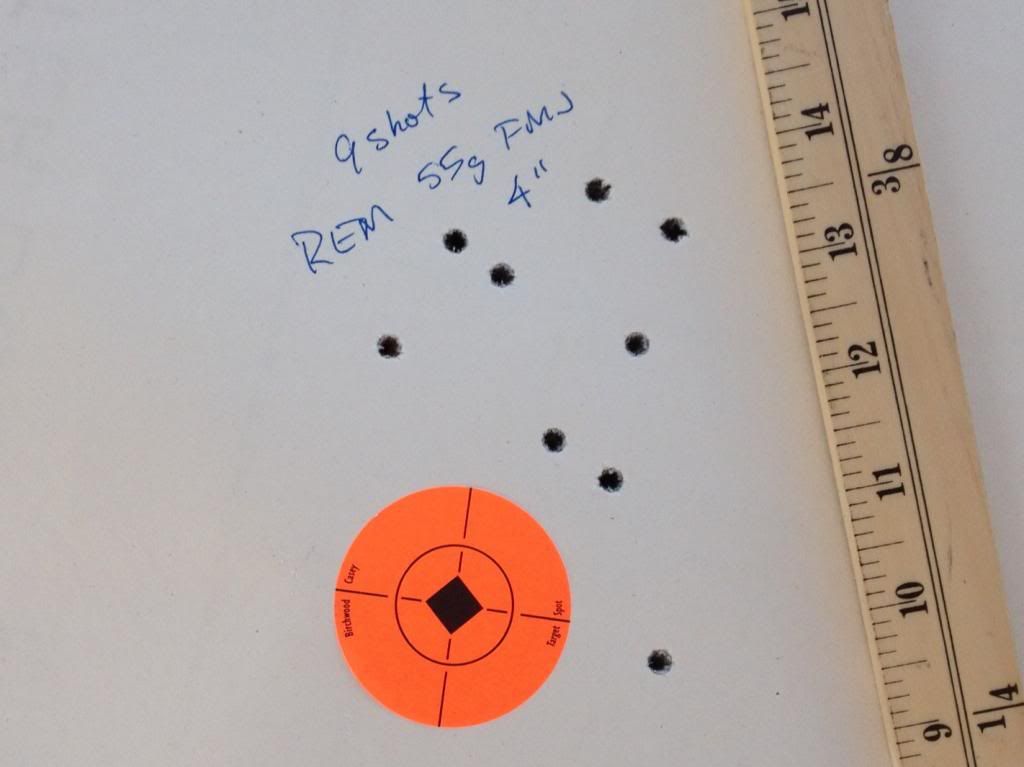
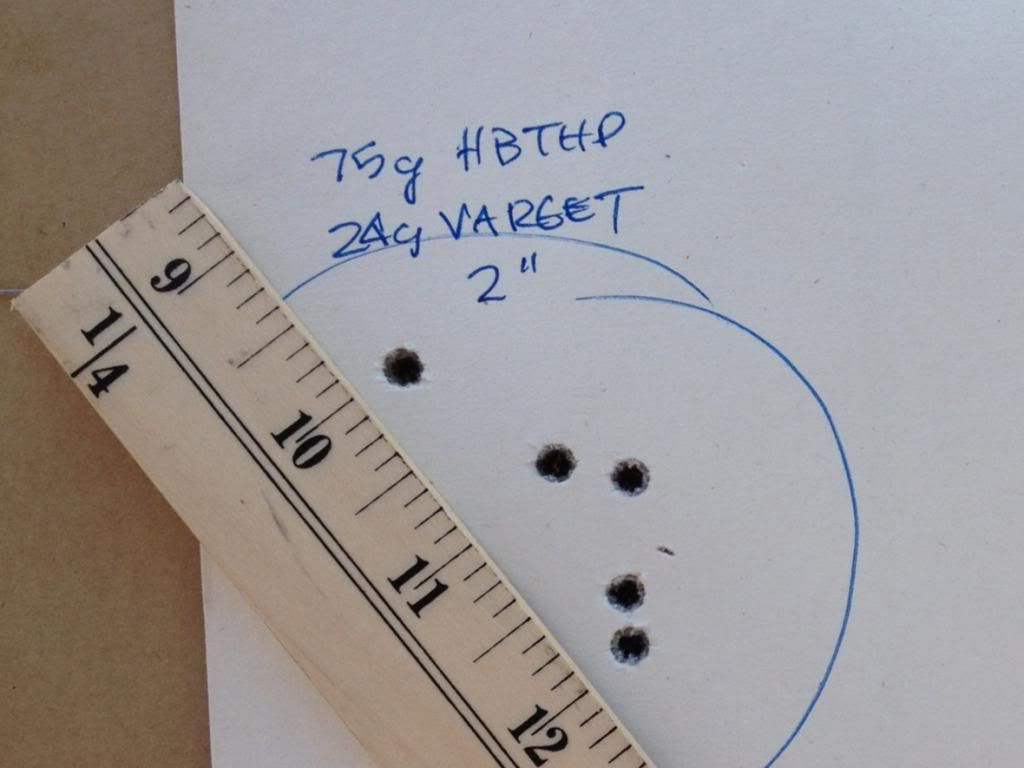
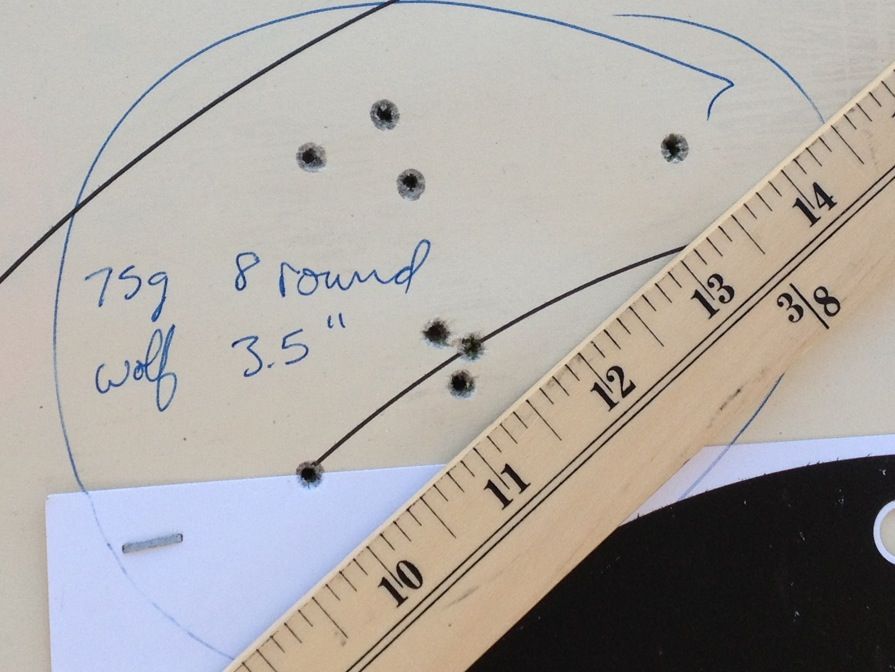
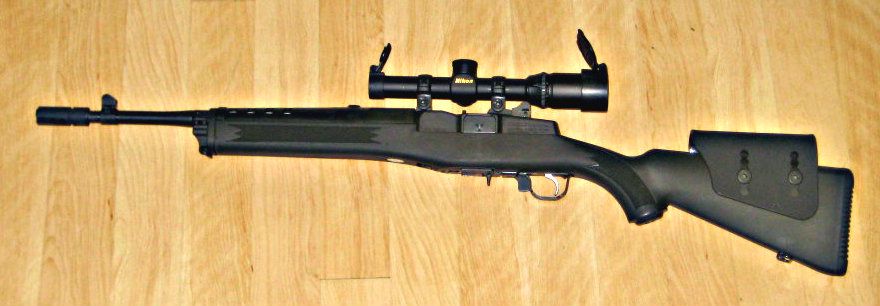
6-8" at best at 100 yards is common. Can be better than 6 to 8 inches at least with the newer rifles. Mine is a 581. It appears to shoot 75 grain bullets not horribly. I have a Nikon 1-4 scope and Smith Enterprise muzzle brake. All shot at 100 yards. Pics indicate load. Was a little windy so groups could be a little smaller but I think this is typical of my gun. I'm going to get a trigger job later, that should help. 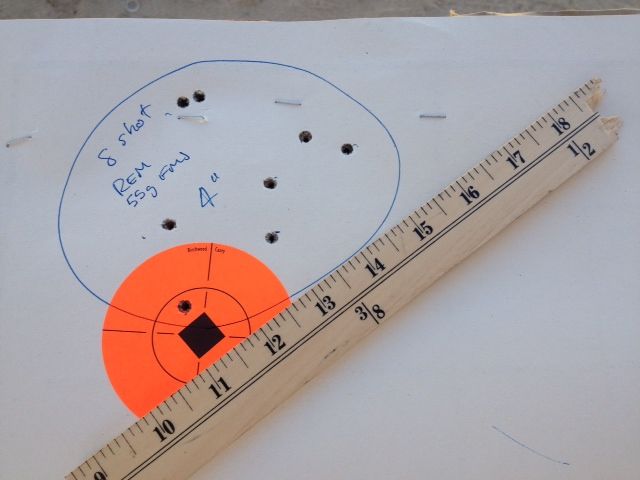
|
|
There are so many variables that factor into a particular rifle's accuracy that I hardly know where to begin. So, in no particular order:
. Ammunition - different barrels like different loads. Most particularly, heavy bullets (e.g. 62g) like faster twists. Usually, they won't shoot as well through a 1:10 twist as in a 1:9. You may need a 1:7 for really heavy .223 bullets, such as 75g. . Quality of the sear release. Long gritty triggers increase the likelihood that the shot will be launched off-mark. I replace the sear spring with one of finer wire - knocks about 2# off the pull. Polishing the sear surfaces will often get another #2. . Stability of the shooting platform. Mini-14s are spec'd to function. If they happen to have a close fit, count your blessings. If you want more than that, you'll have to do a little work on it. Fortunately, the Mini responds to the same - rather simple - procedures used to accurize the M1 and M14 rifles. I.E. glass-bed the action into the stock and free-float the barrel. The latter is a step that is often overlooked; failing to do it will give a symptom of shots walking vertically. I've always started by glass-bedding the metal liner; after it has cured a few days. I start bedding the action itself. Come to think of it, those three considerations should be performed in reverse order: Make the rifle a stable platform. Get the trigger smooth. Find a brand of ammo that it likes and buy/make a lot of it. My first m181 shot about 6 M.O.A. new. Military acceptance standard used to be 4 M.O.A. - at 300 yards, that will give a killing (or at least, disabling) hit on a center of torso aim. Dunno what the standard is now, for M4s. After I finished bedding it, I could consistently get under 2 M.O.A. - even at 300 yards - with Lake City 55g ball. That's a solid hit even at 600 yards, if the wind doesn't fool you. CR |
Armory Sponsor