


Armory Sponsor


Posted: 9/15/2010 8:04:57 PM EDT
|
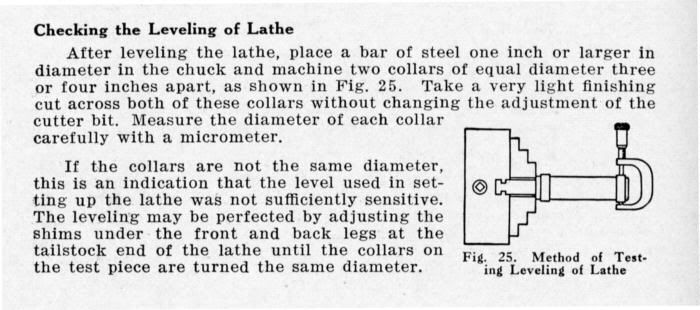
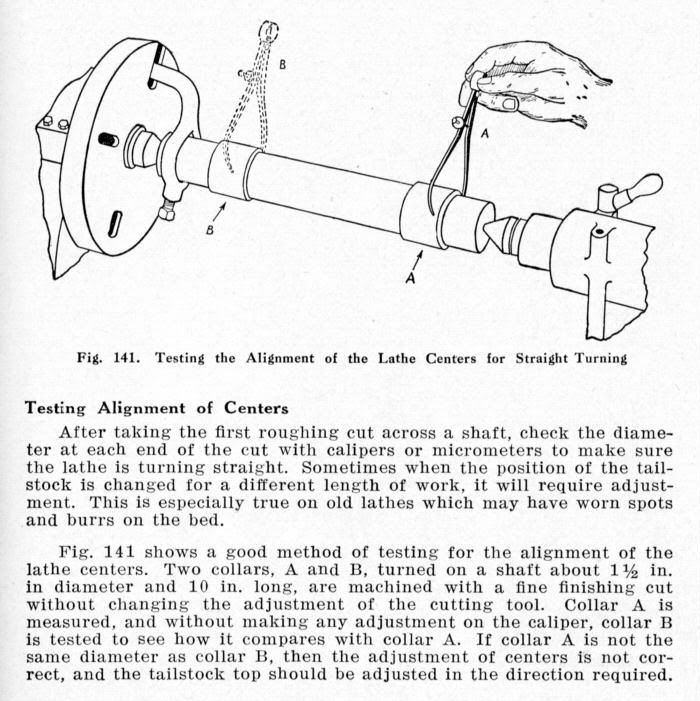
After reading and reading on PM it's become apparent that I need to level the bed of my lathe. OK. The machine as it sits now is temporary, it's getting moved at the end of the month. Once it's in more permanent location I'll perform the tests suggested/exampled in South Bend's book. If the two collar test runs within .001 I'm going to leave it, but what if it does not? Is there a way to remedy this without a Starrett 199z? I'd like to get it as accurate as possible, but don't really want to buy a $700 level for a 68 year old machine.  |
|
Quoted:
After reading and reading on PM it's become apparent that I need to level the bed of my lathe. OK. The machine as it sits now is temporary, it's getting moved at the end of the month. Once it's in more permanent location I'll perform the tests suggested/exampled in South Bend's book. If the two collar test runs within .001 I'm going to leave it, but what if it does not? Is there a way to remedy this without a Starrett 199z? I'd like to get it as accurate as possible, but don't really want to buy a $700 level for a 68 year old machine. i didnt use a machinest level myself i used a 24" Aluminum Level and have the bed level through the length of the bed and it's good enough for me . go here and save what you need in pdf get H1.H2,H3 for sure . http://www.wswells.com/data/howto/howto_index.html If the two collar test runs within .001 I'm going to leave it, but what if it does not? if it does not then you will have to adjust your tail stock did you watch Tubacain yet , he will show you how to do it and make a jig to use . TS2 |
|
Quoted:
Quoted:
After reading and reading on PM it's become apparent that I need to level the bed of my lathe. OK. The machine as it sits now is temporary, it's getting moved at the end of the month. Once it's in more permanent location I'll perform the tests suggested/exampled in South Bend's book. If the two collar test runs within .001 I'm going to leave it, but what if it does not? Is there a way to remedy this without a Starrett 199z? I'd like to get it as accurate as possible, but don't really want to buy a $700 level for a 68 year old machine. i didnt use a machinest level myself i used a 24" Aluminum Level and have the bed level through the length of the bed and it's good enough for me . go here and save what you need in pdf get H1.H2,H3 for sure . http://www.wswells.com/data/howto/howto_index.html If the two collar test runs within .001 I'm going to leave it, but what if it does not? if it does not then you will have to adjust your tail stock did you watch Tubacain yet , he will show you how to do it and make a jig to use . TS2 I watched the one you linked to, but haven't really looked at any others. |
|
You will find two screws at the tailstock end of the bed that are used for minor adjustments. Major adjustments need to be accomplished with shims under the machine, or under the table it is mounted to. The machine also should be firmly bolted to the floor.
Also, you can get a good machine level for way less than the Starrett. Enco will probably have some listed for a couple of hundred. Unless you want a permanently warped machine, it's pretty important to make sure it's level. |
|
When I got my lathe, I took great pains to anchor it solidly into the concrete floor of my little garage; levelling it as perfectly as possible with the various levels I own, shimming and even grinding the concrete floor a little.
But I have to admit that I had, and still have, some doubta about how important it actually is to do that. What I mean is, I can understand why it's important for a lathe to be mounted solidly on a (geometric) plane that is as dead flat as possible, to prevent the ways from getting twisted or warped when anchor bolts are tightened.. But shouldn't it be theoretically just as good to mount it vertically, (headstock at the top ?), on a flat, solid wall? Think about it- it may even be better seeing that the ways would hang in line with gravity, instead of supported at both ends and susceptible to sag. (However imperceptible that sag may be.) And the same thinking applies to turning a long, slender shaft as well.. No sag=greater accuracy, not? Please keep in mind that I'm talking general principles here- NOT practicality of actual operation, etc. What do you guys think? |
|
Quoted:
When I got my lathe, I took great pains to anchor it solidly into the concrete floor of my little garage; levelling it as perfectly as possible with the various levels I own, shimming and even grinding the concrete floor a little. But I have to admit that I had, and still have, some doubta about how important it actually is to do that. What I mean is, I can understand why it's important for a lathe to be mounted solidly on a (geometric) plane that is as dead flat as possible, to prevent the ways from getting twisted or warped when anchor bolts are tightened.. But shouldn't it be theoretically just as good to mount it vertically, (headstock at the top ?), on a flat, solid wall? Think about it- it may even be better seeing that the ways would hang in line with gravity, instead of supported at both ends and susceptible to sag. (However imperceptible that sag may be.) And the same thinking applies to turning a long, slender shaft as well.. No sag=greater accuracy, not? Please keep in mind that I'm talking general principles here- NOT practicality of actual operation, etc. What do you guys think? A part turned in a machine so mounted, if the ways were not rigid enough, would have taper from the chuck to the middle and from the tailstock to the middle. |
|
Quoted:
http://img.photobucket.com/albums/v470/haplesspeanut/2COLLAR.jpg http://img.photobucket.com/albums/v470/haplesspeanut/2COLLAR1.jpg You know, you can also just chuck a piece of stock in, turn in cross slide enough to clean up the end, zero it there, cut...then back cross slide out, move carriage over and bring in to zero again and make a cut and measure those 2 things on nearly any part before you start roughing it (just a quick check tip rather than use a special stepped piece like that––nothing wrong with that method though). |
|
Quoted:
Quoted:
When I got my lathe, I took great pains to anchor it solidly into the concrete floor of my little garage; levelling it as perfectly as possible with the various levels I own, shimming and even grinding the concrete floor a little. But I have to admit that I had, and still have, some doubta about how important it actually is to do that. What I mean is, I can understand why it's important for a lathe to be mounted solidly on a (geometric) plane that is as dead flat as possible, to prevent the ways from getting twisted or warped when anchor bolts are tightened.. But shouldn't it be theoretically just as good to mount it vertically, (headstock at the top ?), on a flat, solid wall? Think about it- it may even be better seeing that the ways would hang in line with gravity, instead of supported at both ends and susceptible to sag. (However imperceptible that sag may be.) And the same thinking applies to turning a long, slender shaft as well.. No sag=greater accuracy, not? Please keep in mind that I'm talking general principles here- NOT practicality of actual operation, etc. What do you guys think? A part turned in a machine so mounted, if the ways were not rigid enough, would have taper from the chuck to the middle and from the tailstock to the middle. I really don't think that it would turn an unintentional taper simply because of its' orientation to either the horizon or to the vertical. Assuming that the lathe is of decent quality to begin with. WHY would it turn anything other than a cut perfectly parallell to the ways, regardless of it's orientation to the floor or the ceiling or the moon or anything else? Seriously- I just don't understand why it would make any difference at all, as long as the surface that the machine is mounted on is FLAT (and I don't mean level or plumb, - I mean FLAT ) and ridgid. The toolbit's path is not controlled by the floor of your shop; it's controlled by the ways, (at least along the axis pertinent to this discussion). And why don't we lay our Bridgeports on their backs and operate them horizontally if my question isn't a valid one? I'm not trying to argue for argument's sake; I think I'm right but I would love to see my argument destroyed by the presentation of some sound scientific or mechanical principle that I haven't yet considered. I really don't want to pull the anchor bolts and mount my lathe on the wall just to prove a point! 
|
|
Quoted:
Quoted:
Quoted:
When I got my lathe, I took great pains to anchor it solidly into the concrete floor of my little garage; levelling it as perfectly as possible with the various levels I own, shimming and even grinding the concrete floor a little. But I have to admit that I had, and still have, some doubta about how important it actually is to do that. What I mean is, I can understand why it's important for a lathe to be mounted solidly on a (geometric) plane that is as dead flat as possible, to prevent the ways from getting twisted or warped when anchor bolts are tightened.. But shouldn't it be theoretically just as good to mount it vertically, (headstock at the top ?), on a flat, solid wall? Think about it- it may even be better seeing that the ways would hang in line with gravity, instead of supported at both ends and susceptible to sag. (However imperceptible that sag may be.) And the same thinking applies to turning a long, slender shaft as well.. No sag=greater accuracy, not? Please keep in mind that I'm talking general principles here- NOT practicality of actual operation, etc. What do you guys think? A part turned in a machine so mounted, if the ways were not rigid enough, would have taper from the chuck to the middle and from the tailstock to the middle. I really don't think that it would turn an unintentional taper simply because of its' orientation to either the horizon or to the vertical. Assuming that the lathe is of decent quality to begin with. WHY would it turn anything other than a cut perfectly parallell to the ways, regardless of it's orientation to the floor or the ceiling or the moon or anything else? Seriously- I just don't understand why it would make any difference at all, as long as the surface that the machine is mounted on is FLAT (and I don't mean level or plumb, - I mean FLAT ) and ridgid. The toolbit's path is not controlled by the floor of your shop; it's controlled by the ways, (at least along the axis pertinent to this discussion). And why don't we lay our Bridgeports on their backs and operate them horizontally if my question isn't a valid one? I'm not trying to argue for argument's sake; I think I'm right but I would love to see my argument destroyed by the presentation of some sound scientific or mechanical principle that I haven't yet considered. I really don't want to pull the anchor bolts and mount my lathe on the wall just to prove a point! please do this and post pics id love to see it |
|
Quoted: http://img.photobucket.com/albums/v470/haplesspeanut/2COLLAR.jpg http://img.photobucket.com/albums/v470/haplesspeanut/2COLLAR1.jpg Ya, I guess that's where I'll start. |
|
Quoted:
Quoted:
Quoted:
When I got my lathe, I took great pains to anchor it solidly into the concrete floor of my little garage; levelling it as perfectly as possible with the various levels I own, shimming and even grinding the concrete floor a little. But I have to admit that I had, and still have, some doubta about how important it actually is to do that. What I mean is, I can understand why it's important for a lathe to be mounted solidly on a (geometric) plane that is as dead flat as possible, to prevent the ways from getting twisted or warped when anchor bolts are tightened.. But shouldn't it be theoretically just as good to mount it vertically, (headstock at the top ?), on a flat, solid wall? Think about it- it may even be better seeing that the ways would hang in line with gravity, instead of supported at both ends and susceptible to sag. (However imperceptible that sag may be.) And the same thinking applies to turning a long, slender shaft as well.. No sag=greater accuracy, not? Please keep in mind that I'm talking general principles here- NOT practicality of actual operation, etc. What do you guys think? A part turned in a machine so mounted, if the ways were not rigid enough, would have taper from the chuck to the middle and from the tailstock to the middle. I really don't think that it would turn an unintentional taper simply because of its' orientation to either the horizon or to the vertical. Assuming that the lathe is of decent quality to begin with. WHY would it turn anything other than a cut perfectly parallell to the ways, regardless of it's orientation to the floor or the ceiling or the moon or anything else? Seriously- I just don't understand why it would make any difference at all, as long as the surface that the machine is mounted on is FLAT (and I don't mean level or plumb, - I mean FLAT ) and ridgid. The toolbit's path is not controlled by the floor of your shop; it's controlled by the ways, (at least along the axis pertinent to this discussion). And why don't we lay our Bridgeports on their backs and operate them horizontally if my question isn't a valid one? I'm not trying to argue for argument's sake; I think I'm right but I would love to see my argument destroyed by the presentation of some sound scientific or mechanical principle that I haven't yet considered. I really don't want to pull the anchor bolts and mount my lathe on the wall just to prove a point! (Not an expert in machine setup, just trying to use intuition a conversation here) You are correct that it would be a cut perfectly parallel to the ways...but what if the ways are warped a little? Then that "straight" (NOTHING is truly straight) cut just became a little less straight... Sooo...what is "flat" and what is "rigid" (or do they need to be "RiDgid" brand ways LOL  ) Answer: Absolutely NOTHING in the real world. So how much error can you take? That is the true question here...sometimes we are happy with .060 tolerances, sometimes we need .0001 tolerances...so setup "needs" will vary. ) Answer: Absolutely NOTHING in the real world. So how much error can you take? That is the true question here...sometimes we are happy with .060 tolerances, sometimes we need .0001 tolerances...so setup "needs" will vary.
As to why you don't mount them vertically? Well, you could, in fact there are many (more special use) lathes made that way (especially BIG stuff) –– but it would kind of be a pain in the ass for most jobs normal folks do as far as ergonomics...most all manual lathes can be set up with the tools upside down like the majority of CNC lathes (nice thing there is the chips falling down instead of wrapping) but yet, hardly anyone sets up their manual lathe that way...So there is something to be said for the "standard" configuration... Just some thoughts... |
|
Quoted:
Quoted:
Quoted:
When I got my lathe, I took great pains to anchor it solidly into the concrete floor of my little garage; levelling it as perfectly as possible with the various levels I own, shimming and even grinding the concrete floor a little. But I have to admit that I had, and still have, some doubta about how important it actually is to do that. What I mean is, I can understand why it's important for a lathe to be mounted solidly on a (geometric) plane that is as dead flat as possible, to prevent the ways from getting twisted or warped when anchor bolts are tightened.. But shouldn't it be theoretically just as good to mount it vertically, (headstock at the top ?), on a flat, solid wall? Think about it- it may even be better seeing that the ways would hang in line with gravity, instead of supported at both ends and susceptible to sag. (However imperceptible that sag may be.) And the same thinking applies to turning a long, slender shaft as well.. No sag=greater accuracy, not? Please keep in mind that I'm talking general principles here- NOT practicality of actual operation, etc. What do you guys think? A part turned in a machine so mounted, if the ways were not rigid enough, would have taper from the chuck to the middle and from the tailstock to the middle. I really don't think that it would turn an unintentional taper simply because of its' orientation to either the horizon or to the vertical. Assuming that the lathe is of decent quality to begin with. WHY would it turn anything other than a cut perfectly parallell to the ways, regardless of it's orientation to the floor or the ceiling or the moon or anything else? Seriously- I just don't understand why it would make any difference at all, as long as the surface that the machine is mounted on is FLAT (and I don't mean level or plumb, - I mean FLAT ) and ridgid. The toolbit's path is not controlled by the floor of your shop; it's controlled by the ways, (at least along the axis pertinent to this discussion). And why don't we lay our Bridgeports on their backs and operate them horizontally if my question isn't a valid one? I'm not trying to argue for argument's sake; I think I'm right but I would love to see my argument destroyed by the presentation of some sound scientific or mechanical principle that I haven't yet considered. I really don't want to pull the anchor bolts and mount my lathe on the wall just to prove a point! I misread it. I was thinking the ways were horizontal along the wall. There are many lathes that are vertical rather than horizontal. The chuck is normally at the bottom though. Guys I used to work with talked about running some with 12'(yes, twelve foot) diameter chucks. parts were loaded with a forklift or overhead crane. |
Armory Sponsor