


Armory Sponsor


Posted: 8/12/2015 6:54:15 PM EDT
| Why are people saying that the sturdy fire protection does not work. My first thought would be it would work great. I'm debating on if I should get the fire or not and need siome good advice on this subject. |
|
It's an unconventional system that virtually nobody else uses. Logic would lead you to believe that if it was so awesome, other safe manufactures would be using similar material, especially in gun safes that cost 3-5x what a Sturdy does. Real safe companies, that also build gun safes, like Brown/Graffunder/AMSEC use various forms of poured concrete as a fire barrier. These are companies that build product with real security ratings, and can pretty much use whatever material performs best given the price point they sell for. Why are NONE using the material Sturdy uses? It certainly isn't a cost reduction measure when you are talking about safes in the $6-$12k price range.
The non fire lined Sturdys are a good value IMO, but I wouldn't consider one of their fire lined models. If you need fire protection, I would look at the AMSEC BF, it's the most affordable of the mainstream gun safes using cast insulation construction. |
|
Has anyone actually called a manufacture of the products sturdy uses and asked an engineer about the products? I would be curious to see what they would say since they know how there products could fair in a fire situation. I am sure they have tested the product under different situations.
I hear what your saying about other safe manufactures and the products they are using but some of those guys using poured fire protection are only using 10g steel plus 11 gauge steel and add them together and advertise a total steel thickness of blah blah blah. |
|
Has anyone actually called a manufacture of the products sturdy uses and asked an engineer about the products? I would be curious to see what they would say since they know how there products could fair in a fire situation. UL is the leading testing agency in the US for burglary and fire protection. Nobody has ever been able to produce a single example of a UL rated, fire resistant safe, using the same materials as a primary insulator. Another manufacturer tested a safe "similar" to a Sturdy, and it failed miserably. Passive insulation does not work to keep heat out of a safe. Period. |
|
Quoted:
Has anyone actually called a manufacture of the products sturdy uses and asked an engineer about the products? I would be curious to see what they would say since they know how there products could fair in a fire situation. I am sure they have tested the product under different situations. I hear what your saying about other safe manufactures and the products they are using but some of those guys using poured fire protection are only using 10g steel plus 11 gauge steel and add them together and advertise a total steel thickness of blah blah blah. If you are talking about the BF, it's also available with a 4ga liner if you are concerned with steel content. With the 4ga liner (not even counting the 11ga outer skin) and the 1/2 inch plate on the door, that gun safe is now at the industry accepted standard of a B-rate. If you add the 11ga outer skin, it exceeds a B-rate, and uses poured insulation. Go price a B-rate Graffunder, it's double what the BF costs, at least. |
|
Quoted:
Has anyone actually called a manufacture of the products sturdy uses and asked an engineer about the products? I would be curious to see what they would say since they know how there products could fair in a fire situation. I am sure they have tested the product under different situations. I hear what your saying about other safe manufactures and the products they are using but some of those guys using poured fire protection are only using 10g steel plus 11 gauge steel and add them together and advertise a total steel thickness of blah blah blah. Optimal, I called a European company (Chubb Safe) and they confirmed that they were using ceramic fiber as their primary fire insulation on a few of their media safes since as their engineer said " ... has superior insulation per volume characteristics of competing cast insulated safes that they and other manufactures offered". I did learn of them from a test engineer at UL who gave me the direction to call Chubb Safe so I know that UL is aware that ceramic fiber is an effective fire insulation barrier in a "safe" application. Also consider that there are many other UL fire rated products using ceramic fiber such as fire doors etc so it is not an un-proven material. There was a chart posted by a competitor recently claiming that Sturdy's safe would fail in some ridiculously low amount of time in a fire based on the design characteristics of the fire insulator itself. I frequently do high temperature testing of this sort and could see from the data as shown on the charts posted that there were some serious problems with the test setup done by the lab. If it were my company (Sturdy) I would have filed a lawsuit but I guess the Sturdy folks didn't feel it was worthwhile. What does matter is that they have customers who have real world success with their fire lined safes in actual burn downs that much larger companies seem to not have. In truth, high temperature fires as occur in an actual burndown have intense radiant heat which is not being tested in these furnace tests. The charts posted by the competitor of Sturdy showed that his cast design had a problem with radiant heat as shown from his very own charts. Ceramic fiber is an excellent radiant heat shield on the other hand so lets see him put his safe next to the Sturdy he bought and burn down a structure and see how the results turn out. |

|
Annnd here come the Sturdy fanboys....
Despite controlled testing which showed ceramic glass mat insulation to fail quickly and predictably in a gun safe, some will just never admit it. IF it worked, it would be used by someone else... Sturdy doesnt hold any patent on it or exclusive rights to the idea. If it really worked, wouldn't even just one other gun safe manufacturer use it? Just one?? And don't think cost different is a factor. People pay more for a pretty paint job and some stickers, so if it truly worked and they could prove it, people would gladly pay more for it... And media safes, as has been previously explained elsewhere in these forums by people that work in the industry, are not constructed the same as gun cabinets, nor do they react the same way. |
| Ceramic Fiber insulation is not that expensive. It's a hell of a lot less costly than building double-walled safe, mixing and pouring a composite mix and spending scads of energy dollars to hot dry it. You can forget the higher-cost makes it less attractive reasoning. We would gladly adapt to a dry insulator if it worked. Been there, done that, and we have shared the data that proves it. ETL has been authorized use our test program for anyone that wants to spend the money to find out. We want there to be a standard, so that fire resistance claims are founded on empirical test data from a standardized test program, not math or raw material specifications. |
|
Quoted:
In the event somebody from one of these companies who's making these claims wanted to test a safe, what does a test run dollar wise? Maybe we can rule out cost as to why they have not had them tested.  Our last test cost $9250 for one safe with setup fees and certified reports. In that last test, we included 5 undisclosed competitors safes, and they charged an additional $1500 per safe. Additional furnace probes were placed all around all safes to assure uniform exposure. Every safe was outfitted with identical thermocouple monitoring and positioning. Competitors safes were tested as-is, except for the necessary arrangement of the interior parts that are generally packed for shipping purposes. We have paid our dues,and we know the truth about fire resistance claims. To date, not a SINGLE competitor has meet their own published claims under these commonly accepted and reasonable test conditions. Providing a superior product costs research dollars, and those that have not tested their products in a fair and honest way are unaware of their true performance, or hiding the truth. |
|
Quoted:
Optimal, I called a European company (Chubb Safe) and they confirmed that they were using ceramic fiber as their primary fire insulation on a few of their media safes since as their engineer said " ... has superior insulation per volume characteristics of competing cast insulated safes that they and other manufactures offered". LOL! This again!! You mean the Chubb safe that has a 5" thick CONCRETE door and weighs over twice as much as a Sturdy of similar size? Yea, it sounds like it's constructed exactly the same as a Sturdy Gun safe! Just the other day, I had a phone conversation with Angelina Jolie and she told me that I was just as handsome as Brad Pitt. In fact, she told me that I was practically him because we're both human males, so we must be the same. In before the space shuttle is brought up. |
|
Quoted:
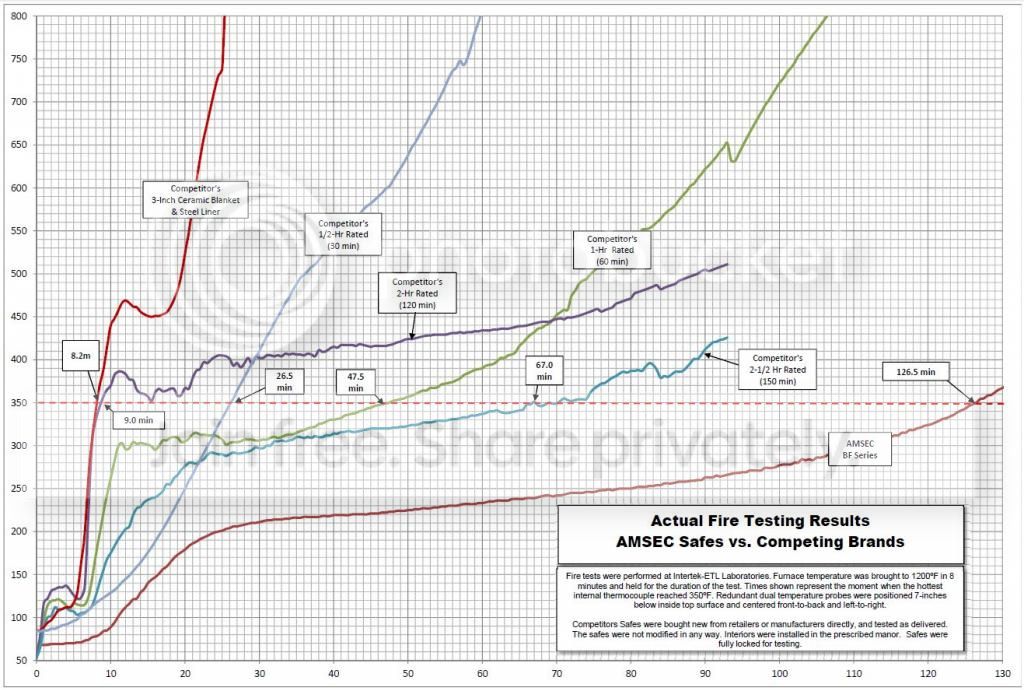
Yep, that's chump change for a safe company, like 6 or 7 safes sold to pay for the test. Sturdy had a group buy awhile back that was around $80k. And that's just one group buy from members of one California gun forum. They are not a tiny company working out of garage that can't afford a $10k test to back up their ridiculous claims. That's a bunch of BS. Here's the testing results of a safe with ceramic insulation: http://i1363.photobucket.com/albums/r703/TheSafeGuy/FireTests2_zps5f6bc9ec.jpg Quoted:
Quoted:
So less than $10,000. Seems like a no-brainer for a company who's doing a few million dollars (or much more in some cases) a year in sales. A small drop in the bucket to prove how superior your product is. Yep, that's chump change for a safe company, like 6 or 7 safes sold to pay for the test. Sturdy had a group buy awhile back that was around $80k. And that's just one group buy from members of one California gun forum. They are not a tiny company working out of garage that can't afford a $10k test to back up their ridiculous claims. That's a bunch of BS. Here's the testing results of a safe with ceramic insulation: http://i1363.photobucket.com/albums/r703/TheSafeGuy/FireTests2_zps5f6bc9ec.jpg I'm glad you posted the graph turnip because I really didn't want to spend the time linking to it. I know you don't have much experience in this sort of stuff but don't you think it's odd that the 'competitors' safes' have erratic patterns in their temperature traces but the Amsec BF has a nice smooth curve? Also, the temperature curves from the competitors show endothermic reactions (absorbing energy) at some atypical temperature levels. So what endothermic reaction would be occurring in a passively lined safe? ... the answer is none (the door seal reaction in negligible). |
|
Quoted:
I'm glad you posted the graph turnip because I really didn't want to spend the time linking to it. I know you don't have much experience in this sort of stuff but don't you think it's odd that the 'competitors' safes' have erratic patterns in their temperature traces but the Amsec BF has a nice smooth curve? Also, the temperature curves from the competitors show endothermic reactions (absorbing energy) at some atypical temperature levels. So what endothermic reaction would be occurring in a passively lined safe? ... the answer is none (the door seal reaction in negligible). I'm always taken back by your random assumptions. The steam generation in all of those safes with drywall liners is from an endothermic reaction. Sorry to say, the ceramic liner has no reactive response, hence a far more rapid rise. The ceramic is subject to straightforward heat transfer without any regulating system. Just as I predicted in our first discussions more than 2 years ago, only then I was conservatively estimating a failure in less than 20 minutes. The real failure point at 8 minutes is pretty close to the mathematical model that was presented based on conventional heat transfer computations. After dozens of REAL safe fire tests, I can tell you with complete confidence that you know nothing about what those graphs lines represent Rocky. Here is a hint... wood construction interior. Now, what are the early combustion components of wood before it flashes into flames? Notice how that inflection is right around the flash point of wood? Did you know that wood is a Hygroscopic material? Nuff said. The smooth nature of the BF curve is the intended result of the BF technology. If you think about it a little more, the composite fill and steel liner should make it apparent that the BF curve is just as it should be. That is the result of sound engineering R&D, with a lot of expensive testing. I'm only sorry I can't explain everything you see in those fire curves. That would educate competitors far too much. Every blip and inflection has a root cause. We are only sharing the data from one key location in the safe, which is the commonly accepted point of measure. The other probe locations that we fit in every safe that you can't see shape a complete tale of the events during the fire testing. Spend 27 years doing fire safe tests, you might understand what you see. |
|
Quoted:
In truth, high temperature fires as occur in an actual burndown have intense radiant heat which is not being tested in these furnace tests. The charts posted by the competitor of Sturdy showed that his cast design had a problem with radiant heat as shown from his very own charts. Ceramic fiber is an excellent radiant heat shield on the other hand so lets see him put his safe next to the Sturdy he bought and burn down a structure and see how the results turn out. First, the material in a lined safe is not exposed to the IR energy forces directly from the furnace. The value that a low emissivity material offers is not a factor unless it is exposed to the radiant source as the receiving exposure surface. So, if you want o wrap the outside of your safe, you may enjoy a very small improvement in thermal performance. Last time I checked, nobody is putting the insulation on the outside. Second, we have conducted thorough testing to measure the impact of Infra-Red energy (radiant) exposure as a part of the energy exposure profile. We completely understand the role played by radiant energy, which if you will recall, you were ignoring in previous discussions. Most test furnaces are lined with the same ceramic fiber insulation used in the safe type in question. The UL furnace, on the other hand, is lined with refractory brick. That brick heats to furnace temperatures, and becomes a secondary energy source, showering the test specimen with additional radiant energy. The gypsum panel or wood walls of homes don't typically do that, so it's an added energy force that is not found in the real world most of the time. It is harder to pass a fire test in the UL furnace, that is indeed true. I have data from parallel testing where the exact same safe was tested in both furnace types, and there is a difference, but I can't share specifics. Suffice it to say, we are talking about a "standardized" test, where radiant energy was NOT a significant energy transfer mode. To fully debunk this line of thinking requires deeper discussion on how a fire safe works, and I'm not willing to share that much knowledge for fear of educating competitors. In any case, at the violent levels of energy transfer in a home fire or furnace, the emissivity of the material is trivial. I have no reason to lie about that fact. If it were an attribute that made things significantly better, it would be my job as an engineer to exploit that property and use it in our safe designs... we don't. This is a simple case of heat transfer, as the thermodynamic formulas accurately predict the real life performance with very little deviation due to conditions that are ignored in the thermal model. There is no magic or mystery. Heat Transfer is heat transfer, whether it be in a safe or a Space Shuttle. The math and the physical reality are all the same. There is no disparity. You can believe what you see in those graphs. There is no attempt to deceive. |
|
Pretty interesting stuff. I do agree that the poured insulation would be a better fire proofing system. I seriously considered getting the amsec bf series. That was my first choice of safe from the beginning. The weight of over a 1000 pounds has made it a tough choice though. The cost does not put me off its the weight.
On the graph test shown above I only wish I knew how much ceramic blanket was in stalled in the safe tested and type, steel thickness and so on. Hopefully it was not a wool, because a natural wool would not work as well. In all reality sturdy should take the plunge and spend the 10gs and do the test. If their fireproofing does work the way they want it to I know the return on investment would be there. I for one would of already made the purchase and I'm sure many others would do the same. Or sturdy should take one of their fireproof safes and take that sucker out back and make a fire around 1200 to 1500 degrees and let it cook for us to see how she does. If it was my company I would so I could add the video to one of study's great informational videos. But who knows, maybe they did and it got burnt. Knowing the fire protection works and seeing it work is an important part of the equation when figuring which safe to buy. Burn a safe sturdy.. |
|
Quoted:
Knowing the fire protection works and seeing it work is an important part of the equation when figuring which safe to buy. Burn a safe sturdy.. How do you know that they haven't? Just because they don't publish something doesn't mean the information is not known. Escalating commitment to a failing course of action. The sturdy would be great for smoker conversion. Best insulation in the biz. |
|
Quoted:
Pretty interesting stuff. I do agree that the poured insulation would be a better fire proofing system. I seriously considered getting the amsec bf series. That was my first choice of safe from the beginning. The weight of over a 1000 pounds has made it a tough choice though. The cost does not put me off its the weight. On the graph test shown above I only wish I knew how much ceramic blanket was in stalled in the safe tested and type, steel thickness and so on. Hopefully it was not a wool, because a natural wool would not work as well. In all reality sturdy should take the plunge and spend the 10gs and do the test. If their fireproofing does work the way they want it to I know the return on investment would be there. I for one would of already made the purchase and I'm sure many others would do the same. Or sturdy should take one of their fireproof safes and take that sucker out back and make a fire around 1200 to 1500 degrees and let it cook for us to see how she does. If it was my company I would so I could add the video to one of study's great informational videos. But who knows, maybe they did and it got burnt. Knowing the fire protection works and seeing it work is an important part of the equation when figuring which safe to buy. Burn a safe sturdy.. Optimal, I spoke with Terry on the phone years ago about their fire testing. Terry said that they would make large bonfires with their safes buried within so that the safes were exposed to intense direct fire heating which safes tested in furnaces don't see including fire endurance tests conducted by UL. I agree with you that it would be great to see some more informational videos by Sturdy but this time some comparing their design against the competition. Personally, I'd like to see how quick they pry open the AMSEC BF; a Safetech posted photos of the bolt support (or lack there of) and I don't think the design would hold up too long. Next video would be to put the AMSEC BF and the fire lined Sturdy along side each other in one of the bonfires Terry said that they used for designing their safes and see how the two designs hold up in a real fire test. They may also wish to invite TSG to witness the testing. Just my two cents as an outsider as that would be a big expense for a small company but I think that the attacks done by AMSEC recently on their company are impacting their sales more than they may realize. A lot of people discount this category of safe since a TL rated safe is superior in security and UL fire rated safes are superior in fire protection but ... a high quality gun safe is really the best choice for most gun owners based on actual risk and they still can be moved and placed without costing a fortune. |
|
Quoted:
I'm always taken back by your random assumptions. The steam generation in all of those safes with drywall liners is from an endothermic reaction. Sorry to say, the ceramic liner has no reactive response, hence a far more rapid rise. The ceramic is subject to straightforward heat transfer without any regulating system. Just as I predicted in our first discussions more than 2 years ago, only then I was conservatively estimating a failure in less than 20 minutes. The real failure point at 8 minutes is pretty close to the mathematical model that was presented based on conventional heat transfer computations. Quoted:
Quoted:
I'm glad you posted the graph turnip because I really didn't want to spend the time linking to it. I know you don't have much experience in this sort of stuff but don't you think it's odd that the 'competitors' safes' have erratic patterns in their temperature traces but the Amsec BF has a nice smooth curve? Also, the temperature curves from the competitors show endothermic reactions (absorbing energy) at some atypical temperature levels. So what endothermic reaction would be occurring in a passively lined safe? ... the answer is none (the door seal reaction in negligible). I'm always taken back by your random assumptions. The steam generation in all of those safes with drywall liners is from an endothermic reaction. Sorry to say, the ceramic liner has no reactive response, hence a far more rapid rise. The ceramic is subject to straightforward heat transfer without any regulating system. Just as I predicted in our first discussions more than 2 years ago, only then I was conservatively estimating a failure in less than 20 minutes. The real failure point at 8 minutes is pretty close to the mathematical model that was presented based on conventional heat transfer computations. The phase change to steam would hold the temperature at around a constant level in the low to mid 200F range would it not? What's with the crazy temperature swings going on in your tests? And yes ceramic liners have no reactive response so why is there one in your graph? After dozens of REAL safe fire tests, I can tell you with complete confidence that you know nothing about what those graphs lines represent Rocky. Here is a hint... wood construction interior. Now, what are the early combustion components of wood before it flashes into flames? Notice how that inflection is right around the flash point of wood? Did you know that wood is a Hygroscopic material? Nuff said. After the hundreds if not thousands of load surveys and furnace qualification testing that I have reviewed in my many years in industry I'm pretty sure I know what happened in your testing. You did not properly shield the thermocouple wires from radiant heat, emf noise or isolate the wires from exchanging heat with attached surfaces while trying to measure the very weak signal given by measuring the temperature of a gas (I.e., air). By not taking the most basic safeguards to ensure an adequate temperature gradient in the wires results in data that is bogus. The smooth nature of the BF curve is the intended result of the BF technology. If you think about it a little more, the composite fill and steel liner should make it apparent that the BF curve is just as it should be. That is the result of sound engineering R&D, with a lot of expensive testing. I'm only sorry I can't explain everything you see in those fire curves. That would educate competitors far too much. Every blip and inflection has a root cause. We are only sharing the data from one key location in the safe, which is the commonly accepted point of measure. The other probe locations that we fit in every safe that you can't see shape a complete tale of the events during the fire testing. Spend 27 years doing fire safe tests, you might understand what you see. I have seen and saved your original test and the temperature trace from the thermocouple mounted at the upper side wall on your safe didn't look so smooth ... why as I mentioned to you shortly after you posted it that you likely have radiant heat contribution from an open burner in the furnace. Funny how after the temperature finished ramping up the the 1200F setpoint and the burners ramped down or shut off that the radiant heat impact stopped, unfortunately the flames don't stop in an actual fire after a temperature level is reached. |
|
Quoted:
First, the material in a lined safe is not exposed to the IR energy forces directly from the furnace. The value that a low emissivity material offers is not a factor unless it is exposed to the radiant source as the receiving exposure surface. So, if you want o wrap the outside of your safe, you may enjoy a very small improvement in thermal performance. Last time I checked, nobody is putting the insulation on the outside. Quoted:
Quoted:
In truth, high temperature fires as occur in an actual burndown have intense radiant heat which is not being tested in these furnace tests. The charts posted by the competitor of Sturdy showed that his cast design had a problem with radiant heat as shown from his very own charts. Ceramic fiber is an excellent radiant heat shield on the other hand so lets see him put his safe next to the Sturdy he bought and burn down a structure and see how the results turn out. First, the material in a lined safe is not exposed to the IR energy forces directly from the furnace. The value that a low emissivity material offers is not a factor unless it is exposed to the radiant source as the receiving exposure surface. So, if you want o wrap the outside of your safe, you may enjoy a very small improvement in thermal performance. Last time I checked, nobody is putting the insulation on the outside. True it's not exposed directly but when there is a thin layer of material such as a thin sheet of steel with a burned black surface that readily absorbs radiant heat the same sheet of unpolished oxidized steel with a relatively high emissivity value in the .5 to .8 range will readily be pushing radiant heat into the insulation layer of the safe. Second, we have conducted thorough testing to measure the impact of Infra-Red energy (radiant) exposure as a part of the energy exposure profile. We completely understand the role played by radiant energy, which if you will recall, you were ignoring in previous discussions. Most test furnaces are lined with the same ceramic fiber insulation used in the safe type in question. The UL furnace, on the other hand, is lined with refractory brick. That brick heats to furnace temperatures, and becomes a secondary energy source, showering the test specimen with additional radiant energy. The gypsum panel or wood walls of homes don't typically do that, so it's an added energy force that is not found in the real world most of the time. It is harder to pass a fire test in the UL furnace, that is indeed true. I have data from parallel testing where the exact same safe was tested in both furnace types, and there is a difference, but I can't share specifics. Suffice it to say, we are talking about a "standardized" test, where radiant energy was NOT a significant energy transfer mode. The radiant heat that's increasing the surface temperature of the safe is coming from the open flame and whatever radiant heat that is coming off the brick by comparison is minimal. Remember radiant heat transfer increases to the fourth power with delta temperature so if the refractory brick on the furnace wall is at about the same temperature as the surface of the safe there will be little radiant heat transfer. To fully debunk this line of thinking requires deeper discussion on how a fire safe works, and I'm not willing to share that much knowledge for fear of educating competitors. In any case, at the violent levels of energy transfer in a home fire or furnace, the emissivity of the material is trivial. I have no reason to lie about that fact. If it were an attribute that made things significantly better, it would be my job as an engineer to exploit that property and use it in our safe designs... we don't. This is a simple case of heat transfer, as the thermodynamic formulas accurately predict the real life performance with very little deviation due to conditions that are ignored in the thermal model. There is no magic or mystery. Heat Transfer is heat transfer, whether it be in a safe or a Space Shuttle. The math and the physical reality are all the same. There is no disparity. You can believe what you see in those graphs. There is no attempt to deceive. I do agree, the emissivity of materials in a home or furnace are trivial. The radiant heat given off by an open flame is not and has far more impact on heat transfer than the other modes of heat transfer in a high temperature fire. |
|
Quoted:
Optimal, I spoke with Terry on the phone years ago about their fire testing. Terry said that they would make large bonfires with their safes buried within so that the safes were exposed to intense direct fire heating which safes tested in furnaces don't see including fire endurance tests conducted by UL. I agree with you that it would be great to see some more informational videos by Sturdy but this time some comparing their design against the competition. Personally, I'd like to see how quick they pry open the AMSEC BF; a Safetech posted photos of the bolt support (or lack there of) and I don't think the design would hold up too long. Next video would be to put the AMSEC BF and the fire lined Sturdy along side each other in one of the bonfires Terry said that they used for designing their safes and see how the two designs hold up in a real fire test. They may also wish to invite TSG to witness the testing. Just my two cents as an outsider as that would be a big expense for a small company but I think that the attacks done by AMSEC recently on their company are impacting their sales more than they may realize. A lot of people discount this category of safe since a TL rated safe is superior in security and UL fire rated safes are superior in fire protection but ... a high quality gun safe is really the best choice for most gun owners based on actual risk and they still can be moved and placed without costing a fortune. Quoted:
Quoted:
Pretty interesting stuff. I do agree that the poured insulation would be a better fire proofing system. I seriously considered getting the amsec bf series. That was my first choice of safe from the beginning. The weight of over a 1000 pounds has made it a tough choice though. The cost does not put me off its the weight. On the graph test shown above I only wish I knew how much ceramic blanket was in stalled in the safe tested and type, steel thickness and so on. Hopefully it was not a wool, because a natural wool would not work as well. In all reality sturdy should take the plunge and spend the 10gs and do the test. If their fireproofing does work the way they want it to I know the return on investment would be there. I for one would of already made the purchase and I'm sure many others would do the same. Or sturdy should take one of their fireproof safes and take that sucker out back and make a fire around 1200 to 1500 degrees and let it cook for us to see how she does. If it was my company I would so I could add the video to one of study's great informational videos. But who knows, maybe they did and it got burnt. Knowing the fire protection works and seeing it work is an important part of the equation when figuring which safe to buy. Burn a safe sturdy.. Optimal, I spoke with Terry on the phone years ago about their fire testing. Terry said that they would make large bonfires with their safes buried within so that the safes were exposed to intense direct fire heating which safes tested in furnaces don't see including fire endurance tests conducted by UL. I agree with you that it would be great to see some more informational videos by Sturdy but this time some comparing their design against the competition. Personally, I'd like to see how quick they pry open the AMSEC BF; a Safetech posted photos of the bolt support (or lack there of) and I don't think the design would hold up too long. Next video would be to put the AMSEC BF and the fire lined Sturdy along side each other in one of the bonfires Terry said that they used for designing their safes and see how the two designs hold up in a real fire test. They may also wish to invite TSG to witness the testing. Just my two cents as an outsider as that would be a big expense for a small company but I think that the attacks done by AMSEC recently on their company are impacting their sales more than they may realize. A lot of people discount this category of safe since a TL rated safe is superior in security and UL fire rated safes are superior in fire protection but ... a high quality gun safe is really the best choice for most gun owners based on actual risk and they still can be moved and placed without costing a fortune. Bonfires seem like a pretty scientific way to test a safe. What is the temperature of the average bonfire? Do different woods burn at different temperatures? What wood does sturdy use in these tests? You actually think that you can reproduce the same conditions bonfire to bonfire? You are harping on trying to pick problems with Amsecs controlled study and in the next paragraph are saying a bonfire is a viable way to test a safe? You have to be joking. Are you joking? Do you believe the stuff you are posting here? Do you work for Sturdy? Seriously I want to know. |
|
Quoted:
Bonfires seem like a pretty scientific way to test a safe. What is the temperature of the average bonfire? Do different woods burn at different temperatures? What wood does sturdy use in these tests? You actually think that you can reproduce the same conditions bonfire to bonfire? You are harping on trying to pick problems with Amsecs controlled study and in the next paragraph are saying a bonfire is a viable way to test a safe? You have to be joking. Are you joking? Do you believe the stuff you are posting here? Do you work for Sturdy? Seriously I want to know. Vet, this is the same kind of random dialog we have had on this matter for a very long time. We have not singled out any one competitor, and we never acknowledged any brand names in relation to any competitive testing. There has been an ongoing debate on the merits of ceramic fiber insulation versus reactive steam generating liners in safes. This is not about the BF series safe, but all safes that utilize steam to regulate the internal temperature of the safe exposed to a fire as it compares to a simple passive insulator. Our friend refuses to accept that the mathematical thermodynamics and the supporting empirical test data prove that the active insulation provides superior fire protection. At no point was there any malice. We had this debate for over two years, and we had an opportunity to do a side-by-side test while we were testing other competing safes that use gypsum board insulation. If it weren't for this very debate here on ARFCOM, a ceramic fiber lined safe would have never found it's way to the furnace. I already knew it would not fair well. We dropped a few grand to prove it. We sell two product lines that have drywall liners. We have used this testing to refine the BF safe to extraordinary performance levels, but we have also conducted these tests to refine and improve our drywall equipped safes as well. While doing these tests, we needed to see how well our competitors performed. We saw ratings that simply can't meet the fire resistance claims based on how many layers of drywall they have. That proved to be true, and we shared that information. The performance of a fire safe is not just about the insulation, there are dozens of other factors in play that can kill even well insulated safes. The test environment is irrelevant, as long as the test is fair, equal and controlled. You will never provide any control or equality in a pile of burning wood, so that's just silly to suggest that would be a viable test program. ETL is a recognized testing agency, and they have been conducting certified fire testing on dozens of various types of fire rated products for decades. They know what they are doing, and they know how to properly set up test probes and assure an accurate measure of performance. There are no studies or evidence that furnace testing is significantly different from residential fires. In fact, based on regular reviews, photos and testimonials of safes surviving residential fires, the furnace testing is considerably more severe except in limited extreme cases where burn times are very long. The testing for fire rated products at UL , ETL and all other labs have always utilized open unshielded TCs inside because they react much faster and provide no buffer to hide thermal anomalies. If radiant heat influences the temperatures inside the safe, so does it impinge on the materials you intend to protect, so it's not something anyone should ignore. Heat damage of the contents will be from the combination of all heat transfer modes; convection, conduction and radiant exposure. Testing methods are not the issue in this "debate", but they are used as a red herring to confuse readers and cause doubt. |
|
To bad sturdy has not done and shown this test sooner. I may have to waite to make my purchase if this is in the pipe works.
A bonfire test would only be a joke if the temps were not over 1,100 degrees. But a nice fire will reach these temps easy so why not throw the 2 in for a safe roast with some good old contents in them. |
|
A bonfire test would only be a joke if the temps where not over 1,100 degrees. But a nice fire will reach these temps easy so why not throw the 2 in for a safe roast with some good old contents in them. The whole point of testing is to give you a known benchmark. For example, 1,200 degrees for 1 hour. Just because a safe survives a bonfire doesn't mean it will survive a house fire, because the two fires could be vastly different. |
|
Quoted:
The whole point of testing is to give you a known benchmark. For example, 1,200 degrees for 1 hour. Just because a safe survives a bonfire doesn't mean it will survive a house fire, because the two fires could be vastly different. Quoted:
A bonfire test would only be a joke if the temps where not over 1,100 degrees. But a nice fire will reach these temps easy so why not throw the 2 in for a safe roast with some good old contents in them. The whole point of testing is to give you a known benchmark. For example, 1,200 degrees for 1 hour. Just because a safe survives a bonfire doesn't mean it will survive a house fire, because the two fires could be vastly different. Any non-standardized test, when conducted on multiple products simultaneously, can give a reliable comparative result. IE, a bonfire with 2 safes in it would be an effective comparison between the 2 safes. It would provide not much more useful data outside of that. The reason standardized tests are developed is because it's too expensive to continuously retest the same products simultaneously in "real world tests" every time a new one is added. To be able to effectively gain comparative results from product to product a standardized test is needed. Standardized tests can be made similar to real-world conditions but it's a generally recognized fact in R&D that standardized tests will NEVER perfectly match real-world conditions. The test is only as good as it's creator. Generally industry recognized standards and standardized tests are created by non-biased panels of industry experts that take years to develop the standard and they continually review it for improvements, inaccuracies/fallacies, etc. I don't believe Amsec's testing standard matches that. Have they even openly published the standard and all the controls put in place so it can be peer reviewed? And while I give them a big thumbs-up for wanting to get the ball rolling on an industry standard I don't see it happening any time soon... Anyways, I digress. Real-world tests aren't the be-all, end-all test, neither are standardized tests. What gives? It is best to use standardized tests to develop the "comparative" results, but never to rely solely on standardized tests as the whole truth. Real world testing is also a crucial part of product testing. How many safe manufacturers are testing their products in real-world burn-downs? None that I am aware of are doing it in a scientific testing sort of way. Nobody is recording safe temps and/or home temps, they always come in at the back end (days after the fire has been out) and say, "Look, our safe protected the contents". Sure, while a single incident is evidence, it's also not the whole story... IMHO, fire-testing safes as it is done today, is all a bunch of BS that does nothing other than give you a "baseline idea" of how fire resistant the safe is. There is no absolute...and because of the lack of an industry standard you can't even effectively compare across brands. Even if Amsec's testing profile may be adopted by industry can it be relied upon to give us an accurate comparison to what would really happen in real life across brands? Or does the Amsec test somehow provide an advantage to their poured concrete liner that isn't necessarily reflected in real-world conditions? Those are all things that would need to be handled by the panel of non-biased experts. I'm curious to see what happens in the industry in the next couple decades... BTW, this is in no way meant to be offensive to Amsec. I'm only offering up facts based upon my use of industry standards in my job and my knowledge of how those standards are created. |
|
Sig,
I agree with everything you have said. I would like make you aware that there have been attempts to pull industry players together to develop a standard. The problem is that most of these safe companies are privately held family businesses. In fact, there is a group of four (or more) different safe companies that all came from the division and break-up from one original company in the Utah area. They are all related by a history of rather unhappy separations and rivalries. There is also a history of several companies, other than the Utah clan, having marketing and design disputes and differences for years. Sadly, the result is that the industry may never agree on a standardized test. There is a lot of animosity and distrust in this small industry. The test that we initiated is very simple. There is no known advantage for any design. We have worked with Intertek - ETL labs out of Elmendorf, Texas. They have been given the authorization to share our test program with anyone that cares to use it. It's important to recognize that furnaces are very different from one to the next, and that home-made furnaces can (and do) provide highly questionable results. It's also important to have an unbiased testing service that will apply consistent testing conditions and methods. We based the testing criteria on a few widely accepted parameters. 1. The curve follows the UL72 - ASTM E119 fire curve to the 1200º point, then levels and maintains 1200º thereafter. (Multiple furnace TCs are placed, and an average is used as the control measure. Failing probes are diregarded)
2. Testing setup and instrumentation methods follow UL72 guidelines. (this included the floor exit of all test leads, lead insulation and TC calibration)
3. Furnace Probes are shielded, and placed at the mid-elevation on all four sides of the test specimen(s). 4. Two redundant internal TC probes are placed 7 inches from the inside ceiling surface, and centered left-right and front-back in the internal space. (client may have other additional TCs installed at their discretion)
5. Failure and test termination occurs when either of the two test probes reach 350ºF. (TCs are consistently within 1-2 degree of each other)
There are lots of details covered by the UL72 standard, which should eliminate any debate about test configuration details. |
|
Quoted:
[span style='font-size: 9pt;'][span style='font-weight: bold;']Sig, I would like make you aware that there have been attempts to pull industry players together to develop a standard. The problem is that most of these safe companies are privately held family businesses. In fact, there is a group of four (or more) different safe companies that all came from the division and break-up from one original company in the Utah area. They are all related by a history of rather unhappy separations and rivalries. There is also a history of several companies, other than the Utah clan, having marketing and design disputes and differences for years. Sadly, the result is that the industry may never agree on a standardized test. There is a lot of animosity and distrust in this small industry. I certainly understand it's an uphill battle, which is why I stated I don't think it will happen. That being said, have you approached one of the big players in the testing/standards world like ASTM and tried to get them to lead the way? ASTM stood for "American Society for Testing and Materials" up until 2001, now it "doesn't stand for anything", they are just ASTM Intl. That is the whole reason they exist and I use ASTM standards on a regular basis. I think a lot of other manufacturers that are serious about proving their product is reliable may be a bit put-off by a single company leading the charge because they will always feel there is an ulterior motive. The same push by a national testing standards society/organization would have a bit more "neutral" feeling and may get a bit more traction from other companies. Think of it in terms of another industry, say the oil industry. If, in 1920 there were no standards and Shell went to Mobile and said, "Hey, we need to get together and standardize our product lines so people know they will get products tested to the same standards" Mobile may say, "Why are you coming to me? Certainly you feel it would be advantageous to your business so it must hurt mine". That may not necessarily be true, but it's the way it's perceived. BTW, that is how "Standard Oil" became a giant, they told the consumer that their oil products were consistent from batch to batch because they met "the standards". The consumer was all about a standardized product, the competitors to "Standard Oil" wanted nothing to do with standards, but eventually ASTM standards came about and now most manufacturers adhere to those standards in their fuel production/refining. |
|
Quoted:
I certainly understand it's an uphill battle, which is why I stated I don't think it will happen. That being said, have you approached one of the big players in the testing/standards world like ASTM and tried to get them to lead the way? ASTM stood for "American Society for Testing and Materials" up until 2001, now it "doesn't stand for anything", they are just ASTM Intl. That is the whole reason they exist and I use ASTM standards on a regular basis. I think a lot of other manufacturers that are serious about proving their product is reliable may be a bit put-off by a single company leading the charge because they will always feel there is an ulterior motive. The same push by a national testing standards society/organization would have a bit more "neutral" feeling and may get a bit more traction from other companies. Think of it in terms of another industry, say the oil industry. If, in 1920 there were no standards and Shell went to Mobile and said, "Hey, we need to get together and standardize our product lines so people know they will get products tested to the same standards" Mobile may say, "Why are you coming to me? Certainly you feel it would be advantageous to your business so it must hurt mine". That may not necessarily be true, but it's the way it's perceived. BTW, that is how "Standard Oil" became a giant, they told the consumer that their oil products were consistent from batch to batch because they met "the standards". The consumer was all about a standardized product, the competitors to "Standard Oil" wanted nothing to do with standards, but eventually ASTM standards came about and now most manufacturers adhere to those standards in their fuel production/refining. I am seated on an ASTM standards panel. We tried to get Residential Burglary Safe Standards advanced as an ASTM Standard, no interest. We were recruited to develop a standard for weapons storage for child protection, sponsored by the CPSC (Consumer Product Safety Commission). That standard fell to disarray after the initial handgun storage standard was published. That standard has never found it's way to any use nation wide. It was quite disappointing when so much work was invested. Participants will find little interest in another wasted effort. The panels that develop standards are made of industry specific panels, which include consumers, manufacturers, distributors, retailers, regulatory agencies and testing labs. The first thing that has to happen is interest and motive. In this industry, neither of those exist. Most of these family owned businesses don't want to spend money on things that don't make them money. Same goes for fire testing in general. It's an expense they don't value for a return. So, ASTM is mostly a dead end. To bring the industry to the table will require legislative forces on a national level. A hard attack on 2nd amendment rights might bring burglary standards to the national spotlight so that federal or state legislators can write laws and site a standard for storage compliance. We are prepared for that eventuality. But, there would be little chance of fire standards finding similar nation wide appeal. There is no green initiatives, child safety or other widely popular compelling interest in how a gunsafe survives a fire. |
Armory Sponsor