


Armory Sponsor


Posted: 8/8/2014 4:42:20 AM EDT
|
Hello i have some questions
My main one is about fire resistant intumescent paint. ive been trying to decide between a fire lined 36-27-72 sturdy safe and a 42-27-72 non fire lined safe as thats kind of my ballpark price range. I was considering using this intumescent paint on the outside to safe some money and get the bigger safe. My question is, has anyone tried this stuff before, or attempted what im thinking of doing? Is it possible to use it over paint, and is it also possible to then paint over it to give the safe a professional look instead of the flat white that seems to be the only option with it? Secondly, how hard would it be to fire line a sturdy safe? its just a god aweful price to add the fire liner, especially with the bigger one i think its almost $900 going off memory. I was thinking of maybe leaving the shelving where its at, and just putting insulation on the walls between the shelves, and on the ceiling/floor. That's the only way i can think to do it because if i insulate behind the shelves i would have to figuer out a way to remount them which im guessing would involve building a steel liner and welding it which sounds like a challenge. my other concern is that a home made liner could end up taking more space using some kind of insulating concrete seems like a quicker/easier way (pull the shelves, build a drywall box, cut hole, fill, done) but i don't know where to buy it or how to make it anyways im sure lots of you have been over this delema yourself and can shed some light on all of this thanks |
|
Quoted:
Keep in mind I'm talking out my ass here..............why not line the inside with a couple of layers of 5/8 firecode sheetrock ? Or maybe consider encasing the outside of the body and roof with a few layers of 5/8" x rated sheetrock and leave the interior original from the factory. I remember there was also a member here that had Sturdy put gaskets on the door of a non-fire rated safe; if Sturdy did that then you'd only have to worry about insulating the door since the body would be fire lined from the outside. |
|
ok but what about rust? thats why i wasn't really considering drywall for firelining, if its against the metal, won't that cause it to rust? especially on the outside since that will be harder to drop the humidity on.
Id be interested in seeing the thread on the fire paint not working, there's plenty of youtube videos showing how cardboard doesn't get burnt on the backside, but that is in the "open air" vs being a "box" so the test i admit is flawed, but id love to see someone testing it. If im not mistaken there is some kind of foam or something that does the exact same thing, i could do the drywall on the outside then spray that foam ontop of it. But the problem i see with building a box on the outside of the safe is that, well for me it would be easiest with the safe in place, but then i have move it around alot which i won't be able to do alone. Otherwise id have to do some major planning ahead, and if my measurements are off then the safe won't fit, or it will but they won't be able to get it inside regardless. I guess id need to just do the back wall and one side, then do the rest afterwords. But what about the bottom? fireboard would crumble from the weight, not to mention trap moisture under the safe, so i really havn't a clue what to do there. speaking of which, what do most of u do as far as putting something under the safe? ive read about hockey pucks but im not even sure what those are made of, id be afraid of them breaking or leaving 2 big of a gap for a crowbar to get under. which also brings me back to fireboard on the outside, as most people say butting against the wall helps protect it, with fireboard there will be a big gap to get one in there either to pry it from the wall, or other. anyone have thoughts on if i should use a golden rod, or silica? i kind of hate to drill a hole threw the safe as to me, it would seem that kind of makes it a bit more vunerable to fires. |
|
The thread I referenced dealt with a gypsum board retrofit inside the safe.
Intumescent paint should be listed with UL or registered with FM. That means it was tested under a published standard and met the acceptance criteria. The listing and standard number will be on the product and are often showcased by the manufacturer. If the acceptance criteria of that test meet your needs AND you can apply AND maintain the paint In a manner consistent with the manufacturers instructions and the tested configuration, then do it. However, if the product your considering is some Mickey Mouse Menards crap, steer clear. What type water supply is at your house? You could route a deluge nozzle or two. |
|
Quoted:
ok but what about rust? thats why i wasn't really considering drywall for firelining, if its against the metal, won't that cause it to rust? especially on the outside since that will be harder to drop the humidity on. Id be interested in seeing the thread on the fire paint not working, there's plenty of youtube videos showing how cardboard doesn't get burnt on the backside, but that is in the "open air" vs being a "box" so the test i admit is flawed, but id love to see someone testing it. If im not mistaken there is some kind of foam or something that does the exact same thing, i could do the drywall on the outside then spray that foam ontop of it. But the problem i see with building a box on the outside of the safe is that, well for me it would be easiest with the safe in place, but then i have move it around alot which i won't be able to do alone. Otherwise id have to do some major planning ahead, and if my measurements are off then the safe won't fit, or it will but they won't be able to get it inside regardless. I guess id need to just do the back wall and one side, then do the rest afterwords. But what about the bottom? fireboard would crumble from the weight, not to mention trap moisture under the safe, so i really havn't a clue what to do there. speaking of which, what do most of u do as far as putting something under the safe? ive read about hockey pucks but im not even sure what those are made of, id be afraid of them breaking or leaving 2 big of a gap for a crowbar to get under. which also brings me back to fireboard on the outside, as most people say butting against the wall helps protect it, with fireboard there will be a big gap to get one in there either to pry it from the wall, or other. anyone have thoughts on if i should use a golden rod, or silica? i kind of hate to drill a hole threw the safe as to me, it would seem that kind of makes it a bit more vunerable to fires. I have heard of corrosion issues related to Chinese made drywall due to high sulfur content but a higher quality domestically made drywall shouldn't in itself create a corrosion issue especially when laying against a painted surface. If you are planning to put your safe in a corner of a room (best place) you can as you've suggested have the one side and back done in advance. Once the safe is in place, you can put the opposing side and roof on after if has been bolted down. TheSafeGuy mentioned that in their testing that it was unnecessary to insulate the floor but I suppose if you are installing on a second level of your home that some insulation could be needed. I have my safe sitting on aluminum rods. I used them to roll the safes into place then bolted them down once they were where I needed them. What's nice about the aluminum rod is aluminum is lower on the nobility scale than steel so in a corrosive environment (E.g., water and road salt on a garage floor) the aluminum will be a sacrificial anode to the steel and will corrode first. The rods will also make it much easier to move the safes when the time comes. Sturdy pre-drills their safes for bolt down and for power access should you wish to bolt it down (highly recommended) put in lighting, or heat. I have LED rope lights in my safes that are always on; the LEDs will likely last 25 years and also will put in a small amount of heat to the safes to raise the internal temperature slightly to keep above the dew point of the ambient air during the summer months when I'm opening my safes frequently. Where I live in Northern NY and due to my safes being in my garage the temperature can swing huge amounts in 24 hours so desiccant really is the only reliable long term solution to keep condensation from occuring within the safes. Rolling Safes into place with Aluminum Rods 
Leveling, installing power and bolting down 
Rope Lights Installed fire lined safe 
As installed, I have been planning on encasing both safes with drywall but I haven't got around to it. The intumesciant paint sounds like a good idea for the unprotected exposed side or at least for the non-firelined safe since it already has been repainted. 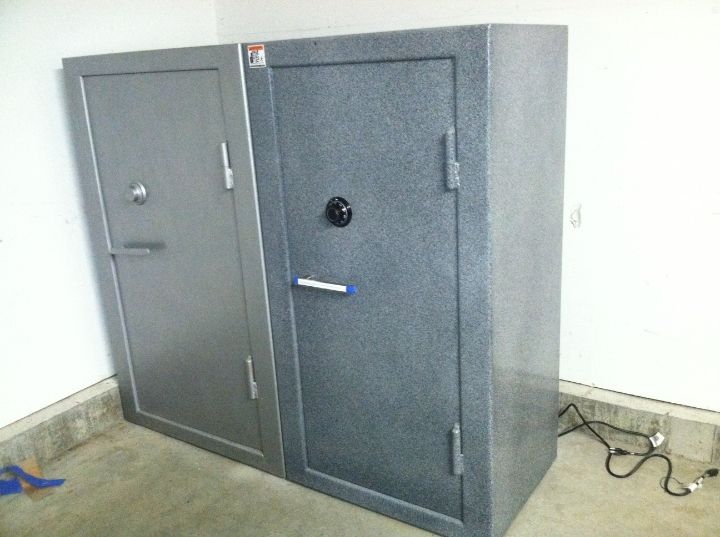
Whatever you decide, keep us updated. It's always helpful to hear others ideas and solutions. |
|
nice information thanks. Those rods look nice for moving but wouldn't it be a pain to get them centered on each side as well as avoiding drilling threw them during the bolt down process? What did you use to level the safe, as in, what did u stick under it besides the rods? lastly, doesn't 2 different metals touching cause corrosion? Im fairly certain it does, i read about that when i was watercooling my computer as the radiator has brass i think, and the cooling blocks would be another metal, and then some people would put silver coils in the water lines to kill bacteria but again that would cause issues because of different metals. The paint on the bottom of the safe would be of some protection but 1000+lb's rolling off shipping pallets, rolling around on rods surely puts a few scratches in there
i still can't find that thread of "thesafeguy" i tried searching but the "auther" is dimmed out and i can't type in that box. If someone could link it that would be great. Otherwise im curious how u would do the dry wall on the outside. I would need to mount the drywall to something i assume which begs the question, what to use, then after that is the issue of how to mount it. I could put the mounting hardware next to the safe and the drywall ontop of that, but then there would be a gap between the drywall and the safe which may or may not affect fire protection. or i could sandwitch the hardware between the drywall, or outside of it. How many bolt down holes did your safe come with? i think i read you have to ask sturdy to drill 2 extra to have 4 holes, is that needed or just overly cautious people doing that? |
| oh could u tell me what the humidity is like in that non fire lined safe without a golden rod? If i do the dry wall thing on the outside of the safe, im thinking i would most likely avoid drilling the hold for one, as having a hole i feel would greatly impact it in a fire being non lined for sure, and with the dry wall, running the cord out, i dunno kinda giving me a headache lol. So i was hoping to get an idea from someone how often id have to change my silica out in a non fire lined safe. If i have to recharge them every week i would go insane, even monthly would get tiresome over the long haul |
|
Quoted:
nice information thanks. Those rods look nice for moving but wouldn't it be a pain to get them centered on each side as well as avoiding drilling threw them during the bolt down process? What did you use to level the safe, as in, what did u stick under it besides the rods? lastly, doesn't 2 different metals touching cause corrosion? Im fairly certain it does, i read about that when i was watercooling my computer as the radiator has brass i think, and the cooling blocks would be another metal, and then some people would put silver coils in the water lines to kill bacteria but again that would cause issues because of different metals. The paint on the bottom of the safe would be of some protection but 1000+lb's rolling off shipping pallets, rolling around on rods surely puts a few scratches in there i still can't find that thread of "thesafeguy" i tried searching but the "auther" is dimmed out and i can't type in that box. If someone could link it that would be great. Otherwise im curious how u would do the dry wall on the outside. I would need to mount the drywall to something i assume which begs the question, what to use, then after that is the issue of how to mount it. I could put the mounting hardware next to the safe and the drywall ontop of that, but then there would be a gap between the drywall and the safe which may or may not affect fire protection. or i could sandwitch the hardware between the drywall, or outside of it. How many bolt down holes did your safe come with? i think i read you have to ask sturdy to drill 2 extra to have 4 holes, is that needed or just overly cautious people doing that? Actually the aluminum rods made the move so easy that I couldn't imagine not using them in the future if I'm moving the safes on a concrete floor. I was able to move both safes by myself with the exception of having my wife pull away the pallet on the new safe once I moved it off. By just using a 3 foot pry bar, I was able to lift the safes up enough to reposition the rods to get the safes to go in any direction I needed them to go; the whole move was less than 30 minutes. 
You are right that all metal will corrode in the presence of another dissimilar metal. The good thing here is that aluminum is lower on the nobility scale so it becomes a sacrificial anode to the steel and will corrode first. Power line towers, water system piping, marine structures are commonly protected from corrosion by galvanic protection which in most cases is accomplished by using a sacrificial metal that will corrode first. Leveling the two safes was accomplished by just putting a couple nuts in the corner; I had several different sizes before I started and was able to push the one safe out of the way, lift the other safe with the pry bar then substitute different sized fasteners until the two safes were level. For one safe, it probably won't be an issue. You might try using 1x1's and create a frame to fasten the drywall to to create panels that you could use to encase your safe. It might also make it easier to dissemble the panels are re-use them if you ever decide to move. |
Armory Sponsor