


Armory Sponsor



Posted: 4/3/2016 5:27:37 PM EDT
[Last Edit: GHPorter][Edited]
|
Part 1 Updated 9April2016 1030 CDT
Most of us use standard-sized stainless steel pins when wet tumbling. They work great, they are easy to handle, and they are easy to get. But there are some drawbacks with pins, such as off-sized pins sticking in flash holes and even regular pins bridging across the insides of some cases. Another potential problem is that maybe some pins might stay inside cases all the way to the loading stage, and you wind up with steel pins inside your round. So far there is no evidence that this is necessarily a disaster waiting to happen, but it's enough of a concern that lazyengineer came up with a way to detect magnetic materials inside a loaded round, which he describes in detail in this thread. Standard pins are 0.047" in diameter by 0.255" long, and are moderately magnetic. They are used throughout the metal parts production industry to "burnish" parts. They're used to smooth surfaces, break edges, and generally polish stuff. Jewelers use a similar grade to polish jewelry in a magnetically driven device called a "pin finisher." Here's the problem though: most US-made brass has flash holes of about 0.080" in diameter. Two slightly undersized pins could jam together in a flash hole, and two normal pins could stick in an oversized flash hole. Not good, but fixable. The more difficult issue is the length - small diameter case necks, like those in various .22 caliber rifle rounds, can catch and hold short pins, and cases like .30 Carbine can have pins bridge across the case inside near the case web. That IS a problem, and it requires visually checking every case. In lazyengineer's thread, zw123 pointed out a different product: stainless steel "chips," sold by a firm called Southern Shine Tumblers. Southern Shine's only web presence that I can find is their Facebook page. These chips are small, random-shaped, and it seems there's no way they can stick in flash holes or bridge across the insides of cases. In other words, they should be the "solution" to both real and potential problems with stainless pins. Update 9Apr16 Here's a visual comparison between standard pins and Southern Shine's "chips." As you can see, the chips are tiny, and sort of "crescent" shaped. There's no way they can stick in a flash hole, nor can they bridge across a primer pocket or case neck/body. 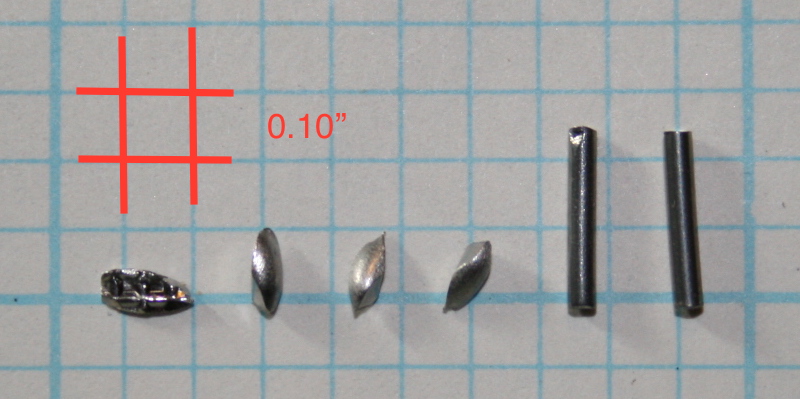
|
"--you can't conquer a free man; the most you can do is kill him."
Heinlein
NRA Life Member
Glock Certified Armorer
Certified AR15 Armorer
Certified M1911 Armorer
Heinlein
NRA Life Member
Glock Certified Armorer
Certified AR15 Armorer
Certified M1911 Armorer
|
Part 2 Updated 9Apr2016 1030 CDT
I ordered 10 pounds of Southern Shine's chip media, and it arrived this past week. I started experimenting with it today, and I'll post detailed results here. I have no pictures yet, since I'm still running test loads in my Thumler's Model B, but so far I see that the chip media cleans brass very nicely - about the same as pins - and there has been absolutely zero issue with chips sticking in flash holes or bridging across cases. My first load was what I consider "challenging" for wet tumbling: a mix of 300 Blackout, .30 Carbine, and .32 Auto brass. All the flash holes were very clean, no media stuck anywhere in the cases, and there is much bling inside and out. However, there were a few details about this media that will take me some getting used to. First, it was a challenge to figure out how much of the stuff was "5 pounds of media," since my postal scale maxes out as far too small a weight (those cheap a$$ Chinese "pocket" digital scales suck for hand loading, but they work fine for weighing letters and small parcels), and my digital bathroom scale won't even notice a weight less than about 12 pounds...and it's definitely NOT a "trickling-friendly" scale! I wound up splitting the 10 pounds by eyeball and heft, and I think I did a fair job of it. Chips flow much like coarse sand, which makes it easier to move them around than pins. And they don't bounce like pins do, so basically when you pour them somewhere they stay there. After realizing that I'd left my pins in the tumbler after my last run, and that I'd forgotten to prop the lid open, I removed 5 pounds of wet pins (a frustrating chore) and gave them a spa day on a baking pan in the oven, so they're now all dry and clean. The chips cleaned the brass very nicely, as I mentioned earlier. However, I had a few issues separating them from the brass that were quite different from separating pins from brass. Firstly, the chips are smaller - and weigh less per piece - than pins. I think in the burnishing process they make up for having less mass by having more "sharp" edges and points. But this also means that the chips stick to wet brass better than pins do. I separate brass and wet media by first pouring the contents of the tumbler into an old tee shirt lining a plastic colander in the sink, where I rinse the stuff to knock down the suds from the Dawn. It works fine with chips, but the shirt seemed to drain much more slowly, maybe because the chips covered up a lot of the bottom, where water should drain through. I'll have to work on keeping that from happening, maybe by changing the shape of the bottom of the colander. Once I rinse the brass/media to knock down the suds, I use the tee shirt to transfer the whole mess to my Berry's rotary media separator. Here's another "detail": chips stick to the tee shirt a LOT more than pins do, and they are so light, it's harder to get them off the shirt (and keep them from going everywhere). The media separator worked well, but I need to work on draining the brass better, because it was still quite wet when I got it in the separator, and those chips liked to stick very well to wet brass. And the separator basket, too. Further, I will probably need to be MUCH MORE vigorous in operating the separator because of how light the stuff is. From the separator, I dump the brass on an old towel to dry the outsides of the cases. Since there was still chip media stuck to the wet cases, there was quite a bit of it to collect up from the towel. I used a large (1" X 2" X 1/4"), rectangular ceramic magnet wrapped in waxed paper to collect the little buggers - the waxed paper helps me separate stuff from the magnet. Here I learned that the chips seem to be less strongly magnetic than pins are. When you ask a metals guy about "magnetic stainless" steels, he'll tell you that "higher grades" of stainless are less magnetic (higher chrome and nickel content is usually the reason), while "really good" (annealed austenic) stainless alloys are non-magnetic. Which kinda says the chips are either more corrosion resistant, or that their tiny mass just makes it look like they're less magnetic. I also noted that the chips had not been as "clean" as they first seemed, since there was some nonmetallic debris left in my colander and separator. No problem but just enough for me to notice. I dry my brass in a Harbor Freight food dehydrator. It works well, is compatible with other kitchen operations (it doesn't stink things up, etc.), and it doesn't take up much space. Once dried, my pin-tumbled brass sometimes surprises me with a pin or two, either still in a case or fallen inside the dehydrator. So far I have not found any of the chip media in the dehydrator. Update 9Apr16 I had a chance to finish the second load, all .45 ACP cases, with a mix of LP and SP brass. Pictures are below. This time, I made sure I didn't overdo the Dawn, so the cases rinsed more cleanly, which let the chips separate much better. I also drained the cases with the tee shirt in a medium sized deep fryer basket, which allowed everything to drain much better, also aiding chip separation. Sadly, I went overboard with the Lemishine because I don't yet have a scoop to use with it - my container is kinda full and when I tipped it to fill my customary .45 case, it overflowed. A lot. So my .45 brass is pink in places, but it's sure shiny! I will add pictures when I have time to take them and format them appropriately. At this point in time, it looks like chips are an overall positive alternative to pins. Here are a couple of pictures of primer pockets after wet tumbling with chips. The flash holes are NOT off-center, that's just the angle the cases are at with my macro lens. Also note the difference in flash hole sizes in the .45 cases - not sure what's up with the difference from brand to brand, but they are clearly very clean. 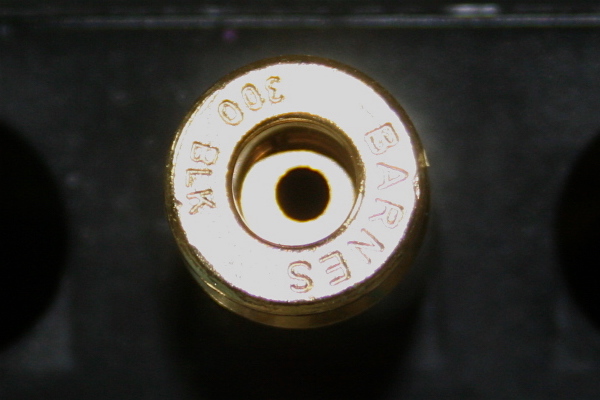
This is a Barnes 300 Blackout case. The pocket and headstamp are completely clean. 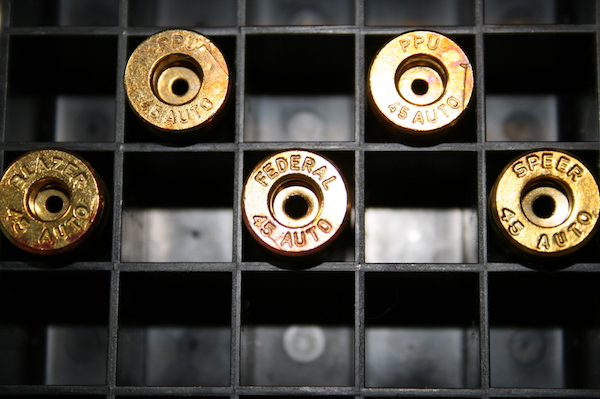
These are .45 ACP cases, with some small primer and some large primer. The PPU and Blazer SP cases have a smaller flash hole, which looks almost drilled, compared to the Federal and Speer cases with what look like punched flash holes. No difference in cleaning though. 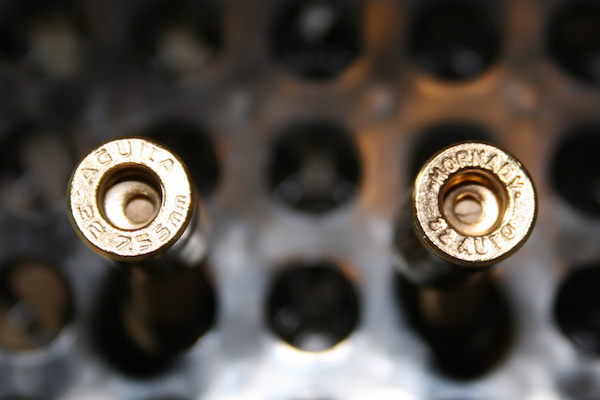
And these are .32 ACP cases. These little buggers gave me fits using pins, but there wasn't a single issue among them, nor the .30 Carbine cases I tumbled with them. Questions? Fire away! |
"--you can't conquer a free man; the most you can do is kill him."
Heinlein
NRA Life Member
Glock Certified Armorer
Certified AR15 Armorer
Certified M1911 Armorer
Heinlein
NRA Life Member
Glock Certified Armorer
Certified AR15 Armorer
Certified M1911 Armorer

Global Warming Hoax Skeptic before it was cool
Joined:
Jun 2007
Posts:
40008
EE: 100% (1)
 WA, USA

|
I have been interested in the chips since I first heard them mentioned. Thank you for being the responsive guinea pig.
I have suggestion for your sorting process that might make it easier. Tumbler is done. Dump nasty water off into a 5 gallon bucket. Try not to let any media or brass flow into bucket. Put empty 2 gallon pail over tumbler. Dump media and brass into pail by inverting them while still nested together. Rinse media and brass in pail. Pour water off into 5 gallon bucket. Repeat rinse as needed. 3 works for me. Dump media into separator. Vigorously spin. Move brass into Salad Spinner (< $20 at Walmart), spin water off and catch any remaining media. Dry brass. Using magnet on a stick, search dump bucket for media. |
|
Thanks, dryflash3. I'll keep my eyes on it, and hopefully I'll have some pictures to add soon.
Snowshooter, I have a couple of ideas for better rinsing and less chance of media loss, but I haven't had a chance to play with them yet. That seems to be the key to reducing the stuff sticking to cases, and I am fairly sure these chips will be a problem if they go down a domestic drain. Basically, I plan to rinse more effectively, and I'll need a way to control the contents while I'm pouring off the water. I'm going to have to tinker a bit to figure out what kind of material will catch these chips. They are VERY small, and I don't yet know how well they'll do with various kinds of mesh. I have synthetic window screen in two grades, which I plan to try. The biggest problem I have isn't figuring out what will catch stuff and let water pass, it's how I'm going to USE the stuff. |
"--you can't conquer a free man; the most you can do is kill him."
Heinlein
NRA Life Member
Glock Certified Armorer
Certified AR15 Armorer
Certified M1911 Armorer
Heinlein
NRA Life Member
Glock Certified Armorer
Certified AR15 Armorer
Certified M1911 Armorer

|
Updated Part 1 and Part 2 with pictures and some observations.
So far, I haven't found a real down side to the chips, even though my techniques and processes need some tweaks when using them. On the other hand, except for some specific situations, there isn't (yet, anyway) anything that says I should give up the pins. The exceptions: mixed SP/LP brass, and/or mixed flash hole size brass might benefit more from chips because of the variations in pocket and hole sizes; small cases like .30 Carbine and .32 ACP definitely benefit from using chips because they cannot stick, bridge or otherwise hose me over. 
Next, I'm going to work on more precise "head-to-head" comparisons between chips and pins for materials handling properties, including avoiding loss, media separation, etc. As I said, my shipment of chips wasn't "clean" by any definition, so I'm going to look at how clean/dirty the other half of the batch is, so I'm also going to assess just how dirty it is, and what to do to clean it before use. |
"--you can't conquer a free man; the most you can do is kill him."
Heinlein
NRA Life Member
Glock Certified Armorer
Certified AR15 Armorer
Certified M1911 Armorer
Heinlein
NRA Life Member
Glock Certified Armorer
Certified AR15 Armorer
Certified M1911 Armorer

|
Can I make a rinsing/separating suggestion?
I use the smaller Harbor Freight tumbler drums but it should work similarly for you. I pour off as much dirty water I can and then dump the brass and pins into my rotary media separator. Then I fill up the base of the media separator with water and spin. The pins don't stick to brass when they're in water. I drain off the dirty water and refill the media separator and spin/rinse one more time. The brass goes on to dry and I pour the water off and the pins all settle into the corner of the separator. Then I divide it and put it back into the drums. This way the pins and brass are both rinsed clean in one step. |
Life is about choices.
If you make a mistake once, it's a mistake.
You make the same mistake again, that's a choice.
If you make a mistake once, it's a mistake.
You make the same mistake again, that's a choice.

| Did you find that the separator was flinging any of the chips away from the bucket that they were supposed to fall into? I'm asking because I use the smaller of the two Dillon separator/tub combinations. When I rinse the cleaned cases, I do so in the separator while I am turning it. If I turn it too vigorously, but vigorously enough to dislodge most from the flash holes, a small number of the pins (I am still using pins) tend to get flung away into the lawn. That by itself is a trivial matter, but my wife's hens tend to eat them. So if the chips are less likely to get flung, they might be worth a try. |
NRA Life Member
|
My separator was NOT separating the media well - mostly because the brass was still wet, but not "under water" wet. My second batch, with the .45 cases, was much better because I got it to drain much better. That left the brass much drier, and the media came off of it much more easily.
I've resisted "underwater" media separation because I would still need to drain the water off of the media, and that's not the simplest thing to do, especially with this tiny stuff. I'm sure it works, as I've fished cases out of the tumbler and the media completely rinses off with just a "swish" of the case in the water. I just don't yet know if that's a process I'll want to work with. |
"--you can't conquer a free man; the most you can do is kill him."
Heinlein
NRA Life Member
Glock Certified Armorer
Certified AR15 Armorer
Certified M1911 Armorer
Heinlein
NRA Life Member
Glock Certified Armorer
Certified AR15 Armorer
Certified M1911 Armorer

|
When I separate my pins and brass, I use a colander which hangs on the edge of a bucket and hangs below into the bucket about 1/3rd of the way.
I take my drum with pins and brass, drain off excess dirty water while keeping pins and brass inside 2 or 3 times. Then I dump everything into the colander which is hanging inside the bucket. I then start rinsing the brass and pins while they are in the colander. The water and pins fall down into the bucket as I hand swish them around. After a minute or 2 the water level reaches the colander and I continue to fill the bucket until the colander is about half submerged. I shut off the water and hand swish the brass which is submerged in the water at this point. The above method completely separated my brass and pins within a few minutes and the pins simply fall out of the brass when it is under water. Then I lift the colander out, shake it a few times, then put the brass on a towel to dry excess water off and then put the brass in a cheap food dehydrator for 30 mins. In over 10000 cases, I've only ever found maybe 10 or 15 pins that made it onto the towel. I wouldn't bother with pins if I didn't have a way to separate brass from pins underwater. |
|
Originally Posted By GHPorter:
My separator was NOT separating the media well - mostly because the brass was still wet, but not "under water" wet. My second batch, with the .45 cases, was much better because I got it to drain much better. That left the brass much drier, and the media came off of it much more easily. I've resisted "underwater" media separation because I would still need to drain the water off of the media, and that's not the simplest thing to do, especially with this tiny stuff. I'm sure it works, as I've fished cases out of the tumbler and the media completely rinses off with just a "swish" of the case in the water. I just don't yet know if that's a process I'll want to work with. This is in line with my experience with pins. The rotating separator will not work as well unless it is in an excess of water. If the cases are just damp, or slightly wet, about 10% by visual estimate of the pins stay stuck inside or on the cases. |
NRA Life Member
|
I use a Lyman media separator which has the separator portion and the enclosed case. The bottom half of the case is deeper then the top half. It's sold in different colors and different name brands.
After wet tumbling I set the deeper bottom of the case in the sink and put the separator in place, open. I dump the contents of the wet tumbler drum into the separator. The dirty water and most pins fall through the separator into the case below. The brass stays in the separator. Then, I close the top off of the separator and spin it back and forth with enough effort to drop the remaining pins, but not so much it flings them - I could put the top on the case and spin it as hard as I want without loosing pins. Once the brass is separated from the pins, I dump them in a Tupperware bowl, fill it with water, shake, dump, repeat until the water is clear, no suds. The brass then goes on the dehydrator. Rarely are there any pins that stick to the brass after spinning in the separator. However, if there were, they would be in the bottom of the rinse bowl. Back to the dirty water and pins in the bottom of the case. I dump the dirty water off, add clean cold water, Shake, dump off and repeat until the water is clear. The case with pins just sits in the sun (or garage) until the pins dry. Really, there are no extras needed to separate media for wet tumbling. The dry separator works just fine. |

Two thirds of the way to being fat, dumb, and lazy
Joined:
Oct 2008
Posts:
4977
EE: 100% (16)
MS, USA
|
Thanks for doing this thread.
I just got my chips yesterday, and haven't had a chance to try them out yet. ETA: Instead of Dawn, I use 1oz/gallon of this: 
It cleans as well as Dawn, but leaves very few suds. It makes for an easier rinsing operation. |
The Marines I have seen around the world have the cleanest bodies, the filthiest minds, the highest morale, and the lowest morals of any group of animals I have ever seen. --Eleanor Roosevelt

|
Helpful tool for rinsing/separating... should work well for the stainless chips too
http://www.amazon.com/SE-GP2-1100-Patented-Stackable-Sifting/dp/B00BP2I77U? 
|
|
Originally Posted By codesmith:
Helpful tool for rinsing/separating... should work well for the stainless chips too http://www.amazon.com/SE-GP2-1100-Patented-Stackable-Sifting/dp/B00BP2I77U? http://i.ebayimg.com/images/g/REQAAOSwvgdW3Jqd/s-l500.jpg That should work well but I'd be concerned that the plastic supports in the bottom might not be up to holding several pounds of brass and chips or pins. Might be worth a try though. |
"--you can't conquer a free man; the most you can do is kill him."
Heinlein
NRA Life Member
Glock Certified Armorer
Certified AR15 Armorer
Certified M1911 Armorer
Heinlein
NRA Life Member
Glock Certified Armorer
Certified AR15 Armorer
Certified M1911 Armorer
|
Originally Posted By GHPorter:
That should work well but I'd be concerned that the plastic supports in the bottom might not be up to holding several pounds of brass and chips or pins. Might be worth a try though. Originally Posted By GHPorter:
Originally Posted By codesmith:
Helpful tool for rinsing/separating... should work well for the stainless chips too http://www.amazon.com/SE-GP2-1100-Patented-Stackable-Sifting/dp/B00BP2I77U? http://i.ebayimg.com/images/g/REQAAOSwvgdW3Jqd/s-l500.jpg That should work well but I'd be concerned that the plastic supports in the bottom might not be up to holding several pounds of brass and chips or pins. Might be worth a try though. It is designed for Gold panning... A little Brass, no problem Product Description SE is proud to present our Patented Stackable 13-¼” Sifting Pan with Mesh Size 1/100”. Use this Stackable Sifting Pan at home, at work, or on your next adventure! Why use our Sifting Pans (AKA classifiers or sieves)? (1) Classification is the most important step in gold recovery. (2) Screen off large, worthless gravel and rock. (3) Size your material to the proper dimensions of the gold you are expecting to recover. (4) Our high quality stainless steel wire mesh is both accurate and durable for everyday use. (5) The plastic is both lightweight and durable. Why choose our stackable design? (1) Takes up less space by stacking the sifting pans on top of each other (2) Nestles neatly into a 5-gallon bucket (3) Makes classifying even faster |
|
Originally Posted By codesmith:
It is designed for Gold panning... A little Brass, no problem Product Description SE is proud to present our Patented Stackable 13-¼” Sifting Pan with Mesh Size 1/100”. Use this Stackable Sifting Pan at home, at work, or on your next adventure! Why use our Sifting Pans (AKA classifiers or sieves)? (1) Classification is the most important step in gold recovery. (2) Screen off large, worthless gravel and rock. (3) Size your material to the proper dimensions of the gold you are expecting to recover. (4) Our high quality stainless steel wire mesh is both accurate and durable for everyday use. (5) The plastic is both lightweight and durable. Why choose our stackable design? (1) Takes up less space by stacking the sifting pans on top of each other (2) Nestles neatly into a 5-gallon bucket (3) Makes classifying even faster Originally Posted By codesmith:
Originally Posted By GHPorter:
Originally Posted By codesmith:
Helpful tool for rinsing/separating... should work well for the stainless chips too http://www.amazon.com/SE-GP2-1100-Patented-Stackable-Sifting/dp/B00BP2I77U? http://i.ebayimg.com/images/g/REQAAOSwvgdW3Jqd/s-l500.jpg That should work well but I'd be concerned that the plastic supports in the bottom might not be up to holding several pounds of brass and chips or pins. Might be worth a try though. It is designed for Gold panning... A little Brass, no problem Product Description SE is proud to present our Patented Stackable 13-¼” Sifting Pan with Mesh Size 1/100”. Use this Stackable Sifting Pan at home, at work, or on your next adventure! Why use our Sifting Pans (AKA classifiers or sieves)? (1) Classification is the most important step in gold recovery. (2) Screen off large, worthless gravel and rock. (3) Size your material to the proper dimensions of the gold you are expecting to recover. (4) Our high quality stainless steel wire mesh is both accurate and durable for everyday use. (5) The plastic is both lightweight and durable. Why choose our stackable design? (1) Takes up less space by stacking the sifting pans on top of each other (2) Nestles neatly into a 5-gallon bucket (3) Makes classifying even faster Codesmith is correct. I use variations on this sieve for---gold panning. And teaching gold panning to the coordination-impaired. They're usually pretty strong, being designed to be filled to the brim with rocks and knocked around. I've never used this brand, but I wouldn't worry. |
NRA Life Member


Two thirds of the way to being fat, dumb, and lazy
Joined:
Oct 2008
Posts:
4980
EE: 100% (16)
MS, USA
|
Originally Posted By codesmith:
Helpful tool for rinsing/separating... should work well for the stainless chips too http://www.amazon.com/SE-GP2-1100-Patented-Stackable-Sifting/dp/B00BP2I77U? http://i.ebayimg.com/images/g/REQAAOSwvgdW3Jqd/s-l500.jpg I have a similar pan. I have 12 pounds of the chips drying in it right now. |
The Marines I have seen around the world have the cleanest bodies, the filthiest minds, the highest morale, and the lowest morals of any group of animals I have ever seen. --Eleanor Roosevelt
|
Originally Posted By bags533:
I have a similar pan. I have 12 pounds of the chips drying in it right now. Originally Posted By bags533:
Originally Posted By codesmith:
Helpful tool for rinsing/separating... should work well for the stainless chips too http://www.amazon.com/SE-GP2-1100-Patented-Stackable-Sifting/dp/B00BP2I77U? http://i.ebayimg.com/images/g/REQAAOSwvgdW3Jqd/s-l500.jpg I have a similar pan. I have 12 pounds of the chips drying in it right now. |
"--you can't conquer a free man; the most you can do is kill him."
Heinlein
NRA Life Member
Glock Certified Armorer
Certified AR15 Armorer
Certified M1911 Armorer
Heinlein
NRA Life Member
Glock Certified Armorer
Certified AR15 Armorer
Certified M1911 Armorer
|
Originally Posted By 4719DAVE:
Well, I'm in the market now  after fighting with my new adventure with 22 hornet brass omg pins stuck inside the cases .. after fighting with my new adventure with 22 hornet brass omg pins stuck inside the cases ..Try the chips. If they didn't stick in my .30 carbine cases, it's unlikely they'll stick in hornet cases. |
"--you can't conquer a free man; the most you can do is kill him."
Heinlein
NRA Life Member
Glock Certified Armorer
Certified AR15 Armorer
Certified M1911 Armorer
Heinlein
NRA Life Member
Glock Certified Armorer
Certified AR15 Armorer
Certified M1911 Armorer
|
Originally Posted By GHPorter:
That tidbit right there is extremely useful. "Loaded with rocks" is a good image, but I'm a numbers-oriented kind of person, and having a concrete number to use here is a great help. (Of course I've never panned for gold, so I don't have a "feel" for how much a pan full of rocks might weigh...) Originally Posted By GHPorter:
Originally Posted By bags533:
Originally Posted By codesmith:
Helpful tool for rinsing/separating... should work well for the stainless chips too http://www.amazon.com/SE-GP2-1100-Patented-Stackable-Sifting/dp/B00BP2I77U? http://i.ebayimg.com/images/g/REQAAOSwvgdW3Jqd/s-l500.jpg I have a similar pan. I have 12 pounds of the chips drying in it right now. Loaded with rocks can be 12 to 40 pounds. Without even trying hard. |
NRA Life Member
|
I'd had issues with separating chip media from my brass in my first couple of go-rounds, so I've tweaked my process. With pins, I would simply place a 2-quart plastic colander in the sink, then put an old tee shirt into the colander, with the edges of the shirt covering the entire sink opening. This was very effective at allowing water to drain from the cases/pins, and once everything had drained, the pins pretty much fell off of everything. That didn't work so well with chips, mainly (I think) because the chips are individually very light, so they stick better with only a trace of liquid on cases.
So now, I've added another layer in my process. I have a 2-quart deep fry basket (with large wire handles - very useful! Thanks, Good Will!) that fits inside the colander. First the colander goes in the sink, then the tee shirt (which captures the chips 100%), then the deep fry basket. Cases are poured into the basket, and most of the chips come off in that step. Next, I rinse to get the dirty water off the cases and cut down on the suds. Finally, I lift the basket and shake it to release more chips. I had to stir the cases in my test, because the chips made 9mm and .380 cases stand mouth up. With a couple of stirs and not-too vigorous shaking, the brass was nearly free of chips before I put it in the separator. After the separator, there was NO media left in or on the cases. This method is a success with pistol cases, but I want to try it out with rifle cases too, as I think longer cases may be more difficult to get to dump their contents in the basket. I'll post pictures of the setup when I can. |
"--you can't conquer a free man; the most you can do is kill him."
Heinlein
NRA Life Member
Glock Certified Armorer
Certified AR15 Armorer
Certified M1911 Armorer
Heinlein
NRA Life Member
Glock Certified Armorer
Certified AR15 Armorer
Certified M1911 Armorer
|
Dang... I was hoping the chips would be the Holy Grail. Seems like no better to me.
My story: I used the media that came with my FA Tumbler for a couple years now. I had a ton of pins stuck in the case mouth of 30 cal (30-06, 308). I wet tumble after sizing for what it's worth. I have never seen a pin stuck in flash hole but to me that is no big deal as I always use a universal decapper when loading. I recently purchased the media from stainlesstumblingmedia.com based on recommendations from this forum. I have used it to clean about 3k of 223 cases without any issues (but I never had issues with those with old pins anyway). BUT I just used the new pins to clean 30 carbine. I have had some really odd bridging in a few cases. The pins are forming a T shape across the inside of the wall of the case with the top of the T laying against the side wall. Essentially, the length of one pin plus the thickness of the pin is just the distance of the inside of the case. This is a FAR worse situation than a bridged case mouth as it's much more difficult to notice this bridging deep inside the case. I want my FA tumbler pins back.. but they are in the trash. Sigh.... |
|
.30 carbine is a pain to wet tumble with pins. I haven't had any "T" bridges, but I've had pins stick across the inside of the case, and somehow .30 carbine tends to collect pins in flash holes more than any other caliber I've tumbled.
The chips work great in cleaning brass, but they need a slightly different approach for separating them from the brass. I think the various "underwater" approaches have merit, but I'm kind of stingy with water, and I'm limited in the spaces and fixtures I have available for messing with brass. I don't think there is "a single best" technique for wet tumbling every possible case. I think pins do very, very well with most calibers, but with the ones they stick/jam/bridge in, chips work great. There's just the matter of getting the media out of the cases that is different (for me, anyway). I'm not doing this on the clock, so extra time isn't an issue, and figuring out stuff like this is fun to me. |
"--you can't conquer a free man; the most you can do is kill him."
Heinlein
NRA Life Member
Glock Certified Armorer
Certified AR15 Armorer
Certified M1911 Armorer
Heinlein
NRA Life Member
Glock Certified Armorer
Certified AR15 Armorer
Certified M1911 Armorer
|
OK, I'm done with pins. I wet tumble with pins. Sift. Visually inspect. Process/resize. Wet tumble again without pins, Visually inspect. And while match preparing a few by deburing a flash hole, out come's an F'ing pin. Good Lord, how many are still slipping by?
I'm switching to chips. Could you please provide a link to the relevant page in the "where do I find" thread, on how to get chips? |
Global Warming Hoax Skeptic before it was cool
Joined:
Jun 2007
Posts:
40983
EE: 100% (1)
WA, USA
|
Originally Posted By lazyengineer: OK, I'm done with pins. I wet tumble with pins. Sift. Visually inspect. Process/resize. Wet tumble again without pins, Visually inspect. And while match preparing a few by deburing a flash hole, out come's an F'ing pin. Good Lord, how many are still slipping by? I'm switching to chips. Could you please provide a link to the relevant page in the "where do I find" thread, on how to get chips? |
Selling agent for Algores carbon credit scam.
Shooting and Reloading, one hobby feeds the other.
Shooting and Reloading, one hobby feeds the other.
|
Originally Posted By dryflash3:
The tacked "where to find" thread is at the top of the page. Originally Posted By dryflash3:
Originally Posted By lazyengineer:
OK, I'm done with pins. I wet tumble with pins. Sift. Visually inspect. Process/resize. Wet tumble again without pins, Visually inspect. And while match preparing a few by deburing a flash hole, out come's an F'ing pin. Good Lord, how many are still slipping by? I'm switching to chips. Could you please provide a link to the relevant page in the "where do I find" thread, on how to get chips? Roger that, but it's a 342 page thread, so I was hoping someone could indicate which page it was on, in the thread. |
Global Warming Hoax Skeptic before it was cool
Joined:
Jun 2007
Posts:
40989
EE: 100% (1)
WA, USA
|
Originally Posted By lazyengineer: Roger that, but it's a 342 page thread, so I was hoping someone could indicate which page it was on, in the thread. Originally Posted By lazyengineer: Originally Posted By dryflash3: Originally Posted By lazyengineer: OK, I'm done with pins. I wet tumble with pins. Sift. Visually inspect. Process/resize. Wet tumble again without pins, Visually inspect. And while match preparing a few by deburing a flash hole, out come's an F'ing pin. Good Lord, how many are still slipping by? I'm switching to chips. Could you please provide a link to the relevant page in the "where do I find" thread, on how to get chips? Roger that, but it's a 342 page thread, so I was hoping someone could indicate which page it was on, in the thread. Hint, you always look at the last page, as things go out of stock frequently. I posted a link a couple of minutes ago for A-1680.  |
Selling agent for Algores carbon credit scam.
Shooting and Reloading, one hobby feeds the other.
Shooting and Reloading, one hobby feeds the other.
Armory Sponsor