


Armory Sponsor


Posted: 1/18/2016 5:06:27 AM EDT
|
Recently started reloading 9mm for idpa and I just had a quick question.
How often do you guys double check a round that you have made? For example how many rounds do you load before you stop and double check coal? Or powder weight? Or plunk test finished round? I'm using a lee classic turret press if that matters. Thanks for your time! |
|
I check powder every 20-25 rds and take the last completed round, give it a quick once-over for OAL, plunk test and any defects.
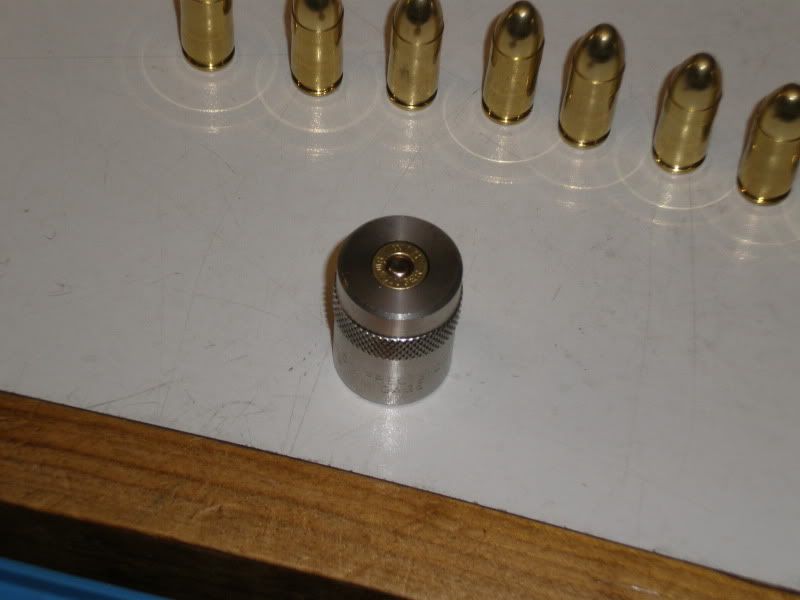
When I finish a batch I plunk test EVERY round while sitting in front of the TV. Better to know every round fits before going to the range and having a stoppage. |
|
Once I get my powder measure set, I check it again after 10 round.
After that I don't check it again until I need to fill the hopper. I use the Lee Factory Crimp die so each and every round is "gauged" and check at the time they are crimped. No need to plunk em again. |
|
Quoted:
Once I get my powder measure set, I check it again after 10 round. After that I don't check it again until I need to fill the hopper. I use the Lee Factory Crimp die so each and every round is "gauged" and check at the time they are crimped. No need to plunk em again. This |
|
Quoted:
Once I get my powder measure set, I check it again after 10 round. After that I don't check it again until I need to fill the hopper. I use the Lee Factory Crimp die so each and every round is "gauged" and check at the time they are crimped. No need to plunk em again. If that's true (I'm hoping and new to reloading) then I owe you a beer. You just saved me some time, thank you! |
|
I load about 50 at a time, I am on a turret press as well.
I check COL about every 50 rounds. I check powder charge every 5-7 rounds. After I charge 50 casings, I flashlight them to make sure they are all charged and none look different. Then I chose 1 from every row and weigh it. It definitely slows me down but I have never had a double charge or a squib. If I am loading for precision or for a load workup, I measure every round and every powder charge by hand. |
|
I visually check EVERY powder charge when reloading rifle and handgun rounds, even on a progressive press. A double charge or missed charge in a handgun round will lead to disaster. If the rifle rounds powder charge doesn't look the same height as the others then powder didn't completely drop from the measure OR something (like a glob of media) is stuck inside the case.
I adjust my Dillon powder measure by throwing ten charges and weighing them in total. This is a better way to discover and adjust for average charge weight per throw. Once adjusted I leave it alone for the entire reloading session. I always recheck everything when I return for the next reloading session. I completely empty the powder measure between reloading sessions and return the powder to the original powder jug. Overall length needs to be established (especially with magazine fed rifles) so the longest bullet in a batch (the one with a burr on the hollowpoint) will still fit and feed from a magazine. It harms nothing if the other bullets are a little shorter or vary slightly from one another. The seating die works off the bullet ogive, not the point. Jump to rifling will be identical in spite of the fact that each round varies slightly in length. If your dies are adjusted properly and tight nothing should change throughout the reloading session. |
|
Quoted:
I visually check EVERY powder charge when reloading rifle and handgun rounds, even on a progressive press. A double charge or missed charge in a handgun round will lead to disaster. If the rifle rounds powder charge doesn't look the same height as the others then powder didn't completely drop from the measure OR something (like a glob of media) is stuck inside the case. I adjust my Dillon powder measure by throwing ten charges and weighing them in total. This is a better way to discover and adjust for average charge weight per throw. Once adjusted I leave it alone for the entire reloading session. I always recheck everything when I return for the next reloading session. I completely empty the powder measure between reloading sessions and return the powder to the original powder jug. Overall length needs to be established (especially with magazine fed rifles) so the longest bullet in a batch (the one with a burr on the hollowpoint) will still fit and feed from a magazine. It harms nothing if the other bullets are a little shorter or vary slightly from one another. The seating die works off the bullet ogive, not the point. Jump to rifling will be identical in spite of the fact that each round varies slightly in length. If your dies are adjusted properly and tight nothing should change throughout the reloading session. Pretty much what I do, however, I use a powder that will overfill the cases when a double charge is present. I'm more concerned with squib loads, I always visually inspect the cases next to one another. |
|
Thanks for the replies. I usually load 50 at a time 9mm. Check the powder charge 1st middle and last of the 50 bullet run. It has never changed. I don't know how it could change using the lee classic turret press if everything is set how would anythjng change?
Every pull of the handle it moves the dies/powder so no chance of a double charge. I measure oal when I check powder. I plunk test a random amount out of the 50 that I reloaded. Maybe I should plunk test every one? Thanks again for the tips! |
|
Quoted: Thanks for the replies. I usually load 50 at a time 9mm. Check the powder charge 1st middle and last of the 50 bullet run. It has never changed. I don't know how it could change using the lee classic turret press if everything is set how would anythjng change? Every pull of the handle it moves the dies/powder so no chance of a double charge. I measure oal when I check powder. I plunk test a random amount out of the 50 that I reloaded. Maybe I should plunk test every one? Thanks again for the tips! If your shooting them in competition it's a good idea. I case gauge every 9mm round I load. Gives me a chance to ensure primer is seated below flush. But I'm picky anyway. |
|
Quoted:
Thanks for the replies. I usually load 50 at a time 9mm. Check the powder charge 1st middle and last of the 50 bullet run. It has never changed. I don't know how it could change using the lee classic turret press if everything is set how would anythjng change? Every pull of the handle it moves the dies/powder so no chance of a double charge. I measure oal when I check powder. I plunk test a random amount out of the 50 that I reloaded. Maybe I should plunk test every one? Thanks again for the tips! Yes. You should plunk test EVERY round, especially if you're using them for competition. You sure don't want a stoppage at a critical time, do you? Unlike loading a revolver where you can feel a round that isn't fitting quite right, a semi-auto doesn't give you that luxury. It just goes from the mag to the chamber and you won't know there's a problem till you pull the trigger and hear a click, or worse, an out of battery discharge. I plunk test every round because I don't want a malf at the range that could have been found at home. Plus, having malf's while shooting with friends doesn't exactly instill confidence with your reloads if they will be using them in your guns to try out. |
Armory Sponsor