


Armory Sponsor


Posted: 5/13/2015 8:18:54 PM EDT
|
Loading some 223 's and the thought came to mind with the press (RCBS ROCKCHUKER) set to cam over a tad I wondered what is too much over cam or can I over cam and can I resize the shoulder too low?
Shooting out of a RRA 223 Wylde hb. I know I should have a case gage but I don't. Thanks in advance! |
|
Without a gage you have no idea.
If you are using the same brand name shell holders as your dies then you "should" be fine. Mixing different brands can cause tolerance stacking. Buy Hornady's Lock-N-Load, RCBS or Mo DeFina's micrometer gages if you want accurate reliable readings. Drop in gages are inferior to any of these, but better than nothing. |
|
Quoted: Loading some 223 's and the thought came to mind with the press (RCBS ROCKCHUCKER) set to cam over a tad I wondered what is too much over cam or can I over cam and can I resize the shoulder too low? Shooting out of a RRA 223 Wylde hb. I know I should have a case gage but I don't. Thanks in advance! Excessive headspace then oversized again will cause premature case failure.  Get a proper headspace tool. http://www.midwayusa.com/product/479704/hornady-lock-n-load-headspace-gage-5-bushing-set-with-comparator Attaches to your caliper. Measure several cases fired in your chamber. The pic is what my chamber measures. 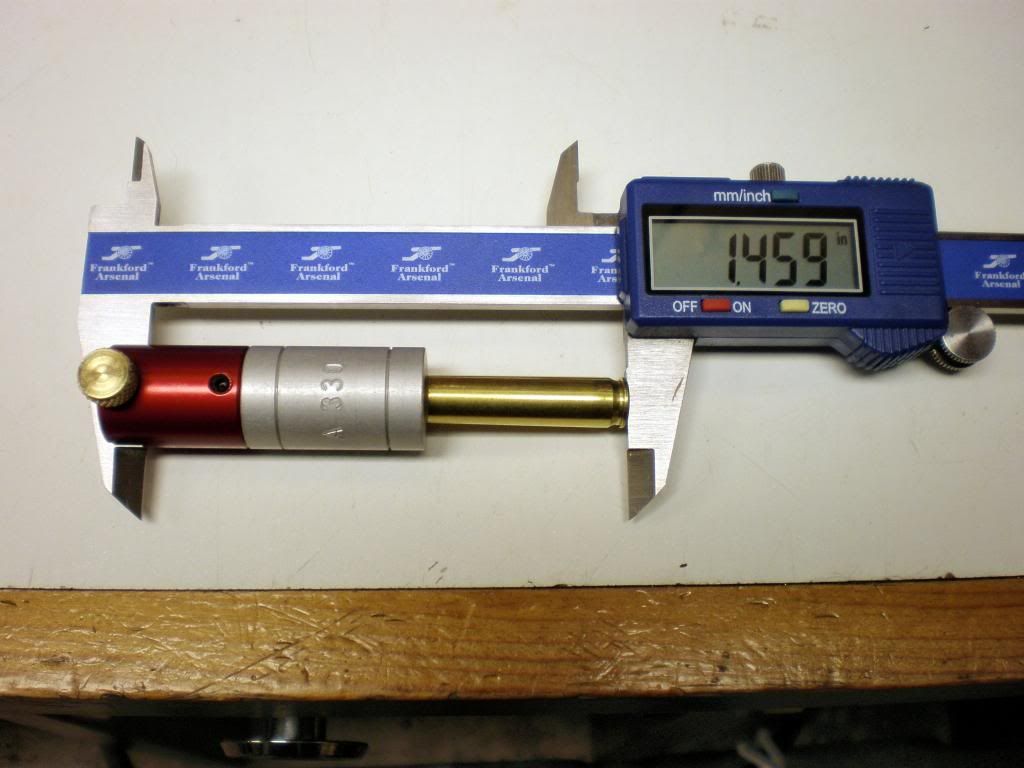 So I set my sizing die to set the shoulder back .003. Perfect function and max case life. A case gauge works, but is not as precise as a headspace gauge.
|
|
Until a few years ago, I had no case gage, and just used the cam-over method of setting up my sizing die. It worked for years, but I had lots of case head separations. Didn't know why. When I bought a Wilson case Gage, and measured my unsized brass, then compared it to my sized brass, I found I was moving the case shoulder back about .007" too far. No wonder I had lots of case head separations! Since setting the size die to push the shoulder back just .002", no more case head separations. If your budget won't allow for a .223 case gage right now, you can use a make-shift gage. Use a sized .30 carbine case (or a .308 Win or 30-06 case). Put the .30 case in your caliper, and zero it. Then put the .30 case over the .223 shoulder and measure. Adjust your sizing die until you get .002" or .003" less. Not as good as a real case gage or the Hornady headspace gage, but better than just guessing. Use a .30 case for .223, use a .40 S&W for .308, .243 Win, 30-06, etc. Make sure the "gage" case mouth is round. |
|
Quoted:
Dryflash3, Are the fired rounds inserted in the gage trimmed first? Doesn't matter, as the Hornady gauge measure off the approximate datum line on the shoulder. This Hornady/Stoney Point gauge is very simple to use. Insert the proper comparator into the base, mount the base on your calipers. I zero my comparator first, but not a requirement. Measure a "Fired" case and record. Set up your sizing die ti bump the shoulder back about .003. Size a few cases and check to see if these sized cases chamber and extract with ease, When chambering do not let the action slam home, let it close slowly. |
|
Quoted:
Dryflash3, Are the fired rounds inserted in the gage trimmed first? It is a good idea to deprime the cases to ensure that you are measuring to the base of the case and not to a protruding primer. If you don't have a Universal Deprimer, an alternative is to re-seat the primers on your fired cases to ensure they are inside the cases. |
|
Quoted: Dryflash3, Are the fired rounds inserted in the gage trimmed first? No. You want to measure your chamber by using the fired case. Pick case off the ground where it was ejected and measure. (that's a fired case) Then you have a number to size .003 smaller than. |
|
If you want to determine if your Hornady Headspace Gauge Bushings used with the Comparator Body allow the caliper's digital readout to show actual case lengths from bolt-face to datum; measure a chamber headspace gauge to see if the digital readout is just about (I say just about since a caliper resolution is only to 0.0005" ten-thousandths of an inch) matching the measurement listed on the chamber headspace gauge. If it is not, you have to stone roughly 0.004" – 0.005" thousandths of an inch off the face of the headspace gauge bushing to get the digital readout to coincide with the listed measurement on the chamber headspace gauge.
The cause for the error is due to Hornady placing a chamfer on the inside edge of the headspace gauge bushing. This causes a conflict with the shoulder angle of the case. So, you stone the face of the headspace gauge bushing however much is necessary to remove the chamfer placed on the inside edge. Also, the digital caliper was checked for accuracy by measuring a Hardened Precision Steel Shaft that is 1" inch in diameter, and has a diameter tolerance of -0.001" to -0.0005" that I use for my 8 Ton Rotary Draw Tubing Bender. So, this digital caliper is not misreading. This information on the need to stone the face of the headspace gauge bushing was found on another forum by another ARFCOM member. 


|
|
Quoted:
If you want to determine if your Hornady Headspace Gauge Bushings used with the Comparator Body allow the caliper's digital readout to show actual case lengths from bolt-face to datum; measure a chamber headspace gauge to see if the digital readout is just about (I say just about since a caliper resolution is only to 0.0005" ten-thousandths of an inch) matching the measurement listed on the chamber headspace gauge. If it is not, you have to stone roughly 0.004" – 0.005" thousandths of an inch off the face of the headspace gauge bushing to get the digital readout to coincide with the listed measurement on the chamber headspace gauge. The cause for the error is due to Hornady placing a chamfer on the inside edge of the headspace gauge bushing. This causes a conflict with the shoulder angle of the case. So, you stone the face of the headspace gauge bushing however much is necessary to remove the chamfer placed on the inside edge. Also, the digital caliper was checked for accuracy by measuring a Hardened Precision Steel Shaft that is 1" inch in diameter, and has a diameter tolerance of -0.001" to -0.0005" that I use for my 8 Ton Rotary Draw Tubing Bender. So, this digital caliper is not misreading. This information on the need to stone the face of the headspace gauge bushing was found on another forum by another ARFCOM member. http://i1286.photobucket.com/albums/a601/AVIDavid1982/Mobile%20Uploads/photo_zps1f08ef70.jpg http://i1286.photobucket.com/albums/a601/AVIDavid1982/Mobile%20Uploads/photo_zps38dc84d7.jpg http://i1286.photobucket.com/albums/a601/AVIDavid1982/Mobile%20Uploads/photo_zps34096b9d.jpg The Hornady/Stoney point gauge was never intended to be used to compare to SAAMI or any other case drawings or dimensions. It is simply a "Comparator" used to Compare ones fired brass to one's sized brass, not to compare to any drawing of spec sheet. Before Stoney Point came along we used to do it like this, work just fine as long as the measurement was not "Compared" to anything but sized vs fired cases. 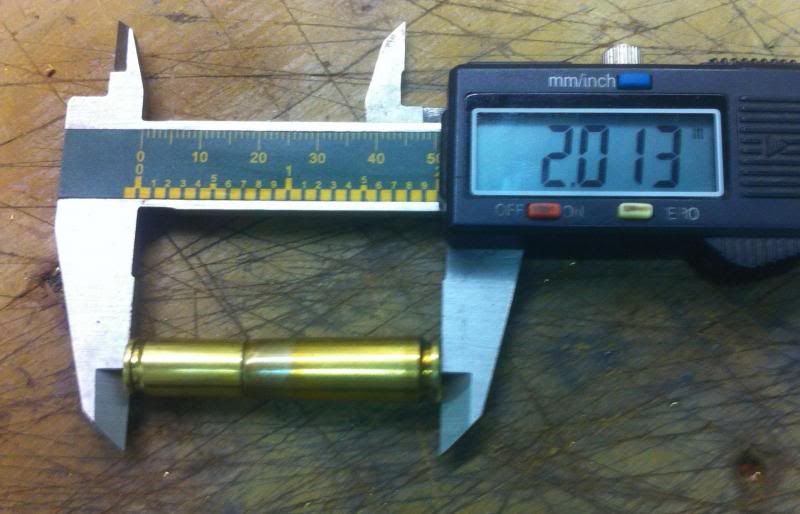
|
|
The Hornady tool is really a comparator; you "compare" two different things, such as the length of a fired case in a specific bushing to a sized case in that bushing. That gives you absolute data, without any need to worry about the exact SAAMI datum circle. Used as dryflash3 describes, you get EXACT measurements of shoulder setback, which allows you to precisely adjust sizing dies.
The SAAMI datum circle for .223 Remington is 0.330" in diameter, while the closest Hornady bushing is 0.350", plus the bushings have a radius that helps keep them centered on the case. Clearly, you can't directly measure just about any specific case's SAAMI headspace dimension. You can get "blank" bushings and bore them as you wish, so you CAN use the Hornady tool to directly measure cartridge case headspace, but that's not needed most of the time. It's important to note that using cam-over, you're not doing anything "bad." You are working the brass more than is needed, which shortens its life, but it's not going to cause a catastrophic failure. On the other hand, having more control over how much you work your brass not only extends its life, but it gives you a more precise fit between cartridge and chamber, which (in theory) should improve the inherent accuracy of rounds sized this way. My only issue with using the comparator as described is that I have 4 or 5 (I forget exactly how many!) 5.56mm chambered uppers, so to be as precise as possible, I would have to fire identical rounds through each one, figure out which has the shortest shoulder, then adjust for a reasonable setback for the shortest one... Which is more work than I've bothered with so far. |
|
Quoted:
I wondered what is too much over cam or can I over cam and can I resize the shoulder too low? Shooting out of a RRA 223 Wylde hb. I know I should have a case gage but I don't. Thanks in advance! It is possible to over-size brass. There are two consequences I have personally seen (but they were not mine). In both instances, resizing was done with good dies in a good press but they were not set up properly (no gage). I've seen brass fail after the first reloading. The case head separations were almost certainly due to oversizing causing excessive headspace. It was not "explosive" but the brass was cracked/separated and some gas was vented. I've seen cartridges fail to fire due to over-sizing, as well. When feeding from the magazine and chambering, the excess headspace allowed the cartridge to move into the chamber so far, it came off the extractor and could not be reached by the firing pin (or moved when hot by the pin). Either way, it did not fire or extract. I'm sure there are other things that can happen, too, none of which are good. The headspace on all my RRA Wylde chambers are all identical - right at nominal SAAMI spec. I was pleasantly surprised by the consistency across the years because the reloads fit all the rifles. Yes, you really should get a gage, even if it's just a case gage. The Hornady is much better but get something. |
|
Quoted: The SAAMI datum circle for .223 Remington is 0.330" in diameter, while the closest Hornady bushing is 0.350" This isn't correct because my "headspace gauge bushing" which is what Hornady calls them is 0.330". You can see what diameters Hornady has listed on their website. Also, my pictures prove if you want to know the actual lengths of your cases from the bolt-face to datum; doing this modification to the headspace gauge bushing will do the trick. Here is the chart from Hornady's website for the headspace gauge bushings. 
|
My bad. I was thinking of something else and typed without verifying my data. Spending too much time messing with 300 Blackout will do that to you. Or at least to me.  In general, the Hornady comparator does work the way I said, but the bushings may or may not be an exact fit for any given cartridge. In general, the Hornady comparator does work the way I said, but the bushings may or may not be an exact fit for any given cartridge.
Is that .330 bushing actually .330" ID exactly? |
|
Quoted:
My bad. I was thinking of something else and typed without verifying my data. Spending too much time messing with 300 Blackout will do that to you. Or at least to me. In general, the Hornady comparator does work the way I said, but the bushings may or may not be an exact fit for any given cartridge.
Is that .330 bushing actually .330" ID exactly? They are exactly the listed diameter. Any deviation is irrelevant (which is good). They are, IMO, an essential tool for every rifle reloader - essential!. |
|
Quoted: Is that .330 bushing actually .330" ID exactly? It is to within 0.001" thousandth of an inch at least. My digital caliper gets a reading of 0.329", though there are better tools to measure the inside diameter of a circle. About the chamfer added to the inside diameter, even with it removed, the case still centers because of the angle of the case's shoulder. |
Armory Sponsor