


Armory Sponsor


Posted: 1/23/2013 5:36:20 PM EDT
|
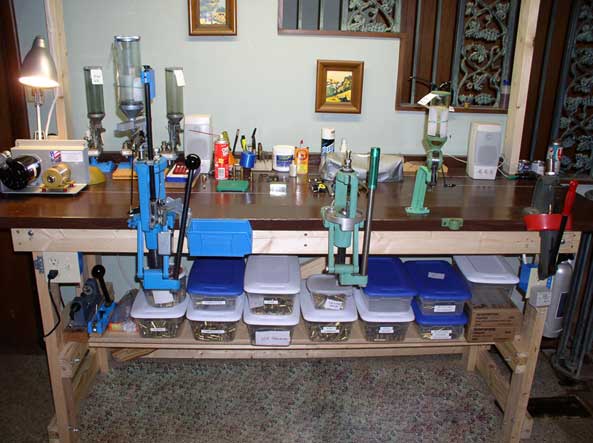
What are you guys using to keep your goodies in. Pic's please.
I work at a old hardware store and I can get some that look like these. But they're kinda old looking. But the price would be right. I'd just have to try and clean the old sticker's off. Or I could try to get new purdy red one's from the our supplier to match my press.  I'd deffenetly prefer new if it was cheap enough. I'd deffenetly prefer new if it was cheap enough.

|


|
Yep, the first one gets it... |
|
I was talking about bins to keep primer's, projectile's, and what not in. Do you keep such item's in ammo can's,,or you thought I meant finished ammo. |
|
Quoted:
I was talking about bins to keep primer's, projectile's, and what not in. Do you keep such item's in ammo can's,,or you thought I meant finished ammo. Buying used storage bins allows more funds for components. You building a reloading station or entering a beauty contest. |
|
Quoted:
Quoted:
I was talking about bins to keep primer's, projectile's, and what not in. Do you keep such item's in ammo can's,,or you thought I meant finished ammo. Buying used storage bins allows more funds for components. You building a reloading station or entering a beauty contest. The one pictured is just a pic I found. The used ones I can get are pretty rough. Like I said. I wouldn't get new unless it was cheap enough. Hey. I guess I could just use an old shoe box. 
|
|
I wouldn't recommend storing primers or powder in ammo cans, but more or less everything else... Yes. Especially dies and other things subject to rust. I also buy projectiles in bulk and store them in ammo cans, along with brass and lead ingots. You do want your fmj projectiles to keep their NIB bling, right?
|
|
Akro Bins are great but expensive, they make them in earth tones if you don't like blue or red or yellow and make clear lids for them
I get used bins from lexingtoncontainercompany.com I use plastic ammo cans and dry boxes from mtm case guard, you can buy straight off their website. |

|
I used 40mm ammo cans for die (in ziplocks), powder measure, swager, and lathe trimmer storage.
I use a cheap, 2 drawer toolbox for the smaller items. I placed a fishing lure box under the lid for small items, ie shell holders, chamfer tool, extra lnl bushings, primer pocket uniformer. The rest of the toolbox has my scale, powder funnel, calipers etc. Nothing too remarkable, but you get the idea. 
|
|
Quoted:
Ammo cans. Even for primers. (Contriversal, I know)
Powder and primes have to be able to vent. if they are contained in metal boxes, you may have made a bomb. I store at least my primers in ammo cans. 1K bricks of wolf small primers you can fit 5 perfectly in a 30 cal ammo can stacked on there sides. I read an EPIC discussion on the issue of storing primers & powder in ammo cans. I've come to the conclusion that it's absolute bs that people thinking storing them inside of a ammo can is going to make them blow up or that it makes a bomb. A bomb works because there is shrapnel in the explosive that blows everywhere. I don't store powder in a ammo can because I only have 8lb jugs, but just primers in an ammo can aren't going to cause an explosion. I imagine if you could somehow manage to see off an ammo can full of primers, it would be equivalent to setting of firecrackers in an ammo can. Scare the crap out you but do nothing. The other logical thing I read is that even if enough pressure was generated to blow the ammo can apart, they are lightly welded together & the side would easily blow off before enough pressure built up that it would actually explode like a real "bomb". Also use some common sense. No storing primers & powder in the same ammo can out in your garage in the south in non-AC environment where it gets to 120+F in summer would not be a good idea. |
|
The following is a compelation of what is required. This is what the insurance company will go by, you deviate and they can void your policy and refuse to pay.
6. Safe Storage of Powder and Primers by Henry E. Schaffer ([email protected]) Recent events have caused many people to become more aware of the need for safe storage practices for primers and smokeless powder. Here is some information I've extracted from various sources - mostly tracing back to practices recommended by SAAMI (the Sporting Arms and Ammunition Manufacturers' Institute.) Some of this may also be in the fire codes, and is recommended by the National Fire Protection Association. Smokeless Powder - Store in a cool, dry place - protected from accidental exposure to ignition by flames, sparks or high temperatures. Avoid open flame, furnaces, hot water heaters, sun's rays, mechanical/electrical equipment. Also avoid solvents, flammable gases and other highly combustible material because of risk of fires in the vicinity. To avoid deterioration chemical, fumes, moisture and heat should be avoided. Deterioration can be checked by smelling the powder. When you open the cap on the container and sniff, good powder may have either a solvent - alcohol, ether, acetone - type of odor, or perhaps little or no odor. Powder going bad will have an acidic odor which irritates. The approved shipping containers are constructed, so that in case of accidental ignition of the powder they will open at quite low internal pressures and so limit the burning rate of the powder. (Smokeless powder burns much faster under pressure and builds up pressure very fast.) Up to 20 pounds (9.1 kg) of smokeless powder can be kept in a residence in its original containers. Up to 50 pounds (22.7 kg) can be kept in a wooden box/cabinet with walls at least 1" thick or perhaps of other fire resistant and insulating construction. The wooden or other construction provides insulation against heat, should be large enough to vent the gas produced if the powder does ignite, or should come apart easily under low pressure to avoid a high pressure rupture which can have the effect of an explosion. A weak wall or weak seams can be used to accomplish this. Don't cram a storage box full, as this increases the potential for high pressure. If you can use equal quality storage places, safety is enhanced by using separate storage locations, with several smaller quantities stored rather than one larger quantity. Black powder is much touchier, and I'm not discussing this at all. I've heard that Pyrodex is less dangerous than black powder - but don't have any reliable information. Only the smallest amounts of smokeless powder needed should be stored, and safety practices should always be used. E.g., don't smoke near powder storage, don't allow spilled powder to accumulate, keep out of direct sunlight, etc. Generally powder should be kept in the original containers which were approved for shipping. Primers - These should be kept in their original factory containers. If primers are taken out of their original containers and kept together, that increases the chance of all of them going off if one of them does. Note that primers are small explosive devices and that a bunch of them going off can cause serious damage to property and personnel. Primer dust, especially mixed with spilled powder is a hazard. Working places should be kept very clean. Only one box at a time should be taken out and loaded into your equipment to minimize danger. Primers should be protected from impact, friction, static electricity, heat/sparks/flame and other abuses which could cause unwanted detonation. To keep them in good condition they also should be kept from exposure to water/moisture, organic solvents including oils, gasoline, various lubricants and thinners, and heat. Temperatures above 140 degrees F. cause a decrease in the usable lifetime. Therefore the same desiderata of cool and dry are recommended. See the discussion on storage of smokeless powder. Note that excessively low humidity can lead to undesirable static electricity condition, and so 60% or higher relative humidity is recommended for working with primers. "Modern sporting ammunition primers will not absorb moisture under normal or even severe conditions of atmospheric humidity. There is no advantage to be gained from air-tight containers. The factory containers in which they are packaged need only normal conditions of storage." Up to 10,000 primers may be stored in a residence. It is suggested that they should be kept in a wood cabinet (with the usual spec of being constructed of lumber at least 1" nominal thickness) and apart from propellant powders. General good safety practices - e.g. No Smoking - should be followed. Bullets and Cases - Being inert, the main concern is to avoid corrosion, and so exposure to water/moisture and corrosive fumes should be avoided. Temperatures high enough to damage bullets or damage or anneal the cases are unlikely to be found in the home, apart from close proximity to furnaces and other heat sources. Such is to be avoided. Loaded Ammunition - One needs to be concerned about all of the environmental situations which would affect any of the components. Loaded ammo is relatively safe to store compared to the same quantities of powder and primers because of the way the charges are divided among the rounds. Still, safety practices should always be used. Possible Information Sources - National Electrical Code National Fire Protection Association Occupational Safety & Health Administration Sporting Arms and Ammunition Manufacturers' Institute, Inc. (send a SASE to them at 11 Mile Hill Road, Newton CT 06470-2359 for information on storage of smokeless powder and primers) SAAMI brochures Sporting Ammunition Primers - Properties, Handling, & Storage for Handloading - 11/93 Smokeless Powder - Properties and Storage - 11/93 --henry schaffer P.S. Additions and corrections to the above are welcome. I've tried to be careful in what I said, but I can't take responsibility for correctness or appropriateness of anything. |
|
I have stored primers & powder in (seperate) metal ammo cans for the last 20+ years (since at least 1985) & have had no issues (including failure to fire problems). Of course, all primers & powder are stored in temp controlled areas (dark closet, etc) In fact, some of my current batch of 5.56 I just loaded was with primers purchased in (I believe) Oct 1985. All of my bench rest / bolt action hunting ammo has been loaded with primer and powder purchased in 1992 ( all same lot numbers - large volume purchase) In the past couple of years, I have moved to the plastic "ammo" cans as long as they have a rubber gasket around the lid (think Cabelas & MTM boxes) The rubber gasketed lid helps with humidity controls, which is my main concern as long as I can control the heat / light. Hope this helps & of course YMMV . . . |
|
Ammo cans offer no extended storage life for primers. And in the event of a fire, that closed ammo can turns into an oven which greatly increases the odds of mass detonation. The smallest ammo can full of primers is more than a hand grenade. Over a half pound of explosive per 1000 primers. Heat increases the brisance of the priming compound, a non-crimped primer can be ejected from an EMPTY shell at velocity over 1000 ft/sec by heating the case with a torch. Don't do it, I did it once in the garage with the .38 Special case held in a vise. The primer ripped through the ceiling drywall and embedded in the roof decking. Now, if the primers are in the open, the package will burn before heat can conduct into the center of the package. The outer primers will detonate like a string of fire crackers, reducing the burn rate and ventilating the bulk of the packaging. |
|
So, how does this work for detached garages? I have a climate controlled exterior garage/building located about 10 ft from my house that I store my 'long term' powder and primers in. I keep about than 8 lbs of powder and 3k primers in my home near my reloading bench.
I've thought about storing some of this stuff sealed up underground... Quoted:
The following is a compelation of what is required. This is what the insurance company will go by, you deviate and they can void your policy and refuse to pay. 6. Safe Storage of Powder and Primers by Henry E. Schaffer ([email protected]) Recent events have caused many people to become more aware of the need for safe storage practices for primers and smokeless powder. Here is some information I've extracted from various sources - mostly tracing back to practices recommended by SAAMI (the Sporting Arms and Ammunition Manufacturers' Institute.) Some of this may also be in the fire codes, and is recommended by the National Fire Protection Association. Smokeless Powder - Store in a cool, dry place - protected from accidental exposure to ignition by flames, sparks or high temperatures. Avoid open flame, furnaces, hot water heaters, sun's rays, mechanical/electrical equipment. Also avoid solvents, flammable gases and other highly combustible material because of risk of fires in the vicinity. To avoid deterioration chemical, fumes, moisture and heat should be avoided. Deterioration can be checked by smelling the powder. When you open the cap on the container and sniff, good powder may have either a solvent - alcohol, ether, acetone - type of odor, or perhaps little or no odor. Powder going bad will have an acidic odor which irritates. The approved shipping containers are constructed, so that in case of accidental ignition of the powder they will open at quite low internal pressures and so limit the burning rate of the powder. (Smokeless powder burns much faster under pressure and builds up pressure very fast.) Up to 20 pounds (9.1 kg) of smokeless powder can be kept in a residence in its original containers. Up to 50 pounds (22.7 kg) can be kept in a wooden box/cabinet with walls at least 1" thick or perhaps of other fire resistant and insulating construction. The wooden or other construction provides insulation against heat, should be large enough to vent the gas produced if the powder does ignite, or should come apart easily under low pressure to avoid a high pressure rupture which can have the effect of an explosion. A weak wall or weak seams can be used to accomplish this. Don't cram a storage box full, as this increases the potential for high pressure. If you can use equal quality storage places, safety is enhanced by using separate storage locations, with several smaller quantities stored rather than one larger quantity. Black powder is much touchier, and I'm not discussing this at all. I've heard that Pyrodex is less dangerous than black powder - but don't have any reliable information. Only the smallest amounts of smokeless powder needed should be stored, and safety practices should always be used. E.g., don't smoke near powder storage, don't allow spilled powder to accumulate, keep out of direct sunlight, etc. Generally powder should be kept in the original containers which were approved for shipping. Primers - These should be kept in their original factory containers. If primers are taken out of their original containers and kept together, that increases the chance of all of them going off if one of them does. Note that primers are small explosive devices and that a bunch of them going off can cause serious damage to property and personnel. Primer dust, especially mixed with spilled powder is a hazard. Working places should be kept very clean. Only one box at a time should be taken out and loaded into your equipment to minimize danger. Primers should be protected from impact, friction, static electricity, heat/sparks/flame and other abuses which could cause unwanted detonation. To keep them in good condition they also should be kept from exposure to water/moisture, organic solvents including oils, gasoline, various lubricants and thinners, and heat. Temperatures above 140 degrees F. cause a decrease in the usable lifetime. Therefore the same desiderata of cool and dry are recommended. See the discussion on storage of smokeless powder. Note that excessively low humidity can lead to undesirable static electricity condition, and so 60% or higher relative humidity is recommended for working with primers. "Modern sporting ammunition primers will not absorb moisture under normal or even severe conditions of atmospheric humidity. There is no advantage to be gained from air-tight containers. The factory containers in which they are packaged need only normal conditions of storage." Up to 10,000 primers may be stored in a residence. It is suggested that they should be kept in a wood cabinet (with the usual spec of being constructed of lumber at least 1" nominal thickness) and apart from propellant powders. General good safety practices - e.g. No Smoking - should be followed. Bullets and Cases - Being inert, the main concern is to avoid corrosion, and so exposure to water/moisture and corrosive fumes should be avoided. Temperatures high enough to damage bullets or damage or anneal the cases are unlikely to be found in the home, apart from close proximity to furnaces and other heat sources. Such is to be avoided. Loaded Ammunition - One needs to be concerned about all of the environmental situations which would affect any of the components. Loaded ammo is relatively safe to store compared to the same quantities of powder and primers because of the way the charges are divided among the rounds. Still, safety practices should always be used. Possible Information Sources - National Electrical Code National Fire Protection Association Occupational Safety & Health Administration Sporting Arms and Ammunition Manufacturers' Institute, Inc. (send a SASE to them at 11 Mile Hill Road, Newton CT 06470-2359 for information on storage of smokeless powder and primers) SAAMI brochures Sporting Ammunition Primers - Properties, Handling, & Storage for Handloading - 11/93 Smokeless Powder - Properties and Storage - 11/93 --henry schaffer P.S. Additions and corrections to the above are welcome. I've tried to be careful in what I said, but I can't take responsibility for correctness or appropriateness of anything. |
|
Quoted:
I got the same ones only in blue, (free, best I could do); kinda match the Dilon prees that's close by. sdshooter................. Post a pic of your set up. I went ahead and got the exact same ones pictured from work,,,,since they were free.  I all most lost my mind and painted them red. But luckily I came to my sense's. I all most lost my mind and painted them red. But luckily I came to my sense's.  I'll post a pic when I get them done. I'll post a pic when I get them done.
|

|
Primers and powder just go on a shelf. I don't have near as big a stock as some of you, I'm sure.
Loaded rounds go back in factory boxes. When I fill all the factory boxes I have, I either stop reloading, or scrounge more boxes from the range. Still trying to figure out what I'm going to do with loaded .223, since the factory boxes are, well, junk (LC M193). Probably store them in an ammo can. Bought some frankford Arsenal Ammo Vaults for .308. |
|
Quoted:
Primers and powder just go on a shelf. I don't have near as big a stock as some of you, I'm sure. Loaded rounds go back in factory boxes. When I fill all the factory boxes I have, I either stop reloading, or scrounge more boxes from the range. Still trying to figure out what I'm going to do with loaded .223, since the factory boxes are, well, junk (LC M193). Probably store them in an ammo can. Bought some frankford Arsenal Ammo Vaults for .308. yup...ammo can's about $9.00 make great places to store the .223 
|
|
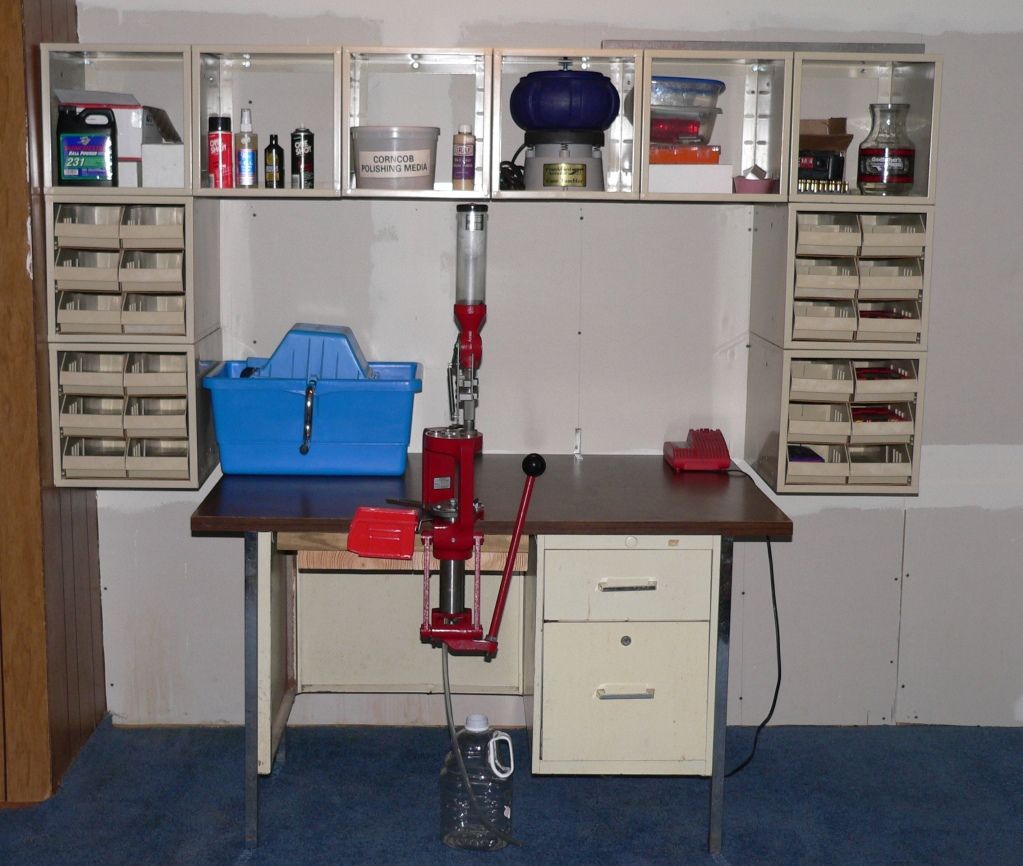
Well it's not 100% done. I need to tighten up the cabinets to each other, and do some final leveling. God I'm being to anal for what this is. Believe it or not, this was hard to do by myself.
I believe I have enough storage space. Ya think. My plan is to remove some of the dividers so I can have some open storage space for bigger items. I kinda hate to put the crappy looking drawers back in. But I guess it makes since. It depends on how nice the old labels clean off.
Now I'll be loosing sleep over deciding where to put the drawers. Across the top, or on the sides. What do you guy's think.

|
|
I use a variety of storage containers.
Bullets, either the box they come in or in ammo cans or the round plastic coffee "cans". Primers, The cases they come in. If I open a box I put all the flats from that box into an akro-bin above my reloading bench. I get my akro-bins free after rebate from Menards. I must have over 100 of them and the entire wall above my reloading bench is covered with them, all hanging up. Brass, I'll store it in anything, round plastic coffee "cans", ammo cans, boxes, you name it. Powder: original container in a wooden chest. Misc: I have some old kitchen cabinets on my wall and some industrial filing cabinets that also work great to put thing in like my other presses and tools etc. So basically, small stuff goes in the akro-bins, large stuff in the filing cabinets etc, and heavy stuff goes wherever I can keep it without crushing things. |
We have cats so I use the empty cat litter jugs for dirty brass, and then the blue plastic bins for clean/sorted brass in various states of prep. DSCN1289 by c.swimm, on Flickr Powder and primers just go on a shelf above my reloading bench cabinets, and the cabinets are filled with plastic 50 round ammo boxes full of finished rounds.  223 loads by c.swimm, on Flickr Bullets usually sit on the left side of the reloading bench until loaded as they usually don't last very long. Once I get my load data figured out, then I load them all until I run out of bullets. If I (god forbid) run out of primers, powder or brass before bullets then I usually put the left overs in the akro bins.  DSCN1124 by c.swimm, on Flickr There have been a couple of large batches of 5.56 5gr FMJ that I loaded and put on stripper clips and put those in ammo cans too.  Ammo cans by c.swimm, on Flickr |
|
Quoted:
We have cats so I use the empty cat litter jugs for dirty brass, and then the blue plastic bins for clean/sorted brass in various states of prep. <a href="http://www.flickr.com/photos/cswimm/8104336867/" target="_blank">http://farm9.staticflickr.com/8189/8104336867_137a6a105e_c.jpg</a> DSCN1289 by c.swimm, on Flickr Powder and primers just go on a shelf above my reloading bench cabinets, and the cabinets are filled with plastic 50 round ammo boxes full of finished rounds. <a href="http://www.flickr.com/photos/cswimm/7450541542/" target="_blank">http://farm9.staticflickr.com/8028/7450541542_1feebbc3c9_c.jpg</a> 223 loads by c.swimm, on Flickr Bullets usually sit on the left side of the reloading bench until loaded as they usually don't last very long. Once I get my load data figured out, then I load them all until I run out of bullets. If I (god forbid) run out of primers, powder or brass before bullets then I usually put the left overs in the akro bins. <a href="http://www.flickr.com/photos/cswimm/7069708035/" target="_blank">http://farm8.staticflickr.com/7130/7069708035_819b898d8c_c.jpg</a> DSCN1124 by c.swimm, on Flickr There have been a couple of large batches of 5.56 5gr FMJ that I loaded and put on stripper clips and put those in ammo cans too. <a href="http://www.flickr.com/photos/cswimm/6118243855/" target="_blank">http://farm7.staticflickr.com/6088/6118243855_146d08cea9_b.jpg</a> Ammo cans by c.swimm, on Flickr Wow love those stickers you should share that template! |
|
Quoted:
We have cats so I use the empty cat litter jugs for dirty brass, and then the blue plastic bins for clean/sorted brass in various states of prep. <a href="http://www.flickr.com/photos/cswimm/8104336867/" target="_blank">http://farm9.staticflickr.com/8189/8104336867_137a6a105e_c.jpg</a> DSCN1289 by c.swimm, on Flickr Powder and primers just go on a shelf above my reloading bench cabinets, and the cabinets are filled with plastic 50 round ammo boxes full of finished rounds. <a href="http://www.flickr.com/photos/cswimm/7450541542/" target="_blank">http://farm9.staticflickr.com/8028/7450541542_1feebbc3c9_c.jpg</a> 223 loads by c.swimm, on Flickr Bullets usually sit on the left side of the reloading bench until loaded as they usually don't last very long. Once I get my load data figured out, then I load them all until I run out of bullets. If I (god forbid) run out of primers, powder or brass before bullets then I usually put the left overs in the akro bins. <a href="http://www.flickr.com/photos/cswimm/7069708035/" target="_blank">http://farm8.staticflickr.com/7130/7069708035_819b898d8c_c.jpg</a> DSCN1124 by c.swimm, on Flickr There have been a couple of large batches of 5.56 5gr FMJ that I loaded and put on stripper clips and put those in ammo cans too. <a href="http://www.flickr.com/photos/cswimm/6118243855/" target="_blank">http://farm7.staticflickr.com/6088/6118243855_146d08cea9_b.jpg</a> Ammo cans by c.swimm, on Flickr The second pic, how did you label them like that, and where did you get the boxes? |
|
Quoted:
We have cats so I use the empty cat litter jugs for dirty brass, and then the blue plastic bins for clean/sorted brass in various states of prep. <a href="http://www.flickr.com/photos/cswimm/8104336867/" target="_blank">http://farm9.staticflickr.com/8189/8104336867_137a6a105e_c.jpg</a> DSCN1289 by c.swimm, on Flickr Powder and primers just go on a shelf above my reloading bench cabinets, and the cabinets are filled with plastic 50 round ammo boxes full of finished rounds. <a href="http://www.flickr.com/photos/cswimm/7450541542/" target="_blank">http://farm9.staticflickr.com/8028/7450541542_1feebbc3c9_c.jpg</a> 223 loads by c.swimm, on Flickr Bullets usually sit on the left side of the reloading bench until loaded as they usually don't last very long. Once I get my load data figured out, then I load them all until I run out of bullets. If I (god forbid) run out of primers, powder or brass before bullets then I usually put the left overs in the akro bins. <a href="http://www.flickr.com/photos/cswimm/7069708035/" target="_blank">http://farm8.staticflickr.com/7130/7069708035_819b898d8c_c.jpg</a> DSCN1124 by c.swimm, on Flickr There have been a couple of large batches of 5.56 5gr FMJ that I loaded and put on stripper clips and put those in ammo cans too. <a href="http://www.flickr.com/photos/cswimm/6118243855/" target="_blank">http://farm7.staticflickr.com/6088/6118243855_146d08cea9_b.jpg</a> Ammo cans by c.swimm, on Flickr Yep. We're all gonna want to know how to make those sticker's,,,and specific's on the box's. Do they happen to have a carry handle. How about some pic's of the .223 boxs,,,,,lol. |
|
Quoted:
Yep. We're all gonna want to know how to make those sticker's,,,and specific's on the box's. Do they happen to have a carry handle. How about some pic's of the .223 boxs,,,,,lol. probably a word template to print out on avery stock sticker sheets, but why reinvent the wheel if he's willing to share :-) As for ammo boxes, everywhere I look they seem to be out of stock for MONTHS. One would think that they are easy to mass produce being it's injection plastic molding. |
For all my bulk "plinking" rounds, they just go into a ammo can with a label on the outside for quick reference. Inside is a couple of silica packets and a more detailed slip of of charge weights,components,etc


For "precision" rounds, they get packed into factory boxes that I turned inside out and stick a label onto like the box in the foreground |
|
Quoted: Quoted: <a href="http://www.flickr.com/photos/cswimm/7450541542/" target="_blank">http://farm9.staticflickr.com/8028/7450541542_1feebbc3c9_c.jpg</a> 223 loads by c.swimm, on Flickr The second pic, how did you label them like that, and where did you get the boxes? The boxes are Berry's MFG 50 round plastic boxes. The labels are from a Dymo label printer. MS word with avery sheet feed labels could work too, but the dedicated label printer is easier. I save them as label files in the Dymo program and have it set up to increase the lot number by one digit for each label printed. It is a thermal printer so no ink to mess with or run out. Also it doesn't run if it gets wet. The labels stick good but come off without leaving any residue which is a good thing since they are replaced every time the box is reused. I also insert clip art on them for easy identification of which gun a specific load might be for. AR picture for my AR15 and AR10 loads. SIG 550 picture for my SIG 556 loads, and mil-dot reticle picture for my match loads.  I was filling out the little sticky labels from MTM by hand but after a couple of large batch runs I relized thta was for the birds. I am a mail clerk so I have a lable priter on my desk so I decided to use that. They are less than $100 from newegg.com |
|
Well I finally got it done,,, more or less. I just kinda have stuff thrown on there for now. I have to do my final organizing. Gee. I wish I had some brass, bullet's, primer's,,, and maybe even a little powder would be nice.
I reinforced the desk top with 2 layer's of 2x10's on the underneath side where the press mounts. That thing is rock solid. I all so used some "L" brackets to mount it to the wall. The desk has no flex at all. But I can see the press flex if I push hard enough. So I think I'll be all right.
|


|
I would get a pic but it is too damn messy matched to the rest of these pics.
Die sets in small square glad tupperware containers lined with VCI paper and labeled. Same for shell plates, shell holders, small parts. Based on the container size I know what is in it even before reading the specifics through the see-thru lid. All stored in a large fishing tackle box I already had. You can get a HUGE supply of these for something like $17 at any one of the warehouse stores. I also use the smaller containers to hold the brass and bullets I am loading at the press. Clean brass (9, 40, 223) in 5 gallon pails from Home Depot, Smaller run (38 spl, 44 mag) clean brass in 1.5 gallon plastic pails from the paint department at HD. Primers in original sleeves in ziplock bags in an ammo locker as well as the powder. |

| For ammo I've been loading up on those green MTM hinged ammo boxes. I used to use the same ones that don't have the hinge and do not like them at all!! They are a pain in the ass when on the range. For bulk ammo like 45acp and 9mm I just put them in the green army cans. I like those little half size cans as they are a heck of a lot easier to tote around once they are full. With my crazy back a regular size ammo can completely full of loose 45acp is freaking heavy!!! |
Armory Sponsor