


Armory Sponsor


Posted: 8/3/2012 5:56:41 PM EDT
|
First things, I am an absolute noob in reloading. I am working with a Lee Challenger breech lock press with Lee Pacesetter .223 dies.... (also CCI400 primers and H4895 powder)
I purchased some 55gr Jacketed bullets w/cannelure (Proofmark brand) as I am reloading for my ARs and have read the cannelure with the factory crimp die helps ensure the bullet isn't moved around in an autoloader. I measured the case OAL of some PMC .223 and then pulled it apart in curiosity; to measure it's factory powder, look at it's factory bullet, measure the factory case OAL ect... I noticed the OAL of the PMC bullet was slightly longer then the Proofmark bullet. I also noticed the cannelure on the PMC bulled was located closer to the BT then the Proofmark bullet was. I decided to size and trim some fired brass and seat a few of the Proofmark bullets without a primer or powder for practice. I trimmed a case to closely match the PMC case ( 1.757in) and then mounted a Proofmark bullet to the case maximum 2.260in and noticed the case mouth did not even come to the bottom of the Proofmark cannelure. In order for the case mouth to be mounted into the center of the cannelure I ended up needing to seat the bullet to 2.242in case OAL for the case mount to be mounted about halfway into the cannelure. Now obviously I'll be starting at the recommended start load of 25gr of H4895 but, I have read about how the the depth of the seated bullet can affect pressure and accuracy... So with those details I have these questions. 1. The listed "Maximum Trim Length" of 1.760in is the absolute longest the case can be for the chamber but it can be trimmed shorter right? 2. How much of an affect does the depth of the seated bullet have on pressures? Accuracy? 3. If the bullet being seat deeper has an effect on pressure... Do reloading manuals build their Min/Max recommendations with the round at max OAL? Does case length have an effect? I would imagine if there were 2 rounds loaded to the same OAL but one of them had a longer case, the bullet would be mounted deeper in the longer case and maybe have more/less pressure with the same powder load? 4. The Lee book I have has a Mimimum OAL of 2.200in listed on the max load side... I am assuming that means that is the shortest length I can have with the Maximum powder load without creating unsafe pressure right? There are some powders that are listed to have a Minimum OAL of 2.260 (which is also Max OAL) when loaded with the max pressure... Which would mean that powder I couldn't load this Proofmark bullet to the cannelure since it would be too short of an OAL... 5. I am over thinking this because I am a noob and I should load the starting load to the cannelure and go shoot the damn round? Thanks for the thoughts, I've read so many things over the last few weeks my head is spinning... Also, I measured different factory PMC rounds in the same box and got different OALs. (2.243 - 2.252) I would Imagine they load the same amount of powder per round so what gives on the OAL? |
|
I am assuming that means that is the shortest length I can have with the Maximum powder load without creating unsafe pressure right?
No not really. In a bottle necked rifle round like the 223/5.56 the shorter the OAL the lower the pressure. The longer the OAL the closer the bullet is to the lands, the closer to the lands the higher the pressure. |
|
so first off you should be good seating your bullets to mid cannelure.
with bottleneck rifle cartridges seating depth does affect pressure but it is most likely opposite to what you expect. The longer you make your col the closer the bullet is to the lands and the more pressure can increase seating deeper/shorter actually decreases pressure to a point. trim length max is 1.760 trim length min is 1.740 I generally trim to about 1.750 seating closer to the lands can offer the best accuracy and can also have the most pressure. loading manuals list the oal of their test cartridges it is usually best to go with the oal recommended by the bullet manufacturer. different construction of bullets need different oals I have some hornaday 55 gr spire points that get seated to 2.220 and are just barely in the cannelure, I have some pulled ss109 and they get seated to 2.260 if you have a 556 chamber you have a long ways to go longer than will fit in the mag before you start running in to the lands and causing pressure issues. Even on the same lot of bullets you will fin that they have varying lengths of just the projectile. There tends to be differences just on the bullet tip shape/meplat the most accurate method to determine your proper seating depth is to use a comparator. I personally measure a sample of projectiles and use the longest one to set my seating depth for most bullets that is close to mag length or 2.260 so if i use the longest one at that I know they are all short enough to fit the mag. |
|
Quoted: First things, I am an absolute noob in reloading. I am working with a Lee Challenger breech lock press with Lee Pacesetter .223 dies.... (also CCI400 primers and H4895 powder) I purchased some 55gr Jacketed bullets w/cannelure (Proofmark brand) as I am reloading for my ARs and have read the cannelure with the factory crimp die helps ensure the bullet isn't moved around in an autoloader. I measured the case OAL of some PMC .223 and then pulled it apart in curiosity; to measure it's factory powder, look at it's factory bullet, measure the factory case OAL ect... I noticed the OAL of the PMC bullet was slightly longer then the Proofmark bullet. I also noticed the cannelure on the PMC bulled was located closer to the BT then the Proofmark bullet was. I decided to size and trim some fired brass and seat a few of the Proofmark bullets without a primer or powder for practice. I trimmed a case to closely match the PMC case ( 1.757in) and then mounted a Proofmark bullet to the case maximum 2.260in and noticed the case mouth did not even come to the bottom of the Proofmark cannelure. In order for the case mouth to be mounted into the center of the cannelure I ended up needing to seat the bullet to 2.242in case OAL for the case mount to be mounted about halfway into the cannelure. Now obviously I'll be starting at the recommended start load of 25gr of H4895 but, I have read about how the the depth of the seated bullet can affect pressure and accuracy... So with those details I have these questions. 1. The listed "Maximum Trim Length" of 1.760in is the absolute longest the case can be for the chamber but it can be trimmed shorter right? Yes 2. How much of an affect does the depth of the seated bullet have on pressures? Accuracy? At your stage, trim cases between 1.750 (trim to length) and 1.760 (max length) and seat bullet to mid cannelure. Accuracy will be fine. 3. If the bullet being seat deeper has an effect on pressure... Do reloading manuals build their Min/Max recommendations with the round at max OAL? Does case length have an effect? I would imagine if there were 2 rounds loaded to the same OAL but one of them had a longer case, the bullet would be mounted deeper in the longer case and maybe have more/less pressure with the same powder load? Manuals depend on you trimming cases to suggested lengths -see above answer- and seating mid cannelure. The load is based on you following the data. 4. The Lee book I have has a Mimimum OAL of 2.200in listed on the max load side... I am assuming that means that is the shortest length I can have with the Maximum powder load without creating unsafe pressure right? There are some powders that are listed to have a Minimum OAL of 2.260 (which is also Max OAL) when loaded with the max pressure... Which would mean that powder I couldn't load this Proofmark bullet to the cannelure since it would be too short of an OAL... Different bullets have a different length, so data is different. 2.260 is max length for 223 that will fit in a magazine. 5. I am over thinking this because I am a noob and I should load the starting load to the cannelure and go shoot the damn round? Yes, and yes. Thanks for the thoughts, I've read so many things over the last few weeks my head is spinning... Lot to learn, just follow the data. If you double space between sentences it makes your post easier to read and to answer. Also, I measured different factory PMC rounds in the same box and got different OALs. (2.243 - 2.252) I would Imagine they load the same amount of powder per round so what gives on the OAL? Normal, PMC ammo shoots fine.  |
|
So if the deeper the bullet is seated the lower the pressure do they list a minimum OAL because that is the deepest seating that will produce approximately the same specs as published?
Also as far as following the suggested length... I don't think the Lee book mentions what they trimmed their cases too unless I am to assume the case dimensions shown at the image at the beginning of that calibers section is what dimensions they used. For general shooting does case length uniformity make a difference? Like right now after I resize the brass I sort it into piles of 1.760 or less and brass thats longer and needs trimming. Do all case lengths need to be the same or is it still best to seat to cannelure and keep OAL under 2.260? Thanks for all the info, clears up some noob worries haha. |
|
most 223 loads assume a case length of 1.750 the lee manual does list the cartridge overall length for a specific bullet.
If you seat deeper than minimum oal you risk seating your bullet so deep that when you crimp it will crimp past the ogive or where the bullet starts to narrow this could cause a pressure issue because you would really be trapping that bullet in the case pretty well. case length uniformity does make a difference in accuracy can result in varying neck tension and thusly velocities and POI. case length can also affect crimping especially if you use a roll crimp (crimp and seat with same die) too short a case and you won't get much if any crimp too long a case and you are likely to crush the case. with a lee factory crimp die the case length is not really an issue. I like to trim all my cases the first time, of course some are shorter than my trim to length so they obviously don't get trimmed. trimming all your cases the first time will give you the most consistent case length and the best accuracy as well as the above mentioned roll crimping. after the first time processing they should all expand in firing and change through resizing consistently so that trimming should not be needed for a few firings. |
|
Quoted: So if the deeper the bullet is seated the lower the pressure do they list a minimum OAL because that is the deepest seating that will produce approximately the same specs as published? Most 223 load will be to mag length, unless bullet is too short (55 gr bullets) to seat to mag length. Also as far as following the suggested length... I don't think the Lee book mentions what they trimmed their cases too unless I am to assume the case dimensions shown at the image at the beginning of that calibers section is what dimensions they used. For general shooting does case length uniformity make a difference? Plinking no. But pay attention to the next answer below. Like right now after I resize the brass I sort it into piles of 1.760 or less and brass thats longer and needs trimming. Do all case lengths need to be the same or is it still best to seat to cannelure and keep OAL under 2.260? You will not be able to seat mid cannelure if your case lengths are not the same length. Some will be good, the shorter cases will have the cannelure above the case mouth, longer cases the cannelure will be buried and not visable. Thanks for all the info, clears up some noob worries haha. This is what you need to do; Trim all cases to the same length. 1.750 is the standard and called the "trim to length". Seat to mid cannelure. Crimp if you want. Go shooting, your loads will be fine if you begin loading at the "start" charge and work up watching for pressure signs. Read your manual for more about pressure signs.
|
|
You have been given good advice.
Also, but a LEE Factory Crimp Die. You will be glad you did. Roll crimps are crazy dependent on every case being the exact same length, and are hard on brass (IMO), and more prone to mushroom the brass, etc, etc. Buy a Factory Crimp Die. |
|
Quoted:
You have been given good advice. Also, but a LEE Factory Crimp Die. You will be glad you did. Roll crimps are crazy dependent on every case being the exact same length, and are hard on brass (IMO), and more prone to mushroom the brass, etc, etc. Buy a Factory Crimp Die. I got the Pacesetter die set, which includes the factory crimp die but, when practicing it was hard for me to see how much of a crimp I was actually putting on the round.. |
These are pics of 30-30 FCD, 223 works the same exact way.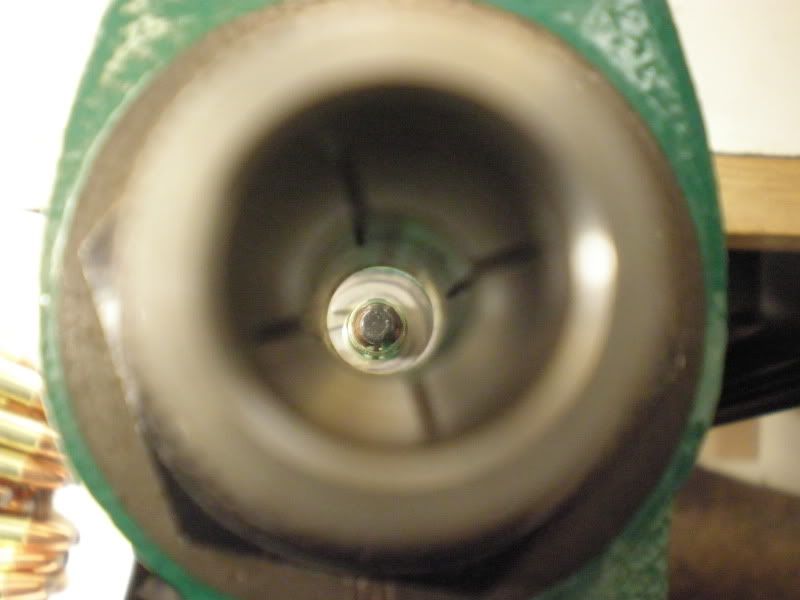 Looking straight down at FCD at rest, see the 4 slots in the collet? 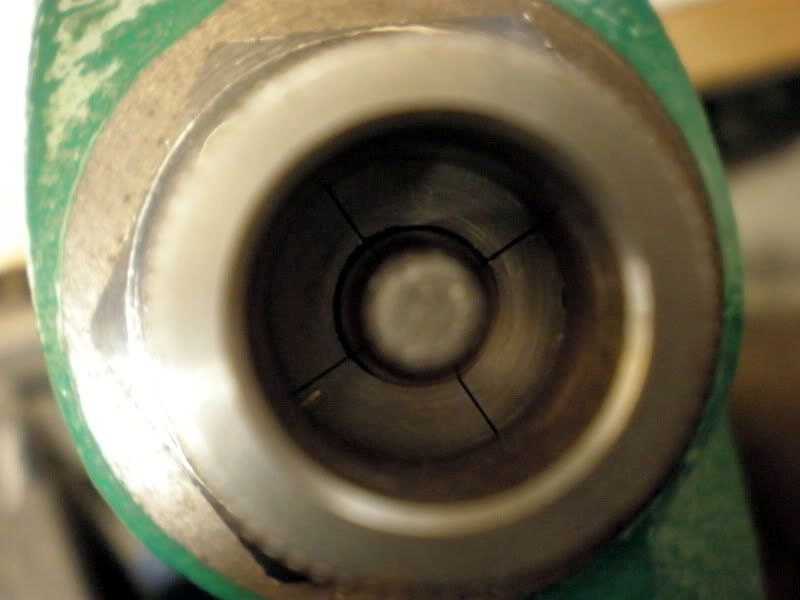 Crimping, see how the slots are almost closed? Take case out and look for the crimp marks at case mouth. Pistol is easier, measure case mouth before and after crimping to see how much crimp was applied.
|
|
So all I will really see to know it is crimped is a slight mark at the mouth of the case, there isn't much measurable change? Also, while I was measuring and sorting brass... It popped into my head to ask: Do different rifles like different case lengths? Obviously if you had a 1.740 OAL and a 1.760 OAL and you mounted 2 similar bullets to the same point on the cannelure you would have approximatly a .020 OAL difference. Would it make a difference for normal shooting situations or is that more of a precision accuracy thing? |
|
Quoted:
So all I will really see to know it is crimped is a slight mark at the mouth of the case, there isn't much measurable change? Also, while I was measuring and sorting brass... It popped into my head to ask: Do different rifles like different case lengths? Obviously if you had a 1.740 OAL and a 1.760 OAL and you mounted 2 similar bullets to the same point on the cannelure you would have approximately a .020 OAL difference. Would it make a difference for normal shooting situations or is that more of a precision accuracy thing? The instructions with the Lee FCD are very good. If you adjust it down to where the gaps between the crimping lugs are completely closing you are probably crimping more than you need. Never push it beyond fully closed. No. Case length is entirely a safety issue. If it is too long the case mouth can get jammed into the rifling which will prevent the neck from expanding to release the bullet. A very dangerous over pressure event can result. (It can blow up your gun) Going short on your trimming is not recommended but does not cause a safety issue unless you go WAY TOO SHORT. Just keep them at or under max and you'll be fine. The Lee trimmer with length rod and stud will make them 1.745" at least mine does. I don't know your intended use or what rifle you have but I don't crimp any of my .223/5.56 ammo. Today, at the range I had the last round in a old GI 20 round mag pop up and get jammed. The bullet was a Hornady 55gr SP with cannelure. The soft point was completely smashed flat against the jacket. The bullet did not move in the case. I don't think a crimp is necessary. BTW: This bullet has to be seated with the entire cannelure out of the case just to get it to 2.235" There is no way I'm pushing it in more just to get to the "crimp groove"aka cannelure. |
|
The instructions with the Lee FCD are very good. If you adjust it down to where the gaps between the crimping lugs are completely closing you are probably crimping more than you need. Never push it beyond fully closed. No. Case length is entirely a safety issue. If it is too long the case mouth can get jammed into the rifling which will prevent the neck from expanding to release the bullet. A very dangerous over pressure event can result. (It can blow up your gun) Going short on your trimming is not recommended but does not cause a safety issue unless you go WAY TOO SHORT. Just keep them at or under max and you'll be fine. The Lee trimmer with length rod and stud will make them 1.745" at least mine does. I don't know your intended use or what rifle you have but I don't crimp any of my .223/5.56 ammo. Today, at the range I had the last round in a old GI 20 round mag pop up and get jammed. The bullet was a Hornady 55gr SP with cannelure. The soft point was completely smashed flat against the jacket. The bullet did not move in the case. I don't think a crimp is necessary. BTW: This bullet has to be seated with the entire cannelure out of the case just to get it to 2.235" There is no way I'm pushing it in more just to get to the "crimp groove"aka cannelure. That's good to know the bullet doesn't HAVE to be seated to cannelure if it has one. These 55gr rounds are for first loads and experimentation and eventually just range rounds. I eventually want to start working on heavier gr bullets (70-77gr range) for the AR I'm currently gathering parts for. I don't want to get into the accuracy side of it until I have practiced enough with these standard 55gr loads. I found 20 cases out of all the brass I have that measured out to 1.750-1.751 OAL and decided to go ahead and load them. I used the 25gr start load of H4895. The book says the min OAL is 2.200 and these loaded cases measure 2.228-2.230 OAL so I guess I'm good... I did look at a crimped round and one I hadn't run through the FCD and I can see a slight line just around the mouth that isn't there on the uncrimped round. I loaded 5 of them (the longest, the shortest and a few random in-between) into a 20rd Pmag and all 5 of them fed fine and bolt closed fine. I locked the bolt open and loaded a round with the bolt release. There was only a .001in change in OAL vs a factory PMC round that had a .004in change. Which isn't even the size of a human hair... So all that's left is a test fire I guess. Thanks everyone. |
|
Quoted: So all I will really see to know it is crimped is a slight mark at the mouth of the case, there isn't much measurable change? Rifle yes, pistol you measure. Also, while I was measuring and sorting brass... It popped into my head to ask: Do different rifles like different case lengths? Again, trim to "trim to length". Obviously if you had a 1.740 OAL and a 1.760 OAL and you mounted 2 similar bullets to the same point on the cannelure you would have approximatly a .020 OAL difference. Would it make a difference for normal shooting situations or is that more of a precision accuracy thing? The 1.740 case is under length. I would scrap it. Some here would reload it. You keep asking the same question different ways. |
Armory Sponsor