


Armory Sponsor


Posted: 5/15/2012 6:45:24 AM EDT
|
I'm looking for ideas for reloading components storage. I've got brass scattered everywhere, with .223 in various headstamps and stages of processing. Plus piles of pistol brass, projectiles, primers, etc. I'm wondering how you all store and catalog your great mountains of stuff!? Bins? Coffee Cans? Tupperware? I'd love to see your ideas! Post some photos and descriptions please?  |
|
For me, I just store projectiles, primers and powders in their original container in a shelving unit I built out of pine board on top of my reloading bench. Brass poses a bit more of an issue, since, as you have already said, it's in all different head stamps and stages of processing. This is my method, which may or may not work for you depending on the volume of brass you work with: 1.) All unsorted, dirty range pickups (including my own fired brass) goes into a cardboard box with a piece of paper explaining what the contents are (the date, whether the contents are range pickups or ___ fired brass, etc) so it isn't a mystery the next time I open the box... which could be a year or two later! 2.) As soon as I do anything to the brass, it gets tossed into one of these things along with a process card I made up to suit my overall workflow:  When I'm done working on a particular lot of brass, it goes up on another shelving unit I built next to my reloading bench, with the card facing out from the inside of the container. I can tell at a moments glance what exactly the brass inside the container is, what has been done to it, and when. This seems to work for me. I've only been reloading for a few years now, so my process is still evolving. Hope this helps. |
Powder goes in the ammo cabinet which stays locked. Primers go in a plastic water proof ammo can. Brass goes in coffee cans, but I found some large clear plastic containers at Walmart for $3, I think they are for cereal or something but they hold about 700 223 brass nicely. They are labeled with making tape and a Sharpie. Blasting pills in the 55gr variety fill a glass block on the bench. It holds about 2000, and it's pretty and makes a nice place for fake flowers.
Things seem to be expanding quickly though. Larger containers are only a few thousand brass away. |
|
Quoted: I have stackable plastic bins and store ziplock bags of brass with sticky notes inside describing the contents. ETA- and 5 gallon buckets of unprocessed brass. I use the clear stackable shoe box sized bins for my brass after it is sorted. I keep small quantities of misc. brass (stuff I don't reload for or shot too often) in Ziploc bags inside one of the shoe box sized bins. I keep my bullets in the original boxes staked on the bottom shelf of my bench. |
|
Quoted: For me, I just store projectiles, primers and powders in their original container in a shelving unit I built out of pine board on top of my reloading bench. Brass poses a bit more of an issue, since, as you have already said, it's in all different head stamps and stages of processing. This is my method, which may or may not work for you depending on the volume of brass you work with: 1.) All unsorted, dirty range pickups (including my own fired brass) goes into a cardboard box with a piece of paper explaining what the contents are (the date, whether the contents are range pickups or ___ fired brass, etc) so it isn't a mystery the next time I open the box... which could be a year or two later! 2.) As soon as I do anything to the brass, it gets tossed into one of these things along with a process card I made up to suit my overall workflow: http://i979.photobucket.com/albums/ae280/sabre19a1/BrassCard.gif When I'm done working on a particular lot of brass, it goes up on another shelving unit I built next to my reloading bench, with the card facing out from the inside of the container. I can tell at a moments glance what exactly the brass inside the container is, what has been done to it, and when. This seems to work for me. I've only been reloading for a few years now, so my process is still evolving. Hope this helps. That's very cool, that's very much along the lines I was thinking.
|
| 120MM Mortar ammo cans- same cross section as a 50 cal, 4 times the height. They hold about 5K 223 or 2500 308. I preclean brass and bag in 1 gallon ziplocks which are then tossed into a can. I can reach in a can and grab a ziplock as needed. The cans have handles at about 32" height are very easy to move around, even full. Will not split or crack like plastic, and are were Hurricane Katrina proof tested by a friend that also uses them. |
|
Everything is out in the ManCave.
I keep my powder, primers and bullets in the original packaging. The primers and powder are stored in cabinets. Primers are stacked according to type. Bullets are stored on shelves, according to calibers. Brass When I return from the range, I sort my brass into plastic colanders (Dollar store, $1. ea.) Once sorted by caliber, I usually wash/rinse the brass to remove dirt. (Outdoor range) Let it dry - Texas summer dries the brass quick. Then it hits the tumbler . After tumbling, it gets sorted and bagged. (Ziploc freezer bags, 1gal size) 5.56 brass is sorted by head stamp. For some reason, I separate Winchester pistol brass and store it separately from the other pistol brass. .45 / .40 / .38spl & .44 brass gets bagged 200 rnds/bag. 9x19 & 9x18 get stored 300rnds/bag. Each bag gets a label with the number of cases. Winchester brass gets marked Winchester and number of cases - again, I don't really know why I do this. The bags get stored in bins I mounted on the wall. (Northern Tool) Here is an old photo, the bins are fuller now: 
I have an excel spreadsheet which I keep updated with the amount of brass, primers, powder, bullets. All sorted by type. Bagging the brass in smaller amounts and keeping everything else in it's original packaging, makes it easy to do inventory and keep track. Plus, with a copy of the spreadsheet on my i-Touch, if I am out and about and find some deals, I know what components I am low on. I also keep track of component costs. I keep an average of my costs for each component. When I load up a batch, I label them with the date loaded, bullet type, powder type, primer type, grains of powder and a total cost per bullet. |
|
That's pretty close to where I am now. I was just looking at similar bins from Harbor Freight, but most of the larger ones were very flimsy. I even found some of those bins that can hang from slat wall! I like the Excel spreadsheet idea, I'm leaning towards keeping a portable inventory for that as well. I'm getting to the point where I can't remember what all I have tucked away in corners of the garage. I think I'm getting closer to figuring this all out. I just need to figure out what kind of drawers/storage I'll build into my reloading bench.
Quoted: Everything is out in the ManCave. I keep my powder, primers and bullets in the original packaging. The primers and powder are stored in cabinets. Primers are stacked according to type. Bullets are stored on shelves, according to calibers. Brass When I return from the range, I sort my brass into plastic colanders (Dollar store, $1. ea.) Once sorted by caliber, I usually wash/rinse the brass to remove dirt. (Outdoor range) Let it dry - Texas summer dries the brass quick. Then it hits the tumbler . After tumbling, it gets sorted and bagged. (Ziploc freezer bags, 1gal size) 5.56 brass is sorted by head stamp. For some reason, I separate Winchester pistol brass and store it separately from the other pistol brass. .45 / .40 / .38spl & .44 brass gets bagged 200 rnds/bag. 9x19 & 9x18 get stored 300rnds/bag. Each bag gets a label with the number of cases. Winchester brass gets marked Winchester and number of cases - again, I don't really know why I do this. The bags get stored in bins I mounted on the wall. (Northern Tool) Here is an old photo, the bins are fuller now: http://img140.imageshack.us/img140/8135/brass.jpg I have an excel spreadsheet which I keep updated with the amount of brass, primers, powder, bullets. All sorted by type. Bagging the brass in smaller amounts and keeping everything else in it's original packaging, makes it easy to do inventory and keep track. Plus, with a copy of the spreadsheet on my i-Touch, if I am out and about and find some deals, I know what components I am low on. I also keep track of component costs. I keep an average of my costs for each component. When I load up a batch, I label them with the date loaded, bullet type, powder type, primer type, grains of powder and a total cost per bullet. |
|
Quoted: Now you, Sir, are squared away. Nice work.Everything is out in the ManCave. I keep my powder, primers and bullets in the original packaging. The primers and powder are stored in cabinets. Primers are stacked according to type. Bullets are stored on shelves, according to calibers. Brass When I return from the range, I sort my brass into plastic colanders (Dollar store, $1. ea.) Once sorted by caliber, I usually wash/rinse the brass to remove dirt. (Outdoor range) Let it dry - Texas summer dries the brass quick. Then it hits the tumbler . After tumbling, it gets sorted and bagged. (Ziploc freezer bags, 1gal size) 5.56 brass is sorted by head stamp. For some reason, I separate Winchester pistol brass and store it separately from the other pistol brass. .45 / .40 / .38spl & .44 brass gets bagged 200 rnds/bag. 9x19 & 9x18 get stored 300rnds/bag. Each bag gets a label with the number of cases. Winchester brass gets marked Winchester and number of cases - again, I don't really know why I do this. The bags get stored in bins I mounted on the wall. (Northern Tool) Here is an old photo, the bins are fuller now: http://img140.imageshack.us/img140/8135/brass.jpg I have an excel spreadsheet which I keep updated with the amount of brass, primers, powder, bullets. All sorted by type. Bagging the brass in smaller amounts and keeping everything else in it's original packaging, makes it easy to do inventory and keep track. Plus, with a copy of the spreadsheet on my i-Touch, if I am out and about and find some deals, I know what components I am low on. I also keep track of component costs. I keep an average of my costs for each component. When I load up a batch, I label them with the date loaded, bullet type, powder type, primer type, grains of powder and a total cost per bullet. |

|
My primers are stored in a plastic ammo can just because when I decided to store stuff in ammo cans by the time I got around to primers a plastic one was all I had left.
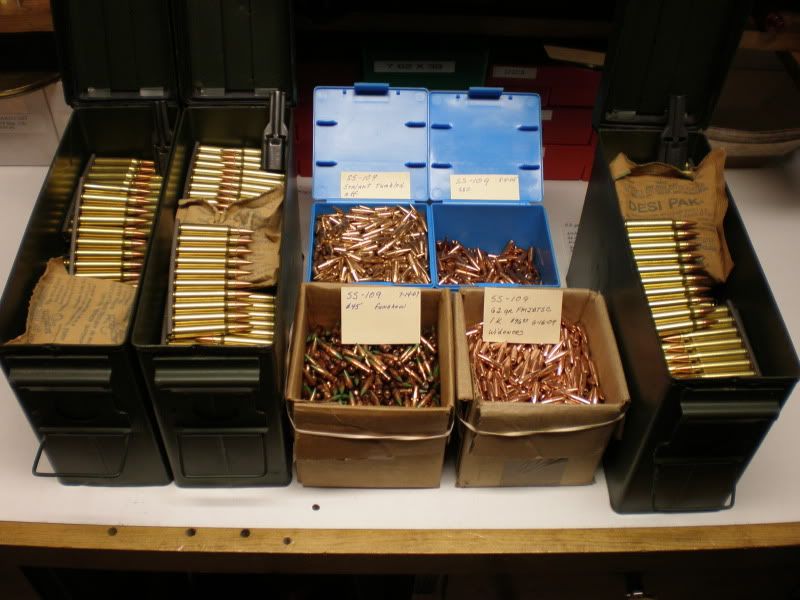
Powder is stored in 120 mm ammo cans I think. The cans are large enough to fit 2 8 pound jugs. I don't secure the lids. I have about 8 one pound working containers on a shelf. Brass is stored in 30, 50 and tall 50 mm ammo cans. Rifle brass is sorted by head stamp and # of firings, pistol brass is sorted by once fired and everything else. I use zip locks inside the ammo cans to keep sized or not brass separate and cardboard dividers to keep head stands separated. Large quantity's of bullets go in 30 and 50 mm ammo cans, small quantity's go in Midway blue plastic storage boxes. Loaded stuff gets stored in plastic ammo boxes on a shelf or in certain quantity Zip lock bags in ammo cans. If I was to do it over again I would not use ammo cans but instead use the plastic tubs available from WalMart. Ammo cans seem like a great idea when you have a couple calibers and a couple thousand pieces of brass but when a guy needs 5 50mm cans to just store his 223 brass it gets a little crazy. I use the index type card posted above to keep track of what has been done to the brass but on mine I left off the date. I don't really care when I sized or trimmed the brass. I also have a similar label for my cast bullets. I track all supplies, loaded ammo, casting, shooting and press time on a couple different excel spread sheets. I find its very convenant to grab the clip board and see how many widgets I have. My sheets have enough room for notes on the sides or I use stickys to keep track of what I have done and update the sheet every so often depending on the amount of stickys. |
Armory Sponsor