


Armory Sponsor


Posted: 9/23/2011 9:19:52 AM EDT
|
I haven't reloaded long, but I have a few hundred .223 and .308 under my belt. My question, is besides inspecting the case for cracks and defects post firing...how can you tell brass is going bad? What are your ttp's? I seperate my brass into tubs with the number of times it's been fired on it. I have heard that primer pockets begin to get loose? How many times can one expect to reload .308 and .223 brass with moderate power loads? I understand it varies by manufacturer, but is there a point at which you start becoming cautious? I appreciate any advice you can provide!
On edit: Full length sizing AR15 and AR10 |
|
The main reason to inspect cases is to determine if they can be reloaded again.
After a few firings, look for incipient case separation and cracks. 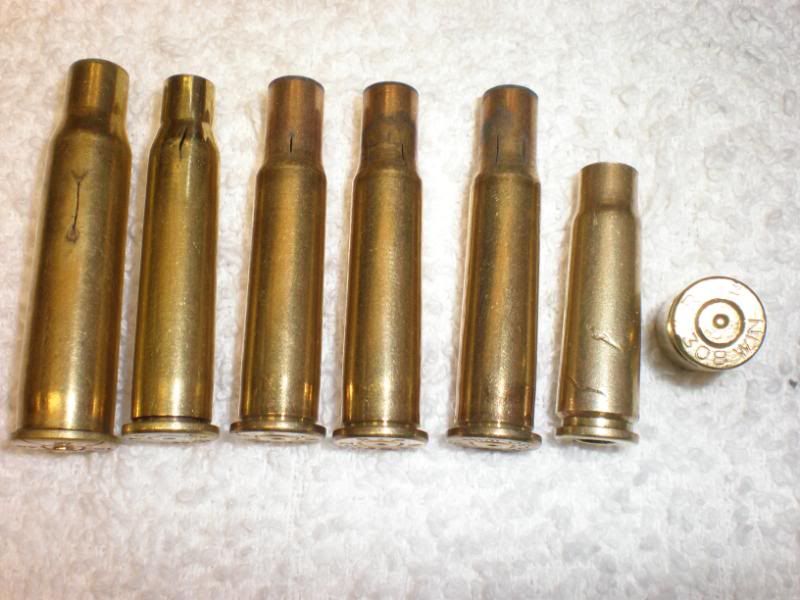
Splits 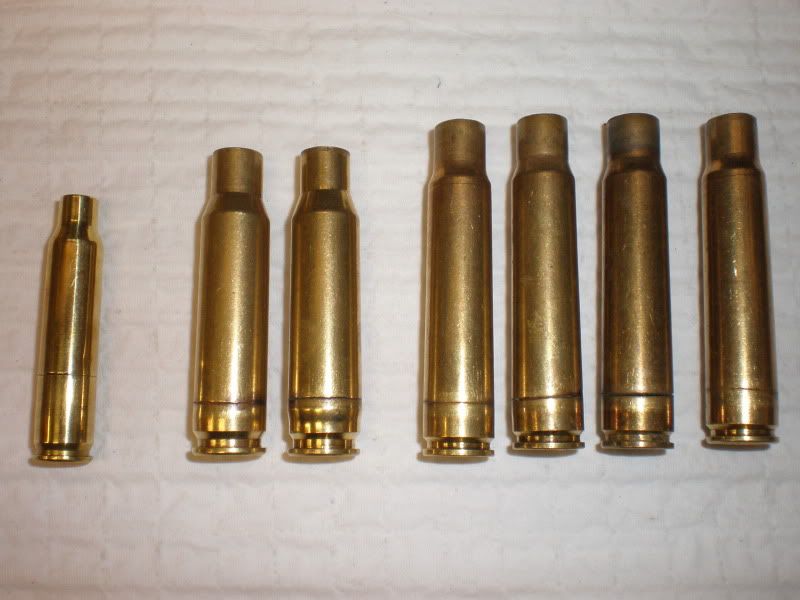
Incipient case separation. These cases were fired one time too many. These are range pick ups. A clear fault line would have been visible where the crack formed if the handloader would have inspected his cases before loading. 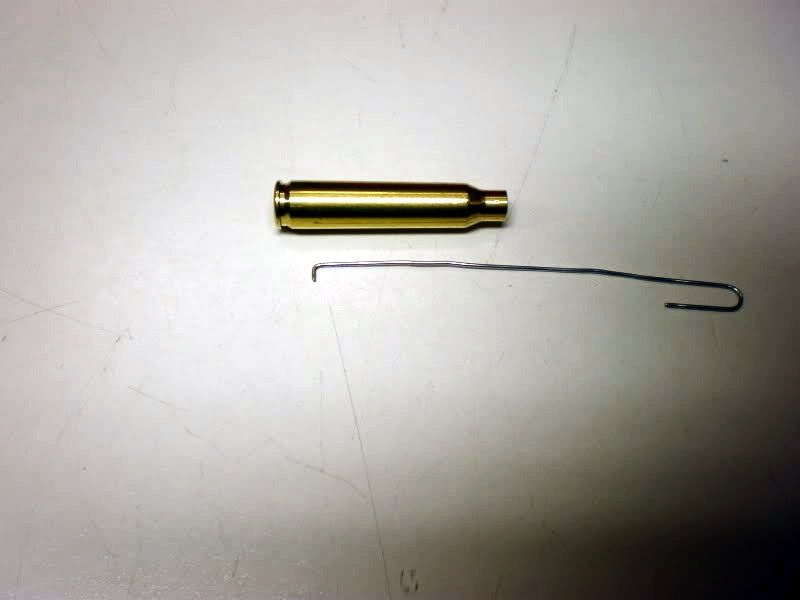
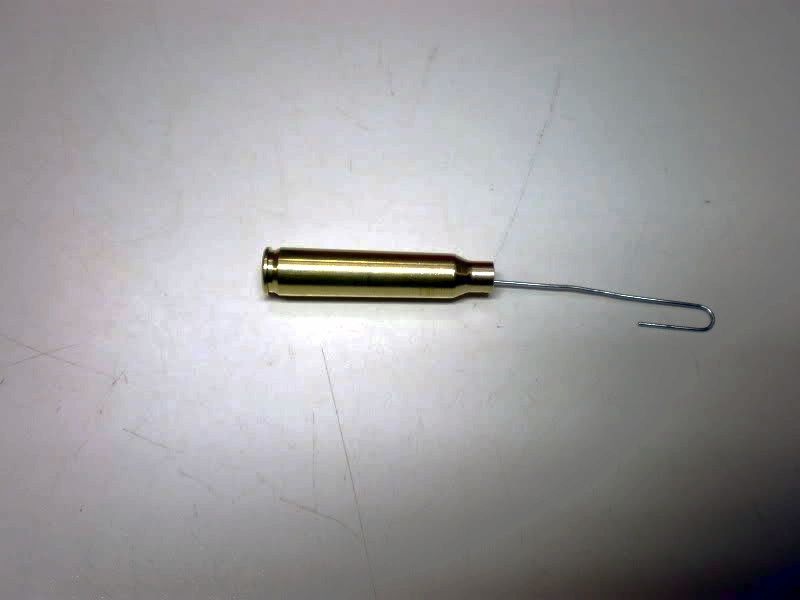
Paper clip test would have found the separation starting. Also if the primer seats with little resistance, the primer pocket has expanded and that case should be scrapped. |
|
Higher pressure centerfire rifle loads be cautious after 2 or 3 loads.
Also beware of mil-surps which tend to have generous chambers for reliability with dirty ammo, this beats the heck out of the brass Higher pressure pistol loads like 357 and 44 mag will beat up the brass fairly fast (watch trim lengths) mild loads like 45acp and 38sp you will lose the brass before you wear it out. In some instances care in reloading such as inside lubeing case necks when using ball type neck expander will have an effect on case life. Different brands and lots of brass can have greatly different lifespan |
|
I closely track the firings on 223 brass, you can start to see some neck cracks sometimes after the first firing, usually second or third firing, after the case has been fired 5 times it enters the "disposable" phase, lots of neck cracks after that point. I save the 5 fired brass and set it aside for hunting or other situations where I can't pick up the brass, its disposable. IMHO 223 brass is good for 5 firings, AR's are rough on brass, don't have a bolt gun in that caliber so I don't know about 223 case life in bolt actions |
|
Quoted:
What's the paper clip test? A point is filed on the straightened out clip then a small length bent 90 degrees. The pointed end is run across the inside of the case to check for internal cracks not visible from the outside. Alot of head separation circumferential cracks start inside. The RCBS case master has a feeler that can be set up to measure case wall thickness and find the location of the crack a little more precise. The model is cut away to show the principle of operation. 
|
| I will probably catch lots of grief from my practices but I have found that as a general rule my primer pockets wear out before my brass shows any signs of fatigue...I dont count how many times I have loaded my brass but I imagine I am somewhere in the ballpark of 8-plus reloadings maybe more.. Now with that said I do inspect brass very good, because I want to get every reload possible.I do load middle of the road. I feel if you have good QC then this practice should treat you well but dont take my word for it...I tested a 100 cases to see how they changed as they was reloaded time after time so I could see what the progression was during the case life..Out of that 100 cases no case failure just primer pockets loose.. Take that for what it is, just my experience.. Be careful and do your own testing.. |
|
In regard to .223 I never had an issue with loose primer pockets (except for FC and Norinco brass) nor case head separations, all my brass dies from neck splits. If you set up your sizing die with the aid of a case gage you shouldn't have case head separation problems unless you shoot that ammo in an out of spec gun |
|
Quoted:
In regard to .223 I never had an issue with loose primer pockets (except for FC and Norinco brass) nor case head separations, all my brass dies from neck splits. If you set up your sizing die with the aid of a case gage you shouldn't have case head separation problems unless you shoot that ammo in an out of spec gun How do you do that? I just screwed my LEE die in until it touched the ram. I guess I am behind the power curve here. I'd appreciate expansion! |
|
Quoted:
Quoted:
In regard to .223 I never had an issue with loose primer pockets (except for FC and Norinco brass) nor case head separations, all my brass dies from neck splits. If you set up your sizing die with the aid of a case gage you shouldn't have case head separation problems unless you shoot that ammo in an out of spec gun How do you do that? I just screwed my LEE die in until it touched the ram. I guess I am behind the power curve here. I'd appreciate expansion! Way behind the curve, a case gauge is OK but all it does is get the head space back down to the SAAMI tolerance which may or may not be OK depending on your rifle chamber, still better than nothing to gauge with since sizing without will usually result in head space even shorter than the SAAMI spec which will cause excessive/loose head space in your rifle which causes case head separation very quickly. A tool like the Hornady head space gauge kit is much better, with it you can measure your fired brass and get the actual head space length of your chamber and then measure how much your setting the shoulder back during sizing which shouldn't be more than .004" which will make case head separation nonexistent. I have almost 20 reloads on over 100 of my 6.8SPC cases and almost 15 loads on another 100 cases and have never had a split neck(anneal after 5 loads) or any case head separation problems but I size my brass so it fits my chamber and doesn't stretch much during firing, I'm fixing to retire the older lot due to loose primers since all 20 loads have been hot to say the least. I size my .223 brass the same way but since .223 brass is so cheap and I have K's of cases already I don't bother annealing it very often and chunk it at about 10 reloads, good factory annealed LC brass will go this long easy without a neck split if using a bushing die instead of a regular FL sizer that way over sizes the neck each time. |
|
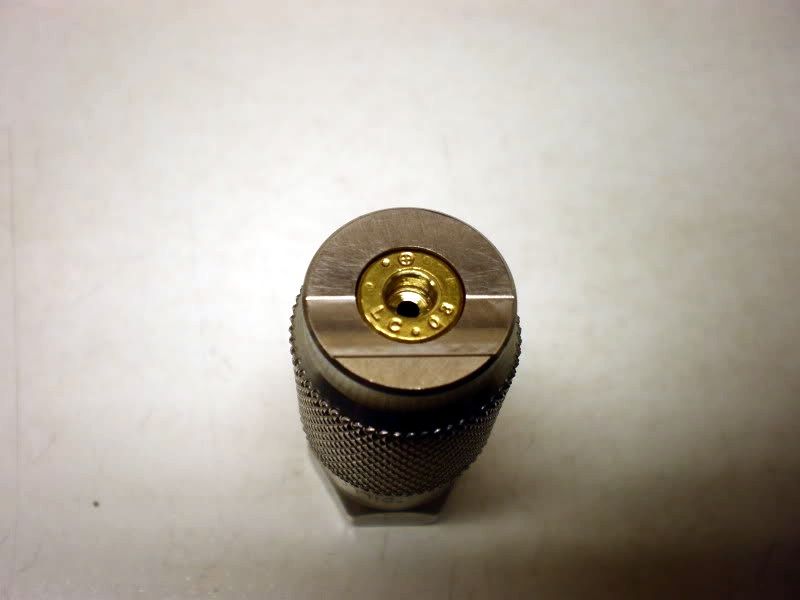
Quoted: Quoted: In regard to .223 I never had an issue with loose primer pockets (except for FC and Norinco brass) nor case head separations, all my brass dies from neck splits. If you set up your sizing die with the aid of a case gage you shouldn't have case head separation problems unless you shoot that ammo in an out of spec gun How do you do that? I just screwed my LEE die in until it touched the ram. I guess I am behind the power curve here. I'd appreciate expansion! See step 4 here http://www.ar15.com/content/page.html?id=451 |
Armory Sponsor