


Armory Sponsor


Posted: 9/18/2011 6:06:49 PM EDT
|
I'm going to give a try for the first time in the morning reloading some .223. I'll be using random make once fired brass and some of the pulled 55gr FMJ from Hi-Tech ammo. For powder I have some H335 to use, and Winchester SR primers.
In my Lyman 49, the closest info is a 55gr jacketed SPT and it says use a start of 24.3. I looked at Hodgdons website and I have no clue what all of the projectiles are there, but it says for a 55gr SFIRE start at 21.4 and max of 22.8. So I'm kind of torn as to what start charge to use. What do you guys use for a start with a 55gr FMJBT w/can. with H335? Oh, and it's for a Smith & Wesson M&P 15. |
|
If the bearing area on that FMJBT looks like the Sierra 55 FMJBT then you might consider looking at their tables as well.
I can't find a description of the Hi Tech 55 FMJBT, so all I can add is that if it looks like a match of the Sierra, they use a low end of 23.6 for H335. http://accurateshooter.net/Downloads/sierra223ar.pdf |
|
Because different projectiles can create different pressure pulses. Even when their weight and rough shape look the same.
You have to look close at the shape of the bearing area to see the point. Longer bearing areas tend to raise pressures, but there are other variables too. Programs like Quickload make an attempt at estimating pressure pulses for different combinations, but it takes measurement to know for sure. If you pay attention, as you obviously have, you can see the differences between similar bullets of the same weight on those load data pages. In other sources, it seems like they are grouping many bullet designs under one table, but it is likely that their bearing area profiles are all similar. Like Sierra for example. |
|
Quoted:
While you need to work up, I've found max loads of 2.3 23.0 of H335 under a 55 FMJ totally safe for a muzzle velocity of around 2850 fps in a 14.5 inch barrel. FIFY PS: I have no idea what hodgdon means by SFIRE. Anybody? PSS: Full length size (even new cases) and trim case to 1.75" afterward. |
|
Yep I've gotten them all trimmed up and ready to go! I've just been procrastinating because I guess I'm kind of intimidated starting in on rifle finally. Lol
I think I've pretty much got the process down for pistol and have been doing well with that so far. Now I'm just worried about damaging an AR that I've got $1,000 plus invested in!! As always thanks for the input so far, its much appreciated! eta: can't spell today sorry |
|
I was trying to think of some of the lessons I learned the hard way here with my first .223 55 fmj loads.
First, after sizing and trimming, put a few together with no powder and primer (dummies). Use your rifle and favorite (dependable) magazine and run a few of these dummies through (dry feed and eject) to assure that head spacing is no problem (BCG closes and locks and round extracts easily with charging handle). One other point: If you are tempted to roll crimp into the cannelure, make it a two step operation. Seat first with die body pulled back out a smidge, then after seating the batch to hold a selected COAL, pull the seater stem up out of the way and gradually come down with the die body until you feel the crimping ledge start to pick up on the neck. If you have accurately trimmed the cases, then you can lock down the die body at the proper roll crimp point and crimp the entire batch from there. The reason: The neck and shoulder region of the case is fairly soft (as it should be). If combined seating and roll crimping forces are applied, it is easy the bulge the shoulder, which will cause FTFs and FTEs. After several assemblies are finished, as a final check, break down the AR and finger feed a few random rounds into the chamber, pushing down snug. Turn the turn chamber up and see that the round slides back out. |
|
Quoted:
Thanks for the tips! That was one other thing I have been debating. I see some people say don't worry about crimping and I see others do it. I do have a Lee FCD for the .223. Crimping is a personnel choice in 223. Try crimping and not crimping and see what works for you. My method is to crimp 55 and 62 gr FMJBT's. These I seat to mid cannelure. All other bullets in 223 I don't crimp. I seat all of these to 2.250, slightly less than mag length of 2.260. Seat and crimp in separate dies. Adjust your seat/crimp die to seat only. Just adjust die up so the crimp ring doesn't touch the case mouth. Then adjust seating stem down to the OAL you want. I crimp with a Lee FCD. Good luck |
|
Another random question related to this. When I reload pistol, there's the powder through expanding die that my powder measure is mounted to. What do I mount my powder measure on when doing the .223? There's no expanding going on here lol.
ETA: nevermind, I see I need the rifle charging die |
|
Quoted:
Thanks for the tips! That was one other thing I have been debating. I see some people say don't worry about crimping and I see others do it. I do have a Lee FCD for the .223. use it........it gives you the ability of giving every rd the same neck tension. and, if there ever is a problem where a rd getsjam,d up against the barrel for what ever reason, the odds of the rd being pushed into the case are minimal....( I promise) |
|
Quoted:
Another random question related to this. When I reload pistol, there's the powder through expanding die that my powder measure is mounted to. What do I mount my powder measure on when doing the .223? There's no expanding going on here lol. ETA: nevermind, I see I need the rifle charging die I have my measure mounted on a separate stand. |
| The pulled 55 fmj's should be seated to approximately 2.250" and that should put the cannelure in position to crimp if you want to crimp. Pulled 55 fmj's I've loaded with H335 are fine from 24.5 to 25 grains. I'd start at 24 and work up to not more than 25 grains of H335. The SFIRE bullets are lead free frangible bullets and load data would not be compatible with jacketed bullets. Make sure your cases do not exceed maximum length and also that primers are seated flush or below into the primer pocket. A lot of loaders use 24.5 to 25 grains. That should give you a velocity from 3000 up to 3150 fps depending on your rifle and barrel length. Sinterfire has a web site. The frangible bullets are pressed together from metals and splatter and turn to dust on impact with a solid object. Some police and military groups use the sinterfire bullets for training to reduce the chance of richochet and to prevent lead contamination. |
|
Ok I had lots of stuff come up and I didn't start when I wanted to unfortunately. So tonight I was setting up the press and was frustrated with a few things lol. I set the measure as close to 24gr as I could. I threw five charges and weighed them. they were 23.8, 23.7, and 23.6 three in a row. So now I'm worried I 'll have to weigh every charge on the scale lol.
Next when I was making some dummy rounds trying to get the bullet seated where I wanted was frustrating as well. By chance, the first one was nearly where I wanted it, almost in the middle of the cannelure. So I just turned the knob ever so minutely to try to just touch it up. So the next one I do, seats it WAY over the cannelure. So anyways, I finally got it set pretty much where I wanted it, but there is still some variance from round to round. Like I said before, I'm pretty new to reloading and these are my first rifle rounds, so maybe I'm still not catching on to something. |
|
After you adjust your powder measure or add more powder I would suggest you tap it a few times to get the powder to settle. H335 should measure pretty much nuts on.
Sounds like in your post above you have it adjusted to 23.6. (Which isn't a terrible place to start anyway, IMO) If you want it to throw 24.0, adjust a little more and throw a few charges (5 or so) without measuring (just toss them back into the hopper). Then start weighing them. If you are consistently throwing +/- .1 grain, you're good to go. |
| 22.4g of H335 under a Hornady 55g FMJBT is my pet range load and its very accurate. I've tried a couple thousand of the air pulled bullets from Hi-Tech and they aren't as accurate as the Hornadys. You can get the Hornady 55g for the same price as the air pulled but you have to buy 6k of them. |
|
Quoted:
Ok, so if one of the rounds doesn't eject easy when I pull the charging handle, what does that mean I've done? LOL You need to size the case some more, the shoulder didn't get pushed back far enough. The Hornady Head Space comparator set is good for setting your sizing die up to size the brass so it will fit your chamber, another good tool is the RCBS Precision Case Mic, it will also show you how much your setting the shoulder back plus it shows you if the sized case is under or over SAAMI mIn head space for an in spec .223 chamber. |
|
Ok, I've been getting the dies all set up and ready to go and making a few test dummy rounds. When I'm seating how exact do you want to be? I know it's not many, but I just made two more dummy rounds and one is seated to 2.24, and the other is at 2.245. I was shooting for 2.250. Is a variance like this ok?
Should I keep making minute turns to get it exactly at 2.250? The reason I ask is because it just seems to be hard to get it right on. I'll get it close then make another adjustment and it's way off the other way then lol. This ammo is just for training purposes, but obviously I'd like for it to be half way accurate. |

|
Quoted:
Ok, I've been getting the dies all set up and ready to go and making a few test dummy rounds. When I'm seating how exact do you want to be? I know it's not many, but I just made two more dummy rounds and one is seated to 2.24, and the other is at 2.245. I was shooting for 2.250. Is a variance like this ok? Should I keep making minute turns to get it exactly at 2.250? The reason I ask is because it just seems to be hard to get it right on. I'll get it close then make another adjustment and it's way off the other way then lol. This ammo is just for training purposes, but obviously I'd like for it to be half way accurate. With 55gr FMJ's with a cannelure, I've always seated the bullet to mid cannelure. With a trim to length of around 1.750 the OAL will be around 2.20, give or take. Depends on the case trim length and where the cannelure is located on your bullets. When I measure the OAL when seating to mid cannelure, if the length is less than 2.250 I'm happy. 55gr FMJ's are shorter than the heavier bullets and you should strive to have 1 diameter length (.224) of the bullet in the neck for good bullet tension. So the cannelure is an easy guide to achieve this. 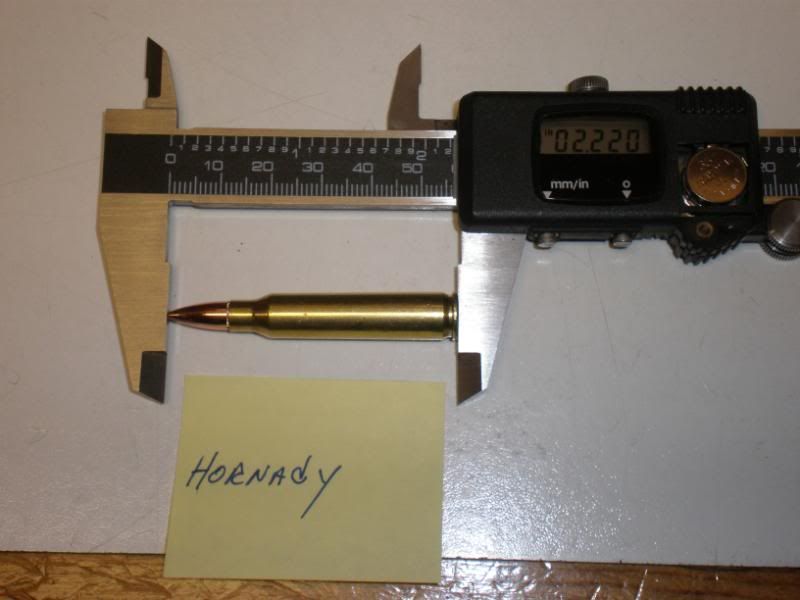
Hornady 55 gr FMJBT. 
Winchester 55 gr FMJBT. 
Wolf factory 55 gr FMJBT. 
And SS-109, 62 gr FMJBTSC. So with the OAL it all depends. All of my cases in the pics were trimmed to 1.750. Except the Wolf factory load. Good luck |
Armory Sponsor