


Armory Sponsor


Posted: 9/6/2011 3:41:40 AM EDT
|
are there any manuals to start with, before buying equipment?
tia |
|
Quoted:
Lyman has about the best casting reference book. Make sure you have a supply of lead and wheel weights before dumping $$$ into equipment unless you are going to buy "new" alloy from Roto-Metals or the like. +1 about supplies if you cant get the lead free or cheap makes not worth the investment |
|
well, a buck a pound is a deal that i can't touch, either in houston or california.
i spoke w/a lady at houston lead company and it's about $2 and change per pound for lead here. i'm assuming, ready to melt, pour and load. my go to guys are: on the east coast w/the power company or were evacuated from their homes last night due to fire! i guess i'll have to wait. thanks for the responses. |
|
Regular Lyman handloading manual has more loads and information than most of the other books but what you really want is "Lymans Cast Bullet Handbook" It has pretty much any load you could want and the front section has the basic theory up to and includeing advanced chemistry of alloys. It lays out the special techniques that apply only to cast bullets and their loading
This isn't the only source on cast bullet info but it is surely a must have |
| Free e-book on casting...http://www.lasc.us/Fryxell_Book_Contents.htm |
|
Quoted:
thanks guys. Angus, i found lead for $1/pd! i'll hit up 10ring tomorrow and look at my lee book this evening! It's out there, was several ton of lino/mono type sold not to long back at $1.00 a pound , been getting a bit of Isotope lead at a $1.05 shipped |
|
This an excellent book, I printed the whole thing. |
|
Someone said it the cast boolits forums,, I have been casting for 15+ years now,,, paid for itself many times over! you always have something to trade too,, find a source of Wheel Weights,, a mom and pop tire/ Garage,, pay them,,, and keep going back,,, they like ,, lunch money too! |
|
morris',
i ordered 65#s from a guy on castboolits, arriving shortly. i've been trying to get advice from the guys at 10ring(down the way from my office)but so far: the guru is on the east coast, working for the power company; the second guy got displaced by the shenandoah fires so i bought the lyman casting book and will begin reading after our son gets married this weekend! i'm holding off on buying equipment until i'm sure about what i'm doing! |
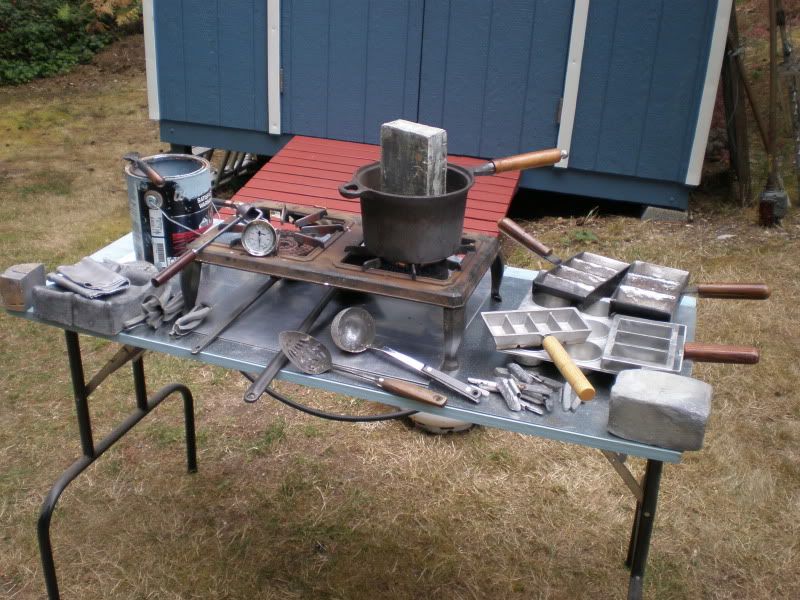
Depending on the lead you bought, you may be able to skip the smelting phase. ( removing the clips on WW wheel weights, or melting down large pieces into ingots) 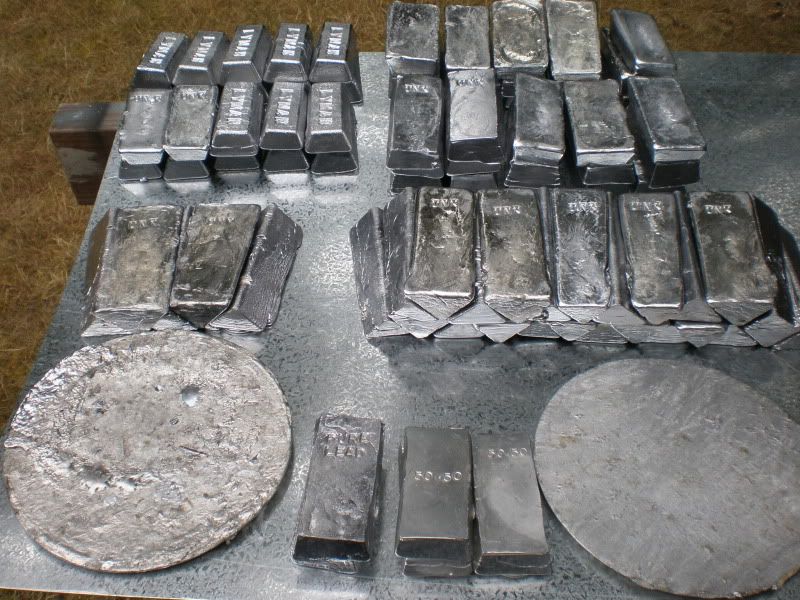
Ingots. 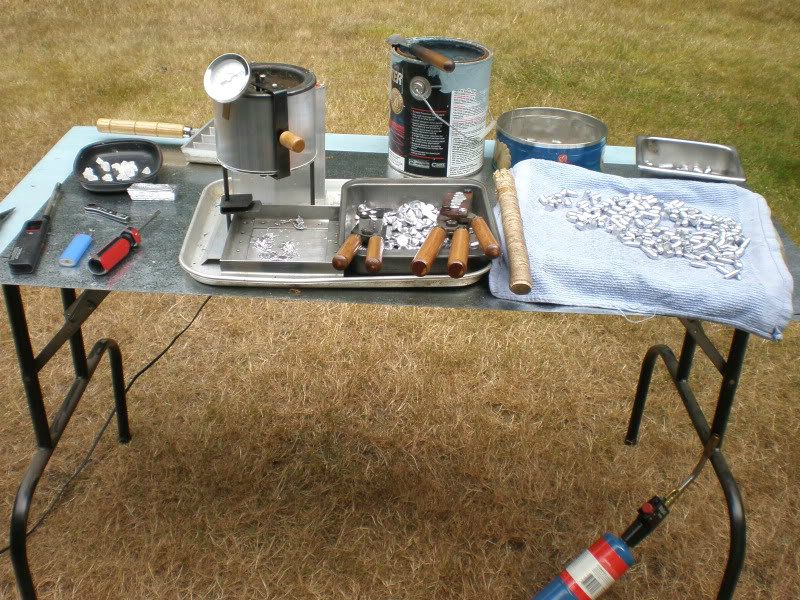
Then on to casting bullets. 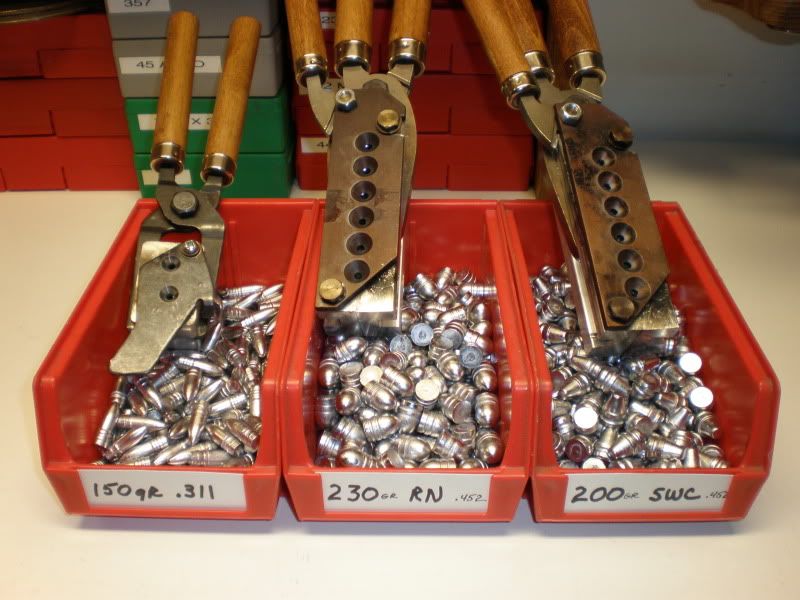
Results 
Lubing and sizing. 
Loaded. My number one tip, use plain sawdust for fluxing. The results beat anything you can buy, Link to Chapter 4 of the e book mentioned earlier. Lots of science then the last paragraph tell about using sawdust. |
|
Guys that mess with it, how do you melt down range scrap?
I am talking mangled FMJs, Cast lead bullets anywhere from clean enough to load again to smashed up slivers or just the base bands, plated bullets that have turned into quarter to half dollar sized copper backed stars. Little pieces of 22s from underneath the spinners. I did read once that if you have near whole plated bullets, that you need to smack'em good with a hammer to let the lead flow. Otherwise they will build up pressure and pop, not a good thing. Talking about fluxing too much and losing the good trace metals, I would think that just picking and scooping the copper scrap out of range lead would encourage that also? Brett |
|
Quoted:
Guys that mess with it, how do you melt down range scrap? I am talking mangled FMJs, Cast lead bullets anywhere from clean enough to load again to smashed up slivers or just the base bands, plated bullets that have turned into quarter to half dollar sized copper backed stars. Little pieces of 22s from underneath the spinners. I did read once that if you have near whole plated bullets, that you need to smack'em good with a hammer to let the lead flow. Otherwise they will build up pressure and pop, not a good thing. Talking about fluxing too much and losing the good trace metals, I would think that just picking and scooping the copper scrap out of range lead would encourage that also? Brett Here's a thread I posted on Castboolits about smelting range scrap. FWIW, the trash in the melt works fine for an initial flux. After I pull off the jackets and large trash with a wire scoop, I flux with paraffin skim the final dross, turn the gas low and pour... http://castboolits.gunloads.com/showthread.php?t=42278&highlight=smelting+day |
|
Quoted:
Guys that mess with it, how do you melt down range scrap? I am talking mangled FMJs, Cast lead bullets anywhere from clean enough to load again to smashed up slivers or just the base bands, plated bullets that have turned into quarter to half dollar sized copper backed stars. Little pieces of 22s from underneath the spinners. I did read once that if you have near whole plated bullets, that you need to smack'em good with a hammer to let the lead flow. Otherwise they will build up pressure and pop, not a good thing. Talking about fluxing too much and losing the good trace metals, I would think that just picking and scooping the copper scrap out of range lead would encourage that also? Brett The biggest pain with range scrap is all the dirt that has to be removed from the melt. Next time I melt range scrap I will try washing on a screen and laying in the driveway to dry before I melt. Start with a cold pot and let the scrap heat with the pot. This allows the scrap to heat slowly boiling off any trapped moisture. If you do add to a hot melt, add slowly and only a few at a time. Have a cover of some kind handy to contain any "popping" bullets as they are heating. Smelt with sawdust with the jackets in the melt. It will help separate melt from jackets and help keep lead from sticking to them. Remove as much dirt as possible before fluxing. Only add a small amount or scrap at a time or you will have a hell of a time skimming off the jackets. They don't scoop out as easily as clips from WW do. Use a slotted spoon or skimmer and jiggle a small amount on the skimmer at a time. The jackets will act like small cups and hold the melted lead until you jiggle them around a bit and it falls out back into the melt. ETA: Don't fill a 5 gallon bucket all the way if you are working alone unless you have a hand cart to move them. A full 5 gallon bucket of range scrap will weigh close to 200lbs and you won't be able to lift it. Range scrap is a bit more work than WW but it is worth the effort. My last range scrap smelting netted over 300lbs of dead soft lead (all commercial jacketed ammo) and 110 lbs of copper jackets. I took the jackets to the scrap yard and walked out with $310 for my effort. Free lead and $310 for my time. I think it's worth the effort. |

|
Quoted:
Guys that mess with it, how do you melt down range scrap? I am talking mangled FMJs, Cast lead bullets anywhere from clean enough to load again to smashed up slivers or just the base bands, plated bullets that have turned into quarter to half dollar sized copper backed stars. Little pieces of 22s from underneath the spinners. I did read once that if you have near whole plated bullets, that you need to smack'em good with a hammer to let the lead flow. Otherwise they will build up pressure and pop, not a good thing. Talking about fluxing too much and losing the good trace metals, I would think that just picking and scooping the copper scrap out of range lead would encourage that also? Brett You melt the scraps, like in my first pic, flux and clean the melt and pour it into ingot molds. Repeat until finished. |


|
Will you be smelting as well as casting?
Most of the smelting tools can be scrounged second hand. Propane burner Cast iron pot Slotted spoon Steel scoop for filling ingot molds Bucket for slag, an empty paint can in my pic. Ingot mold, some of mine are store bought, others I made, also use an aluminum muffin pan. Leather gloves and eye protection Flux, I use sawdust Do smelting outdoors Casting Table I'm using a Lee 20 pound furnace and mostly Lee 2 and 6 gang molds. Lyman lube sizer and dies. Lee has cheaper methods of lubing and sizing. Towels to drop soft just cast bullets on Flux, I use sawdust Lead scoop Leather gloves and eye protection Lead thermometer, optional Bullet lube I do my casting outdoors Just look at my pics, It's all shown. |
|
Ok, thanks guys! A lot of it seems pretty simple.
Sounds like I need to start looking for a fish fryer with a heavy duty base. I got plenty of sawdust or can get it. Great idea on the bed frame for material for ingot molds, never thought of that. I don't have diddly for lead compared to you guys. I barely have enough to try my hand at it once I get it smelted and get a casting pot. I do have a pistol funshoot coming up this weekend at the gun club. I am going to take a couple buckets and see what I can pick up over the lunch hour. Does anyone presort range scrap into cast lead bullets and FMJs for harder and softer lead? Or is it worth the time? Probably not, although if it was bullets you had previously cast or bullets that you knew the alloy was desirable, I would think it might be. Then again, I am talking about maybe 30 lbs, and you guys talk about 3000 lbs. Thanks, Brett |
|
Quoted:
Ok, thanks guys! A lot of it seems pretty simple. Sounds like I need to start looking for a fish fryer with a heavy duty base. I got plenty of sawdust or can get it. Great idea on the bed frame for material for ingot molds, never thought of that. I don't have diddly for lead compared to you guys. I barely have enough to try my hand at it once I get it smelted and get a casting pot. I do have a pistol funshoot coming up this weekend at the gun club. I am going to take a couple buckets and see what I can pick up over the lunch hour. Does anyone presort range scrap into cast lead bullets and FMJs for harder and softer lead? Or is it worth the time? Probably not, although if it was bullets you had previously cast or bullets that you knew the alloy was desirable, I would think it might be. Then again, I am talking about maybe 30 lbs, and you guys talk about 3000 lbs. Thanks, Brett I melt all range lead together and mark it as unknown.
I use a metal stamp set. UNK= unknown 50-50= 50-50 bar solder WW= wheel weights Pure lead= for black powder bullets I mix in WW's with UNK in the lead furnace when I cast to get the hardness I want. |
|
Quoted:
Brett, you can go to castboolits.com or i can send you the seller's info. i'm expecting 65#s for $70, shipped today. i asked another houston guy on castboolits what he thought of my purchase and he said it should pretty much be ready to heat and pour. michael Thanks, but I am not ready(financially) to get into casting just yet. I have spent a ton of time reading on cast boolits and know that there are guys that have plenty of lead for sale. Setting up an account there will be one of the first things I do after I get a furnace and molds. Dryflash, if you mix your UNK ingots with your WW ingots, how do you know when you have the right hardness? Do you batch mark your UNK lead? I would think that the WW would be somewhat more consistent? After a while do you just get a feel for it and learn that you need such and such ratio of UNK to WW to get proper hardness for whatever bullet you are casting for? I plan on starting out casting for my 45 ACP, seems like the easiest. Casting for my 629 44 mag probably wouldn't be tough either, but it would use up more lead. Thanks, Brett |
|
Quoted:
Quoted:
Brett, you can go to castboolits.com or i can send you the seller's info. i'm expecting 65#s for $70, shipped today. i asked another houston guy on castboolits what he thought of my purchase and he said it should pretty much be ready to heat and pour. michael Thanks, but I am not ready(financially) to get into casting just yet. I have spent a ton of time reading on cast boolits and know that there are guys that have plenty of lead for sale. Setting up an account there will be one of the first things I do after I get a furnace and molds. Dryflash, if you mix your UNK ingots with your WW ingots, how do you know when you have the right hardness? Experiance and not needing super hard bullets. Do you batch mark your UNK lead? Yes I would think that the WW would be somewhat more consistent? Can't say, all different brands and sizes. After a while do you just get a feel for it and learn that you need such and such ratio of UNK to WW to get proper hardness for whatever bullet you are casting for? Yes. I plan on starting out casting for my 45 ACP, seems like the easiest. Casting for my 629 44 mag probably wouldn't be tough either, but it would use up more lead. Thanks, Brett 45 ACP would be a good place to start. You don't need hard bullets for velocities under 1,000 fps. 44 mag if you want top velocities, then the hard bullets are needed. |
|
Quoted:
Thanks, but I am not ready(financially) to get into casting just yet. I have spent a ton of time reading on cast boolits and know that there are guys that have plenty of lead for sale. Setting up an account there will be one of the first things I do after I get a furnace and molds. Dryflash, if you mix your UNK ingots with your WW ingots, how do you know when you have the right hardness? Do you batch mark your UNK lead? I would think that the WW would be somewhat more consistent? After a while do you just get a feel for it and learn that you need such and such ratio of UNK to WW to get proper hardness for whatever bullet you are casting for? I plan on starting out casting for my 45 ACP, seems like the easiest. Casting for my 629 44 mag probably wouldn't be tough either, but it would use up more lead. Thanks, Brett If you are even considering casting, start collecting all the lead you can get your hands on. I started collecting lead for 6 months before I ever bought a single mold. Got almost all of it free. Even if you end up not casting you can always sell the lead and you're not out anything but your time. ETA: Do realize that casting is an addicting hobby. Pretty soon you'll be spending all your money on custom bullet molds and buying guns you can cast for. These bad boys came in the mail today. I know what I'll be doing tonight. 

|
|
i'v been checking into lubrisizers and thought about going with star but at almost $300 i think i need to catch my breath.
i'm strongly considering going w/lee to start, just for .45. can anyone give evidence that this would be a horrible waste of money? if it was it wouldn't be a horrible waste of much money! thank you all for all the help you've been so far! also, got my lead today; it came in 1# 1.4oz ingots. |
|
Quoted:
dryflash' do gaschecks reduce/eliminate the need for lube? what exactly do they do? i looked but couldn't find much info on this. muchas gracias. For rifle bullets gas checks are needed to keep the bullets from leading. You always need lube, gas check or not. With pistol bullets generally not needed, I never use them on pistol bullets. They cost about .03 cents each, so they add to the cost of the bullet. |
|
dryflash3, what type of lubesizer are you using? i had originally planned to go w/star as it's said to be the best, but the cost made me sit back down!
how was the alox too messy? you're dealing w/lead so you'd need to wash up after playing w/it anyway. i'm glad i haven't bought anything yet. |
|
Quoted:
dryflash3, what type of lubesizer are you using? i had originally planned to go w/star as it's said to be the best, but the cost made me sit back down! how was the alox too messy? you're dealing w/lead so you'd need to wash up after playing w/it anyway. i'm glad i haven't bought anything yet. Liquid Alox is very sticky/tacky and takes a while to dry. There are other ways of using it and you can read about it Here that are less messy. If your buying a new lube sizer your choices are pretty much Lyman, RCBS, Saeco or a Star. The Star's biggest advantage over the other three is it's nose first push through design. Take a look on Goggle and you'll see what I'm talking about. |
|
The Star's biggest advantage over the other three is it's nose first push through design.
I found that the Star was so much faster to use, started out with the Lyman , then went to the Star , think single stage vs progressive . Need to cast some next week might finally get around to seeing how the Lube Master runs |
|
Quoted:
dryflash3, what type of lubesizer are you using? i had originally planned to go w/star as it's said to be the best, but the cost made me sit back down! how was the alox too messy? you're dealing w/lead so you'd need to wash up after playing w/it anyway. i'm glad i haven't bought anything yet. Lyman sizer as shown in the pic, the RCBS is simular but costs a little more. The Star is the better tool, but costs a lot more. Too messy as in all over the bullets where you don't want or need lube. |
|
one bottle lee liquid alox/white liquid alox, one bottle johnson paste wax and one oz mineral spirits-got it!
i have a meeting w/the casting guru of nwhouston at noon (before the games get going well) to help me decide on which pot(bottom pour/regular dip pot)and which molds. many thanks to everyone who shared their information! |
|
There are many ways to lube bullets.
Like most of reloading the tools for casting pretty much follow this rule; the more expensive tools are faster and easier to use. Just buy within your budget. My advice, Get a bottom pour furnace and multi cavity molds. The Lee 6 gang molds make a lot of bullets fast. But double molds are an option to be considered also. |
Armory Sponsor