


Armory Sponsor


Posted: 9/4/2011 3:46:48 PM EDT
Do any of yall do it? Here's the deal, the only range in my area is a 100 yarder and it's not really suited to load work-up. Now I have just completed my own personal 200yd range on my property which I would be able to do my own thing with no interuptions. Quick side note, there is a rivine at 100yd on my range so cant set up there . What would be the pros and cons of doing load work ups @ 200yds? Obviously wind would be more of a factor and a con but i'd think the longer range would show you more about the round. All thoughts welcome . What would be the pros and cons of doing load work ups @ 200yds? Obviously wind would be more of a factor and a con but i'd think the longer range would show you more about the round. All thoughts welcome 
|
|
200 magnifies everything - an accurate load at 100 will sometimes fall apart at 200 - -especially with velocity variations, turning into vertical stringing.
Also magnifies your Bench technique - bag set-up, trigger squease, how consistently you hold the gun. With my bench guns, I do as much testing as I can at 200. |
| 200 is the farthest I can shoot at the local ranges. I've pretty much got my standard hunting/target load down for my Rem 700 .308 - 42.5 Varget, Barnes 168 TS, Fed primer, fire formed neck sized brass - but for each new batch I put together I randomly grab 20 and go play. Doing that at the 200 helps me work on fundamentals. Although If I could find a place to shoot that had a longer range, I'd go there. Enjoy the new range and have fun! |
| Well I have access to about 700yds at a buddies ranch but it's a little drive. Right now it's between the 1 & 200 yard ranges. I think I like the advantages of the 200 yarder, I was just curious if anyone was having any negative experiences trying to work a load farther out than 100 yards. |
|
I've almost totally abandoned 100 yd load development. I am fortunate to have a private 300 yd range just behind my house.
At 100 yds groups are so similar that I really don't get any significant variations. At 300, group differences are obvious. My technique has greatly improved as has my load development. Only disadvantages are more wind deflection (have to shoot in the calm of the morning or evening) and more time travelling to targets. Longer range = many advantages and so far, few disadvantages. |
|
Quoted:
Well I love the positives about working up my load at 200yds plus the fact that it will help me become a better shooter at the same time. Not to worried about the walk though. Got the good 'ole John Deere to help me out Sir, FWIW I do all my load testing at 200yd. 200yd is the shortest distance fired in across the course high power competition so for my purposes shooting groups at a lesser distance is really a waste of time and good ammo. I like to be able to set up my chronograph and shoot through it for groups. You can tell pretty quick which loads are performing best both in terms of group size and chronograph data at the same time. Sub MOA shot dispersions at shorter distances are really difficult to distinguish from each other but at 200yd it's pretty easy to differentiate the smaller groups from the larger. About the only real disadvantage to shooting at this distance and further is being able to see the shot holes through your scope. I have a Kowa TSN 821 scope with a 27X LER eyepiece and when the light is good I can generally see the .22 cal. shot holes in the aiming black and make sight adjustments as needed. On dark or overcast days it is much more difficult to see the shot holes so I put a white plastic bag behind the target of provide some backlight. HTH, 7zero1. |
|
Quoted:
Quoted:
Well I love the positives about working up my load at 200yds plus the fact that it will help me become a better shooter at the same time. Not to worried about the walk though. Got the good 'ole John Deere to help me out Sir, FWIW I do all my load testing at 200yd. 200yd is the shortest distance fired in across the course high power competition so for my purposes shooting groups at a lesser distance is really a waste of time and good ammo. I like to be able to set up my chronograph and shoot through it for groups. You can tell pretty quick which loads are performing best both in terms of group size and chronograph data at the same time. Sub MOA shot dispersions at shorter distances are really difficult to distinguish from each other but at 200yd it's pretty easy to differentiate the smaller groups from the larger. About the only real disadvantage to shooting at this distance and further is being able to see the shot holes through your scope. I have a Kowa TSN 821 scope with a 27X LER eyepiece and when the light is good I can generally see the .22 cal. shot holes in the aiming black and make sight adjustments as needed. On dark or overcast days it is much more difficult to see the shot holes so I put a white plastic bag behind the target of provide some backlight. HTH, 7zero1. I'm going to have to try that one, thanks! To the OP, 100 yards isn't a waste of time. I do so often for convenience. But 200 yard will tell you more, as the others have pointed out. Also, I'm guessing this will end up being the range that you zero your rifle for. And on that, I also think that the 200 yard zero is a better choice for most folks than a 100 yard zero. See the figure: a 100 yard zero means you are always shooting low at any range other than 100 yards. If you're really anal, the 170 yard zero (which is also 67.5 yard zero) gives you about the longest span where you bullet is within 1" of zero. 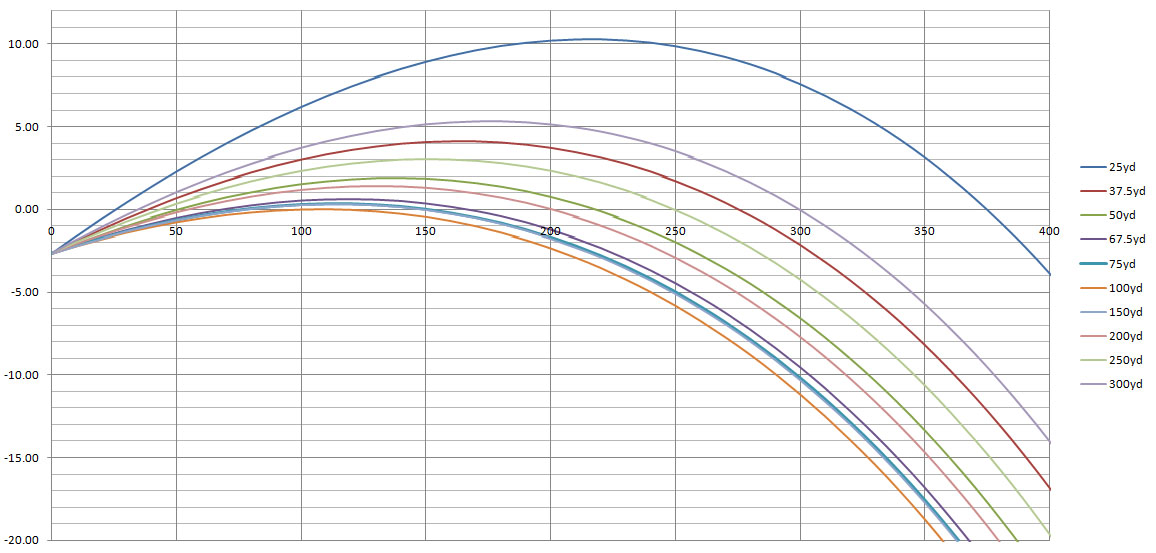
http://www.ar15.com/content/page.html?id=659 |
|
Quoted:
Quoted:
Quoted:
Well I love the positives about working up my load at 200yds plus the fact that it will help me become a better shooter at the same time. Not to worried about the walk though. Got the good 'ole John Deere to help me out Sir, FWIW I do all my load testing at 200yd. 200yd is the shortest distance fired in across the course high power competition so for my purposes shooting groups at a lesser distance is really a waste of time and good ammo. I like to be able to set up my chronograph and shoot through it for groups. You can tell pretty quick which loads are performing best both in terms of group size and chronograph data at the same time. Sub MOA shot dispersions at shorter distances are really difficult to distinguish from each other but at 200yd it's pretty easy to differentiate the smaller groups from the larger. About the only real disadvantage to shooting at this distance and further is being able to see the shot holes through your scope. I have a Kowa TSN 821 scope with a 27X LER eyepiece and when the light is good I can generally see the .22 cal. shot holes in the aiming black and make sight adjustments as needed. On dark or overcast days it is much more difficult to see the shot holes so I put a white plastic bag behind the target of provide some backlight. HTH, 7zero1. I'm going to have to try that one, thanks! To the OP, 100 yards isn't a waste of time. I do so often for convenience. But 200 yard will tell you more, as the others have pointed out. Also, I'm guessing this will end up being the range that you zero your rifle for. And on that, I also think that the 200 yard zero is a better choice for most folks than a 100 yard zero. See the figure: a 100 yard zero means you are always shooting low at any range other than 100 yards. If you're really anal, the 170 yard zero (which is also 67.5 yard zero) gives you about the longest span where you bullet is within 1" of zero. http://www.ar15.com/media/viewFile.html?i=26758 http://www.ar15.com/content/page.html?id=659 Sir, actually it should read: "...to provide some back light", so much for my proof reading skills. I won't bore everyone with the details regarding different bullets having different BCs but I do use the Sierra Infinity V ballistics program to keep it simple for my purposes. I find that 200yd groups with the JLK or Berger VLD bullets aren't easily distinguished so I actually do load testing with those bullets at 300yd which is the limit of the range I have available. 200 yds is quite adequate for load testing with 77gr SMKs and I would agree that trajectory results and your comment that results are largely comparable to the 55gr FMJ bullet graphs you have shown. The main problem load testing at greater distances has to do with being unable to see the shot holes so I usually keep the number of shots fired to just five, between trips down range. Since the range I use is a public range I have to wait for everyone else to call a cease fire. That makes load testing at that distance quite time consuming so I try to go only on days I know there will be few other shooters around. 7zero1 out. |
| I generally start at 100. However, as I move out farther to see how a load really performs, I find some loads shoot even better at 200+ than they did at 100. For example, I have a 69 SMK load that hold roughly 1" at 100. The same load shoots about 1.3" at 200. Very happy with that, especially with my CL barrel. |
Armory Sponsor