


Armory Sponsor


Posted: 6/8/2011 11:39:23 AM EDT
|
I have some .38 special cases laying around. I was wondering if a .38 special case could withstand the load a a .357 magnum since it is significantly higher.
Thanks |
|
Don't try. It's possible that there are cases around with the same wall and head dimensions as .357 Magnum, but it's certain that mostly they aren't.
Even if the case cross section is the same, the bullet will be seated deeper than in the .357 Mag case, so chamber pressure will be higher, even higher than normal for .357 Mag ammunition. Cases and guns are cheap and replaceable compared to eyes. |
|
I wouldn't mess with that either, and I'm pretty experimentive.
It might work fine as most revolvers have 100% excellent chamber support and there are all different loading levels for .357 Magnum, however, the risk to reward ratio is all out of whack for actually trying it. 
Also, if you're thinking about doing it with true magnum loads with big charges of slow burning powder, you'll have to deal with erosion problems. |
|
I have gotten good results with 8.2 grains of Blue Dot in .38spl cases.
This is far more potent than even a .38+p load while remaining under light load pressures for .357mag (for which I use 12.5gr) These loads are using CCI small pistol (not magnum) primers and firing 125gr jacketed bullets out of .357 magnum S&W revolvers. |
|
Quoted:
I have some .38 special cases laying around. I was wondering if a .38 special case could withstand the load a a .357 magnum since it is significantly higher. Thanks For better or worse , I load .357 & .38 brass the same . Bullets seated to ~ the same OAL for the loaded ammo . ( One groove further our in .38 brass . ) This gives ~ the same internal volume in both cases . Which should give ~ the same pressure . Most of these are shot in a lever gun , a few in a wheel gun . Just clean the chamber well . God bless Wyr |
Oh teh noes! Run Away! 
(just kidding) The brass will handle the pressures fine, and should match .357 pressures / velocities if you load to the same OAL as with .357. If anything, you would get slightly less pressure, due to less neck tension (less case holding the bullet in .38 vs. .357 case for same OAL). Keep in mind, when the .357 Mag was invented, they did not make the case longer to hold more powder. Rather, it was longer so you couldn't accidentally put one of their new-fangled nuclear-powered (oh wait - we hadn't invented nukes then) Magnum Powered rounds in a weaker .38 Spl gun. They had already tried that with the S&W .38 HD (heavy duty). It worked great in the big (N-Frame?) guns that they designed for the hot round. But people were blowing up their smaller guns by getting this ammo in them. If you start loading .357-pressured ammo in .38 Spl cases, there is the real possibility of getting one in a gun that can't handle it. I doubt you'd have the gun grenade in your hand, but a steady diet would likely shorten the gun's life span dramatically. I did the same thing with .44 Spl / .44 Mag cases. I didn't have all that many .44 Mag cases, and had 100 or so .44 Spl cases. End result was the same velocities using either case. In the end, I decided it wasn't worth the bother changing my reloading dies back and forth and have since acquired more .44 Mag cases. 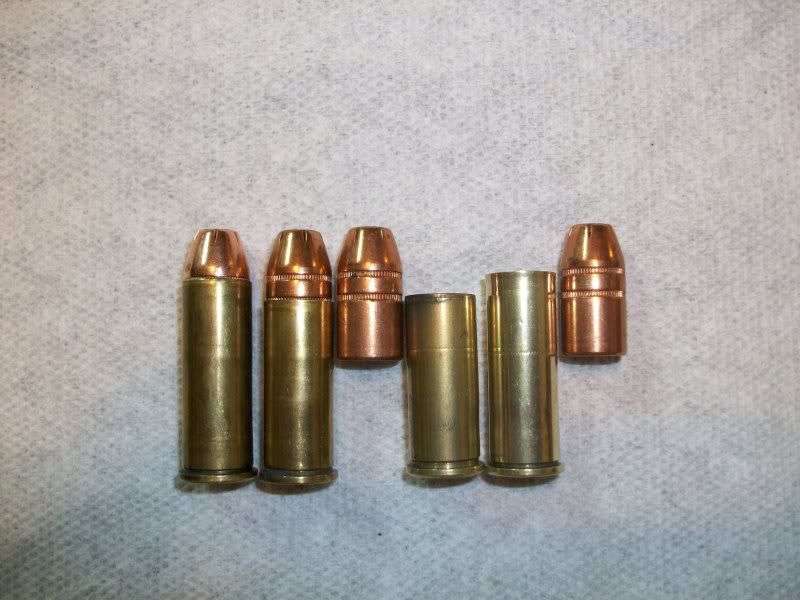
|

|
Chamber pressure is determined in a revolver just like it is in a rifle by the chamber dimension and throat length of the firearm not by the cartridge length, though it is affected by the cartridge brass thickness to the point where it uses up some of the internal chamber dimensions. That being said, a 38spl case probably is cause for slightly less chamber pressure, though I agree with those who said its a waste of time and effort for the previous reasons stated, plus the fact that some poor slob might get a hold of one of these overloaded cases and fire it in his 38spl.
357's are one of the easiest cartridges to find at most public ranges that I don't believe it makes sense to hot load 38's even if you can't find new or once fired brass.. |
|
Dumb idea. The 357mag case is not only longer, the case walls are thicker farther up the walls than the 38spl case as is clearly seen here plus the cases are made of a tougher brass compound. The max SAAMI pressure rating for a 357mag is 35,000psi vs 18,500psi for a 38spl+P and 17,000 for a 38spl. The 38spl cases were never designed to handle anywhere near full 357mag level pressure. Further, I load heavy 158grn 38spl+P loads specifically for my 357mag levergun that Quickloads predicts peak at 23,200psi and those are loaded long at 1.500" OAL. The charge is 13.5grns of H110 which is below the starting load for a 357mag. I picked it because it gives approximately the same case density as in the 357mag loads. However, its hard on the brass and I have to retire them after only 5 reloads as the cases will fail about 3/8" up the case wall if I reload them at that level too many times. Note that this load is significantly lower pressure than the full 357mag loads and it's loaded almost at 357mag length. A full 357mag charge in this setup would almost surely fail the case immediately.  |
Armory Sponsor