


Armory Sponsor


Posted: 7/6/2008 12:57:10 AM EDT
| a while ago i came by an excellent case prep site that goes through the process step by step, and can't find it. anyone link me a site that goes through the details. |
| bunch of tutorials and links to tutorials here www.ar15.com/content/page.html?id=399 |

|
babob has it close but he forgot to inspect his brass to cull out any bad ones. I do that step twice during the brass prep process and then again after I've completed reloading the rounds just to make sure I've caught any bad brass and/or rounds. In addition, I have a Dillon trimmer so my steps are slightly different. Brass Prep 1. Inspect Brass 2. Tumble / Clean Brass - Lizard Litter Walnut & Car wax - 1 hr max 3. Lube Brass - Dillon Spray Lube not One-Shot 4. Install Case Prep Toolhead in XL650 - confirm adjustments * Dillon Decapper/Resizer die in #1 * Dillon Trimmer in #4 5. Drop Brass in Casefeeder and crank handle to Decap/Resize and Trim - if necessary 6. Tumble / Clean Brass - Lizard Litter Walnut - 10 minutes max 7. Inspect brass again and Dillon Case Gage - Lot samples: 10% of total. If question, then gage every case. 8. Swage - only if needed 9. Store prep'd brass for reloading in future * Note that I neither chamfer nor deburr the case neck nor clean the primer pockets. - I don't do Bullseye shooting and so far have never needed to clean my primer pockets and, - the Dillon Super Swage does a great job at both removing the crimp and swaging a uniform primer pocket and, - the Dillon trimmer leaves a smooth, bur free edge and, - I use boat tailed bullets so chamfering is unnecessary. Reloading 1. Install Reloading Toolhead in XL650, fill powder measure, primer feed, and bullet bin - confirm adjustments * Lee Universal Decapper die in #1 - to remove any media in flash hole * Dillon Powder die in #2 * Dillon Powder Check die in #3 * Dillon Bullet Seater in #4 * Dillon FCD in #5 2. Drop Brass in Casefeeder and crank handle while adding bullets 3. Inspect finished rounds 4. Box and label Go to range and make empty brass to start cycle once again |
|
A question for those of you who tumble to clean the lube off the brass. Why? I use very little of the Dillon lube, just enough to prevent wear and sticking to the die. Yes, there is a detectable amount left on the case when I drop powder and seat the bullet. But what harm can that do? Haven't had a malf after hundreds of reloaded rounds in my AR. Am I missing something here? |
|
1. Clean brass 2. Size/Deprime in a Lee Collet Neck Die. (produces straighter necks) 3. Lube w/ Imperial Sizing Wax (every other lube sux ass) 4. Size body in a Redding Body Die (otherwise they won't feed in an auto) 5. Wipe Imperial Sizing Wax off (with a rag) 6. Run a bronze brush inside the neck to clean out the carbon (better bullet retention) 7. Clean the primer pocket (cuz I'm anal) 8. Prime (wit a hand priming tool) 9. Charge wit powder 10. Seat the bullet 11. Shoot 12. Repeat |
|
I do all of that but use the hell out of Hornady One Shot. I don't seperate standard brass anymore for 5.56 I do seperate Lapua as that is what I use for match brass. 1. tumble brass, I have 3 tumblers and they are often on all night. 2. Pour brass from tumbler into a medis seperator and examine and measure each piece in the Lyman quick measure. The brass that is too long I put into a loading block for trimming. 3. Spray from four directions with One Shot let sit for 20 minutes. I normally load 200 rounds at a sitting. 4. Using my Lyman T Mag II I load 200 rounds of the same load. (I have six dies on the head. Xdie for all resizing, Redding seater for 77 grain loads, Lee seater for 62 grain trigger time loads, RCBS seater for 55 grain loads, Lyman seater for 73 grain Berber loads, and the Lee Military crimp die. 5. Box and then apply Laquer paint in the color I want on the edge of the primer. (I use a color code so I can immediately see the power level of the cartridge I'm firing.) 6. Store with appropriate load. |

I also mark the base of my loaded brass using a Sharpie. Red dot for first time fired. Black dot for reloaded once. Two dots for twice reloaded, and so forth. The dots seldom last through tumbling so I tumble the dot groups separately and mark the base before sizing and priming. Rounds are packaged with labels containing all loading data printed directly from my shooting and reloading database (homebrew). Added benefit is that at the range when someone else picks up my brass they know it is mine. I have had other shooters hand me a pile of my brass that they have picked up. |
|
Re-Loading Rifle Ammo….. rifle-company.com/phpbb/viewtopic.php?t=911 OR Match Case Prep (mostly for BR)...... www.6mmbr.com/jgcaseprep.html Aloha, Mark |
|
Here is my .02 on the subject of “production loading” of rifle cartridges, for my “gas guns.“ Let’s start with “once fired” LC military cases, in whatever number of cases you want for your, “lot.” 1) Inspect and clean the cases. I use a liquid brass cleaner (Birchwood Casey # 33845 CCI). Follow the mixing instructions on the package. After the soak/cleaning, the cases are removed from the solution and air dried. The solution is re-usable. IF, you want to use an oven for drying, use the lowest heat setting. Why a liquid brass cleaner? Well, it eliminates the need to buy a tumbler (or vibratory machine). I don’t have to buy media and I save on electricity. There is the added bonus of no noise and/or dust in my work space. And, if I were to tumble/clean de-primed brass, I would have to worry about stuck media in primer pockets and flash holes. 2) With once fired military brass, this next step only has to be done once. De-cap the once fired military brass using either, a “universal” de-capper die or with a skinny nail/punch and anvil (with a hole in it, large enough for the old primer to fall out of, but still support the case rim). Or, buy the LEE military primer de-capper set (#90102-.30 cal., #90103-.22 cal.). Simply, run the nail/punch down through the case neck. The nail will enter the flash hole and rest against the old primer. Put the case on the anvil (old primer centered over the anvil’s hole). Then, with a hammer knock out the old primer, letting the old primer fall through the hole in the anvil. Yes, the military crimp is sometimes that stubborn. 3) Again, since we’re using once fired military brass, this next step has to be done only once. The primer crimp will need to be removed. The crimp gets either swaged or reamed/cut. My friend has a Dillon swage and I use a Lyman hand reamer/cutting tool. Both can do the job......one is cheaper. Lyman hand reamer (#7777785 Large, #7777784 Small). I do the crimp removal while watching TV. It's as simple as: pick up a case, insert the tool into the primer pocket and twist, remove case, next..... *Commercial cases, usually don't have a primer crimp to bother with. So, steps 2 and 3 can be omitted. Likewise, for the next time you load these “already treated” military cases. 4) Next, is lubing the cases. I use a spray lube on the outside of the cases......not too much......and not too little. As you re-load more and more, you'll get better at judging the amount needed. You don't want dimples on the shoulders of your cases (too much lube) and you don't want a stuck case in your die (not enough lube). I simply lay a single layer of cases on a piece of cardboard and spray. Shake the cardboard a little and spray the cases again. 5) Also, I like to use a little bit of mica inside of the case neck, just so I don't have to hear the "squeak." Not every case gets the mica. You can feel it and hear it, when you're getting to the point of having to add more mica. I use a Forster original case graphiter (#011341). IF you have a carbide neck expander button you won't need the mica. 6) I use a single station press (RCBS Rock Chucker). You could use a progressive Dillon IF you wanted to. It's a personal choice. But, with whatever press you choose, consider shell plate/shell holder and/or press "flex.” I use a regular FL size/de-capper die, NOT the small base dies. To begin, FL size and de-cap, 1 or 2 cases for a test. Gauge the re-sized case(s), to confirm that the "correct size" has been achieved. I use a Forster Products case gauge (the Wilson gauge is also a popular choice). Insert a case into the die. The headstamped end of the case, needs to be at or between the high and low cuts on the gauge, to pass. This checks the headspace. While the other end, is used to check if the case will need to be trimmed (a job for later on). IF, it’s not the “correct size,” your die setting will need adjustment. Lower the ram and simply screw the die in or out a little. Don’t forget about the lock nut. Then, re-size another couple of test cases and check your work again. Repeat the test and adjustments, as needed. When you're satisfied that your test cases are properly re-sized, do the entire lot. 7) Case trimming. Check first: Place the gauge (w/cartridge case in it) headstamp end down, on a flat surface. The case will sit on the flat surface. The neck end should be, at or between the two cuts, to be correct. IF you have a caliper.........measuring works too. For ME, first time: New, once fired (purchased and given) and range pick up brass are always trimmed (with few exceptions) for consistency sake. I'll trim the cases with my Gracey trimmer (it’ll trim, chamfer, and de-burr in a single operation). Remember, we are doing this as a "lot." So, IF one case needs a trim......they all get a run through the trimmer. More info on the Gracey Trimmer www.matchprep.com/trimmer.htm NOTE: IF it's not done with your brand of trimmer..........don't forget to slightly chamfer and slightly de-burr the necks. It'll ease bullet seating. Use this style of tool......... www.midwayusa.com/eproductpage.exe/showproduct?saleitemid=364181&t=11082005 8) Clean off the case lube. Either with another soak in Birchwood Casey cleaner or a quick wipe off with a cloth dampened in solvent. 9) While you're holding the cases......inspect them for, "other problems." Splits or impending case separation. IF, I see it or suspect it......the whole lot may get dumped (or just a few). With my 7.62x51 NATO brass (shot through an M1A), I don’t anneal, I’ll usually get 3 re-loads out of a case. IMHO…..a 4th would be, "pushing it." 10) Some old primer residue may still be left in the primer pocket. It’s optional to clean it. I use a LEE primer pocket cleaner (#90101). It flips over to do both large and small primer pockets. Insert the tool into the primer pocket and twist. Also optional, is to de-burr and make the flash hole a uniform size. The tool is a simple device that is inserted through the case neck. An adjustable flange on the shaft prevents it from going any further into the case. A quick twist and the job is done. More info on Preparing Cases For Long Range Accuracy www.6mmbr.com/jgcaseprep.html 11) My cases are then primed w/ a handheld LEE Auto Prime tool (#90230). It comes with both large and small primer rods. But, you'll have to purchase the correct shell holder(s) for your caliber of choice. 12) Then, it all gets loaded, as usual (powder is measured and dropped into the case, bullet gets placed and bullet gets seated). ______________________________________ For those who don't know about it.........IMHO…………"the secret" to re-loading a bottle neck cartridge for a gas gun is.......a case gauge. There are many different brands and ways to gauge your re-loads. Examples…….. www.sinclairintl.com/cgi-bin/category.cgi?category=REMTHT&type=store ______________________________________ Remember, like most everything......YOUR MILEAGE WILL VARY. There are many other products, loads, and ways to skin a cat......this was only my advice. Which you got for FREE. ______________________________________ Aloha, Mark |
To insure the cases stick to the oil free chamber wall when fired, and to prevent picking up dust and dirt. Most of the lubes leave very little material behind, but delube those and you'll notice a difference. Some lubes that bear water promote case corrosion, however slight. |
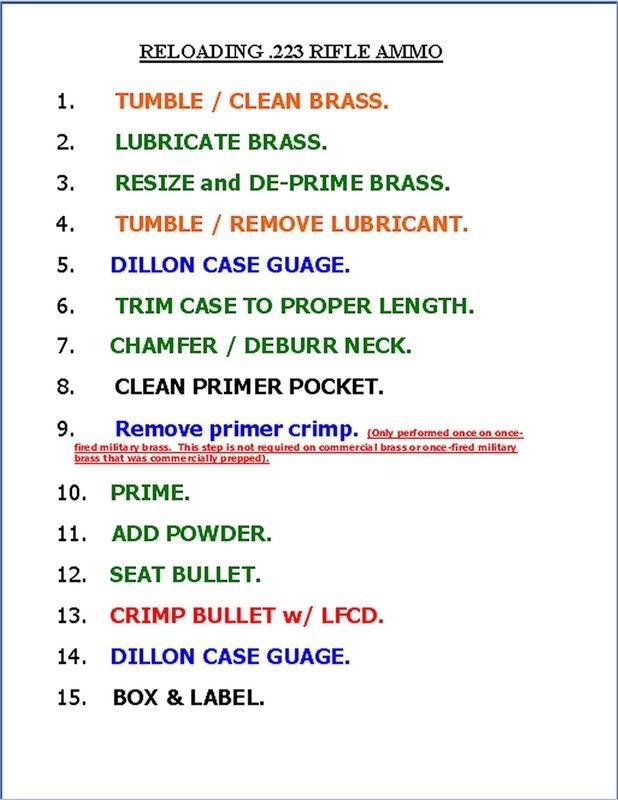
I don't do step 14 for rifle rounds. I only use the case gage to make sure my sizing die is set correctly. Main reason is the rifle case gages are not faux chambers as the pistol case gages are. I do check every completed pistol round with a case gage though. I used pretty much the same chart when teaching some folks reloading .223 as a sort of "You are here" guide. --- I'm down to a measly 1800 rds of 223 
|
|
This is my case prep for bulk bought surplus brass. I use an RCBS Rock Chucker PREPARE THE BRASS 1. Inspect brass (also inspect throughout) 2. Sort Brass by headstamp 3. Decap with RCBS universal decap die 4. Remove crimp with RCBS swager (each headstamp requires it's own adjustment) 5. Deburr flash hole 6. Clean primer pocket 7. Tumble brass 8. Lube case necks 9. Lube brass with RCBS lube pad (depeneding on condition of lube in the pad, 1:1, 2:1, 3:1 etc.) 10. I initially resize milsurp with RCBS Small Base Dies 11. Wipe off excess lube and tumble 12. Measure OAL 13. Trim, Chamfer, Deburr with RCBS Trim Pro upgraded with power unit and 3-Way cutter head. RELOAD 14. Prime with RCBS hand primer 15. Charge with Uniflow 16. Seat bullet to predermined depth |
|
My first batch of .223 took too long to make. Currently trying to work on a systematic approach to hopefully improve output. My setup is xl650+1200b trim and auto case feed. This will be my rotation 1. clean case by tumbling. Station 1: RCBS Lube / Decap dies Station 2: Station 3: sizing and trimming with 1200b Station 4/5: chamfer and debur Is this step really necessary? swage the crimps., but otherwise at this point, the cases are preped. Do cleaning primer pocket and bore hole make real difference? How important is it to weight each case to see if they are consistent? TO loading Station 1: empty, since the trim dies also sized. Station 2: Powder bar Station 3: Powder check Station 4: Seat and crimp. The label |
Unless you are making 'match' ammo... I wouldn't worry about it. If you are making 'blaster' stuff, it's a waste of time because a) the components you are using are going to limit your overall average accuracy far more than whether or not the primer pocket is uniformed and the flash hole deburred.
Unless you are doing all the above (trim/chamfer/debur, uniform primer pockets, debur flash hole, etc.) plus weighing charges, using bushing dies for precise neck tension, using a micrometer seater and have the correct tools to set your loads up to seat the bullets into the lands, etc. etc.... don't bother. You have to be getting on the persnickety side to be able to even tell the difference (mainly in elevation @ longer ranges). If you're loading on a XL650 + case feeder + rapid trim... no offense, but you ain't there by a long shot. |
|
|
How about adding some redding competition dies to fill up the empty stations -Clean case by tumbling. -Station 1: RCBS Lube / Decap dies -Station 2: -Station 3: sizing and trimming with 1200b -Station 4/5: Competition Micrometer Bushing Neck Die Chamfer and deburr. Shoudl this be done before or after the bushing neck die? -Clean case by tumbling -Swage the crimps. if necessary. -Clean primer pocket TO loading Station 1: empty, since the trim dies also sized. Station 2: Powder bar Station 3: Powder check Station 4: Competition Micrometer Bullet Seating Die Station 5: Dillon crimping die The label |
Armory Sponsor