


Armory Sponsor

Posted: 5/1/2008 12:46:19 PM EDT
I saw the thread about loading blocks, and decided to share my method of making loading blocks. On the left are two loading blocks from midway, two loading blocks on right I made. Midway no longer sells wood loading blocks, they are plastic now. 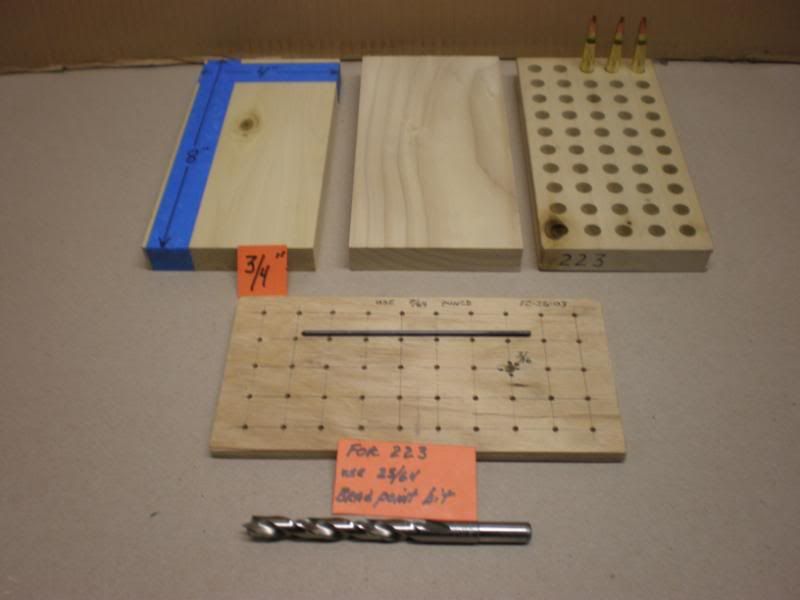 I use poplar, same as Midway, 8"x4"x3/4". You can pencil in the hole locations, I use a template, 7/64" center punch, and a 25/64" Brad point drill bit for 223. 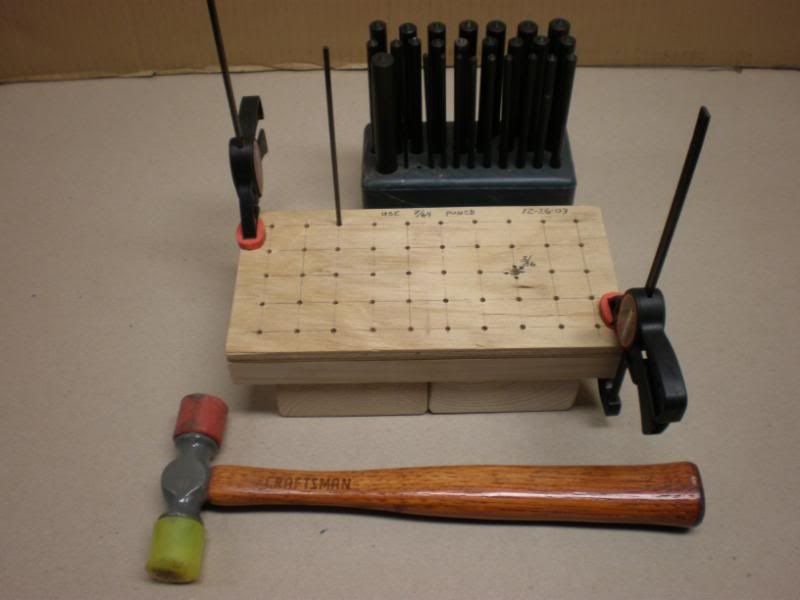 Template clamped to blank, center punch to mark where to drill. 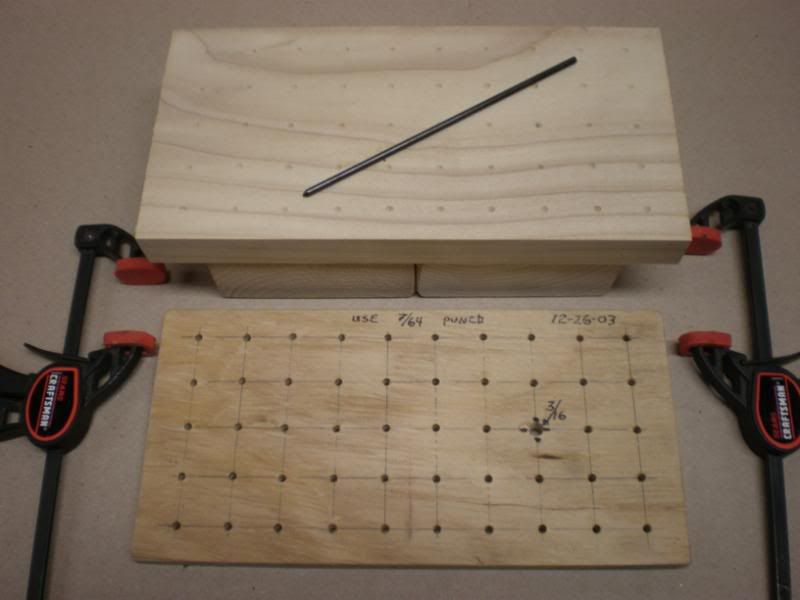 Holes center punched, ready to drill. 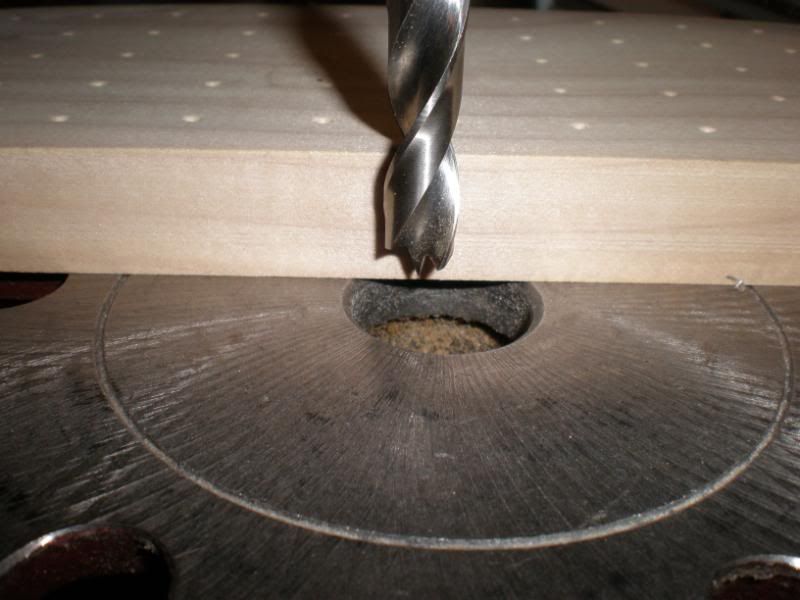 Setting drilling depth at the drill press. About 1/8" from going through.  Drill the holes, center bit in punched hole. 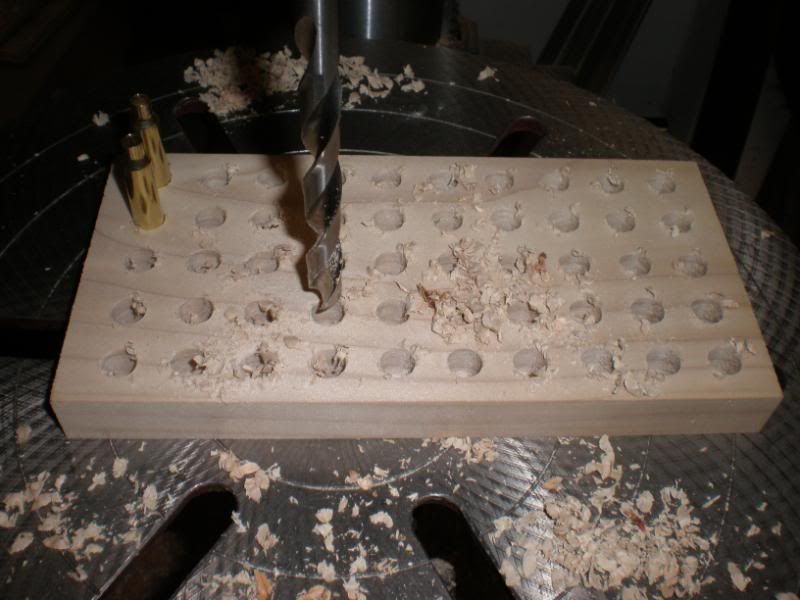 Holes all drilled, ready to clean up holes.  Sand lightly on belt sander. Hand sanding will certainly work as well. 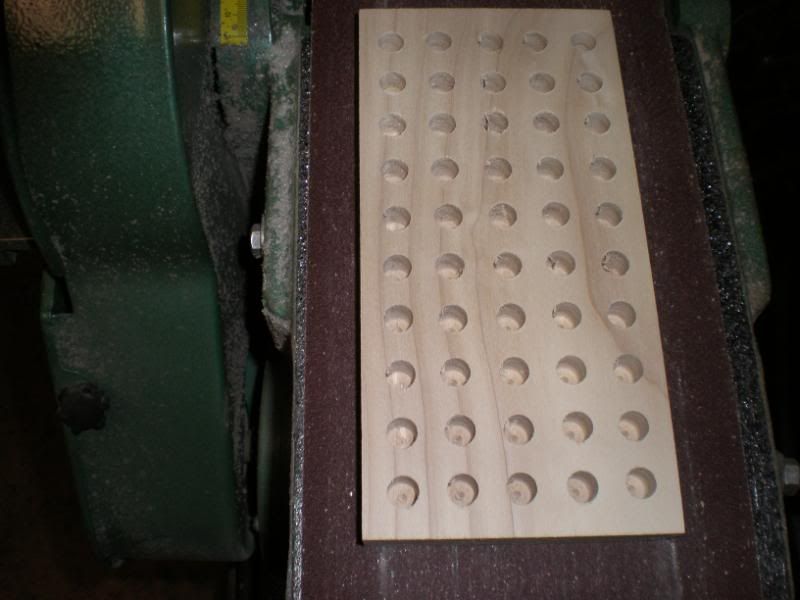 Finished on the belt sander. 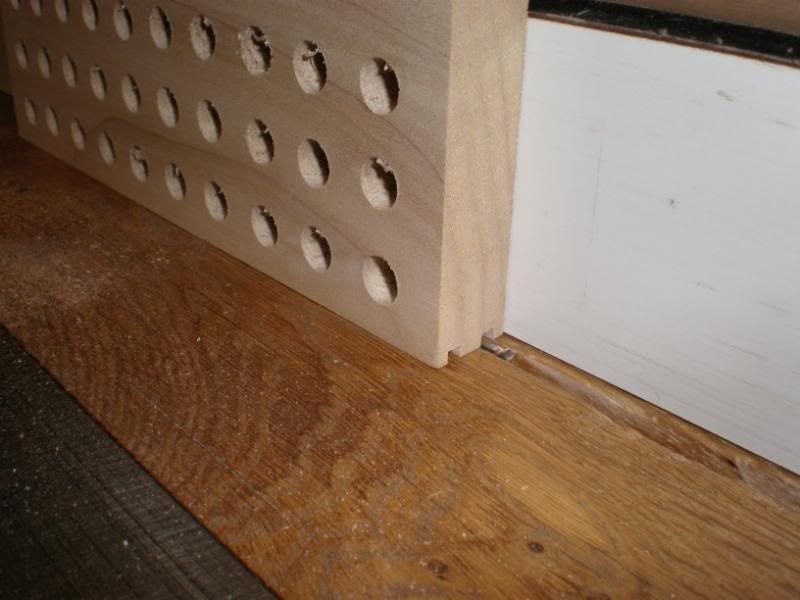 Cutting the grove on the side of the block at the table saw. Fence is set at 1/8", blade is raised 1/16". This step is optional, grove can be cut with a wood rasp, chisel, ect.  Second pass, making grove.  Last time through saw, grove complete. Grove is for fingers to grasp when lifting block.  Time to debur the holes. Right 25 holes deburred, Left 25 holes still to be deburred. I used these two Exacto knives to gently cut away the last of the fuzz.  Finish sanding, go over all edges with 220 grit sandpaper. 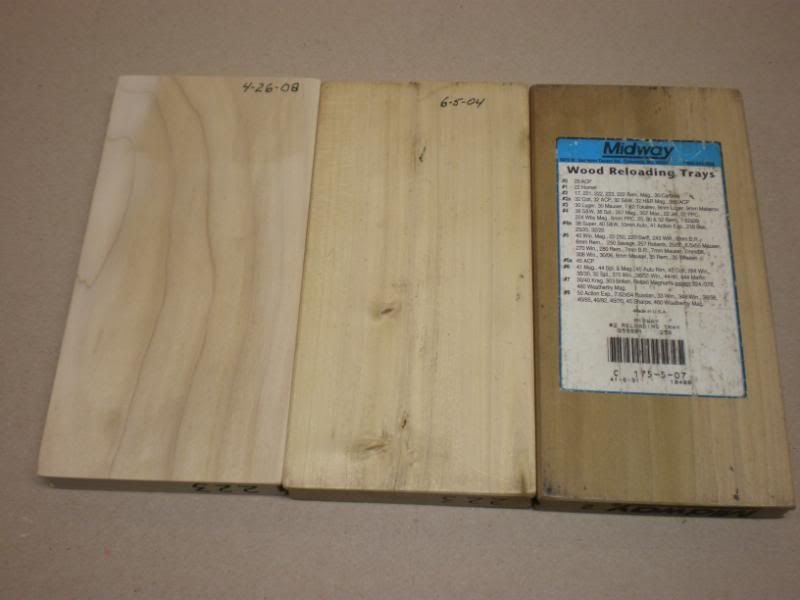 Just finished block on left, center older block I made in 2004, right Midway block. 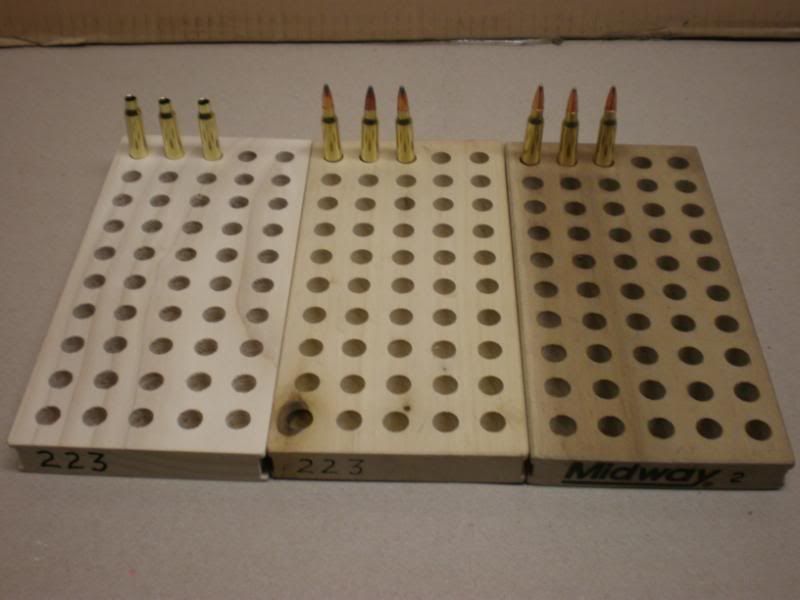 Other side, Just finished block on left, center older block I made in 2004, right Midway block. 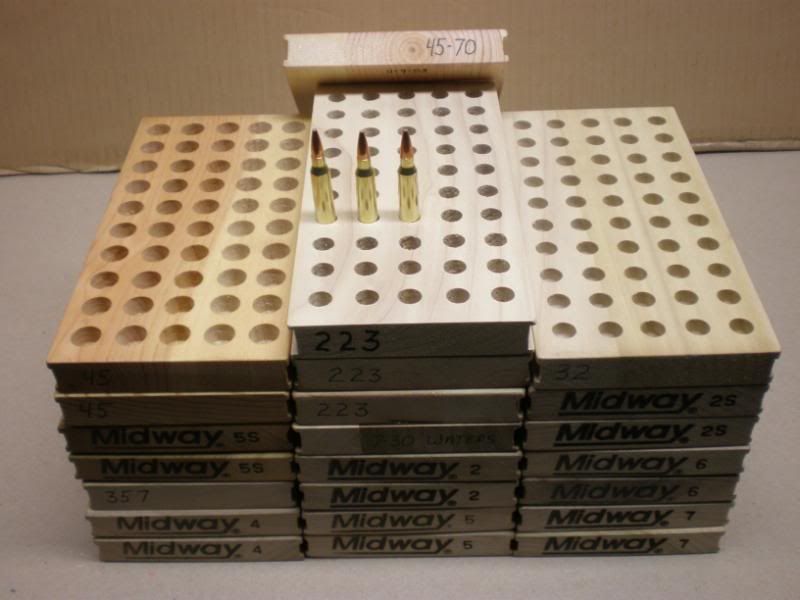 The loading blocks I made and some I bought from Midway. 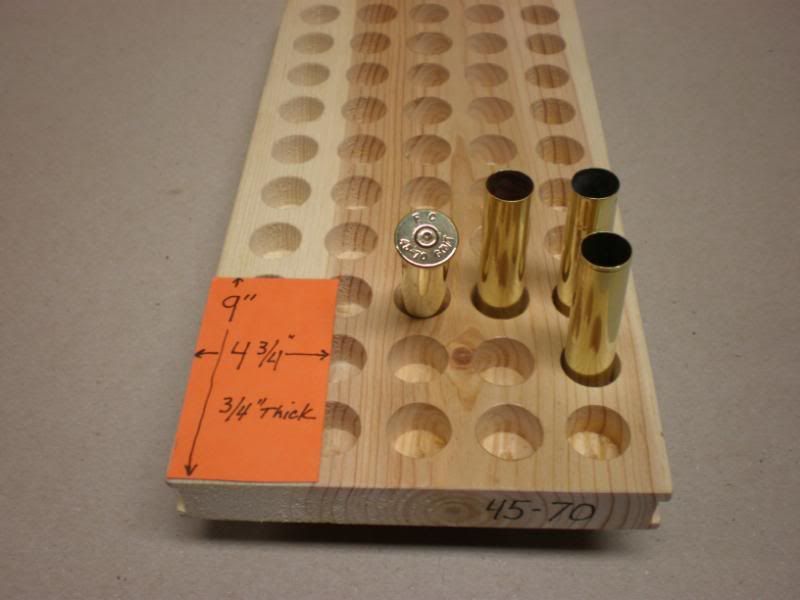 Custom sized for 50, 45-70 cases. I used Pine for this one. If you have limited tools, there is an optional method to make loading blocks.  Use a regular high speed drill bit, drill all the way through a blank that is 1/2" thick. I am using scraps to show the technique, use the normal size blank. 4"x8"x 1/2" thick.  Glue or nail a piece of 1/4" thick wood to the bottom to complete.  Block will look something like this when complete. Drill bit sizes for the following cases: RIFLE 223, 25/64, or 10mm Forstner bit 308, 243, 270, 30-06 ect 1/2 30-30, 7-30 Waters 9/16 7mm mag, 300 mag, 338 mag, ect AND 7.62x54R 9/16 PISTOL 32 S&W, 32 H&R mag, 3/8 380, 9mm 13/32 38, 357, 40 S&W 7/16 44 special, 44 mag 9/16 45 auto 1/2 Notice lots of rifle and pistol calibers use the same size bit. Example 308 and 45 Auto use a 1/2" bit. Don't drill the pistol blocks as deep as the rifle blocks. As in 380, if you drill too deep, you won't have enough of the case above the block to use a powder funnel. |

|
I just used a spade bit and a marker in a hand drill on a scrap of 1 X 2 to make a block for my new .44 Mag. Check the depth required in the hole to leave 1/8 inch in the bottom and run the marker on the spade bit as a guide. Use the hand drill to run the spade bit into the block up to the line. Deburr with a bit of 60 grit. Not the sort of thing to engender pride of ownership like dryflash3's blocks, but I was in business in less than 15 minutes. |
|
Very nice indeed. When I started loading .50bmg I couldn't find any loading blocks. I had an old Safariland revolver loading tray (the thing that holds 14 sets of 6 38/357 rds end up so you can clip your speedloader on them) that I had fastened to a 2x4 to have it higher in my shooter's box. Flipped it over, marked out 10 spots and used a .75" "paddle bit" Works like a champ. I like the deeper pockets for the heavy/tall 50bmg, and the weight of the 2x4 keeps it stable. Very nice work on those trays. Looks professional. Great pics. Thanks. |
|
FishTheRockRiver, I don't finish mine because I like to write powder charges in pencil when working up loads. Erase pencil marks later. Sniper7, for 243, use a 1/2" bit. AR, thanks, following you lead of great posts. jms92, hole locations, On the 4" width side, 1/2" from edge of board to center of first hole. Center of first hole, 3/4" to center of second hole, center of third hole, 3/4" to center of forth hole, 3/4" to center of fifth hole. Center of fifth hole to edge of board is 1/2". See the pattern? On the 8" length side, 5/8" from edge of board to center of first hole. Center of first hole, 3/4" to center of next hole. Continue the 3/4" spacing, center to center, to the tenth hole. Center of tenth hole to the edge of board is 5/8". Again a pattern here. |
| Thanks for the great set of instructions, dryflash3! I had always looked at is as a matter of laying out the centers on the block by hand, and that looked WAY too error-prone for my tastes. Your template makes it easy. And since all you need is the right bits and a drill press, this looks like something you could do fairly quickly and very accurately. Nice! |

|
-How about you post this in my thread "Share your cheap but potentially valuable tricks..."for reloaders". Thread. 
|
|
My "other" hobby is woodworking, so I am using up scraps. Poplar is normally used when you are planning to paint your woodworking project. Try the home centers for 1x6 boards. You can also use pine, just have to do more clean up around the drilled holes. I used pine with the oversize 45-70 block. |
This is what my dad did over 50 years ago for '06 & .222 blocks. He used oak for the block and small screws to attach a thin piece of masonite to the bottom of each block. He didn't have access to a drill press back then, but carefully used a hand drill - so drilling thru was the only viable option. A person could use a thin piece of plywood or something as well, I suppose. I still use these blocks today. |

Just like I showed in the last part of my orginal post. 
|
|
For loading blocks, I just use the Winchester Western 9mm styrofoam bullet holders. When I've loaded 50 rounds I take another block and slip it over the top of the bullets and put a rubber band around the blocks to hold them together. When I've warn them out, I just stop by the pistol range and pick up a couple more  It's not fancy but it works well and it's cheap. |
The original question:
6.8 SPC needs a 0.422 + clearance hole in a load block; I would use a 7/16 inch Forstner bit or a drill just slightly larger. The parent case for 6.8 SPC is the .30 Remington cartridge. The maximum diameter of a .30 Carbine case is 0.360 inches, in case anyone is considering a custom load block for that cartridge. Here's a link to letter and fractional drill sizes. I would choose a drill bit about 0020 to 0.030 inches (1/16th inch) larger than the maximum case diameter for this application. www.engineersedge.com/drill_sizes.htm |
Thanks for the clarification AeroE. |
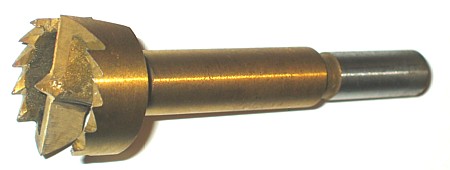 Forstner bit. They are the preferred bit to use for a project like this. Description If you are going to buy a bit for this project, they will save some time/labor. |
Forstner bits would be my first choice IF I had the correct sized Forstner bit. Since this for ARF I chose to make 223 loading blocks. The size hole that I have found to work best for 223 is 25/64" My 16 piece set of Forstner bits starts at 1/4" and the size increases by 1/8" until the 1 1/2" bit.  So I had a choice of 3/8" ( too small of hole for case ) Or 7/16" ( hole too large, if a powder funnel is placed on case, it will tip over) So I chose to go with a 25/64" Brad point bit, which is 1/64" larger than 3/8". (fits just right) By all means use a Forstner bit for any of the hole sizes that they make bits for. Like 1/2" for 45 Auto, 308, 30-06 ect. For 223 use a 25/64" Brad point bit. |
|
Thanks very much for taking the time to put this together, dryflash. It's very helpful and useful information presented in great detail. After 8 years away from reloading I've started back in with a progressive and for some reason figured there would less/no need for loading blocks like when I was using a single stage press. I'm finding that is not necessarily the case. I'll put these blocks on the to-do list for this winter. I always struggle to figure out how to capture this type of info for use at a later date, and remember where the heck I put the info with my crappy memory. If this post is put in the forum resources will it come up if I do a search on "loading blocks" some time in the future? Thanks |
Your welcome, Look under Reloading Tools and Equipment, at the top of the page, it is tacked there. |
7.62x54R uses the same loading block as the belted magnum cases. 7mm, 300, 338 mag, ect. Use a 9/16" bit. |
Not sure about this question. 9mm is 0.354 inches. [9mm / 25.4 mm/inch = 0.354 inches] The greatest diameter of a 9mm Para case is 0.394 inches 13/32 = 0.406 inches 0.406 - 0.394 = 0.012 |
A 10mm bit = .393, too small A 11mm bit = .433, too large |
|
Drilled holes are always larger than the bit (even in metal) by at least 3-5 thousandths. In wood it is usually more. That is why for a precision hole in metal you dril lundersize and ream to final size. Reamers can hit within a thou, or even better if handled in tooling (lath). I use a plastic kitchen cutting board instead of wood. By a large board of an appropriate thickness and cut it up on the table saw using a rip blade, then drill away. You can even run core box router bit on the sides to create nice finger grooves. |
|
I just picked up a 25/64 Hitachi wood bit because I couldn't find a forstner bit, so I will just drill straight through a piece of 1x6x2-foot red oak board I also bought. I guess it would be best to sandwich the oak board between a couple pieces of old plywood so the the hole will be cleaner. And I will then glue a 1/4 inch piece of red oak to the bottom. I intend to make a pair of 12-inch long blocks. Two questions: --After I've drilled abut 100 or more holes, which size and/or type bit or tool would be best to chamfer or countersink each hole so the brass will slip in a little easier. --Also, I've seen loading boards that have an "indented" or "cut in" square about 4x4 inches by about 1/4 inch deep near one end to put loose bullets or whatnot into. I'm not a big woodworker, so please talk plain. Is this chisel work? Is there a tool that will bore or gouge this pit out of the wood. Equipment I do have is a table top drill press, compound miter saw, roto-saw, tons of Dremel stuff, a bench top table saw -- I do NOT have a router and that's what I'll probably need. I could bring it to my woodworking friend but I want to do this project myself -- screwed up or not. Please advise -- these little projects keep my interest in reloading at a peak. And it is more fun than just buying one. |
|
The hole chamfer can be made by a larger diameter drill bit, or you could buy an 82 degree countersink. The lead in is not really needed. The recess you want to make could be done with really sharp chisels. But first, you have to know how to sharpen them correctly. There are excellent tutorials by David Price, my favorite master builder, at www.americanlongrifles.com. Enter this site with caution, it may cause your interest to wander away from auto loaders. The easier modern method is a router. A bit with a tracing bearing can run inside a guide made from 1/4 inch ply to give a very neat pocket. First you have to measure the diameter of the guide bearing and adjust the inner dimension of the guide cutout. The good thing is, once the guide is finished you can make piles of blocks. ETA: Another way to make the pocket recess is by using a large diameter drill or a Forstner bit to remove as much material as possible, then remove the rest with the chisel. This is a practical method that will delay the pruchase of a router. Let the quill stop on the drill press control the depth. |
 Heck, if I can get all these rifles and reloading tools adn components past her, an inexpensive router should be a snap.
|

Armory Sponsor