


Armory Sponsor


Posted: 8/16/2010 12:39:30 PM EDT
|
Why don't more knives, especially the fighting knives, come with blade guards. I feel as though some form of positive protection to prevent your hand from sliding forward would be, could be, of benefit in a fight. It seems that after the sweat starts to pour and the blood starts to flow (which surely it will), the knife may become more slippery than you are used to. You don't want your hand going forward over the blade.
I am not thinking of using the guard to stop your opponent's blade from getting to your hand, as in sword fighting. I know I am ignorant of knife fighting but it also seems like a safety feature for general purpose use, too. Slicing your hand open when in the back country is generally a bad thing. Please explain. |
All fighting knives have guards. 
So you have to ask, why is someone selling something that looks like a fighting or survival knife without a guard? I think because "it looks cool". Kind of sad really. For instance the SOG SEAL dive knife that has no guard? It's easier, quicker, less costly. It's a red flag to me so I know what not to buy. |
If there is a finger hole you don't need a guard as the heel of the blade will keep your hand from sliding forward.
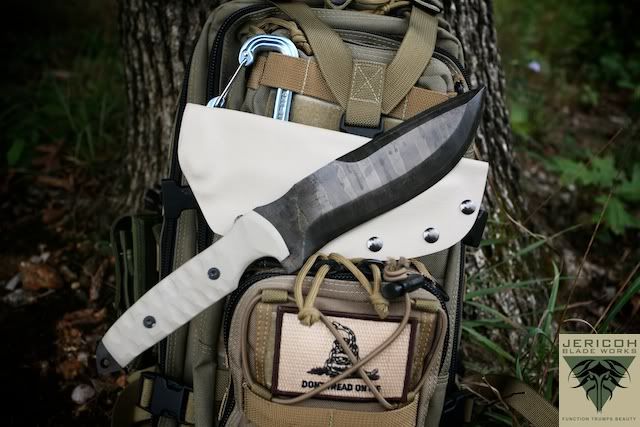
See in the photo, the combination of finger hole and the fact that the heel of the knife comes down so far prevents the hand from sliding forward. I specifically didn't have the top edge come all the way up the spine to the handle in case there was any slippage over the top. There just behind the front of the grip the tang is ground away leaving a place to support the thumb when using a sabre grip. This speed bump will keep the hand in place. You can see it better in this pic 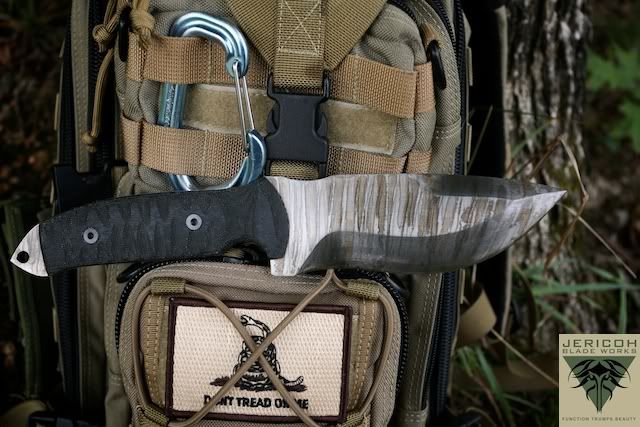
I've jammed the prototype of this knife into tree trunks, both jabbing and a full on overhead reverse gripped stab while sweating and once in the rain with no slippage. ETA- That's also why it's not a good idea to use oiled wood handles on a fighting knife. Grooved micarta or G10 gives a much more positive grip. Sorry to the old school bowie knife people. |
|
A real fighting knife is one designed to kill people...
It's not designed to cut, chop stuff or eat with. To name a few: M3 Sykes fairbairn Case V-42 USMC raider stiletto Poignard There are a lot of knives that can pull double duty but that's not what you asked for |
|
There's a VERY fuzzy line between a combat knife and a fighting knife.
A combat knife is designed to be a tool for cutting rope, opening rations, slicing food, and if necessary, killing people. It usually has a single edge, sometimes with a clip portion of the blade that can be sharpened, like the Ka-Bar. A fighting knife is designed to kill people, can be used for the other purposes but not well. It almost always has a double edge. Classic cases of fighting knives misused as combat knives are the delicate Sykes-Fairbairn British Commando knife and the V-42 Special Services knife. These were designed to assassinate German sentries on the French coast. As always, some people used them for combat knife utility purposes, which is why you see many of them with the tips broken off or even the blade broken off the handle. A classic combat knife is the Ka-Bar Marine and Navy knife. It shades toward the fighting knife line, but has the classic combat knifes single edge, while most fighting knives have a double edge or the M3 knifes partial double edge. While a combat knife can dispense with a guard, a fighting knife needs one for several reasons. The cross guard prevents the hand from sliding up on the blade, injuring the hand. The guard can serve as a finger grip to pull a stuck blade back out of a body. The guard in a well-designed knife serves as a fighting knife thumb rest, as in the excellent Applegate knife. The guard can serve as an "index" of where the blades edges are. This is where the British Commando knife really needs the guard. The handle is perfectly round so there's no fast way to tell how the edges are indexed in your hand other than the guard. The excellent Applegate has an oval shaped handle that instantly tells the user where the edges are even without the guard. Everyone has an idea of what a fighting knife or combat knife should be, and again, the line between is very fuzzy. However, many fighting knife designs are by people who are good knife makers, but who know nothing about fighting with a knife, thus no guards. They may call their design a fighting knife ("fighting knives" sell better) but what they've actually designed is a combat knife or even a straight utility knife. There's MANY good fighting knife designs out there, but one of the very best ever designed is the Applegate-Fairbairn. Had the war continued past Spring 1945, the Applegate would have been the issue knife for Commandos and Rangers. It was an improved Commando knife, designed after the experiences of actual combat use exposed the weaknesses of knives like the F-S and V-42. The blade is the perfect length. It's slightly hollow ground so it takes and holds a very sharp edge. This allows the knife to stab and slash where the F-S and V-42 are pure stabbers. The blade is thick enough and shaped so as to be very strong and won't break the tip or off the handle like the Commando knife and V-42. The shape cuts it's way into a body doing far more damage then the Commando knife which is more of a stabbing ice pick. The handle is oval in shape and in a coke bottle profile that offers a good grip and an instant index of where the edge is. The handle can be removed for cleaning and it has lead or steel weights inside so the user can balance it for his personal best feel. The cross guard is big enough to do the job, but small enough not to get in the way or entangled in gear. The slanted ends serve as an excellent knife fighters thumb rest. It's a very tough, durable knife, with a handle that won't deteriorate like leather handles or get slick. It's inexpensive, but not at the expense of making it a weak or cheap knife. Like most really great fighting knives, it's deceptively simple and plain with no frills or high price that makes people reluctant to actually carry it in circumstances where it could be lost or damaged. You see a lot of professionals carrying an Applegate, but most don't notice it due to the plain, low profile look. |
|
I'll go ahead and blur the line a little more and put forth that the term "fighting knife" is an archaic term that should have been put to bed decades ago.
Fighting is 2 guys punching the snot out of each other over a woman or the last beer. You fight, you get over it, split the beer, spit on the woman and do it again the next weekend. Take 2 guys having a fight on Friday night and one of them pulls a knife. That shit just got real and it's no longer a fight. It is now combat. No less than opposing soldiers on the battlefield and no less the stakes. There is no real difference between a "fighting knife" and a "combat knife" other than personal preference. They both have one end result, to make someone dead. The fact that one style is better at opening an MRE is besides the point. Making someone dead is the whole point, and just as there are many different styles of fighting, there are many different styles of "make someone dead" knives. Some peoples styles are more towards a fast handling, twitchy blade, just like there are guys that are a flurry of fists and feet. Then there are blades for more the heavy hitters. The guys that take their time to deliver a crushing blow, the guys that hit hard. By taking the standard definition of fighting knife, then the Japanese never made "fighting" knives, even though they had a whole culture based on fighting with bladed objects. A samurai sword, or tanto wouldn't fit the standard definition since it is not double edged, but it has no use other than killing. For the same reason that I would rather shoot someone with a big and slow .45 over a fast and light 9mm, I would rather stab someone with a 7" to 9" long, 2" tall and 1/4" thick piece of sharpened steel, over a lightweight dagger. Both are different routes to take to the same result. So there you go. Take from this what you want. Feel free to disagree. I'm not an expert on the history of knives and their intentions, just a redneck knife maker. |
|
Two great posts, thank you, gentlemen. I used the term "fighting knife" (combat knife) for lack of a better term and only to contrast it with a general purpose cutting instrument.
The real question for you, Timberwolf_71, is this. Do you think "fighting knives" need a blade guard? |
|
If it looks like this
fighting knife then I would say it should absolutely have one. But if it has ample finger hole and heel then it's not necessary. The back of the blade will act as one ETA- And I'm not opposed to guards 
as here on my Fury, there are guards integral to the blade |
|
Quoted:
If there is a finger hole you don't need a guard as the heel of the blade will keep your hand from sliding forward. http://i77.photobucket.com/albums/j67/Timberwolf_71/ReflectionMkVII-1.jpg See in the photo, the combination of finger hole and the fact that the heel of the knife comes down so far prevents the hand from sliding forward. I specifically didn't have the top edge come all the way up the spine to the handle in case there was any slippage over the top. There just behind the front of the grip the tang is ground away leaving a place to support the thumb when using a sabre grip. This speed bump will keep the hand in place. You can see it better in this pic http://i77.photobucket.com/albums/j67/Timberwolf_71/ReflectionMkV-3.jpg I've jammed the prototype of this knife into tree trunks, both jabbing and a full on overhead reverse gripped stab while sweating and once in the rain with no slippage. ETA- That's also why it's not a good idea to use oiled wood handles on a fighting knife. Grooved micarta or G10 gives a much more positive grip. Sorry to the old school bowie knife people. Damn, those are some beautifully ugly blades! |
Armory Sponsor