


Armory Sponsor


[ARCHIVED THREAD] - When Does a Gun Move From Recoil (Page 1 of 2)
Posted: 2/3/2014 9:22:04 PM EDT
|
An AR-15 is suspended a few feet above ground in the air via string or wire or something. In other words, other than the string holding it up, is is free floating in space.
When primer is ignited, when does gun as a whole (not B/C) move from effects of recoil? Ignore issues such as gravity, Earth rotation, air in BBL, etc. In other words, instantly, when bullet leaves case, when x pressure is reached, when bullet leaves BBL, etc. |
|
Quoted:
An AR-15 is suspended a few feet above ground in the air via string or wire or something. In other words, other than the string holding it up, is is free floating in space. When primer is ignited, when does gun as a whole (not B/C) move from effects of recoil? Ignore issues such as gravity, Earth rotation, air in BBL, etc. In other words, instantly, when bullet leaves case, when x pressure is reached, when bullet leaves BBL, etc. The explosion applies force in all directions. A great deal of this force is directed by the barrel into a concentrated direction away from the shooter, however not all of the explosions forces are directed in that way. Some of the explosion is absorbed by bolt face and receiver. This force continues in all directions until stopped by the butt pad (you) or escapes the barrel with the bullet in front of it. The size and shape of the stock/butt pad diminishes the impact on you. If the rear end of the rifle was tapered to a point the same size and shape as a .223 round, you would have a hole in your shoulder after firing. The buffer spring absorbs some, but not all of the force. |
|
In a "perfect world" movement backwards should start when the bullet starts moving forward = action - reaction
If you could detonate primer and propellant without the bullet moving forward the rifle would not move, since the explosion inside the cartridge chamber is equal in all directions and cancels itself. |
| It's immediate. Mass of weapon reduces the speed in which it is reflected. It happens very fast, but the bullet has already exited the barrel before the inertia hits you. A hyper-velocity round will already be on target before the recoil on a light rifle is fully felt. Ultra-slow-motion photography shows this. Even the tiny bit of gas bled into your AR is so violently pressurized that the bullet is long gone before the action is cycled. to really warp your brain, watch a big bore thin barreled sporter fire in slo-mo. You can actually see the barrel twist from the pressure and friction of the the projectile being accelerated with twist being forced down the tube! Alot going on in 1/3000 th of a second. How well you time and control the effects will determine your accuracy and repeatable performance. |
|
From a pure science standpoint the recoil movement of a rifle starts as soon as the bullet starts to move down the barrel . the two movements go hand in hand
From watching high speed photography of a rifle being fired a great majority of the rifle movement happens long after the bullet zips downrange . You see the bullet zipping out the barrel , you see the effects of muzzle blast and quite some time after the movement of the rifle we associate with felt recoil can be seen . If you consider with a AR the total rifle movement is a couple of inches at most and the bullet travels a thousand feet or more in that same half second the relative speeds of the rifle and bullet are quite different . The weight and speed of the moving bullet are part of the whole recoil thing but the weight of the powder and the weight of the gas produced when it burns is also moving and has effect on the recoil forces . This is why a muzzle brake has effect on recoil . the recoil energy is still there but the direction and time frame of that energy is changed by the brake |
|
Quoted:
It's immediate. Mass of weapon reduces the speed in which it is reflected. It happens very fast, but the bullet has already exited the barrel before the inertia hits you. A hyper-velocity round will already be on target before the recoil on a light rifle is fully felt. Ultra-slow-motion photography shows this. Even the tiny bit of gas bled into your AR is so violently pressurized that the bullet is long gone before the action is cycled. to really warp your brain, watch a big bore thin barreled sporter fire in slo-mo. You can actually see the barrel twist from the pressure and friction of the the projectile being accelerated with twist being forced down the tube! Alot going on in 1/3000 th of a second. How well you time and control the effects will determine your accuracy and repeatable performance. This is true! I shot an elk at 450 yards with a Weatherby MKV/300 Wea.Mag. with a thin barrel and saw him fall before the recoil lifted the scope off target! 
|
|
Quoted:
The explosion applies force in all directions. A great deal of this force is directed by the barrel into a concentrated direction away from the shooter, however not all of the explosions forces are directed in that way. Some of the explosion is absorbed by bolt face and receiver. This force continues in all directions until stopped by the butt pad (you) or escapes the barrel with the bullet in front of it. The size and shape of the stock/butt pad diminishes the impact on you. If the rear end of the rifle was tapered to a point the same size and shape as a .223 round, you would have a hole in your shoulder after firing. The buffer spring absorbs some, but not all of the force. Quoted:
Quoted:
An AR-15 is suspended a few feet above ground in the air via string or wire or something. In other words, other than the string holding it up, is is free floating in space. When primer is ignited, when does gun as a whole (not B/C) move from effects of recoil? Ignore issues such as gravity, Earth rotation, air in BBL, etc. In other words, instantly, when bullet leaves case, when x pressure is reached, when bullet leaves BBL, etc. The explosion applies force in all directions. A great deal of this force is directed by the barrel into a concentrated direction away from the shooter, however not all of the explosions forces are directed in that way. Some of the explosion is absorbed by bolt face and receiver. This force continues in all directions until stopped by the butt pad (you) or escapes the barrel with the bullet in front of it. The size and shape of the stock/butt pad diminishes the impact on you. If the rear end of the rifle was tapered to a point the same size and shape as a .223 round, you would have a hole in your shoulder after firing. The buffer spring absorbs some, but not all of the force. This isn't true. Momenteum is conserved, but energy is not. If it was shaped like you say, it would hurt, but not leave a hole. The gun is 1,000 times heavier than the bullet, so it would recoil at 1/1000th of the velocity of the bullet or ~3 ft/s. |
|
Quoted:
if you are talking total muzzle movement, and not just recoil, don't overlook the movement added as the result of the piece of ejected brass...principle reason for clocking a compensator On a rifle- the AK being a prime example- the brake/compensator is clocked to counter the rotational force of the rifle against the shooter's shoulder, more specifically, their center of mass/rotation: up and to the right for a right-handed shooter. The Rhodesian compensator for the FAL is another example directing a portion of muzzle gases in a more desirable direction. Ejecting brass, especially in a rifle, is a negligible amount of mass. |
|
Quoted:
If you really want to split hairs the gun starts recoiling/moving as soon as the hammer moves. (In a rotary motion for a pivoting hammer firearm, linear motion in a striker fired firearm.) I wouldn't consider the hammer falling forward "recoil". After talking with a few buddies we all agreed that recoil begins the moment the projectile starts moving forward. http://www.youtube.com/watch?v=NHA2XGhjYXQ |
|
Quoted:
Not to split hairs, but that's not 'recoil.' Quoted:
Quoted:
If you really want to split hairs the gun starts recoiling/moving as soon as the hammer moves. (In a rotary motion for a pivoting hammer firearm, linear motion in a striker fired firearm.) Not to split hairs, but that's not 'recoil.' So a spring piston air rifle doesn't recoil. Got it. 
It's all a matter of magnitude. Like I said, splitting hairs... |
|
Quoted:
So a spring piston air rifle doesn't recoil. Got it.
It's all a matter of magnitude. Like I said, splitting hairs... Quoted:
Quoted:
Quoted:
If you really want to split hairs the gun starts recoiling/moving as soon as the hammer moves. (In a rotary motion for a pivoting hammer firearm, linear motion in a striker fired firearm.) Not to split hairs, but that's not 'recoil.' So a spring piston air rifle doesn't recoil. Got it.
It's all a matter of magnitude. Like I said, splitting hairs... A spring piston rifle doesn't recoil from the hammer falling, it recoils from the energy pushing the projectile forward. |
|
Quoted: So a spring piston air rifle doesn't recoil. Got it. It's all a matter of magnitude. Like I said, splitting hairs... Quoted: Quoted: Quoted: If you really want to split hairs the gun starts recoiling/moving as soon as the hammer moves. (In a rotary motion for a pivoting hammer firearm, linear motion in a striker fired firearm.) Not to split hairs, but that's not 'recoil.' So a spring piston air rifle doesn't recoil. Got it. It's all a matter of magnitude. Like I said, splitting hairs... Recoil is not initiated until the hammer strikes the primer, causing it to detonate, or in the case of an air gun, when the valve is opened and air pressure pushes against the breech. You want to split hairs? The gun moves when the trigger pull begins. But that's also not 'recoil.' |
|
Quoted:
A spring piston rifle doesn't recoil from the hammer falling, it recoils from the energy pushing the projectile forward. Quoted:
Quoted:
Quoted:
Quoted:
If you really want to split hairs the gun starts recoiling/moving as soon as the hammer moves. (In a rotary motion for a pivoting hammer firearm, linear motion in a striker fired firearm.) Not to split hairs, but that's not 'recoil.' So a spring piston air rifle doesn't recoil. Got it.
It's all a matter of magnitude. Like I said, splitting hairs... A spring piston rifle doesn't recoil from the hammer falling, it recoils from the energy pushing the projectile forward. Correct. It recoils because the trigger releases a big piston that is shoved forward by a big spring. This causes a reaction force great enough that you can feel it. The amount of energy that is contained in the reaction force (recoil) of the tiny pellet traveling relatively slow is minisucle (less than 10% of a .22 LR). So if we reduce the size of the piston and spring by a whole bunch we have a striker fired firearm. A little spring moving a little firing pin. Just because you can't feel it doesn't mean the force doesn't exist.
You can actually feel the force when you dry fire a handgun with a large hammer such as a Ruger Blackhawk or Colt SAA. It's not much but it's noticable if you concentrate. Again I'm splitting hairs with the theoretical vs. what you can perceive. 
|
|
Quoted:
Recoil is not initiated until the hammer strikes the primer, causing it to detonate, or in the case of an air gun, when the valve is opened and air pressure pushes against the breech. You want to split hairs? The gun moves when the trigger pull begins. But that's also not 'recoil.' Quoted:
Quoted:
Quoted:
Quoted:
If you really want to split hairs the gun starts recoiling/moving as soon as the hammer moves. (In a rotary motion for a pivoting hammer firearm, linear motion in a striker fired firearm.) Not to split hairs, but that's not 'recoil.' So a spring piston air rifle doesn't recoil. Got it.
It's all a matter of magnitude. Like I said, splitting hairs... Recoil is not initiated until the hammer strikes the primer, causing it to detonate, or in the case of an air gun, when the valve is opened and air pressure pushes against the breech. You want to split hairs? The gun moves when the trigger pull begins. But that's also not 'recoil.' Sure, if you want the easy answer, it doesn't recoil until the bullet starts moving since we can not perceive all the small magnitude forces that occur before bullet movement. For the record I'm going to include primer detonation in the list of forces we can't really feel. I do agree there is a force there. But when I've popped a primer in an empty case there was no recoil that I could perceive. I was ignoring the trigger pull since you are directly inputting that force into the system. But if you'd like to count it I'm good with that.
|
|
Quoted:
No, you are comparing dry fire to recoil. It's not. Quoted:
Quoted:
Again I'm splitting hairs with the theoretical vs. what you can perceive.
No, you are comparing dry fire to recoil. It's not. Just because you can't feel it doesn't mean it's not there. Again drop the hammer in a single action revolver and really concentrate. The gun will move if you really pay attention. |
|
Quoted:
Just because you can't feel it doesn't mean it's not there. Again drop the hammer in a single action revolver and really concentrate. The gun will move if you really pay attention. Quoted:
Quoted:
Quoted:
Again I'm splitting hairs with the theoretical vs. what you can perceive.
No, you are comparing dry fire to recoil. It's not. Just because you can't feel it doesn't mean it's not there. Again drop the hammer in a single action revolver and really concentrate. The gun will move if you really pay attention. "Recoil", is the backward momentum of a gun when it is discharged. How exactly does a hammer falling forward have any effect on backward momentum? Search Results re·coil verb verb: recoil; 3rd person present: recoils; past tense: recoiled; past participle: recoiled; gerund or present participle: recoiling ri'koil/ suddenly spring or flinch back in fear, horror, or disgust. "he recoiled in horror" synonyms:draw back, jump back, pull back; More flinch, shy away, shrink (back) "she instinctively recoiled" feel fear, horror, or disgust at the thought or prospect of something; shrink mentally. "Renee felt herself recoil at the very thought" synonyms:feel revulsion at, feel disgust at, be unable to stomach, shrink from, balk at More "he recoiled from the thought" (of a gun) move abruptly backward as a reaction on firing a bullet, shell, or other missile. synonyms:kick (back), jerk back, spring back More "her rifle recoiled" rebound or spring back through force of impact or elasticity. "the muscle has the ability to recoil" (of an action) have an adverse reactive effect on (the originator). "the soothsayers agreed that all the dangers would recoil on the heads of those who were in possession of the entrails" synonyms:have an adverse effect on, rebound on, affect badly, backfire on, boomerang on, come back to haunt; More |
|
Lets go to basics here...
Newton's third law: When one body exerts a force on a second body, the second body simultaneously exerts a force equal in magnitude and opposite in direction to that of the first body. Or... For every action there is an equal and opposite reaction. So firing pin goes forward = gun goes backward. The magnitude is so small you can't perceive it but I could probably measure it by hanging the rifle from a couple strings in a sealed box and remotely dryfiring it and measuring the resulting movement with something like an LVDT. |
|
Quoted:
"Recoil", is the backward momentum of a gun when it is discharged. How exactly does a hammer falling forward have any effect on backward momentum? Search Results re·coil verb verb: recoil; 3rd person present: recoils; past tense: recoiled; past participle: recoiled; gerund or present participle: recoiling ri'koil/ suddenly spring or flinch back in fear, horror, or disgust. "he recoiled in horror" synonyms:draw back, jump back, pull back; More flinch, shy away, shrink (back) "she instinctively recoiled" feel fear, horror, or disgust at the thought or prospect of something; shrink mentally. "Renee felt herself recoil at the very thought" synonyms:feel revulsion at, feel disgust at, be unable to stomach, shrink from, balk at More "he recoiled from the thought" (of a gun) move abruptly backward as a reaction on firing a bullet, shell, or other missile. synonyms:kick (back), jerk back, spring back More "her rifle recoiled" rebound or spring back through force of impact or elasticity. "the muscle has the ability to recoil" (of an action) have an adverse reactive effect on (the originator). "the soothsayers agreed that all the dangers would recoil on the heads of those who were in possession of the entrails" synonyms:have an adverse effect on, rebound on, affect badly, backfire on, boomerang on, come back to haunt; More Quoted:
Quoted:
Quoted:
Quoted:
Again I'm splitting hairs with the theoretical vs. what you can perceive.
No, you are comparing dry fire to recoil. It's not. Just because you can't feel it doesn't mean it's not there. Again drop the hammer in a single action revolver and really concentrate. The gun will move if you really pay attention. "Recoil", is the backward momentum of a gun when it is discharged. How exactly does a hammer falling forward have any effect on backward momentum? Search Results re·coil verb verb: recoil; 3rd person present: recoils; past tense: recoiled; past participle: recoiled; gerund or present participle: recoiling ri'koil/ suddenly spring or flinch back in fear, horror, or disgust. "he recoiled in horror" synonyms:draw back, jump back, pull back; More flinch, shy away, shrink (back) "she instinctively recoiled" feel fear, horror, or disgust at the thought or prospect of something; shrink mentally. "Renee felt herself recoil at the very thought" synonyms:feel revulsion at, feel disgust at, be unable to stomach, shrink from, balk at More "he recoiled from the thought" (of a gun) move abruptly backward as a reaction on firing a bullet, shell, or other missile. synonyms:kick (back), jerk back, spring back More "her rifle recoiled" rebound or spring back through force of impact or elasticity. "the muscle has the ability to recoil" (of an action) have an adverse reactive effect on (the originator). "the soothsayers agreed that all the dangers would recoil on the heads of those who were in possession of the entrails" synonyms:have an adverse effect on, rebound on, affect badly, backfire on, boomerang on, come back to haunt; More I believe Green_Canoe is explaining the one in red above. There is more than one act of "recoil" when firing a weapon. One of those acts of recoil, however, is MUCH more easily perceived/felt. |
|
Quoted:
Dry fires EFFECT recoil? Not sure what you mean there. You could certainly say dry fires cause an act of recoil. To say that act of recoil is perceivable or felt, however, is another matter. Quoted:
Quoted:
So then we go back to considering dry fires effect recoil. Dry fires EFFECT recoil? Not sure what you mean there. You could certainly say dry fires cause an act of recoil. To say that act of recoil is perceivable or felt, however, is another matter. I"m saying, that by this logic, the act of dry firing a hammer or striker fired pistol or rifle is considered recoil. I disagree with that conclusion. Whether or not a light pistol with a heavy hammer falling causes enough force to feel movement doesn't count. I'm no engineer or physicist, but wouldn't that force actually be moving the pistol forward? Recoil is happening when the projectile is being pushed forward by the spent gasses as it moves down the barrel. Those gasses are pushing on the breech face moving the pistol backward. So again, how does dry fire case a pistol to recoil backward? I'm not trying to be argumentative, I'm genuinely curious about this. |
|
Quoted:
Dry fires EFFECT recoil? Not sure what you mean there. You could certainly say dry fires cause an act of recoil. To say that act of recoil is perceivable or felt, however, is another matter. Quoted:
Quoted:
So then we go back to considering dry fires effect recoil. Dry fires EFFECT recoil? Not sure what you mean there. You could certainly say dry fires cause an act of recoil. To say that act of recoil is perceivable or felt, however, is another matter.  Bailey Bailey 
|
|
Quoted:
I"m saying, that by this logic, the act of dry firing a hammer or striker fired pistol or rifle is considered recoil. I disagree with that conclusion. Whether or not a light pistol with a heavy hammer falling causes enough force to feel movement doesn't count. I'm no engineer or physicist, but wouldn't that force actually be moving the pistol forward? Recoil is happening when the projectile is being pushed forward by the spent gasses as it moves down the barrel. Those gasses are pushing on the breech face moving the pistol backward. So again, how does dry fire case a pistol to recoil backward? I'm not trying to be argumentative, I'm genuinely curious about this. Quoted:
Quoted:
Quoted:
So then we go back to considering dry fires effect recoil. Dry fires EFFECT recoil? Not sure what you mean there. You could certainly say dry fires cause an act of recoil. To say that act of recoil is perceivable or felt, however, is another matter. I"m saying, that by this logic, the act of dry firing a hammer or striker fired pistol or rifle is considered recoil. I disagree with that conclusion. Whether or not a light pistol with a heavy hammer falling causes enough force to feel movement doesn't count. I'm no engineer or physicist, but wouldn't that force actually be moving the pistol forward? Recoil is happening when the projectile is being pushed forward by the spent gasses as it moves down the barrel. Those gasses are pushing on the breech face moving the pistol backward. So again, how does dry fire case a pistol to recoil backward? I'm not trying to be argumentative, I'm genuinely curious about this. I think the problem may be you are getting hung up on the semantics of what recoil is. I think you may be thinking along the lines of what you can actually feel while I'm talking in the purely theoretical world. In the theoretical world the firearm moves (recoils if you will allow me ) as soon as the sear releases the hammer or striker. In the real world the hammer or striker weights under an ounce while the rest of the firearm weights 2 to 20 lbs. In the real world the resulting motion of the full firearm in comparison to a stationary point is imperceptible. So you are welcome to ignore it or say it's not recoil. But that doesn't change the fact that according to the accepted theories of physics the movement (Recoil if you will allow me) is still there. i.e. You can't feel it but NASA could measure it and an engineer can calculate it.
In a hammer firearm the gun will rotate counter to the direction of the hammer rotation when the sear is released. i.e. For typical firearm it would be a similar rotation to muzzle rise. Again the force is small and spread over several milliseconds. When the hammer reaches the end of travel most of that energy is tranfered back to the frame of the pistol very suddenly causing the force you are more likely to feel. Think of how a mouse trap reacts when you set it off, same principle in a much lighter system. Instead of gasses pushing on the breech face you have a spring pushing on the rear of the bolt. But the reason you can't feel it is because the force of the spring is much smaller than the force of the gasses on the breech face. No problem. As long as you're having fun with the discussion, I am too. 
|
|
For those of you who say that the hammer dropping, sear releasing, or any other "action-motion" that preceeds the bang doesn't count...
What about open bolt firearms? You had better believe that your point of aim/impact will be affected by the forward motion of the bolt & round chambering. Everything that moves as part of the firing sequence will impart a force that will definitively and measurably affect the bullets trajectory, however great or miniscule. This is why the newest and most advanced firearm designs are starting to feature "balanced recoil" systems, to eliminate some of these variables. |
|
Quoted:
For those of you who say that the hammer dropping, sear releasing, or any other "action-motion" that preceeds the bang doesn't count... What about open bolt firearms? You had better believe that your point of aim/impact will be affected by the forward motion of the bolt & round chambering. Everything that moves as part of the firing sequence will impart a force that will definitively and measurably affect the bullets trajectory, however great or miniscule. This is why the newest and most advanced firearm designs are starting to feature "balanced recoil" systems, to eliminate some of these variables. Good point! Not having ever fired an open bolt gun it didn't come to mind. Excellent example! |

|
Quoted: Lets go to basics here... Newton's third law: When one body exerts a force on a second body, the second body simultaneously exerts a force equal in magnitude and opposite in direction to that of the first body. Or... For every action there is an equal and opposite reaction. So firing pin goes forward = gun goes backward. The magnitude is so small you can't perceive it but I could probably measure it by hanging the rifle from a couple strings in a sealed box and remotely dryfiring it and measuring the resulting movement with something like an LVDT. Similarly, when Phil Mickelson made that 'drumset king' jump after winning his first Masters, the Earth rebounded ever so slightly when he daintily touched down. |
|
Quoted:
Lets go to basics here... Newton's third law: When one body exerts a force on a second body, the second body simultaneously exerts a force equal in magnitude and opposite in direction to that of the first body. Or... For every action there is an equal and opposite reaction. So firing pin goes forward = gun goes backward. The magnitude is so small you can't perceive it but I could probably measure it by hanging the rifle from a couple strings in a sealed box and remotely dryfiring it and measuring the resulting movement with something like an LVDT. Newton's law states that an equal and opposite force is applied. This energy need not - and won't be - expressed as linear motion until it becomes enough to overcome the mass of the body being acted upon... in this case, the rifle. Until that point, the force is absorbed by the molecular structure of the "receiving" body or expressed as heat, light, or another form of energy release. |
|
Quoted:
Newton's law states that an equal and opposite force is applied. This energy need not - and won't be - expressed as linear motion until it becomes enough to overcome the mass of the body being acted upon... in this case, the rifle. Until that point, the force is absorbed by the molecular structure of the "receiving" body or expressed as heat, light, or another form of energy release. Quoted:
Quoted:
Lets go to basics here... Newton's third law: When one body exerts a force on a second body, the second body simultaneously exerts a force equal in magnitude and opposite in direction to that of the first body. Or... For every action there is an equal and opposite reaction. So firing pin goes forward = gun goes backward. The magnitude is so small you can't perceive it but I could probably measure it by hanging the rifle from a couple strings in a sealed box and remotely dryfiring it and measuring the resulting movement with something like an LVDT. Newton's law states that an equal and opposite force is applied. This energy need not - and won't be - expressed as linear motion until it becomes enough to overcome the mass of the body being acted upon... in this case, the rifle. Until that point, the force is absorbed by the molecular structure of the "receiving" body or expressed as heat, light, or another form of energy release. So thats why my rifle develops a nice warm glow when I dry fire.
In addition to the energy losses the mass differential in the best case (Blackhawk or SAA) is greater than 40 to 1. When you do the old F=MA the acceleration of the entire firearm is miniscule even if you ignore the energy losses in the system. |
|
Quoted:
I would venture to guess recoil begins the moment the powder is ignited and the gasses begin to expand in the cartridge while propelling the bullet forward. Action/reaction and all that. No, the center of gravity will change as the bullet moves forward. The center of gravity will change more as the bullet passes the gas hole and the bolt moves rearward. Recoil happens when the bullet leaves the barrel. Until the bullet passes the gas hole, the pressure is equally contained in the mostly sealed portion of the barrel. It is pressing outward, but the barrel presses inward equally. (No different than gas contained in a scuba tank for example.) A scuba tank doesn't move just because there is pressure inside. That pressure must somehow exit. |
|
Quoted:
No, the center of gravity will change as the bullet moves forward. The center of gravity will change more as the bullet passes the gas hole and the bolt moves rearward. Recoil happens when the bullet leaves the barrel. Until the bullet passes the gas hole, the pressure is equally contained in the mostly sealed portion of the barrel. It is pressing outward, but the barrel presses inward equally. (No different than gas contained in a scuba tank for example) Quoted:
Quoted:
I would venture to guess recoil begins the moment the powder is ignited and the gasses begin to expand in the cartridge while propelling the bullet forward. Action/reaction and all that. No, the center of gravity will change as the bullet moves forward. The center of gravity will change more as the bullet passes the gas hole and the bolt moves rearward. Recoil happens when the bullet leaves the barrel. Until the bullet passes the gas hole, the pressure is equally contained in the mostly sealed portion of the barrel. It is pressing outward, but the barrel presses inward equally. (No different than gas contained in a scuba tank for example) What about the acceleration of the bullet down the barrel? F=MA F= recoil M=bullet A= 0 to 3000 fps in a few milliseconds |
|
Quoted:
F=MA F= recoil M=bullet A= 0 to 3000 fps in a few milliseconds Quoted:
Quoted:
Quoted:
I would venture to guess recoil begins the moment the powder is ignited and the gasses begin to expand in the cartridge while propelling the bullet forward. Action/reaction and all that. No, the center of gravity will change as the bullet moves forward. The center of gravity will change more as the bullet passes the gas hole and the bolt moves rearward. Recoil happens when the bullet leaves the barrel. Until the bullet passes the gas hole, the pressure is equally contained in the mostly sealed portion of the barrel. It is pressing outward, but the barrel presses inward equally. (No different than gas contained in a scuba tank for example) F=MA F= recoil M=bullet A= 0 to 3000 fps in a few milliseconds What about the acceleration of the bullet down the barrel? The force at the top of the scuba tank = the force at the bottom of the scuba tank. Forces against the bullet and the breach are equal. The cancel out. Basically, a gun barrel is a pressure vessel with a (very) controlled leak. You can change the pressure inside it all day long but if the leak doesn't occur, it's not going to move. Suppose you got a squib that stuck right under the gas hole. Do you get recoil on the 2nd round after that squib? (If you were to do such a thing) No, you just get a cg shift as the 2nd bullet moves forward in the barrel. A bullet is not a spit wad sitting loosely in a straw. The bullet is tightly fit into the barrel. As it moves forward, it has a huge amount of friction that is also pushing the barrel forward. if you don't think so, just try to hammer one out that is stuck. |
|
Quoted:
It's not, once the bolt starts to move, the CG shifts rearward. Hang your AR from a wire with the bolt closed, level it. Now open the bolt. It's not level anymore. Quoted:
Quoted:
Why are you so fixed on the gas hole? It is irrelevant. It's not, once the bolt starts to move, the CG shifts rearward. Hang your AR from a wire with the bolt closed, level it. Now open the bolt. It's not level anymore. Take AR's completely out of the equation. Let's use a bolt action rifle for example. The recoil impulse begins the moment the projectile begins to move down the barrel. F=MA The action of a semiautomatic cycling and shifting CG doesn't pertain to this discussion. |
|
Quoted:
Take AR's completely out of the equation. Let's use a bolt action rifle for example. The recoil impulse begins the moment the projectile begins to move down the barrel. F=MA The action of a semiautomatic cycling and shifting CG doesn't pertain to this discussion. Quoted:
Quoted:
Quoted:
Why are you so fixed on the gas hole? It is irrelevant. It's not, once the bolt starts to move, the CG shifts rearward. Hang your AR from a wire with the bolt closed, level it. Now open the bolt. It's not level anymore. Take AR's completely out of the equation. Let's use a bolt action rifle for example. The recoil impulse begins the moment the projectile begins to move down the barrel. F=MA The action of a semiautomatic cycling and shifting CG doesn't pertain to this discussion. OK yes, but barely. The bullet is tightly fit into the barrel and until it leaves the barrel, it is pushing the barrel forward (kinetic friction) almost as hard as the pressure against the closed breach is pushing the gun backwards. Read about squibs. They all say little or no recoil is felt if you get a squib. Obviously part of the reason is because the load is weak, but mostly it is because the bullet didn't leave the barrel. The big recoil, probably 99% of the force, occurs when the bullet leaves the barrel and that kinetic friction suddenly friction drops to zero. Like cutting the rope between two teams doing a tug of war. |
|
Quoted:
OK yes, but barely. The bullet is tightly fit into the barrel and until it leaves the barrel, it is pushing the barrel forward (kinetic friction) almost as hard as the pressure against the closed breach is pushing the gun backwards. Read about squibs. They all say little or no recoil is felt if you get a squib. Obviously part of the reason is because the load is weak, but mostly it is because the bullet didn't leave the barrel. The big recoil, probably 99% of the force, occurs when the bullet leaves the barrel and that kinetic friction suddenly friction drops to zero. Like cutting the rope between two teams doing a tug of war. Quoted:
Quoted:
Quoted:
Quoted:
Why are you so fixed on the gas hole? It is irrelevant. It's not, once the bolt starts to move, the CG shifts rearward. Hang your AR from a wire with the bolt closed, level it. Now open the bolt. It's not level anymore. Take AR's completely out of the equation. Let's use a bolt action rifle for example. The recoil impulse begins the moment the projectile begins to move down the barrel. F=MA The action of a semiautomatic cycling and shifting CG doesn't pertain to this discussion. OK yes, but barely. The bullet is tightly fit into the barrel and until it leaves the barrel, it is pushing the barrel forward (kinetic friction) almost as hard as the pressure against the closed breach is pushing the gun backwards. Read about squibs. They all say little or no recoil is felt if you get a squib. Obviously part of the reason is because the load is weak, but mostly it is because the bullet didn't leave the barrel. The big recoil, probably 99% of the force, occurs when the bullet leaves the barrel and that kinetic friction suddenly friction drops to zero. Like cutting the rope between two teams doing a tug of war. A squib doesn't have recoil because the bullet didn't accelerate. A bullet stuck in the bore means a net acceleration of zero in relation to the entire gun over a short time period.
You are giving the kinetic friction between the bullet and the barrel too much credit. All the kinetic friction does is stretch the barrel into a longer tube. Are you saying the barrel springing back to it's original length is responsible for recoil? The situation you descibe in the SCUBA tank is a closed system with no change occuring. Once you open the valve on the SCUBA tank you get a force on the SCUBA tank. This is because a mass (air) is being accelerated out of the tank by the difference in pressure from the inside of the tank to the outside. In a firearm a mass consisting of the bullet and the propellant gasses is accelerated down the length of the bore. You can't observe this happening until it exits the bore. But the fact that you can't observe it doesn't mean there isn't a mass being accelerated. And when a mass is accelerated there's a force. |
|
Quoted:
OK yes, but barely. The bullet is tightly fit into the barrel and until it leaves the barrel, it is pushing the barrel forward (kinetic friction) almost as hard as the pressure against the closed breach is pushing the gun backwards. Read about squibs. They all say little or no recoil is felt if you get a squib. Obviously part of the reason is because the load is weak, but mostly it is because the bullet didn't leave the barrel. The big recoil, probably 99% of the force, occurs when the bullet leaves the barrel and that kinetic friction suddenly friction drops to zero. Like cutting the rope between two teams doing a tug of war. Quoted:
Quoted:
Quoted:
Quoted:
Why are you so fixed on the gas hole? It is irrelevant. It's not, once the bolt starts to move, the CG shifts rearward. Hang your AR from a wire with the bolt closed, level it. Now open the bolt. It's not level anymore. Take AR's completely out of the equation. Let's use a bolt action rifle for example. The recoil impulse begins the moment the projectile begins to move down the barrel. F=MA The action of a semiautomatic cycling and shifting CG doesn't pertain to this discussion. OK yes, but barely. The bullet is tightly fit into the barrel and until it leaves the barrel, it is pushing the barrel forward (kinetic friction) almost as hard as the pressure against the closed breach is pushing the gun backwards. Read about squibs. They all say little or no recoil is felt if you get a squib. Obviously part of the reason is because the load is weak, but mostly it is because the bullet didn't leave the barrel. The big recoil, probably 99% of the force, occurs when the bullet leaves the barrel and that kinetic friction suddenly friction drops to zero. Like cutting the rope between two teams doing a tug of war. The force of friction does not move the gun, it just acts against the accelerating bullet. It does not cause the gun to move backwards. The rifle recoils first from the hammer/striker being released, then the directed force from the primer, then from the acceleration of the bullet/powder. It doesn't wait until the bullet leaves the barrel. If that were true, those mercury recoil reducers wouldn't work until you removed them from the gun. |
| Come on guys. There is no recoil until the bullet leaves the muzzle. Lets take the 5.56. 3200 fps. Got it, the bullet travels "3200 feet in one second." That is over 1/2 mile. How long do you think it takes to travel 16 inches? The bullet doesn`t start out slowly & pick up speed, it starts out at sonic speed right from the get-go. It`s gone before you could even say recoil. If the recoil was at the instance the primer was set off, then you would have to adjust your sights accordingly to how much recoil the firearm made, & you know that you don`t adjust them that way. |
|
Quoted:
Come on guys. There is no recoil until the bullet leaves the muzzle. Lets take the 5.56. 3200 fps. Got it, the bullet travels "3200 feet in one second." That is over 1/2 mile. How long do you think it takes to travel 16 inches? The bullet doesn`t start out slowly & pick up speed, it starts out at sonic speed right from the get-go. It`s gone before you could even say recoil. If the recoil was at the instance the primer was set off, then you would have to adjust your sights accordingly to how much recoil the firearm made, & you know that you don`t adjust them that way. From a laymans point of view, you're right. It's recoils when the gun is fired, and nobody cares. Now from a scientific/engineering point of view, which is how I took the orginal post, it recoils when the hammer drops. Every action happens in milliseconds, perhaps nanoseconds, and that's how I would analyze it. Referencing the bolded part, the bullet starts off at rest, 0, right from the get-go. If it started off at muzzle velocity, there would be no acceleration and thus no recoil. It may seem like some of us anal people look too deeply into things, but I'm an engineer and it's what I do. |
|
Quoted:
Come on guys. There is no recoil until the bullet leaves the muzzle. Lets take the 5.56. 3200 fps. Got it, the bullet travels "3200 feet in one second." That is over 1/2 mile. How long do you think it takes to travel 16 inches? The bullet doesn`t start out slowly & pick up speed, it starts out at sonic speed right from the get-go. It`s gone before you could even say recoil. If the recoil was at the instance the primer was set off, then you would have to adjust your sights accordingly to how much recoil the firearm made, & you know that you don`t adjust them that way. I have a graph that says otherwise: It gives the velocity vs the bullet travel in the barrel. As you can see it starts at 0 and ramps up to 3000 fps. Very quickly mind you at around 0.9 milliseconds from start to finish in a 20 inch barrel. Now because it happens in 0.9 milliseconds you don't perceive it as anything other than the gun recoils when it goes bang. Humans don't have a clock speed that allows us to measure events that happen so fast. 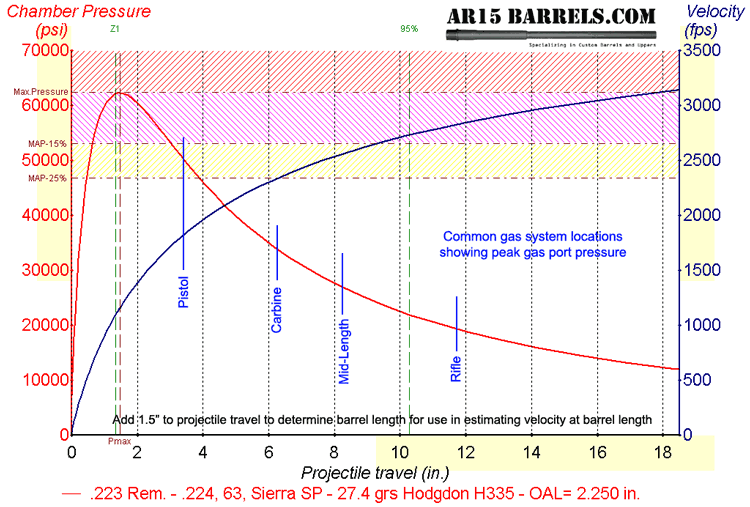
How do I know you haven't shot magnum pistols at targets with varying loads? A .44 mag with a 300 grain bullet hits significantly higher on a target than a 240 grain load because the 300 grain bullet is traveling slower and the muzzle rises more before it leaves the barrel compared to the 240 grain bullet. |
[ARCHIVED THREAD] - When Does a Gun Move From Recoil (Page 1 of 2)
Armory Sponsor