


Armory Sponsor


Posted: 8/31/2008 6:05:03 PM EDT
 American Rifleman has a long history of showcasing the latest developments in military arms and ammunition. What follows is a close look at cutting-edge work that is well underway toward the goal of sharply reducing the infantry soldier’s combat load. It could be the future of U.S. infantry weapons. By Robert Bruce The Lightweight Small Arms Technologies program (LSAT) has been on our radar screen since its inception in 2003. Plastic-cased cartridges are already performing well, and caseless ammunition—a concept dating back to the dawn of firearms—is said to offer the greatest potential. Today, these high-tech cartridges and the innovative lightweight small arms that fire them are showing great promise. What emerges from these experiments is likely to yield benefits not only to the military, but also to law enforcement and to the shooting sports. It’s real and right now: a dramatically different squad automatic weapon (SAW) that fires radically new ammunition. And this combination is half the combat weight of the M249, the current SAW. We asked the Army’s program manager how soon it could be in the hands of Americas warfighters? That is a tough question, so lets go back a few years. The Army-led Joint Services Small Arms Program (JSSAP) challenged the defense industry to develop and present innovative ideas for dramatically reducing the combined gun and ammunition weight in a family of small arms. These new arms are intended to bridge the gap between what is in use now and the directed energy “ray guns” or other radical armament that might be available to the American soldier of 2025. In March 2005 it was publicly announced that the concept from well-respected defense contractor AAI—heading up a team of eight specialized companies—had been judged superior to that of rival General Dynamics, and was “downselected” by JSSAP for further development. At the time, AAI’s proposed Squad Automatic Weapon and its radical ammunition existed only in “virtual reality”—animated 3-D models generated by astonishingly complex computer programs. With JSSAP’s approval and selection of these digital designs came sufficient funding to begin fabrication of actual cartridges and the guns to send rounds downrange. 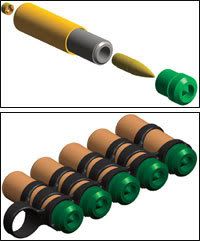 The Cased Telescoped (CT) ammunition (above) is one of the approaches to meeting LSAT’s weight reduction goals. The most current generation, “Spiral 2” CT, uses specialized polymer formulations for the cartridge case and end cap, but priming is conventional. Six-hundred rounds of 5.56 CT weighs 35 percent less than an equal number of 5.56x45 mm rounds. Live Fire Demonstration By May 2007, things were moving along so well with the Cased Telescoped (CT) ammunition and prototype SAW that Kori Spiegel, JSSAP’s LSAT project manager, took the calculated risk of authorizing the first public LSAT live-fire demonstration held in conjunction with the National Defense Industrial Association’s annual Small Arms Symposium. Tim Livelsberger pumped out nearly 50 rounds of CT in flawless semi- and full-automatic operation from the serial number 1 (SN1) light machine gun. This clearly showed that its theoretical potential had been turned into something very real. It seemed that the uncannily light gun and its distinctive plastic “lipstick tube” ammunition were on the fast track to fielding. Invitation To AAI Further inquiries were rewarded with an invitation for the author to visit AAI’s Hunt Valley, Md., headquarters for an exclusive LSAT status briefing in December 2007. This also included the opportunity to formally interview Spiegel and the program’s other top official, AAI’s Paul Shipley, who heads the corporation’s team of industry partners. I was brought up to date on the series of successful demonstrations for senior officers and others in the military community that followed LSAT’s public debut seven months earlier. All have included the opportunity to handle and shoot the CT serial number 1 prototype with “Spiral 2” (second generation) cased telescoped ammunition on military ranges with pop-up targets positioned from 100 to 800 meters. These demonstrations allow decision makers to assess the system’s combat potential. “Results have been very positive,” Spiegel said, “particularly in favorable comments on the design’s light weight, mild recoil and accuracy—all measurably superior to the current squad automatic weapon.” Live fire video clips of this arm in action are available for viewing at www.americanrifleman.org. Shipley told us that the test and demonstration prototype CT SN1 has received a pretty good workout along the way. “We’ve fired about 5,000 rounds in that weapon,” he said, “in temperature conditions from very cold to very hot.” So, what’s next? LSAT fact sheets predict the gun and ammunition being transitioned to Program Manager Soldier Weapons (PMSW) in 2010. Why two more years? Spiegel replied this date was a guideline and there are compelling reasons to keep it in “Technology Base” for a bit longer. “It’s more about the best solution,” she explained. “Cased Telescoped [ammunition] is out in front, time-wise—probably between six months to a year ahead of where we are with caseless. We could transition that package tomorrow and PMSW could continue to develop it and then field it in a few years. But we think there’s more potential there and we should work more on the caseless, or in developing other types of weapons, and really find the right fit for our user before … transition.” Indeed, as I saw a bit later that day in a visit to AAI’s subterranean small-arms test range, engineers from ARES, the weapon design partner, were working with counterparts from AAI in conducting live-fire experiments with the updated CT SN2 weapon. I received a close look at ATK’s latest caseless ammunition, but the test fixture that fires it—said to be significantly different in mechanical function from that of CT—was literally under wraps for security purposes. I asked about “thermal management,” the vexing problem of keeping the LSAT from prematurely overheating. Shipley corrected the misconception that this is particularly challenging in both CT and CL because there is no brass case that ejects along with most of the heat generated on firing. Brass transfers a lot of heat to the chamber, he said, but the CT’s polymer case is an insulator. The CT’s “combination of a separate chamber and polymer case results in considerable heat isolation,” Shipley explained. “You can fire to the point where the barrel is too hot to touch yet the chamber is only slightly warm.” And Spiegel said that the high-temperature steel used in the barrel was nothing unusual. “There’s no ‘unobtanium’ [miraculous metal] in the weapon itself,” she said. “The only thing we haven’t made a determination on yet is the chamber for the caseless weapon,” she offered. “We are looking at everything including ceramics, approaching it from all angles. We want to find the optimum combination and that will probably be some kind of ‘sandwich,’ but we don’t know yet.” 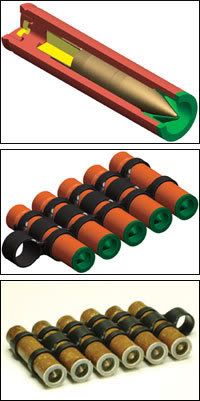 The Caseless Telescoped (CL) cartridges (top), developed by Alliant TechSystems, use the propellant itself for the role of the “case,” which is fully consumed on firing. Optimum Caliber Proponents of various alternative calibers should take heart. Both Spiegel and Shipley were careful to point out that the conventional G.I. 5.56x45 mm ball and tracer bullets used in the program’s experimental CT ammo serve primarily as a baseline standard since everyone can relate to their performance. “There is some other work in the Army for what they’re calling a ‘green bullet’ program which is not only lead-free, but probably has other improvements in it,” Spiegel said. “We’d like to see if we could integrate that with our ammunition as well as look at calibers other than 5.56 millimeter. We would like an optimum caliber, we just don’t know yet what that is.” Virtual Guns And Ammunition LSAT information papers indicate that a lot of the most challenging obstacles in ammunition and firing mechanisms had been cleared ahead of time in super-smart computer models. Both Spiegel and Shipley were quick to credit partner firms for their expertise in this cutting-edge computer science. “They’re bringing gun design into the 21st Century,” Spiegel said. “We did some of it with the Objective Crew Served Weapon (circa 1995) but really the tools weren’t there to do it back then.” Once a decision is made on CT vs. CL with a well-developed prototype weapon, the team would like to move the system into limited production stage before handing it off to PMSW. “Our plan is to bring a weapon producer on before that so we can get a little bit of the manufacturing experience,” Spiegel said. “We have a lot of R&D experience on this team, we don’t have a lot of weapon manufacturing experience. We’d like to get a little bit of feedback as far as designing parts, making parts, materials, that kind of thing.” LSAT’s Future JSSAP’s winning LSAT team is uniquely structured to make the best use of the program’s many and very different scientific, technical and soldier-interface disciplines. The lead contractor is defense giant Textron’s AAI subsidiary, with more than a half-century of experience in armament and ammunition development. Its five main partners include ARES for weapon engineering, ATK and General Dynamics’ St. Marks Powder for ammunition, Battelle for material investigation and Omega Training for human factors. Cased Telescoped LMG Weapon Prototype serial number 2 is nearing finalization, making best use of important lessons learned along the way and optimized for the latest CT cartridges. A prototype Caseless Telescoped weapon is coming soon. At this point, I’ve seen enough evidence on LSAT to convince me that the program is making meaningful progress. This leads to intriguing possibilities for some likely spin-offs and their benefits to military, law enforcement and shooting sports. Consider the deceptively modest phrase “family of weapons” in LSAT fact sheets. Might this family include pistols, rifles and machine guns? I learned that AAI is already at work on a lightweight assault rifle to fire the same CT and CL ammunition for the LSAT SAW. This initiative is particularly timely given growing dissatisfaction with the U.S. military’s currently issued M16 rifle and M4 carbine. If caseless ammunition advances to the point where it is comparable to traditional, brass-cased cartridges in price, performance and durability, a number of practical reasons would invite change. The Crystal Ball A final try for an answer to the “when” question was once again met by Spiegel with the kind of cautious wisdom that comes from many years of experience. “We just don’t know because both cartridge types hold so much promise and there’s more work to be done,” she advised. “My assumption for LSAT’s transition to Program Manager Soldier Weapons is that it would not happen before 2010.” I didn’t ask Spiegel to speculate on how long it will take after her team’s finalized “best solution” gun and ammunition have been passed on to PMSW before the M249 is replaced. By this time I realized that it was just not a fair question. So I didn’t ask about ray guns, either. AAI’s website has a downloadable LSAT brochure and more at www.aaicorp.com. Click Advanced Programs then Lightweight Small Arms Technologies. A formal briefing on LSAT was presented at National Defense Industrial Association’s Small Arms Symposium. It may be found at www.dtic.mil/ndia/2007smallarms/5_9_07/Spiegel_820am.pdf. |
|
I asked about “thermal management,” the vexing problem of keeping the LSAT from prematurely overheating. Shipley corrected the misconception that this is particularly challenging in both CT and CL because there is no brass case that ejects along with most of the heat generated on firing. Brass transfers a lot of heat to the chamber, he said, but the CT’s polymer case is an insulator. The CT’s “combination of a separate chamber and polymer case results in considerable heat isolation,” Shipley explained. “You can fire to the point where the barrel is too hot to touch yet the chamber is only slightly warm.” And Spiegel said that the high-temperature steel used in the barrel was nothing unusual. |
| I wonder how long it will take for the reloading industry to proliferate CT and CL capable gear? I definitely won't miss the de-priming, tumbling, and resizing steps of reloading. OTOH, I'm not exactly sure how you will be able to develop loads unless they sell machines that compact the propellant into the required cylindrical shapes. |
|
1. I'm not sure the plastic cases would expand and stay expanded the way brass does. 2. in my experience with "regular" rifles the barrel up near the muzzle is always a lot hotter than the barrel back by the chamber (chamber has thicker metal and is attached to the receiver - a heat sink) 3. I know they've made all plastic shotgun hulls for years and you can reload those, but the peak pressures are much higher in the rifle and I don't know how many reloads folks get out of all plastic hulls 4. The car folks got all excited 20 or more years ago about the use of polymer/plastic in car engines (lightweight polymer connecting rods that were going to revolutionize high performance engines). It looked good on paper, seemed to work on a few test engines but then just disappeared. I won't hold my breath waiting on polymer to replace brass in rifle cases either, but who knows. |
|
The interesting thing is if you move from brass to polymet, there would likely not only be a weight savings, no issues with ammo corrosion, and to boot you are now not using up brass whic is a rather valuable resource. Granted the polymer is probably made with pertochemicals, but it seems that it may offer some interesting advantages. The idea of using the case as an insulator instead of a ehatsink is pretty damn creative. [ETA] One other thought occured to me. Look at the legnth of the telscoped ammunition, probaly half of that of a standard 5.56x45 round. it loos short enough that you could actually mount a magazine of it P90 style, or even do a Bizon helical mag under/over the barrel. Also, shorter round= shorter bolt stroke for laoding = shorter weapon, even if by only a few inches. Some real 'synergistic' possiblites if the ammo is reliable and affordable. I daresay even if this is not the round adaopted for the future, it likely points the driection we are headed. |

That was my first thought as well. Just think of a weapon the size of a P-90, but firing real ammunition with high lethality. |
|
Anyone else here actually tried any polymer-cased ammo (PCA Spectrum)? Yeah. Brings a whole new meaning to "fail" when a load makes crappy steel Russian ammo look like Lake City quality. Seperated case heads galore, stovepipes, feeding issues, everything...there's a reason why brass has been around for so long. The last 10% of efficiency always costs far, far more in time and development than the previous 90%. |
Totally different. Not at all comparable. |
|
Quoted:
I wonder how long it will take for the reloading industry to proliferate CT and CL capable gear? I definitely won't miss the de-priming, tumbling, and resizing steps of reloading. OTOH, I'm not exactly sure how you will be able to develop loads unless they sell machines that compact the propellant into the required cylindrical shapes. Polymer ammo will likely NOT be reloadable.... This is a polymer case plus a 'chamber liner/bullet-carrier' round.... Think a sabot round, but the 'sabot' is attached to and extracted/ejected with the case-body... Caseless and Consumable-Case (think M1 tank rounds, but rifle-sized) ammo leaves nothing to reload - it's all consumed in the firing... |
|
I wouldn't go so far as to say that. They are fundamentally different weapons used for similar purposes.
LSAT is great, but it shouldn't be made to replace the SAW. It should target the 240. The new 240 is only 23 pounds, but this would be 18 or less. Not to mention ammunition weight. |
|
When this weapon dosn't get adopted––and it won't-this program will join the long line of failed army programs that once again seem like a great idea and yet don't work in practice. It is in the intrest of the contractor that the program last as long as possible and yet don't produce a useable weapon.
During my recent Iraq tour I was amazed how well the hundred year old design of the M2 .50 cal worked. Despite the fact that it didn't have a safety, my squad never had an AD and as long as the gunner cleaned it then it went bang. We mounted PAQ 4 lasers and were able to shoot accurately at night. Ammo boxes grew from 100 to 200 to over 300rds atop our uparmoured humvees. My hummer held over 1K rds alone. And the army wants to replace it with a "lightweight" .50 that only fires 250rds a minute. Believe me, during a firefight, I thought the M2 fired way, way too slow. The abuse that small arms ammo gets during wartime is substantial, it gets rained on, snowed on and endures both high and low temps, dust, dirt and corrosion. Brass cased ammo can take it, this new telescoped ammo, well, that remains to be seen. There are more important things that the army should be spending it's money on. |
|
They are very keen on fielding this one.
The rate of fire on the LW50MG is too low. I believe I read that they are trying to raise it. I think that it will probably work well out of a CROWS-Lightning though. How many of those are there, about 200? The .50 does have problems. We go over this every few weeks. It is too heavy and the headspace design is terrible. The sights are hard to use. Improvement would be good, although I am somewhat skeptical of the new .50s. |
|
Quoted:
Look at PMAGs... polymer is cheap, cheap. If it weren't for their demand they could be sold for 8 dollars a piece and still be profitable. I hope the polymer cased ammo is cheap, for when we civvies get our caseless wonder guns in 5 or 10 years. we wont. the next generation guns will not be available to civilians. caseless, TC, directed energy. all of these things will be highly regulated by the government. the only reason we can own guns right now is because they have been available for a long time. if they were invented today, we would not be allowed to own them. |
|
Quoted:
They are very keen on fielding this one. The rate of fire on the LW50MG is too low. I believe I read that they are trying to raise it. I think that it will probably work well out of a CROWS-Lightning though. How many of those are there, about 200? The .50 does have problems. We go over this every few weeks. It is too heavy and the headspace design is terrible. The sights are hard to use. Improvement would be good, although I am somewhat skeptical of the new .50s. Jack, I assure you, there are significantly more CROW systems out there than 200. There is nothing terrible or difficult about the Headspace system of an M2. It was designed to be adjustable so the end user can compensate for the inevitable wear that would otherwise take a fixed headspace system out of the game. The only “problem” the M2 has ever had is throwing an untrained Joe behind it that has not been properly trained on how to headspace and time the weapon correctly. Almost every incident involving an accident with a .50 ultimately boils down to a lack of proper training. Though it seems every contractor and internet commando out there with NO functional knowledge always seems to turn this into a flaw of a combat proven weapon in an effort to pack some untested, unproven and ill-advised POS up our collective ass. I give you the failed XM8 program as exhibit A. Though there are still morons in the food chain that are ignorantly enamored with this abortion for whatever reason. This stuff is not rocket science. Given 3 or 4 hours, you can properly train any Soldier, Sailor or Marine to correctly set up and operate an M2. Once trained, an experienced operator can have a M2 up and going in a matter of minutes. While I am all in favor of R&D to develop the next best thing, it had better be a quantum improvement on the existing proven system or why bother. As far as improvements in sights go, well that's not rocket science either. I cobbled this together to utilize the common M2 Aimpoint on my first deployment in ’05. 

WpnsMan |
|
The .50 does have problems. We go over this every few weeks. It is too heavy and the headspace design is terrible. The sights are hard to use. Improvement would be good, although I am somewhat skeptical of the new .50s.
Were it of a lighter weight, it probably wouldn't have anywhere near the longevity of the Browning. Heavy as they may be, there's vanishingly few other designs where one can find an individual weapon that's been in continual service for more than half a century...and still works just as well. Sights are an easy fix..and there's a flood of aftermarket options out there to choose from. Headspace and timing is what it is...although the FN design rectifies some of those issues. I don't really expect we'll see it replaced unless something radically better comes along, or it becomes politically necessary for some reason or another to field some piece-of-crap untried new system. |


|
Quoted:
The ammunition looks bulky too me not weight wise, but size wise. I don't think it's going to be practical. That's what I'm thinking....ya, it weighs less, but the diameter means mags going into rifles would be cumbersome to say the least if you wanted a 25-30 round mag. I can't get the "lipstick" size comment out of my head.....that's significantly bigger around than a 5.56 round. JMO, Sean |
|
Quoted:
Quoted:
They are very keen on fielding this one. The rate of fire on the LW50MG is too low. I believe I read that they are trying to raise it. I think that it will probably work well out of a CROWS-Lightning though. How many of those are there, about 200? The .50 does have problems. We go over this every few weeks. It is too heavy and the headspace design is terrible. The sights are hard to use. Improvement would be good, although I am somewhat skeptical of the new .50s. Jack, I assure you, there are significantly more CROW systems out there than 200. There is nothing terrible or difficult about the Headspace system of an M2. It was designed to be adjustable so the end user can compensate for the inevitable wear that would otherwise take a fixed headspace system out of the game. The only “problem” the M2 has ever had is throwing an untrained Joe behind it that has not been properly trained on how to headspace and time the weapon correctly. Almost every incident involving an accident with a .50 ultimately boils down to a lack of proper training. Though it seems every contractor and internet commando out there with NO functional knowledge always seems to turn this into a flaw of a combat proven weapon in an effort to pack some untested, unproven and ill-advised POS up our collective ass. I give you the failed XM8 program as exhibit A. Though there are still morons in the food chain that are ignorantly enamored with this abortion for whatever reason. This stuff is not rocket science. Given 3 or 4 hours, you can properly train any Soldier, Sailor or Marine to correctly set up and operate an M2. Once trained, an experienced operator can have a M2 up and going in a matter of minutes. While I am all in favor of R&D to develop the next best thing, it had better be a quantum improvement on the existing proven system or why bother. As far as improvements in sights go, well that's not rocket science either. I cobbled this together to utilize the common M2 Aimpoint on my first deployment in ’05. http://i445.photobucket.com/albums/qq174/WpnsMan/OIF%20M2/HPIM0249.jpg http://i445.photobucket.com/albums/qq174/WpnsMan/OIF%20M2/HPIM0250.jpg WpnsMan The problem with all of that is simple: There is NO reason to keep a closed-bolt, non-QCB crew-served weapon in service... Period... Yes, 'with training', you can teach a soldier to get a .50 going in a few minutes... However, the amount of training & time-to-function-when-trained for a modern, M240-style weapon is much lower.... Give it a light-profile, quick-change barrel (the weight of the M2 BBL is for cooling) with a fixed headspace, and make it gas operated and you will have a MUCH better weapon... Especially if it's designed to snap and pin together, eliminating the need for nuts, bolts & lock-wire... |
|
The problem with all of that is simple:
There is NO reason to keep a closed-bolt, non-QCB crew-served weapon in service... Period... Yes, 'with training', you can teach a soldier to get a .50 going in a few minutes... However, the amount of training & time-to-function-when-trained for a modern, M240-style weapon is much lower.... Give it a light-profile, quick-change barrel (the weight of the M2 BBL is for cooling) with a fixed headspace, and make it gas operated and you will have a MUCH better weapon... Especially if it's designed to snap and pin together, eliminating the need for nuts, bolts & lock-wire... Great. FN did it years ago: it's called the M2HB QCB. Buy the kit, swap out the parts, keep the ol girl running. http://www.fnhusa.com/mil/products/firearms/family.asp?fid=FNF016&gid=FNG008 |
|
Originally Posted By Dave_A
The problem with all of that is simple: There is NO reason to keep a closed-bolt, non-QCB crew-served weapon in service... Period... Yes, 'with training', you can teach a soldier to get a .50 going in a few minutes... However, the amount of training & time-to-function-when-trained for a modern, M240-style weapon is much lower.... Give it a light-profile, quick-change barrel (the weight of the M2 BBL is for cooling) with a fixed headspace, and make it gas operated and you will have a MUCH better weapon... Especially if it's designed to snap and pin together, eliminating the need for nuts, bolts & lock-wire... Dave_A, The reason to keep the M2 is that there is currently nothing better to replace it with that has proven to be more effective or reliable. Don’t get me wrong, I am all for replacing the M2 “when” something better comes along but, to date that has not happened. Though the FN re-designed M2 with fixed headspace is probably the best option at this point. The major miss-conception about the M2 is that it somehow requires an inordinate amount of training or maintenance. Most of those assumptions regarding the M2 come from those unfamiliar with it. Add to that the numerous .mil urban legends of the weapon self-destructing or the drive spring assembly perforating some poor Joe during disassembly and one can understand the apprehension or outright fear many have concerning the weapon. It requires no more time to train a Joe to properly set up and maintain a .50 than it does to train a private the cycle of operation and how to field strip and maintain a M16 for the first time during basic training. I.e., after initial training it becomes a no-brainer. Is the M2 perfect, no. Can it be improved upon, yes. But, many of its perceived faults have only surfaced in the last decade or so of its existence. Funny that our fathers and grandfathers found it adequate and easy to maintain yet somehow it is to complicated for our generation. I have been doing this since the early 80’s and “we” always seem to want mechanical solutions to somehow mitigate a lack of proper training. Evidenced by the introduction of the 3 round burst in the M16A2 as opposed to teaching proper fire discipline and now the latest MWO concerning the M2 is to retro-fit them with a manual safety because there are to many ND’s. Just my .02 WpnsMan |

|
Quoted:
The problem with all of that is simple:
There is NO reason to keep a closed-bolt, non-QCB crew-served weapon in service... Period... Yes, 'with training', you can teach a soldier to get a .50 going in a few minutes... However, the amount of training & time-to-function-when-trained for a modern, M240-style weapon is much lower.... Give it a light-profile, quick-change barrel (the weight of the M2 BBL is for cooling) with a fixed headspace, and make it gas operated and you will have a MUCH better weapon... Especially if it's designed to snap and pin together, eliminating the need for nuts, bolts & lock-wire... Great. FN did it years ago: it's called the M2HB QCB. Buy the kit, swap out the parts, keep the ol girl running. http://www.fnhusa.com/mil/products/firearms/family.asp?fid=FNF016&gid=FNG008 Still not open bolt, still heavy barrel, still blowback operated... |
|
Quoted:
Originally Posted By Dave_A
The problem with all of that is simple: There is NO reason to keep a closed-bolt, non-QCB crew-served weapon in service... Period... Yes, 'with training', you can teach a soldier to get a .50 going in a few minutes... However, the amount of training & time-to-function-when-trained for a modern, M240-style weapon is much lower.... Give it a light-profile, quick-change barrel (the weight of the M2 BBL is for cooling) with a fixed headspace, and make it gas operated and you will have a MUCH better weapon... Especially if it's designed to snap and pin together, eliminating the need for nuts, bolts & lock-wire... Dave_A, The reason to keep the M2 is that there is currently nothing better to replace it with that has proven to be more effective or reliable. Don’t get me wrong, I am all for replacing the M2 “when” something better comes along but, to date that has not happened. Though the FN re-designed M2 with fixed headspace is probably the best option at this point. It hasn't happened yet because they only recently put out a contract for it... The design shortcomings of the M2 are obvious: 1) Blowback operated (Ok, 'Short Recoil') - resulting in excess weight due to the need for a heavy bolt/lockframe/etc... 2) Uses barrel weight for cooling 3) Closed bolt (heats up faster) 4) Barrel changes are complicated by adjustable headspace & timing The major miss-conception about the M2 is that it somehow requires an inordinate amount of training or maintenance. Most of those assumptions regarding the M2 come from those unfamiliar with it. Add to that the numerous .mil urban legends of the weapon self-destructing or the drive spring assembly perforating some poor Joe during disassembly and one can understand the apprehension or outright fear many have concerning the weapon. It requires more training & practice than modern MGs such as the M240 and M249. This is an undisputable fact It requires no more time to train a Joe to properly set up and maintain a .50 than it does to train a private the cycle of operation and how to field strip and maintain a M16 for the first time during basic training. I.e., after initial training it becomes a no-brainer. Somehow, it never seems to work out this 'well' Is the M2 perfect, no. Can it be improved upon, yes. But, many of its perceived faults have only surfaced in the last decade or so of its existence. Funny that our fathers and grandfathers found it adequate and easy to maintain yet somehow it is to complicated for our generation. I have been doing this since the early 80’s and “we” always seem to want mechanical solutions to somehow mitigate a lack of proper training. Evidenced by the introduction of the 3 round burst in the M16A2 as opposed to teaching proper fire discipline and now the latest MWO concerning the M2 is to retro-fit them with a manual safety because there are to many ND’s. The M1919 was replaced after Korea... Your entire argument could be given for keeping THAT weapon system too... The M2 is quite simply an obsolete design - it's not about 'mechanical solutions to a training problem' - it's about a 2nd-generation machine gun that is still in use decades after it should have been replaced... The reason 'our grandfathers' used the M2 is the same reason that the 1911 lived so long in service - no one bothered to replace it with obviously better weapons, because that was not a priority... Just my .02 WpnsMan |
|
I got a five minute lesson from an Army sgt about setting up and running a .50.
Wasn't "full blown training" but we took a completely disassembled for training M2, set it up, and had it running in a couple minutes when none of us had handled one before. All of us were qualified machine gunners (had classes on the 240 and 249 and experience), but it wasn't exactly rocket science. The 240 and 249 aren't particularly hard to learn either. And as others have said, the FN version with fixed headspacing has been around for at least a decade. |
|
Quoted:
Dave_A, The reason to keep the M2 is that there is currently nothing better to replace it with that has proven to be more effective or reliable. Don’t get me wrong, I am all for replacing the M2 “when” something better comes along but, to date that has not happened. Though the FN re-designed M2 with fixed headspace is probably the best option at this point. It hasn't happened yet because they only recently put out a contract for it... The design shortcomings of the M2 are obvious: 1) Blowback operated (Ok, 'Short Recoil') - resulting in excess weight due to the need for a heavy bolt/lockframe/etc... 2) Uses barrel weight for cooling 3) Closed bolt (heats up faster) 4) Barrel changes are complicated by adjustable headspace & timing The major miss-conception about the M2 is that it somehow requires an inordinate amount of training or maintenance. Most of those assumptions regarding the M2 come from those unfamiliar with it. Add to that the numerous .mil urban legends of the weapon self-destructing or the drive spring assembly perforating some poor Joe during disassembly and one can understand the apprehension or outright fear many have concerning the weapon. It requires more training & practice than modern MGs such as the M240 and M249. This is an undisputable fact It requires no more time to train a Joe to properly set up and maintain a .50 than it does to train a private the cycle of operation and how to field strip and maintain a M16 for the first time during basic training. I.e., after initial training it becomes a no-brainer. Somehow, it never seems to work out this 'well' Is the M2 perfect, no. Can it be improved upon, yes. But, many of its perceived faults have only surfaced in the last decade or so of its existence. Funny that our fathers and grandfathers found it adequate and easy to maintain yet somehow it is to complicated for our generation. I have been doing this since the early 80’s and “we” always seem to want mechanical solutions to somehow mitigate a lack of proper training. Evidenced by the introduction of the 3 round burst in the M16A2 as opposed to teaching proper fire discipline and now the latest MWO concerning the M2 is to retro-fit them with a manual safety because there are to many ND’s. The M1919 was replaced after Korea... Your entire argument could be given for keeping THAT weapon system too... The M2 is quite simply an obsolete design - it's not about 'mechanical solutions to a training problem' - it's about a 2nd-generation machine gun that is still in use decades after it should have been replaced... The reason 'our grandfathers' used the M2 is the same reason that the 1911 lived so long in service - no one bothered to replace it with obviously better weapons, because that was not a priority... Just my .02 WpnsMan Dave_A, I agreed that the M2 does have some shortcomings, thats a given. Trying to find a replacement for the M2 is not a "new" concept. There are designs going back at least 15-20 years that were found lacking. To date, in its class the only proven competition the M2 has on the battlefield is its gas operated Russian, designed counterparts and I wouldn't exactly call them light or modern. While some of your points are valid concerns, others not so much. The M2 is what it is. I really don't see the point of your weight related arguments. It was designed as an anti-materiel weapon to be mounted on vehicles, aircraft, etc or used in semi-fixed positions to provide direct fire support in defense or assaults. The only thing lighter with a higher rate of fire is the Aircraft version. All the points you make as negatives are what have kept it alive in the system for as long as it has. Please provide an example of an "obviously better weapon" to replace the M2 and I will get on board. While a fine weapon for its day and intended purpose, don't assume that I am advocating using the 1919A4. That design was replaced by more versatile systems being the M60 and later the M240. Bringing that into this discussion is like comparing apples to oranges. So far during my 20+ year career I have had countless NCO's and Soldiers who didn't find the M2 to be rocket science when comared to any other system as far as training or maintenance is concerned. I guess maybe I am just lucky, WpnsMan |
|
Quoted:
Quoted:
The problem with all of that is simple:
There is NO reason to keep a closed-bolt, non-QCB crew-served weapon in service... Period... Yes, 'with training', you can teach a soldier to get a .50 going in a few minutes... However, the amount of training & time-to-function-when-trained for a modern, M240-style weapon is much lower.... Give it a light-profile, quick-change barrel (the weight of the M2 BBL is for cooling) with a fixed headspace, and make it gas operated and you will have a MUCH better weapon... Especially if it's designed to snap and pin together, eliminating the need for nuts, bolts & lock-wire... Great. FN did it years ago: it's called the M2HB QCB. Buy the kit, swap out the parts, keep the ol girl running. http://www.fnhusa.com/mil/products/firearms/family.asp?fid=FNF016&gid=FNG008 Still not open bolt, still heavy barrel, still blowback operated... To clear up a couple mis conceptions for you Read TM 9-1005-213-10 to see what the tab in between the butterfly's is for I like to call it "Dual Mode" Heat sink and slow the cyclic rate. google the cyclic rate and specs of the M3 for comparison or watch the youtube video of a M3 firing its recoil operated read TM 9-1005-213-10 for an explanation of how that system works. A good example of a blow back system would be the Ruger 10-22 |
Armory Sponsor