


Posted: 3/20/2010 6:44:43 PM EDT
|
So I want to get really good at target shooting as with my P89X and my dad's M&P but I am all over with my G19. Anything up to about 15 meters I am fine. After that I am all over the target. What can I do to improve? Here are some pics but I don't think they tell much because I am all over.
(Sorry for the crappy quality. I took them with my cellphone.) 

(The photos are supposed to be horizontal but I have no clue how to do that.) I shot 100 rounds and only 61 landed.  These two targets where @ about 23 meters. These two targets where @ about 23 meters.
Thank you for any input you guys may have. I know many of you will recommend to take courses with professionals but money is an issue right now so any exercises that you think may help my shooting will be great. Thank you. |
| Yeah i would get overly proficient up close and then move the target back a little at a time. Main thing for me for shooting accurately has always been make sure to keep the sights on target while slowly squeezing the trigger. If the sights are on target when it fires it will hit the right spot every time. A lot of people aim and then jerk the trigger quick which will throw off your shots. Also you want to focus your eyes on the front sight, rear sight and target should be a little blurry, but that front sight should be crystal clear. Keep the web of your hand as far up on the pistol as possible. Practice of course makes perfect. |
| Nothing may help. It may simply not it your hand. I know they don't fit mine and no amount of practice helped. I do just fine with a 1911 or a third gen Smith and any variety of .22s and even Smith J and K frames, but a Glock simply fits my hand so poorly that I can't shoot one well. |
|
Quoted:
Quoted:
Start much closer and shoot at 1" sticky dots. Don't move the target back until you can consistently place 5 shots into the dot. +1 on starting much closer to the target. Get good up close. It's all about consistency in trigger pull/control. You are changing something in your technique when you move further out. Rushing the shot/ jerking the trigger maybe? |
|
Quoted:
You are changing something in your technique when you move further out. Rushing the shot/ jerking the trigger maybe? I did rush a few shots thats why I was a bit mad with myself. I will try to keep getting over excited. Quoted:
You're shooting a glock, not a target pistol. Keeping 61% on an 8x11 target at 23 meters is nothing to sneeze at. I mean really, you're likely hitting 100% on a chest-sized target at 75 feet. Be happy. Sure, but I shoot much better with my P89 and my father's M&P. It is my first Glock so I understand that and thats why I wanted some input from you guys to help me improve my Glock aiming. |
|
Quoted:
You're shooting a glock, not a target pistol. Keeping 61% on an 8x11 target at 23 meters is nothing to sneeze at. I mean really, you're likely hitting 100% on a chest-sized target at 75 feet. Be happy. Glocks can and do ruitinely shoot 1-2" groups at 25 yards from ransom rests, or in the hands of skilled shooters from a sand-bag. They are mechanically capable of great accuracy. Practice is needed, that's all. |
|
Sights:
What it takes on the sights to make a precise shot at 7 yards is very different than what it takes to make a precise shot at 25. At 7 yards the natural movement of your sights doesn't seem like much on a reasonable target, like this UPC code: 
Shot at under 10 yards it wasn't hard to produce that group. When you move the target to 25 yards, however, suddenly you're looking at this: 
With the natural movement of the sights it now looks like your sights are all over the bloody target. That trips people up. Here's the reality: That natural movement is there at 7 yards and at 25 yards...and it's the same amount of movement. If you move the gun in a 2" circle around the target at 2 yards and then do the same thing with the target at 25 yards, it's the same 2" circle...but because of the distance it LOOKS like a 3 foot circle at 25 yards. What you have to learn is that the sights can be on the edge of the target and still hit center at those longer distances: 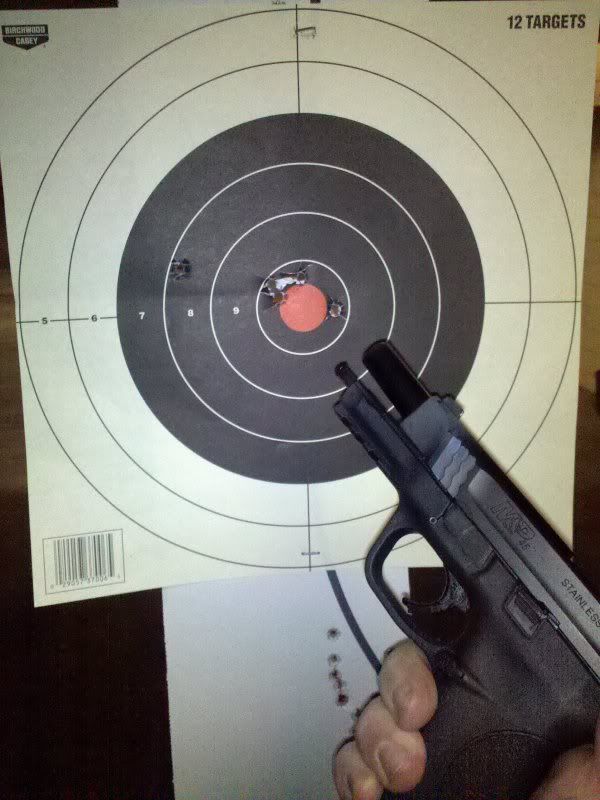
Now my front sight was not sitting right under the orange dot when I fired that 5 shot string. I couldn't SEE the dot at 25 yards. I just tried to keep the sights perfectly aligned and somewhere around the center area of the black, (sometimes the sights were on the left side of the black, sometimes on the right side of the black, sometimes in the top 1/3, sometimes in the lower 1/3 but the sights were in perfect relationship to each other) took the slack out of the trigger, and then executed a proper trigger press. The flyer seen (which is still in the black, you'll notice) came from a failure to properly align my sights. I didn't have that bullseye perfect sight orientation but it still landed in the 8 ring at 25 yards. What a lot of people do is see their sights moving around and then when they get the sight picture somewhere close to where they want it, they think "NOW!" and then gank the shot, slapping the trigger and anticipating recoil. Learning to get over the psychological fakeout of the ever-moving sights is a huge issue for lots of folks. Learning to understand how to manage the sights is a big hurdle for many. If you can get to the point where you can shoot 1 hole groups at 7 yards your trigger control is where it needs to be. If you don't know how to manage your sight picture at longer ranges, however, even perfect trigger manipulation won't be visible on target. Note about shooting bullseye: The longer you hang a gun out there the more you screw yourself. One of the most revealing things I've ever seen was watching LAV shoot walkback drills. On more than one occasion I saw him press out, hang for a second, and then bring the gun back into his chest, look down, and then press out again. He was doing a mental reset. Generally after doing that he scored a hit, usually a damn good one. The longer you hang the gun out there the more the sights move, the more the sights move the more pressure you feel to try and pull the trigger at the exact moment that the sight picture looks ideal, which leads to poor trigger manipulation and often anticipation of the shot. Trigger: Since you are new at this, work on trigger control first. The Glock has a really two stage feel to it. Take an [SIZE="4"]UNLOADED[/SIZE] Glock (and you're sure it's unloaded, right? Triple check.) and press the trigger using only enough pressure to move the trigger. At some point, usually about halfway through the trigger, you'll notice that the trigger stops moving unless you add more pressure. The section of the trigger pull that you could accomplish with the lighter pressure is called the "takeup". The point where the pressure required to keep the trigger moving is the actual trigger pull. The "takeup" on the Glock is mainly there to allow the trigger bar to deactivate the striker block. The point where you hit the heavier resistance is the actual trigger pull...the point where the trigger's movement is actually cocking (and subsequently releasing) the striker to fire the pistol. Often with Glock triggers I see that new shooters try and pull entirely through the trigger in one motion. Generally their results improve by teaching them to treat the Glock trigger almost like a 2 stage trigger where they quickly press through the "takeup" (also called "slack in the trigger") and then once they hit the increased resistance of the "actual" trigger pull, to pause briefly. Then to apply deliberate and ever increasing pressure on the trigger. To understand what I mean by "deliberate and ever increasing pressure" use a mental exercise. Imagine that your trigger finger is a lever and that on the other end of the lever there is a platform where you place weight to make the lever eventually pull the trigger. Imagine placing 1/4 of a pound of weight on the platform and then adding another 1/4 of a pound steadily until the weapon goes boom. That's the proverbial "perfect" trigger pull. If the sights are anywhere on target with a trigger pull like that, you will hit...because that trigger pull does not disrupt the aim of the firearm. Probably the best method of practicing the perfect trigger pull at home is to use the case/penny on the front sight drill. The drill involves using taking an unloaded firearm and balancing either an empty cartridge case or a dime on the front sight. 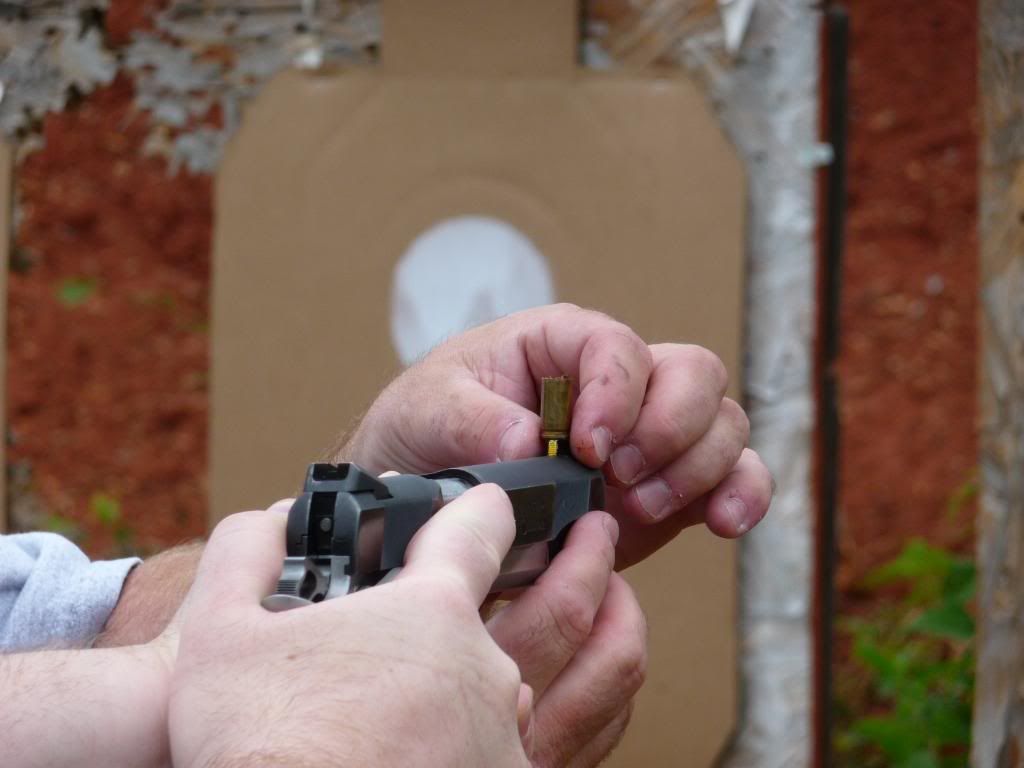
The goal is to pull the trigger in such a way that the casing/dime doesn't fall off the front sight. 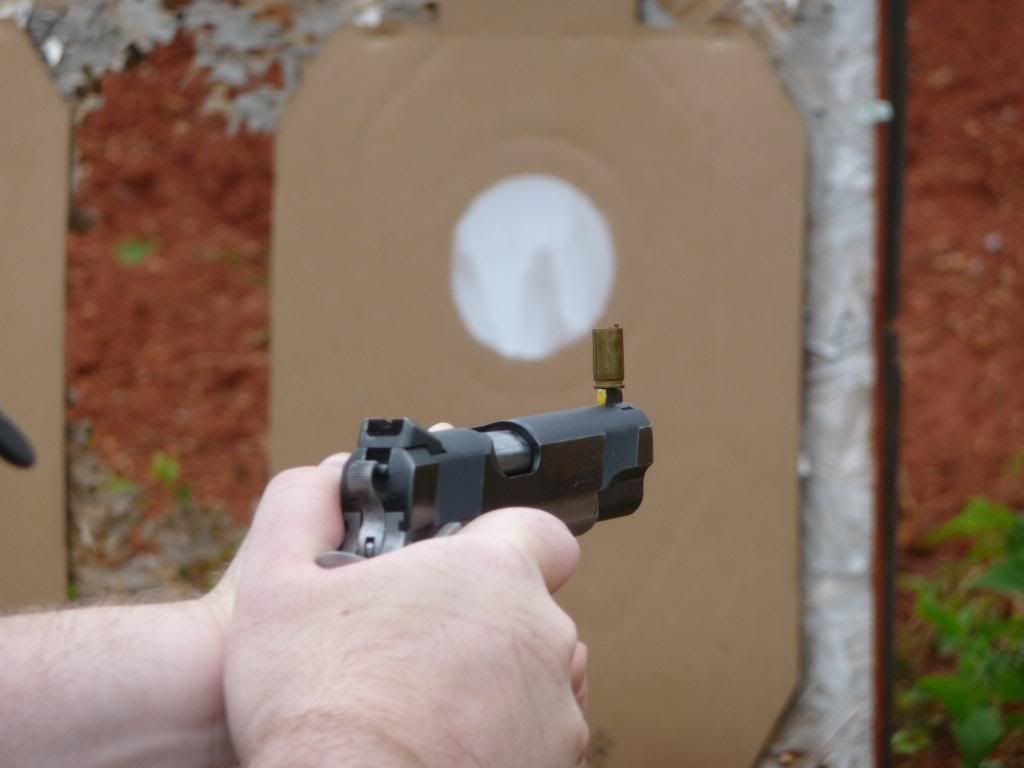
Work on developing that perfect trigger pull with dryfire and practice by shooting the smallest groups you can at the range at relatively close distances, say 3-7 yards. Start at 3 with the goal of putting all the bullets through a single hole. (Yes, it can be done even with a Glock). With the perfect trigger pull and a perfect sight picture you should be able to shoot insanely tiny groups at those distances. The key to good accuracy is not mucking with the trigger chasing particular trigger characteristics, it's learning to properly control the trigger. Wait to fool with modding the weapon until after you've established good trigger control fundamentals. |
|
Quoted:
WOW. Thank you John_Wayne777!! No problem. The other 1/2 of the walnut is learning to reset the trigger under recoil. Once you get good at finding that spot where the trigger pull is actually moving the striker, work on being able to move the trigger to JUST that point as the gun recoils. When you hit it right under recoil you're dealing with essentially a 5 pound short travel trigger, which generally allows you to press with a minimal chance of anticipation getting in the way. |
|
Quoted:
Quoted:
WOW. Thank you John_Wayne777!! No problem. The other 1/2 of the walnut is learning to reset the trigger under recoil. Once you get good at finding that spot where the trigger pull is actually moving the striker, work on being able to move the trigger to JUST that point as the gun recoils. When you hit it right under recoil you're dealing with essentially a 5 pound short travel trigger, which generally allows you to press with a minimal chance of anticipation getting in the way. Awesome. I really appreciate your answers. I will ask you more questions in the future if its okay with you. |
|
Quoted: sights, trigger, followthrough I'm a rookie pistol shooter and trying to get better with a my new G19 RTF, read/watched a lot on trigger and sights. Can you help me/us out with the followthrough. ETA: After comparing my last targets with the chart this seems as though it could be my problem I had decent grouping but it was all upper left. Any info would be great guys thanks. |
|
It's really hard to shoot the Glock well:
Because of the extreme grip angle you have to bend your right wrist way forward, and that's not very comfortable Because of the long scungy trigger, it's hard to get a clean break and keep the firearm steady. Slow down, concentrate on basics. Proper Weaver or modified weaver stance, push/pull grip, concentrate on the front sight, keep the front sight in focus, squeeze the trigger without mashing it. use a target with about a 4" bull, it will be easier to concentrate on the front sight. |
|
Quoted:
Quoted:
sights, trigger, followthrough I'm a rookie pistol shooter and trying to get better with a my new G19 RTF, read/watched a lot on trigger and sights. Can you help me/us out with the followthrough. ETA: After comparing my last targets with the chart this seems as though it could be my problem I had decent grouping but it was all upper left. Any info would be great guys thanks. +1 |
|
Quoted:
Quoted:
sights, trigger, followthrough I'm a rookie pistol shooter and trying to get better with a my new G19 RTF, read/watched a lot on trigger and sights. Can you help me/us out with the followthrough. ETA: After comparing my last targets with the chart this seems as though it could be my problem I had decent grouping but it was all upper left. Any info would be great guys thanks. followthrough is probably the MOST neglected aspect of marksmanship several ways to think of it is the principles and actions you do during and after the trigger is fully depressed and the shot goes downrange followthrough encompasses the mental visualization of you calling your shot as the gun recoils; if will be your visual ok in holding both your position, watching your sight picture/front sight (very important) during recoil and reposition, and mechanically resetting your gun for the next shot (trigger reset) in words: you are getting feedback from the shot you just launched; the feedback will take a slight amount of time (think of it like a pause), with the information coming from your sights and ending w/ your satisfaction of your shot called and the gun and trigger resetting for the next shot/end of the string after you get the "next sight picture" ("for ever shot you press, you should have one more sight picture") and have allowed your trigger to reset, and your visual/mental image of your called shot has impacted do you go to the next shot/end your string of shots; all in all, followthrough will be holding your aim on target (remember: your gun is recoiling now) as the shot goes, watching the sights througout, and allowing the gun to finally resettle into its position after recoil subsides hope that helps combine the above with mr John_Wayne777's advice (great trigger manipulation advice too!), and go at your current pace; speed will come w/ proper practice and smooth applicaiton |
|
Thanks Alphaghost, If I got what you are throwing out there correct it is definatley a step I have not been doing at all. I was more or less just waiting for the shot to "end" and then refocus on the sights. I will be working on this and see how I do. I am very happy with my grouping(and new pistol) now I just want it to be where I'm aiming. Thanks again everyone. |