


Posted: 3/8/2009 2:20:55 PM EDT
| Do I have that terminology right? Anyway, I'm clueless when it comes to Colt pistols. I handled a Colt 80 series at the fun store a few days ago and fell in LOVE with it. What's the difference between the two? |
|
The "original" Series 70 (1970 to 1983) had a fingered barrel bushing and no firing pin block. The Series 80 came along in 1983 with the firing pin block. The first few years of Series 80 production also used the fingered barrel bushing. Eventually the fingered bushing was eliminated on the 80 Series in favor of the solid barrel bushing. The repro Series 70 that came along in the '90s had the solid barrel bushing that the Series 80 utilized, but delieted the firing pin block.
So for current production, the difference is the firing pin block––Series 70 doesn't have it. Series 80 does. |
|
Quoted:
The firing pin block serves to prevent discharge unless the trigger is pulled, right? Correct. The driver in firing pin safety (fps) appears to be the California drop test where the pistol has to be dropped on its barrel from a certain height on a hard surface and not discharge. Colt uses the fps. Kimber uses something called the "Schwartz safety", also a fps. Don't know anything about that except that I think its mechanically different than the Series 80 fps. Other manufacturers use a lightweight titanium firing pin with a heavy firing pin spring, without using any additinal mechanical gadgetry to pass the test. Looks like all SA 1911s are approved in California so it must work. |
|
Pre-emptive strike - there are no Series 70 Commanders.
"Series 70" refers to a very particular model - namely, the MkIV Series 70 Government Model. The distinguishing feature, as previously mentioned, is the fingered collet bushing, in addition to the corresponding "accurizer" barrel. Contrary to popular misconception, "Series 70" DOES NOT refer to the FCG design or function. As far as Colts go, there are two FCGs for standard 1911s - Series 80 and Pre-80. Series 80 here DOES connotate the FCG design, as the Series 80 moniker is directly applied to many models - including the "original" MkIV Series 80 as well as the later (current) 1991 series. No Commanders of any kind were ever produced with the S70 collet bushing system, and no Commanders of any kind were ever marked Series 70. |

|
Quoted:
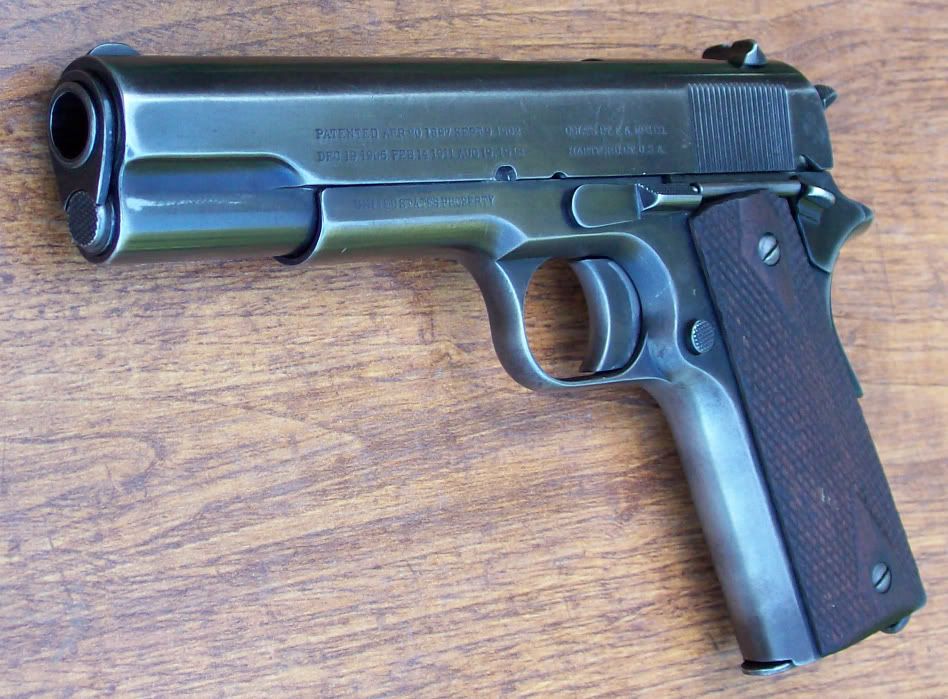
My Grandfather didn't need any extra series 80 lawyer parts in his beloved 1911 when he was gunning down Germans in WWI http://img.photobucket.com/albums/v488/derek45/1911/1911pistols023.jpg My Father didn't when he earned an expert ribbon with the 1911 and I sure as hell don't either. Beautiful weapon! |
|
Quoted:
My Grandfather didn't need any extra series 80 lawyer parts in his beloved 1911 when he was gunning down Germans in WWI My Father didn't when he earned an expert ribbon with the 1911 and I sure as hell don't either. I have a Colt Officer model that I removed the safety block from. I carry cocked and locked anyway. No need for gadgets that have a tendency to fail and jam the weapon. |