


AR Sponsor


Posted: 1/15/2009 7:44:08 AM EDT
At just over 10k rounds I experienced bolt failure, as pictured. For those interested it is from a Colt upper which is about 5 years old, and the bolt is marked MPC.

My plan was to replace the complete bolt and put the rifle back in service as a range gun. My questions are: 1. My understanding is that I do not need to check headspace, is this correct? 2. I was not going to change the barrel or any other upper parts. Barrel accuracy has not noticeably deteriorated, and as a range CQB gun, I’m not concerned with it anyway. Does this plan seem reasonable? Thank you. |
|
Quoted:
At just over 10k rounds I experienced bolt failure, as pictured. For those interested it is from a Colt upper which is about 5 years old, and the bolt is marked MPC. http://media.ar15.com/media/viewFile.html?i=7127 My plan was to replace the complete bolt and put the rifle back in service as a range gun. My questions are: 1. My understanding is that I do not need to check headspace, is this correct? 2. I was not going to change the barrel or any other upper parts. Barrel accuracy has not noticeably deteriorated, and as a range CQB gun, I’m not concerned with it anyway. Does this plan seem reasonable? Thank you. I was always told as long as it's new bolt/used barrel you're good to go. It's when you go used/used you may run into a headspace issue. ymmv |
|
Quoted:
What is the typical life expectancy of a bolt? How about a carrier? Bolts all fail eventually, usually without warning. From what I've read 6k would be a short lifetime and 20k would be a long one. How a weapon is used also seems to have a influence on bolt life, with lots of full auto fire leading to decreased lifetimes. This is one of the reasons I carry a spare bolt (already headspace checked) in my MIAD pistol grip. BSW |
|
Quoted:
What is the typical life expectancy of a bolt? How about a carrier? I'll hazard somewhat educated guess here since it depends on the bolt and carrier (manufacturer) and whether it was primarily full or semi auto use. Most bolts are going to fail at the cam pin hole. I've seen pics here of bolts failing in the 1st 1000 rounds and others that have lasted 20k+. IMO, stick to Colt, BCM, or LMT bolts. Shoot factory ammunition or ammunition you personally reloaded (no gunshow reloads). all that said, expect 10-20k rounds+ out of your bolt. Your carrier will last much longer. |
|
I purchased a field gauge and want to be sure I performed the test correctly, as there where no instructions.
I placed the gauge in the chamber (it appears to only go in 1 way) of the assembled rifle containing the new bolt, gently eased the bolt forward, and pulled the trigger, which fell. My understanding is that this indicates the rifle is safe to use. Is this correct? |
|
Quoted:
I purchased a field gauge and want to be sure I performed the test correctly, as there where no instructions. I placed the gauge in the chamber (it appears to only go in 1 way) of the assembled rifle containing the new bolt, gently eased the bolt forward, and pulled the trigger, which fell. My understanding is that this indicates the rifle is safe to use. Is this correct? Eh, no. 
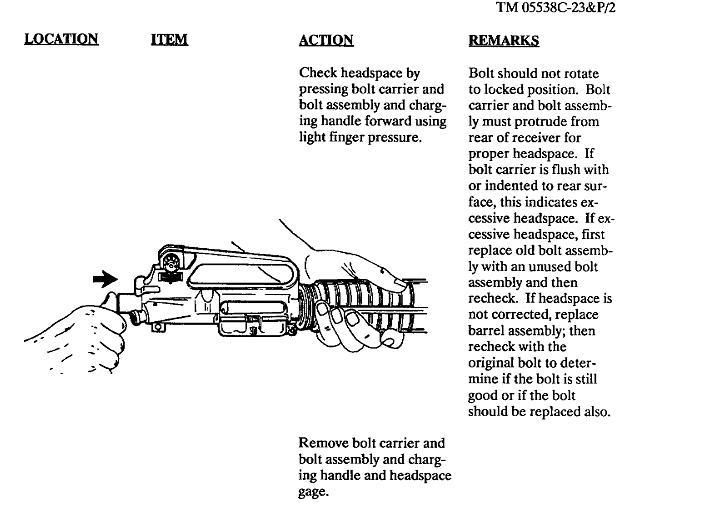
BSW |
|
Quoted:
I take it this guage is made to where you don't have to remove the ejector and extractor ??? Just curious...TIA WarDawg The USGI field gage has a rebated rim so you don't have to remove the ejector or extractor. Commercial gages may require removal og those parts. BSW |
|
Quoted:
I purchased a field gauge and want to be sure I performed the test correctly, as there where no instructions. I placed the gauge in the chamber (it appears to only go in 1 way) of the assembled rifle containing the new bolt, gently eased the bolt forward, and pulled the trigger, which fell. My understanding is that this indicates the rifle is safe to use. Is this correct? There are more than 5 different chamber types for the .223/5.56 rifles (.223, Wylde, a couple of NATO variants, etc). It's important to make sure you are using the correct gauge based upon the chamber in your barrel. If you want to be exact, contact the barrel manufacturer and have them tell you which gauge to use to match the chamber. You then need to follow the headspace gauge's instructions exactly to make sure you are getting the correct result. |
|
Good point about chamber type.
My barrel is marked 5.56 Nato, so I got a M16 gauge from http://www.billricca.com/collectors_corner.htm It was easy to use once I knew how. Following the instructions above the bolt carrier protruded about 1/8th inch past the receiver. I put 150 rds through it this afternoon, and all I can say is that I'm no uglier that before I shot the rifle. |
AR Sponsor