


AR Sponsor


Posted: 3/28/2015 5:53:01 PM EDT
|
Hy gents,
I do own a Frankenstein AR 15 built by myself. I am having over pressure problems with hot hirtenberger ammo. Let me explain the rifle first. It is a Bushmaster predator 20 inch barrell on a yankee hill upper, JP full weight bolt carrier and jp steel bolt. Spring and buffer are standard. Range 11000feet elevation. Andean Mountains. M 855 3049 fps no issues goog groups 250 yards M 139 3300 fps no issues groups are bad at 250 yd. Hirtenberger 55 gn ammo. 3453 fps with overpressure signs. Primer is out. small damages in the brass and the bolt does pot adjust properly for the next shoot. Groups are B.S. I believe I do habe some pressure issues. Need some suggestions: using a heavier buffer or spring will help? Do I have to use a regulable gas key? Avoid Hirtenberger? Other sugestions? Thank you |
|
Brutal facts time,
Colt, FN, and most world government firearm supplies tend to chamber (sidewall dimensions) on the looser side. Yes, you give up a touch of accuracy with the chambers this way, but with the slightly looser sidewalls chambers (head space is still held), this allows the rifles to be run harder/longer, and to allow them to keep on running when the conditions become adverse. Now in the civilian market, chambers (sidewall demensions) are kept to a tighter 223 rem type chamber to promote accuracy instead. Hence rifle are not going to see any full auto use, so looser side wall chambers are a disadvantage instead. Also, some of the barrels are actually chambered 223 Rem, instead of the longer throated 5.56 nato, and when Nato ammo is run in these barrels, going to get signs of higher pressures as well. So with the looser sidewall chambers, during ignition, you have more blow by at case fire forming, and what may be high pressure ammo in a tighter 223rem side wall chambered barrel, will be fine in a full auto type government chambered barrel instead. So regarding the Hirtenberger ammo, not for this Bushmaster barreled rig as is (with a more accuracy tighter type sidewall dimension type chamber). Also, really need to check if the barrel is chambered 223 Rem, or 5.56 Nato. If the barrel is chambered 223 rem, then any Nato ammo run through it will so signs of over pressure. Lastly here, if the barrel is 1/8, then it will be more happy with a 62 grain round or heavy, instead of the lighter 55gr rounds. Hence, M-193 is really a throw back ammo, and still in government production since there are still some 1/12 rigs out there that require such, with this ammo as a filler for those type rig. In the 1/9 barrel rig's, the M-855 at 62gr is the ball ammo for that rig. As for 1/8, pushed to 250 yards or longer, the Mk-262 is your better choice for ammo instead (if the barrel is chambered 5.56 Nato, and not 223 rem instead). |
|
Quoted:
3453 fps from M193 is too hot by at least 200 fps. Blown primers are a dead give away. Don't shoot any more of that ammo. Inspect your firing pin tip for damage, replace it if it's got a sharpened tip caused by gas erosion. Go back and take a look at his elevation (11k feet, hence reduction in barometric pressure that the bullet has to fight against). Also, you may be thinking that the ammo is out of the LC plant in the USA; while it may be from another country instead. Hence ATK holds the M-193 to 3200fps at sea level for the M-16/M-249, while ammo out of say Germany like the Hirtenberger (RUAG and the ammo now made by Norma), may be producing ammo much faster or slower instead (all depends on the rifles that they are being manufactured for in the first place). Bluntly, M-193 and M-885 are just the bullet designs in the greater sence, and not a speed hold spec for how the bullets itself is loaded across the world instead. |
|
Barrel should be 5.56 Nato according to the manufacturers specs.
I have no way to demonstrate if this is true or not. There is no go no go gauge in the country. I might purchase those in my next trip to the us this november. M 855 i have is us ammo as well as the M193. Might be that the Hirtenbergers I have are a bad lot. Altitude: 695 hPa preassure against 1024 sea level. means at sea level preassure is allmost 1 kg/square cm. Here about 600 g /sq cm. Means preassure against the muzzle is allmost half. What I wonder is that speeds in 855 and 193 are allmost same as the ones at sea level. Guess Hirtenbergers will be disassambed and reasambled with proper loads. Whay would yos say about an H buffer? |
|
Quoted:
Whay would yos say about an H buffer? The H buffer (carbine buffers across the board) only work when you are using a telescoping stock/ carbine receiver extension. The reason for them, the Buffer itself is a B/C limiter formost for how far the B/C can go back during cycle, and if you use a Carbine buffer in a rifle that is using a fixed full length stock (A-1/A-2 receiver extension), then the back of the carrier key will crash into the back of the lower receiver (where the buffer tube threads on) and crack the lower receiver. As for a A-1 or A-2 stock receiver extension, they are the same thing, and in the case of an A-2 buttstock, then there is a 5/8" cup piece that goes on the end of the tube first, the butt stock is installed, and the butt stock bolt to hold the butt stock on is 5/8" longer than a A-1 butt stock screw. So really, receiver extensions come it two different lengths and the inner void of the tube dictates the buffer and recoil spring to be used. Note, carbine recoil spring is around 10.5" (26.67cm), while a fixed stock spring is around 11.75"(29.85cm) instead. 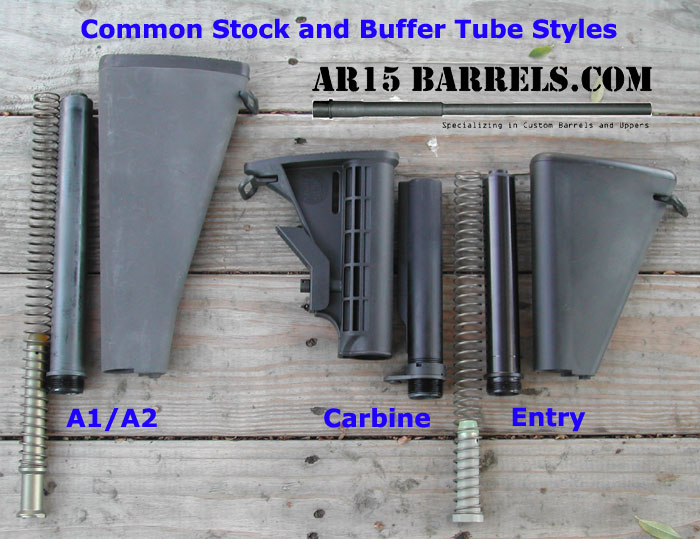
So if you have a fixed full length stock, then the standard buffer is already 5.15oz, http://www.biggerhammer.net/ar15/buffers/ If you are running a telescoping stock on the rig, the heaver buffer may slow down the unlock, but at the same time, may slow the unlock down so much that the bolt does not lock back on the bolt catch after the last round is fired, and such will cause nothing by feeding problems instead. So on that note, with the barrel being 1/8, and tighter semi auto side wall dimensioned chambered, would reserve the rifle to at least the M855 of the current line up, or if you can get your hands on some Mk-262 (or commercial 69gr ammo), give it a try in the rig. Although the heaver round is a touch slower in speeds, it much better at bucking cross winds at the longer ranges instead. |
|
Quoted:
Very usefull information. thank you. Ammo is Salt Lake. Telescoping stock. The tele stock puts you into the carbine buffer weight system. I carry all weights....CAR, H, H2 and H3 in my range kit. In this way, I can swap them out for the best effect depending on ammo. I use H2 most of the time, if I were to pick one. So many ask, "Which buffer ?" and there's no way to answer definitively via the internet. Too many variables. Sounds like your rifle is built like a Canadian C7 
|
|
Quoted:
Ammo is Salt Lake. ????? SL brass stamped US ammo is, St. Louis Ordnance Plant - St.Louis, Missouri: (November 1941 to June 1945), and never produced 5.56 nato ammo (5.56 was not first produced until the early 60's) Current ammo US ammo be head stamped LC, which is Lake City Ordnance Plant, Independence, Missouri: and currently run by ATK. (1940–Present) If you want to check the brass head stamp and figure where the ammo came from, then here. http://en.wikipedia.org/wiki/List_of_military_headstamps |
|
Quoted:
Go back and take a look at his elevation (11k feet, hence reduction in barometric pressure that the bullet has to fight against). Also, you may be thinking that the ammo is out of the LC plant in the USA; while it may be from another country instead. Hence ATK holds the M-193 to 3200fps at sea level for the M-16/M-249, while ammo out of say Germany like the Hirtenberger (RUAG and the ammo now made by Norma), may be producing ammo much faster or slower instead (all depends on the rifles that they are being manufactured for in the first place). Bluntly, M-193 and M-885 are just the bullet designs in the greater sence, and not a speed hold spec for how the bullets itself is loaded across the world instead. Quoted:
Quoted:
3453 fps from M193 is too hot by at least 200 fps. Blown primers are a dead give away. Don't shoot any more of that ammo. Inspect your firing pin tip for damage, replace it if it's got a sharpened tip caused by gas erosion. Go back and take a look at his elevation (11k feet, hence reduction in barometric pressure that the bullet has to fight against). Also, you may be thinking that the ammo is out of the LC plant in the USA; while it may be from another country instead. Hence ATK holds the M-193 to 3200fps at sea level for the M-16/M-249, while ammo out of say Germany like the Hirtenberger (RUAG and the ammo now made by Norma), may be producing ammo much faster or slower instead (all depends on the rifles that they are being manufactured for in the first place). Bluntly, M-193 and M-885 are just the bullet designs in the greater sence, and not a speed hold spec for how the bullets itself is loaded across the world instead. Elevation has zero effect on muzzle velocity. Higher elevations have thinner air and bullets loose velocity at a slower pace than they would at sea level. Higher ambient temperatures or leaving ammo sitting in direct sunlight will increase velocity. We're talking almost 250 fps faster than government reference velocity for 55 grain fmj M193 ammo. That ammo is loaded too hot. M193 is loaded to spec of approximately 62,000 psi in order to push that bullet that fast. If the Armed Services could safely get 3400+ fps and still be under 62k psi. that would be their new spec. They can't or they would. |
|
Quoted:
????? SL brass stamped US ammo is, St. Louis Ordnance Plant - St.Louis, Missouri: (November 1941 to June 1945), and never produced 5.56 nato ammo (5.56 was not first produced until the early 60's) Current ammo US ammo be head stamped LC, which is Lake City Ordnance Plant, Independence, Missouri: and currently run by ATK. (1940–Present) If you want to check the brass head stamp and figure where the ammo came from, then here. http://en.wikipedia.org/wiki/List_of_military_headstamps Quoted:
Quoted:
Ammo is Salt Lake. ????? SL brass stamped US ammo is, St. Louis Ordnance Plant - St.Louis, Missouri: (November 1941 to June 1945), and never produced 5.56 nato ammo (5.56 was not first produced until the early 60's) Current ammo US ammo be head stamped LC, which is Lake City Ordnance Plant, Independence, Missouri: and currently run by ATK. (1940–Present) If you want to check the brass head stamp and figure where the ammo came from, then here. http://en.wikipedia.org/wiki/List_of_military_headstamps Lake City is a US Government Owned Ammo Plant currently operated under contract by ATK. Previous contracts to run Lake City were held by Winchester in the past. |
|
Quoted:
Lake City is a US Government Owned Ammo Plant currently operated under contract by ATK. Previous contracts to run Lake City were held by Winchester in the past. Quoted:
Quoted:
Quoted:
Ammo is Salt Lake. ????? SL brass stamped US ammo is, St. Louis Ordnance Plant - St.Louis, Missouri: (November 1941 to June 1945), and never produced 5.56 nato ammo (5.56 was not first produced until the early 60's) Current ammo US ammo be head stamped LC, which is Lake City Ordnance Plant, Independence, Missouri: and currently run by ATK. (1940–Present) If you want to check the brass head stamp and figure where the ammo came from, then here. http://en.wikipedia.org/wiki/List_of_military_headstamps Lake City is a US Government Owned Ammo Plant currently operated under contract by ATK. Previous contracts to run Lake City were held by Winchester in the past. And is in Independence, Missouri. So on that note, trying to figure out where in the world is "Salt lake", and if they have an ammo plant there. I even checked Salar de Uyuni, Boliva to see they had an ammo plant there,and it came up as a bust. 
|
|
Salar de uyuni is allmost 14.000 feet high.
I said Salt Lake City, because I believed ys military ammo is built there. Understand US military ammo. Is the one with the cross. LC and WCC nato Regarding bullet speeds at differen altitude, the only experience I have is that reloaded 9 mm ammo for IPSC has to be loaded with a little bit extra powder when we compete in lowlands. Factor decreases in lowlands in high altitude reloaded ammo. Just as comment. Do not ask me for a scientific explanation I have no idea why. No idea what happens in rifle loads. I will make exact notations next time I bring my at home reloaded ammo to shoot in lowlands and present exact numbers in a proper ammo topic. |
|
No worries,
LC is the Lake city plant in Independence, Missouri. Salt lake city is in Utah, and is better know for the moron temple instead. 
And yes, the higher you get in altitude, the lower the ambient pressure, so you need less gun power to make your power factors. |
AR Sponsor