


AR Sponsor


Posted: 2/12/2015 9:30:26 PM EDT
| I have just finished milling my first 80. Everything seems to fit nicely, and all springs are where they belong. When the trigger is pressed it fires, and when the trigger is released, it fires again. Pulling the hammer back while pressing the trigger, the hammer engages the disco. When the trigger is released, the hammer misses the front sear, and continues ahead. I get the same result with another brand of FCG. Both sets are brand new. Anybody have a fix? |
|
Do you think the disco hook needs to sit farther forward to catch the hammer for a longer period of time?
If so, slightly file the bottom front of the disco, allowing its spring to push up farther and cause the disco to catch the hammer earlier. This gives it more reach before the disco bottoms out within the trigger. Do not file too much, you still need the disco to release the hammer as it passes to the trigger nose sear surface. Another, more expensive, fix is to run a complete trigger pack...like the Wilson Combat or such like. Hope the trigger and hammer holes were drilled into the receiver at the right spec...measure them off drawings? hth |
|
^
This. Your hammer pin hole is probably too high. You may be able to fix it by timing the disconnector, but it may not work, depending on how far/where the hole is out of spec. Most likely bringing the disconnector forward with a little filing will fix it. Don't file the disconnector hook though. That will definitely fuck it up worse. |

|
Quoted:
This was my first thought, but if the hammer pin holes are too high, then the jig, with bushings, is made wrong. Unlikely?. I have 3 discos to experiment with ,so I'll try the file job. I really appreciate the input. The jigs aren't perfect, your bits aren't perfect, and it's likely your work wasn't perfect, either. A few ten-thousandths (.0001) in location CAN and do make a difference in disconnector engagement, especially given normal tolerances among parts kits. Hell, you can get this problem with factory lowers and factory parts kits, so encountering it with an 80% is not at all unexpected. Hopefully it's close enough you can adjust the overlap by filing the front foot of the disconnector. If not - lesson learned and try again. |
|
https://www.youtube.com/watch?v=-sjGzvyQcvg
From 00:46 to 00:52 deals with free gap of the disco to back hammer sear, so when the trigger is released, the disco hangs onto the hammer long enough for the trigger front sear to get into the correct position to catch the hammer on disco release. As for free gap, when you cock the hammer back past the disco with the trigger untouched, the back hammer sear should missed the tip of the disco sear by .001" to .003". To correctly time the disco (cam it more forward at free rest of the trigger, metal from the front/ bottom of the sear where it rests against front/top of the trigger. Checking the free gap, 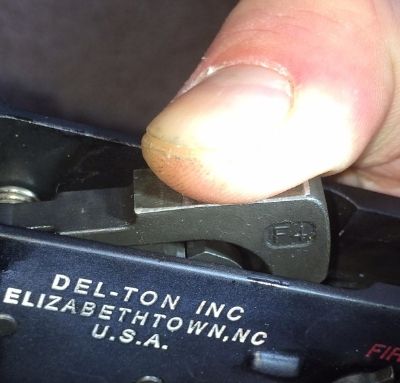
If the gap is too large, then here is where you remove metal to close the free gap down to spec. 
M-16 if you want to learn how the auto sear works in a full auto rig, https://www.youtube.com/watch?v=VntwFqcE4-g In a M-16a2, there is a three round burst fire control group, instead of a full auto fire group. In it, there is a three position cam that is spring loaded and rides on the right hand side of the hammer, and an addition sear that rides against the cam (selector only cams the primary sear out of position in burst, not the cam burst disco). Also note, the back disco sear on the a2 hammer is wider on the right hand side in a A2 FCG, since it needed for the extra burst disco that rides to on the right hand side in the trigger tail. When the third round is fired in burst, the secondary disco drops down into the lowest cam position on the side of the hammer, and the secondary disco catches the hammer instead of the rifle firing a forth time in burst. 
|
AR Sponsor