


AR Sponsor


Posted: 4/22/2014 1:42:52 PM EDT
|
First here are the rifle particulars
Colt lower with Geissele trigger, "H" buffer, fired thousands of rounds without issues Upper - new professionally built, fired less than 200 rounds New Colt 6920 bolt and carrier assembly Used Colt upper with new Ranier Ultramatch 10.5" barrel New Ranier gas tube and gas block Suppressed with AAC M4-2000 Ammo - Factory M193 I had what I thought were bump fires (2 rounds back to back), say once every mag or two. In addition once every mag or so the rifle would not fire, the bolt was all the way forward, had a live round in the chamber but you could not pull the trigger. I racked the slide and ejected the round and was ready to go again. I took a closer look at the ejected rounds after the failures and each had a light primer strike, not from pulling the trigger but from the firing pin striking the primer as the carrier went forward. Starting to wonder if the "bumpfires" were actually the firing pin striking the primer without pulling the trigger or the trigger not re-setting and striking the firing pin as the carrier goes forward. Any ideas what may be ocurring and how to fix? I don't work on my own rifles so if it's anything other than swapping a part I will be taking it to the gunsmith. Left round fired, right round live and ejected after malfunction. 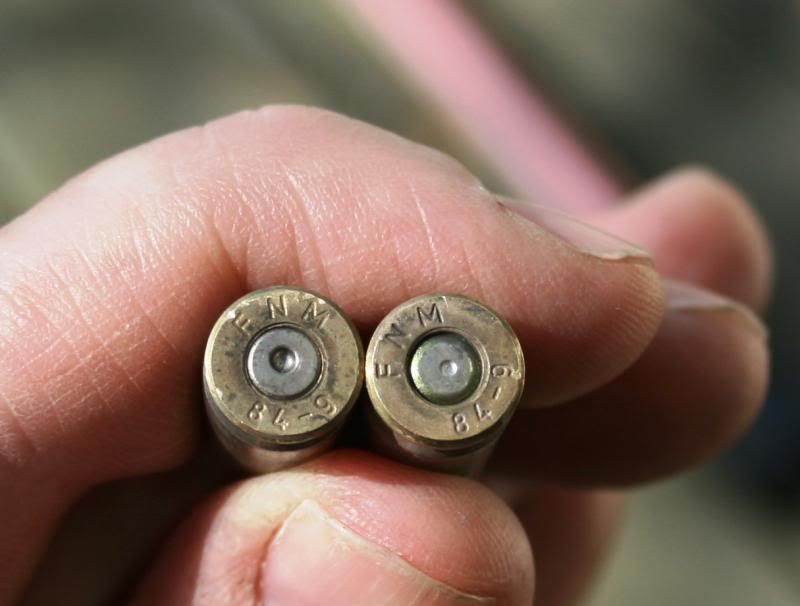
|
|
That dimple happens in every AR, it is caused by the floating firing pin and is not a concern. I'll bet my next paycheck that it has nothing to do with your malfunction.
When you say "professionally built," who built it? I think it's safe to say that in the collective arfcom experience, claiming to be a "professional" means as many things as claiming to be an "artist" does (i.e. they might not know shit). I kind of wonder if your double firing may be from inadvertently resetting and pulling the trigger during recoil. I've seen a girl do that when shooting a rifle that had a SSA-E trigger. I figured that she was holding it so gently and pulling the trigger so softly that it was causing her to double tap immediately after the first round went off. I'm not knocking the way you're holding it, just suggesting that you might be pulling the trigger twice and not realizing it? Also, when it doesn't go off, is the hammer cocked? Maybe it's short stroking and not cocking the hammer? Although this would be hard to do if it's chambering a fresh round but not cocking the hammer. If it's cocking it when this happens, does it feel like pulling the trigger with the safety on? As many details like that would help 
ETA I re-read this and wanted to make clear that I was not calling you a girl. I meant that a shooter, who happened to be a girl, was inadvertently double tapping. 
|
|
THIS 100% ...... I have doubled several rifles by gently pulling a match trigger while the rifle sat in a rest with only my shoulder touching the gun... Good luck. WD Quoted:
That dimple happens in every AR, it is caused by the floating firing pin and is not a concern. I'll bet my next paycheck that it has nothing to do with your malfunction. When you say "professionally built," who built it? I think it's safe to say that in the collective arfcom experience, claiming to be a "professional" means as many things as claiming to be an "artist" does (i.e. they might not know shit). I kind of wonder if your double firing may be from inadvertently resetting and pulling the trigger during recoil. I've seen a girl do that when shooting a rifle that had a SSA-E trigger. I figured that she was holding it so gently and pulling the trigger so softly that it was causing her to double tap immediately after the first round went off. I'm not knocking the way you're holding it, just suggesting that you might be pulling the trigger twice and not realizing it? Also, when it doesn't go off, is the hammer cocked? Maybe it's short stroking and not cocking the hammer? Although this would be hard to do if it's chambering a fresh round but not cocking the hammer. If it's cocking it when this happens, does it feel like pulling the trigger with the safety on? As many details like that would help |
|
The disconnector you must fix.
"Hammer following" because the disconnector is failing to catch. When the trigger is pulled, it is no longer able to catch the hammer sear surface, the disconnector is supposed to catch the hammer. As the trigger moves forward, the disconnector releases and allows the hammer/trigger sear surfaces to catch. The light firing pin strikes are caused by the floating firing pin, striking forward as the bolt goes forward and rotates into battery. You may have gotten the rapid firing due to the hammer being released just fast enough to fall as the bolt went into battery. When the hammer slightly slower and was allowed to fall prior to the bolt being in battery, you got the fail to fire and light primer strike, |
|
My kids have done the same, bump fire a few rounds, and on the third or so nothing. With them, the rifle wasnt going all the way into battery. If you have a good hold on your rifle and it bumpfires, you may have hammer follow. Swap out your disconnect and see if that solves the problem. |
|
Quoted:
That dimple happens in every AR, it is caused by the floating firing pin and is not a concern. I'll bet my next paycheck that it has nothing to do with your malfunction. When you say "professionally built," who built it? I think it's safe to say that in the collective arfcom experience, claiming to be a "professional" means as many things as claiming to be an "artist" does (i.e. they might not know shit). Well respected Arfcom industry partner, didn't mention them as I have not consulted them yet and I don't want to drag them thru the mud I kind of wonder if your double firing may be from inadvertently resetting and pulling the trigger during recoil. I've seen a girl do that when shooting a rifle that had a SSA-E trigger. I figured that she was holding it so gently and pulling the trigger so softly that it was causing her to double tap immediately after the first round went off. I'm not knocking the way you're holding it, just suggesting that you might be pulling the trigger twice and not realizing it? Not sure, it did happen more often during sighting in and gently squeezing the trigger. Also, when it doesn't go off, is the hammer cocked? Maybe it's short stroking and not cocking the hammer? Although this would be hard to do if it's chambering a fresh round but not cocking the hammer. If it's cocking it when this happens, does it feel like pulling the trigger with the safety on? I don't think the trigger was cocked but I did not physically check prior to clearing the chamber, I will make sure to check on the next malfunction As many details like that would help
ETA I re-read this and wanted to make clear that I was not calling you a girl. I meant that a shooter, who happened to be a girl, was inadvertently double tapping.
No offense taken, I have fired this particular lower several thousand rounds without bump firing with the same trigger/stance/hold so that is why I suspect something in the upper is not quite right. |
|
Weak/incorrectly installed disco spring (should be large coil side down), or the disco is out of time (free gap too large).
With the trigger untouched, lower the hammer back until you get the back hammer sear and the disco sear as close to each other as possable. The free gap between the two should be in the .001" to .003" range (thickness of a human hair). If the free gap is much larger, then the disco will need to be re-timed. To do this, you will remove metal from the front/bottom of the disco where it seats against the front/ top of the trigger. Take your time, and dry fit/test a few times to get the correct free gap of the two with the trigger untouched. Here a post with the the ops rifle that have no free gap, and has to adjust the disco the other way to create the needed .001 free gap instead. http://www.ar15.com/forums/t_3_66/643697_Unfired_AR_trigger_not_functioning.html |
|
You mentioned bump firing, when these problems happened, were you firing the rifle from a solid stationary platform with a single trigger press for each round fired, or were you bump firing? You state that you have had the lower assembly and it has run reliably on for quite some time, was this with a suppressed upper? Did you try running the rifle unsuppressed and if so then what were the results?
CY6 Greg Sullivan "Sully" SLR15 Rifles TheDefensiveEdge.com (763) 712-0123 |
|
Quoted:
You mentioned bump firing, when these problems happened, were you firing the rifle from a solid stationary platform with a single trigger press for each round fired, or were you bump firing? Had issues from a caldwell rest and standing, I was not intentionally "bump firing" intention was a single trigger pull and single shot You state that you have had the lower assembly and it has run reliably on for quite some time, was this with a suppressed upper? Previous upper used was 14.5" unsuppressed Did you try running the rifle unsuppressed and if so then what were the results? Ran suppressed only, but will give it a try unsuppressed on next range trip CY6 Greg Sullivan "Sully" SLR15 Rifles TheDefensiveEdge.com (763) 712-0123 |
|
Disco does not sound broken, but instead the free gap too large, while allows you to double the rifle too easly instead.
With the free gap set to .001", then you have to allow the trigger to move almost all the way forward before the disco will release the hammer down to the trigger sear, which solves the self induced doubling/hammer following the back of the carrier forward problems. |
|
When grinding the JP trigger, they have a video of how to test this. You fully depress the trigger with hammer cocked, dry firing it. Don't let off the trigger. Slow let off the trigger and listen for the disconnector(I guess?) to release. It should do so at the pinnacle of the release stage, so on a single stage trigger, it shouldn't let go until the trigger is almost back to its default cocked position. If it lets go before then, you have to adjust the screws on that trigger, or you may have ground too much off.
In practice, incorrectly set, this will cause the gun to double tap. Maybe someone can find that JP Enterprises video, it explains it very well. Long and short, there is a way to audible and accurately check the disconnector setting through dry firing. I just am no good at explaining it. |
|
Update from today's range session
Quoted:
That is not from the floating pin hitting a round being chamberd. That's way deeper then the "ping" you normally see. I agree with dano that you have hammer follow caused by a broken disconnector. I did compare the primer dent in a round that malfunctioned and a round that loaded normally and the primer dent in the malfunctioning round was deeper, the normally fed rounds had a very very light marks |
|
Update from today's range session
Quoted:
You mentioned bump firing, when these problems happened, were you firing the rifle from a solid stationary platform with a single trigger press for each round fired, or were you bump firing? Had issues from a caldwell rest and standing, I was not intentionally "bump firing" intention was a single trigger pull and single shot You state that you have had the lower assembly and it has run reliably on for quite some time, was this with a suppressed upper? Previous upper used was 14.5" unsuppressed Did you try running the rifle unsuppressed and if so then what were the results? I ran un-suppressed 150 rounds with no issues. I then put the suppressor on and the fourth round loaded but would not fire, opened the lower and the hammer was not cocked but round was fully seated in the chamber, primer had a light strike as posted above. Compared this primer strike to a normally load round strike and the malfuntioning strike was twice as deep. Had a second round fail to load later in the same mag - 2 malfunctions in 30 rounds suppressed, none in 150 rounds unsuppressed.. CY6 Greg Sullivan "Sully" SLR15 Rifles TheDefensiveEdge.com (763) 712-0123 |
|
Disconnector appears to work properly when doing a function check.
Looking thru the archives it appears the upper may be overgassed when running suppressed and I may need a heavier buffer or buffer spring? The reason I suspect this is the rifle works fine unsuppressed, no trigger issues or malfunctions. I think I will consult the builder as well to get their input. |
|
Quoted:
Talked to the builder today who suggested it may be overgassed causing the bolt to bounce. Installed a heavier 9mm buffer and it fixed the problem, fired 180 rounds without a malfunction. Unless he are talking about a full auto rig and auto sear release timing, bolt bounce is not relevant in semi auto only rig. If the heaver buffer solved the problem in a semi auto rig, then it was the over function unlock problem, with the stroke correctly controlled/slowed back down via the heaver buffer to bring the stroke back into check. I still think that you have a disco problem if a semi auto rig, but if the heaver buffer slowing the stroke back down solved it, then all is well I guess. |
|
Quoted:
Unless he are talking about a full auto rig and auto sear release timing, bolt bounce is not relevant in semi auto only rig. If the heaver buffer solved the problem in a semi auto rig, then it was the over function unlock problem, with the stroke correctly controlled/slowed back down via the heaver buffer to bring the stroke back into check. I still think that you have a disco problem if a semi auto rig, but if the heaver buffer slowing the stroke back down solved it, then all is well I guess. Quoted:
Quoted:
Talked to the builder today who suggested it may be overgassed causing the bolt to bounce. Installed a heavier 9mm buffer and it fixed the problem, fired 180 rounds without a malfunction. Unless he are talking about a full auto rig and auto sear release timing, bolt bounce is not relevant in semi auto only rig. If the heaver buffer solved the problem in a semi auto rig, then it was the over function unlock problem, with the stroke correctly controlled/slowed back down via the heaver buffer to bring the stroke back into check. I still think that you have a disco problem if a semi auto rig, but if the heaver buffer slowing the stroke back down solved it, then all is well I guess. I will take your advice and have the disconnector thoroughly inspected to take care of any issues. |
AR Sponsor