


AR Sponsor

Posted: 2/3/2016 9:52:47 PM EDT
|
I realize this is somewhat of a crystal-ball type question, but just built a Mk 12 upper but don't have a BCG yet. Going to the range this weekend and wondering what y'all think about just popping in a BCG from another upper I have (BCG has about 2000 rounds on it.
Is this a dumb decision? |
|
Quoted:
I realize this is somewhat of a crystal-ball type question, but just built a Mk 12 upper but don't have a BCG yet. Going to the range this weekend and wondering what y'all think about just popping in a BCG from another upper I have (BCG has about 2000 rounds on it. Is this a dumb decision? I do it all the time. If you have a barrel from a reputable company i have never ever checked Headspace. I swap my bcg all the time from different rifles. The Headspace is a function primarily of the barrel and is relatively independent of the bcg (imho). |
|
Quoted:
It shouldn't be a problem. Interchangeable means interchangeable. Quoted:
It shouldn't be a problem. Interchangeable means interchangeable. Only, the bolts are not technically "interchangeable".... From TM 9-1005-319-23&P, we get this dire warning, in no less than five (5) places: -WARNING-
Unless performed by qualified maintenance personnel, do not interchange bolt assemblies from one weapon to another. Doing so may result in injury to, or death of, personnel. General Warnings summary, pg b; WP 008, Table 1, pg 0008-16; WP 0009, ASSEMBLY, pg 0009-3; WP0011, ASSEMBLY, pg 0011-7; WP 0012, ASSEMBLY, pg 0012-6. While I think that is a bit excessive, switching bolts should not be done without at least considering the risks. The more rounds on a bolt or barrel extension the more likely there has been a shift in headspace. The type of load also play into it, ie, mild loads vs hot loads. A visual examination on the bolt and extension locking lugs is also in order, at an absolute minimum. |
|
Quoted:
The Headspace is a function primarily of the barrel and is relatively independent of the bcg (imho). False. The chamber headspace is the measurement of the distance from the face of the bolt to a reference diameter on the shoulder in the chamber. It will always vary between barrel/extensions/bolt combinations due to how the tolerances of the bolt dimensions, the barrel extension dimensions and the barrel dimensions stack-up. 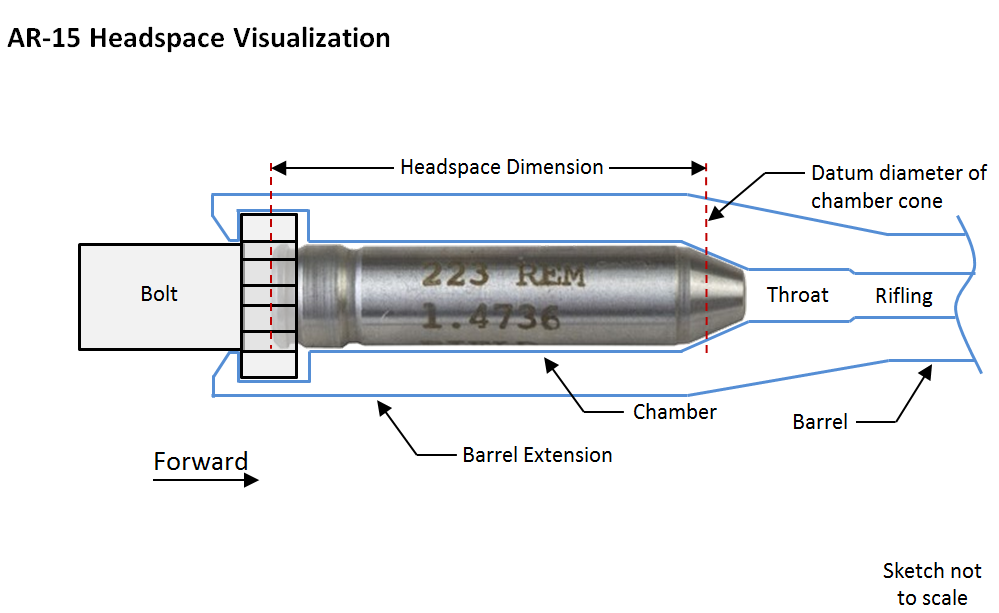
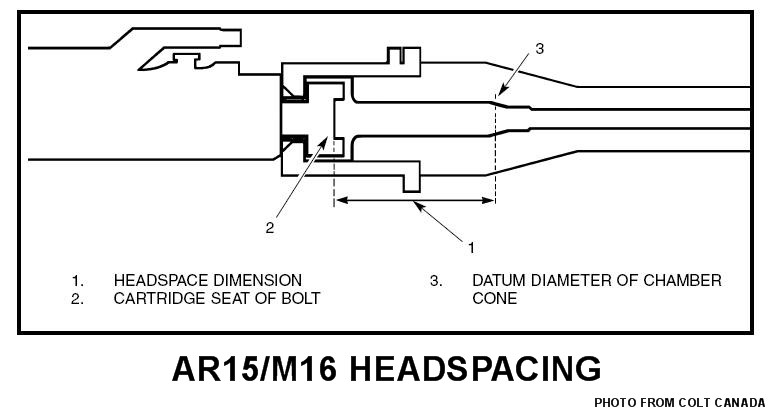
I am amazed that there are still people who have no idea about what chamber headspace is, and are willing to spread their lack of knowledge.... |
|
An out of spec headspace has two possibilities:
Too short - bolt won't close or lock. In most weapon systems this is the greatest danger with the possibility of an out of battery detonation which is typically catastrophic. Too long - It would be extremely rare for a chamber to be so long as to actually cause a danger. In fact wildcat chambers are sometimes larger than the parent, and they simply use the first firing of a case to blow it out to match that chamber. |
|
I went along fat, dumb and happy building AR15's a few years ago. Never an issue (other than some break in/teething problems on one lone 20" rifle).
Then, for my "last" build I built my dream carbine. All the fancy pieces/parts I wanted on one AR15. Well, it would blow primers out of the case, the bolt would lock up, I'd have to take it apart or beat the bolt back, etc., etc. The standard load of IMR4198 and 55 grain bullets that worked in every other AR15 I had weren't working in that rifle. For the first time I bought headspace gauges. Sure enough, that carbine was very, very tight compared to my other AR15's. Yes, the bolt would close on the Go ga. but it was so tight, compared to every other AR15 I had it was a noticeable. I had one 20" rifle that was very sloppy on the Go ga.and would even close on the No Go ga, (but not the field ga.) I swapped bolts (took out the matching chromed bolt bought with the barrel from the same maker) and put a plain jane pakerized bolt from the 20" rifle into my new carbine and put the chromed bolt in the 20" rifle (I almost never shoot) and everything was fine again. No more issues with the carbine (at least not in 3 years or so since I swapped bolts). So, sometimes, there can be headspace issues. Not all the time, not every time, but every now and then. |
|
Quoted:
False. The chamber headspace is the measurement of the distance from the face of the bolt to a reference diameter on the shoulder in the chamber. It will always vary between barrel/extensions/bolt combinations due to how the tolerances of the bolt dimensions, the barrel extension dimensions and the barrel dimensions stack-up. http://i1280.photobucket.com/albums/a496/Dans_PhotoBucket/Firearms/Headspace_zpsd583b8af.png http://ar15barrels.com/tech/headspace.jpg I am amazed that there are still people who have no idea about what chamber headspace is, and are willing to spread their lack of knowledge.... Quoted:
Quoted:
The Headspace is a function primarily of the barrel and is relatively independent of the bcg (imho). False. The chamber headspace is the measurement of the distance from the face of the bolt to a reference diameter on the shoulder in the chamber. It will always vary between barrel/extensions/bolt combinations due to how the tolerances of the bolt dimensions, the barrel extension dimensions and the barrel dimensions stack-up. http://i1280.photobucket.com/albums/a496/Dans_PhotoBucket/Firearms/Headspace_zpsd583b8af.png http://ar15barrels.com/tech/headspace.jpg I am amazed that there are still people who have no idea about what chamber headspace is, and are willing to spread their lack of knowledge.... You must have missed the "relatively independent of the bcg" part of my post. Answer me this, do barrel manufacturers check headspace? What about BCG manufacturers, do they check headspace? Why do you think barrel manufacturers check headspace and bcg manufacturers dont? In reality, my post should have stated: Quoted:
Headspace problems are a function primarily of the barrel and are relatively independent of the bcg (imho). White oak specifically states "Headspace controlled to no more than .001 over SAAMI minimum." Please find me a bcg manufacturer that makes a reference to their headspace values. Probably 9.9 times out of 10 when there is a headspace issue the barrel does not have the correct spacing on the barrel extension and thus we send the barrel back for one that has the correct headspacing. I have never heard of anyone sending back a bcg because their headspace was incorrect, it just doesn't make any sense. Sure there are out of spec parts here and there, but to say headspace problems are 'primarily caused by the bcg' is just plain wrong, it is primarily caused by out of spec barrel extensions and/or incorrectly cut barrels. Every single barrel manufacturer will replace a barrel if you tell them the headspace is incorrect. I doubt you will have as much luck replacing a bcg because of "headspace issues." |
| Anybody who does not check the headspace on a newly assembled rifle is a fool, no matter how many times that they have gotten away with it. Yes, the vast majority of the time it will be fine, but not every time. I've only had two out of a whole bunch that didn't HS correctly, but it does happen. |
|
Quoted:
You must have missed the "relatively independent of the bcg" part of my post. Answer me this, do barrel manufacturers check headspace? What about BCG manufacturers, do they check headspace? Why do you think barrel manufacturers check headspace and bcg manufacturers dont? In reality, my post should have stated: White oak specifically states "Headspace controlled to no more than .001 over SAAMI minimum." Please find me a bcg manufacturer that makes a reference to their headspace values. Probably 9.9 times out of 10 when there is a headspace issue the barrel does not have the correct spacing on the barrel extension and thus we send the barrel back for one that has the correct headspacing. I have never heard of anyone sending back a bcg because their headspace was incorrect, it just doesn't make any sense. Sure there are out of spec parts here and there, but to say headspace problems are 'primarily caused by the bcg' is just plain wrong, it is primarily caused by out of spec barrel extensions and/or incorrectly cut barrels. Every single barrel manufacturer will replace a barrel if you tell them the headspace is incorrect. I doubt you will have as much luck replacing a bcg because of "headspace issues." Quoted:
You must have missed the "relatively independent of the bcg" part of my post. Answer me this, do barrel manufacturers check headspace? What about BCG manufacturers, do they check headspace? Why do you think barrel manufacturers check headspace and bcg manufacturers dont? In reality, my post should have stated: Quoted:
Headspace problems are a function primarily of the barrel and are relatively independent of the bcg (imho). White oak specifically states "Headspace controlled to no more than .001 over SAAMI minimum." Please find me a bcg manufacturer that makes a reference to their headspace values. Probably 9.9 times out of 10 when there is a headspace issue the barrel does not have the correct spacing on the barrel extension and thus we send the barrel back for one that has the correct headspacing. I have never heard of anyone sending back a bcg because their headspace was incorrect, it just doesn't make any sense. Sure there are out of spec parts here and there, but to say headspace problems are 'primarily caused by the bcg' is just plain wrong, it is primarily caused by out of spec barrel extensions and/or incorrectly cut barrels. Every single barrel manufacturer will replace a barrel if you tell them the headspace is incorrect. I doubt you will have as much luck replacing a bcg because of "headspace issues." When two (or three) parts interface, there either is, or is not, a relationship between them. It cannot be mostly only one part. For any given chamber, there is a distance from the datum diameter to the front face of the locking lugs. For any bolt, there is a distance from the face of the bolt to the rear face of the locking lugs. When the two are assembled, the distance from the bolt face to the datum diameter is, or is not in tolerance due to the tolerance stack up at the interface. Incidentally, White Oak is making an impossible claim. They are claiming, if you are quoting correctly, that with any bolt the measured chamber headspace will be between 1.4636" and 1.4646". The tolerance of the "mil-spec" bolt face to rear of the lugs is 0.003". This means if they cut every chamber to the exact same distance (virtually impossible), let's say 1.4636", they would still see a variation of 0.003", or 1.4636" to 1.4666". That is more that 0.001". And, that is assuming every bolt out there is made to the tolerances of Colt's drawing. That is not something I would bet money on. The normal way the chamber is cut is they have a "gauge bolt" ground to very exacting face-to-rear lug-distance, and they ream the chamber to meet headspace requirements with this gauge bolt. That does not mean your bolt is anywhere near the gauge bolt dimensions and will not guarantee that the measured chamber headspace will be the same. And these two statements are not equal: Quoted:
The Headspace is a function primarily of the barrel and is relatively independent of the bcg (imho). and Quoted:
Headspace problems are a function primarily of the barrel and are relatively independent of the bcg (imho). Even so the additional word does not make the statement true. Let's say you have two barrel/extension/bolt combinations, one that measures 1.4640" (call it the short chamber), and one that measures 1.4660" (call it the long chamber). Now, you swap the bolts and now the 'short' chamber measures 1.4610", 0.002" under SAAMI minimum, and the 'long' chamber measures 1.4690", 0.0024" over SAAMI maximum. How can you say the barrel is the problem? With the right bolt both barrels were acceptable. |
|
Quoted:
I've only had two out of a whole bunch that didn't HS correctly, but it does happen. I have had 3 that failed the NO-GO gauge, but passed on a field gauge. I adjusted my sizing die to match that chamber when I reloaded for it - problem solved. For the record, not one of those was a .223 chambered AR barrel. They were a G36 in .223 which was expected to turn out this way being a service rifle, then a Grendel chambered AR barrel, and the last was a Creedmore chambered 308AR barrel. That last one was a wild experiment of putting a DPMS patterned barrel into a Rock River LAR-8 to begin with. So, I was just happy that it passed at all. FWIW: I have never had one fail a GO gauge. I almost want to put a 7.62x39 bolt into a Grendel upper, just so I can justify even owning a GO gauge. |
AR Sponsor