


AR Sponsor


Posted: 9/11/2015 8:42:52 PM EDT
| Looking at the V7 muzzle devices to lighten up my 14.5 inch build. Is there a way to attach titanium perm to the barrel? |
|
Ti can be welded with TIG or gas. Only thing to be aware of is that it will discolor from the heat.
I did a blind pin, except my "pin" is a stainless #10-32 screw. I drilled and threaded a hole in the brake, spot drilled the threads with a 3/16" end mill, slobbered the thing with red loctite, cranked on it until I stripped the socket head, then cut it off and ground it flush. It's still visible, but not an eyesore. It would have to be drilled out the same as a welded over pin. 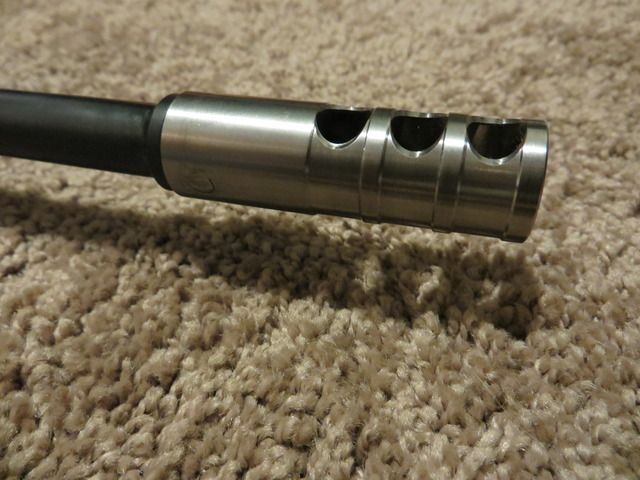
|
|
Quoted:
Ti can be welded with TIG or gas. Only thing to be aware of is that it will discolor from the heat. I did a blind pin, except my "pin" is a stainless #10-32 screw. I drilled and threaded a hole in the brake, spot drilled the threads with a 3/16" end mill, slobbered the thing with red loctite, cranked on it until I stripped the socket head, then cut it off and ground it flush. It's still visible, but not an eyesore. It would have to be drilled out the same as a welded over pin. http://i110.photobucket.com/albums/n117/Hunter2506/Machining%20projects/IMG_1381_zpswnmdjhwq.jpg So you have an SBR according to the BATFE 
All said in jest, but the ATF does not recognize this method as permanently attaching a device to increase overall barrel length |
|
Quoted:
So you have an UNREGISTERED SBR according to the BATFE
All said in jest, but the ATF does not recognize this method as permanently attaching a device to increase overall barrel length Quoted:
Quoted:
Ti can be welded with TIG or gas. Only thing to be aware of is that it will discolor from the heat. I did a blind pin, except my "pin" is a stainless #10-32 screw. I drilled and threaded a hole in the brake, spot drilled the threads with a 3/16" end mill, slobbered the thing with red loctite, cranked on it until I stripped the socket head, then cut it off and ground it flush. It's still visible, but not an eyesore. It would have to be drilled out the same as a welded over pin. http://i110.photobucket.com/albums/n117/Hunter2506/Machining%20projects/IMG_1381_zpswnmdjhwq.jpg So you have an UNREGISTERED SBR according to the BATFE
All said in jest, but the ATF does not recognize this method as permanently attaching a device to increase overall barrel length Fixed it for you, seriously BATFE will NOT recognize this method as it doesn't meet the letter of the law. |
|
Quoted:
Fixed it for you, seriously BATFE will NOT recognize this method as it doesn't meet the letter of the law. Quoted:
Quoted:
Quoted:
Ti can be welded with TIG or gas. Only thing to be aware of is that it will discolor from the heat. I did a blind pin, except my "pin" is a stainless #10-32 screw. I drilled and threaded a hole in the brake, spot drilled the threads with a 3/16" end mill, slobbered the thing with red loctite, cranked on it until I stripped the socket head, then cut it off and ground it flush. It's still visible, but not an eyesore. It would have to be drilled out the same as a welded over pin. http://i110.photobucket.com/albums/n117/Hunter2506/Machining%20projects/IMG_1381_zpswnmdjhwq.jpg So you have an UNREGISTERED SBR according to the BATFE
All said in jest, but the ATF does not recognize this method as permanently attaching a device to increase overall barrel length Fixed it for you, seriously BATFE will NOT recognize this method as it doesn't meet the letter of the law. good edit. thanks |
|
Quoted:
Ti can be welded with TIG or gas. Only thing to be aware of is that it will discolor from the heat. If it's discolored after welding, you did it wrong. Titanium turns colors because it has been contaminated by the atmosphere while above a certain temperature. Bad things happen in the microstructure and the material will be very brittle. I would not want an embrittled titanium pin keeping my comp in place incase you were ever in a situation where someone wanted to test out just how permanently attached it was. Titanium actually welds very easily. It's just really important that you make sure it stays shielded for a long time. In the case of pinning a comp, that should be no big deal. |
|
Quoted:
If it's discolored after welding, you did it wrong. Titanium turns colors because it has been contaminated by the atmosphere while above a certain temperature. Bad things happen in the microstructure and the material will be very brittle. I would not want an embrittled titanium pin keeping my comp in place incase you were ever in a situation where someone wanted to test out just how permanently attached it was. Titanium actually welds very easily. It's just really important that you make sure it stays shielded for a long time. In the case of pinning a comp, that should be no big deal. Quoted:
Quoted:
Ti can be welded with TIG or gas. Only thing to be aware of is that it will discolor from the heat. If it's discolored after welding, you did it wrong. Titanium turns colors because it has been contaminated by the atmosphere while above a certain temperature. Bad things happen in the microstructure and the material will be very brittle. I would not want an embrittled titanium pin keeping my comp in place incase you were ever in a situation where someone wanted to test out just how permanently attached it was. Titanium actually welds very easily. It's just really important that you make sure it stays shielded for a long time. In the case of pinning a comp, that should be no big deal. This is correct. I would use a Ti set screw and weld it in or a stainless set screw and weld over the head. |
|
Fixed it for you, seriously BATFE will NOT recognize this method as it doesn't meet the letter of the law. We've been through this before on this exact rifle, more than once. I'm not interested in rehashing the arguments. I'll simply point out, once again, that the cited verbiage is: Permanent methods of attachment include full-fusion gas or electric steel-seam welding, high-temperature (1100°F) silver soldering, or blind pinning with the pin head welded over. Operative word is include, as opposed to are. Semantics matter, especially in legalese. The reason for welding over the blind pin is that a smooth pin that is not welded will ride up on the muzzle threads and push out of the hole as you unscrew the muzzle device. That can't happen with a threaded pin. My method would mangle the muzzle if you attempted to unscrew the brake, hence it is permanent. That is the real criteria, as there is no language citing specific requirements of pin size, depth, etc; if you use a 1/16" mild steel pin and weld it over, but it shears and leaves muzzle and threads relatively in-tact, it would not meet the requirement of permanent. |
|
Quoted:
We've been through this before on this exact rifle, more than once. I'm not interested in rehashing the arguments. I'll simply point out, once again, that the cited verbiage is: Permanent methods of attachment include full-fusion gas or electric steel-seam welding, high-temperature (1100°F) silver soldering, or blind pinning with the pin head welded over. Operative word is include, as opposed to are. Semantics matter, especially in legalese. The reason for welding over the blind pin is that a smooth pin that is not welded will ride up on the muzzle threads and push out of the hole as you unscrew the muzzle device. That can't happen with a threaded pin. My method would mangle the muzzle if you attempted to unscrew the brake, hence it is permanent. That is the real criteria, as there is no language citing specific requirements of pin size, depth, etc; if you use a 1/16" mild steel pin and weld it over, but it shears and leaves muzzle and threads relatively in-tact, it would not meet the requirement of permanent. Quoted:
Fixed it for you, seriously BATFE will NOT recognize this method as it doesn't meet the letter of the law. We've been through this before on this exact rifle, more than once. I'm not interested in rehashing the arguments. I'll simply point out, once again, that the cited verbiage is: Permanent methods of attachment include full-fusion gas or electric steel-seam welding, high-temperature (1100°F) silver soldering, or blind pinning with the pin head welded over. Operative word is include, as opposed to are. Semantics matter, especially in legalese. The reason for welding over the blind pin is that a smooth pin that is not welded will ride up on the muzzle threads and push out of the hole as you unscrew the muzzle device. That can't happen with a threaded pin. My method would mangle the muzzle if you attempted to unscrew the brake, hence it is permanent. That is the real criteria, as there is no language citing specific requirements of pin size, depth, etc; if you use a 1/16" mild steel pin and weld it over, but it shears and leaves muzzle and threads relatively in-tact, it would not meet the requirement of permanent. I'm a former Class III Dealer, I contacted BATF NFA Branch on the request of a friend of mine. They connected me with a Specialist who stated they had encountered this method before and he stated its NOT legal. |
|
They connected me with a Specialist who stated they had encountered this method before and he stated its NOT legal. I'd love to see the correspondence. Bear in mind, this is NOT a grub screw (set screw), which I know people have queried before, and no, a thread locked grub screw doesn't cut it. You simply can't apply enough torque to the small hex of a grub screw to make it too tight for extraction, and the hole for an extraction tool is already there; I've removed countless stripped grub screws with a torx drive and a hammer. This was a socket head cap screw (5/32 drive, vs. 5/64 of a #10 grub screw) that was torqued to the point of twisting the exposed shank and then stripping the head before being cut off and ground flush & smooth. The amount of torque applied would likely have pulled threads on an aluminum brake. Even if you heated it with a torch to sublime the thread locking compound, you would not be able to remove the stub using an extractor or cutting a slot. It's far too tight. The only way it's coming out is drilling all the way through. |
|
Quoted:
I'm a former Class III Dealer, I contacted BATF NFA Branch on the request of a friend of mine. They connected me with a Specialist who stated they had encountered this method before and he stated its NOT legal. Quoted:
Quoted:
Fixed it for you, seriously BATFE will NOT recognize this method as it doesn't meet the letter of the law. We've been through this before on this exact rifle, more than once. I'm not interested in rehashing the arguments. I'll simply point out, once again, that the cited verbiage is: Permanent methods of attachment include full-fusion gas or electric steel-seam welding, high-temperature (1100°F) silver soldering, or blind pinning with the pin head welded over. Operative word is include, as opposed to are. Semantics matter, especially in legalese. The reason for welding over the blind pin is that a smooth pin that is not welded will ride up on the muzzle threads and push out of the hole as you unscrew the muzzle device. That can't happen with a threaded pin. My method would mangle the muzzle if you attempted to unscrew the brake, hence it is permanent. That is the real criteria, as there is no language citing specific requirements of pin size, depth, etc; if you use a 1/16" mild steel pin and weld it over, but it shears and leaves muzzle and threads relatively in-tact, it would not meet the requirement of permanent. I'm a former Class III Dealer, I contacted BATF NFA Branch on the request of a friend of mine. They connected me with a Specialist who stated they had encountered this method before and he stated its NOT legal. This. |
|
Oh, one more thing:
I contacted BATF NFA Branch on the request of a friend of mine. It would be FTB that would handle such inquiries. Lot's of people claiming this method can't be used, but not a one who can cite a credible source to substantiate that claim (I heard, was told, blah, blah). We have a word for that: bullshit. One of you shows me a bona fide letter, I'll eat my words and fire up the TIG. Otherwise, it's just internet chatter. |
|
Quoted:
Oh, one more thing: It would be FTB that would handle such inquiries. Lot's of people claiming this method can't be used, but not a one who can cite a credible source to substantiate that claim (I heard, was told, blah, blah). We have a word for that: bullshit. One of you shows me a bona fide letter, I'll eat my words and fire up the TIG. Otherwise, it's just internet chatter. Quoted:
Oh, one more thing: I contacted BATF NFA Branch on the request of a friend of mine. It would be FTB that would handle such inquiries. Lot's of people claiming this method can't be used, but not a one who can cite a credible source to substantiate that claim (I heard, was told, blah, blah). We have a word for that: bullshit. One of you shows me a bona fide letter, I'll eat my words and fire up the TIG. Otherwise, it's just internet chatter. I agree with you that it's permanent, as permanent as pinning and welding. And I agree with you on interpreting their legalese. You know how the ATF can be with making up rules as they go. I will always stick to pinning and welding because I don't want to have to get a lawyer and roll the dice in court. |
|
I will always stick to pinning and welding because I don't want to have to get a lawyer and roll the dice in court. Totally understandable, and anyone who is uncomfortable exploring other methods that have not been published as examples should do the same for their own peace of mind. But they should also do it understanding that it is still up to the individual affixing the device to make it permanent enough, as there is no stipulation on pin size, pin alloy, depth of hole into threaded area, thickness of weld, etc. to where you'd still be OK if it failed the test because you complied with the requirements. I think we all know there are a lot of P&W or solder jobs that would fail. |
|
Quoted:
We've been through this before on this exact rifle, more than once. I'm not interested in rehashing the arguments. I'll simply point out, once again, that the cited verbiage is: Permanent methods of attachment include full-fusion gas or electric steel-seam welding, high-temperature (1100°F) silver soldering, or blind pinning with the pin head welded over. Operative word is include, as opposed to are. Semantics matter, especially in legalese. The reason for welding over the blind pin is that a smooth pin that is not welded will ride up on the muzzle threads and push out of the hole as you unscrew the muzzle device. That can't happen with a threaded pin. My method would mangle the muzzle if you attempted to unscrew the brake, hence it is permanent. That is the real criteria, as there is no language citing specific requirements of pin size, depth, etc; if you use a 1/16" mild steel pin and weld it over, but it shears and leaves muzzle and threads relatively in-tact, it would not meet the requirement of permanent. Quoted:
Fixed it for you, seriously BATFE will NOT recognize this method as it doesn't meet the letter of the law. We've been through this before on this exact rifle, more than once. I'm not interested in rehashing the arguments. I'll simply point out, once again, that the cited verbiage is: Permanent methods of attachment include full-fusion gas or electric steel-seam welding, high-temperature (1100°F) silver soldering, or blind pinning with the pin head welded over. Operative word is include, as opposed to are. Semantics matter, especially in legalese. The reason for welding over the blind pin is that a smooth pin that is not welded will ride up on the muzzle threads and push out of the hole as you unscrew the muzzle device. That can't happen with a threaded pin. My method would mangle the muzzle if you attempted to unscrew the brake, hence it is permanent. That is the real criteria, as there is no language citing specific requirements of pin size, depth, etc; if you use a 1/16" mild steel pin and weld it over, but it shears and leaves muzzle and threads relatively in-tact, it would not meet the requirement of permanent. so the BATFE lists ways to make it permanent: full-fusion gas or seam weld high temp silver solder blind pinning wit the head welded over none of which you have met. I agree with you that your method is permanent, and you used the strongest screws ever forged by man and the Hulk himself could not get it loose. but you did not do it to the methods given by the BATFE. Speaking "legalese" would you like to sit on the stand in federal court as a defendant and being asked the following questions. "Is it seam welded?" NO "is it silver soldered?" NO "Is the head of your blind pin welded over?" NO |
|
Quoted:
I'm pretty sure they wouldn't be able to tell the difference between a well dressed up blind pin weld and a ground screw, but as others stated, I'd rather stick to KNOWN approved methods myself. They would simply drill a hole in the screw and use an ez-out to remove it. Then they would arrest the person for an unregistered SBR. People can do what they want and believe what he wants but I personally wouldn't take the risk and live with the consequences over a few bucks. |
|
Quoted:
They would simply drill a hole in the screw and use an ez-out to remove it. Then they would arrest the person for an unregistered SBR. People can do what they want and believe what he wants but I personally wouldn't take the risk and live with the consequences over a few bucks. Quoted:
Quoted:
I'm pretty sure they wouldn't be able to tell the difference between a well dressed up blind pin weld and a ground screw, but as others stated, I'd rather stick to KNOWN approved methods myself. They would simply drill a hole in the screw and use an ez-out to remove it. Then they would arrest the person for an unregistered SBR. People can do what they want and believe what he wants but I personally wouldn't take the risk and live with the consequences over a few bucks. This right here. Do it at your own risk but people need to remember that this is in a build it yourself forum and we do not want a newbie gun owner/builder taking someone else's risk |
|
Quoted:
They would simply drill a hole in the screw and use an ez-out to remove it. Then they would arrest the person for an unregistered SBR. People can do what they want and believe what he wants but I personally wouldn't take the risk and live with the consequences over a few bucks. Quoted:
Quoted:
I'm pretty sure they wouldn't be able to tell the difference between a well dressed up blind pin weld and a ground screw, but as others stated, I'd rather stick to KNOWN approved methods myself. They would simply drill a hole in the screw and use an ez-out to remove it. Then they would arrest the person for an unregistered SBR. People can do what they want and believe what he wants but I personally wouldn't take the risk and live with the consequences over a few bucks. So how is that at all different than just drilling through a welded over pin? That is actually more steps then just straight up drilling out the pin and u threading the device. No where does the ATF say those are the only three methods. They just say it must be permanently attached and list those three as acceptable methods. It is a wise decision to stick with one of those methods to lessen the chance you'll have legal issues. |
|
Quoted:
So how is that at all different than just drilling through a welded over pin? That is actually more steps then just straight up drilling out the pin and u threading the device. No where does the ATF say those are the only three methods. They just say it must be permanently attached and list those three as acceptable methods. It is a wise decision to stick with one of those methods to lessen the chance you'll have legal issues. Quoted:
Quoted:
Quoted:
I'm pretty sure they wouldn't be able to tell the difference between a well dressed up blind pin weld and a ground screw, but as others stated, I'd rather stick to KNOWN approved methods myself. They would simply drill a hole in the screw and use an ez-out to remove it. Then they would arrest the person for an unregistered SBR. People can do what they want and believe what he wants but I personally wouldn't take the risk and live with the consequences over a few bucks. So how is that at all different than just drilling through a welded over pin? That is actually more steps then just straight up drilling out the pin and u threading the device. No where does the ATF say those are the only three methods. They just say it must be permanently attached and list those three as acceptable methods. It is a wise decision to stick with one of those methods to lessen the chance you'll have legal issues. It may be less steps to remove a weld but how many people have a mill or angle grider to do it versus a drill bit? Welds are a bitch to drill. |
|
Quoted:
so the BATFE lists ways to make it permanent: full-fusion gas or seam weld high temp silver solder blind pinning wit the head welded over none of which you have met. I agree with you that your method is permanent, and you used the strongest screws ever forged by man and the Hulk himself could not get it loose. but you did not do it to the methods given by the BATFE. Speaking "legalese" would you like to sit on the stand in federal court as a defendant and being asked the following questions. "Is it seam welded?" NO "is it silver soldered?" NO "Is the head of your blind pin welded over?" NO Quoted:
Quoted:
Fixed it for you, seriously BATFE will NOT recognize this method as it doesn't meet the letter of the law. We've been through this before on this exact rifle, more than once. I'm not interested in rehashing the arguments. I'll simply point out, once again, that the cited verbiage is: Permanent methods of attachment include full-fusion gas or electric steel-seam welding, high-temperature (1100°F) silver soldering, or blind pinning with the pin head welded over. Operative word is include, as opposed to are. Semantics matter, especially in legalese. The reason for welding over the blind pin is that a smooth pin that is not welded will ride up on the muzzle threads and push out of the hole as you unscrew the muzzle device. That can't happen with a threaded pin. My method would mangle the muzzle if you attempted to unscrew the brake, hence it is permanent. That is the real criteria, as there is no language citing specific requirements of pin size, depth, etc; if you use a 1/16" mild steel pin and weld it over, but it shears and leaves muzzle and threads relatively in-tact, it would not meet the requirement of permanent. so the BATFE lists ways to make it permanent: full-fusion gas or seam weld high temp silver solder blind pinning wit the head welded over none of which you have met. I agree with you that your method is permanent, and you used the strongest screws ever forged by man and the Hulk himself could not get it loose. but you did not do it to the methods given by the BATFE. Speaking "legalese" would you like to sit on the stand in federal court as a defendant and being asked the following questions. "Is it seam welded?" NO "is it silver soldered?" NO "Is the head of your blind pin welded over?" NO The verbiage does not use the key word ''shall". It does not limit you by saying it shall be one of those three methods. Nor does it say: ''and no others...'' Are you actually doing anything better other than CYA by using one of these methods? No. The FH on my XM-177 build was removed from its original barrel with a wrench, it had been blind pinned and welded. The barrel I used had had a FH installed by DPMS. They had used a roll pin in their pin and weld job. Nothing a carbide drill bit couldn't take care of. I simply pinned and welded it using a piece of drill rod. Permanent? F#$k no. The error is in the use of that word '''permanent". |
|
They would simply drill a hole in the screw and use an ez-out to remove it. Then they would arrest the person for an unregistered SBR. It may be less steps to remove a weld but how many people have a mill or angle grider to do it versus a drill bit? Welds are a bitch to drill. Ignoring the fact that you're not going to get such an over torqued and thread locked screw out with an extractor (Easy Out is a trademark name like Kleenex, FYI), the use of metal cutting tools (twist drills are cutting tools) is not part of the test. If it were, all long arms would be SBR or SBS. I could poke a few holes in your 24" Remington 700 and then twist the end of the barrel off with a good pair of pliers like my Knipex Alligators. I could also punch through any welded over pin with a hand drill, Dremel or die grinder in <5 minutes. Welds are harder than mild steel, but not difficult to cut through. Do it all the time, including thread cutting through welds. No. If they decide to test your permanent device, they're gonna stick your action in a vise and crank on the muzzle device until something gives. If the barrel unscrews from or turns in the receiver first, or if the receiver, barrel or muzzle device are wrecked in the process, it was permanent. |
For the most part they aren't gong to resort to destructive testing, they WILL use X-Rays to check to see if the proper procedure was performed

They know if it was done PROPERLY the above photos are the result. Personally, I prefer High Temperature Silver Soldering because if it's properly done there is NO removing it without heating it to 1,200 degrees F. |

AR Sponsor