


AR Sponsor


Posted: 4/11/2015 7:06:49 PM EDT
|
I've looked over all the FAQ and the different pieces on ammo selection for self defense but still have one question. If someone uses a bullet / barrel combination that does not give optimal stability, such as certain rifles using 75 / 77 grain OTM bullets, I know that down-range at several hundred yards, and maybe less, grouping will be less than optimal or even poor, and keyholing is possible. But if someone uses that "unstable" bullet / barrel combination strictly for home defense, where any shots fired would be within a 20' range, is this instability likely to have a noticeable impact on performance in terms of wounding capability / expansion / penetration / performance? If there are measurable negative effects, can anyone point me towards relevant reading material / testing? Thanks.
|
|
Quoted:
I've looked over all the FAQ and the different pieces on ammo selection for self defense but still have one question. If someone uses a bullet / barrel combination that does not give optimal stability, such as certain rifles using 75 / 77 grain OTM bullets, I know that down-range at several hundred yards, and maybe less, grouping will be less than optimal or even poor, and keyholing is possible. But if someone uses that "unstable" bullet / barrel combination strictly for home defense, where any shots fired would be within a 20' range, is this instability likely to have a noticeable impact on performance in terms of wounding capability / expansion / penetration / performance? If there are measurable negative effects, can anyone point me towards relevant reading material / testing? Thanks. Within 20 feet? You can be effective with anytihing. Period. End of story. For a 20 feet range get some quallity brass ammo and you are good to go. Period. The key here is: Are you ready to go with a SD situation? Have you taken a professional training class? Are you really mentally/emotionally ready to take a life? Have you practiced shooting a 20' Is your weapon well prepared? 'nuff said God bless |
|
Quoted:
...is this instability likely to have a noticeable impact on performance in terms of wounding capability / expansion / penetration / performance?... Yes. With qualifiers: Will it prevent wounding? No. Artillery fragments tumble and still are great at producing wounds. In some cases, it might enhance wounding potential. Will it prevent expansion? Probably. Bullets are designed to expand on point contact, A tumbling bullet probably won't hit in such a manner to maximize expansion. What will it penetrate? Depends on what it hits, and the exact bullet design. Performance? Which performance parameter are you asking about? Muzzle velocity? No, that is governed by what goes on in the barrel. Velocity at the target? Yes, a tumbling bullet will lose velocity faster that a stabilized bullet, but at 20 feet, the velocity will still be a high percentage of Vm. Accuracy? Yes, goes without saying. Will it hit a man-sized target at 20 feet, yes. Another question you have to ask yourself is: What happens to the bullet after it passes through (or misses) the target? Where will it go? |
|
Quoted: Yes. With qualifiers: Will it prevent wounding? No. Artillery fragments tumble and still are great at producing wounds. In some cases, it might enhance wounding potential. Will it prevent expansion? Probably. Bullets are designed to expand on point contact, A tumbling bullet probably won't hit in such a manner to maximize expansion. What will it penetrate? Depends on what it hits, and the exact bullet design. Performance? Which performance parameter are you asking about? Muzzle velocity? No, that is governed by what goes on in the barrel. Velocity at the target? Yes, a tumbling bullet will lose velocity faster that a stabilized bullet, but at 20 feet, the velocity will still be a high percentage of Vm. Accuracy? Yes, goes without saying. Will it hit a man-sized target at 20 feet, yes. Another question you have to ask yourself is: What happens to the bullet after it passes through (or misses) the target? Where will it go? Quoted: Quoted: ...is this instability likely to have a noticeable impact on performance in terms of wounding capability / expansion / penetration / performance?... Yes. With qualifiers: Will it prevent wounding? No. Artillery fragments tumble and still are great at producing wounds. In some cases, it might enhance wounding potential. Will it prevent expansion? Probably. Bullets are designed to expand on point contact, A tumbling bullet probably won't hit in such a manner to maximize expansion. What will it penetrate? Depends on what it hits, and the exact bullet design. Performance? Which performance parameter are you asking about? Muzzle velocity? No, that is governed by what goes on in the barrel. Velocity at the target? Yes, a tumbling bullet will lose velocity faster that a stabilized bullet, but at 20 feet, the velocity will still be a high percentage of Vm. Accuracy? Yes, goes without saying. Will it hit a man-sized target at 20 feet, yes. Another question you have to ask yourself is: What happens to the bullet after it passes through (or misses) the target? Where will it go? no. a non-stable 75/77 gr bullet will not be 'tumbling' through the air, esp not at short distances. there may be a few degrees more fleet yaw involved but thats about it. and the more off axis an OTM round is when it hit, the shorter the neck will be before fragmentation starts |
|
Quoted:
no. a non-stable 75/77 gr bullet will not be 'tumbling' through the air, esp not at short distances. there may be a few degrees more fleet yaw involved but thats about it. and the more off axis an OTM round is when it hit, the shorter the neck will be before fragmentation starts Quoted:
Quoted:
Quoted:
...is this instability likely to have a noticeable impact on performance in terms of wounding capability / expansion / penetration / performance?... Yes. With qualifiers: Will it prevent wounding? No. Artillery fragments tumble and still are great at producing wounds. In some cases, it might enhance wounding potential. Will it prevent expansion? Probably. Bullets are designed to expand on point contact, A tumbling bullet probably won't hit in such a manner to maximize expansion. What will it penetrate? Depends on what it hits, and the exact bullet design. Performance? Which performance parameter are you asking about? Muzzle velocity? No, that is governed by what goes on in the barrel. Velocity at the target? Yes, a tumbling bullet will lose velocity faster that a stabilized bullet, but at 20 feet, the velocity will still be a high percentage of Vm. Accuracy? Yes, goes without saying. Will it hit a man-sized target at 20 feet, yes. Another question you have to ask yourself is: What happens to the bullet after it passes through (or misses) the target? Where will it go? no. a non-stable 75/77 gr bullet will not be 'tumbling' through the air, esp not at short distances. there may be a few degrees more fleet yaw involved but thats about it. and the more off axis an OTM round is when it hit, the shorter the neck will be before fragmentation starts Of course it also depends on what the stability factor is. If you get anything above 1.0 here your bullet will be gyroscopically stable out of the barrel, but it may have dynamic instability that will only manifest itself at ranges far beyond 20 feet. If your gyroscopic stability factor is really low, 0.2 or 0.3 or so, the bullet may be going end-over-end by 20 feet. |
| I probably didn't use the best wording to begin with, so here's another stab at it. If a heavy bullet is unstable, will this affect fragmentation at close ranges, under 20'. It sounds like if anything, any extra yaw present would only serve to cause fragmentation to begin earlier in the process after impact. If so this would mean there is no real downside and maybe even an upside for those with slow twists who use the heavy OTMs for home defense. While the long rang performance might be poor, up close, these bullets should still work well in terms of fragmentation. If that is the case, then it would seem a lot of folks are steering away from these loads for self defense when they don't need to. Folks like myself with 1:9 (or slower) twists who won't be doing much more than home defense, plinking, and maybe 100 or 200 yard target work, the heavy OTM should work well for close range HD / SD, and we can always use our lighter bullets for the other things we do. Hopefully I am understanding that correctly. I may well buy a 1:7 rifle in the future that will be setup more for long range work and for longer bullets, but right now I'm just looking at possibilities for what I have currently, a M4 with 1:9. Thanks for the input. |
|
Quoted:
I probably didn't use the best wording to begin with, so here's another stab at it. If a heavy bullet is unstable, will this affect fragmentation at close ranges, under 20'. It sounds like if anything, any extra yaw present would only serve to cause fragmentation to begin earlier in the process after impact. If so this would mean there is no real downside and maybe even an upside for those with slow twists who use the heavy OTMs for home defense. While the long rang performance might be poor, up close, these bullets should still work well in terms of fragmentation. If that is the case, then it would seem a lot of folks are steering away from these loads for self defense when they don't need to. Folks like myself with 1:9 (or slower) twists who won't be doing much more than home defense, plinking, and maybe 100 or 200 yard target work, the heavy OTM should work well for close range HD / SD, and we can always use our lighter bullets for the other things we do. Hopefully I am understanding that correctly. I may well buy a 1:7 rifle in the future that will be setup more for long range work and for longer bullets, but right now I'm just looking at possibilities for what I have currently, a M4 with 1:9. Thanks for the input. As was stated before, depend on just how unstable it is. If you run the numbers through the link above and get anything above 1.0, it will be stable enough for a few dozen yards. In technical terms, for all elongated projectiles, the aerodynamic center is always forward of the CG, and tends to push the nose of the projectile away from the line of flight. If the gyroscopic moment equals the aerodynamic moment the stability factor is 1.0 (that what you calculate in that link). If the gyroscopic moment about the bullets center of gravity (CG) is greater than the aerodynamic moment about the CG (the stability factor is above 1.0), the bullet will by gyrodynamically stable. You also have dynamic stability, but that does not manifest itself at very short ranges You have seen a toy top spin on a table? At first the top stays straight up, that is a stable bullet, the angular velocity is enough to make the bullet a gyroscope. As the top slows down, it begins to wobble, and at some point the wobble gets so bad the top hits the table and skids to a stop, that point is analogous to when a bullet begins to tumble, end over end (or break-up depending on the bullets construction). Bullets are spun extremely fast and there is little drag in the direction of spin, so they do not lose spin nearly as fast as they lose forward velocity. But think of the initial stability as how fast you start the top spinning. BTW, just ran the stability factor for Sierra 77 grain .224 bullets in a 1:9 twist. The stability factor is 1.34, they actually are stable, in fact they are slight better than 55 grain bullets at normal velocities. Probably wouldn't last out to 500 yards, but you might try them at 100-200 and see what they do. |
|
Quoted: As was stated before, depend on just how unstable it is. If you run the numbers through the link above and get anything above 1.0, it will be stable enough for a few dozen yards. In technical terms, for all elongated projectiles, the aerodynamic center is always forward of the CG, and tends to push the nose of the projectile away from the line of flight. If the gyroscopic moment equals the aerodynamic moment the stability factor is 1.0 (that what you calculate in that link). If the gyroscopic moment about the bullets center of gravity (CG) is greater than the aerodynamic moment about the CG (the stability factor is above 1.0), the bullet will by gyrodynamically stable. You also have dynamic stability, but that does not manifest itself at very short ranges You have seen a toy top spin on a table? At first the top stays straight up, that is a stable bullet, the angular velocity is enough to make the bullet a gyroscope. As the top slows down, it begins to wobble, and at some point the wobble gets so bad the top hits the table and skids to a stop, that point is analogous to when a bullet begins to tumble, end over end (or break-up depending on the bullets construction). Bullets are spun extremely fast and there is little drag in the direction of spin, so they do not lose spin nearly as fast as they lose forward velocity. But think of the initial stability as how fast you start the top spinning. BTW, just ran the stability factor for Sierra 77 grain .224 bullets in a 1:9 twist. The stability factor is 1.34, they actually are stable, in fact they are slight better than 55 grain bullets at normal velocities. Probably wouldn't last out to 500 yards, but you might try them at 100-200 and see what they do. Quoted: Quoted: I probably didn't use the best wording to begin with, so here's another stab at it. If a heavy bullet is unstable, will this affect fragmentation at close ranges, under 20'. It sounds like if anything, any extra yaw present would only serve to cause fragmentation to begin earlier in the process after impact. If so this would mean there is no real downside and maybe even an upside for those with slow twists who use the heavy OTMs for home defense. While the long rang performance might be poor, up close, these bullets should still work well in terms of fragmentation. If that is the case, then it would seem a lot of folks are steering away from these loads for self defense when they don't need to. Folks like myself with 1:9 (or slower) twists who won't be doing much more than home defense, plinking, and maybe 100 or 200 yard target work, the heavy OTM should work well for close range HD / SD, and we can always use our lighter bullets for the other things we do. Hopefully I am understanding that correctly. I may well buy a 1:7 rifle in the future that will be setup more for long range work and for longer bullets, but right now I'm just looking at possibilities for what I have currently, a M4 with 1:9. Thanks for the input. As was stated before, depend on just how unstable it is. If you run the numbers through the link above and get anything above 1.0, it will be stable enough for a few dozen yards. In technical terms, for all elongated projectiles, the aerodynamic center is always forward of the CG, and tends to push the nose of the projectile away from the line of flight. If the gyroscopic moment equals the aerodynamic moment the stability factor is 1.0 (that what you calculate in that link). If the gyroscopic moment about the bullets center of gravity (CG) is greater than the aerodynamic moment about the CG (the stability factor is above 1.0), the bullet will by gyrodynamically stable. You also have dynamic stability, but that does not manifest itself at very short ranges You have seen a toy top spin on a table? At first the top stays straight up, that is a stable bullet, the angular velocity is enough to make the bullet a gyroscope. As the top slows down, it begins to wobble, and at some point the wobble gets so bad the top hits the table and skids to a stop, that point is analogous to when a bullet begins to tumble, end over end (or break-up depending on the bullets construction). Bullets are spun extremely fast and there is little drag in the direction of spin, so they do not lose spin nearly as fast as they lose forward velocity. But think of the initial stability as how fast you start the top spinning. BTW, just ran the stability factor for Sierra 77 grain .224 bullets in a 1:9 twist. The stability factor is 1.34, they actually are stable, in fact they are slight better than 55 grain bullets at normal velocities. Probably wouldn't last out to 500 yards, but you might try them at 100-200 and see what they do. except that a top sometimes wobbles a bit at the beginning before it stablizes... 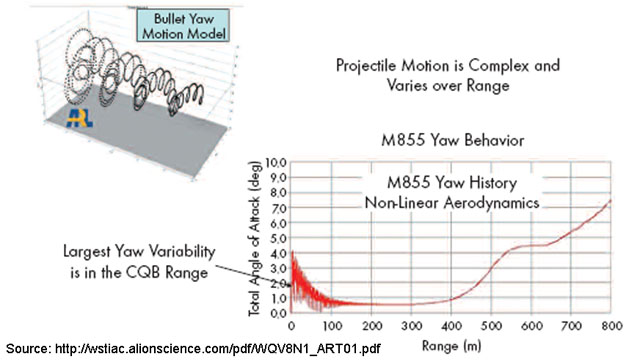 OP, another option is the new Sierra 77gr TMK, which begins to fragment right away: 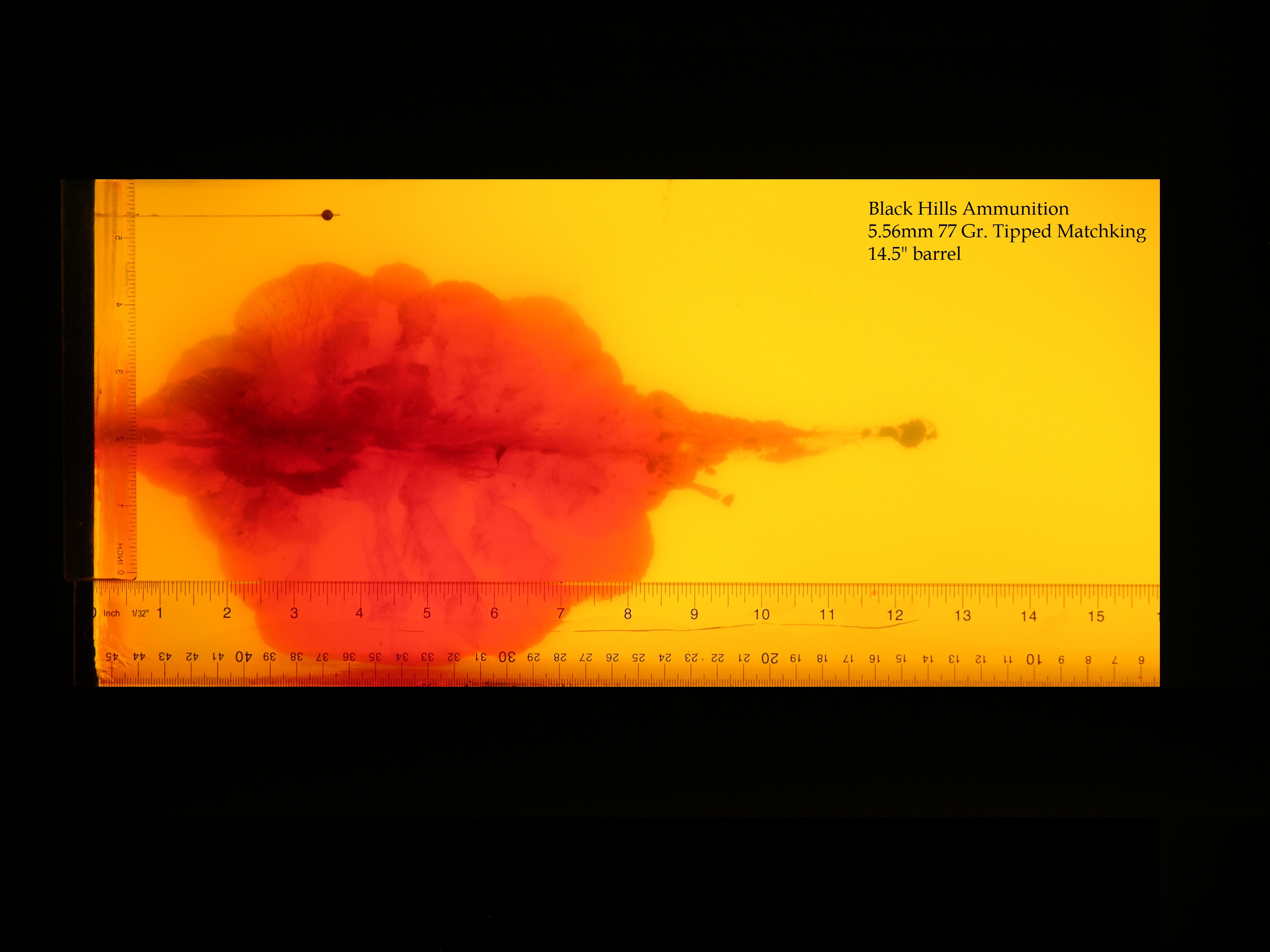 |
|
I am pretty sure I understand what you are asking.... but, I do feel like you might be missing one aspect of bullet performance... reliable, consistent expansion or performance.
In the version you are asking about, your "unstable" bullet would not produce reliable, consistent performance... in other words, it might work some times well and it might not work at all as hoped for. Without trying to sound like a know it all... the key to bullet performance is a bullet that does what it is designed to do... every time. The various bullet manufacturers ( as well as Uncle Sam ) have spent a great deal of money trying to produce ammo that will behave as desired. A very good example is the current M855A1, the old M855 would not produce consistent wounds... it would sometimes penetrate much further then needed and as a result would not start producing a good wound channel until it was mostly through the soft target... and some times it would immediately frag and make a great wound channel. Or even somewhere in between those two. Image from AR15.com FAQ... 
Bottom line M855 did not produce a reliable, consistent wound channel. The new M855A1 is much more predictable under the same circumstances. ( That is not to say it is the best bullet out there, by any means.. ) Anyway what I am saying is you really want your bullet to perform the same way every time..... not maybe some of the time. I hope that makes sense. |
|
Quoted:
except that a top sometimes wobbles a bit at the beginning before it stablizes... http://www.ar15.com/ammo/project/Misc_Images/Zhukov/FleetYaw1.jpg OP, another option is the new Sierra 77gr TMK, which begins to fragment right away: https://blackhillsammo.files.wordpress.com/2014/02/5-56-77-gr-tipped-matchking-14-5-in-barrel-10-17-2013-a.jpg All bullets wobble initially, some more that others. Unstable bullets show an increase in yaw as range increases. Some, like the 55 gr M193 seem to show a neutral dynamic stability and the yaw stays pretty much the same throughout the flight. 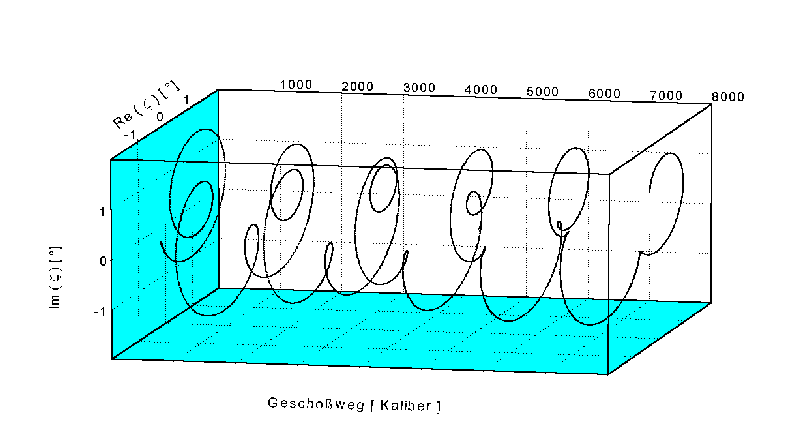
|
| OK. I think that I have digested all of that for the most part. The fact that all bullets yaw in the first yards out of the muzzle makes me conclude that at very short ranges, a slower twist rate isn't going to cause any harm unless it is far too slow and causes dramatic instability. As I understand it, instability means greater yaw at a distance, not necessarily more yaw up close anyway (except in extreme cases). I understand why you would want consistency and that makes sense. If you fired a 77 grain bullet out of a 1:7 bore and it consistently fragmented and then penetrated about 13", you might fire the same bullet out of a 1:9 or slower twist bore and find that in some cases you had a more dramatic yaw, translating into a shorter "neck" and less total penetration, which could be a bad thing depending on shot angle. |
|
Quoted:
In 20 feet? :) This thread is arguing the effects in 20 feet of a bullet that is less than optimally stabilized? Yes it is... 
I'm enjoying the conversation. I would just shoot what I have at whoever I needed to shoot, if the desired effect doesn't happen, I would shoot again. But please, smart people, please continue.. I'm learning new stuff.. |
|
At 20 feet, most all bullets will have some degree of yaw. What happens if the yaw is too great is the bullet tumbles in the soft tissue. This can create a spectacular but shallow wound cavity; penetration is reduced. A bullet that is designed to break-up anyway and still have its various pieces penetrate will do better than one that is designed to expand controllably while going nose first.
Oh, the diagrams showing bullet precess is quite noticeable in some YouTube videos with pellet guns. You can watch the spiraling pellet travel all the way to the target. Rifle bullets behave much the same, though it is much more difficult to see and video this effect. |
| Seems like OP is asking the wrong question, unless he has a huge stash of heavy non expanding ammo and a skow twist barrel. Hor home defense you are governed by military restrictions on bullet construction. Get soft points or expanding monithic bullets like Barnes TSX and be done with it. No Hague Convention protocols for home defense. |
AR Sponsor