


AR Sponsor


Posted: 10/7/2010 2:16:35 PM EDT
[Last Edit: Molon][Edited]
|
A PRIMER ON THE MEAN RADIUS The mean radius is a method of measurement of the radial dispersion of shot-groups that takes into account every shot in the group. It provides a more useful analysis of the consistency of ammunition and firearms than the commonly used method of extreme spread. Mean radius as defined in Hatcher's Notebook “is the average distance of all the shots from the center of the group. It is usually about one third the group diameter (extreme spread)” for 10-shot groups. The ratio is actually closer to 3.2 x the mean radius = the extreme spread for 10-shot groups, depending on the sample size and the morphology of the particular groups sampled. To obtain the mean radius of a shot-group, measure the heights of all shots above the lowest shot in the group. Average these measurements. The result is the height of the center of the group above the lowest shot. Then in the same way, get the horizontal distance of the center from the shot farthest to the left. These two measurements will locate the group center. Now measure the distance of each shot from this center. The average of these measures is the mean radius. Once you get the hang of measuring groups using the mean radius it becomes very simple to do. While being very simple to do, it is also very time consuming. Modern software programs such as RSI Shooting Lab and On Target make determining the mean radius a snap. The picture below is a screen capture from RSI Shooting Lab. The red cross is the center of the group (a little high and right of the aiming point). The long red line shows the two shots forming the extreme spread or group size. The yellow line from the red cross to one of the shots is a radius. Measure all the radii and take the average to obtain the mean radius. Attached File Mean Radius Demonstration Let’s say you fired a 5-shot group from 100 yards and the resulting target looks like this. (The X-ring measures 1.5” and the 10-ring measures 3.5”.) Attached File The extreme spread of the group measures 2.83”, but we want to find the mean radius (or average group radius.) In order to find the mean radius we must first find the center of the group. By “eye-balling” the target most people would see that the group is centered to the left of the “X-ring” and probably a little high, but we need to find the exact location of the center of the group. Locating the Center of the Group The first step in finding the center of the group is to find the lowest shot of the group and draw a horizontal line through the center of that shot. Attached File Next, find the left-most shot of the group and draw a vertical line through the center of that shot. Attached File Now measure the distance from the horizontal line to the other four shots of the group that are above that line. Add those numbers together and divide by the total number of shots in the group (5). Attached File 2.50” + 1.03” + 2.01” + 1.30” = 6.84” Divide by 5 to get 1.37”. This number is the elevation component of the center of the group. Next we need to find the windage component of the center of the group. From the vertical line, measure the distance to the other four shots of the group that are to the right of the line. Add those numbers together and again divide by the total number of shots in the group (5). Attached File Attached File 1.76” + 2.54” + 0.45” + 1.19” = 5.94” Divide by 5 to get 1.19” This is the windage component of the center of the group. Finding the windage and elevation components of the center of the group is the most difficult part of this process. Once that is done the rest of the process is a piece of cake. Using the windage and elevation components, locate the position on the target that is 1.37” (elevation component) above the horizontal line and 1.19” (windage component) to the right of the vertical line. This location is the center of the group! Attached File Attached File Determining the Mean Radius Now that we have located the position of the center of the group, the first step in determining the mean radius is to measure the distance from the center of the group to the center of one of the shots. This line is a single “radius”. Attached File Now measure the distance from the center of the group to the center of each of the rest of the shots in the group. Add the measurements of all the radii together and then divide by the total number of shots in the group (5). Attached File 0.85” + 1.35” + 1.38” + 0.84” + 1.61” = 6.03” Divide by 5 to get 1.21”. This is the mean radius (or average group radius) of the group! Using the mean radius measurement to scribe a circle around the center of the group gives you a graphic representation of the mean radius. This shows the average accuracy of all the shots in the group. This demonstrates why the mean radius is much more useful than the extreme spread in evaluating the radial dispersion of our rifles and ammunition. Attached File The table below will give you an idea of the relationship between the mean radius and extreme spread for 10-shot groups. Attached File Here are some interesting quotes on the subject from old issues of American Rifleman. “Mean radius is the mean distance of bullet impacts from the center of the test group. It is used in government ammunition acceptance because it takes account of every shot and comes close to maximizing the test information. While there is no exact relationship between this measure and the simpler and more convenient group diameter, the 10-shot group diameter averages slightly over 3 times the mean radius.” "These examples illustrate the sensitiveness of the extreme spread to number of shots in the group. Indeed, as the table indicates, the measures made to only the outside shots of the group, e.g. the extreme spread, are very sensitive to number of shots, while the measures made to all the shots, e.g. the mean radius are far less so. It may be added that the latter measures are also less variable in their representation of the group; they are more efficient. This explains why the target testing of U.S. military rifle ammunition is by mean radius." … |
All that is necessary for Trolls to flourish, is for good men to do nothing.
In God We Trust. Everyone else needs to post data.
In God We Trust. Everyone else needs to post data.


|
Originally Posted By MK402: Very informative! So, from a reloader's perspective, what is a good benchmark mean radius for match ammo? Providing a ten shot group at 100 yards. Is there a military specification? Just curious... I agree that extreme spread alone can be misleading. I would say at 100 yards, a good benchmark would be a mean radius of 1''.  |
|
Originally Posted By MK402:
Very informative! So, from a reloader's perspective, what is a good benchmark mean radius for match ammo? Providing a ten shot group at 100 yards. Is there a military specification? Just curious... I agree that extreme spread alone can be misleading. Depends on what you want that rifle to do... Service/Battle accuracy? Match Grade? Hunting? etc... |
|
Originally Posted By 45-Seventy:
Originally Posted By MK402:
Very informative! So, from a reloader's perspective, what is a good benchmark mean radius for match ammo? Providing a ten shot group at 100 yards. Is there a military specification? Just curious... I agree that extreme spread alone can be misleading. Depends on what you want that rifle to do... Service/Battle accuracy? Match Grade? Hunting? etc... How about match grade? |
|
Originally Posted By Freakinout:
Originally Posted By MK402:
How about match grade? Originally Posted By kingoftheroad:
I would say at 100 yards, a good benchmark would be a mean radius of 1''.
This I think. Is that a guess or something you have actually researched? 1 inch mean radius (average to center) would make about a two inch group give or take if I am reading this correctly. That's hardly match grade accuracy. |
|
Originally Posted By MK402: Originally Posted By Freakinout: Originally Posted By MK402: How about match grade? Originally Posted By kingoftheroad: I would say at 100 yards, a good benchmark would be a mean radius of 1''. This I think. Is that a guess or something you have actually researched? 1 inch mean radius (average to center) would make about a two inch group give or take if I am reading this correctly. That's hardly match grade accuracy. Incorrect. The table below will give you an idea of the relationship between the mean radius and extreme spread. Attached File |
All that is necessary for Trolls to flourish, is for good men to do nothing.
In God We Trust. Everyone else needs to post data.
In God We Trust. Everyone else needs to post data.
|
Originally Posted By Molon:
Originally Posted By MK402:
Originally Posted By Freakinout:
Originally Posted By MK402:
How about match grade? Originally Posted By kingoftheroad:
I would say at 100 yards, a good benchmark would be a mean radius of 1''.
This I think. Ok. So its even worse, which was my point. So i guess something in the .5" or better is what I am looking for????? Thanks for the help. Any idea what the military spec for MK262 is? Is that a guess or something you have actually researched? 1 inch mean radius (average to center) would make about a two inch group give or take if I am reading this correctly. That's hardly match grade accuracy. Incorrect. The table below will give you an idea of the relationship between the mean radius and extreme spread. http://www.box.net/shared/static/e4ckmi2y36.jpg |
|
Molon's calculations come from 3x10rd groups for each load, iirc.
ETA: Is the 'average to center' (ATC) calculated by on target the mean radius? I read the definition of mean radius in hatcher's notebook, and it would appear to be the same thing, just making sure I'm understanding it. |
God Bless Texas
"... it's the socialism, stupid." - RL
"... it's the socialism, stupid." - RL
|
Originally Posted By Freakinout:
Molon's calculations come from 3x10rd groups for each load, iirc. ETA: Is the 'average to center' (ATC) calculated by on target the mean radius? I read the definition of mean radius in hatcher's notebook, and it would appear to be the same thing, just making sure I'm understanding it. Correct. |
All that is necessary for Trolls to flourish, is for good men to do nothing.
In God We Trust. Everyone else needs to post data.
In God We Trust. Everyone else needs to post data.
|
Originally Posted By MK402:
So, from a reloader's perspective, what is a good benchmark mean radius for match ammo? Providing a ten shot group at 100 yards. Is there a military specification? Excellent questions. A mean radius of 1.0” for 10-shot groups at 100 yards would be the mathematical equivalent of the accuracy acceptance standard for U.S. Military M193. As for match-grade ammunition, unlike caliber .30 and caliber 7.62mm ammunition, there has never been a National Match standard for caliber 5.56mm/.223 Remington ammunition. In 1965, the caliber 7.62mm Match ammunition was standardized as M118 . The 1965 lot of 7.62mm M118 National Match ammunition had an acceptance testing mean radius of 1.9” for 10-shot groups fired at 600 yards. At that time, this was the smallest acceptance mean radius ever achieved for National Match ammunition since records were kept, starting in the year 1919. Naturally, the ammunition was tested from machine-rested, bolt-actioned test barrels. The composite target pictured below shows the twenty-seven, 10-shot acceptance groups (that’s 270 rounds!) of the 1965, M118 National Match ammunition fired from the test barrels at 600 yards. The small circle has a diameter of 6” and the large circle has a diameter of 12”. 
From American Rifleman, September 1965 
From American Rifleman, August 1962. Everything else being equal, (which of course, it seldom is) a mean radius of 1.9” at 600 yards would have a mathematical equivalent of 0.32” at 100 yards. Now, 100 yards is not 600 yards, but then, a semi-automatic AR-15 is not a machine-rested, bolt-actioned test barrel either. For this reason, I like to use the mean radius of 0.32” for 10-shot groups fired at 100 yards as the benchmark for match-grade ammunition, when fired from a semi-automatic AR-15. I personally prefer that my match-grade hand-loads have a mean radius “in the twos,” i.e. a mean radius of 0.2x”. My best hand-loads fired from a semi-automatic AR-15 at 100 yards have had mean radii “in the ones,” i.e. 0.1x”. The 10-shot group pictured below has a mean radius of 0.13”. 
|
All that is necessary for Trolls to flourish, is for good men to do nothing.
In God We Trust. Everyone else needs to post data.
In God We Trust. Everyone else needs to post data.
|
Originally Posted By Molon:
Originally Posted By MK402:
So, from a reloader's perspective, what is a good benchmark mean radius for match ammo? Providing a ten shot group at 100 yards. Is there a military specification? Excellent questions. A mean radius of 1.0” for 10-shot groups at 100 yards would be the mathematical equivalent of the accuracy acceptance standard for U.S. Military M193. As for match-grade ammunition, unlike caliber .30 and caliber 7.62mm ammunition, there has never been a National Match standard for caliber 5.56mm/.223 Remington ammunition. In 1965, the caliber 7.62mm Match ammunition was standardized as M118 . The 1965 lot of 7.62mm M118 National Match ammunition had an acceptance testing mean radius of 1.9” for 10-shot groups fired at 600 yards. At that time, this was the smallest acceptance mean radius ever achieved for National Match ammunition since records were kept, starting in the year 1919. Naturally, the ammunition was tested from machine-rested, bolt-actioned test barrels. The composite target pictured below shows the twenty-seven, 10-shot acceptance groups (that’s 270 rounds!) of the 1965, M118 National Match ammunition fired from the test barrels at 600 yards. The small circle has a diameter of 6” and the large circle has a diameter of 12”. http://www.box.net/shared/static/g3vdx4d8z5.jpg From American Rifleman, September 1965 http://www.box.net/shared/static/edok5vzo2s.jpg From American Rifleman, August 1962. Everything else being equal, (which of course, it seldom is) a mean radius of 1.9” at 600 yards would have a mathematical equivalent of 0.32” at 100 yards. Now, 100 yards is not 600 yards, but then, a semi-automatic AR-15 is not a machine-rested, bolt-actioned test barrel either. For this reason, I like to use the mean radius of 0.32” for 10-shot groups fired at 100 yards as the benchmark for match-grade ammunition, when fired from a semi-automatic AR-15. I personally prefer that my match-grade hand-loads have a mean radius “in the twos,” i.e. a mean radius of 0.2x”. My best hand-loads fired from a semi-automatic AR-15 at 100 yards have had mean radii “in the ones,” i.e. 0.1x”. The 10-shot group pictured below has a mean radius of 0.13”. http://www.box.net/shared/static/9vux4ug0du.jpg Here is the specification for the SASS MIL-PRF-32316 (AR) : 3 REQUIREMENTS 3.4.1.1 Accuracy/dispersion. After the optic sight is zeroed, the accuracy and dispersion of the SASS shall meet the following: 3.4.1.1.1 Accuracy. . The distance between the mean point of impact of each shot group, both unsuppressed and suppressed, shall be not greater than 1.1 inches at 300 feet. The distance between the mean point of impact of the combined unsuppressed shot groups and the combined suppressed shot groups shall not be greater than 3.14 inches at 300 feet. 3.4.1.1.2 Dispersion. The average mean radius (AMR) (see 6.11), of each shot group shall be not greater than to 0.68 inches at 300 feet. All targets shall be fired on using M118LR ammunition or equivalent, using five (5) round groups. |
|
Hi , I have discover this very interesting topic meanwhile I was searching for group size measuring methods.
I think that it's very important to have a statistical view of this matter because is different to have a 10 shot group of 5 inchs with 8 holes in 3 inches tha a 5 inches group with all 10 shot within 3 and 5 inches. So i would share this knowledge with an Italian forum named " Armimilitari" that means " Militaryweapons" end in order to make this I obviously ask your permission in advance. Thankyou |


|
Originally Posted By MRW: can the photos be salvaged? This is a critically important thread. |
Don't be so open-minded that your brains fall out.
General education should not be mere job training, but training in how to be fully human.
https://www.memoriapress.com/articles/the-four-causes-of-classical-education/
General education should not be mere job training, but training in how to be fully human.
https://www.memoriapress.com/articles/the-four-causes-of-classical-education/


|
Originally Posted By MRW: This needs to be discussed again. Mean Radius is the better way to measure the middle of a group ES is best for short range shots that are tight enough to make measuring each hole difficult, and for fudds who measure by hand or unit of currency. |
"Technique isn't something that can be taught. It's something you find on your own." - Bunta Fujiwara
|
16 years after Molon's post and the Ballistic-X app makes finding the mean radius easy Attached File Attached File Overlayed both groups on top of each other to assemble a 10 shot group Attached File |
If you don't have a plan, you can't change it.
|
Originally Posted By SyberSniper: So... if it is a radius, why isn't it commonly converted into a diameter... as a MOA unit that everyone understands? wouldn't that be something like 2x MR= MOAmr? Because people still wouldn't understand it. And as Ironmaker points out, the apps now automatically do that. They show MR in inches or MOA. |

|
Originally Posted By SyberSniper: So... if it is a radius, why isn't it commonly converted into a diameter... as a MOA unit that everyone understands? wouldn't that be something like 2x MR= MOAmr? Hatcher's Notebook states that mean radius is "usually about one third the group diameter." |

|
Originally Posted By mcantu: yup, OnTarget also shows a circle for it https://live.staticflickr.com/65535/53569355737_0e41e58c48_h.jpg Originally Posted By mcantu: Originally Posted By TGH456E: Because people still wouldn't understand it. And as Ironmaker points out, the apps now automatically do that. They show MR in inches or MOA. https://live.staticflickr.com/65535/53569355737_0e41e58c48_h.jpg And if go into the settings it will list it on the posted data. So you've both the circle and the actual measurements. |
|
"Double the MR and you have a diameter of a circle with half of your shots inside. " "And if go into the settings it will list it on the posted data. So you've both the circle and the actual measurements. " "Hatcher's Notebook states that mean radius is "usually about one third the group diameter." "yup, OnTarget also shows a circle for it" I think that illustrates my point... I've used OT for years and evaluate my load groups with the MR it provides x2, however although the graphic shows a circle, the data is still given as a radius (MOA)... The dilemma comes, when converting - do you simply take MRx2 to get the circle as shown (and IS it really half the group size or does StdDev play a part like other programs also show) or... like someone else mentioned, Hatcher indicated MR is "about" 1/3 the group size... so which method is a better estimate to compare 2 or 3 load groups? I understand there will be outliers and the real group will grow larger as additional shots are fired, but for casual review of 5-10-20 shot groups, these minor differences in interpreting MR can make a much larger final answer... A smaller MR is always good and several groups should be averaged to get a feel as to the loads repeatability. I guess I'm looking for additional info to using the MR more effectively. |
|
Originally Posted By SyberSniper: "Double the MR and you have a diameter of a circle with half of your shots inside. " "And if go into the settings it will list it on the posted data. So you've both the circle and the actual measurements. " "Hatcher's Notebook states that mean radius is "usually about one third the group diameter." "yup, OnTarget also shows a circle for it" I think that illustrates my point... I've used OT for years and evaluate my load groups with the MR it provides x2, however although the graphic shows a circle, the data is still given as a radius (MOA)... The dilemma comes, when converting - do you simply take MRx2 to get the circle as shown (and IS it really half the group size or does StdDev play a part like other programs also show) or... like someone else mentioned, Hatcher indicated MR is "about" 1/3 the group size... so which method is a better estimate to compare 2 or 3 load groups? I understand there will be outliers and the real group will grow larger as additional shots are fired, but for casual review of 5-10-20 shot groups, these minor differences in interpreting MR can make a much larger final answer... A smaller MR is always good and several groups should be averaged to get a feel as to the loads repeatability. I guess I'm looking for additional info to using the MR more effectively. |
|
I agree with what both of you said, and as mentioned, I also generally look for a MR*2 under 1 MOA... but is that the correct way to look at it? Should I be looking at MR*3 to compare group potential? Isn't it normal to convert a radius into a diameter? Circles seem more intuitive than radius unless your considering a corner... As an example, one of my better 5-shot OT groups has a MR of 0.238", OT also reports it as 0.227 MOA, my spreadsheet then calcs it at 0.4546 Avg Mean Group in MOA... Maybe that should really be 0.4760 since OT reports in MOA and I also convert to MOA... Anyway, if I used MR*3 instead, it would be about 0.681 (or .714-see how it grows) - so which is more realistic? OTOH it may not matter as I would be comparing one group to another using the same system... it would only 'look' better. |
|
Originally Posted By SyberSniper: I agree with what both of you said, and as mentioned, I also generally look for a MR*2 under 1 MOA... but is that the correct way to look at it? Should I be looking at MR*3 to compare group potential? Isn't it normal to convert a radius into a diameter? Circles seem more intuitive than radius unless your considering a corner... As an example, one of my better 5-shot OT groups has a MR of 0.238", OT also reports it as 0.227 MOA, my spreadsheet then calcs it at 0.4546 Avg Mean Group in MOA... Maybe that should really be 0.4760 since OT reports in MOA and I also convert to MOA... Anyway, if I used MR*3 instead, it would be about 0.681 (or .714-see how it grows) - so which is more realistic? OTOH it may not matter as I would be comparing one group to another using the same system... it would only 'look' better. Sir: I'll be honest you've lost me in your wanderings. Here's my 2%: You are looking at this sortta like the MOA vs MIL arguments. And jumping between the two or trying to convert from one/another. Don't. Pick one. Since MR considers all the rounds fired, that is a more accurate numeric to the precision of the group. I'd suggest you use that and stop all this conversion stuff. What I mean is shoot the groups, read which one has a smaller MR and be done. If you really want to wander into the weeds, take the vertical and horizontal MR of each group and average those out. What I do: I use the MR with 2 considerations: -since I shoot LR, I also look at the chrono graph results as a large velocity ES is concerning to me at distance. -since I shoot LR, I will sometimes accept a larger MR if the group is otherwise consistent. (What I mean is the whole "flyer" question. I'd consider a larger MR without a flyer vs a small group with 1-2 "flyers.") PS SYPER: The OT system will give you the MR expressed in either inches or MOA, if you select that. The circle is simply a representation. You might be better served to ignore that circle. It seems to be confusing your thoughts on this. |
|
I appreciate your comments. It sounds like I use similar constructs as you when evaluating shot groups, but I left out other chrono/POI data to keep it simple. "If you really want to wander into the weeds, take the vertical and horizontal MR of each group and average those out. " ... Isn't that already done when figuring the MR? The weeds is where it is... Using MR only, one considers only half the circle, which represents the group. Converting to a circle aligns with typical app graphics and the mind's visualization of a group (while also reducing and normalizing the impact of flyers). IMO either would represent the result with the MOA circle being more visually acceptable (at least , to me). It really doesn't matter if we use MR or 2*MR or even 3*MR but I would like to know which will give me a better representation of expectations so I can adjust accordingly... |
|
Originally Posted By SyberSniper: I appreciate your comments. It sounds like I use similar constructs as you when evaluating shot groups, but I left out other chrono/POI data to keep it simple. "If you really want to wander into the weeds, take the vertical and horizontal MR of each group and average those out. " ... Isn't that already done when figuring the MR? The weeds is where it is... Using MR only, one considers only half the circle, which represents the group. Converting to a circle aligns with typical app graphics and the mind's visualization of a group (while also reducing and normalizing the impact of flyers). IMO either would represent the result with the MOA circle being more visually acceptable (at least , to me). It really doesn't matter if we use MR or 2*MR or even 3*MR but I would like to know which will give me a better representation of expectations so I can adjust accordingly... First part italics: Yes, that is MR if you were only looking at one group. What I meant was say you have 5 groups you are evaluating. Take each vertical MR of all 5 and average them(or mean). Then take the 5 horizontal MR's and average them. Because of course you dont just shoot one group and decide off that do you? Bold part: I'll be honest, your whole circle commentary is confusing to me and making this Far Far too complicated . And your 2*MR etc is defeating the whole purpose of finding the MR in the first place. If you want to find a circle where all the holes are inside- use ES. But if you want " a better representation of expectations" then stop bouncing back/forth and use the MR. Use MR and shoot as many shots as possible. I use 10 shot groups and when I'm done testing promising loads have 50 or so data points as they say. |
|
Mean Radius versus Extreme Spread Mean radii are statistical data that can be used to calculate other statistical information such as Circular Error Probable (CEP), or probability of a first round hit on a given size target. Extreme spread (ES) is quick and easy estimation of group size for pass/fail criteria. However, if ES is to be used as a pass/fail gauge, you have to be careful in selecting the limit as it tends to under estimate actual group size unless a very large sample is taken. |
|
Originally Posted By Molon: A PRIMER ON THE MEAN RADIUS “Mean radius is the mean distance of bullet impacts from the center of the test group. It is used in government ammunition acceptance because it takes account of every shot and comes close to maximizing the test information. While there is no exact relationship between this measure and the simpler and more convenient group diameter, the 10-shot group diameter averages slightly over 3 times the mean radius.” I seem to remember "Mean radius x 3.2 = group size in minutes of angle." |
|
@sinister "I seem to remember "Mean radius x 3.2 = group size in minutes of angle." The quote from American Rifleman isn't as specific but Yes, I think you are correct... in the Intro Molon says "The ratio is actually closer to 3.2 x the mean radius = the extreme spread for 10-shot groups, depending " and we all understand that 3.2 is just a convenient approximation, so I think you are saying the same thing if you mean 3.2*MR = group-size = ES (MOA) I do not normally consider the ES useful info unless it looks like a shotgun made it. |
|
Sorry if it appears I am rambling, I do get verbose when writing what I'm trying to say...so TL;DR may apply here. What I'm trying to do is show different aspects on the subject. I think we can all agree that using the MR is a much better metric than ES... that's not the issue. Calculating the Mean Radius is one thing. Using it effectively is another. Fortunately many programs now calculate it for us. Looking back at Molon's blue target calculation example, he says " Using the mean radius measurement to scribe a circle around the center of the group gives you a graphic representation of the mean radius. This shows the average accuracy of all the shots in the group. This demonstrates why the mean radius is much more useful than the extreme spread in evaluating the radial dispersion of our rifles and ammunition." One does not typically think of groups as half a circle (hmmm... which half?), or a linear radius line - IMO, MR are conceptualized as a circle, thus the MR determines the circle's diameter, which is then used in other evaluations. That may be why the various programs (ie:OT) depict them as circles. I guess that answers my question of using 2*MR as a group's MOA accuracy potential.. Averaging multiple groups and comparing to other loads comes later One thing this thread helped me refresh in my memory (Thanks to a post by TGH456E) was that On-Target reports the MR in both Inches and MOA. At first I thought I had made an error in the SS formula I use to calc the MR - but after a little looking, I see that I didn't. Typically I use the MR "inches" figure for my Excel calculations... because it allows me to figure the mean radius based on the distance the group was shot, converted to MOA. This helps when comparing groups that were shot at different distances without additional complicated conversions. |
|
well I subscribe to the thought that 10-shot groups can also be 2) 5-shot groups and 20-shot = 4) 5-shot... ETA... MR is still MR and is based off the POI group center, so IMO it doesn't matter if they were shot at different days, temps, conditions - future shots will never be the same as test shots and having different test conditions smooths the overall results... |

|
Originally Posted By MRW: The advantage of MR is that every shot is included in the measure, not just the farthest two. I'm really picking nits here. 
|
Daddy loves you. Now go away.
Ruthless ruler of cubicle B300.2C.983
Ruthless ruler of cubicle B300.2C.983
|
I have read conflicting assessments of that very fact (5 vs 20). Since 5 shots costs less than 20 I went with that (my average workup test is 5-shots per load x 3~5 load increments min per powder x 3~5 powders = 45~125 shots per session) On one hand I have read that 20 (or 30) is the minimum for statistical significance, OTOH I have also read that multiples of 5 combined would suffice... so which is it? how about we try an experiment . Lets shoot a 20 round group (or compare past numbers) and then also 4) 5-shot groups, and compare them for MR would that tell us anything? What if they aren't even close? How about taking a 20 round group and breaking it up into 4) 5-rounders? Would that be better as there would be a common POI and shot distances but would that a be valid test or a contrived one? Help me here I'm no scientist - lets see if we can figure out what would be a valid determination of how many total shots and how many per individual test group are really necessary to derive a realistic MR number |
|
Originally Posted By SyberSniper: I have read conflicting assessments of that very fact (5 vs 20). Since 5 shots costs less than 20 I went with that (my average workup test is 5-shots per load x 3~5 load increments min per powder x 3~5 powders = 45~125 shots per session) On one hand I have read that 20 (or 30) is the minimum for statistical significance, OTOH I have also read that multiples of 5 combined would suffice... so which is it? how about we try an experiment . Lets shoot a 20 round group (or compare past numbers) and then also 4) 5-shot groups, and compare them for MR would that tell us anything? What if they aren't even close? How about taking a 20 round group and breaking it up into 4) 5-rounders? Would that be better as there would be a common POI and shot distances but would that a be valid test or a contrived one? Help me here I'm no scientist - lets see if we can figure out what would be a valid determination of how many total shots and how many per individual test group are really necessary to derive a realistic MR number I, too, shoot a lot of 5-shot groups to get a rough idea but I also know that it's not quite enough to make definitive claims about the overall rifle/ammo accuracy. I get especially nervous if I notice a POI shift between two 5 shot groups (unless the temperature has changed, I cleaned the barrel just before the second group, etc. etc.) |
Daddy loves you. Now go away.
Ruthless ruler of cubicle B300.2C.983
Ruthless ruler of cubicle B300.2C.983
Here's a 10 shot group with 7 right in a cluster and then 3 outside, and in particular, 1 down and right. ES is only concerned with the distance between the two farthest shots, the remaining 8 are not considered. With ES, this is only a 1.224 MOA group. But MR takes into consideration all ten individual shots, and so the tight 7-shot cluster matters, and the MR of ALL of them is 0.296 MOA, which is right at "Match" level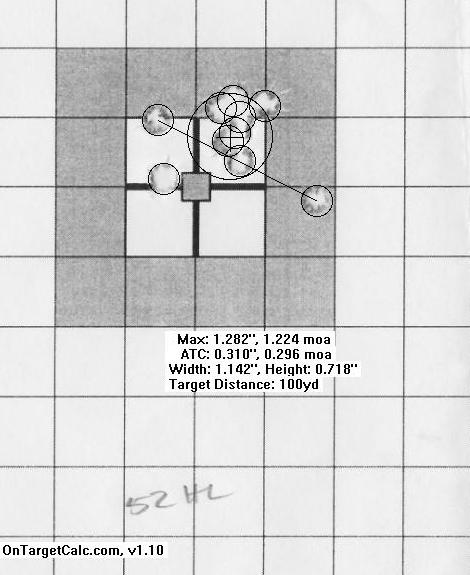 |
Don't be so open-minded that your brains fall out.
General education should not be mere job training, but training in how to be fully human.
General education should not be mere job training, but training in how to be fully human.
|
From AccurateShooter.com, July 1st, 2023: 500-Shot Group at 300 Meters — Now That’s a Serious Test Sierra Bullets 500 round tunnel test  "For load development, some guys shoot 3-shot groups. Other guys shoot 5-shot groups, or even 10-shot strings. But for testing its projectiles, Sierra Bullets takes it to another level entirely. A while back Sierra was testing its .30-Caliber 175gr HPBT MatchKing in the Sierra underground tunnel. The results appear above — a FIVE HUNDRED Round group! 500 Shots Form 0.82 MOA Group at 300m (328 yards) Sierra’s trigger-pullers sent five full boxes of bullets down-range at a single target. The photo above shows the result of 500 shots taken in a 300 meter test tunnel. The raw group size, edge to edge of the farthest shots, is about 3.13 inches, as shown on the calipers’ metal linear scale. Subtract a .308″ nominal bullet diameter* to get the 2.823″ on the digital readout. So you’re seeing a 2.823″ group at 300 meters (328 yards). One MOA at this distance is 3.435″ so this 500-round group is 2.823 divided by 3.435 or 0.82 MOA (0.8218 MOA to be precise). This 500-round group was shoot as part of a pressure/velocity test for a commercial customer. The cartridge was .308 Winchester, loaded at 2.800″. The powder was Reloder 15. A 26″ barrel was shot from a return to battery rest. The gun was cleaned every 125 rounds with two fouler shots. What do you think — could you beat this group from a bench for 500 rounds? One Facebook poster joked: “500-round group? Everyone knows anything less than 1000-round groups are a waste of time and statistically irrelevant.”  Attached File Sierra’s 300 Meter Testing Tunnel Ever wonder how (and where) Sierra tests its bullets? The answer is underground, in a 300-meter test tunnel located under Sierra’s factory in Sedalia, Missouri. The photo above shows the construction of the tunnel back in May, 1990. Like most bullet manufacturers, Sierra does live-fire bullet testing of its projectiles. Sierra’s 300-meter test range is the longest, manufacturer-owned underground bullet test facility in the world. In years past, Sierra offered free visits to the test tunnel as part of a factory tour." |
AR Sponsor