


AR Sponsor


Posted: 11/2/2008 5:26:33 PM EDT
| I've read a lot of posts about using heavy, extra heavy, even insanely heavy buffers in 9mm carbines. What would a stock Rock River buffer weigh (it's black; the front surface is a circle, not like a 5.56 buffer with flats; and it has two roll pins through it front and back)? Is there any benefit from going heavier? Any benefit from going lighter? |
|
Quoted:
I definitly recommend going with the heavier buffer from Slash or Spikes as it makes the gun shoot a lot smoother...less recoil! It also makes for less gas in the face and is less likely to break bolt catches. . +1 and the heavy bolt stays closed longer and makes the gun Quieter with a can. |
|
Quoted:
I've read a lot of posts about using heavy, extra heavy, even insanely heavy buffers in 9mm carbines. What would a stock Rock River buffer weigh (it's black; the front surface is a circle, not like a 5.56 buffer with flats; and it has two roll pins through it front and back)? Is there any benefit from going heavier? Any benefit from going lighter? Stock 9mm buffer weighs 5.5oz the same as a rifle buffer. Since it is a blowback gun, using a lighter buffer than that will allow the bolt to open too soon and a lot of high pressure gas will vent directly toward the shooter. I wouldn't use anything lighter than the standard 9mm. The heavier buffers keep the action closed longer and soften the recoil, which reduces wear. With a can the heavier buffers keep the action closed to allow pressures to subside. Some heavier buffers, Slash 9mm, are longer as well to shorten the recoil stroke. On a dedicated 9mm gun with the longer 9mm boltcatch (using the Colt 2 piece magwell block), this is important to reduce the force of the bolt slamming into the bolt catch. The longer lever arm on the 9mm bolt catch creates more toruqe around the pivot and tends to crack the part. Most 9mm carbines use the one piece magwell block, which has an actuator to activate the standard .223 bolt catch. So it is not as likely to crack. I run Slash's 9mm Q buffer in mine. It actually weighs right at 9oz on my postal scale. Here's a buffer table Slash put together showing the various buffers and their weights 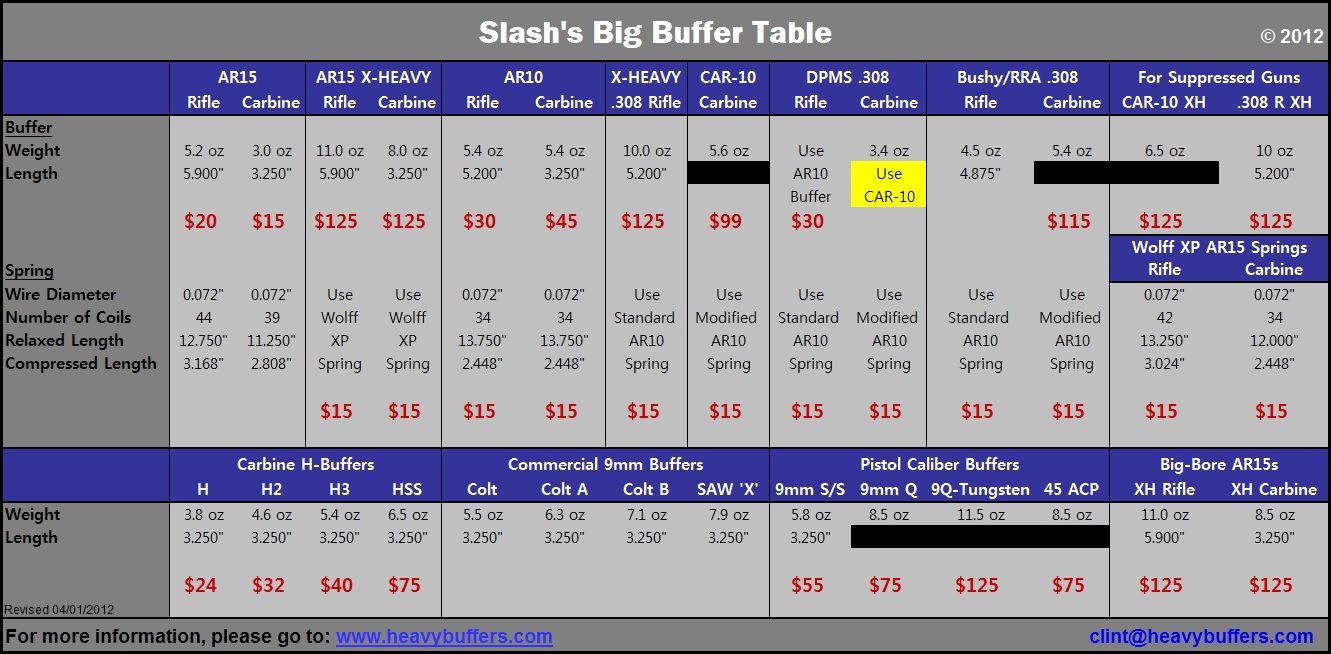
Here's a pic of disassembled buffers and their internals from Randall at AR15Barrels 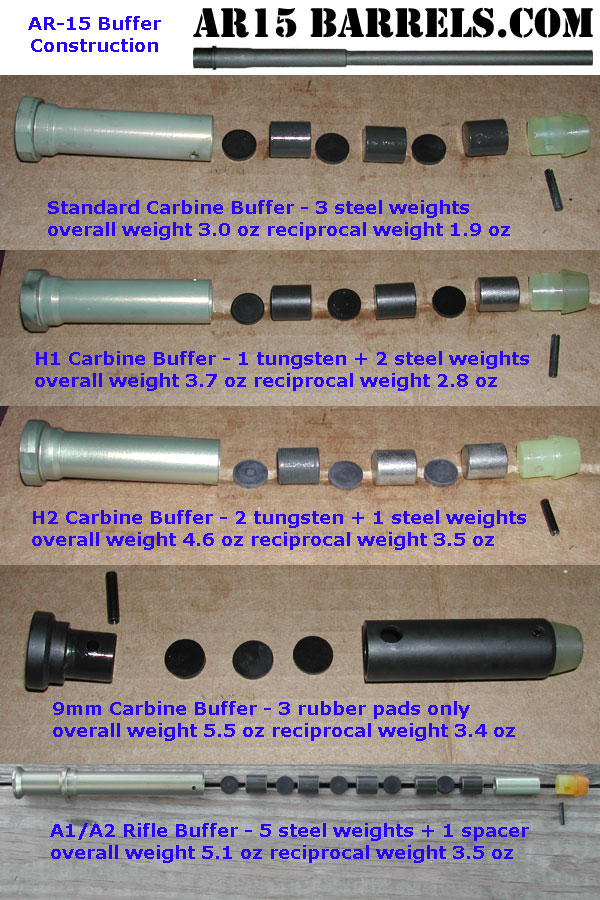
|
|
Quoted:
Can you speak to the effect of different reciprocating weights? It seems to me that you'd get a substantially different effect from a 5.5oz rifle buffer with 1.9 oz reciprocating weight and a 5.6 oz 9mm buffer with 3.4 oz reciprocating weight. There has to be a reason for the different recip weights...
Stock 9mm buffer weighs 5.5oz the same as a rifle buffer. Since it is a blowback gun, using a lighter buffer than that will allow the bolt to open too soon and a lot of high pressure gas will vent directly toward the shooter. I wouldn't use anything lighter than the standard 9mm. The heavier buffers keep the action closed longer and soften the recoil, which reduces wear. With a can the heavier buffers keep the action closed to allow pressures to subside. |
|
Quoted:
Quoted:
Can you speak to the effect of different reciprocating weights? It seems to me that you'd get a substantially different effect from a 5.5oz rifle buffer with 1.9 oz reciprocating weight and a 5.6 oz 9mm buffer with 3.4 oz reciprocating weight. There has to be a reason for the different recip weights...
Stock 9mm buffer weighs 5.5oz the same as a rifle buffer. Since it is a blowback gun, using a lighter buffer than that will allow the bolt to open too soon and a lot of high pressure gas will vent directly toward the shooter. I wouldn't use anything lighter than the standard 9mm. The heavier buffers keep the action closed longer and soften the recoil, which reduces wear. With a can the heavier buffers keep the action closed to allow pressures to subside. The only time it really plays a big part is when shooting full-auto. You can get bolt bounce. |
|
Quoted:
Quoted:
Quoted:
Can you speak to the effect of different reciprocating weights? It seems to me that you'd get a substantially different effect from a 5.5oz rifle buffer with 1.9 oz reciprocating weight and a 5.6 oz 9mm buffer with 3.4 oz reciprocating weight. There has to be a reason for the different recip weights...
Stock 9mm buffer weighs 5.5oz the same as a rifle buffer. Since it is a blowback gun, using a lighter buffer than that will allow the bolt to open too soon and a lot of high pressure gas will vent directly toward the shooter. I wouldn't use anything lighter than the standard 9mm. The heavier buffers keep the action closed longer and soften the recoil, which reduces wear. With a can the heavier buffers keep the action closed to allow pressures to subside. The only time it really plays a big part is when shooting full-auto. You can get bolt bounce. Exactly. That's why guys can run an H3 or 9mm buffer (same total weight) in a semi-auto (talking 5.56 here) gun with the same results, but they are quite different in an auto gun. The 9mm is a lot less expensive. The reciprocating weight gives the bolt an extra shove to ensure it locks. Think of having a cardboard box in the back of a van. When you slam on the brakes the box comes flying forward. Even though the van (outer buffer shell) stopped moving, the free sliding box (internal weights) still carrys momentum and it continues moving forward until it strikes the windshield (bolt). Slash's Q buffer is solid, like the standard 9mm buffer, no sliding weights inside. |
AR Sponsor