


AR Sponsor


Posted: 4/27/2011 5:02:19 PM EDT
| Anyone on here ever carry the Colt GAU5/A? I carried one in the Air Force and was wondering if anyone else on here ever carried them. Great rifle and wish I owned one today. |
|
Yep, carried one! You can find lot's of info about them in the Retro Forum
http://www.ar15.com/forums/forum.html?b=3&f=123 
|
Damn, I'm CATM and even I can't keep up with Care Force nomenclature!  I first had a GUU-5P (basically a Colt 727) when I first came in in 2004 but I'm not sure what the GAU5/A is off the top of my head. I'm thinking it's the XM-177E2 style without a forward assist but I'm not 100% sure. I first had a GUU-5P (basically a Colt 727) when I first came in in 2004 but I'm not sure what the GAU5/A is off the top of my head. I'm thinking it's the XM-177E2 style without a forward assist but I'm not 100% sure.
|

|
Quoted:
This is not me, but a fellow flight member carrying one. This is 1983/84 ish. They were the issued weapon for SP K-9 handlers. Regular SP's, usually carried 604's as the rifle and SW 38's as the pistol during that time period. http://i369.photobucket.com/albums/oo134/rlr350/K-9Handler.jpg Are those MK 82s? |
 A 604 is sitting on the ground.

|
Carried one in the early 70s (71/75) as a USAF SP K-9 Finished this one earlier this year
The engraving on the mag well is the Security Police Shield done by Laser Scribe in Indianapolis 
Then I built this 604 complete with bayonet. My wife then called for professional help and an intervention, the UPS trucks stopped coming and I am back to normal 
Then I had a relapse and built this 
|
|
Yep,
Carried one in the USAF S.P. as a Flight Commander Great little rifle, no two the same configuration. CATM rebuilt them from leftover parts. Some were tack drivers, some were better as flamethrowers. Beat the hell out of that rifle, it always held zero, and I shot qualification courses almost every month. I'd really like to have another one, or even a semi clone. |
|
Quoted:
No, but I retain the dubious distinction of actually having one pointed at me in hostility by our esteemed USAF SP's. 
I have carried one, and yes, it is a well balanced near perfect version of the AR, IMHO. 
Don't feel bad. You have lots of company. I led an S.P. flight on a SAC base during the Cold War. Lots of junior birdmen thought that silly red line next to their aircraft didn't apply to them. They thought wrong. Of course, a full bird Colonel only listens to God, and then, only when he is in the mood. I had a couple of pilots try to smuggle a UZI and a MAC-10 (replicas) out of an Alert Area and got caught at the Entry Control Point. I think they crapped their pants when a couple of 18 yr olds pointed M-16s at them, and the cavalry arrived with bigger weapons 20 seconds later. |
|
Quoted:
This is not me, but a fellow flight member carrying one. This is 1983/84 ish. They were the issued weapon for SP K-9 handlers. Regular SP's, usually carried 604's as the rifle and SW 38's as the pistol during that time period. http://i369.photobucket.com/albums/oo134/rlr350/K-9Handler.jpg That pic was taken at the Andersen Air Force Base on Guam. I remember an earlier post with that pic. As a teen, back in 1977, I had a job with a surveying company marking out areas for more bomb "igloos" at AAFB. |
|
Quoted:
Quoted:
No, but I retain the dubious distinction of actually having one pointed at me in hostility by our esteemed USAF SP's.
I have carried one, and yes, it is a well balanced near perfect version of the AR, IMHO.
Don't feel bad. You have lots of company. I led an S.P. flight on a SAC base during the Cold War. Lots of junior birdmen thought that silly red line next to their aircraft didn't apply to them. They thought wrong. Of course, a full bird Colonel only listens to God, and then, only when he is in the mood. I had a couple of pilots try to smuggle a UZI and a MAC-10 (replicas) out of an Alert Area and got caught at the Entry Control Point. I think they crapped their pants when a couple of 18 yr olds pointed M-16s at them, and the cavalry arrived with bigger weapons 20 seconds later. That reminds me of when the B1 bomber first came to Eglin for tests at the Climatic Hangar. They had armed guards all around the hangar. I was scared to even look in that direction. 
The funny thing was I had just spent a year working on the rear stabilizers at Martin Marietta; now I couldn't get within 100 feet of it. |
|
Still in service but different configuration. AF rebuild SMG with GAU-5/A x'd out and currently marked GUU-5/P. While others in the unit shoot M-4s, I'll keep using the last "retro"until turned-in.
http://i727.photobucket.com/albums/ww278/ol-Dan/IMG_0457.jpg http://i727.photobucket.com/albums/ww278/ol-Dan/IMG_0456.jpg http://i727.photobucket.com/albums/ww278/ol-Dan/IMG_0455_crop.jpg |
| I carried a few beat up GAU's and GUU's in my day. The variations were too many to list. They were all old beat up rifles that rattled and were fun to shoot on full auto. I liked them because they were light and didn't get in of the way. Now the M4's we have are weighted down with all kinds of needless junk. |
|
Quoted:
I carried a few beat up GAU's and GUU's in my day. The variations were too many to list. They were all old beat up rifles that rattled and were fun to shoot on full auto. I liked them because they were light and didn't get in of the way. Now the M4's we have are weighted down with all kinds of needless junk. I love the AF carbines and lightweight carbines, I've got a 653 clone and a 723 clone, and working on a 654 clone. But I've never gotten the argument about "M4s are so much heavier." You know you can strip those down so they're just as light as a GUU-5P, using a BUIS and carbine handguards, possibly even lighter, and you get the same thing. Just because you can bolt stuff on to the rifle doesn't mean you have to. Plus, you can bolt just as much stuff to a lightweight carbine. The M4 didn't suddenly get heavier than the RO727, people just started adding more crap to them. You don't have to play that game! 
~Augee |
|
Quoted:
Quoted:
I carried a few beat up GAU's and GUU's in my day. The variations were too many to list. They were all old beat up rifles that rattled and were fun to shoot on full auto. I liked them because they were light and didn't get in of the way. Now the M4's we have are weighted down with all kinds of needless junk. I love the AF carbines and lightweight carbines, I've got a 653 clone and a 723 clone, and working on a 654 clone. But I've never gotten the argument about "M4s are so much heavier." You know you can strip those down so they're just as light as a GUU-5P, using a BUIS and carbine handguards, possibly even lighter, and you get the same thing. Just because you can bolt stuff on to the rifle doesn't mean you have to. Plus, you can bolt just as much stuff to a lightweight carbine. The M4 didn't suddenly get heavier than the RO727, people just started adding more crap to them. You don't have to play that game!
Yeah you do have to play that game when you're ordered to put all that stuff on. While I appreciate the compactness of the M4 the weight savings just isn't there. It's more of annoyance when the weapon is also front heavy because the items you have bolted on the weapon were intended for the M16 like the M203. I'll put up with the weight considering I humped M60's and M249's. I also started off with an M16 and then watched as the years went by more and more junk got bolted on the M4. ~Augee |
|
Quoted:
Yeah you do have to play that game when you're ordered to put all that stuff on. While I appreciate the compactness of the M4 the weight savings just isn't there. It's more of annoyance when the weapon is also front heavy because the items you have bolted on the weapon were intended for the M16 like the M203. I'll put up with the weight considering I humped M60's and M249's. I also started off with an M16 and then watched as the years went by more and more junk got bolted on the M4. Well, I suppose you do if you're ordered to put it on, seems a little silly to me to order people to configure their weapons a certain way, but I've got into an ass of a fight with First Sergeant who tried to standardize what rail slot everyone's CCO should be mounted on. My first rotation downrange, for the last few days I was in Afghanistan, after we'd completed the full RIP-TOA and turned everything over to our replacements and were just waiting to get on the plane, I stripped my M4 down completely- much lighter and nicer for walking around the FOB. Went from that: 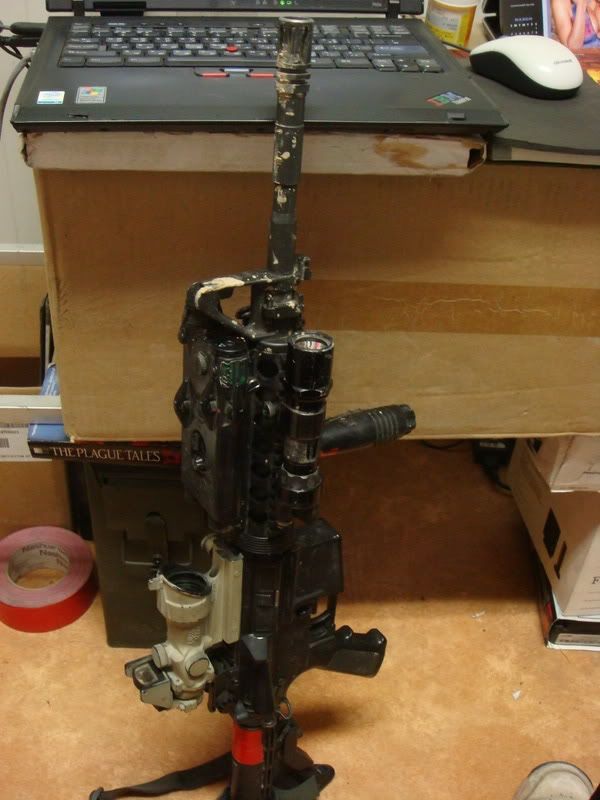
To: 
(it was still early enough that we were issued complete M4s- they came with the KAC rail already installed, with the Colt handguards in the RAS box with the detachable carry handle, and a little blue baggie with a MATECH BUIS) Anyways, to keep it more on topic, that same tour, one of the Air Force guys that needed a ride showed up with this puppy, a GUU-5/P. Couldn't figure out why the hell I was so interested in taking photographs of his "ghetto-M4." The rollmarks are faint, but it's marked "M16A1," commercial rollmarks, and if I were to venture to guess, I'd say it probably started out life as an R653 and was rebarreled with a 723 barrel. Interestingly enough, the pistol grip has been replaced with an A2, but has an A1 birdcage installed. 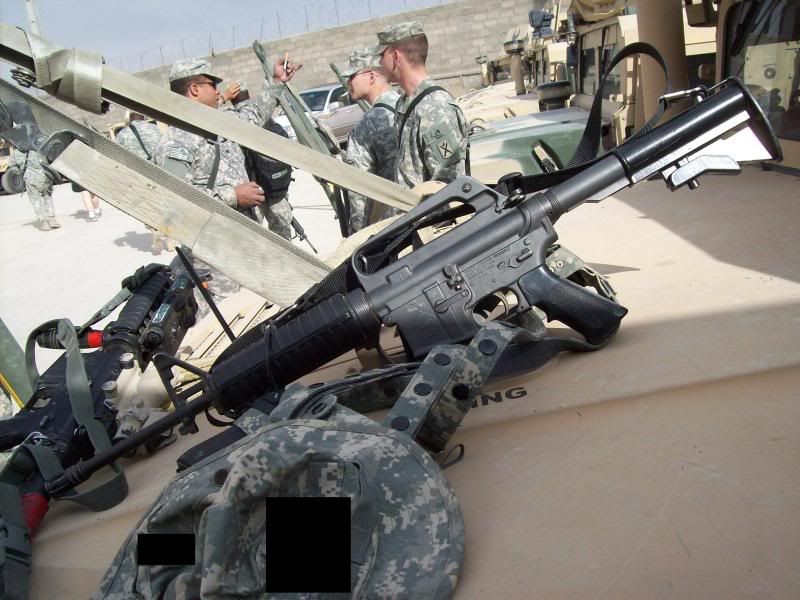
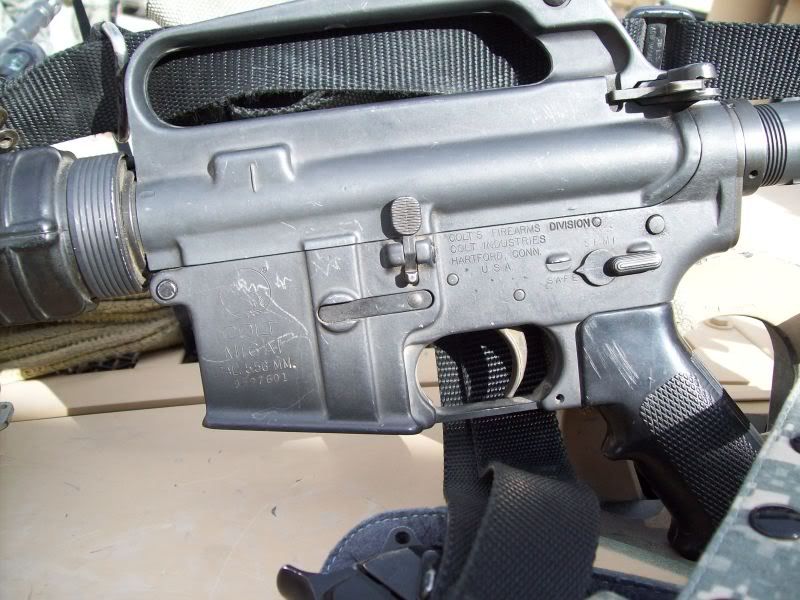
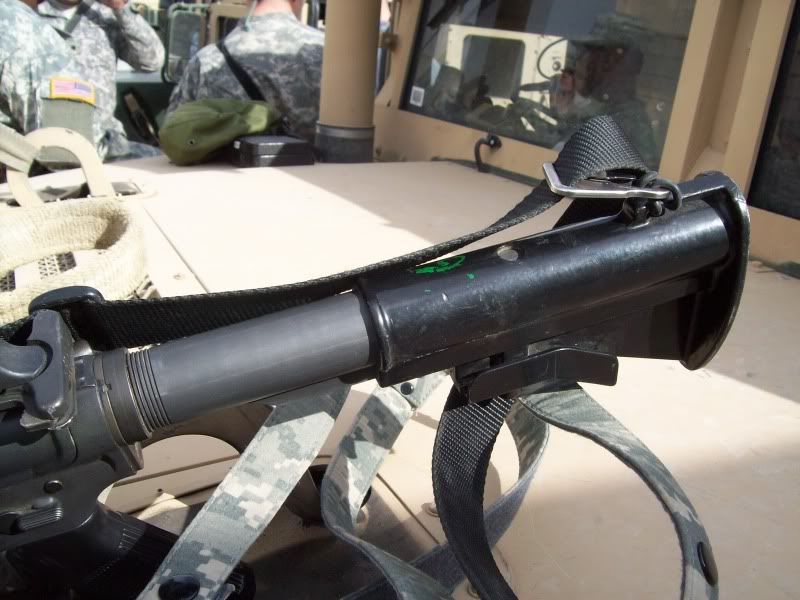
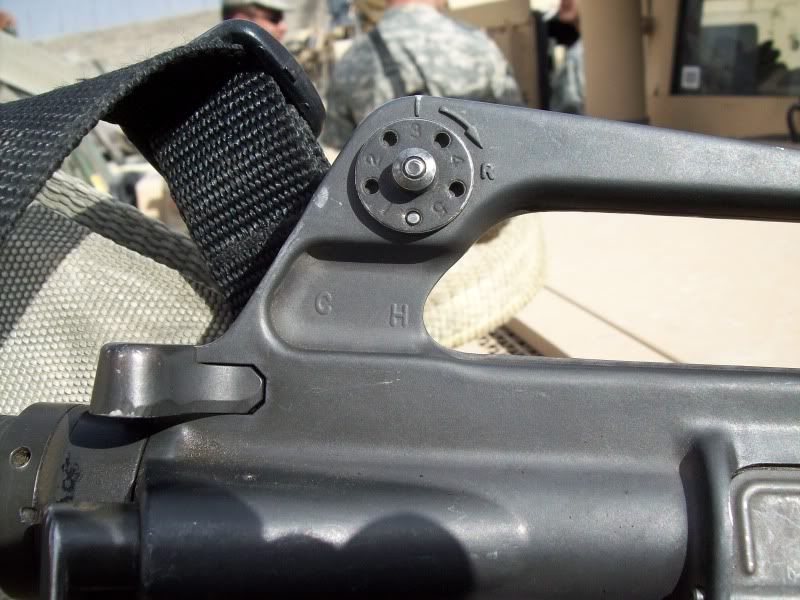
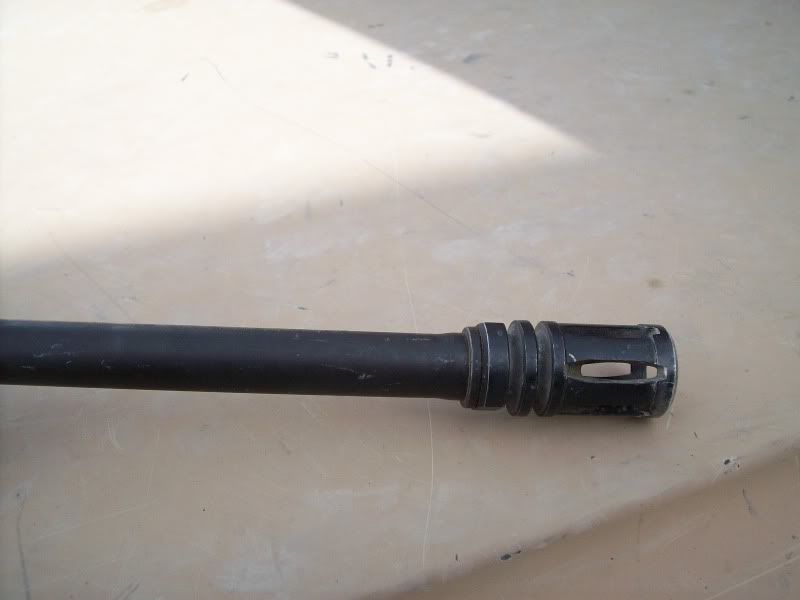

I did also run into a staff-weenie from the 101st at Bagram who had a late RO723, "CH" marked upper with case deflector, .750 notched barrel marked (C) MP, and with commercial rollmarks that read, ETA* - M4/M16A2E. No photographs of that one, unfortunately. ~Augee |
|
I will have to check out the retro, thanks. Going to have to get into the shed and find some old Air Force photos. Glad to see a response on this. The GAU5/A was indeed a blast to shoot on full auto.
As for the member in Indiana that got the SP Badge engraved? Where did you get it done and how much? Really think that looks sharp. |

|
Quoted:
Just a "by the way," the rollmark on that RO723 was "M4/M16A2E," commercial rollmarkings, just like this one: http://disassociatedpersonalities.files.wordpress.com/2010/12/benellim1entry009.jpg ~Augee "E" standing for "export"? |
| When I was in 142 SPF at PANGB, I was in the arms room instead of out on the stick line. We had a real hodge-podge of AR platforms. Most were 14.5" barreled (1/12) with either slick side GAU/604 uppers or M16A1 FA uppers- both with aluminum collapsible stocks, a few 20 inch M16 (604) and M16A1s. There were a couple 11.5 barreled GAU5-As and one hade a M16A1 upper with forward assist. many were cobbled together from mis-matched parts. Some loweres were partial fence, some full fence, and at least one had a slab side lower. This is looking back 30 years, comparing what I remember, and what I know now. |
|
Pinghar, Ted the owner of Laser Scribe on the south side of Indy near Greenwood did the work.
It depends on what you have on what the cost will be. Talk to Ted, if its late in the day he will do the work right then. He will also do ATF required depth for your SBR as was on my Thompson in the pic. I know my GAU is not totally accurate, but when I get it out of the safe and wiipe it down I go back in time. I can smell the JP-4 

|
|
Quoted:
Quoted:
Just a "by the way," the rollmark on that RO723 was "M4/M16A2E," commercial rollmarkings, just like this one: http://disassociatedpersonalities.files.wordpress.com/2010/12/benellim1entry009.jpg ~Augee "E" standing for "export"? IIRC, when used as a military designation, the "E" signifies a modification made based on operational experience. I would guess Colt used more or less the same convention, at least for a short while before the M4 was officially type classified, anticipating the "M4" classification, as they were already developing the XM4, and considered it to be an enhanced M16A2 carbine, hence the M4/M16A2E designation. This is much the same way that the M16A1 was designated the XM16E1, and the M16A3 originally entered service as the M16A2E3 (some lowers were marked this way). When used for military weapon types: "X" - experimental "A" - alteration "E" - change based on operational experience/needs Thus the XM16E1 was an experimental weapon that would be type classified as the M16, modified based on operational experience (forward assist, full fence, birdcage FH, parkerized BCG, standard buffer and gas tube, ect.). Once adopted in its "finalized" configuration, it became the first series alteration of the M16 (having been already accepted as is by the AF), thus "M16A1." When additional changes were made based on the M16A1, it became designated the M16A1E1, which would eventually evolve into the M16A2. The XM177E2 was an experimental submachine gun that would have been designated the M177 if type classified, that went through two operationally based changes. Of course, as I said... there's no way of really knowing if that's what Colt had in mind with the M4/M16A2E rollmark, but it's a possible explanation. By that time, Colt had gone through quite a few "E" series variants and was probably well familiar with its use. ~Augee |
|
Quoted:
Quoted:
Quoted:
Just a "by the way," the rollmark on that RO723 was "M4/M16A2E," commercial rollmarkings, just like this one: http://disassociatedpersonalities.files.wordpress.com/2010/12/benellim1entry009.jpg ~Augee "E" standing for "export"? IIRC, when used as a military designation, the "E" signifies a modification made based on operational experience. I would guess Colt used more or less the same convention, at least for a short while before the M4 was officially type classified, anticipating the "M4" classification, as they were already developing the XM4, and considered it to be an enhanced M16A2 carbine, hence the M4/M16A2E designation. This is much the same way that the M16A1 was designated the XM16E1, and the M16A3 originally entered service as the M16A2E3 (some lowers were marked this way). When used for military weapon types: "X" - experimental "A" - alteration "E" - change based on operational experience/needs Thus the XM16E1 was an experimental weapon that would be type classified as the M16, modified based on operational experience (forward assist, full fence, birdcage FH, parkerized BCG, standard buffer and gas tube, ect.). Once adopted in its "finalized" configuration, it became the first series alteration of the M16 (having been already accepted as is by the AF), thus "M16A1." When additional changes were made based on the M16A1, it became designated the M16A1E1, which would eventually evolve into the M16A2. The XM177E2 was an experimental submachine gun that would have been designated the M177 if type classified, that went through two operationally based changes. Of course, as I said... there's no way of really knowing if that's what Colt had in mind with the M4/M16A2E rollmark, but it's a possible explanation. By that time, Colt had gone through quite a few "E" series variants and was probably well familiar with its use. ~Augee Gotcha. Thanks for the info. 
|
|
Quoted:
Quoted:
Quoted:
Just a "by the way," the rollmark on that RO723 was "M4/M16A2E," commercial rollmarkings, just like this one: http://disassociatedpersonalities.files.wordpress.com/2010/12/benellim1entry009.jpg ~Augee "E" standing for "export"? IIRC, when used as a military designation, the "E" signifies a modification made based on operational experience. I would guess Colt used more or less the same convention, at least for a short while before the M4 was officially type classified, anticipating the "M4" classification, as they were already developing the XM4, and considered it to be an enhanced M16A2 carbine, hence the M4/M16A2E designation. This is much the same way that the M16A1 was designated the XM16E1, and the M16A3 originally entered service as the M16A2E3 (some lowers were marked this way). When used for military weapon types: "X" - experimental "A" - alteration "E" - change based on operational experience/needs Thus the XM16E1 was an experimental weapon that would be type classified as the M16, modified based on operational experience (forward assist, full fence, birdcage FH, parkerized BCG, standard buffer and gas tube, ect.). Once adopted in its "finalized" configuration, it became the first series alteration of the M16 (having been already accepted as is by the AF), thus "M16A1." When additional changes were made based on the M16A1, it became designated the M16A1E1, which would eventually evolve into the M16A2. The XM177E2 was an experimental submachine gun that would have been designated the M177 if type classified, that went through two operationally based changes. Of course, as I said... there's no way of really knowing if that's what Colt had in mind with the M4/M16A2E rollmark, but it's a possible explanation. By that time, Colt had gone through quite a few "E" series variants and was probably well familiar with its use. ~Augee The E suffix is applied to experimental modifications that have not been type classified as standard, including limited production. The E suffix can be applied to either developmental items (XM) or to items already classified as standard (M). When the first modification to a developmental item is type classified as standard, it looses the XM and any E suffixes to become the base type. Any other developmental items also type classified as standard gain A suffixes. The XM16E1 was type classified as the M16A1. This is a confusing case, because it appears that the XM16 designation existed only on paper, if at all, and that M16 was essentially retroactively applied to commercial AR-15 types that had already been type classified as standard. Commercial items can be type classified as standard using the commercial nomenclature under the Army's nomenclature system if no major modification was required for US Army use. Very minor modifications also do not necessarily require a modification in nomenclature and can be indicated in a change to the MIL-STD for a particular system, if at all. In other cases, an additional piece of text is appended to the complete formal nomenclature. This is also not always utilized. In this case, the rollmark could apply to Colt's 645E, the M16A2 Enhanced, which featured a folding front sight for when optics were mounted on the carry handle. The US Army assigned the nomenclature M16A2E1 to this variant. |
|
Funny I stumbled onto this thread...... I've got a spare "vintage" slickside SP-1 upper receiver that's looking for a new project, and I'm really looking hard at the idea of an Air Force carbine.
I know that it's almost an "anything goes" kind of recepe, but what barrel would be apropriate for such a build? I've seen "newer" M-4 barrels... but already have my "M-forgery" and want to do somthing different. |
|
Quoted:
Funny I stumbled onto this thread...... I've got a spare "vintage" slickside SP-1 upper receiver that's looking for a new project, and I'm really looking hard at the idea of an Air Force carbine. I know that it's almost an "anything goes" kind of recepe, but what barrel would be apropriate for such a build? I've seen "newer" M-4 barrels... but already have my "M-forgery" and want to do somthing different. Now I am going off memory here, but I'm 98% sure the barrels were M4 profile, however...they had a non F marked FSB and rifle extension (no M4 feedramps). There were also a few floating around with lightweight 1/7 twist 14.5 inch pencil barrels. Both were made by Colt. By the time I came in (mid '90's), the 1/12 twist barrels had been replaced with one of the later 1/7 twisters. I was CATM back then so i'm pretty sure I remember the details. They sure were neat Carbines...but man they looked rough! Always worked though. |
|
So.... does anyone make a 15" pencil barrel that can have an "a1" birdcage permanently installed to keep everything "kosher"? Hell..... I might pick up a 16" pencil barrel and have it cut down. Hmmmmmm.....
I'm planning on installing a USGI "Gen 3" stock, going with this look: 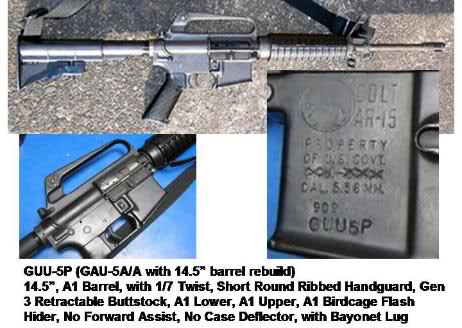
|
|
Quoted:
Quoted:
Quoted:
Quoted:
Just a "by the way," the rollmark on that RO723 was "M4/M16A2E," commercial rollmarkings, just like this one: http://disassociatedpersonalities.files.wordpress.com/2010/12/benellim1entry009.jpg ~Augee "E" standing for "export"? IIRC, when used as a military designation, the "E" signifies a modification made based on operational experience. I would guess Colt used more or less the same convention, at least for a short while before the M4 was officially type classified, anticipating the "M4" classification, as they were already developing the XM4, and considered it to be an enhanced M16A2 carbine, hence the M4/M16A2E designation. This is much the same way that the M16A1 was designated the XM16E1, and the M16A3 originally entered service as the M16A2E3 (some lowers were marked this way). When used for military weapon types: "X" - experimental "A" - alteration "E" - change based on operational experience/needs Thus the XM16E1 was an experimental weapon that would be type classified as the M16, modified based on operational experience (forward assist, full fence, birdcage FH, parkerized BCG, standard buffer and gas tube, ect.). Once adopted in its "finalized" configuration, it became the first series alteration of the M16 (having been already accepted as is by the AF), thus "M16A1." When additional changes were made based on the M16A1, it became designated the M16A1E1, which would eventually evolve into the M16A2. The XM177E2 was an experimental submachine gun that would have been designated the M177 if type classified, that went through two operationally based changes. Of course, as I said... there's no way of really knowing if that's what Colt had in mind with the M4/M16A2E rollmark, but it's a possible explanation. By that time, Colt had gone through quite a few "E" series variants and was probably well familiar with its use. ~Augee The E suffix is applied to experimental modifications that have not been type classified as standard, including limited production. The E suffix can be applied to either developmental items (XM) or to items already classified as standard (M). When the first modification to a developmental item is type classified as standard, it looses the XM and any E suffixes to become the base type. Any other developmental items also type classified as standard gain A suffixes. The XM16E1 was type classified as the M16A1. This is a confusing case, because it appears that the XM16 designation existed only on paper, if at all, and that M16 was essentially retroactively applied to commercial AR-15 types that had already been type classified as standard. Commercial items can be type classified as standard using the commercial nomenclature under the Army's nomenclature system if no major modification was required for US Army use. Very minor modifications also do not necessarily require a modification in nomenclature and can be indicated in a change to the MIL-STD for a particular system, if at all. In other cases, an additional piece of text is appended to the complete formal nomenclature. This is also not always utilized. In this case, the rollmark could apply to Colt's 645E, the M16A2 Enhanced, which featured a folding front sight for when optics were mounted on the carry handle. The US Army assigned the nomenclature M16A2E1 to this variant. Will defer to you on this one, as how nomenclature is determined is not my area of expertise, I still can't figure out why the Inight M3X and EOTech 553 and ELCAN Specter are all classified as "AN/SU-xxx" while the AN/PEQ-2A and AN/PAQ-4C are classified as different items. As to the particular rifle with the M4/M16A2E rollmark, it was definitely an RO723, and appeared to be factory (staked two-position fiberlite stock). ~Augee |
|
Will defer to you on this one, as how nomenclature is determined is not my area of expertise, I still can't figure out why the Inight M3X and EOTech 553 and ELCAN Specter are all classified as "AN/SU-xxx" while the AN/PEQ-2A and AN/PAQ-4C are classified as different items.
Not sure what you mean. The Insight M3X is the SU-233/PVS, the EOTech 553 is the SU-231/PEQ, the ELCAN Specter DR is either SU-230/PVS or SU-238/PVS (or both). They are all designated separately. Those are the formal nomenclature, as they are designated as electro-optic units. Sets and systems are designated using the "AN/" prefix followed by a 3 letter code. If you're asking why PEQ for one and PAQ for the other, some made a likely arbitrary determination that one better fit into one category than the other. As to the particular rifle with the M4/M16A2E rollmark, it was definitely an RO723, and appeared to be factory (staked two-position fiberlite stock).
~Augee Indeed. I still have to wonder if the weapon wasn't marked as part of some early special series, that might have included the M16A2 Enhanced rifles, preceding the current Enhanced Series. |
|
Quoted:
Will defer to you on this one, as how nomenclature is determined is not my area of expertise, I still can't figure out why the Inight M3X and EOTech 553 and ELCAN Specter are all classified as "AN/SU-xxx" while the AN/PEQ-2A and AN/PAQ-4C are classified as different items.
Not sure what you mean. The Insight M3X is the SU-233/PVS, the EOTech 553 is the SU-231/PEQ, the ELCAN Specter DR is either SU-230/PVS or SU-238/PVS (or both). They are all designated separately. Those are the formal nomenclature, as they are designated as electro-optic units. Sets and systems are designated using the "AN/" prefix followed by a 3 letter code. If you're asking why PEQ for one and PAQ for the other, some made a likely arbitrary determination that one better fit into one category than the other. Not strictly confused so much as amused by the designation systems, and why some things use similar "series" designations when they're so different, while some things that are so similar use different designations. As you pointed out, the Insight M3X VBL III is designated the AN/SU-233/PVS - it's a flashlight. The ELCAN SpecterDR is designated AN/SU-230/PVS - it's a variable power scope (1x and 4x) with illuminated reticule. Why are they both SU-xxx/PVS series items? The TA01ECOS makes a little bit of sense that it would also be an AN/SU-237/PVS - it's a 4x scope with a DocOptic. Of course, where does the EOTech 553 HWS fall into play here? It's also an AN/SU-xxx, but instead of /PVS, it's /PEQ. On the other hand, with all of these diverse things - a variable power scope, a HWS, a fixed power scope with MRD, and a flashlight all falling into the AN/SU-xxx numbering series, you'd think that the TA31RCO would at very least be classified with them as an AN/SU-xxx. Except, it's not, it's an AN/PVQ-31A or B. So... it's apparently different enough from the TA01ECOS to warrant being classified as a completely different type of item, an AN/PVQ-xxx. But a flashlight isn't, it's still an AN/SU-xxx item. Similarly, the AN/PAQ-4C and AN/PEQ-2A are both used as weapon mounted IR laser sights. In their operational use, they're pretty similar, the AN/PEQ-2A has an illuminator as well as a pointer. Yet, one is an AN/PAQ, while another is an AN/PEQ. As a matter of fact, there is in fact an AN/PEQ-4 as well, and it's completely different from both the AN/PAQ-4C and the AN/PEQ-2A. In fact, I actually do understand the reasons for some of these designations, and why they're different, but it doesn't make it any less amusing that the Army and Navy (the "A" and the "N" in the "AN," so to speak) think that a weapon mounted incandescent light and the TA01ECOS are more closely related than the TA01ECOS and the TA31RCO.
~Augee |
|
Quoted:
As you pointed out, the Insight M3X VBL III is designated the AN/SU-233/PVS - it's a flashlight. The ELCAN SpecterDR is designated AN/SU-230/PVS - it's a variable power scope (1x and 4x) with illuminated reticule. Why are they both SU-xxx/PVS series items? This one is easier to figure out. All the SU series is for electro-optical units and groups (and again, the "AN/" prefix isn't technically used with these designations). Both are electrical devices that helps with your targeting, whether its sighting or otherwise acquiring the target. You're right on the PVS and PEQ things though, but that seems likely to be as arbitrary as the PEQ/PAQ difference. I agree that "amusing" is probably the best term for all this silliness. |
|
Quoted:
Quoted:
As you pointed out, the Insight M3X VBL III is designated the AN/SU-233/PVS - it's a flashlight. The ELCAN SpecterDR is designated AN/SU-230/PVS - it's a variable power scope (1x and 4x) with illuminated reticule. Why are they both SU-xxx/PVS series items? This one is easier to figure out. All the SU series is for electro-optical units and groups (and again, the "AN/" prefix isn't technically used with these designations). Both are electrical devices that helps with your targeting, whether its sighting or otherwise acquiring the target. You're right on the PVS and PEQ things though, but that seems likely to be as arbitrary as the PEQ/PAQ difference. I agree that "amusing" is probably the best term for all this silliness. Things were so much simpler back in the early 70's |
|
Quoted:
Things were so much simpler back in the early 70's Not sure why you'd say that, the Joint Electronics Type Designation System was formalized in 1957. The joint service MDS designation system for aerospace vehicles was formalized in 1962. The Army and Navy nomenclature systems have their origins around the turn of the century, and in those instances they've both become increasing more simple over time, especially since the end of the Second World War. The real problem in my opinion is that there all items aren't either in joint service system or just use their commercial nomenclature, and in instances where their is a joint service agreement, the system on covers certain items (leading to numerous joint service systems, which don't do anything to reduce confusion). |
| I am familiar with firearm nomenclature. What I am saying is back then it was simple. Walking behind a dog with a plain ol GAU with a handle. AR's have handles you know.You had twenty round magazines, no lasers, lights, gps, or an espresso makers bolted on the front of your weapon. Just you and your dog. |
|
Quoted:
I am familiar with firearm nomenclature. What I am saying is back then it was simple. Walking behind a dog with a plain ol GAU with a handle. AR's have handles you know.You had twenty round magazines, no lasers, lights, gps, or an espresso makers bolted on the front of your weapon. Just you and your dog. I love it! a lot of the M4s (and even more M4geries have so much stuff on them, they make a sub-6 pound platform into a 10 pound rifle that needs a wheel barrow to haul it. AT the Watermelon demolition Derby with my son and his friends, everyone wanted to know what kind of weapon my slick side retro was! I told them it was the AR as Armalite intended. It got fired way more than the tacticool weapons! When I was in 142nd, we had nothing but basic GAU with no goo-gahs. My XM177 on the SO was plain, also. |
|
Quoted:
Quoted:
Quoted:
Quoted:
Quoted:
Just a "by the way," the rollmark on that RO723 was "M4/M16A2E," commercial rollmarkings, just like this one: http://disassociatedpersonalities.files.wordpress.com/2010/12/benellim1entry009.jpg ~Augee "E" standing for "export"? IIRC, when used as a military designation, the "E" signifies a modification made based on operational experience. I would guess Colt used more or less the same convention, at least for a short while before the M4 was officially type classified, anticipating the "M4" classification, as they were already developing the XM4, and considered it to be an enhanced M16A2 carbine, hence the M4/M16A2E designation. This is much the same way that the M16A1 was designated the XM16E1, and the M16A3 originally entered service as the M16A2E3 (some lowers were marked this way). When used for military weapon types: "X" - experimental "A" - alteration "E" - change based on operational experience/needs Thus the XM16E1 was an experimental weapon that would be type classified as the M16, modified based on operational experience (forward assist, full fence, birdcage FH, parkerized BCG, standard buffer and gas tube, ect.). Once adopted in its "finalized" configuration, it became the first series alteration of the M16 (having been already accepted as is by the AF), thus "M16A1." When additional changes were made based on the M16A1, it became designated the M16A1E1, which would eventually evolve into the M16A2. The XM177E2 was an experimental submachine gun that would have been designated the M177 if type classified, that went through two operationally based changes. Of course, as I said... there's no way of really knowing if that's what Colt had in mind with the M4/M16A2E rollmark, but it's a possible explanation. By that time, Colt had gone through quite a few "E" series variants and was probably well familiar with its use. ~Augee The E suffix is applied to experimental modifications that have not been type classified as standard, including limited production. The E suffix can be applied to either developmental items (XM) or to items already classified as standard (M). When the first modification to a developmental item is type classified as standard, it looses the XM and any E suffixes to become the base type. Any other developmental items also type classified as standard gain A suffixes. The XM16E1 was type classified as the M16A1. This is a confusing case, because it appears that the XM16 designation existed only on paper, if at all, and that M16 was essentially retroactively applied to commercial AR-15 types that had already been type classified as standard. Commercial items can be type classified as standard using the commercial nomenclature under the Army's nomenclature system if no major modification was required for US Army use. Very minor modifications also do not necessarily require a modification in nomenclature and can be indicated in a change to the MIL-STD for a particular system, if at all. In other cases, an additional piece of text is appended to the complete formal nomenclature. This is also not always utilized. In this case, the rollmark could apply to Colt's 645E, the M16A2 Enhanced, which featured a folding front sight for when optics were mounted on the carry handle. The US Army assigned the nomenclature M16A2E1 to this variant. Will defer to you on this one, as how nomenclature is determined is not my area of expertise, I still can't figure out why the Inight M3X and EOTech 553 and ELCAN Specter are all classified as "AN/SU-xxx" while the AN/PEQ-2A and AN/PAQ-4C are classified as different items. As to the particular rifle with the M4/M16A2E rollmark, it was definitely an RO723, and appeared to be factory (staked two-position fiberlite stock). ~Augee Augee - got any pics or links to the M16A2E1? I'd like to see a pic of it - interesting sounding variant. |
|
Quoted:
Quoted:
Quoted:
Quoted:
Quoted:
Quoted:
Just a "by the way," the rollmark on that RO723 was "M4/M16A2E," commercial rollmarkings, just like this one: http://disassociatedpersonalities.files.wordpress.com/2010/12/benellim1entry009.jpg ~Augee "E" standing for "export"? IIRC, when used as a military designation, the "E" signifies a modification made based on operational experience. I would guess Colt used more or less the same convention, at least for a short while before the M4 was officially type classified, anticipating the "M4" classification, as they were already developing the XM4, and considered it to be an enhanced M16A2 carbine, hence the M4/M16A2E designation. This is much the same way that the M16A1 was designated the XM16E1, and the M16A3 originally entered service as the M16A2E3 (some lowers were marked this way). When used for military weapon types: "X" - experimental "A" - alteration "E" - change based on operational experience/needs Thus the XM16E1 was an experimental weapon that would be type classified as the M16, modified based on operational experience (forward assist, full fence, birdcage FH, parkerized BCG, standard buffer and gas tube, ect.). Once adopted in its "finalized" configuration, it became the first series alteration of the M16 (having been already accepted as is by the AF), thus "M16A1." When additional changes were made based on the M16A1, it became designated the M16A1E1, which would eventually evolve into the M16A2. The XM177E2 was an experimental submachine gun that would have been designated the M177 if type classified, that went through two operationally based changes. Of course, as I said... there's no way of really knowing if that's what Colt had in mind with the M4/M16A2E rollmark, but it's a possible explanation. By that time, Colt had gone through quite a few "E" series variants and was probably well familiar with its use. ~Augee The E suffix is applied to experimental modifications that have not been type classified as standard, including limited production. The E suffix can be applied to either developmental items (XM) or to items already classified as standard (M). When the first modification to a developmental item is type classified as standard, it looses the XM and any E suffixes to become the base type. Any other developmental items also type classified as standard gain A suffixes. The XM16E1 was type classified as the M16A1. This is a confusing case, because it appears that the XM16 designation existed only on paper, if at all, and that M16 was essentially retroactively applied to commercial AR-15 types that had already been type classified as standard. Commercial items can be type classified as standard using the commercial nomenclature under the Army's nomenclature system if no major modification was required for US Army use. Very minor modifications also do not necessarily require a modification in nomenclature and can be indicated in a change to the MIL-STD for a particular system, if at all. In other cases, an additional piece of text is appended to the complete formal nomenclature. This is also not always utilized. In this case, the rollmark could apply to Colt's 645E, the M16A2 Enhanced, which featured a folding front sight for when optics were mounted on the carry handle. The US Army assigned the nomenclature M16A2E1 to this variant. Will defer to you on this one, as how nomenclature is determined is not my area of expertise, I still can't figure out why the Inight M3X and EOTech 553 and ELCAN Specter are all classified as "AN/SU-xxx" while the AN/PEQ-2A and AN/PAQ-4C are classified as different items. As to the particular rifle with the M4/M16A2E rollmark, it was definitely an RO723, and appeared to be factory (staked two-position fiberlite stock). ~Augee Augee - got any pics or links to the M16A2E1? I'd like to see a pic of it - interesting sounding variant. I don't have the ability to scan right now, and I don't know, off top of my head of any links - but page 29 of TBR 2 has a photo of the RO645E, with detailed photographs on page 30. Imagine, if you will, an M16A4 with a YHM flip-up FSB, except taper pinned instead of clamp on, and you'll have a decent mental image of it. An interesting element is the integral flip up BUIS under the detachable carrying handle. Also, on page 90 is a photograph of an RO727(?) with a four position FCG and "star" selector lever that also bears the commercial "M4/M16A2E" rollmark. Needless to say, those of you who peruse the Retro and A2 sections are highly encouraged to get a copy of both TBR and TBR2. While there are some definite errors in both that have since been corrected, they're an excellent baseline and reference (the first MOE handguard is on page 159). Required reading. ~Augee |
| I was a Security Police Armorer at Aviano Air Base (88-91). We had two types of GAU's. An older type had a 6 inch flash suppressor that was permanently attached. Similar to a CAR. There was not a bayonet lug. The second type had a M4 type that did have the bayonet lug. The one with the 6 inch suppressor was a bit heavier but stout. |
|
Quoted:
Also, on page 90 is a photograph of an RO727(?) with a four position FCG and "star" selector lever that also bears the commercial "M4/M16A2E" rollmark. This in my mind would point even more toward this being an early enhanced series rollmark. The current enhanced series differs from their associate models only in the four position FCG. |
AR Sponsor