


AR Sponsor


[ARCHIVED THREAD] - New Member With Odd Lower Find (Page 1 of 2)
Posted: 8/2/2014 7:06:04 PM EDT
|
Hi guys, new member from SC here. Collector of Milsurps & Militaria, also vintage motorcycles. I belong to many other gun forums, thought maybe you would like to comment on this item........
From the cool but what is it file......... I went to look at some motorcycle parts today, this was in one of the boxes I went through...... I took pictures because I thought it was cool, but, what is it ??? Real machining blank ? Training piece ? Fake piece ? Prop? It is aluminum. 


|
|
Quoted:
That looks stamped, not engraved. Quoted:
Quoted:
That's how the old 80% were done before people started leaving the fcg pocket filled in. I vet it's just one someone engraved to look official, much like how people have the colt roll marks done. That looks stamped, not engraved. Some of both id say |
|
Quoted:
What serial number? Quoted:
Quoted:
Would be curious to see what FN has to say about that serial number. What serial number? My bad, the mfg code is stamped on it, also numbering where the pistol grip goes. I am sure it is some kind of identifying mark, lot number or something. |
|
Interesting....KAO is KAO MING Machinery Industrial Co.,Ltd in Taiwan. You may want to send an email to ask FN what KAO-6 stands for...may just be a cheap knock of or something we don't know about. Hard to tell from the pictures but it looks like it may be steel from the pitting...does it feel heavier then other lowers? |
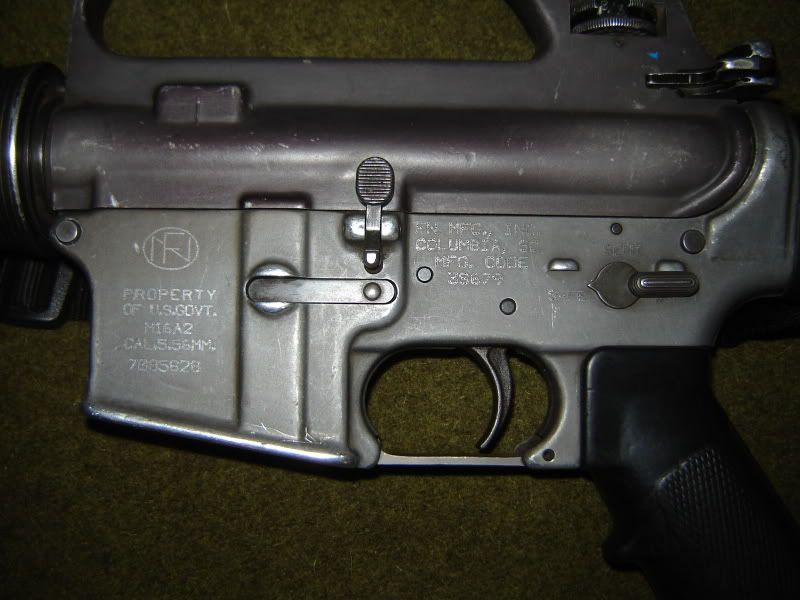
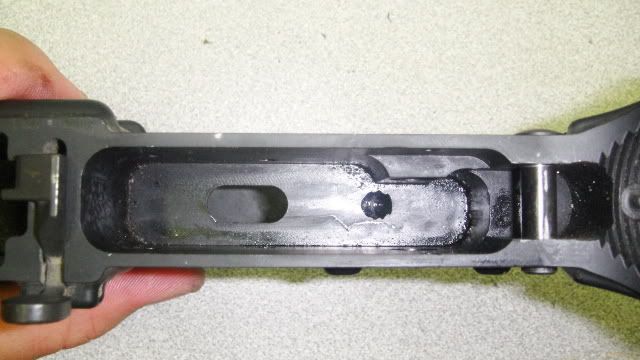
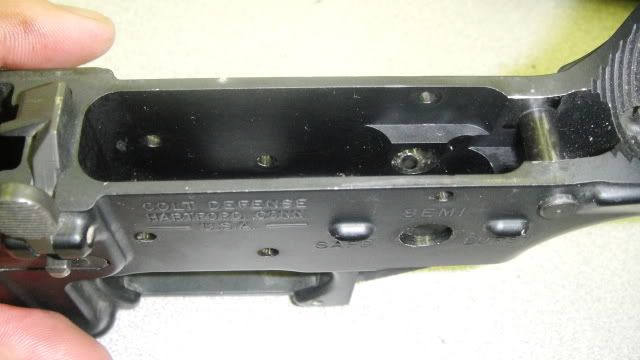
| I carried a FN M16 for some time in the Army days and combined with what I know about ARs today, I believe this to be real from FN. Looks like an old-school 80%er. Best-case guess: somebody at the FN plant was given this as a paperweight or some other gift from the company, maybe it was a reject or was taken off the line and given out to an employee. Worst-case guess: somebody at the FN plant stole it before it was finished and serialized to give themselves a trophy or possibly even finish up into the real deal on their own -either way, not good. It could always be an impressive 80% with fake roll marks, but given the nature of the situation and those machine processes I'm looking at, I think that's pretty much ruled out at this point. Conclusion: this is either a really cool novelty item to own or stay the Hell away from it. I would advise to avoid it given the potential for things to go wrong, but some may call me paranoid -better safe than sorry in my book. |
|
Speaking as an amateur machinist and looking at finished mag well and other things on my receivers
1. Wouldn’t it be difficult a best to machine the mag well correctly? 2. Same for all the missing detent holes and bolt latch pivot point holes? 3. Same for buffer tube hole and treads? I know how id go about it and possibly succeed but I find it hard to believe something like this would have ever be offered as a finish it yourself part … I would need to go out and find some very specialized tooling im thinking. |
|
A for instance of what im talking about
This is photo of a machined mag well in a billet lower Note the very tight corners It would take an extremely long and small diameter cutter to pull this off 
The well in my forged lowers looks un machined / forged that way |
|
Quoted: . Conclusion: this is either a really cool novelty item to own or stay the Hell away from it. I would advise to avoid it given the potential for things to go wrong, but some may call me paranoid -better safe than sorry in my book. its not a gun, its a chunk of metal, Its has roll marks but no serial number, even if it dis its not finished so who cares OP I would finish it w/o the 3rd hole |
|
Quoted:
(SNIP) "virtually all FN A2's are electro stenciled, not roll marked. Earliset rollmark I've seen are the A3-A4" My mileage varies quite a bit as from my observations and notes; While early receivers had the FN logo, markings and serial numbers applied by the electro stencil process, by 7090XXX (observed) the serial numbers were roll stamped in the conventional manner while the other markings continued to use the earlier electro stencil process. By 711XXXX (observed) the serial number and all marking were roll stamped. Wpns Man |
|
I have built several 0% lowers into usable lowers with my mini mill. Finishing that lower would not be a major problem. You can buy a $14.00 drill bit that reams out the buffer tube to the correct diameter and then you thread it.
If you want to sell it, PM me and I will buy it. |
|
Quoted:
why its not a gun, its a chunk of metal, Its has roll marks but no serial number, even if it dis its not finished so who cares OP I would finish it w/o the 3rd hole Quoted:
Quoted:
. Conclusion: this is either a really cool novelty item to own or stay the Hell away from it. I would advise to avoid it given the potential for things to go wrong, but some may call me paranoid -better safe than sorry in my book. its not a gun, its a chunk of metal, Its has roll marks but no serial number, even if it dis its not finished so who cares OP I would finish it w/o the 3rd hole Exactly This, ASAP!!! |

|
Looks like a FN lower that "escaped" from manufacturing. It makes sense that the rollmarks are applied prior to machining, when you have a solid chunk (and not thin sidewalls to break). It also makes sense that the serial # isn't applied until after the unit is done...if the part has to be scrapped at any point in the process, it's easier to toss a scrap chunk of AL, that isn't a gun, vs make a real gun "no longer exist" on paper. I'd say it's a raw forging (0%) that has been rollmarked with it's batch (sans serial), and was pulled from the line (for whatever reason) before any machine work. Based on that magwell, I'd think the other machinework was done by a personal machine, not a "real" manufacturer. Though, it would be nice to get it after it had been decked. Lack of takedown holes for indexing/fixturing, lack of profiling, etc make me think this work was done on a manual machine, not a CNC. I think it probably WAS FN property at one time, but now it's just an interestingly marked raw forging (well, partially completed forging). I find it interesting that the deck and FC pocket have been cut, but it's not been profiled, nor any takedown pin holes to reference from. I would also think the FCG holes, safety selector hole, etc would be better served cut from a solid piece, as opposed to cutting after the FC pocket has been milled out. It would seem that having the drill hit 2 faces (vs just one) would introduce 2x the opportunity for the bit to "walk". Based on the oddball machining process (IMO), and the fact that the (FA width) FC pocket has been cut, followed by the magwell...I personally think someone wanted a FN/US Prop marked M16A2 that was "off the books". On the way to having a 3rd hole. They were more interested in having that FC pocket cut, than they were getting the rest of it done in the best manner. All my opinion. I'm not a machinist. As it is now...cool find. I'd finish it out, and enjoy it. Nothing wrong with having it at this point.
|
|
Quoted: Looks like a FN lower that "escaped" from manufacturing. It makes sense that the rollmarks are applied prior to machining, when you have a solid chunk (and not thin sidewalls to break). It also makes sense that the serial # isn't applied until after the unit is done...if the part has to be scrapped at any point in the process, it's easier to toss a scrap chunk of AL, that isn't a gun, vs make a real gun "no longer exist" on paper. I'd say it's a raw forging (0%) that has been rollmarked with it's batch (sans serial), and was pulled from the line (for whatever reason) before any machine work. Based on that magwell, I'd think the other machinework was done by a personal machine, not a "real" manufacturer. Though, it would be nice to get it after it had been decked. Lack of takedown holes for indexing/fixturing, lack of profiling, etc make me think this work was done on a manual machine, not a CNC. I think it probably WAS FN property at one time, but now it's just an interestingly marked raw forging (well, partially completed forging). I find it interesting that the deck and FC pocket have been cut, but it's not been profiled, nor any takedown pin holes to reference from. I would also think the FCG holes, safety selector hole, etc would be better served cut from a solid piece, as opposed to cutting after the FC pocket has been milled out. It would seem that having the drill hit 2 faces (vs just one) would introduce 2x the opportunity for the bit to "walk". Based on the oddball machining process (IMO), and the fact that the (FA width) FC pocket has been cut, followed by the magwell...I personally think someone wanted a FN/US Prop marked M16A2 that was "off the books". On the way to having a 3rd hole. They were more interested in having that FC pocket cut, than they were getting the rest of it done in the best manner. All my opinion. I'm not a machinist. As it is now...cool find. I'd finish it out, and enjoy it. Nothing wrong with having it at this point. have it professionally finished, and then have the serial number Stamped into it. I'd go with a 100XXXX range. I saw a lot of them converted over to M16A4's with the 10110XX range on them. :)
|
|
Quoted:
I think you won't be leaving with it at that point. Quoted:
Quoted:
I visit Columbia SC often, I think I will drop in and see what they think of it. I think you won't be leaving with it at that point. +1 If it is indeed theirs they might decide they want it back. |
| High volume lower manufacturers broach the mag well, which means they mill most of it out and then run a humongous broaching tool through it. From the looks of the part, it seems that the "rough" mag well cut wasn't finished, as if (as noted earlier) it was a "tooling example" part that might have been used to set up some of the machining processes. It looks very legit to me. |
|
Quoted:
It's a setup or fixture part that just more than likely got thrown out or made it out of the factory. That would be my guess too. It is odd that the mag well area was only partially milled out. There are no jigs to finish a mag well. It can be done manually with standard drilling and milling along with some hand filing fitting. But that involves way too much work and I would not spend the time to do it. I'd just use it as a paper weight / conversation piece, but I get paranoid about having anything around that says US government property on it. 
|
| I think it might be an unfinished set of blanks quite possibly from FN. Machining sort of looks like shit but rollmarks/engraving look good, maybe someone who work(ed) for FN 'accidentally' took it home and didn't have a mill so they used a drill press. I don't know what ATF would think of it, but I certainly wouldn't build it out anymore. Cool conversation piece? |
|
Quoted:
I think it might be an unfinished set of blanks quite possibly from FN. Machining sort of looks like shit but rollmarks/engraving look good, maybe someone who work(ed) for FN 'accidentally' took it home and didn't have a mill so they used a drill press. I don't know what ATF would think of it, but I certainly wouldn't build it out anymore. Cool conversation piece? You bring up a very good point mooseishman. Given that there was milling into the FC pocket, this lower is now considered a firearm. Be careful transporting that lower around. (I would not transport it.) To legally transfer an 80% lower, it has to be done via a FFL. Since the OP did not mill out the lower, it probably is illegal to be in possession of it, since it was not transferred to him. If you are in state that requires registration of AR's, you may also get hit on the state side too. |
| Look like rejects. Fire control pocket wall looks to thin on one side or milled off to one side and the forward assist retaining pin hole in the upper looks oblonged. Side catch is missing on the upper for the charging handle. I would guess pulls for failing some check in the process. |
|
Quoted: You bring up a very good point mooseishman. Given that there was milling into the FC pocket, this lower is now considered a firearm. Be careful transporting that lower around. (I would not transport it.) To legally transfer an 80% lower, it has to be done via a FFL. Since the OP did not mill out the lower, it probably is illegal to be in possession of it, since it was not transferred to him. If you are in state that requires registration of AR's, you may also get hit on the state side too. Why would he need an FFL to transfer an AR lower that had been made from an 80% or 0% forging? As long as the original manufacturer did not make the firearm intending to sell it, the fella who milled it is in the clear. You can sell firearms you make - you just can't make them w/ intent to sell. |
|
Quoted:
Quoted: You bring up a very good point mooseishman. Given that there was milling into the FC pocket, this lower is now considered a firearm. Be careful transporting that lower around. (I would not transport it.) To legally transfer an 80% lower, it has to be done via a FFL. Since the OP did not mill out the lower, it probably is illegal to be in possession of it, since it was not transferred to him. If you are in state that requires registration of AR's, you may also get hit on the state side too. Why would he need an FFL to transfer an AR lower that had been made from an 80% or 0% forging? As long as the original manufacturer did not make the firearm intending to sell it, the fella who milled it is in the clear. You can sell firearms you make - you just can't make them w/ intent to sell. Sorry backbencher – I’ve been in CA too long. Here it must go through a FFL. This will vary from state to state. Quoted:
Quoted:
You bring up a very good point mooseishman. Given that there was milling into the FC pocket, this lower is now considered a firearm. Hey TaylorWSO - I don’t know of any specific definition for an 80% lower. The process the 80% lower manufacturers use is to send a sample lower to the ATF and get a letter from them that states it is not a firearm. But I'm certain the picture posted by the OP is legally a firearm. (I've read a lot of ATF letters to be 100% confident on that...) The ATF uses 18 U.S.C. 921(a)(3) to determine if a lower is a firearm. This topic can really make your head spin. Combine that with being in California and it gets exponentially complex to stay safe of the law. I will try not to confuse CA law in this post. It takes very little for a paperweight, blank, forging, billet 80% lower, etc., to be considered a firearm. The image posted by the OP was not a firearm originally sold by a licensed manufacturer. Therefore, it will be considered for purposes of this post a firearm made an unlicensed individual. I say firearm because the lower does not have to be functional to be considered a firearm. To show how ridiculously easy it is for a lower to be considered a firearm, let's take a look at the EP Armory 80% polymer lower the was recently determined to be a firearm by the ATF. The two primary issues with it was the "biscuit" insert in the fire control pocket and "indexing" on the fire control area. Either one of these features made it a “firearm” prior to any milling taking place. To try to keep this post short let's take a look at “indexing” only. Indexing is simply outlining on a blank or 80% lower the area to mill out or where to drill the pin holes in the fire control area. In the case of EP Arms, just the fact that there were 3 little raised dimples to show where to drill the holes for the trigger and selector pins made the 80% lower a firearm. The image in the OP's photo clearly is milled in the FC group. There is no debate that legally it is firearm despite the mag well not being finished. Any milling or drilling into the FC area instantly makes the lower a firearm. For those who want to see the ridiculous DOJ letter, it is posted at this link. I don't agree with it, but they make the rules, not us. http://www.scribd.com/doc/217153992/atf-letter-to-ep-armory Now that we've established that it is a firearm, and that it was not a firearm built by a license manufacturer, what are the requirements to sell such a thing? The ATF says, “Individuals manufacturing sporting-type firearms for their own use need not hold Federal Firearms Licenses (FFLs). However, we suggest that the manufacturer at least identify the firearm with a serial number as a safeguard in the event that the firearm is lost or stolen. Also, the firearm should be identified as required in 27 CFR 478.92 if it is sold or otherwise lawfully transferred in the future.” Did the ATF mean “shall” where they said “should”? If you read the ATF letter in this link below it says it “must” comply with 27 CFR 478.92 markings to be transferred. If you don’t want to read the full letter I’ll quote the relevant paragraph: “Also, for your information, a nonlicensee may manufacture a semiautomatic rifle for his or her own personal use. As long as the firearm remains in the custody of the person who manufactured it, the firearm need not be marked with a serial number or name or location of the manufacturer. However, if the firearm is transferred to another party as some point in the future, the firearm must be marked in accordance with the provisions set forth in 27 CFR & 478.92 (formerly 178.92).” http://www.hoffmang.com/firearms/BATFE-AMD-65-Manufacture-Marking-2004-11-09.pdf So far it seems clear that you can sell or transfer a home built firearm, that you’ve built without the intention to sell or transfer. But the OP did not build this firearm. Is he in a catch 22 situation unless he lies that he milled it? Maybe there is a provision to transfer to yourself a firearm built by an unlicensed manufacturer that is found, but I am not aware of it. It may be as simple as just saying “I found it” but I don’t know. In CA it would need to go through a FFL but I doubt you could find a FFL willing to do it. In states that allow unrestricted private party transfers he may be okay. I don’t know the laws in SC where the OP is from. If anyone has links to the code or ATF site with further information on this topic please share it. So far I have not had any interest to sell any of my 80% builds so I'm not fully familiar with the laws other than those to keep me out of trouble in CA. |
|
Quoted: Hey TaylorWSO - I don’t know of any specific definition for an 80% lower. The process the 80% lower manufacturers use is to send a sample lower to the ATF and get a letter from them that states it is not a firearm. But I'm certain the picture posted by the OP is legally a firearm. (I've read a lot of ATF letters to be 100% confident on that...) The ATF uses 18 U.S.C. 921(a)(3) to determine if a lower is a firearm.
This topic can really make your head spin. Combine that with being in California and it gets exponentially complex to stay safe of the law. I will try not to confuse CA law in this post. It takes very little for a paperweight, blank, forging, billet 80% lower, etc., to be considered a firearm. The image posted by the OP was not a firearm originally sold by a licensed manufacturer. Therefore, it will be considered for purposes of this post a firearm made an unlicensed individual. I say firearm because the lower does not have to be functional to be considered a firearm. To show how ridiculously easy it is for a lower to be considered a firearm, let's take a look at the EP Armory 80% polymer lower the was recently determined to be a firearm by the ATF. The two primary issues with it was the "biscuit" insert in the fire control pocket and "indexing" on the fire control area. Either one of these features made it a “firearm” prior to any milling taking place. To try to keep this post short let's take a look at “indexing” only. Indexing is simply outlining on a blank or 80% lower the area to mill out or where to drill the pin holes in the fire control area. In the case of EP Arms, just the fact that there were 3 little raised dimples to show where to drill the holes for the trigger and selector pins made the 80% lower a firearm. The image in the OP's photo clearly is milled in the FC group. There is no debate that legally it is firearm despite the mag well not being finished. Any milling or drilling into the FC area instantly makes the lower a firearm. For those who want to see the ridiculous DOJ letter, it is posted at this link. I don't agree with it, but they make the rules, not us. http://www.scribd.com/doc/217153992/atf-letter-to-ep-armory Now that we've established that it is a firearm, and that it was not a firearm built by a license manufacturer, what are the requirements to sell such a thing? The ATF says, “Individuals manufacturing sporting-type firearms for their own use need not hold Federal Firearms Licenses (FFLs). However, we suggest that the manufacturer at least identify the firearm with a serial number as a safeguard in the event that the firearm is lost or stolen. Also, the firearm should be identified as required in 27 CFR 478.92 if it is sold or otherwise lawfully transferred in the future.” Did the ATF mean “shall” where they said “should”? If you read the ATF letter in this link below it says it “must” comply with 27 CFR 478.92 markings to be transferred. If you don’t want to read the full letter I’ll quote the relevant paragraph: “Also, for your information, a nonlicensee may manufacture a semiautomatic rifle for his or her own personal use. As long as the firearm remains in the custody of the person who manufactured it, the firearm need not be marked with a serial number or name or location of the manufacturer. However, if the firearm is transferred to another party as some point in the future, the firearm must be marked in accordance with the provisions set forth in 27 CFR & 478.92 (formerly 178.92).” http://www.hoffmang.com/firearms/BATFE-AMD-65-Manufacture-Marking-2004-11-09.pdf So far it seems clear that you can sell or transfer a home built firearm, that you’ve built without the intention to sell or transfer. But the OP did not build this firearm. Is he in a catch 22 situation unless he lies that he milled it? Maybe there is a provision to transfer to yourself a firearm built by an unlicensed manufacturer that is found, but I am not aware of it. It may be as simple as just saying “I found it” but I don’t know. In CA it would need to go through a FFL but I doubt you could find a FFL willing to do it. In states that allow unrestricted private party transfers he may be okay. I don’t know the laws in SC where the OP is from. If anyone has links to the code or ATF site with further information on this topic please share it. So far I have not had any interest to sell any of my 80% builds so I'm not fully familiar with the laws other than those to keep me out of trouble in CA. Wait a second. Yes, the FCS pocket has been milled out. But no holes have been drilled, the buffer tube hole has not been drilled or tapped, and the magazine well is not complete. There's no magazine release even. This corresponds more to an older 80% forging than a recent one. Some older 80% forgings shipped w/ the FCS milled, but not the buffer tube nor the mag well. So I'm not going to buy that it's cut & dried an unserialized firearm. It might be. But you'd be hard pressed to make that fire a single shot, as is. You can purchase, under Federal law, a homemade firearm, as long as it was not built w/ the intent to sell. It needs to be properly marked w/ the manufacturer & a serial number. So if BATFE decides the paperweight OP has is a firearm, then whoever milled out the FCS pocket might be on the hook for not marking it properly before they sold it. If OP were to complete it, then it would behoove him to mark it w/ the manufacturer (him) and a serial number. Otherwise, it's an interesting paperweight & if BATFE is very very bored they can make a Federal case out of it & try to seize it from the OP. |
|
That chunk of aluminum does not look to me like it's anywhere near 80% finished. As noted above there are several critical parts of the piece that aren't machined at all, and others that are only very roughly started. Since there is no real fixed definition of what constitutes "80% finished," it would be up to someone who really wanted to push the issue to show that there were only a few, relatively trivial steps left to finish this hunk of metal as a firearm, and that would be very hard to do.
As others have noted, it looks like a manufacturing test piece to me, one used to assess the tooling or processes for one step of the lower manufacturing process. There isn't even anything related to how they were doing things in that process, so there don't seem to be any trade secrets involved either. As such, it's still a paperweight. |
[ARCHIVED THREAD] - New Member With Odd Lower Find (Page 1 of 2)
AR Sponsor