


AR Sponsor


Posted: 6/22/2006 11:42:18 AM EDT
|
A common thread here seems to be "My Model 1 Sales Bolt Broke" (or on rare occasions another AR firm's name). The reply seems to always be " Buy a Colt MPC marked bolt from SAW (or whoever) and live happily ever after". I was looking at some ads today and found this one. www.sturmgewehr.com/webBBS/parts.cgi?read=170595 A pretty good picture to support the comments of the wiser responders here who state that MP testing provides an improved measure of confidence, but no guarantee tha a part will not break. There are other potential modes of failure that MP testing will not identify and every part has a service life. Most AR parts are seldom tested to a failure limit. Those with military experience as an armorer will tell you that bolt breakage, Colt and otherwise, is a fairly common occurence . To believe that MP testing on a bolt will guarantee a lifetime of trouble free preformance is a myth at best, and a fairy tale at worst. Does it provide an additional quality check at some cost? You bet. After reading all the tales posted on AR15.com and giving them careful consideration, did I run out and replace all my bolts with MPC marked bolts? No, and I don't intend to either. As that great country singer Jerry Jeff Walker once sang "Think it over darling". |

|
The only way magnaflux testing is going to do you any real good is to test your bolt regularly after some certain number of rounds [ a number you would have to decide on ]. I bet all those bolts in the pic have a hell of a lot of rounds through them. Look at the wear where the extractor spring rides. Test the bolt every 1500 to 3000 rounds and you might catch a crack before it propagates [sp] and causes a failure. Testing a new part just tells you that it was manufactured with no suface defects. It doesn't tell you if there is some subsurface issue that will cause problems a few K rounds down the road. rj |
|
And do we know how many cycles those bolts ran through before that broke? Actually, do we know anything about that picture at all? No. MP testing ensures there are no pre-existing flaws. That gives the bolt a good 10,000 rounds before failure, on average. Non-MP tested bolts have a higher chance of having some type of pre-existing flaw, shortening average over all service life. How does what you posted make any sense? |
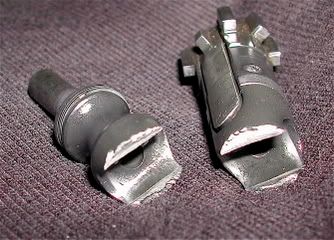 YaWannaSeeabrokenBolt..How's this! 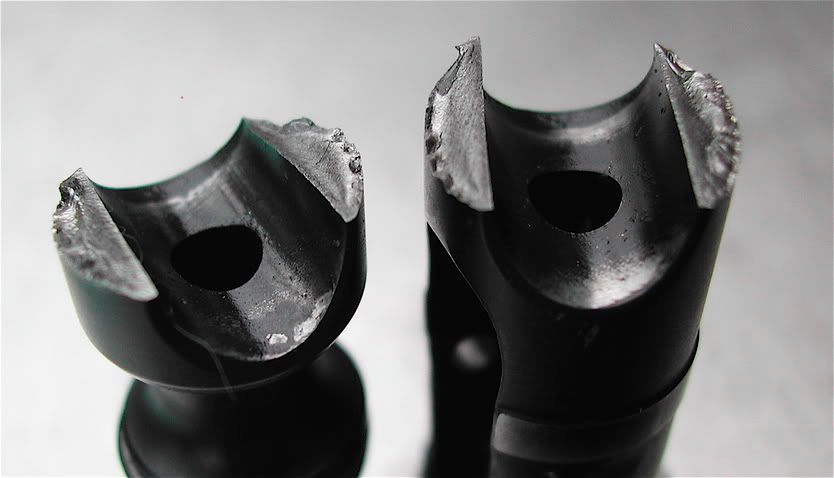 Enclosed is an excellent study on bolt failures by folks who know. The main presentation should be required reading for everyone here since it's gospel for the entire weapon system past, present and future. Page 44 details expected bolt failures, and mine came just about as predicted! http://www.dtic.mil/ndia/2006smallarms/taylor.pdf Update: Plz double check my page 2 reply...more information you may want to know on this issue. |
|
Most have posted correctly that all MP testing does is reveal flaws in new bolts after the bolt has been subjected to proof testing. The vast majority of commercial bolts on the market are not proof tested but as the vast majority of civilian users will not subject their weapons to the sort of use that can break a bolt in 3,000 to 6,000 rounds, some manufacturers do not see value in offering this expensive QA inspection. The reason for the lug breakage is due to the original design of the bolt itself; the two lugs either side of the extractor cut out take a greater proportion of the stress during firing due to the "missing" lug where the extractor is. As these lugs themselves are weakened by the extractor cut and the undercuts beneath them, they will likely fail in time. Breakage by the cam pin hole is due to poor original material choice and other things such as heat treat, shot peening etc. |
|
The bolts in the picture show normal end of life failures. Lugs breaking off are a sign that the bolt lived out it's useful life and it's very common in high round count rifles. I saw more than I care to remember when I was in the Army. DPMS and other bolts have a tendancy to break at the cam pin hole. |

Bullshit. How "hard" you run your rifle makes no difference when a bolt will break due to fatigue from load cycling. 5,000 rounds is 5,000 rounds no matter how fast they were fired. |
Heat is a very big factor in metal fatigue and failure. |
Wondering if perhaps he is talking about heat? Just like in a barrel, shooting slow, and allowing the barrel to cool will prolong the life? |
Full auto use subjects all the parts to a LOT more heat than semi auto use. Heat is the number one enemy to any highly stressed part. It reduces the effectiveness of the lube, causes the parts to expand which alters the fits, and just in general creates a lot more stress on the parts. rj |

Agreed
Agreed, but... The change in dimension due to temperature is negligible in this case. Temperture might change the part 0.0001" ~ 0.0002" in this case which a whole order of magnitude smaller than what the part was probably made to. |
+1 |
I have to disagree with your summation of previous bolt threads here. Yes, there have been some people who have made comments that mirror what you wrote. Some of those people were joking, some not but I believe the overall general reason given for buying Colt bolts is not to guarantee you anything other then knowing the bolts have been properly tested and that, that testing lowers the likelihood of you experiencing premature bolt failure. With enough use, any bolt will eventually break. The difference is, how much use can that bolt typically see before breaking? The usual reason why you see threads about M1S or BM bolts breaking, isn't because they broke, it's because they broke prematurely (less then 1-2k rounds). While I'm sure at least a few Colt bolts have broken after only a limited amount of rounds, that occurrence seems to be much more rare then that of their competitions. I believe Colt's testing is a big part of the reason of why that is. I'm not saying other companies bolts are crap, just that they have a higher probability of letting out sub-par units because each and every unit is not properly tested. For those reasons, I only buy and use Colt bolts but that's just me. If you don't agree, thats fine, use whatever you feel comfortable with. |
|
"YaWannaSeeabrokenBolt!" If this is confusing anyone, I apologize. Here's the appropriate translation: "Are you interested in seeing a seriously broken bolt? How does this look to you as an example?" 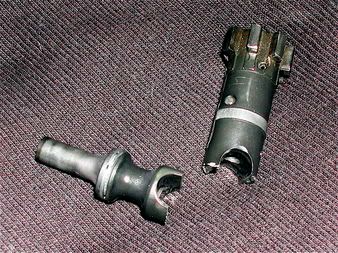 Back to business. Regarding my broken bolt: I have even had the Commander of the AMU discuss this specific failure, which has happened to him too on a several year old, high-use military bolt. If you download the link from my earlier post, page 44 deals specifically with the known bolt failures that affect the AR weapons system. Occasional, recreation shooters learn what the GI folks already know: Metal Fatigue and cracked bolts are fact of life in the AR design and it's nothing new. I suspect my cam pin failure could have been exacerbated by poor metallurgy, and in fact, it's in the hands of a materials engineer right now. But whether it was overstressed by "hot ammo", or wasn't heat treated properly to begin with, it failed and could have cost a GI his life if he depended on it in combat. The bolt came from a known AR-15 Smith, in a Douglas Hbar 1-8 barrel that's about 5 years old and has seen about 5000-7000 mil-spec rounds thru it. The ammo I shot the day it failed was XM-193 PD bulk pack. The 'Smith says it's bad ammo. The consensus from HM's I respect is poor metallurgy, poor heat tretment. A replacement bolt in the exact same upper shooting the same XM193PD worked fine. What I've learned is simple. For competition, always carry a spare-broken in bolt....or keep the old one as a spare and start a new season with a new bolt. If you bet your life on it daily, listen to your armorer, try to keep a rough round count, and replace the damn thing when told, if not sooner. Page 44 of this presentation explains it all and should be required reading for everyone on this issue: http://www.dtic.mil/ndia/2006smallarms/taylor.pdf 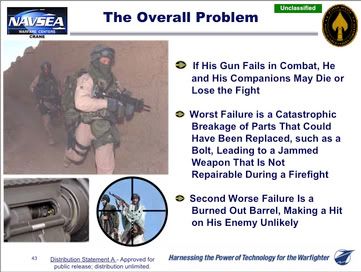 |

Overall, Gus's presentation was pretty good...mostly facts...but, small amount of either poorly thought-out or intentional mis-information (possibly to support SOCOM's agendas?). One of these agendas is that the M4A1 Carbine isn't up-to the task at their hands. This provides justification to continue their quest (& funding  ) to continue looking for something "better". To date, they haven't found the miracle weapon of their dreams. Hey, I don't mean to knock 'em ....some of their work has been leveraged for the big Army & may do so again. ) to continue looking for something "better". To date, they haven't found the miracle weapon of their dreams. Hey, I don't mean to knock 'em ....some of their work has been leveraged for the big Army & may do so again.One myth in the charts is that heat affects bolts....well, bolts don't reach the kind of temps that will cause problems. I know this, cause I've had thermocouples on them  Truth is, all carbine bolts show evidence of a crack around 3,000 rounds (with a Carbine!!), but don't shear a lug until 10,000 + Another favorite slide shows that worn gas rings with a photo of a fail to extract...these have nothing to with each other Hotgun |
AR Sponsor