


[ARCHIVED THREAD] - Astronomy question. (Page 1 of 5)
Posted: 1/17/2010 6:51:18 PM EDT
|
When we are looking out into space at some of the farthest objects, it is said we are looking back in time. Fair enough. We are looking at things that happened billions of years ago and traveling at the speed of light, that light has taken billions of years to get here.
Now here is the question. If the universe started as a single point in a big bang, how can we be looking at light from where that occurred. That would mean that we had to get here faster than light travels to look at the light that occurred billions of years ago. ? |
|
Quoted:
You are looking at the results of billions of years after the big bang, billions of years later. Actually, I have read articles that claim some of the objects/energies we are looking at occurred within minutes (or seconds) of when the big bang was to have occurred. The farther out we look, the farther back in time we are looking at. |
|
My understanding is that the electromagnetic radiation shortly after the Big Bang was scattered and reflected throughout the expanding universe due to a high concentration of matter in some form or another. Thus, the radiation was 'spread evenly' (to use perhaps a stupid analogy) throughout the universe instead of being thrown outward in a spherical shell. Hence it can be observed today as a background radiation.
Also waiting for someone more well versed in this sort of thing to set us straight. |
|
Quoted:
My understanding is that the electromagnetic radiation shortly after the Big Bang was scattered and reflected throughout the expanding universe due to a high concentration of matter in some form or another. Thus, the radiation was 'spread evenly' (to use perhaps a stupid analogy) throughout the universe instead of being thrown outward in a spherical shell. Hence it can be observed today as a background radiation. Also waiting for someone more well versed in this sort of thing to set us straight. But that radiation still can only travel at a maximum speed of c. |
|
Quoted:
Quoted:
You are looking at the results of billions of years after the big bang, billions of years later. Actually, I have read articles that claim some of the objects/energies we are looking at occurred within minutes (or seconds) of when the big bang was to have occurred. The farther out we look, the farther back in time we are looking at. Now I don't buy that....how can we look at something that happened eons before we even existed. I can't get my mind around that one. |
|
Quoted:
The fabric of space over great distances can expand at speeds that locally would exceed the speed of light. Sorry, never heard that one before. Sounds like a fudge factor to me. It's been 20+ years since my last physics class, but relativity doesn't even exceed c if I remember correctly. |
|
Think of the universe as a Balloon, that's constantly getting blown up larger. At one point, it was infinitely small, but now it's bigger, and growing bigger. The light is traveling along the surface of the Balloon at constant speed.
'We' are simply in another spot on the balloon. The light will still reach us. If that makes any sense at all... (For a real mind-fuck, try to imagine that I've taken a whole third dimension out of it, and treated the Universe as a two dimensional object. Try to wrap your head around that one.  ) )
Don't feel bad if none of this stuff makes much sense, it's kinda hard to wrap your head around, learning it usually involves a lot of 'WTF???' moments before it kinda suddenly all comes together and makes sense. |
|
Quoted:
Quoted:
You are looking at the results of billions of years after the big bang, billions of years later. Actually, I have read articles that claim some of the objects/energies we are looking at occurred within minutes (or seconds) of when the big bang was to have occurred. The farther out we look, the farther back in time we are looking at. The farther away you look, the longer ago it occurred. If you look 'far' enough away, you could, in theory, see back to the beginning of time. I don't think we can see anything near that far away/long ago. |
|
Quoted: Quoted: Quoted: You are looking at the results of billions of years after the big bang, billions of years later. Actually, I have read articles that claim some of the objects/energies we are looking at occurred within minutes (or seconds) of when the big bang was to have occurred. The farther out we look, the farther back in time we are looking at. Now I don't buy that....how can we look at something that happened eons before we even existed. I can't get my mind around that one. The human mind cannot grasp the vastness of space. They see only what is outside their front door. It's hard to even conceive "the speed of light". Add that to "billions of years", and you've got entities in space that are literally, for example, a trillion light years away. No, I can't really comprehend that. Anything over a mile is just "far".
 |
|
Quoted:
My understanding is that the electromagnetic radiation shortly after the Big Bang was scattered and reflected throughout the expanding universe due to a high concentration of matter in some form or another. Thus, the radiation was 'spread evenly' (to use perhaps a stupid analogy) throughout the universe instead of being thrown outward in a spherical shell. Hence it can be observed today as a background radiation. Also waiting for someone more well versed in this sort of thing to set us straight. That's pretty much it in a nutshell. The background microwave radiation is thought to come from the big bang. Note however, the initial singularity event and for some time after (I don't recall how long) transmission of photons wasn't so straight forward as it is now. The "looking back in time" light is often not the microwave background radiation stuff though, that's just a cheezy thing to say when talking about distant objects. As far as WE are concerned, we are looking at what the thing is now anyway. On a cosmic scale, saying it "happened a long time ago" is the same thing as saying "it happened far away". |
|
Quoted:
Quoted:
You are looking at the results of billions of years after the big bang, billions of years later. Actually, I have read articles that claim some of the objects/energies we are looking at occurred within minutes (or seconds) of when the big bang was to have occurred. The farther out we look, the farther back in time we are looking at. I beleive you missread that or what you were reading was incorrect.. please quote your source.. http://www.sciencenews.org/view/generic/id/52404/title/New-found_galaxies_may_be_farthest_back_in_time_and_space_yet "By pushing the refurbished Hubble Space Telescope to its very limits as a cosmic time machine, astronomers have identified three galaxies that may hail from an era only a few hundred million years after the Big Bang" |
|
Quoted:
Quoted:
Quoted:
You are looking at the results of billions of years after the big bang, billions of years later. Actually, I have read articles that claim some of the objects/energies we are looking at occurred within minutes (or seconds) of when the big bang was to have occurred. The farther out we look, the farther back in time we are looking at. Now I don't buy that....how can we look at something that happened eons before we even existed. I can't get my mind around that one. Think of a gunshot in the distance. You hear it after it happens. You 'heard' back in time - something that already happened. Same concept, just vastly increased in scale and speed. Light moves really fast, but the universe is also really big. ETA: We can't 'see back' THAT far, but still billions of years. |
|
Quoted:
Think of the universe as a Balloon, that's constantly getting blown up larger. At one point, it was infinitely small, but now it's bigger, and growing bigger. The light is traveling along the surface of the Balloon at constant speed. 'We' are simply in another spot on the balloon. The light will still reach us. If that makes any sense at all... (For a real mind-fuck, try to imagine that I've taken a whole third dimension out of it, and treated the Universe as a two dimensional object. Try to wrap your head around that one. )
Don't feel bad if none of this stuff makes much sense, it's kinda hard to wrap your head around, learning it usually involves a lot of 'WTF???' moments before it kinda suddenly all comes together and makes sense. I can understand that. But how did we get here to look back at where it started from? If the big bang occurred as a single point, and time is linear then the ballon theory breaks down as we can see things that "occurred" much closer to the big bang time wise. Not another point in space that occurred now, as the ballon theory would lead me to believe. |
| You cannot look as far back as the big bang we don't have tools that can do that...and at the point of the big bang most physics breaks down...and all the propeller heads essentially don't have a clue...as for looking at stars, yes you are looking at them the way that they were billions of years ago, not the way they look today. Did you know that it takes light 6.x seconds to get from the sun to the earth...same sort of thing...if the sun blacks out, at 1:00...you won't know it till 1.06. Now what you can do...is hear the big bang...there is static noise that was discovered using radio telescopes in the 70's I believe, which is the radio spectrum of the big bang. |
|
Quoted:
Quoted:
You are looking at the results of billions of years after the big bang, billions of years later. Actually, I have read articles that claim some of the objects/energies we are looking at occurred within minutes (or seconds) of when the big bang was to have occurred. The farther out we look, the farther back in time we are looking at. Not exactly. Hyperinflation may have happened, there's nothing in general or special relativity that prohibits space/time itself expanding faster than the speed of light. And there was a time when the universe was opaque because it was still at a temperature where particles couldn't bind into atoms, and the plasma was optically opaque. And there is an observable horizon where the size of the universe in light-years is larger than it's age. Of course, this is all just trickery by da debbil to lead the faithful astray.  An infinite and omnipotent God couldn't have possibly invented a universe that's a measly 12-20 billion years old... An infinite and omnipotent God couldn't have possibly invented a universe that's a measly 12-20 billion years old...
|
|
There is no central point in the universe. There is no place we can look back directly into the sky and say "that's where the big bang happened." The universe isn't expanding like an grenade explosion where just the debris is flying outward. Space ITSELF is expanding, even the space between you and the computer monitor is expanding. Your question is tricky to answer though, not that I don't know how to explain it. It is just difficult for me to put it into words. |
|
Quoted:
Quoted:
Think of the universe as a Balloon, that's constantly getting blown up larger. At one point, it was infinitely small, but now it's bigger, and growing bigger. The light is traveling along the surface of the Balloon at constant speed. 'We' are simply in another spot on the balloon. The light will still reach us. If that makes any sense at all... (For a real mind-fuck, try to imagine that I've taken a whole third dimension out of it, and treated the Universe as a two dimensional object. Try to wrap your head around that one. )
Don't feel bad if none of this stuff makes much sense, it's kinda hard to wrap your head around, learning it usually involves a lot of 'WTF???' moments before it kinda suddenly all comes together and makes sense. I can understand that. But how did we get here to look back at where it started from? If the big bang occurred as a single point, and time is linear then the ballon theory breaks down as we can see things that "occurred" much closer to the big bang time wise. Not another point in space that occurred now, as the ballon theory would lead me to believe. The universe and particles travel at differnt speeds and at different times... Imagine a explosion of a ball of material.. the outer material will be farther out sooner than the material at the core.. Thats also assuming uniform exspansion and speed.. |
|
Quoted:
Quoted:
Think of the universe as a Balloon, that's constantly getting blown up larger. At one point, it was infinitely small, but now it's bigger, and growing bigger. The light is traveling along the surface of the Balloon at constant speed. 'We' are simply in another spot on the balloon. The light will still reach us. If that makes any sense at all... (For a real mind-fuck, try to imagine that I've taken a whole third dimension out of it, and treated the Universe as a two dimensional object. Try to wrap your head around that one. )
Don't feel bad if none of this stuff makes much sense, it's kinda hard to wrap your head around, learning it usually involves a lot of 'WTF???' moments before it kinda suddenly all comes together and makes sense. I can understand that. But how did we get here to look back at where it started from? If the big bang occurred as a single point, and time is linear then the ballon theory breaks down as we can see things that "occurred" much closer to the big bang time wise. Not another point in space that occurred now, as the ballon theory would lead me to believe. When the transmission was sent, the balloon was smaller, so you see an 'image' of what it was like then, even though it isn't like that anymore. Think of the transmission as a message in a bottle floating on the ocean. The message might give you an image of what happened in, say, WWII, even though you just now found it. |
|
Quoted:
The farther away you look, the longer ago it occurred. If you look 'far' enough away, you could, in theory, see back to the beginning of time. I don't think we can see anything near that far away/long ago. So what happened to the starlight I saw a few minutes ago....is it now finally gone, history? I can understand it take a really long time for light to get "here" but there was light hitting this planet long before we arrived. How can we be looking at seconds after the big bang, no matter how far back we look? |
|
Quoted:
Quoted:
Quoted:
You are looking at the results of billions of years after the big bang, billions of years later. Actually, I have read articles that claim some of the objects/energies we are looking at occurred within minutes (or seconds) of when the big bang was to have occurred. The farther out we look, the farther back in time we are looking at. I beleive you missread that or what you were reading was incorrect.. please quote your source.. A hundred million years is pretty damn close to when it ocurred. And how can this background radiation travel faster than c. Sorry, that makes no logical sense. As I said, it sounds like a physics fudge factor. http://www.sciencenews.org/view/generic/id/52404/title/New-found_galaxies_may_be_farthest_back_in_time_and_space_yet "By pushing the refurbished Hubble Space Telescope to its very limits as a cosmic time machine, astronomers have identified three galaxies that may hail from an era only a few hundred million years after the Big Bang" |
|
Quoted:
Quoted:
Quoted:
You are looking at the results of billions of years after the big bang, billions of years later. Actually, I have read articles that claim some of the objects/energies we are looking at occurred within minutes (or seconds) of when the big bang was to have occurred. The farther out we look, the farther back in time we are looking at. Not exactly. Hyperinflation may have happened, there's nothing in general or special relativity that prohibits space/time itself expanding faster than the speed of light. And there was a time when the universe was opaque because it was still at a temperature where particles couldn't bind into atoms, and the plasma was optically opaque. And there is an observable horizon where the size of the universe in light-years is larger than it's age. Of course, this is all just trickery by da debbil to lead the faithful astray. An infinite and omnipotent God couldn't have possibly invented a universe that's a measly 12-20 billion years old...So that is the current theory. So in other words, we don't know. |
|
Quoted:
There is no central point in the universe. There is no place we can look back directly into the sky and say "that's where the big bang happened." The universe isn't expanding like an grenade explosion where just the debris is flying outward. Space ITSELF is expanding, even the space between you and the computer monitor is expanding. Your question is tricky to answer though, not that I don't know how to explain it. It is just difficult for me to put it into words. I don't think anyone can. It would require matter to travel faster than light. |
|
Quoted:
You cannot look as far back as the big bang we don't have tools that can do that...and at the point of the big bang most physics breaks down...and all the propeller heads essentially don't have a clue...as for looking at stars, yes you are looking at them the way that they were billions of years ago, not the way they look today. Did you know that it takes light 6.x seconds to get from the sun to the earth...same sort of thing...if the sun blacks out, at 1:00...you won't know it till 1.06. Now what you can do...is hear the big bang...there is static noise that was discovered using radio telescopes in the 70's I believe, which is the radio spectrum of the big bang. The first radio telescope was built in 1931 and built by Karl Guthe Jansky who worked for Bell Labs to find out why radio picked up static. Im not saying they understood what they were looking at but it was created then. |
|
Quoted:
Quoted:
Quoted:
Think of the universe as a Balloon, that's constantly getting blown up larger. At one point, it was infinitely small, but now it's bigger, and growing bigger. The light is traveling along the surface of the Balloon at constant speed. 'We' are simply in another spot on the balloon. The light will still reach us. If that makes any sense at all... (For a real mind-fuck, try to imagine that I've taken a whole third dimension out of it, and treated the Universe as a two dimensional object. Try to wrap your head around that one. )
Don't feel bad if none of this stuff makes much sense, it's kinda hard to wrap your head around, learning it usually involves a lot of 'WTF???' moments before it kinda suddenly all comes together and makes sense. I can understand that. But how did we get here to look back at where it started from? If the big bang occurred as a single point, and time is linear then the ballon theory breaks down as we can see things that "occurred" much closer to the big bang time wise. Not another point in space that occurred now, as the ballon theory would lead me to believe. The universe and particles travel at differnt speeds and at different times... Imagine a explosion of a ball of material.. the outer material will be farther out sooner than the material at the core.. Thats also assuming uniform exspansion and speed.. Light can only go as fast as c. |
|
Quoted:
Quoted:
The farther away you look, the longer ago it occurred. If you look 'far' enough away, you could, in theory, see back to the beginning of time. I don't think we can see anything near that far away/long ago. So what happened to the starlight I saw a few minutes ago....is it now finally gone, history? I can understand it take a really long time for light to get "here" but there was light hitting this planet long before we arrived. How can we be looking at seconds after the big bang, no matter how far back we look? The photon that hit your eyes - that image is gone. But other ones, that didn't hit anything - those are still out there. And the universe is mostly empty, so most of the photons don't hit anything, at least for a cosmic while. We can't see back to right after the Big Bang. IIRC, most modern physics assumes that most of those images are now background radiation. But we can see back a really long time. |
| the big bang is a theory that isn't likely to be accurate. basically, some scientists decided that because the galaxies are all red.. that they must all be moving away from us... then if everything is moving outward, if you rewind that motion they must have all been together at some point in the past... so to explain how that is possible they decided that it was a magical time where space and time didn't exist yet. makes no sense. isn't grounded in reality. the farthest we can see is nothing compared to what is out there... |
|
Quoted:
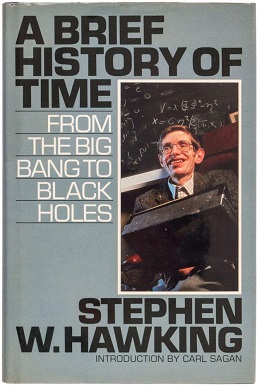
If I might make a suggestion: http://upload.wikimedia.org/wikipedia/en/a/a3/BriefHistoryTime.jpg My guess he can't explain it either. The big bang either occurred as a point event, or it had to have occurred everyone at once. Everywhere would make more sense. Also, what is space expanding into? Evil space? 
|
|
Quoted: Quoted: Sorry, never heard that one before. Sounds like a fudge factor to me.The fabric of space over great distances can expand at speeds that locally would exceed the speed of light. It's been 20+ years since my last physics class, but relativity doesn't even exceed c if I remember correctly. Think of the universe (one dimensionally) as a long bungee cord with galaxies attached along it at various points. When that bungee cord starts to expand points close to one another don't move very much or very quickly. The two "ends" however move much more and much more quickly apart. The ability of space to expand and contract like this at speeds that would locally exceed c is one of the leading points of speculation into future faster than light propulsion theories. Whether or not it would be possible to manipulate space in this manner some time in the distant future is anyone's guess. |
|
Quoted:
Light can only go as fast as c. Yup, and nothing can go faster. Of course, when you can't manipulate speed, you simply manipulate time. http://en.wikipedia.org/wiki/Time_dilation I know....
|
|
Quoted:
Quoted:
Quoted:
Quoted:
You are looking at the results of billions of years after the big bang, billions of years later. Actually, I have read articles that claim some of the objects/energies we are looking at occurred within minutes (or seconds) of when the big bang was to have occurred. The farther out we look, the farther back in time we are looking at. I beleive you missread that or what you were reading was incorrect.. please quote your source.. A hundred million years is pretty damn close to when it ocurred. And how can this background radiation travel faster than c. Sorry, that makes no logical sense. As I said, it sounds like a physics fudge factor. http://www.sciencenews.org/view/generic/id/52404/title/New-found_galaxies_may_be_farthest_back_in_time_and_space_yet "By pushing the refurbished Hubble Space Telescope to its very limits as a cosmic time machine, astronomers have identified three galaxies that may hail from an era only a few hundred million years after the Big Bang" its not a hundred million years.. its a speculation of 400 million years.. 400 MILLION isnt a small number or pretty damn close .. If you read the article they are only guessing it to be 400 million years after the big bang but they have not yet confirmed. I still suspect your source to be fradulent or you missread it. Mind telling us who told you this? |
|
Quoted: Quoted: There is no central point in the universe. There is no place we can look back directly into the sky and say "that's where the big bang happened." The universe isn't expanding like an grenade explosion where just the debris is flying outward. Space ITSELF is expanding, even the space between you and the computer monitor is expanding. Your question is tricky to answer though, not that I don't know how to explain it. It is just difficult for me to put it into words. I don't think anyone can. It would require matter to travel faster than light. Well, at one point the universe did expand faster than light. It was dubbed the super force IIRC. Just a term to describe what happened. What it says is there are 4 different forces that rule the universe, which is gravity, nuclear, I forgot the other two. What happened was when the universe was first born, these were NOT divided and were a "super force" and thus meaning that Einstein's theory of relativity didn't work. Meaning things could actually move FASTER than light. It's called inflation if you want to look it up. |
|
Quoted:
the big bang is a theory that isn't likely to be accurate. basically, some scientists decided that because the galaxies are all red.. that they must all be moving away from us... then if everything is moving outward, if you rewind that motion they must have all been together at some point in the past... so to explain how that is possible they decided that it was a magical time where space and time didn't exist yet. makes no sense. isn't grounded in reality. the farthest we can see is nothing compared to what is out there... If I remember correctly, the theory is everything is expanding away from everything else, but not from a single point. |
|
Quoted:
Quoted:
Quoted:
Sorry, never heard that one before. Sounds like a fudge factor to me.
The fabric of space over great distances can expand at speeds that locally would exceed the speed of light. It's been 20+ years since my last physics class, but relativity doesn't even exceed c if I remember correctly. Think of the universe (one dimensionally) as a long bungee cord with galaxies attached along it at various points. When that bungee cord starts to expand points close to one another don't move very much or very quickly. The two "ends" however move much more and much more quickly apart. The ability of space to expand and contract like this at speeds that would locally exceed c is one of the leading points of speculation into future faster than light propulsion theories. Whether or not it would be possible to manipulate space in this manner some time in the distant future is anyone's guess. Define "space". A place with matter and elecromagnetic energy? What is it expanding into? |
|
Quoted:
Quoted:
If I might make a suggestion: http://upload.wikimedia.org/wikipedia/en/a/a3/BriefHistoryTime.jpg My guess he can't explain it either. The big bang either occurred as a point event, or it had to have occurred everyone at once. Everywhere would make more sense. Also, what is space expanding into? Evil space? No, he can't. Noone really knows. But he can make what we DO know fit together better. As a Book, Hawking's stuff is a good starting point. He makes stuff simple enough that you don't need a physics degree to understand it. |
|
Quoted: Quoted: Yup, and nothing can go faster.Light can only go as fast as c. Of course, when you can't manipulate speed, you simply manipulate time. http://en.wikipedia.org/wiki/Time_dilation I know.... Since photons travel (by definition) at c, they do not experience the passage of time. |
|
Quoted:
Quoted:
Quoted:
Quoted:
Quoted:
You are looking at the results of billions of years after the big bang, billions of years later. Actually, I have read articles that claim some of the objects/energies we are looking at occurred within minutes (or seconds) of when the big bang was to have occurred. The farther out we look, the farther back in time we are looking at. I beleive you missread that or what you were reading was incorrect.. please quote your source.. A hundred million years is pretty damn close to when it ocurred. And how can this background radiation travel faster than c. Sorry, that makes no logical sense. As I said, it sounds like a physics fudge factor. http://www.sciencenews.org/view/generic/id/52404/title/New-found_galaxies_may_be_farthest_back_in_time_and_space_yet "By pushing the refurbished Hubble Space Telescope to its very limits as a cosmic time machine, astronomers have identified three galaxies that may hail from an era only a few hundred million years after the Big Bang" its not a hundred million years.. its a speculation of 400 million years.. 400 MILLION isnt a small number or pretty damn close .. If you read the article they are only guessing it to be 400 million years after the big bang but they have not yet confirmed. I still suspect your source to be fradulent or you missread it. Mind telling us who told you this? I don't recall where I read it, but it was a news article. Not recently. Again, how can you explain our position versus the speed of light. |
|
Quoted:
Quoted:
the big bang is a theory that isn't likely to be accurate. basically, some scientists decided that because the galaxies are all red.. that they must all be moving away from us... then if everything is moving outward, if you rewind that motion they must have all been together at some point in the past... so to explain how that is possible they decided that it was a magical time where space and time didn't exist yet. makes no sense. isn't grounded in reality. the farthest we can see is nothing compared to what is out there... If I remember correctly, the theory is everything is expanding away from everything else, but not from a single point. Please tell me how everything can be expanding away form everything else and it not come from a singularity? just curious how you explain that. |
|
Quoted:
Quoted:
Quoted:
There is no central point in the universe. There is no place we can look back directly into the sky and say "that's where the big bang happened." The universe isn't expanding like an grenade explosion where just the debris is flying outward. Space ITSELF is expanding, even the space between you and the computer monitor is expanding. Your question is tricky to answer though, not that I don't know how to explain it. It is just difficult for me to put it into words. I don't think anyone can. It would require matter to travel faster than light. Well, at one point the universe did expand faster than light. It was dubbed the super force IIRC. Just a term to describe what happened. What it says is there are 4 different forces that rule the universe, which is gravity, nuclear, I forgot the other two. What happened was when the universe was first born, these were NOT divided and were a "super force" and thus meaning that Einstein's theory of relativity didn't work. Meaning things could actually move FASTER than light. It's called inflation if you want to look it up. Sorry, we know of nothing that can travel faster than c. It's a fudge factor cuz we don't know, correct? |
|
Quoted:
Quoted:
Quoted:
Quoted:
Quoted:
Quoted:
You are looking at the results of billions of years after the big bang, billions of years later. Actually, I have read articles that claim some of the objects/energies we are looking at occurred within minutes (or seconds) of when the big bang was to have occurred. The farther out we look, the farther back in time we are looking at. I beleive you missread that or what you were reading was incorrect.. please quote your source.. A hundred million years is pretty damn close to when it ocurred. And how can this background radiation travel faster than c. Sorry, that makes no logical sense. As I said, it sounds like a physics fudge factor. http://www.sciencenews.org/view/generic/id/52404/title/New-found_galaxies_may_be_farthest_back_in_time_and_space_yet "By pushing the refurbished Hubble Space Telescope to its very limits as a cosmic time machine, astronomers have identified three galaxies that may hail from an era only a few hundred million years after the Big Bang" its not a hundred million years.. its a speculation of 400 million years.. 400 MILLION isnt a small number or pretty damn close .. If you read the article they are only guessing it to be 400 million years after the big bang but they have not yet confirmed. I still suspect your source to be fradulent or you missread it. Mind telling us who told you this? I don't recall where I read it, but it was a news article. Not recently. Again, how can you explain our position versus the speed of light. Not all objects move that the same speed.. Give things 13 billion years to move apart and your likely to get some distance apart.. |
|
Quoted:
Quoted:
Quoted:
the big bang is a theory that isn't likely to be accurate. basically, some scientists decided that because the galaxies are all red.. that they must all be moving away from us... then if everything is moving outward, if you rewind that motion they must have all been together at some point in the past... so to explain how that is possible they decided that it was a magical time where space and time didn't exist yet. makes no sense. isn't grounded in reality. the farthest we can see is nothing compared to what is out there... If I remember correctly, the theory is everything is expanding away from everything else, but not from a single point. Please tell me how everything can be expanding away form everything else and it not come from a singularity? just curious how you explain that. Exactly... The single point theory breaks from my OP. If we are looking back in time, we should be able to identify the single point at some point in time. I don't think the single point theory is correct. |
|
Quoted: Define "space". A place with matter and elecromagnetic energy? What is it expanding into? There is some "research" into what exactly space itself is, and to what it is expanding into. Much of this is either way over my head or seems like complete bullshit to me at this point. Eventually someone will come out with another breakthrough in this area that makes the math more pleasant but for now I tend to thing that whatever is being looked at in this area is just not getting anywhere. Of course if anyone here knows more about this area, I would be interested in hearing it! |
|
What we've seen is I think within millions of years of the big bang and those images are not of objects but of "background radiation". What the large hadron collider is trying to do is recreate the environment fractions of a second after the big bang so we can look at it. They are fairly certain that the fabric of space can expand at speeds faster than the speed of light and that it did so within the first few seconds of the big bang. |
|
Quoted:
We also have to remember that shortly after the big bang happened, light didn't exist. Hence why we can't see anything until 400,000 years after the big bang. Or we just dont have optics that sensative.. Light has nothing to do with radiation or heat. We can see objects outside of the visual spectrum by using radio or other spectrums of light/radiation.. saying something isnt there because we cant see it would be foolish. |