


Posted: 10/16/2009 11:14:25 AM EDT
|
My son is a cub scout this year and the Pinewood Derby sneaked up on us. The race is on Sunday with a practice day tomorrow. I do not even have a kit yet.
This is my preliminary plan: 1. Shape the car as aerodynamic as I can make it 2. Fill it with leadshot until max weight is reached 3. Polish the axles with a Dremmel 4. Lube the axles with graphite Some questions I have: - Would Militec work better than graphite (dry lube only is allowed)? - How should I distribute the weight? If you have any tips, stories, pictures, or any other advice, I would appreciate them. For the record, my son will be helping me with everything. I don't care if we don't win, I just don't want it to be for lack of effort. Edited for syntax. |
|
Arodynamics don't mean squat in pinewood. It's all about wheel alignment and smooth/graphited axels. In an ideal situation the weight will be slightly aft (to help with the transition from down to the flat). Wheels: 3 should be touching (on the edge - not flat) and 1 wheel should not be touching the ground at all -> all the while the car needs to track straight. This is not easy, but it will produces the fast possible car. |
|
Some say when you set the axles, try to only have 3 wheels touching instead of all 4. Less rolling resistance if only 3 are on the ground.
It will be obvious when you see all the cars which ones the dads made, and which ones the boys made. It frustrates me to see the boys become visibly upset when they lose to a "dad" car, because they know it also. |
Everything has already been covered. I used (I mean, my nephew used ) a threaded plug so that we could fine tune the weight, even if their scale was off by adding BBs. ) a threaded plug so that we could fine tune the weight, even if their scale was off by adding BBs.I'd still encourage making the car look cool. Not that it will help win but because of pride in craftmanship. |
|
Let your son design it. If he is a tiger, you do the cutting, let him file and sand. The older he is, the more he should do. This is more about teaching basic wood working then the race. :)
Now the tricks to win :) :) Get the axles as smooth as possible. Put the axle IN a drill (not the part that touhed the plastic wheel) and spin it, lightly file, then steel wool, then buff. Make sure the car goes strait! Only let three wheels touch the ground, 25% less friction. Have one of the front tires up in the air, Make sure it does strait! Put your best spinning tires in the rear. Make sure the weigh is towards the rear, so the car balances about 3/4 inch in front of the rear axle. Get the gray graphite from home depot used for keys; it works great. Put in plenty before the race, spin the tires a few times to get the extra out. Make sure they spin for very well and then check it in. But the number one rule is - Have fun spending time with and teaching your son! |
|
Last time I did this I was 8, so don't think I'm an expert, but IMO:
2. Fill it with leadshot until max weight is reached
Won't make it go faster, but the car will have more inertia, so it won't be slowed down as much by rough spots/gaps/bumps in the track. 3. Polish the axles with a Dremmel
4. Lube the axles with graphite Sounds good. - How should I distribute the weight?
I'd say equally. The biggest factor in your speed that you can adjust for will be friction between the axle and wheel, which will increase the more weight bears on them. Which argues against loading the car down with weight, but I don't know at what point the friction disadvantage exceeds the inertial advantage, no doubt this depends on the track you use. ETA: didn't think about the track transition, hmmm.... |
|
Quoted:
Arodynamics don't mean squat in pinewood. It's all about wheel alignment and smooth/graphited axels. In an ideal situation the weight will be slightly aft (to help with the transition from down to the flat). Wheels: 3 should be touching (on the edge - not flat) and 1 wheel should not be touching the ground at all -> all the while the car needs to track straight. This is not easy, but it will produces the fast possible car. And lighten the wheels. Less mass spinning the faster they will spin up. I got a buddy who makes kits on his lathe and sells them to dads. I think its kind of cheating but they are with in regs to use the kits he sells since the kits are bought from BSOA. He lightens the wheels and also lightens and polishes the axles. |
|
Quoted: Let your son design it. If he is a tiger, you do the cutting, let him file and sand. The older he is, the more he should do. This is more about teaching basic wood working then the race. :) ..But the number one rule is - Have fun spending time with and teaching your son! Words of wisdom. My kid's cars got more 'sophisticated' as they got older because they could use more tools. To smooth the axels we'd put them in the drill press and I showed my son how to hold emmory cloth to the metal and let him do the work. The kid gets far more out of it when he does the work. |
|
We had some kid who didn't do anything but work obsessively on his wheels and axle alignment. He didn't try and shape or paint the car at all and it was the plain wood block with some washers glued on top for weight. He took 2nd place with his well-aligned and lubed brick.
The place where the cars slow down is either due to the wheels rubbing on crooked or rough axles or on the car body itself or the car being out of alignment and trying to turn causing the wheels to rub against the raised part of the track. Get a nice flat straight area and roll the car. Should roll straight and not turn to either side. Some places will let you use a drill press to drill your own axle holes instead of those grooves they put in the bottom of the block which may help (check your local rules first). Good luck. |
| polish the nail/axel so that there is no burr under the head of the nail, take some small weights that can be added at checkin so the car is right at the intended weight using the race scale, weight goes toward the back, undercut the front of the car so that when the gate drops it starts to roll sooner. |
|
Quoted:
Last time I did this I was 8, so don't think I'm an expert, but IMO: <snip> - How should I distribute the weight?
I'd say equally. The biggest factor in your speed that you can adjust for will be friction between the axle and wheel, which will increase the more weight bears on them. Which argues against loading the car down with weight, but I don't know at what point the friction disadvantage exceeds the inertial advantage, no doubt this depends on the track you use. ETA: didn't think about the track transition, hmmm.... Negative. You want the center of gravity (CG) as far back as possible. Since only gravity accelerates the derby car, you want to have the gravity acting over the greatest distance. The farther back the CG, the greater the vertical distance the CG travels, hence more acceleration and velocity (all else being equal). |
|
Router out some of the bottom of the car, attach birdshot using hot glue. Any debate over weight and you can use your pocket knife to bring it down.
Dad had his old cub pack's two-lane track, he would teach my brother and I all sorts of engineering and design stuff using it to test prototypes and different ideas back in the late 80s/early 90s. I can only imagine the extent the sure-to-exist pinewood derby forums go into, almost like 9mm vs 45 here I'm sure. Kharn |
| All I know is that for two years, I shaped my boys' cars like NASCARs, painted them in gloss colors, and then put lead weight right in the middle of the car. (I did have the boys help out here and there with sanding, etc.) They smoked everyone both years. It felt good because when I was a cub scout my dad let me do my car all by myself (it was pretty much square like the block of wood it started-out as and painted flat) and I stunk it up bad. I've got one more who may be in cub scouts and since I'll only have to do one... I'm going to REALLY make it smoke! |

Fine art:


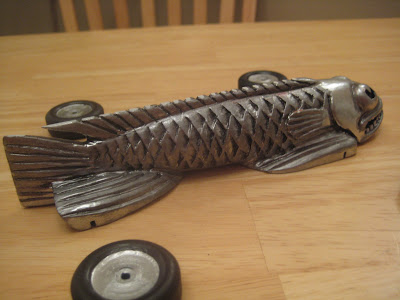
ARFCOMish: 
(With instructions!) Makes me want to build one, and I don't even have kids, let alone one in the scouts. |
I've helped my boys build several. Discuss the design decisions with your son and make sure he understands why you are doing what you do (polishing axles, lubing etc.). Let him design and make the car, and most of all HAVE FUN  . Here is my youngest son's car from February this year - it got a huge cheer and actually did pretty well (in the top 30% of finishers): . Here is my youngest son's car from February this year - it got a huge cheer and actually did pretty well (in the top 30% of finishers):

|