Warning


Close
Confirm Action

Are you sure you wish to do this?

Cancel Confirm
AR15.COM
9/27/2008 8:49:44 AM EDT
Bear with me, i'm a gunsmithing NOOB, and needed to pick up a touch of loctite....is there a specific kind that you would use for a handgun or would any kind work?

Thanks!
9/27/2008 8:50:59 AM EDT
[#1]
This thread is gonna get locktite
9/27/2008 8:53:28 AM EDT
[#2]
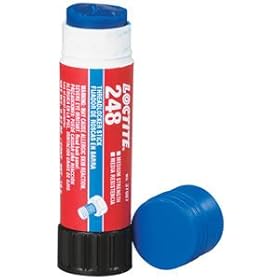
Use the blue Loctite if you ever want to remove the screw again without a lot of hassle.
Use the red Loctite if you want a very very secure hard to remove lock.

en.wikipedia.org/wiki/Loctite
9/27/2008 8:58:27 AM EDT
[#3]

Quoted:
Use the blue Loctite if you ever want to remove the screw again without a lot of hassle.
Use the red Loctite if you want a very very secure hard to remove lock.

en.wikipedia.org/wiki/Loctite


Thanks, i'm running out the door right now and wasn't quite sure.  I figured GD would respond a helluva lot faster than the handgun forum.
9/27/2008 8:59:49 AM EDT
[#4]
yep...echo what was said above. Red is supposed to require the addition of heat (in the form of a torch) to be removed.
9/27/2008 9:05:31 AM EDT
[#5]
I've always been able to get red out with ease, I think they over market that stuff.

But play it safe with blue.
9/27/2008 9:10:54 AM EDT
[#6]
Locticte depends on surface area to really work to the advertised strength. I would still
go with blue or red on gun parts. Green is even harder to remove if there is enough surface area to let it really grab. SS
9/27/2008 10:40:44 AM EDT
[#7]
Blue Locktite (242) is "service removable".  This is what you want for most of your gunsmithing work.  There is a little blue band on the label of the red bottle.


Red Locktite (262 or 271) is designed for the permanent locking and sealing of threaded fasteners.  Use with caution, make sure this is what you want when you use it.  There is a red band on the label of the red bottle and the label says "Red".


Green Locktite (290) is "wicking", that is, it wicks into threads of screws and nuts already made up.  It is stronger than Blue, but not as strong as Red.  There is a green band on the label of the red bottle.
9/27/2008 10:44:47 AM EDT
[#8]
do not apply it to 'sensitive areas'
9/27/2008 10:47:12 AM EDT
[#9]
Loctite lipstick.  

9/27/2008 10:48:52 AM EDT
[#10]

Quoted:
I've always been able to get red out with ease, I think they over market that stuff.

But play it safe with blue.


You must not be using the proper kind. I was a mechanic for a long time and our 5 year build all got red loctite and we still had to torch them after 5 years of use.
9/27/2008 11:55:47 AM EDT
[#11]
Isn't there a purple Loctite for tiny screws?
9/27/2008 12:02:24 PM EDT
[#12]
I put red on the gas key screws on one of my bolt carriers a few years ago and the screws havent budged after many thousands of rounds. Good stuff.
9/27/2008 12:05:59 PM EDT
[#13]
Be sure to thoroughly degrease and clean the threads.

The red 'permanent' grades can be softened with a soldering iron for smaller fasteners.

Just put the tip on the screw head and you will see some smoke and bubbling when the Loctite softens.

9/27/2008 2:49:30 PM EDT
[#14]

Quoted:
Isn't there a purple Loctite for tiny screws?


Yes.  "Service Removable".  Very similar in use to Blue.
9/27/2008 2:51:36 PM EDT
[#15]

Quoted:
Use the blue Loctite if you ever want to remove the screw again without a lot of hassle.
Use the red Loctite if you want a very very secure hard to remove lock.

en.wikipedia.org/wiki/Loctite


Yes, blue is if you want to waffle about how locked up the threads are.

Red is for knowing what you want to do.