


Posted: 2/4/2008 8:18:19 PM EDT
|
So, I hate to bring this up but............ I'm in a "spirited debate" with someone about the airplane/treadmill thing. They say that mathematically, the conveyor speed, wheel speed and airplane speed don't work in a vector  and challenged me to prove them wrong. Can anyone help me out? and challenged me to prove them wrong. Can anyone help me out?
|
|
Vector model as in free body diagram? Assuming that the conveyer belt is frictionless and the aircraft wheels ride on frictionless bearings, the only force acting on the airplane would be the force of the prop vs the force of aerodynamic drag. If friction is allowed, and assuming all of newtons laws applied, the only "extra" force required to get airborne would be the additional friction caused by the wheels spinning at the higher rate induced by the conveyer belt. |


Thank you. I was looking at what he said and i started to draw it out on the paper and i came up with it if it was in a frictionless enviroment (i think) |
|
This is what he posted. "I mean...you are soooo beyond wrong. Here, I'll try again, using several numbers...I picked 10mph in the last example because I figured it'd be easier to follow...little did I know I'll try a number of scenario's: 1.Plane is traveling 25 mph. The wheel is traveling 25mph rolling in the SAME direction. Therefore the conveyor Cannot be MOVING. 2. Okay, plane is traveling 50mph. The tires are moving 100mph. Then the conveyor is moving 50 mph in the opposite direction. 3. The plane is moving 40 mph west. The conveyor is moving 80mph east. The wheels have to be turning 120mph west. 4. The plane is moving 1,204mph in the west direction. The wheel is turning 1,893 mph in the same direction. Then the conveyor HAS to be turning 689mph in the opposite direction. 5. Plane is traveling 65 mph. The wheels are traveling only 30 mph in the same direction. Therefore the conveyor must be traveling 35mph IN THE SAME DIRECTION. 6. The plane is traveling 100mph. The wheels are traveling 200mph in the opposite direction. The conveyor MUST be moving 300mph in the same direction of the plane! 7. If the plane is traveling 0mph. And the wheels are traveling 35mph west. Then the conveyor MUST be traveling 35mph east. 8. If plane is moving 43mph in the west direction, and the conveyor is moving 43 mph in the west direction, the the wheels are moving 0 mph. It's a vector. Everything must add up (unless the tire is slipping on the conveyor). Basically, the speed of the wheels must equal the difference of speed of plane and speed of conveyor. What YOU describe in the quote above is a mathmatical impossibility. If plane moves X, and conveyor moves 2X in the opposite direction, then the wheels has to move 3X. If plane moves X and wheels are moving 2X then the convyor HAS to be moving only 1X in the opposite direction. Therefore, if the wheel is spinning 2X and the conveyor is traveling 2X in the opposite direction, then the plane is moving 0X...IE it is NOT moving AND not flying per the question asked." |

|
Trying to justify their incorrect belief using a disclipline of math they know even less about is one clusterfuck of futility. What vector (force) prevails? Wheel drag? At what speed? Can they state the partial differential equations describing the hysteresis of the tire rubber, the viscoelasticity of the wheel bearing grease and the inertial resistance? I think not. For one, the hysteresis of the tire's rubber are far from linear because as speed increases, centripital accleration adds to the ridigity of the tire carcass. At infinite speed, only the squirm portion of the rubber outside the cord threads is of significance. Even I cannot begin to compose the equations necessary. But suffice to say, this component of drag is NOTHING compared to the drag on the conveyor! He is trying to baffle you with bullshit. He has not the brilliance to do anything more than dump a load of bovine excrement. |
|
I'll undoubtedly regret this - This is the problem statement from the first thread posted here; there are no substantial differences in this one and the variations posted here - "Imagine a plane is sitting on a massive conveyor belt, as wide and as long as a runway. The conveyer belt is designed to exactly match the speed of the wheels, moving in the opposite direction. Can the plane take off?" The solution is fundamental: the total unbalanced force on the airplane, F=ma => the airplane's acceleration, a = F/m, the airplane's speed, V=at, and the distance traveled, S=Vt, where t is the time. An airplane's engine pushes the airplane along, whether it's on a runway or airborne. The treadmill does not push or hold back the airplane, it only causes the wheels to spin at a different rpm than they would on a runway. Furthermore, the speed and direction of the belt are irrelevent, the speed can be any value and the belt can move in either direction without preventing the airplane from taking off. If the conveyor/runway is sufficiently long that the airplane can accelerate to takeoff speed, it will fly. This sketch depicts the forces on an airplane, and are applicable whether it's on the ground, on a conveyor belt, or airborne (some of the forces shown are zero when airborne). 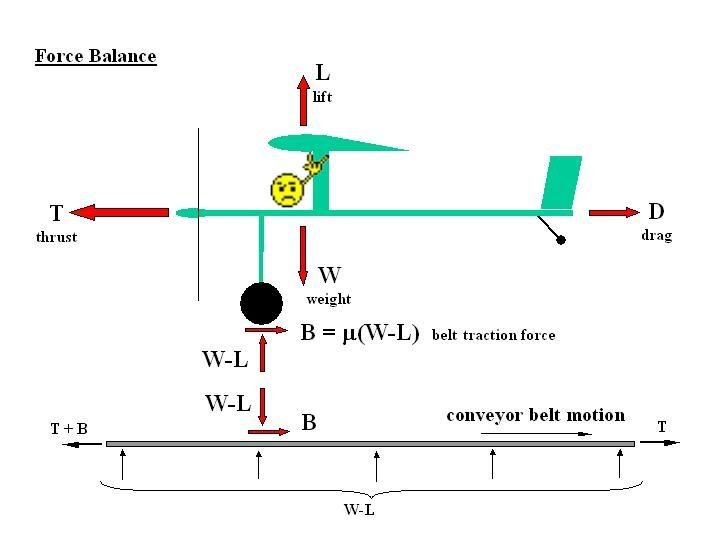 This explanation came about in the first thread about this problem when it cropped up just after Christmas last year - "Imagine a plane is sitting on a massive conveyor belt, as wide and as long as a runway. The conveyer belt is designed to exactly match the speed of the wheels, moving in the opposite direction. Can the plane take off?" The problem has two possibilities for speed of the airplane (VA) and the belt (VB) . In each case, the speed of the belt matches the speed of the wheels, either VA = VB = 0, or VA = VB > 0. A conventional airplane requires VA > 0 to fly, hence VA = 0 is eliminated as a possibility. ---------------------- This edit was required in the first thread due to all the esteemed members that wanted to argue about wheel speeds. Edit: There is a second reason VA>0 is required; look at page 4. If you decide the tangential speed of the wheel where it contacts the belt is the speed of the wheel that must "match the speed of the wheel, moving in the opposite direction" to satisfy the problem statement, then VA=0, but in that case, the tangential speed of the wheel is in the same direction as the belt, hence VA>0 is required. If you want to argue that the tangential speed 180 degrees away from the contact point with VA=0 is the "speed of the wheel", you are a moron, and need to consider the remainder of the physical system - if the airplane is permitted to have an engine, and the engine produces thrust that equals or exceeds B+D, then VA>0. D is always less than or equal to T, even when unreasonable conditions for takeoff, such as a drag chute, are imposed. That leaves B. B is a function of (W-L), the coefficient of rolling friction, and the coefficient of friction in the wheel bearings. If the coefficient of friction at the wheel bearings is 1, then the axle plus wheel assembly ceases to meet the definition of a wheel since it's no longer permitted to roll, and therefore every point on the wheel has speed in the same direction as the belt. If the coefficient of rolling friction is 1, and VA=0, the same situation exists, the wheel can't roll and its speed is in the same direction as the belt. Both of these conditions violate the problem statement. Skidding of the belt under the wheel also violates the problem statement because the speeds are different. That leaves the case for coefficient of rolling friction < 1. If T=0, then VA=0, and the problem statement is violated by the belt and every point on the wheel moving in the same direction. Some that want to argue that the acceleration of the belt at startup can overcome the friction force and angular moment of inertia of the wheel and cause the wheel to spin without moving the airplane, analogous to the "tablecloth under dishes" trick, and there is no argument that this might happen, but, T>0 is the only option left, hence VA>0 due to the acceleration of the airplane; this is not the same condition as the tablecloth trick. What that leaves is either translation down the belt with insufficient acceleration to reach takeoff speed before the end of the conveyor belt/runway, or acceleration to takeoff and flying speed before the end of the belt. The airplane will become airborne. [Indulge me by agreeing that a powerplant sized to produce sufficient thrust for takeoff and flying is implicit in the definition of an airplane. If not, the machine is a piss poor ground vehicle and someone should break the "designer's" t-square or shoot his 'puter.] -------------------------------- For a rigid body, the translational velocity is identical at every point on the body. This means the translational speed of the wheels is identical to the translational speed of the airplane VA . [From now on, I will use “speed” unless more detail is required.] As can be seen on the preceding chart, the velocity of the belt has no effect on the velocity of the wheel except to add a component of angular velocity. The angular velocity causes the wheel to spin, but not translate; every tangential velocity at the surface of the wheel has an equal and opposite twin separated by 180 degrees, therefore there is zero net translational speed added by the belt. Note that there are two engineering proofs here that the “speed of the wheels” is equal to the speed of the airplane; one here and the other on page 4. And now, that is out of the way. Consider the freebody diagrams on the first three pages; these show the external static force balances on the overall airplane and the belt on the first page, the force balance on the wheel alone on the second page, and then the external forces on the airplane again with the internal forces at the wheel-axle interface detailed on the third page. The sum of the forces on the airplane parallel to the belt determine whether the airplane can accelerate and fly. There are three possibilities – Thrust, T, is zero. This case has already been eliminated since VA > 0 is required for the airplane to fly, which in turn requires T>0. Infinite friction in the axle that permits the belt to fling the airplane into the air is eliminated in this case because it violates the requirement that the belt and the wheels move in the opposite direction. In that case, they move in the same direction. The second case is where VA > 0 and T-D-B = F= 0. In this case, if the net force is zero, F=ma implies the airplane is moving at constant speed, will not accelerate to a speed sufficient for takeoff, and will simply run down the belt until it crashes off the end. As long as sufficient thrust is available to overcome B and D, the airplane will accelerate to takeoff and flying speed. The speed of the conveyor belt has no influence beyond the small amount of rolling friction to retard the airplane’s acceleration. The third case is VA > 0 and T-D-B = F > 0. This net force on the airplane causes its mass (m) to accelerate to some finite value. That acceleration is a = F/m. After a time, t, the airplane’s speed is VA = at and after sufficient time the airplane will accelerate to flying speed, say a(t|T/O). Simultaneously, the airplane is traveling down the belt, and after t passes, it has traveled VA(t )distance. If the runway length is greater than or equal to VA (t|T/O), the airplane will become airborne. These sketches and equations are included to help the naysayers understand how the various forces relate to one another, and the last page proves that the speed and direction of the conveyor do not matter, the conveyor can run in any direction at any speed without affecting whether the airplane will take off.    |
So how do I prove that with a vector? And thanks for the link, I was on page 30 (going backwards) looking for that in the big thread. I know he's wrong, but I havent done this stuff in awhile. By the way, your avitar is my screensaver (the bigger picture). I've been meaning to tell you that for about a year now. |
|
Good old vectors. Why don't you put it in matrix form and and make it succinct. The risk factor is low, only .001 percent of the folks who read it will have their heads explode. www.kwon3d.com/theory/vect/vectmat.html |
|
Your friend is missing a couple of inportant vectors. He is essentially right, in that if the wheel and conveyor are spinning at the same speed but in opposite directions, the plane is standing still. But, when you add the vectors of the unbalanced forces, it becomes clear that the original scenario is impossible to maintain. The thrust of the engines easily overcomes any of the retarding forces cause by friction, mass moments of inertia of the wheels, etc. So again, your friend is omitting important vectors by over simplifiying the problem. It would be enough for you to add the vector of thrust (huge), and the vector of friction, etc. (small). In the real world these forces (vectors) exist. |
|
He is explaining himself poorly and is being an arrogant twit, but despite that his point is still quite clear. As we can easily tell from the context and his use of "turning" and "rolling" he is referring to the tangential velocity of the wheel. As long as the wheel is not slipping against the conveyor, wr = Va + Vb. This guy believes that the problem requires wr = Vb. The only Va that satisfies both equations is Va = 0. Therefore "Will it take off?" only applies to scenarios where the plane is not moving relative to the ground/air. |
Find someone else to troll. |
DOOO DOOOO DOOOOOOOOOOOOOOOOOOOOOOOOOOOOO!  As a guy with a master's degree in engineering, I can tell you with complete certainty that: The above is 100% exactly correct. All you guys have to do from now on when this stupid topic pops up is cut and paste the above. Problem solved. BTW, About ten years ago I wrote a little 20 line BASIC program that exactly reproduces the ballistic table in the back of the speer manual, bullet time of flight and everything. I used euler's method to solve the 2nd order diff eq. and reverse calculated the drag function. (I sent it to a bunch of gun magazines but nobody wanted it.) The airplane conveyor belt problem is SIMPLE. Trust me. |
This is stupid - This wheel diagram is a waste of time. The only way the wheel can slow the plane down is two ways: 1. Friction in the bearings, etc. 2. Accellerating the wheel spin rate. But it doesn't matter. When a plane takes off, the wheels spin anyway. Obviously, the wheel drag is not that great. The conveyor belt would just spin the wheels a little faster. The drag from friction might go up a little, but not enough to counteract the thrust from the engine. This is a bone simple problem, people. BONE SIMPLE. The reason you think it's some kind of galactic brain teaser is because MOST OF YOU DON'T I don't know how to repair the transmission on my car. But it's a simple job for a guy who is a transmission tech. I'm not about to get into a 25 page debate with a postman and housewife about transmissions. BECAUSE NONE OF US WOULD KNOW WHAT THEY'RE TALKING ABOUT SO WHY BOTHER? |
Does not!!! It's the only way geeks can get Pi!!!! 
|
As long as the brakes are NOT on!!! 
|
A vector is just a quantity that has a direction. Temperature has no direction. Velocity has a a direction. Force has a direction. You just add the vectors together. Net force = 20,000 lbs of engine thrust forward - 1,000 lbs of wheel drag backwards = 19,000 lbs forward If there was a giant chain holding the plane from moving, then Net force = 20,000 lbs of engine thrust forward - 20,000 lbs of chain pulling backwards = 0 lbs , therefore no accelleration it's that simple When something is standing still or moving at a constant velocity, the forces on the object are balanced out and the net force is zero. When the net force does not equal zero, the object changes speed (accellerates). If your car is rolling along at a constant velocity, that means the force of the wind on your car is equal to the force or the drive wheels pushing the car along. When you step on the gas, the force becomes unbalanced and the car accellerates. hope this helps |
The simplest formula would be: T>>f which implies forward motion where T is thrust and f is the frictional forces at the wheel. For something to be in static equilibrium, which is what your friend supposes, then the force vectors must equal zero. I.e. the sum of all forces must be equal to zero or Sigma (that funny looking E thingy) F = 0. Since Sigma F does not equal zero, then Sigma F = M*A where M is mass and A is acceleration. |
Could you explain exactly which of the following statements you have a problem with? - The unnamed poster is being an arrogant twit. - The unnamed poster is explaining himself poorly. - The unnamed poster is referring to the correlation between wr, Va, and Vb. - Correlation is not causation. - wr = Va + Vb, if there is no slippage between the wheel and conveyor. - If X = Y + Z and X = Y then Z = 0. - The unnamed poster believes the problem requires wr = Vb. - IF the question requires wr = Vb then the problem requires Va = 0. - IF the problem requires Va = 0 then "Will it take off?" only applies to scenarios where the plane is not moving. - The problem and solution must be logically consistent. |
I can certainly understand not wanting to get involved in anymore threads on the subject, but you really should leave the information you already provided since it was so very well done... |
The belt drags the tire along; that's the frictional force applied to the tire. It's not an internal force, it's an external force applied to the tire, in the same direction as the belt motion. |
|
Won't the force on the conveyor belt be in the opposite direction then? Assuming that what you have labeled as "B" on both the belt and tire. I'm just trying to understand what is going on at that interface I guess, it seems like one should be pointed to the left and one to the right. I agree with the direction on the tire, driving the tire off the belt, but it seems like the force on the belt should be in the opposite direction unless I'm not following your method completely. Thanks. |
Put your hand on a piece of paper on a desk top, then push; which direction is the force applied to the paper? This is not the same problem as drawing a free body of the internal forces in a beam. In that case, you are correct, the internal forces at an interface are drawn in opposite directions. This is not the same problem. |
|
Correct, but doesn't Newton's Third law still apply at that point? An interaction between two bodies, there will be a action reaction pair. I know the plane will fly regardless but I just want to understand this interaction at that point. It just seems like based on everything I've been taught that that force on the conveyor belt should be opposite direction just like where you pulled the wheel and axle/plane apart, the B forces are in the opposite direction. In this case we are pulling the belt and the wheel apart and drawing seperate free body diagrams. I guess I'm just not sure I follow it yet. Thanks. |
The frictional reaction you're looking for with the paper example is between the paper and the table top - that resisting load is opposite the applied load. The load between your hand and the paper, or the belt and the tire is a traction load. In that case, the reaction occurs at the axle. That's shown in the FBD of the tire in either the second or third chart. There are two reactions at the axle - the balancing force, and the balancing moment. Get a toy car, hold it upside down, and run your hand along one of the wheels. At the point of contact, the tire moves in the same direction as your hand, and your other hand holds the car back against that tiny traction force. |
In the good old days, before we had treadmills this big we had aircraft carriers for the planes to sit on and the carriers made it even harder because they were going in the direction the plane wanted to go. So if the carrier was going 15 knots the plane had to go 15 knots just so it wouldn't be rolling backwards.
|
|