


[ARCHIVED THREAD] - Know thy enemy- Chinese weapons (Page 1 of 2)
Posted: 6/10/2007 12:43:13 PM EDT
|
Here's a list of ChiCom small arms we may be facing in the next decade or so. I invite others to provide images and detailed information on ChiCom armor, artillery, aircraft, naval vessels, etc. Assault rifles:  QBZ-95/Type 95 Caliber: 5.8x42 mm Action: Gas operated, rotating bolt Overall length: 760 mm Barrel length: 520 mm Weight: 3.4 kg unloaded Rate of fire: ~ 650 rounds per minute Magazine capacity: 30 rounds In the late 1980s Chinese designers developed a 5.8 x 42 cartridge, apparently designated DBP87, which is claimed to be superior to both the 5.56 mm NATO and the 5.54 mm Soviet. This cartridge develops a muzzle velocity of 930 metres per second from a standard barrel, with a bullet weighing 4.26 gram. As soon as the ammunition was ready, the PLA began to develop an entirely new and much more modern family of small arms based on the same action. This family, known as QBZ-95 ('Qing Buqiang Zu' = Light Rifles family, 1995), was first displayed outside the PLA in 1997, when China took over Hong Kong; it was observed that the Chinese guards were armed with a new, modern looking bullpup rifle. In fact it is one of an entirely new family of weapons, all designed around the same action and bullpup layout, which include the assault rifle, a shorter carbine, a light support weapon (with a bipod, a heavier barrel and large capacity magazine), and a sniper rifle. While being quite similar inside, these guns have different body shapes and cannot be converted from one configuration to another. The QBZ-95 line of weapons is now spreading throughout the PLA, commencing with elite units. The QBZ-95 is a gas operated, magazine fed, automatic weapon with a bullpup layout. It has a short stroke gas piston and a rotating bolt. The charging handle is located at the top of the receiver, under the carrying handle. The housing is made from polymer, with an integral carrying handle, which holds the rear sight base, and has mounting points for optical or night vision scopes. The ejection port is made only at the right side of the weapon, so it cannot be fired from the left shoulder. Standard sights are of the open type, graduated from 100 to 500 metres. The front part of the barrel in the standard version is left unobstructed, so the QBZ-95 rifle can be used to launch rifle grenades. It also can be fitted with an underbarrel grenade launcher or with a knife bayonet. A compact carbine version, sometimes referred to as the CAR-95, cannot use either a grenade launcher or a bayonet, because of the much shortened barrel. Fire controls of QBZ-95 rifle consist of a trigger and a safety/selector switch, located (quite inconveniently) at the rear left of the receiver, behind the magazine housing. QBZ-95 can fire single shots or bursts. The export version, QBZ-97, which is chambered for popular 5.56 x 45 NATO ammunition, is internally similar to QBZ-95, but has a different, much deeper magazine housing, which accepts a NATO-standard (M16-type) magazines.  QBZ-03/Type 03 Caliber: 5.8x42 mm Action: Gas operated, rotating bolt Overall length: 950 mm (725mm with butt folded) Barrel length: n/a Weight: 3.5 kg Rate of fire: ~650 rounds per minute Magazine capacity: 30 rounds Type 03 (QBZ-03) assault rifle is most recent development of Chinese state arms factories. For various but unpublished reasons the bullpup Type 95 / QBZ-95 assault rifle was apparently found not entirely satisfactory in PLA service. Therefore it was decided to develop a new 5.8mm assault rifle of conventional layout, which will provide necessary competition and backup to its older bullpup brother. In some respects this new weapon, known as QBZ-03 (Type 03 / 2003), is reminiscent to the experimental Type 87 rifle, which was developed in mid-1980s for testing of the new 5.8x42mm DAP-87 cartridge. It is not yet known if Type 03 rifle will enter widespread service with PLA troops to replace or complement Type 95 rifle. Type 03 (QBZ-03) assault rifle is gas operated, selective fired weapon, which fires 5.8mm cartridge of indigenous design. Basic action of the Type 03 rifle is based on the older 7.62x39 Type 81 assault rifle, with similar rotating bolt locking and short-stroke gas piston. The gas block, which is integral to the front sight base, contains a 2-position gas regulator. Muzzle of the barrel contains a combination flash-hider which also serves as a grenade launcher for rifle grenades. Receiver is made from stamped steel, and unlike earlier designs consists of two parts, upper and lower, which are connected by two push-pins. Upper receiver hosts the barrel and entire bolt group; lower receiver hosts the magazine port, trigger unit, pistol grip and folding shoulder stock. Small safety / fire selector switch is located on the left side of the lower receiver, above the pistol grip. Skeletonized shoulder stock is made from polymer and folds forward and to the right to save the length. Standard sights are of open type, with hooded front post and flip-up type diopter rear. Additionally, every Type 03 rifle has a proprietary scope rail on the top of the receiver, which will accept a variety of day and night scopes.  Type 81 Caliber: 7.62x39 mm M43 Action: Gas operated, rotating bolt Overall length: 955 mm (730 mm with butt folded for Type 81-1) Barrel length: 445 mm Weight: 3.5 kg Rate of fire: 650 rounds per minute Magazine capacity: 30 rounds Type 81 assault rifle appeared in the early 1980s. This is a further development of the Type 63 / Type 68 rifles, and it is easily distinguished by the separate pistol grip, handguards and buttstock instead of the SKS-style wooden stock found on earlier types. The Type 81 was more than a single assault rifle – it was a family of infantry firearms, much like the Soviet Kalashnikov AK / RPK family. Type 81 weapons were made as an assault rifle with a fixed butt, an assault rifle with a folding butt for paratroopers (Type 81-1), and a heavy barreled Type 81 Squad Automatic weapon / light machine gun, fitted with a bipod and issued with 75-round drum magazines instead of the typical 30-round boxes. Despite being externally somewhat similar to the AK-47, it is significantly different from it, with its most easily distinguishable feature being an exposed muzzle part of the barrel, with the foresight moved back. This was done to be able to fire rifle grenades from the barrel. Type 81 rifles replaced some obsolescent Type 56 assault rifles and carbines, as well as Type 63 / Type 68 rifles, in most PLA units, and saw some action in border clashes between China and Vietnam during the late 1980s. This rifle was also exported through the NORINCO state company into several neighboring countries. During the late 1980s and early 1990s the Type 81, under designation of Type 87, served as a development platform for the next generation of PLA small arms, being used as a test-bed for 5.8 x 42 ammunition. The Type 81 is a gas operated, magazine fed, automatic rifle. It uses a short-stroke gas piston, located above the barrel, and a two-position gas regulator, along with a gas cut-off valve for launching rifle grenades. The gas system, as well as the bolt group with the AK-47 type rotating bolt, is reminiscent of those of Type 63 rifles. Type 81 rifles also retain the bolt hold-open device, which catches the bolt in the open position after the last round has been fired from magazine. The fire selector – safety switch is located at the left side of the receiver, just above the pistol grip, and can be easily operated with the right hand thumb. The late production Type 81S rifles have a separate SKS-type safety switch just behind the trigger. The open sights are marked from 100 to 500 metres, with the front sight being mounted just ahead of the gas block, leaving the front portion of the barrel free for the rifle grenade launcher. Ammunition is fed from Type 56 (Kalashnikov) 30-round magazines, or from 75-round drums intended for the Type 81 light machine gun. At the first glance, the Type 81 assault rifle looks much like the Kalashnikov AKM, but, on closer inspection, there are some significant external differences, most notably in the receiver cover shape and front sight location. There is also a significant gap between the trigger guard and the magazine on Type 81 rifles, while on AK-47 type rifles the magazine is adjacent to the front of the trigger guard. On Type 81 rifles the obsolete spike-shaped non-detachable bayonet, preferred by the PLA before, is also replaced with the more "modern" detachable knife-bayonet. Most probably this was required to leave the significant portion of the muzzle area of the barrel unobstructed, which is required for launching of rifle grenades. Many second-line reserve units and militia units in the PLA are still equipped with the Type 56 (essentially an AKM) or SKS rifles, both in 7.62x39mm. Submachine guns:  Type 05 Caliber 5.8x21mm DAP92-5.8 /9x19mm DAP92-9 (9mm Luger/Para) Weight 2.2 kg empty/ 2.1 kg empty Length 500 mm /450 mm Barrel length n/a /n/a Rate of fire n/a/ n/a Magazine capacity 50 rounds/ 30 rounds Effective range 150-200 m/ 100-150 m The Type 05 submachine gun is the join development of the PLA's 208 Research Institute and Jian She Group. This design won the Compact Submachine gun trials initiated by PLA in early 1990s, and is intended to replace earlier weapons in service with PLA, such as Type 85 silenced submachine gun. Externally resembling the new Chinese assault rifle, the QBZ-95, the Type 05 is much simpler design internally. For military use it is produced in the new Chinese 5.8mm caliber, chambered for 5.8x21 DAP92-5.8 cartridge, which is loaded with pointed, armor piercing bullets; subsonic loadings also available for use with detachable silencer. For police use and commercial export sales, Jian She Group also produced a 9mm version of the Type 05, generally known as JS submachine gun. This weapon is similar in design to its military brother but uses standard Picatinny rail instead of carrying handle, and also uses commonly available 9mm magazines compatible with famous German HK MP5 submachine gun. Type 05 submachine gun is blowback operated weapon that fires from open bolt. Gun is made in bullpup configuration, with compact aluminium receiver and separate polymer shoulder stock / housing and pistol grip / trigger units. Safety / fire mode selector switch is located above the pistol grip, and allows for single shots, 3-round bursts and full automatic fire; charging handle is located at the top of the receiver, inside the carrying handle on Type 05 submachine guns, and on the right side on the JS 9mm submachine gun. Both weapons also fitted with automated grip safety. Despite the bullpup design, ejection is possible only to the right side, so firing from the left shoulder is seems to be impossible or art least dangerous for the shooter. Type 05 submachine guns are fitted with open sights and with proprietary scope mounts at the top of carrying handle; JS submachine guns have no open sights and fitted with Picatinny rail at the top of the receiver which can accept various types of sighting equipment. Either weapon can be equipped with detachable optional silencer. Military issue Type 05 submachine guns are fed from proprietary four-row box magazines that hold 50 rounds of 5.8mm ammunition; JS submachine guns use two-row 30-round box magazines compatible with HK MP5.  Type 85 Type 85 Type 85 silenced Caliber 7.62x25 Type 51 / TT 7.62x25 Type 64 Weight 1.9 kg empty 2.5 kg empty Length (stock closed/open) 444 / 628 mm 631 / 869 mm Barrel length 210 mm n/a Rate of fire 780 rounds per minute 800 rounds per minute Magazine capacity 30 rounds 30 rounds Effective range 150-200 m 100-150 m Type 85 submachine gun has been developed during early 1980s as a less expensive replacement for Type 79 submachine gun; silenced version of the same weapon was developed to replace Type 64 silenced submachine guns then in service with PLA. Both weapons were offered for export sales, as well as used by domestic police and military units. Type 85 submachine gun is a simple blowback weapon that fires from open bolt. It uses tubular receiver made from steel; long silencer tube is also made from steel. Safety / fire mode selector lever is located at the right side of the trigger unit, above the triggerguard, and allows for single shots and full automatic fire. Type 85 silenced SMG is optimized for special 7.62x25mm type 64 ammunition with heavy, subsonic bullet, but also can fire standard 7.62mm Type 51 / 7.62x25mm TT ammunition (with increased sound level). Gun is fed using same 30-round box magazines as Type 64 SMG. Shoulder stock is made from steel and folds to the right when not in use. Second-line reserve units and militias have older SMG's also chambered for 7.62x25 Tokarev. Note that 7.62 Tokarev, with the proper ammunition, will penetrate soft armor. Pistols:  QSZ-92 Type: Double Action Calibers: 5.8mm Chinese or 9x19mm Para Weight unloaded: 760 g Length: 190 mm Barrel length: not known Capacity: 15 rounds The QSZ-92 pistol is a most recent development of the Chinese state arms factories, and, apparently, it is now adopted by the PLA (Chinese people's Liberation Army) forces. QSZ-92 pistol is available in two versions, with the only difference being caliber: one is chambered for most common 9x19mm Luger / Parabellum ammunition (QSZ-92-9), and another is chambered for proprietary 5.8mm ammunition with bottle-necked case and pointed bullets (QSZ-92-5.8). The development of the QSZ-92 pistol apparently began circa 1994, and it is in limited service with PLA since the late 1990s. The QSZ-92 is a short recoil operated, locked breech pistol. It uses a rotating barrel to lock and unlock the slide on recoil. Frame of the QSZ-92 pistol is made from polymer. Trigger mechanism is Double Action, with external hammer and ambidextrous safety / decocker lever, mounted on both sides of the frame. Dual stack magazine holds 15 rounds of ammunition in either caliber. Front part of the frame under the barrel is shaped as an accessory rail to accept laser sights or flashlights. Fixed sights have luminous inserts for low light conditions.  Type 80 Type: Single Action Caliber: 7.62x25mm Weight unloaded: 1160 g Length: 300 mm Barrel length: 140 mm Capacity: 10 or 20 rounds Type 80 automatic (or machine) pistol has been developed in late 1970s as a personal defense weapon for vehicle crews and other military personnel, which is not issued with an assault rifle but may require a weapon with more firepower, than a typical pistol can provide. Type 80 pistol was apparently inspired by the classic German Mauser C96 pistol, in its late production "Schnellfeuer" (fast-firing or automatic) versions, and its design is heavily based on the old "broomhandle". However, there's plenty of differences both in internal design and in external appearance. Type 80 automatic pistol is a short recoil operated, locked breech, selective fired weapon. The bolt of rectangular cross-section is located within a barrel extension, and is locked by a large tilting locking piece, which is mounted under the bolt in the extension. The single action firing mechanism has an external hammer, the single safety switch / fire mode selector is located at the left side of the frame, above the grip. The grip panel is reshaped and apparently of better design than of old Mauser. The magazine is also different - it is detachable, and sloped forward to provide more reliable feeding. The sights are fixed, and the rear of the grip frame is slotted to accept a separate telescoped shoulder stock, made of steel, or a special holster / shoulder stock. The stock is necessary to fire the pistol in full automatic mode or in single shots at extended ranges. Use of a relatively long barrel and a detachable shoulder stock, in combination of a relatively powerful 7.62x25mm cartridge, extends the effective range of pistol (in aimed semi-automatic fire) to 100 meters and maybe even further; the full auto capability is more of an emergency value, as the light and slim barrel will heat up quickly. Note that second-line PLA units and militias have older pistols chambered for 9x19mm, 7.62x25 Tokarev, and an obsolete ChiCom 7.62 caliber that is equivelent to .32ACP. Sniper rifles:  QBU-88 Caliber: 5.8x42 Chinese, special sniper/MG loading Operation: gas operated, rotating bolt Barrel: 620 mm Weight: 4.1 kg Length: 920 mm Feed Mechanism: 10 rounds detachable box magazine Effective range: up to 800 meters The QBU-88 rifle (also sometimes referred to as Type 88 rifle) was the first weapon of the newest generation of Chinese small arms, chambered for proprietary 5.8x42mm ammunition. Adopted in the late 1980s, the QBU-88 is, by the modern sense, not a true sniper rifle - it is more of designated marksman rifle, intended for aimed semiautomatic fire at ranges beyond the capabilities of standard infantry assault rifles. The rifle is intended for rough military use, so it is fitted with adjustable iron sights by default, and could be equipped with 4X magnification telescope sight or with night sight. QBU-88 rifle is optimized for a special heavy loading of 5.8x42 cartridge, with longer streamlined bullet with steel core, but, apparently, can also fire standard 5.8mm ammunition, intended for the QBZ-95 assault rifles. At the present time the QBU-88 rifle is in service with PLA and Chinese police forces. The QBU-88 rifle is a gas operated, semiautomatic rifle. It utilizes a short stroke gas piston, located above the barrel, and three-lug rotating bolt. Action is mounted in the compact steel receiver, and enclosed into the polymer bullpup-type housing. The safety switch is located at the bottom of the receiver, just behind the magazine opening. QBU-88 rifle is equipped with open, diopter type adjustable sights, mounted on folding posts; it also has a short rail which can accept telescope or night sight mounts. Long barrel is apparently not free-floated, and is fitted with flash hider. Quick-detachable bipod is clamped to the barrel when required. Machine guns:  Type 95 light machine gun Caliber: 5.8x42mm (5.56x45 NATO in Type 97) Weight: 3,9 kg less magazine Length: 840 mm Length of barrel: 600 mm Feeding: 30 round box or 80 round drum magazines Rate of fire: 650 rounds/min Type 95 light machine gun (Chinese designation QBB-97) is a companion weapon for relatively new QBZ-95 assault rifle, which is now in service with People's Liberation Army of China. QBB-97 shares about 70% of components with the assault rifle, and differs mostly in that it has a longer and heavier barrel, fitted with folding bipod. It is intended to serve as a squad automatic weapon, providing effective automatic fire at ranges up to 600 meters. An export version of the QBB-95 is offered through NORINCO corporation as Type 97 LMG. It is basically same weapon but adapted to fire 5.56x45mm NATO cartridge from M16-compatible magazines. Type 95 is gas operated, selective fired, air cooled light machine gun. It uses a short stroke gas piston, located above the barrel. Rotary bolt has three lugs that lock into the barrel extension. Receiver is made from polymer and is of bull-pup layout. Charging handle is located at the top of the receiver, under the carrying handle. Safety / fire mode selector switch is located at the left side of the buttstock, close to the rear end of the weapon. Ejection is to the right side only. Standard magazine is a proprietary 80-round drum with asymmetrically located mouth. QBB-95 also can accept standard 30 round box magazines from QBZ-95 assault rifle.  Type 88 general-purpose machine gun Caliber: 5.8x42mm Weight: 11,8 kg with bipod + 4.2 kg infantry tripod Length: 1151 mm Length of barrel: 600 mm Feeding: belt, 200 rounds Rate of fire: rounds/min The Type 88 general purpose machine gun (Chinese designation QJY 88) is intended to replace obsolete Type 67 machine guns in service with PLA. New weapon uses recently adopted 5.8mm ammunition of Chinese origin, although it is believed that a special loading with heavier bullet is used for this weapon, as opposed to QBZ-95 assault rifle and QBB-95 light machine gun. Despite the "type 88" designation the gun is relatively young, as it is believed to enter the service during first years of 21st century. It must be noted that according to available information Type 88 machine gun is not so popular among its users in PLA. While it is somewhat lighter than previous Type 67 GPMG, it also lacks its range and lethality; compared to western 5.56mm LMGs such as FN Minimi, Type 88 is significantly heavier, while having almost same combat effectiveness. QJY 88 is gas operated, air cooled, belt fed machine gun with quick-detachable barrel. Design is rather conventional, with long-stroke gas piston, located below the barrel, which operates bolt group with rotary locking. Feed is from disintegrating steel belts, from left side only. Special plastic container can be attached to the left side of receiver to hold the belt on the move. Gun is fitted with skeletonized shoulder stock, made of polymer, and integral folding bipod, attached to the gas block. For sustained fire missions QJY 88 machine gun can be installed on a special lightweight tripod. Strandard sights are of open type, but a telescope or IR sight can be attached to the weapon if required.  Type 67 general-purpose machine gun Caliber: 7.62x54mmR Weight: 11 kg (gun) + 13 kg (tripod, Type 67) or 5 kg (tripod, Type 67-2) Length: 1345 mm Length of barrel: 605 mm Feeding: belt, 100 or 250 rounds Rate of fire: 650-700 rounds/min Type 67 was the first Chinese general purpose machine gun, developed to replace earlier Type 53 and Type 57 7,62mm medium machine guns (license-built copies of Soviet SG-43 and SGM respectively). This weapon combined features borrowed from many other machine guns, and went through a number of variations, still serving with PLA (Chinese People's Liberation Army). Development of a new medium machine gun commenced in 1959, with first prototypes tested in 1963. At that time the concept of a new weapon was broaden from medium to universal machine gun. Adopted in 1967, it was improved with the introduction of the Type 67-1 in 1978. In 1982 PLA has adopted the Type 67-2 GPMG, which was somewhat lighter and used a lighter tripod. Type 67-2 is so far a standard general purpose machine gun of PLA. It saw limited use during closing days of Vietnam war, and few guns of this type also found its way (through the Pakistan) into the hands of Afghanistan mujaheds that fought Soviet army during early 1980s. Type 67 machine gun is gas operated, air cooled, belt fed machine gun that fires from open bolt. Barrel is quick-detachable. It uses ZB-26 type vertically tilting bolt to lock the barrel. Feed is from right side only, using steel, non-disintegrating belts with open pockets (type 67-2 belts are assembled from 25-round pieces using cartridge as an inter-link). To avoid two-stage feed with rimmed ammunition, Type 67 uses push-out type feed, where cartridges are pushed down and out of the link by the cams in the feed module, then fed forward and into the chamber by the closing bolt. Standard belt capacity is 250 rounds, but for LMG role 100-round belts can be loaded into drum-type container which can be clipped to the receiver. Belt is said to be incompatible with any other weapon. Early Type 67 machine guns had fluted barrels; Type 67-1 and 67-2 have smooth barrels, probably as a cost-saving measure, type 67-2 barrels also are somewhat lighter than earlier ones. Furniture (pistol grip and shoulder stock) was made from wood on Type 67 and from polymer on later Type 67-1 and 67-2 weapons. Every Type 67 machine gun is fitted with integral, folding bipod, and also can be installed on infantry tripod. Type 67 and Type 67-1 tripods had legs made from heavy steel tubes; Type 67-2 tripod had lighter legs made from steel stampings. Grenade launchers:  QLZ-87 grenade launcher Caliber: 35x32mm SR Type: gas operated, magazine fed automatic grenade launcher Overall length: 970 mm Weight: 12 kg in light configuration (with scope and bipod, less magazine); 20kg on tripod, less magazine Effective range: up to 600 m point targets; 1700 m maximum. Rate of fire: 500 rounds per minute After much experimentation with locally built copies of Soviet AGS-17 grenade launcher, Chinese experts developed their own concept of such infantry support weapon. For some reasons they decided to trade some firepower for mobility, and to develop the lightest possible weapon, which can be operated and carried on battlefield by a single man. Furthermore, they developed their own 35mm grenade ammunition. To achieve minimum weight of weapon, they used locked breech action (that minimizes weight of recoiling parts) and discarded the complicated belt feed in the favor of much simpler magazine feed. early experiments were conducted with weapons known as W-87. these were distinguishable by wood buttstocks, bottom pistol grips and large conical flash hiders. W-87 launchers used top feed with box or drum magazines. With the time the design evolved, and several years ago PLA adopted the QLZ-87 automatic grenade launcher, that is a further development of W-87. At the present time (early 1987) the QLZ-87 launcher is being used by Chinese troops of Hong Kong garrison, as well as by some units located near the strait that separates mainland China and Taiwan. From available information it seems that QLZ-87 still has some teething problems and probably will be gradually improved in coming years. The QLZ-87 grenade launcher is gas operated, locked breech weapon that uses rotary bolt and direct gas impingement system probably borrowed from M16 rifle. Gas system is fitted with manual adjustment valve. Charging of the weapon is conducted by pulling back and forward the pistol grip which is (unusually) located at the right side of weapon. This pistol grip is accompanied with trigger and safety/fire selector that allows for single shots and full auto fire. The steel receiver is of tubular shape and rather slim; at the top of the receiver there is a fixed carrying handle. Rear part of receiver is fitted with rubber shoulder pad. Feed is using drum magazines of various diameter, that can hold 6, 9, 12 or 15 rounds; standard capacities seem to be 6 or 15 rounds. Drums are attached at the bottom of the gun, unlike earlier W87 weapons. The smaller capacity drums are used in "light" configuration when gun is used from integral bipod; larger capacity drums are mostly used in heavy configuration, when gun is used from special tripod. Standard sighting equipment is telescope sight with fixed magnification which is offset to the left to provide low profile of weapon while firing at high angles. It must be noted that rate of fire of QLZ-87 is rather high for such a weapon, especially consider its relatively low weight, and it must be a tough task to control the gun in full auto fire, especially in "light' configuration. Relatively small magazine capacity (even the biggest 15-round magazine holds two times less ammunition than a belt box for AGS-17 or Mk.19 launchers) also decreases the suppressive fire capabilities of the QLZ-87, but it seems that PLA experts prefer maneuverability over firepower. There are few types of 35mm ammunition for QLZ-87 weapon; these include fragmentation shells that provide kill zone with claimed radius of about 10 meters, and armor piercing grenades with penetration up to 80 mm (not confirmed). The weight of complete 35mm round is about 250 gram, muzzle velocity about 190 m/s. ChiComs also have rifle grenade launchers, launchers similar to our M203's and Russian GP-25's, and possibly multiple grenade launchers like an Armscor MGL. I was unable to find information on any RPG's they have, but they have (or had) Stinger surface-to-air launchers. All images and information from world.guns.ru. Feel free to add your own info and images of ChiCom weaponry and gear. |


A little over a year ago, somebody posted three articles where a rancher and a game warden found piles of spent 5.8 casings in the middle of no where. I've not been able to find the articles again and any time I mention it, the BS flag gets raised. "Why would they want to get caught with ChiCom guns with proprietary ammo?" and other crap. |

Could be bad guys with chicom guns, or it could have been us playing with "borrowed" chicom weapons. |
Personal Defense Weapons (PDW): Jian Jian is a double-edged straight sword used during the last 2,500 years in China. Historical one-handed versions have blades varying from 0.45 to 0.8 meter (17.7 to 31.5 inches) in length. The weight of an average sword of 0.7 meter (28 inch) blade-length would be in a range of approximately 700 to 900 g (1.5 to 2 pounds). There are also larger two-handed versions used for training by many styles of Chinese martial arts.  |
Yes, it was Swindle1984 who posted that. Don't recall who/where he heard it from. I'd love to see the casings or an article. I doubt it, only because it makes little military sense. If you have guys here, why not equip them with US military weapons? Ammo resupply would be easy, some guys with AR15s wouldn't raise questions, etc. |
If it was the US playing with them, wouldn't they be shooting them on restricted army bases and ranges instead of in the woods? The ChiComs wouldn't sell their weapons to terrorists since there's only ONE source of the guns and ammo and that could start a tizzy. The only explanation is that either some Chinese spies were practicing with their issued weapons (and being irresponsible with brass clean up) or some rich bastard bought one for his personal amusement and in defiance with importation laws and the '86 ban. |


|
Is it just me or does their camo look like a bad rip off of German flecktarn? Oh, and from what I've read about their new bullpup it SUCKS. Sounds like they had a good concept they rushed to production, because China is all about numbers and speed and quality takes a back seat way at the rear of the bus. |

| There was an interesting article in Cartridges of the World about the 5.8 ammunition. The general gist of it was that the 5.8 cartridge is far superior to both the 5.56 and 5.45 ammunition in regards to armor piercing capability but produced pitiful wounds on soft targets that were far less lethal than both 5.56 and 5.45. |
Is that real? So they are really shooting into the building in the background? |

Yeah. It looks like a Baby Eagle pinned down and fucked a Firestar. |


I don't think that pic is real. The backstop is a wooden fence, and there are civ looking buildings beyond the fence. |
 I don't know anyone stupid enough to hold a target with the exception of the morons in this country on youtube I don't know anyone stupid enough to hold a target with the exception of the morons in this country on youtube
|

LMAO.. it looks a lot like this from Muzzlelite. 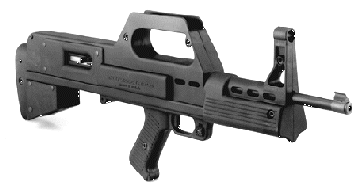
|
With all the stuff that China exports, It's not too hard to imagine a crate or two of weopons hitting the black market here or in Mexico. In fact, it's more surprising that the streets are not flooded with them. |
|
Most of their tanks and afvs are adaptations of old soviet designs T55/T62 etc but they do have some newer stuff. From Sinodefence:  The Type 99 (also known as ZTZ99, industrial designation WZ123) manufactured by NORINCO is the most advanced main battle tank (MBT) fielded by the PLA. First entering the PLA service in late 2001, the Type 99 provides a significant improvement in firepower, mobility, and protection compared to older Chinese-made tanks. As a 'high-end' MBT, the Type 99 was only built in a small number (~200) due to its high unit price (~US$1.9 Million in 1999). These tanks are currently deployed by two elite armour regiments in Beijing and Shenyang Military Region respectively. Some of the Type 99's technologies have been used to upgrade the less expensive Type 96 MBT. The Type 99 was a direct result of the PLA's third-generation MBT programme which first commenced in the late 1970s. An early prototype known as Type 90 featuring a Russian-style 125mm gun with autoloader was built and tested in early 1990. However, close observation of the 1990s Gulf War made the PLA realise that the tank was still no match to Western MBT designs such as the M1A1 and Challenger 2. A revised design known as Type 98 featuring a T-72-like hull was first revealed in October 1999 during the national day parade held in Beijing. A further improved variant known as Type 99 (originally known as Type 98G) featuring improved armour protection and a more powerful engine was introduced in 2000 and the tank entered service with the PLA in late 2001. The Type 99 MBT shows a mixture of Russian and Western influence in its design and technology. The hull of the tank is very similar to that of the Russian T-72, though the angular welded turret is clearly of Western style. The 125mm smoothbore main gun and the autoloader, which allows the crew of the tank to be reduced to three man, are both believed to be of Soviet/Russian origin. The Type 99 carries the Russian 9M119 Refleks (NATO codename: AT-11 Sniper) anti-tank guided missile locally produced in China under license. The tank's liquid-cooled, turbo-charged diesel engine was said to be based on the German technology. The Type 99 is generally similar to the Type 98 (ZTZ98) MBT, which was briefly displayed during the parade on 1 October 1999 in Beijing to celebrate the 50th anniversary of the People's Republic of China (PRC). The Type 99 was incorporated with a number of improvements. The vertically faced front armour on the Type 98 turret was replaced by Leopard 2A5-style arrow-shaped spaced add-on armour modules. Externally-mounted explosive reaction armour (ERA) modules were added to the hull front and turret to provide additional protection. The original 1,200hp diesel engine used by the Type 98 was replaced by a 1,500hp diesel engine on the Type 99. The hull of the Type 99 is very similar to that of the T-72, but is about one metre longer. The tank adopts a conventional layout, with the driving compartment at the front, the fighting compartment in the centre, and the engine compartment at the rear. The turret and hull are of all-welded steel armour construction. The front arc on the turret can be added with a layer of composite armour, or arrow-shaped spaced add-on armour modules. The armour package is of modular design, enabling damaged sections to be replaced or upgrades installed throughout service life. With the arrow-shaped add-on armour modules on the turret front and explosive reactive armour (ERA) modules on the turret and hull, the tank's front armour protection is equivalent to 1,000~1,200mm of steel armour. Despite a Western-style welded turret in appearance, the inside layout of the Type 99's turret is very much of Russian style. The Type 99 directly inherited the Russian 2A46M autoloader design, with the extra ammunitions placed inside the fighting compartment. This arrangement makes the tank highly vulnerable to catastrophic fire once being penetrated, a lesson learned in many conflicts in which T-72s and T-80s have participated. China has yet been able to produce a Western-style bustle autoloader for its MBT. Tank crew is protected by a over-pressure collective NBC protection and a fully automatic fire suppression system. The Type 99's main armament includes a dual-axis stabilised 125mm/50-calibre ZPT98 smoothbore gun, which is equipped with an autoloader, a thermal sleeve, and a fume extractor. The gun can be fired by either electronic or manual control. The gun barrel can be replaced within one hour. Loading is mechanical with 41 rounds carried inside the turret and vehicle hull. The gun can fire about 8 rounds per minute using autoloader and 1~2 rounds per minute with manual loading. The tank gun fires separate loading projectiles which have semi-combustible cartridge case and sabot. Ammunition includes armour piercing fin stabilised discarding sabot (APFSDS), high explosive anti-tank (HEAT), and high explosive fragmentation (HE-FRAG). The primary kinetic energy armour-piercing ammunition for the 125mm tank gun is the APFSDS round with a 30:1 length/calibre heavy tungsten alloy penetrator. The round has a muzzle velocity of 1,780m/s and is capable of penetrating 850mm steel armour at a distance of 2,000m. A depleted uranium (DU) APFSDS round has also been developed, which can penetrate 960mm steel armour at a distance of 2,000m. The Type 99 carries the Russian 9M119 Refleks (NATO codename: AT-11 Sniper) anti-tank guided missile, which is fired from the 125mm main gun. The missile uses a semi-automatic laser beam-riding guidance, and has an effective range of 100m to 4,000m. The missile system is intended to engage tanks fitted with ERA as well as low-flying air targets such as helicopters, at a range of up to 5km. Four missile rounds are carried inside the vehicle. China has been producing the 9M119 missile under license since the mid-1990s. A 12.7mm antiaircraft machine gun is mounted on the commander's cupola, with an elevation of -4°~75°. The machine gun is fitted with an optical sight. The maximum range against airborne target is 1,500m. The sustained rate of fire is 80~100rds/min. The tanks carries 300 rounds. A remotely operated, fixed-mount coaxial 7.62mm machine gun is fitted on the right side of the main gun, with 2,000 rounds. The tank is fitted with two five-barrelled smoke grenade launchers, one on each side of the turret. Additional smoke can be generated by injecting diesel fuel in to the engine's exhaust. The Type 99 MBT utilises a unique electro-optical countermeasures suite, which is located on the turret roof behind the gunner hatch. The system comprises a laser warning receiver (LWR) and an box-shape active laser self-defence weapon (LSDW), which was designed to use high-powered laser to attack the enemy weapon's optics and gunner. Once the LWR detects that the tank is being illuminated by an enemy range-finding or weapon-guidance laser, the system warns the tank crew and the LSDW is employed against the source of the enemy laser. The LSDW can disrupt the laser/infrared guidance signal of the enemy missile, disable the enemy observation optics (optical, night vision, thermal imager, laser rangefinder, etc.), and damage the eyesight of the enemy gunner. Photos of the Type 99 showed that the LSDW can be elevated to a higher angle than the tank's main gun, indicating that the engagement of attack helicopters is possible. The Type 99 is equipped with HF/VHF radio as well as a laser communication device, which is mounted on the mast on the turret roof behind the commander hatch. The device can be used for line of sight (LOS) information transmission (encrypted text, data and voice) and identification of friend or foe (IFF). The system is capable of 360 degrees traverse and -10°~45° elevation, and has an effective range of 3,600m. Additionally, the tank can be fitted with a GPS/GLONSS receiver for navigation and positioning. There are six dual rubber-tyred road wheels, two rubber-tyred track support rollers, a drive sprocket at the rear, and an idler at the front. The upper part of the track is protected by a light-weight rubber skirt. The engeine is a liquid-cooled, turbocharged 1,500hp diesel based on the German MB871ka501 diesel technology. At its current battle weight of 54t, this gives a power-to-weight ratio of about 27.78. The maximum speed by road is 80km/h and 60km/h cross country. Acceleration from 0 to 32km/h takes 12 seconds. The transmission provides seven forward and one reverse gears.  The ZBD97 (also known as Type 97) is the tracked infantry fighting vehicle (IFV) developed for the PLA in the late 1990s. The vehicle features a Russian BMP-3-style turret armed with a 100mm rifled main gun and a coaxial 30mm cannon. The vehicle was designed to provide protected transport for an infantry squad on the battlefield; to provide fire support for dismounted infantry, and to engage enemy tanks and armoured vehicles. The ZBD97 is currently equipped by the amphibious mechanised divisions in Nanjing and Guangzhou Military Region. An armoured recovery vehicle (ARV) variant was also developed. Traditionally, Chinese-made armoured fighting vehicles all had limited amphibious capability for river crossing operations. However, these vehicles were generally incapable of long distance swimming in the sea for amphibious assault role, while dedicated amphibious warfare armoured vehicles suffered from thin armour protection and weak firepower. Driven by the growing tension between China mainland and Taiwan in the mid-1990s, the PLA began to develop a dedicated amphibious IFV which still retained strong firepower and armour protection for land warfare. The resulted ZBD97 was introduced in the early 2000s. The photo of a new IFV undergoing road testing began to speculate on the Chinese Internet in 2003. The vehicle appeared to be under certain influence of the Russian BMP-3. The new vehicle, which was reportedly designated ZBD97, used a two-man turret almost identical to that of the BMP-3, though its hull appeared to be a new design. Some reports suggested that China had obtained the BMD-3 fire-control and associated laser missile guidance system technologies from Russia in the late 1990s to be used in the development of its own indigenous IFV. Although no much detailed information on the performance of the new Type 97 IFV is available at this stage, the vehicle is expected to be comparable to the BMP-3 in general performance. Armed with an automatically loaded 100mm main gun and a 30mm coaxial cannon, the Type 97 outperforms most armoured combat vehicles in firepower. When facing heavier enemy armour, the vehicle relies on the gun-fired laser-beam riding anti-tank guided missile (ATGM), which can penetrate the armour of any current armoured vehicle or even shoot down slow-flying helicopters. The vehicle appears to be fully amphibious, making it suitable for the use of the Marine Corps and amphibious mechanised infantry troops. Unlike the BMP-3's rear-mounted powerpack arrangement, the BMD97 uses a conventional front-mounted powerpack layout, with the liquid-cooled diesel located at the right front of the hull. The drive's hatch which mounts three periscopes is located on the left of the hull immediately in front of a passenger hatch. The two-man turret is mounted in the middle section of the vehicle. The gunner's hatch on the left has a thermal image sight and a box-shape device for ATGM guidance. The commander hatch is on the right. The troop compartment is located on the rear of the vehicle. There are two large hatches on the troop compartment roof, and a single exit door in the rear. There are two observation ports on the left of the hull, one on the right side and one in the exit door. Three firing ports (left, right, and exit door) allow the infantrymen to fire assault rifles and light machine guns from inside the vehicle on the move. The vehicle has a three-man crew, including the vehicle commander, drive and gunner, and can carry 5~7 infantry soldiers. The vehicle is believed to be fitted with a collective over-pressure NBC protection system. The vehicle has six unevenly spaced road wheels, with three track support rollers and a front drive sprocket on each side. The vehicle features strong amphibious capability, with two large water jet ports on the rear of the vehicle for high-speed swimming. The vehicle is fitted with a hydraulically actuated wave fence at front, which can be raised to prevent the front section of the vehicle from being overflowed when travelling on water surface. The vehicle is believed to be powered by a water-cooled diesel engine. Transmission is hydromechanical with a hydrostatic gearbox for the steering gear and power take-off for the water jets. The road wheels and rollers are all rubber-tyred. Torsion bar suspensions with hydraulic shock absorbers are fitted on the 1st, 2nd, and 6th road wheels. The metallic tracks are fitted with removable rubber pads to improve the comfort of the passenger. The main armament of the vehicle is a 100mm semi-automatic rifled gun which is stabilised in two axes and can fire both HE-FRAG (High Explosive-Fragmentation) rounds and Chinese indigenous anti-tank guided missiles. The main gun is equipped with an automatic loader. The effective range of the HE-FRAG round is estimated to be 4,000m, with a total of 40 rounds carried inside the vehicle. The rate of fire is 10 rounds per minute. The 100mm main gun is also capable of firing the Chinese indigenous ATGM, which was derived from the Russian Bastion missile system (NATO codename: AT-10 Stabber). The missile can engage tanks with explosive reactive armour (ERA) as well as slow, low-flying targets such as helicopters. Range is 100~4,000m. Hit probability is given as at least 0.8 with armour penetration of 600mm. Ammunition load is 8 rounds. The secondary armament includes a 30mm cannon, stabilised in two axes, which fires AP (Armour-Piercing) and/or HE-FRAG rounds. Rate of fire is more than 300 rounds/min and range is 1,500~2,000m. A 7.62mm machine gun may also be fitted. The vehicle has a 3-barrel smoke grenade launcher mounted on both sides of the turret.  The Type 92 series wheeled armoured combat vehicles is based on the NORINCO Type 90 (also known as WZ551) 6X6 armoured vehicle. The series include the Type 92 wheeled infantry fight vehicle (IFV) and Type 92A wheeled armoured personnel carrier (APC), of which over 1,200 vehicles have been produced. The two variants are deployed in mixture in the PLA 'rapid reactionl' light mechanised infantry troops. PROGRAMME NORINCO introduced the WZ551 (PLA designation Type 90) wheeled armoured vehicle in the 1986 on the basis of Southwest Automobile Works Tiema CX2200 6X6 heavy-duty truck, a Chinese copy of the German Mercedes-Benz 2060 truck. The WZ551 is avaialble in 4X4, 6X6, and 8X8 configurations. NORINCO had developed a number of variants for a variety of combat and support mission tasks. These include Type 92 IFV, Type 92A APC, command and reconnaissance vehicle, self-propelled artillery, anti-tank missile version, air-defence missile version, ambulance, WZ-901 armoured anti-riot vehicle, and armoured recovery vehicle (ARV) version. As the PLA was not satisfied with the vehicle's performance, the development of an improved variant WZ551A began in April 1987. The main improvement on the WZ551A is the introduction of a more powerful 235kW four-stroke, air-cooled, turbo-charged diesel engine based on the German BF8L413F technology. The vehicle's hull design was also modified to fit the new engine. The first two prototypes of the WZ551A were finished in August 1991. Following over 30,000km road tests carried out by the PLA, the vehicle received its design certificate in 1994 and was officially designated Type 92 (ZSL92). The vehicle entered service in 1995. DESIGN The basic variant Type 92 has an overall combat weight of 15.3t. The hull of the vehicle comprises three sections: the driver compartment in the front, the powerpack compartment in the middle left, and the troop compartment in the rear. The vehicle is fully amphibious. There are six firing ports in the vehicle hull, three on each side of the vehicle. Communications equipments include a VRC-83 radio set and VIC-83 telephone. TYPE 92 INFANTRY FIGHTING VEHICLE The IFV variant has three crews (driver, commander, and gunner) and carries 9 infantry soldiers in its troop compartment. The main armament is a 25mm cannon mounted on a one-man turret. The 25mm cannon has a full 360° traverse with an elevation of -8° ~ 55°. Ammunition load for the 25mm gun is 400 rounds, with an additional 120 HE (High-Explosive) rounds and 80 AP (Armour-Piercing) rounds carried in the turret. The gun can fire single, 3-round burst, or 5-round burst. The max rate of fire is 100r/min or 200r/min. Secondary weapon is a coaxial 7.62mm Type 59 machinegun with 1,000 rounds. NORINCO also introduced an experimental variant NGV-1 infantry fighting vehicle, which is fitted with a French designed one-man Giat DRAGAR 25mm cannon turret, with stabilised sight and night vision. Auxiliary weapon include a coaxial 7.62 mm machine gun. This variant did not enter production due to lack of interest. TYPE 92A ARMOURED PERSONNEL CARRIER The Type 92A wheeled armoured personnel carrier variant, which is also based on the WZ551A chassis, is armed with a roof-mounted 12.7mm machinegun and carries 11 infantry soldiers in its troops compartment. The vehicle entered service in 1997. PROTECTION The Type 92 is fitted with NBC (nuclear, biological, chemical) protection system and automatic fire suppression system. Armour protection against 12.7mm calibre weapon systems is provided all round. There are eight smoke grenade launchers, four fitted either side of the main gun. PROPULSION The Type 92 is powered by a German-designed BF8L413F 4-stroke, 8-cylinder, turbo-charged, air-cooled diesel engine with a standard power of 235kW (320hp) at 2,500r/min. The vehicle has 9 forward and 1 reverse gears, with mechanical gear box, power assisted steering and independent suspensions. Its a central inflating system can adjust the tire pressure according to road conditions. The tires can support the vehicle to travel 100km at a speed of 30km/h after being damaged. In addition, the vehicle is fitted with two propellers for swimming. The vehicle is capable of a maximum speed of 85km/h on paved road and 8km/h when afloat. The capacity of the fuel tank was increased by 90 litre to fulfil the PLA's requirement for a fuel endurance range of 600 to 800km. SPECIFICATIONS Crew: 12 (3+9) Type: Wheeled, armoured, amphibious Weight: 12.5 tonnes Engine: 320hp BF8L413F 4-stroke, 8-cylinder, turbo-charged, air-cooled diesel Transmission: Mechanical Suspension: Independent Radio: VRC-83 radio set; VIC-83 telephone Dimension: Length: 6.63m; Height: 2.8m; Width: 2.8m Cruising Range: 600~800km Speed: Max road 85km/h; max off-road N/A; max swim 8km/h Main Gun: 25mm (IFV variant), or 12.7mm (APC variant) Rate of Fire: (IFV) 100~200 rounds/min Elevation/Depression: (IFV) -8° to 55° Auxiliary Weapon: (IFV) One coaxial 7.62mm machine gun |