


Posted: 10/26/2006 6:21:31 AM EDT
|
How exactly do they work? Is the image first recorded in a digital format and if you like the picture you can burn it onto the film???? |
 Theres no 35mm digital SLRs?


I'm not sure what you mean. Is it just a photography class where you are learning how to take pictures? Or do you have to learn how to develop film and prints too? If it's the latter, then they can't do that with a DSLR, they need to get a film SLR. |

No... real cameras for real jobs. I would guess most news photographers now use digital SLR cameras as their primary camera… why wouldn’t they shoot a news photo and then e-mail it to the editor without having to develop film and then scan it. Digital is the future… Film will always be around especially in the art field but digital (no film) is going to dominate virtually every other sector of photography. |
|
Film is dead for all intents and purposes (except for art). What was once the black room is now Photoshop, what was once film is now CMOS sensors. Personally, I think it's GREAT. You don't have to spend money on film, you can preview your pictures before you develop them, you can fix some really BAD shots in photoshop and make them look quite good. I use a Canon Rebel XT myself now, and I think it is WONDERFUL! |
So true. Go look at Oleg Volk's blog. He still has some film cameras of course, but a lot of that truly artistic progun stuff you see is coming out of Canon digitals. |
D80 are still at around $900 to $1,000 range, the D70S (discontinued) is avaliable at discounted price. The D70 was a legend when Nikon introduce the camera, but have since eclipsed by other DSLR. You need to work a bit more to get good pictures, for example, their Auto White Balance is practical useless unles you are using flash or shooting at sunny outdoors (use custom white balance instead, and perform white balance everytime you shoot), the 6 MP sensor is a bit small by today's standard but will still give good pictures, noise level above ISO 400 (use flash), and slower AF (limited sports). Most of these negatives will not bother most amature photographers. As for film, I believe it is a dead issue. Not only the APS/35mm size SLR are switching to digital (almost all camera manufacturers have discontinued film with the exception of Nikon, Leica, Rollei), and even Kodak have abandon film, plus the medium format cameras have embrassed digital more than the SLR does. There will still be some puriest that insist on film, but 99% of the professional world have switched to digital for quite a while. Yes, film does have one major advantage that 35mm/APS/DX DSLR can yet acheived, it is the dynamic range (color), but that will not be the case when the cameras start to switch from 12 bit to 16 or higher bit processing. A 16 Bit Hasse H3D (Medium Format) looks equal or better than the 110 film. Most DSLR have crop sensor except a few. Canon 1D and 5D have full frame 35mm sensors, so were the now discontinued Kodak DSLRs. Nikon uses a constant 1.5 crop factor for all their DSLR (DX format), Canon uses 1.33 to 1.35 for their DSLR, and Sigma, Pentax, Samsung, Olympus... are using 2.0 crop factor (four-thirds). Crop sensor are good and bad news. The good news is the gain in telephoto, and the bad news is the lost in the wide angle range. |
Dynamic range has nothing to do with color, it is concerned with tonal range (ie blowing out highlights, losing shadow detail). This is a common and often erroneous complaint about digital. Most pros used chrome film and digital has a greater dynamic range than chrome so nothing was lost there. My 1Ds MkII beats Velvia here by several stops.
A/D converters have nothing to do with the limits of a sensor's dynamic range. The reason for the limited dynamic range is the linear response of CCD/CMOS sensors. In theory, greater bit depth would help, but beyond 12 bits you are operating within the noise of a sensor so it does nothing for you. That's why most RAW data is written with 12-14 bit precision. Some will tout 16 bit A/D converters but it is nothing more than a marketing ploy.
I sure hope so! Everything beats 110 film! 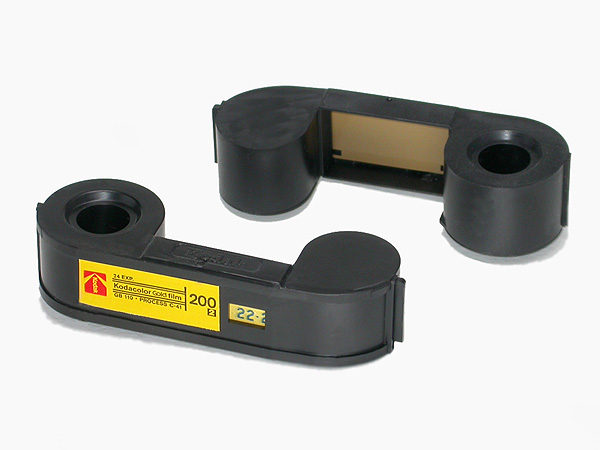 Medium Format uses 120/220 film. It doesn't take an H3D either, medium format resolution was virtually matched when the 1Ds MkII came out.
Incorrect, the 1D has a cropped sensor, the 1Ds has a full frame.
You don't actually "gain" anything. Another common misnomer. All you did is crop the edges. If you want this same false telephoto effect, take the photo from a full frame camera and cut off the edges. |